A HINSA view of cosmic-ray ionization in IC 348 and NGC 1333: evidence for a strong low-energy cosmic-ray disparity
Pith reviewed 2026-06-27 03:40 UTC · model grok-4.3
The pith
IC 348 shows cosmic-ray ionization rates an order of magnitude higher than NGC 1333, indicating strong local differences in low-energy cosmic-ray populations.
A machine-rendered reading of the paper's core claim, the machinery that carries it, and where it could break.
Core claim
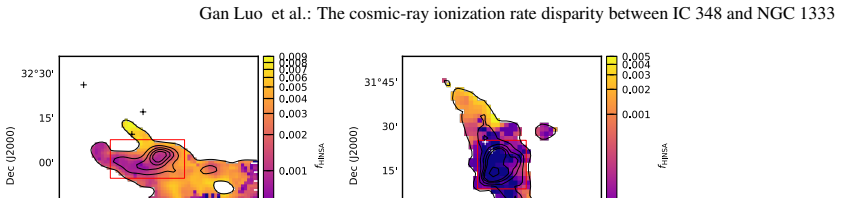
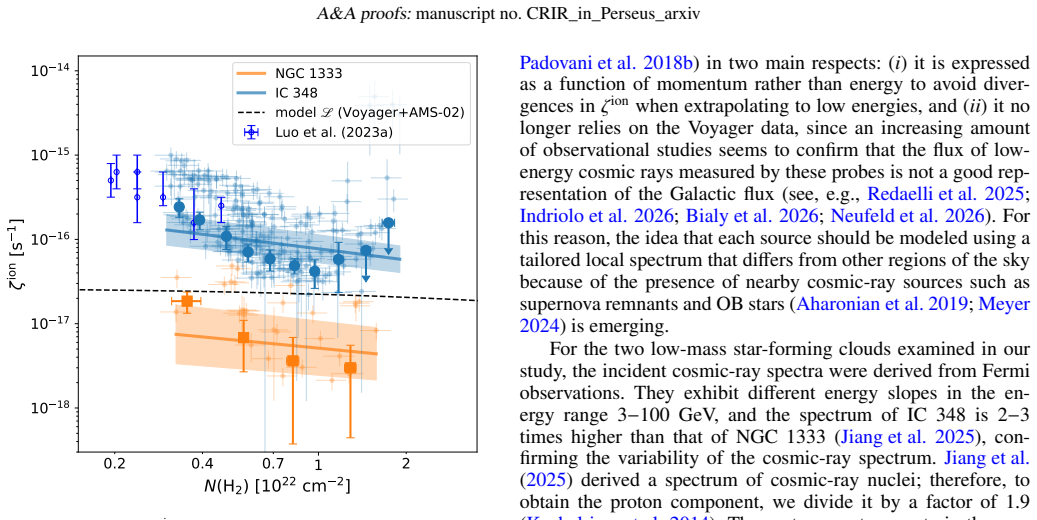
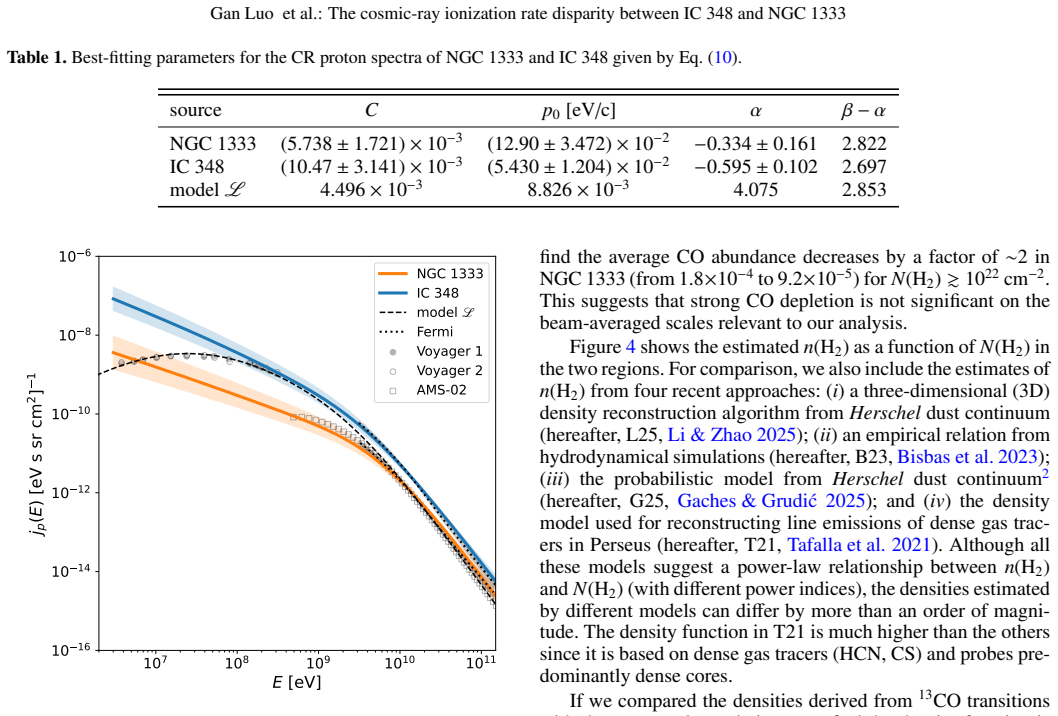
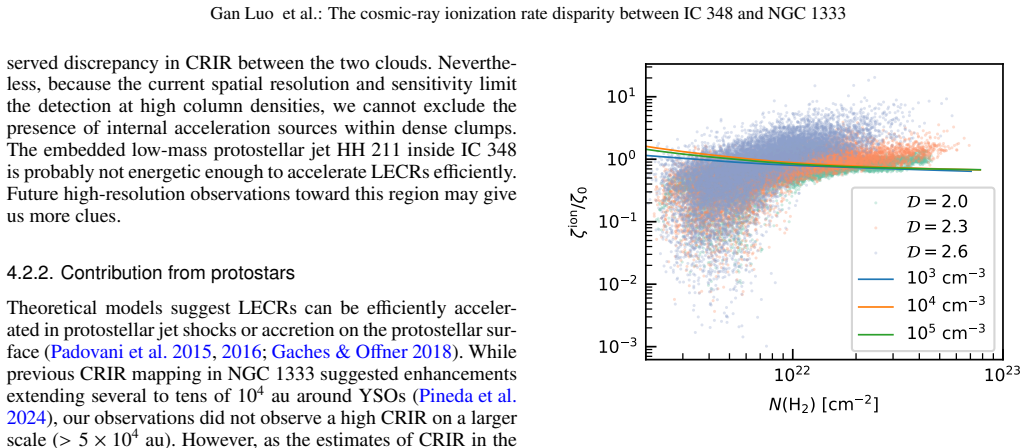
HINSA observations yield cosmic-ray ionization rates that decrease with H2 column density in both IC 348 and NGC 1333, yet remain an order of magnitude higher in IC 348. A finite-slab attenuation model constrained by the high-energy cosmic-ray spectrum from Fermi gamma-ray data reproduces the observed profiles only when the low-energy cosmic-ray spectrum is allowed to differ substantially between the two clouds. The authors conclude that the disparity originates from local acceleration sources beyond protostars, such as stellar-wind termination shocks, and that these sources also contribute to the GeV gamma-ray excess.
What carries the argument
The HINSA (HI narrow self-absorption) technique, which converts observed HI absorption features into cosmic-ray ionization rates, combined with a finite-slab cosmic-ray attenuation model constrained by Fermi gamma-ray spectra.
If this is right
- Cosmic-ray ionization rates decline with increasing H2 column density inside each cloud.
- Low-energy cosmic-ray populations differ by roughly an order of magnitude between IC 348 and NGC 1333.
- Stellar-wind termination shocks and related local accelerators supply the excess low-energy cosmic rays.
- The same local sources contribute to the observed GeV gamma-ray excess in these regions.
Where Pith is reading between the lines
- If local accelerators dominate low-energy cosmic rays near young stars, ionization rates in other star-forming regions may also vary by large factors.
- Chemical and dynamical models of molecular clouds will need spatially varying cosmic-ray spectra rather than a single galactic average.
- Targeted gamma-ray or radio observations of additional clouds could map the distribution of these local cosmic-ray sources.
Load-bearing premise
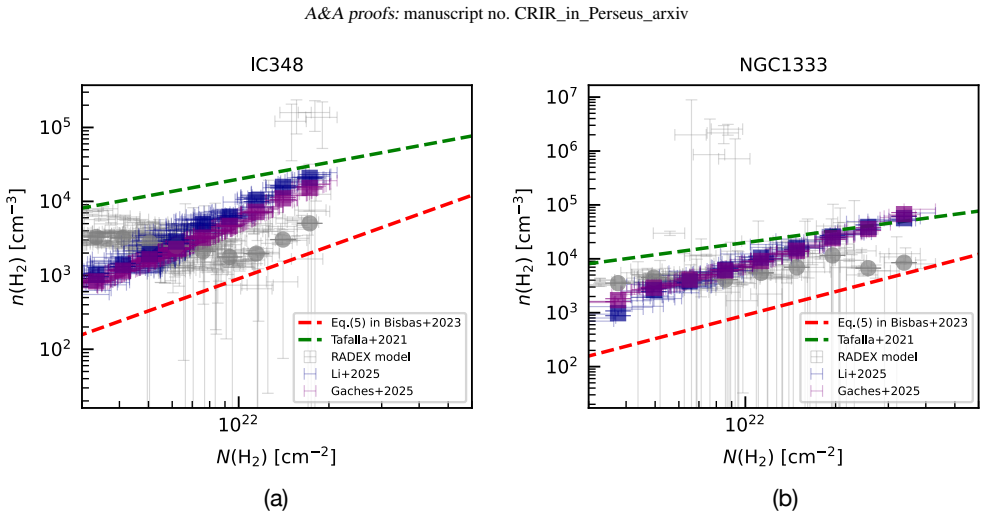
The order-of-magnitude contrast in HINSA-derived ionization rates between the two clouds reflects genuine differences in low-energy cosmic-ray populations rather than differences in cloud structure, density distribution, or observational biases.
What would settle it
A three-dimensional density and velocity structure model of both clouds that, when inserted into the HINSA analysis pipeline, erases the observed ionization-rate contrast without any change to the cosmic-ray spectrum.
Figures
read the original abstract
The cosmic-ray ionization rate (CRIR) is one of the fundamental parameters influencing the chemical and dynamical evolution of molecular clouds. Although observations in recent years have revealed high CRIR values in massive star-forming regions and in the vicinity of protostars, the sources and acceleration mechanisms of cosmic rays remain uncertain. In this work, we present our new estimates of CRIR using the HI narrow self-absorption (HINSA) technique towards two nearby low-mass star-forming clouds, IC 348 and NGC 1333. In both clouds, the CRIR decreases with increasing H$_2$ column density, but IC 348 exhibits values that are roughly an order of magnitude higher than those in NGC 1333. To interpret this contrast, we model the low-energy spectrum of CRs in a finite slab attenuation framework, using additional constraints from the high-energy CR spectrum inferred from Fermi $\gamma$-ray observations. The best-fit spectra reproduce the observed CRIR profiles and the contrast between IC 348 and NGC 1333 suggests an order of magnitude difference in low-energy CR populations, likely originating from local acceleration sources beyond protostars (e.g., stellar-wind termination shocks), and partly from the same sources responsible for the GeV $\gamma$-ray excess. Although uncertainties in cloud structure and gas density may affect the absolute CRIR values, they do not erase the pronounced disparity between the two regions.
Editorial analysis
A structured set of objections, weighed in public.
Referee Report
Summary. The manuscript reports new HINSA-derived cosmic-ray ionization rate (CRIR) estimates toward the low-mass star-forming regions IC 348 and NGC 1333. Both clouds show CRIR declining with increasing H2 column density, yet IC 348 exhibits values roughly an order of magnitude higher than NGC 1333. The authors interpret the contrast via a finite-slab attenuation model for the low-energy CR spectrum, constrained by Fermi GeV γ-ray data, and conclude that the disparity arises from differing low-energy CR populations produced by local acceleration sources (e.g., stellar-wind termination shocks) beyond protostars.
Significance. If the reported order-of-magnitude CRIR contrast is shown to be robust against plausible variations in cloud density structure, the result would provide direct evidence for local, non-protostellar cosmic-ray acceleration in nearby star-forming regions and would link such sources to the observed GeV γ-ray excess. The HINSA technique and the joint use of ionization and γ-ray constraints are potentially valuable if the modeling assumptions can be validated.
major comments (2)
- [Abstract] Abstract: The claim that 'uncertainties in cloud structure and gas density may affect the absolute CRIR values, but they do not erase the pronounced disparity' is load-bearing for the central conclusion yet is presented without a quantitative error budget, sensitivity analysis on density PDF variations, temperature gradients, or HI/H2 filling factors, or comparison to independent CRIR tracers. This leaves open the possibility that systematic differences in the two regions' volume-density distributions or column-density mapping produce the observed contrast even under identical incident CR spectra.
- The finite-slab attenuation model for the low-energy CR spectrum is fitted after deriving CRIR from HINSA; the manuscript provides no indication that the slab parameters (e.g., thickness, density profile) or the low-energy spectral shape are chosen independently of the HINSA-derived CRIR values themselves. This raises a circularity concern for the inference that the contrast reflects an intrinsic difference in low-energy CR populations.
minor comments (1)
- The abstract and introduction would benefit from explicit references to prior HINSA-based CRIR studies and to independent tracers (e.g., H3+, DCO+/HCO+) to place the new measurements in context.
Simulated Author's Rebuttal
We thank the referee for their constructive and detailed comments, which help clarify the presentation of our results. We address each major comment below and indicate the revisions planned for the manuscript.
read point-by-point responses
-
Referee: [Abstract] Abstract: The claim that 'uncertainties in cloud structure and gas density may affect the absolute CRIR values, but they do not erase the pronounced disparity' is load-bearing for the central conclusion yet is presented without a quantitative error budget, sensitivity analysis on density PDF variations, temperature gradients, or HI/H2 filling factors, or comparison to independent CRIR tracers. This leaves open the possibility that systematic differences in the two regions' volume-density distributions or column-density mapping produce the observed contrast even under identical incident CR spectra.
Authors: We agree that the abstract claim would be strengthened by an explicit quantitative error budget. In the revised manuscript we will add a new subsection (or appendix) that quantifies the impact of plausible variations in the density PDF, temperature gradients, and HI/H2 filling factors on the derived CRIR values. We will also include a direct comparison of our HINSA results with any available independent CRIR tracers in the two regions. These additions will demonstrate that the order-of-magnitude contrast survives the explored systematics. revision: yes
-
Referee: [—] The finite-slab attenuation model for the low-energy CR spectrum is fitted after deriving CRIR from HINSA; the manuscript provides no indication that the slab parameters (e.g., thickness, density profile) or the low-energy spectral shape are chosen independently of the HINSA-derived CRIR values themselves. This raises a circularity concern for the inference that the contrast reflects an intrinsic difference in low-energy CR populations.
Authors: The finite-slab thickness and density profile are taken directly from independent observational constraints: the projected sizes and column-density maps of the two clouds (derived from dust continuum and molecular-line data) together with volume-density estimates from standard tracers. These quantities are fixed before any CRIR modeling is performed. The high-energy CR spectrum is anchored exclusively to the Fermi γ-ray observations, which are independent of the HINSA measurements. Only the low-energy spectral index and normalization are allowed to vary within physically motivated ranges to reproduce the observed CRIR profiles. We will revise the modeling section to state these sources of the parameters explicitly and thereby remove any ambiguity about circularity. revision: partial
Circularity Check
No significant circularity; derivation uses observations then explicit fitting
full rationale
The paper first derives CRIR values directly from HINSA observations in the two clouds and reports an observed contrast. It then applies a finite-slab model whose low-energy parameters are explicitly adjusted (best-fit) to match those observed CRIR profiles while also satisfying Fermi constraints. This is standard model fitting rather than an independent first-principles prediction or derivation that reduces to the inputs by construction. No self-citations, uniqueness theorems, or ansatzes are invoked as load-bearing steps, and the text acknowledges that structure uncertainties affect absolute values without erasing the disparity. The central claim is therefore an interpretation of the fitted contrast, not a circular reduction.
Axiom & Free-Parameter Ledger
free parameters (1)
- low-energy CR spectrum parameters in slab model
axioms (2)
- domain assumption HINSA absorption directly measures the cosmic-ray ionization rate without significant bias from velocity structure or excitation conditions
- domain assumption The high-energy CR spectrum from Fermi gamma-ray observations can be extrapolated downward to anchor the low-energy part of the model
Reference graph
Works this paper leans on
-
[1]
2015, , 114, 171103
Aguilar , M., Aisa , D., Alpat , B., et al. 2015, , 114, 171103
2015
-
[2]
2019, Nature Astronomy, 3, 561
Aharonian , F., Yang , R., & de O \ n a Wilhelmi , E. 2019, Nature Astronomy, 3, 561
2019
-
[3]
2010, , 518, L102
Andr \'e , P., Men'shchikov , A., Bontemps , S., et al. 2010, , 518, L102
2010
-
[4]
2008, in Handbook of Star Forming Regions, Volume I, ed
Bally , J., Walawender , J., Johnstone , D., Kirk , H., & Goodman , A. 2008, in Handbook of Star Forming Regions, Volume I, ed. B. Reipurth , Vol. 4, 308
2008
-
[5]
2020, Communications Physics, 3, 32
Bialy , S. 2020, Communications Physics, 3, 32
2020
- [6]
-
[7]
G., Bell , T
Bisbas , T. G., Bell , T. A., Viti , S., Yates , J., & Barlow , M. J. 2012, , 427, 2100
2012
-
[8]
G., van Dishoeck , E
Bisbas , T. G., van Dishoeck , E. F., Hu , C.-Y., & Schruba , A. 2023, , 519, 729
2023
-
[9]
& Eichler , D
Blandford , R. & Eichler , D. 1987, , 154, 1
1987
-
[10]
2013, , 21, 70
Blasi , P. 2013, , 21, 70
2013
-
[11]
2014, , 569, A100
Bron , E., Le Bourlot , J., & Le Petit , F. 2014, , 569, A100
2014
-
[12]
& Paul , J
Casse , M. & Paul , J. A. 1980, , 237, 236
1980
-
[13]
2014, , 790, L1
Ceccarelli , C., Dominik , C., L \'o pez-Sepulcre , A., et al. 2014, , 790, L1
2014
-
[14]
C., Stone , E
Cummings , A. C., Stone , E. C., Heikkila , B. C., et al. 2016, , 831, 18
2016
-
[15]
I., Richer , J
Curtis , E. I., Richer , J. S., & Buckle , J. V. 2010 a , , 401, 455
2010
-
[16]
I., Richer , J
Curtis , E. I., Richer , J. S., Swift , J. J., & Williams , J. P. 2010 b , , 408, 1516
2010
-
[17]
2006, Proceedings of the National Academy of Science, 103, 12269
Dalgarno , A. 2006, Proceedings of the National Academy of Science, 103, 12269
2006
-
[18]
Draine , B. T. 1978, , 36, 595
1978
-
[19]
O., Aharonian , F
Drury , L. O., Aharonian , F. A., & Voelk , H. J. 1994, , 287, 959
1994
-
[20]
Ferri \`e re , K. M. 2001, Reviews of Modern Physics, 73, 1031
2001
-
[21]
2017, , 605, A57
Fontani , F., Ceccarelli , C., Favre , C., et al. 2017, , 605, A57
2017
-
[22]
W., Lang , D., & Goodman , J
Foreman-Mackey , D., Hogg , D. W., Lang , D., & Goodman , J. 2013, , 125, 306
2013
-
[23]
& Diaconis, P
Freedman, D. & Diaconis, P. 1981, Zeitschrift f \"u r Wahrscheinlichkeitstheorie und Verwandte Gebiete, 57, 453
1981
-
[24]
2022, , 30, 4
Gabici , S. 2022, , 30, 4
2022
-
[25]
Gaches , B. A. L. & Grudi \'c , M. Y. 2025, , 696, A20
2025
-
[26]
Gaches , B. A. L. & Offner , S. S. R. 2018, , 861, 87
2018
-
[27]
Gaches , B. A. L., Offner , S. S. R., & Bisbas , T. G. 2019, , 878, 105
2019
-
[28]
Gaches, B. A. L. & Viti, S. 2026, ACS Earth and Space Chemistry, 10, 276
2026
-
[29]
Goldsmith , P. F. 2001, , 557, 736
2001
-
[30]
Goldsmith , P. F. & Li , D. 2005, , 622, 938
2005
-
[31]
A., Black , J
Grenier , I. A., Black , J. H., & Strong , A. W. 2015, , 53, 199
2015
-
[32]
2002, , 391, 675
Gry , C., Boulanger , F., Nehm \'e , C., et al. 2002, , 391, 675
2002
-
[33]
B., Sharma , P., & Eichler , D
Gupta , S., Nath , B. B., Sharma , P., & Eichler , D. 2020, , 493, 3159
2020
-
[34]
A., Richer , J
Hatchell , J., Fuller , G. A., Richer , J. S., Harries , T. J., & Ladd , E. F. 2007, , 468, 1009
2007
-
[35]
N., Bosman , A
Heays , A. N., Bosman , A. D., & van Dishoeck , E. F. 2017, , 602, A105
2017
-
[36]
V., Pellegrin , T., et al
Indriolo , N., Ivlev , A. V., Pellegrin , T., et al. 2026, , 997, 123
2026
-
[37]
V., Padovani , M., Galli , D., & Caselli , P
Ivlev , A. V., Padovani , M., Galli , D., & Caselli , P. 2015, , 812, 135
2015
-
[38]
2025, , 541, 1254
Jiang , M., Sun , X.-N., Wu , Q.-H., et al. 2025, , 541, 1254
2025
-
[39]
1975, , 197, 575
Jura , M. 1975, , 197, 575
1975
-
[40]
V., & Ostapchenko , S
Kachelriess , M., Moskalenko , I. V., & Ostapchenko , S. S. 2014, , 789, 136
2014
-
[41]
2015, in International Cosmic Ray Conference, Vol
Krause , J., Morlino , G., & Gabici , S. 2015, in International Cosmic Ray Conference, Vol. 34, 34th International Cosmic Ray Conference (ICRC2015), 518
2015
-
[42]
F., Brown , R
Kr c o , M., Goldsmith , P. F., Brown , R. L., & Li , D. 2008, , 689, 276
2008
-
[43]
2020, , 639, A86
Kuffmeier , M., Zhao , B., & Caselli , P. 2020, , 639, A86
2020
-
[44]
& Goldsmith , P
Li , D. & Goldsmith , P. F. 2003, , 585, 823
2003
-
[45]
2024, Commensal Radio Astronomy FasT survey (CRAFTS) data sets
Li, D., Wang, P., Qian, L., et al. 2024, Commensal Radio Astronomy FasT survey (CRAFTS) data sets
2024
-
[46]
2018, IEEE Microwave Magazine, 19, 112
Li , D., Wang , P., Qian , L., et al. 2018, IEEE Microwave Magazine, 19, 112
2018
- [47]
-
[48]
L., Esplin , T
Luhman , K. L., Esplin , T. L., & Loutrel , N. P. 2016, , 827, 52
2016
-
[49]
G., Padovani , M., & Gaches , B
Luo , G., Bisbas , T. G., Padovani , M., & Gaches , B. A. L. 2024 a , , 690, A293
2024
-
[50]
M., Padovani , M., et al
Luo , G., Jacob , A. M., Padovani , M., et al. 2025, , 703, A159
2025
-
[51]
2024 b , , 685, L12
Luo , G., Li , D., Zhang , Z.-Y., et al. 2024 b , , 685, L12
2024
-
[52]
G., et al
Luo , G., Zhang , Z.-Y., Bisbas , T. G., et al. 2023, , 942, 101
2023
-
[53]
D., & Su \'a rez , S
Mart \' nez , S., Bernardi , G., Focke , P., Gonz \'a lez , A. D., & Su \'a rez , S. 2003, Journal of Physics B Atomic Molecular Physics, 36, 4813
2003
-
[54]
J., et al
McElroy , D., Walsh , C., Markwick , A. J., et al. 2013, , 550, A36
2013
-
[55]
2024, in 38th International Cosmic Ray Conference, 59
Menchiari , S., Morlino , G., Amato , E., & Bucciantini , N. 2024, in 38th International Cosmic Ray Conference, 59
2024
-
[56]
Meyer , D. M.-A. 2024, , 530, 539
2024
-
[57]
2021, , 504, 6096
Morlino , G., Blasi , P., Peretti , E., & Cristofari , P. 2021, , 504, 6096
2021
-
[58]
2011, International Journal of Modern Physics D, 20, 989
Nan , R., Li , D., Jin , C., et al. 2011, International Journal of Modern Physics D, 20, 989
2011
-
[59]
A., Silsbee , K., Ivlev , A
Neufeld , D. A., Silsbee , K., Ivlev , A. V., et al. 2026, , 998, 71
2026
-
[60]
A., Welty , D
Neufeld , D. A., Welty , D. E., Ivlev , A. V., et al. 2024, , 973, 143
2024
-
[61]
2023, , 671, A1
Olivares , J., Bouy , H., Miret-Roig , N., et al. 2023, , 671, A1
2023
-
[62]
2022, , 658, A189
Padovani , M., Bialy , S., Galli , D., et al. 2022, , 658, A189
2022
-
[63]
Padovani , M., Galli , D., & Glassgold , A. E. 2009, , 501, 619
2009
-
[64]
V., Caselli , P., & Ferrara , A
Padovani , M., Galli , D., Ivlev , A. V., Caselli , P., & Ferrara , A. 2018 a , , 619, A144
2018
-
[65]
T., et al
Padovani , M., Galli , D., Plowman , C. T., et al. 2026, ACS Earth and Space Chemistry, 10, 189
2026
-
[66]
H., et al
Padovani , M., Galli , D., Scarlett , L. H., et al. 2024, , 682, A131
2024
-
[67]
2015, , 582, L13
Padovani , M., Hennebelle , P., Marcowith , A., & Ferri \`e re , K. 2015, , 582, L13
2015
-
[68]
V., Galli , D., & Caselli , P
Padovani , M., Ivlev , A. V., Galli , D., & Caselli , P. 2018 b , , 614, A111
2018
-
[69]
V., Galli , D., et al
Padovani , M., Ivlev , A. V., Galli , D., et al. 2020, , 216, 29
2020
-
[70]
2016, , 590, A8
Padovani , M., Marcowith , A., Hennebelle , P., & Ferri \`e re , K. 2016, , 590, A8
2016
-
[71]
Peek , J. E. G., Babler , B. L., Zheng , Y., et al. 2018, , 234, 2
2018
-
[72]
2024, Nature Astronomy, 8, 530
Peron , G., Casanova , S., Gabici , S., Baghmanyan , V., & Aharonian , F. 2024, Nature Astronomy, 8, 530
2024
-
[73]
2021, , 645, A55
Pezzuto , S., Benedettini , M., Di Francesco , J., et al. 2021, , 645, A55
2021
-
[74]
Phan , V. H. M., Recchia , S., Mertsch , P., & Gabici , S. 2023, , 107, 123006
2023
-
[75]
E., Sipil \"a , O., Segura-Cox , D
Pineda , J. E., Sipil \"a , O., Segura-Cox , D. M., et al. 2024, , 686, A162
2024
-
[76]
T., Scarlett , L
Plowman , C. T., Scarlett , L. H., Zammit , M. C., Bray , I., & Fursa , D. V. 2026, Plasma Physics and Controlled Fusion, 68, 035006
2026
-
[77]
2025, , 702, A210
Redaelli , E., Bovino , S., Sabatini , G., et al. 2025, , 702, A210
2025
-
[78]
A., Di Francesco , J., Kirk , H., et al
Ridge , N. A., Di Francesco , J., Kirk , H., et al. 2006, , 131, 2921
2006
-
[79]
2014, , 562, A138
Roy , A., Andr \'e , P., Palmeirim , P., et al. 2014, , 562, A138
2014
-
[80]
E., Kim , Y.-K., Madison , D
Rudd , M. E., Kim , Y.-K., Madison , D. H., & Gallagher , J. W. 1985, Reviews of Modern Physics, 57, 965
1985
discussion (0)
Sign in with ORCID, Apple, or X to comment. Anyone can read and Pith papers without signing in.