Holonic Active Distillation for Scalable Multi-Agent Learning in Multi-Sensor Systems
Pith reviewed 2026-07-01 03:01 UTC · model grok-4.3
The pith
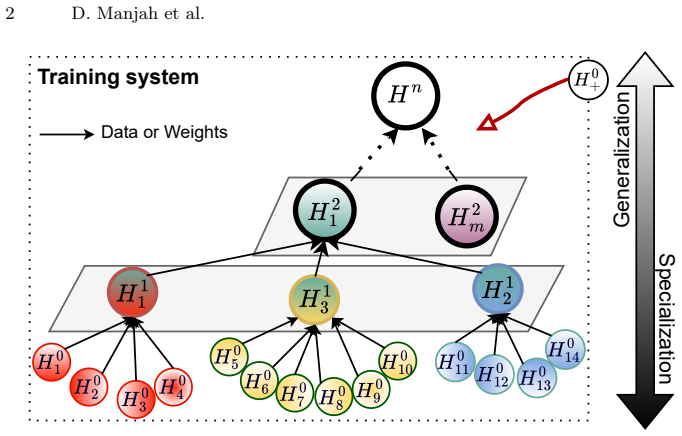
A holonic active distillation architecture lets multi-sensor systems keep local specialization while maintaining global generalization and adapting when sensors join or leave.
A machine-rendered reading of the paper's core claim, the machinery that carries it, and where it could break.
Core claim
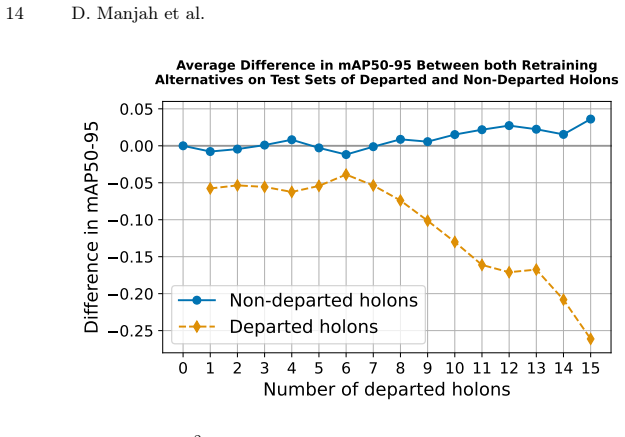
The holonic organization balances local specialization with global generalization, while efficiently adapting to sensor departures and re-integrations.
What carries the argument
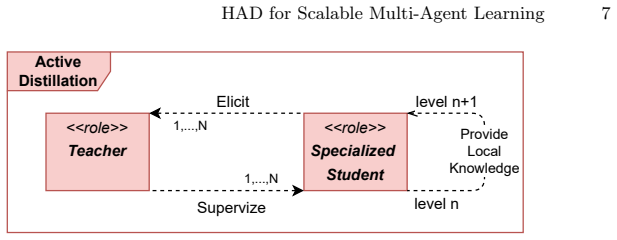
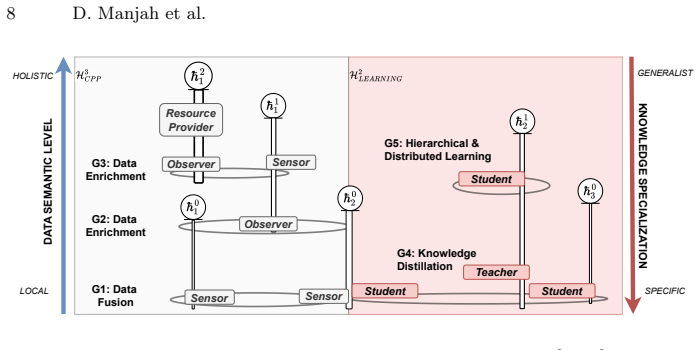
Clustered Stream-Based Active Distillation (CSBAD) inside a Holonic Multi-Agent System (HMAS), in which student models query pseudo-labels from teachers and group into clusters of similar sensors.
If this is right
- The system scales to larger sensor counts by limiting communication to teacher queries and cluster-level sharing.
- Dynamic membership changes are absorbed through reorganization without restarting the entire learning process.
- Local specialization improves accuracy on sensor-specific data while the holonic structure preserves cross-cluster consistency.
- Incremental updates and periodic reorganization can be balanced to control computational cost.
Where Pith is reading between the lines
- The same clustering-plus-pseudo-label pattern could be tested in other distributed settings such as robot swarms or edge-device fleets where agents enter and exit groups.
- Long-running deployments would need an explicit drift threshold to trigger cluster re-formation or teacher retraining.
- Combining the method with existing sensor calibration routines might reduce the frequency of teacher queries.
Load-bearing premise
Clustering similar sensors and transferring knowledge via teacher pseudo-labels produces stable models without unacceptable drift when sensors join or leave the network.
What would settle it
A controlled test in which sensors repeatedly join and leave over hundreds of cycles while measuring whether local and global model accuracy drops below a non-holonic baseline by more than a few percent.
Figures
read the original abstract
The rapid expansion of sensor-based networks introduces major challenges in scalability, adaptability, and knowledge transfer, especially in open environments where new subsystems can dynamically join or leave. In this work, we propose a Holonic Active Distillation architecture within a Holonic Multi-Agent System (HMAS) to address these issues. Our approach integrates Clustered Stream-Based Active Distillation (CSBAD), a framework in which specialized student models collect local data, query pseudo-labels from teacher models, and cluster into groups of similar sensors. Results show that the holonic organization balances local specialization with global generalization, while efficiently adapting to sensor departures and re-integrations. We also analyzed trade-offs among incremental model updates, system reorganization, and scalability limits. Our findings highlight the advantages of holonic learning for multi-sensor systems while identifying key challenges related to model drift and long-term adaptation.
Editorial analysis
A structured set of objections, weighed in public.
Referee Report
Summary. The manuscript proposes a Holonic Active Distillation architecture within a Holonic Multi-Agent System (HMAS) to address scalability, adaptability, and knowledge transfer in open multi-sensor networks where subsystems dynamically join or leave. It integrates Clustered Stream-Based Active Distillation (CSBAD), in which specialized student models collect local data, query pseudo-labels from teacher models, and cluster into groups of similar sensors. The central claim is that the holonic organization balances local specialization with global generalization while efficiently adapting to sensor departures and re-integrations; the work also analyzes trade-offs among incremental model updates, system reorganization, and scalability limits, and identifies challenges related to model drift and long-term adaptation.
Significance. If the empirical results hold, the framework could offer a structured approach to scalable multi-agent learning in dynamic sensor environments by combining holonic organization with active distillation and clustering for knowledge transfer. The explicit acknowledgment of open challenges such as model drift demonstrates appropriate caution. However, the complete absence of metrics, experimental setups, error bars, or data details prevents any assessment of whether the claimed balance and adaptation efficiency are achieved.
major comments (2)
- [Abstract] Abstract (results paragraph): The statement that 'Results show that the holonic organization balances local specialization with global generalization, while efficiently adapting to sensor departures and re-integrations' supplies no metrics, experimental setup, error bars, or data details. This is load-bearing for the central claim, as the efficiency of adaptation under dynamic membership cannot be evaluated without quantitative tracking of error accumulation or stability across reorganization events.
- [Abstract] Abstract (trade-offs paragraph): The analysis of trade-offs among incremental model updates, system reorganization, and scalability limits is referenced but provides no specific findings, quantitative measures, or description of how model drift was monitored during repeated sensor join/leave cycles. This directly affects the weakest assumption that CSBAD clustering plus teacher pseudo-labels yields stable transfer without unacceptable drift.
minor comments (1)
- [Abstract] The abstract would be strengthened by including at least one concrete detail on the scale of the sensor system or simulation used to generate the reported results.
Simulated Author's Rebuttal
We thank the referee for the feedback. We agree that the abstract contains unsupported claims about empirical results and analyses. The manuscript is a conceptual proposal of the architecture without experiments or quantitative data, and we will revise the abstract to remove or qualify these statements.
read point-by-point responses
-
Referee: [Abstract] Abstract (results paragraph): The statement that 'Results show that the holonic organization balances local specialization with global generalization, while efficiently adapting to sensor departures and re-integrations' supplies no metrics, experimental setup, error bars, or data details. This is load-bearing for the central claim, as the efficiency of adaptation under dynamic membership cannot be evaluated without quantitative tracking of error accumulation or stability across reorganization events.
Authors: We agree. The manuscript presents a proposed framework and does not contain experiments, metrics, setups, or data on adaptation. The abstract phrasing overstated intended benefits as demonstrated results. We will revise the abstract to remove this claim or rephrase it as hypothesized properties of the holonic organization. revision: yes
-
Referee: [Abstract] Abstract (trade-offs paragraph): The analysis of trade-offs among incremental model updates, system reorganization, and scalability limits is referenced but provides no specific findings, quantitative measures, or description of how model drift was monitored during repeated sensor join/leave cycles. This directly affects the weakest assumption that CSBAD clustering plus teacher pseudo-labels yields stable transfer without unacceptable drift.
Authors: We concur. No quantitative analysis of trade-offs or model drift monitoring appears in the manuscript. We will revise the abstract to eliminate the reference to such an analysis or to frame these as identified open challenges rather than completed work. revision: yes
Circularity Check
No circularity; proposal lacks derivations or fitted predictions
full rationale
The manuscript presents an architectural proposal (Holonic Active Distillation + CSBAD clustering with pseudo-label queries) and states empirical outcomes on specialization/generalization balance and adaptation. No equations, parameter-fitting steps, uniqueness theorems, or self-citations appear in the supplied text. The central claims are not shown to reduce by construction to inputs; they are presented as observed results of the framework. This matches the default expectation of a non-circular methodological paper.
Axiom & Free-Parameter Ledger
Reference graph
Works this paper leans on
-
[1]
Abbas, H.A.: Organization of multi-agent systems: An overview. Interna- tional Journal of Intelligent Information Systems4(3), 46 (2015),https: //doi.org/10.11648/j.ijiis.20150403.11
-
[2]
In: 2016 IEEE 10th International Conference on Self- Adaptive and Self-Organizing Systems (SASO), pp
Beal, J., Viroli, M., Pianini, D., Damiani, F.: Self-adaptation to device dis- tribution changes. In: 2016 IEEE 10th International Conference on Self- Adaptive and Self-Organizing Systems (SASO), pp. 60–69 (2016),https: //doi.org/10.1109/SASO.2016.12
-
[3]
In: Petta, P., Tolksdorf, R., Zambonelli, F
Bernon, C., Gleizes, M.P., Peyruqueou, S., Picard, G.: Adelfe: A methodol- ogy for adaptive multi-agent systems engineering. In: Petta, P., Tolksdorf, R., Zambonelli, F. (eds.) Engineering Societies in the Agents World III, pp. 156–169, Springer Berlin Heidelberg, Berlin, Heidelberg (2003), ISBN 978-3-540-39173-9,https://doi.org/10.1007/3-540-39173-8_12
-
[4]
Brion, E., Léger, J., Javaid, U., Lee, J., Vleeschouwer, C.D., Macq, B.: Using planning CTs to enhance CNN-based bladder segmentation on cone beam CT. In: Fei, B., Linte, C.A. (eds.) Medical Imaging 2019: Image-Guided Procedures, Robotic Interventions, and Modeling, vol. 10951, p. 109511M, International Society for Optics and Photonics, SPIE (2019),https:...
-
[5]
Campagner, A., Ciucci, D., Cabitza, F.: Aggregation models in ensem- ble learning: A large-scale comparison. Information Fusion90, 241–252 (2023), ISSN 1566-2535,https://doi.org/https://doi.org/10.1016/j. inffus.2022.09.015
work page doi:10.1016/j 2023
-
[6]
Information Sys- tems27(6), 365–389 (2002), ISSN 0306-4379,https://doi.org/10.1016/ S0306-4379(02)00012-1
Castro, J., Kolp, M., Mylopoulos, J.: Towards requirements-driven in- formation systems engineering: the tropos project. Information Sys- tems27(6), 365–389 (2002), ISSN 0306-4379,https://doi.org/10.1016/ S0306-4379(02)00012-1
2002
-
[7]
In: Proceedings of the IEEE/CVF Conference on Computer Vision and Pattern Recognition (CVPR) Workshops (June 2019)
Cioppa, A., Deliege, A., Istasse, M., De Vleeschouwer, C., Van Droogen- broeck, M.: Arthus: Adaptive real-time human segmentation in sports through online distillation. In: Proceedings of the IEEE/CVF Conference on Computer Vision and Pattern Recognition (CVPR) Workshops (June 2019)
2019
-
[8]
In: Multi- Agent Systems and Applications IV, pp
Cossentino, M., Gaglio, S., Sabatucci, L., Seidita, V.: The passi and ag- ile passi mas meta-models compared with a unifying proposal. In: Multi- Agent Systems and Applications IV, pp. 183–192, Springer Berlin Heidel- berg, Berlin, Heidelberg (2005), ISBN 978-3-540-31731-9
2005
-
[9]
Cossentino, M., Gaud, N., Hilaire, V., Galland, S., Koukam, A.: Aspecs: an agent-oriented software process for engineering complex systems. Au- tonomous Agents and Multi-Agent Systems20(2), 260–304 (2010),https: //doi.org/10.1007/s10458-009-9099-4
-
[10]
In: 2016 IEEE 10th International Conference on Self-Adaptive and 18 D
Diaconescu, A., Frey, S., Müller-Schloer, C., Pitt, J., Tomforde, S.: Goal- oriented holonics for complex system (self-)integration: Concepts and case studies. In: 2016 IEEE 10th International Conference on Self-Adaptive and 18 D. Manjah et al. Self-Organizing Systems (SASO), pp. 100–109 (2016),https://doi.org/ 10.1109/SASO.2016.16
-
[11]
The Leadership Quarterly32(3), 101477 (2021), ISSN 1048-9843
Dong, J., Liu, R., Qiu, Y., Crossan, M.: Should knowledge be distorted? managers’ knowledge distortion strategies and organizational learning in different environments. The Leadership Quarterly32(3), 101477 (2021), ISSN 1048-9843
2021
-
[12]
Syst.16(3–4) (jul 2022), ISSN 1556-4665
Esmaeili, A., Gallagher, J.C., Springer, J.A., Matson, E.T.: Hamlet: A hier- archicalagent-basedmachinelearningplatform.ACMTrans.Auton.Adapt. Syst.16(3–4) (jul 2022), ISSN 1556-4665
2022
-
[13]
ACM Trans
Esmaeili, A., Gallagher, J.C., Springer, J.A., Matson, E.T.: Hamlet: A hierarchical agent-based machine learning platform. ACM Trans. Auton. Adapt. Syst.16(3–4) (Jul 2022), ISSN 1556-4665,https://doi.org/10. 1145/3530191
2022
-
[14]
In: Proceedings of the 23rd International Conference on Autonomous Agents and Multiagent Systems, p
Esmaeili, A., Ghorrati, Z., Matson, E.T.: Holonic learning: A flexible agent- based distributed machine learning framework. In: Proceedings of the 23rd International Conference on Autonomous Agents and Multiagent Systems, p. 525–533, AAMAS ’24, International Foundation for Autonomous Agents and Multiagent Systems, Richland, SC (2024), ISBN 9798400704864
2024
-
[15]
In: Ad- vances in Practical Applications of Survivable Agents and Multi-Agent Sys- tems: The PAAMS Collection, pp
Esmaeili, A., Mozayani, N., Jahed-Motlagh, M.R., Matson, E.T.: Towards topological analysis of networked holonic multi-agent systems. In: Ad- vances in Practical Applications of Survivable Agents and Multi-Agent Sys- tems: The PAAMS Collection, pp. 42–54, Springer International Publishing, Cham (2019), ISBN 978-3-030-24209-1
2019
-
[16]
Engineering Applications of Artificial Intelligence55, 186–201 (2016), ISSN 0952-1976
Esmaeili, A., Mozayani, N., Motlagh, M.R.J., Matson, E.T.: The impact of diversity on performance of holonic multi-agent systems. Engineering Applications of Artificial Intelligence55, 186–201 (2016), ISSN 0952-1976
2016
-
[17]
Feraud, M., Galland, S.: First comparison of sarl to other agent- programming languages and frameworks. Procedia Computer Science109, 1080 – 1085 (2017), ISSN 1877-0509,https://doi.org/https://doi.org/ 10.1016/j.procs.2017.05.389
-
[18]
Addison- Wesley Professional (2018)
Fowler, M.: Refactoring: improving the design of existing code. Addison- Wesley Professional (2018)
2018
-
[19]
Trends in Cognitive Sciences3(4), 128–135 (1999), ISSN 1364-6613,https://doi
French, R.M.: Catastrophic forgetting in connectionist networks. Trends in Cognitive Sciences3(4), 128–135 (1999), ISSN 1364-6613,https://doi. org/10.1016/S1364-6613(99)01294-2
-
[20]
In: Sixth International Workshop From Agent Theory to Agent Implementation (AT2AI-6), pp
Garcia, E., Argente, E., Giret, A., Botti, V.: Issues for organizational multi- agent systems development. In: Sixth International Workshop From Agent Theory to Agent Implementation (AT2AI-6), pp. 59–65, Citeseer (2008)
2008
-
[21]
In: International Encyclopedia of the Social & Behavioral Sciences (Second Edition), pp
Gherardi, S.: Learning: Organizational. In: International Encyclopedia of the Social & Behavioral Sciences (Second Edition), pp. 695–698, Elsevier, Oxford, second edition edn. (2015), ISBN 978-0-08-097087-5
2015
-
[22]
In: Advances in Neural Information Processing Systems, vol
Ghosh, A., Chung, J., Yin, D., Ramchandran, K.: An efficient framework for clustered federated learning. In: Advances in Neural Information Processing Systems, vol. 33, pp. 19586–19597, Curran Associates, Inc. (2020)
2020
-
[23]
In: Multi-Agent Systems, pp
Gleizes, M.P.: Self-adaptive complex systems. In: Multi-Agent Systems, pp. 114–128, Springer, Berlin, Heidelberg (2012), ISBN 978-3-642-34799-3 HAD for Scalable Multi-Agent Learning 19
2012
-
[24]
Gupta, O., Raskar, R.: Distributed learning of deep neural network over multiple agents. Journal of Network and Computer Applications116, 1–8 (2018), ISSN 1084-8045,https://doi.org/10.1016/j.jnca.2018.05.003
-
[25]
IEEE Communications Magazine58(12), 41–47 (2020)
Hosseinalipour, S., Brinton, C.G., Aggarwal, V., Dai, H., Chiang, M.: From federated to fog learning: Distributed machine learning over heterogeneous wireless networks. IEEE Communications Magazine58(12), 41–47 (2020)
2020
-
[26]
giving the organ- isational power back to the agents
Hübner, J.F., Boissier, O., Kitio, R., Ricci, A.: Instrumenting multi-agent organisations with organisational artifacts and agents: “giving the organ- isational power back to the agents”. Autonomous agents and multi-agent systems20(3), 369–400 (2010)
2010
-
[27]
Jocher, G., Chaurasia, A., Qiu, J.: Ultralytics YOLO (2023), URLhttps: //github.com/ultralytics/ultralytics
2023
-
[28]
Hutchinson, London, UK (1967)
Koestler, A.: The ghost in the machine. Hutchinson, London, UK (1967)
1967
-
[29]
Autonomous Agents and Multi-Agent Systems13, 3–25 (2006)
Kolp, M., Giorgini, P., Mylopoulos, J.: Multi-agent architectures as organi- zational structures. Autonomous Agents and Multi-Agent Systems13, 3–25 (2006)
2006
-
[30]
Le, J., Lei, X., Mu, N., Zhang, H., Zeng, K., Liao, X.: Federated continuous learning with broad network architecture. IEEE Transactions on Cybernet- ics51(8), 3874–3888 (2021), ISSN 2168-2275,https://doi.org/10.1109/ TCYB.2021.3090260
-
[31]
Microsoft COCO: Common Objects in Context
Lin, T., Maire, M., Belongie, S.J., Bourdev, L.D., Girshick, R.B., Hays, J., Perona, P., Ramanan, D., Dollár, P., Zitnick, C.L.: Microsoft COCO: common objects in context. CoRRabs/1405.0312(2014)
work page internal anchor Pith review Pith/arXiv arXiv 2014
-
[32]
In: 2022 17th Conference on Computer Science and Intelligence Systems (FedCSIS), pp
Lippi, M., Mariani, S., Martinelli, M., Zambonelli, F.: Individual and col- lective self-development: Concepts and challenges. In: 2022 17th Conference on Computer Science and Intelligence Systems (FedCSIS), pp. 15–21 (2022)
2022
-
[33]
Applied Sciences10(3) (2020), ISSN 2076-3417,https://doi.org/10.3390/app10031154, URLhttps://www
Léger, J., Brion, E., Desbordes, P., De Vleeschouwer, C., Lee, J.A., Macq, B.: Cross-domain data augmentation for deep-learning-based male pelvic organ segmentation in cone beam ct. Applied Sciences10(3) (2020), ISSN 2076-3417,https://doi.org/10.3390/app10031154, URLhttps://www. mdpi.com/2076-3417/10/3/1154
-
[34]
IEEE Transactions on Mobile Computing23(2), 1080–1096 (2024), ISSN 1558-0660
Ma, Z., Xu, Y., Xu, H., Liu, J., Xue, Y.: Like attracts like: Personalized federated learning in decentralized edge computing. IEEE Transactions on Mobile Computing23(2), 1080–1096 (2024), ISSN 1558-0660
2024
-
[35]
Manjah, D., Cacciarelli, D., De Vleeschouwer, C., Macq, B.: Camera cluster- ing for scalable stream-based active distillation. Expert Systems with Ap- plications290, 128408 (2025), ISSN 0957-4174,https://doi.org/https: //doi.org/10.1016/j.eswa.2025.128408
-
[36]
In: Proceedings of the IEEE/CVF Conference on Computer Vision and Pattern Recognition (CVPR) Work- shops, pp
Manjah, D., Cacciarelli, D., Standaert, B., Benkedadra, M., de Hertaing, G.R., Macq, B., Galland, S., De Vleeschouwer, C.: Stream-based active dis- tillation for scalable model deployment. In: Proceedings of the IEEE/CVF Conference on Computer Vision and Pattern Recognition (CVPR) Work- shops, pp. 4998–5006 (2023)
2023
-
[37]
In: Proceedings of the 16th International Conference on Agents and Artificial Intelligence, vol
Manjah, D., Galland, S., Vleeschouwer, C.D., Macq, B.: Autonomous meth- ods in multisensor architecture for smart surveillance. In: Proceedings of the 16th International Conference on Agents and Artificial Intelligence, vol. 3, pp. 824–832 (2024), ISBN 978-989-758-680-4, ISSN 2184-433X 20 D. Manjah et al
2024
-
[38]
In: The IEEE Con- ference on Computer Vision and Pattern Recognition (CVPR) Workshops (2021)
Naphade, M., Wang, S., Anastasiu, D.C., Tang, Z., Chang, M.C., Yang, X., Yao, Y., Zheng, L., Chakraborty, P., Lopez, C.E., Sharma, A., Feng, Q., Ablavsky, V., Sclaroff, S.: The 5th ai city challenge. In: The IEEE Con- ference on Computer Vision and Pattern Recognition (CVPR) Workshops (2021)
2021
-
[39]
Smart Cities5(1), 318–347 (2022), ISSN 2624-6511
Nezamoddini, N., Gholami, A.: A survey of adaptive multi-agent networks and their applications in smart cities. Smart Cities5(1), 318–347 (2022), ISSN 2624-6511
2022
-
[40]
In: Agent-Oriented Software Engineering, pp
Omicini, A.: Soda: Societies and infrastructures in the analysis and design of agent-based systems. In: Agent-Oriented Software Engineering, pp. 185– 193, Springer Berlin Heidelberg (2001), ISBN 978-3-540-44564-7
2001
-
[41]
In: Agent-Oriented Software Engineering III, pp
Padgham, L., Winikoff, M.: Prometheus: A methodology for developing intelligent agents. In: Agent-Oriented Software Engineering III, pp. 174– 185, Springer Berlin Heidelberg, Berlin, Heidelberg (2003), ISBN 978-3- 540-36540-2
2003
-
[42]
In: Multi-Agent Systems and Applications III, pp
Pavón, J., Gómez-Sanz, J.: Agent oriented software engineering with inge- nias. In: Multi-Agent Systems and Applications III, pp. 394–403, Springer, Berlin, Heidelberg (2003), ISBN 978-3-540-45023-8
2003
-
[43]
Transactions on Emerging Telecommunications Technologies25(1), 81–93 (2014), ISSN 2161-3915
Perera, C., Zaslavsky, A., Christen, P., Georgakopoulos, D.: Sensing as a service model for smart cities supported by Internet of Things. Transactions on Emerging Telecommunications Technologies25(1), 81–93 (2014), ISSN 2161-3915
2014
-
[44]
In: 2019 IEEE 13th International Conference on Self-Adaptive and Self-Organizing Systems (SASO), pp
Porter, B., Rodrigues Filho, R.: Distributed emergent software: Assembling, perceiving and learning systems at scale. In: 2019 IEEE 13th International Conference on Self-Adaptive and Self-Organizing Systems (SASO), pp. 127– 136 (2019)
2019
-
[45]
In: Proceedings of the IEEE/CVF Conference on Computer Vision and Pattern Recognition (CVPR), pp
Reddy, N.D., Tamburo, R., Narasimhan, S.G.: Walt: Watch and learn 2d amodal representation from time-lapse imagery. In: Proceedings of the IEEE/CVF Conference on Computer Vision and Pattern Recognition (CVPR), pp. 9356–9366 (2022)
2022
-
[46]
Natural Computing Series37, 251–279 (2011), https://doi.org/10.1007/978-3-642-17348-6_11
Rodriguez, S., Hilaire, V., Gaud, N., Galland, S., Koukam, A.: Holonic Multi-Agent Systems. Natural Computing Series37, 251–279 (2011), https://doi.org/10.1007/978-3-642-17348-6_11
-
[47]
Schatten, M., Grd, P., Konecki, M., Kudelić, R.: Towards a formal conceptu- alization of organizational design techniques for large scale multi agent sys- tems. Procedia Technology15, 576–585 (2014), ISSN 2212-0173,https:// doi.org/10.1016/j.protcy.2014.09.018, 2nd International Conference on System-Integrated Intelligence: Challenges for Product and Prod...
-
[48]
In: Advances in Neural Information Pro- cessing Systems, vol
Sculley, D., Holt, G., Golovin, D., Davydov, E., Phillips, T., Ebner, D., Chaudhary, V., Young, M., Crespo, J.F., Dennison, D.: Hidden technical debt in machine learning systems. In: Advances in Neural Information Pro- cessing Systems, vol. 28, Curran Associates, Inc. (2015)
2015
-
[49]
The Computer Journal16(1), 30–34 (1973), ISSN 0010-4620 HAD for Scalable Multi-Agent Learning 21
Sibson, R.: SLINK: An optimally efficient algorithm for the single-link clus- ter method. The Computer Journal16(1), 30–34 (1973), ISSN 0010-4620 HAD for Scalable Multi-Agent Learning 21
1973
-
[50]
In: Distributed Artificial Intelligence Meets Machine Learning Learning in Multi-Agent Environments, pp
Terabe, M., Washio, T., Katai, O., Sawaragi, T.: A study of organiza- tional learning in multiagents systems. In: Distributed Artificial Intelligence Meets Machine Learning Learning in Multi-Agent Environments, pp. 168– 179, Springer Berlin Heidelberg, Berlin, Heidelberg (1997), ISBN 978-3-540- 69050-4
1997
-
[51]
In: Research Anthology on Recent Trends, Tools, and Implications of Computer Programming, pp
Wautelet, Y., Schinckus, C., Kolp, M.: Agent-based software engineering, paradigm shift, or research program evolution. In: Research Anthology on Recent Trends, Tools, and Implications of Computer Programming, pp. 1642–1654, IGI Global (2021)
2021
-
[52]
ACM Trans
Weyns, D., Gerostathopoulos, I., Abbas, N., Andersson, J., Biffl, S., Brada, P., Bures, T., Di Salle, A., Galster, M., Lago, P., Lewis, G., Litoiu, M., Musil, A., Musil, J., Patros, P., Pelliccione, P.: Self-adaptation in industry: A survey. ACM Trans. Auton. Adapt. Syst.18(2) (2023), ISSN 1556-4665
2023
-
[53]
Wolpert, D.H., Macready, W.G.: No free lunch theorems for optimization. IEEE Transactions on Evolutionary Computation1(1), 67–82 (1997), ISSN 1089778X,https://doi.org/10.1109/4235.585893
-
[54]
Wooldridge,M.,Jennings,N.R.,Kinny,D.:Thegaiamethodologyforagent- oriented analysis and design. Autonomous Agents and Multi-Agent Systems 3(3), 285–312 (2000),https://doi.org/10.1023/A:1010071910869
-
[55]
IEEE Transactions on Vehicular Technology71(2), 2070–2083 (2021)
Xu, B., Xia, W., Wen, W., Liu, P., Zhao, H., Zhu, H.: Adaptive hierarchical federated learning over wireless networks. IEEE Transactions on Vehicular Technology71(2), 2070–2083 (2021)
2070
-
[56]
In: Proceedings of the 20th Inter- national Conference on Autonomous Agents and MultiAgent Systems, p
Yang, Y., Luo, J., Wen, Y., Slumbers, O., Graves, D., Bou Ammar, H., Wang, J., Taylor, M.E.: Diverse auto-curriculum is critical for successful real-world multiagent learning systems. In: Proceedings of the 20th Inter- national Conference on Autonomous Agents and MultiAgent Systems, p. 51–56, AAMAS ’21, International Foundation for Autonomous Agents and M...
2021
-
[57]
In: Proceedings of the Twenty-First International Conference on Artificial Intelligence and Statistics, Proceedings of Machine Learning Re- search, vol
Yin, D., Pananjady, A., Lam, M., Papailiopoulos, D., Ramchandran, K., Bartlett, P.: Gradient diversity: a key ingredient for scalable distributed learning. In: Proceedings of the Twenty-First International Conference on Artificial Intelligence and Statistics, Proceedings of Machine Learning Re- search, vol. 84, pp. 1998–2007, PMLR (2018)
1998
discussion (0)
Sign in with ORCID, Apple, or X to comment. Anyone can read and Pith papers without signing in.