REVIEW 3 major objections 4 minor 61 references
Emergent bosons in the fermionic two-leg flux ladder
T0 review · 3 major / 4 minor · reviewed 2026-08-14 · deepseek-v4-flash
Pith's one-line read In a fermionic two-leg flux ladder with strong competing interactions, fermions bind into bosonic pairs, and the gauge flux drives an Ising-type quantum phase transition between a vortex density wave and a charge density wave.
desk verdict A solid numerical and field-theory study of emergent bosonic pairs in a fermionic flux ladder with a real new model, but the Ising classification of the VDW-CDW transition is asserted rather than demonstrated. read the letter →
The pith
A machine-rendered reading of the paper's core claim, the machinery that carries it, and where it could break.
The reading
What carries the argument
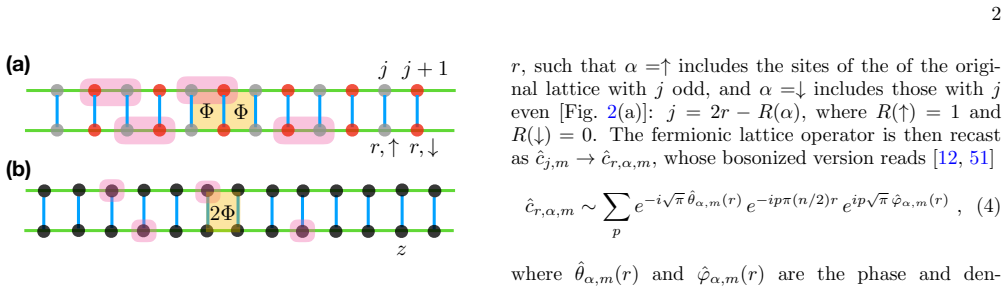
The load-bearing object is the effective self-dual sine-Gordon model for the antisymmetric sector, Eq. (13): $\hat{H}^{(a)} = \hat{H}^{(a)}_{\mathrm{LL}} + \tilde{t}_\perp \int dz \cos\big(\sqrt{2\pi}\,\hat{\theta}_{B,a} + 2\Phi z\big) + \tilde{U} \int dz \cos\big(2\sqrt{2\pi}\,\hat{\phi}_{B,a}\big)$. Its two cosine terms are dual under exchange of the phase field $\hat{\theta}_{B,a}$ and the density field $\hat{\phi}_{B,a}$, which is what places the transition in the Ising universality class. To reach this model, the paper splits each fermionic chain into two sublattices, bosonizes the fermionic pair operator, uses the attractive nearest-neighbour interaction to pin the $\hat{\phi}_{-,m}$ fields to zero, and thereby recovers a bosonic operator for the pair; the repulsive next-to-nearest-neighbour interaction becomes an effective intra-chain repulsion between pairs, while the transverse hopping generates the Josephson coupling and the effective on-site inter-leg pair interaction. This chain of mappings is what converts the microscopic fermionic Hamiltonian into the self-dual bosonic model whose Ising transition is then probed numerically.
What would settle it
Carry out the effective field theory to next order in $t_\perp/|V|$ and test every newly generated cosine term for relevance; if any term with scaling dimension below 2 appears, the self-dual sine-Gordon description is preempted. In DMRG, look for a discontinuous jump in the relative density $\delta n_B(\Phi)$ or a gap-exponent $\nu$ departing from the Ising value 1, i.e., $\xi^{-1} \sim |\Phi - \Phi_c|$, as parameters approach the boundary of the strongly paired regime.
Extended reading notes
Core claim
The central claim is that in the strongly paired regime, the two-leg fermionic flux ladder is governed by an emergent bosonic description. The pair creation operator, written in terms of the original fermions, bosonizes into a standard bosonic operator after the antisymmetric density fields are pinned, so each tightly bound fermion pair behaves as a single bosonic particle located at its center of mass and carrying twice the gauge flux. The low-energy Hamiltonian then splits into an independent gapless symmetric Luttinger liquid and an antisymmetric self-dual sine-Gordon model, Eq. (13), which is known to belong to the Ising universality class. The paper claims that the gauge flux drives a quantum phase transition in this antisymmetric sector, from a vortex density wave, where the relative phase is locked, to a charge density wave, where the relative density is locked. The numerical data reproduce the expected order parameter behavior, the linear closing of the gap with flux, and a central charge c = 1 away from the critical point.
Load-bearing premise
The prediction rests on the truncation of the effective low-energy Hamiltonian to a gapless Luttinger liquid plus the two cosine terms in Eq. (13): if higher-order symmetry-allowed processes generated by the inter-leg hopping are relevant, or if the pinning of the $\hat{\phi}_{-,m}$ fields to zero used in the bosonization fails, the Ising transition and its numerical signatures could be altered.
Editorial extensions
If this is right
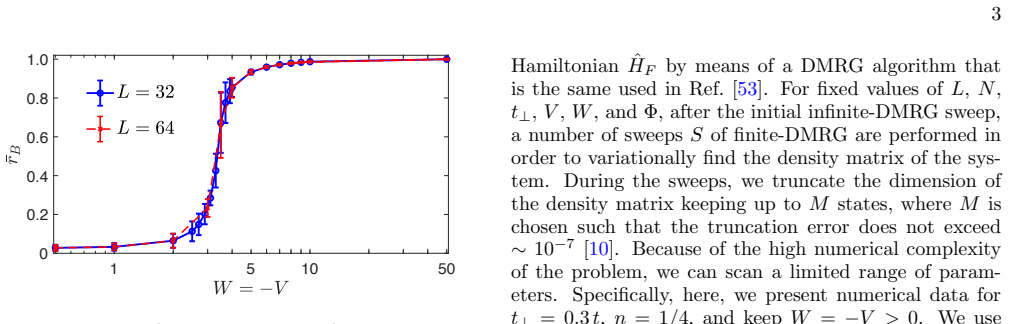
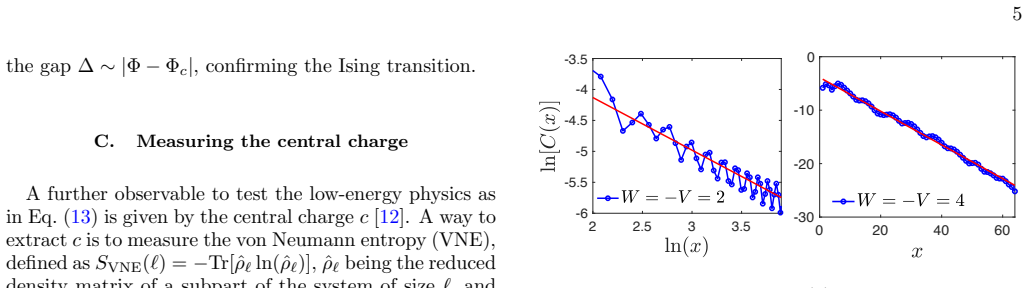
- For sufficiently large attractive nearest-neighbour and repulsive next-to-nearest-neighbour interactions, single-fermion correlations decay exponentially while the pair density saturates to half the fermionic density, so the system is genuinely in a strongly paired bosonic regime.
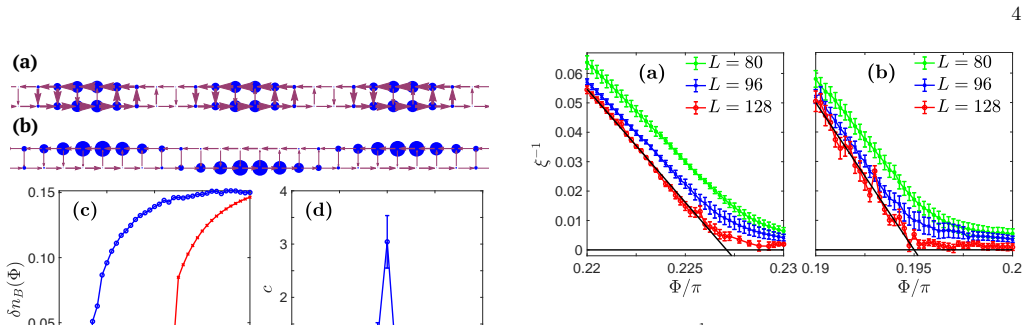
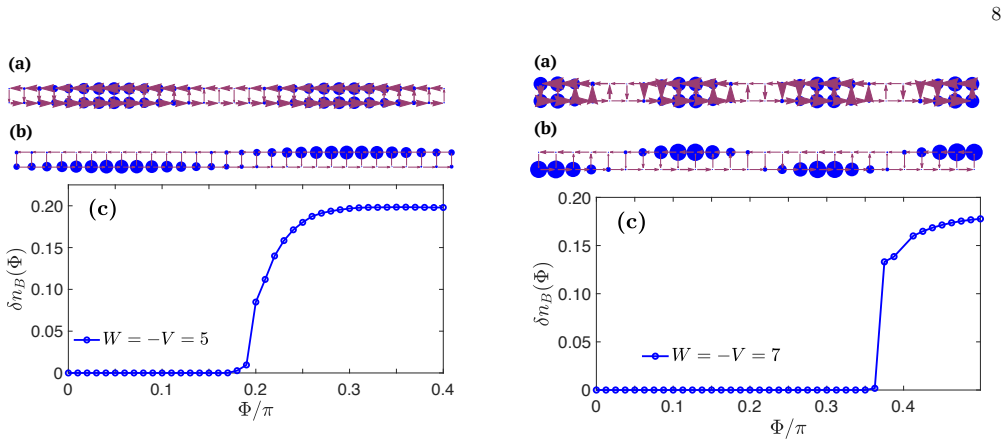
- Tuning the gauge flux at fixed strong interactions drives the emergent bosons from a vortex density wave below the critical flux to a charge density wave above it, with the relative leg density imbalance serving as the order parameter.
- The antisymmetric-sector gap closes linearly as $|\Phi - \Phi_c|$, the characteristic signature of an Ising transition in one spatial dimension, while the symmetric sector remains a gapless Luttinger liquid with central charge $c = 1$.
- Because each fermion pair experiences an effective flux of $2\Phi$, the bosonic description predicts that the fermionic ladder realizes the vortex-charge duality encoded in the self-dual sine-Gordon model rather than single-fermion physics.
- The same Ising transition should appear for a range of fillings, interaction strengths, and transverse hoppings, since the numerical results show the same phenomenology for $n = 1/4$ and $n = 1/8$, for $W = 3t$ to $50t$, and for $t_\perp = 0.3t$ and $0.5t$.
Reading between the lines
- Editorial inference: the same self-dual sine-Gordon Hamiltonian Eq. (13) should also describe a genuinely bosonic two-leg ladder with nearest-neighbour repulsion and Josephson coupling; a DMRG study of that model would test whether the Ising transition and its dependence on the couplings are universal across fermionic and bosonic realizations.
- Editorial inference: a spatial step in the flux, realized for instance by a phase twist across a junction, would create an interface between the vortex density wave and the charge density wave; if the two phases are separated by an Ising critical point, such an interface could host localized zero modes of the kind proposed for parafermion realization, a possibility the paper mentions but does not
- Editorial inference: the flux-averaged pair fraction $\bar{r}_B$ and its fluctuation across flux values provide a practical experimental diagnostic: in cold-atom setups with synthetic gauge fields, measuring the pair density across a flux scan would directly expose the emergence of the bosonic pairs and the sharpening of the fully paired regime.
- Editorial inference: the truncation of the effective theory to the two displayed cosine terms can be stress-tested by computing higher-order symmetry-allowed processes; if any additional cosine term became relevant, the transition would be preempted or change universality, so the reported agreement for the simulated parameter range is evidence for, but not a proof of, the irrelevance of such terms
Signed reviews
Editorial analysis
A structured set of objections, weighed in public.
Referee Report
Summary. The paper studies a two-leg fermionic flux ladder with attractive nearest-neighbor and repulsive next-to-nearest-neighbor interactions and asks whether, in the strongly paired regime, the system is described by emergent bosonic pairs. The authors derive an effective low-energy theory in which the antisymmetric sector is a self-dual sine-Gordon model, Eq. (13), which is known to host an Ising-type quantum phase transition between a vortex density wave (VDW) and a charge density wave (CDW). Using DMRG on the original fermionic Hamiltonian, they report three key observations: the pair-density ratio rB saturates to 1 at strong coupling, the single-fermion correlation function C(x) decays exponentially in the paired regime, and a flux-driven VDW-CDW transition appears with an inverse correlation length that closes linearly as the critical flux is approached. The central-charge fit away from the transition gives c=1. The manuscript concludes that the gauge flux induces an Ising-type transition between VDW and CDW, characteristic of the emergent bosonic description.
Significance. If the Ising classification is correct, the paper provides a concrete example of emergent bosonic degrees of freedom in a fermionic flux ladder and connects their phase diagram to the vortex-charge duality familiar from bosonic ladder systems. A clear strength is that all DMRG simulations are performed on the original fermionic Hamiltonian rather than on the effective bosonic model, so the phase diagram is not an artifact of the mapping; the additional parameter scans in Appendices B and C (varying V, W, n, t⊥, and adding an on-site inter-leg interaction U) show that the qualitative VDW-CDW phenomenology is robust. The evidence for pair formation (rB saturation and exponential single-particle decay) is convincing. However, the specific claim of Ising universality, which is the headline of the abstract, is supported only by a subset of the signatures needed to establish a universality class; the missing finite-size scaling and critical-entropy analysis are load-bearing for that claim.
major comments (3)
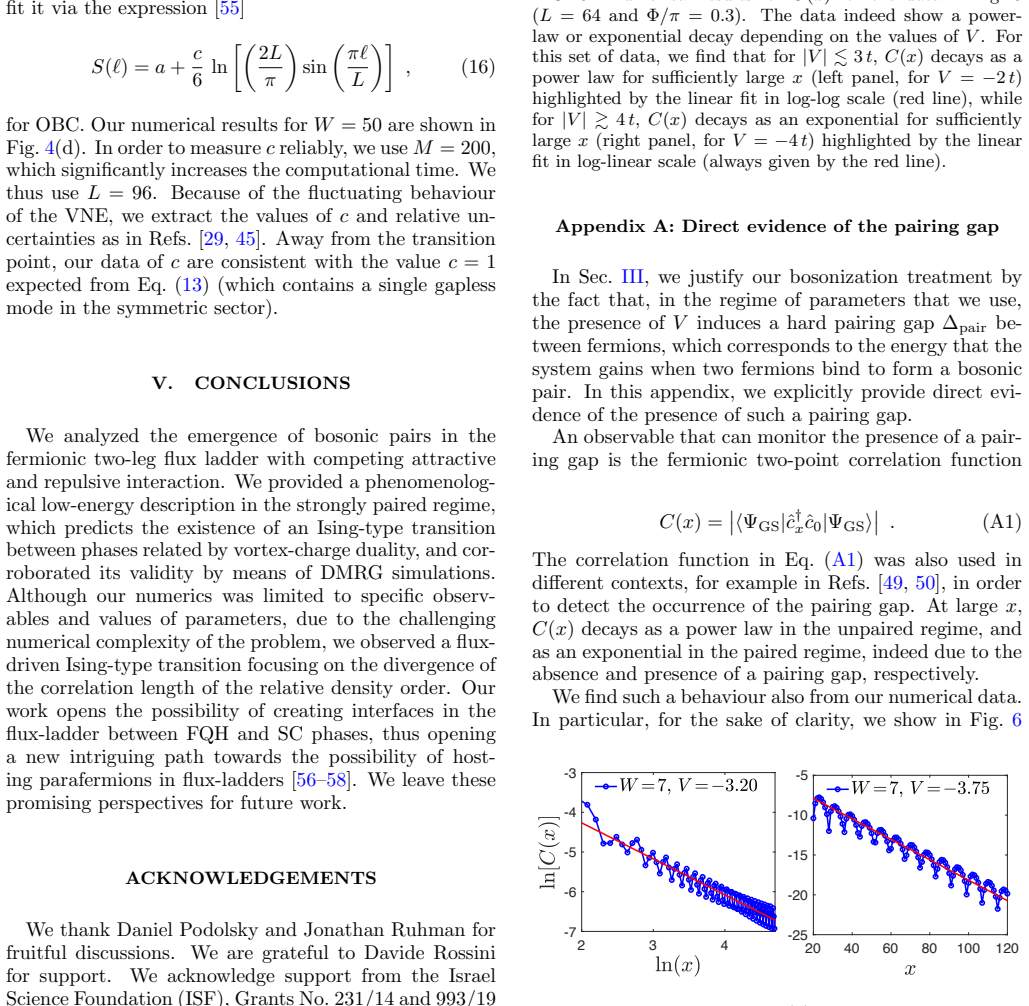
- [Sec. IV B, Figs. 4(c) and 5] The conclusion 'confirming the Ising transition' is not yet established. The only critical-scaling evidence is a linear closing of the inverse correlation length ξ^{-1}(Φ) with distance from Φc, obtained from an impurity probe. A linear gap is consistent with the ν=1 side of Ising, but it is also consistent with any continuous transition with a single correlation-length exponent ν=1, and it does not rule out a weakly first-order transition that mimics linear scaling over the available system sizes. No order-parameter scaling, Binder cumulant, or data collapse is presented. Because the abstract's central claim is the Ising nature of the transition, a finite-size scaling analysis of the CDW order parameter (e.g., collapse of δnB(Φ,L) using Ising exponents) should be provided, or at least a quantitative comparison with the expected Ising scaling form.
- [Sec. III, Eq. (13)] The derivation of the effective antisymmetric Hamiltonian truncates to the two displayed cosine terms, while the text immediately before Eq. (11) states that the transverse hopping can 'perturbatively generate all interactions processes allowed by symmetry.' The Luttinger parameter and the coefficients of the two cosines in Eq. (13) are not computed from the microscopic parameters, so the self-dual sine-Gordon description and its Ising classification are a plausible conjecture rather than a controlled projection. The authors should either estimate these parameters and verify the self-duality condition (or the condition for the Ising fixed point), or explicitly argue that the omitted symmetry-allowed processes have irrelevant scaling dimensions; without this, the analytic route to the Ising class remains incomplete.
- [Sec. IV C, Fig. 4(d)] The central-charge measurement is performed away from the critical flux, where the antisymmetric sector is gapped and only the symmetric gapless mode contributes c=1. This measurement does not test the critical antisymmetric sector: at Φc, an Ising transition would add c=1/2, giving a total central charge c=3/2 for the two sectors combined. Measuring the von Neumann entropy at Φc, or showing a collapse of the entropy data with the expected scaling form, would provide a direct and non-perturbative test of the claimed Ising universality class.
minor comments (4)
- [Appendix B] The word 'phenology' appears twice in the final paragraph ('the phenology discussed in this paper'); this should be 'phenomenology'.
- [Appendix B] In the sentence 'with a slight shift in the critical value of Φc', a closing period is missing, and the sentence is a fragment after the preceding comma; it should be completed.
- [Appendix A] The symbol '∆ pair' in the description of the pairing gap is not typeset as a subscripted quantity; using 'Δ_pair' (or an explicit symbol definition) would improve readability.
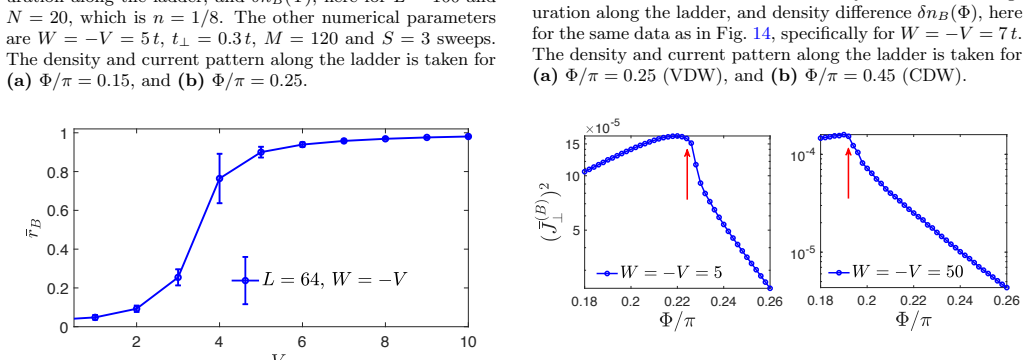
- [Fig. 5] The linear fits to ξ^{-1}(Φ) are shown only for the largest system size L=128; for the other sizes, only data points are shown. Since the scaling analysis is the main evidence for the gap closing, it would be helpful to show the fits for all sizes or to report the fitted slopes and their uncertainties in the text.
Circularity Check
No significant circularity: the Ising prediction rests on an external sine-Gordon result and is checked by DMRG on the original fermionic Hamiltonian; self-citations are routine and non-load-bearing.
full rationale
The derivation chain is not circular. The effective low-energy description in Sec. III is obtained by standard bosonization of the microscopic fermionic ladder: Eq. (4) is the standard bosonized fermion operator, Eq. (7) follows from the NN interaction, and the pair operator is recast as a bosonic operator in Eq. (9) through canonical transformations. The load-bearing universality statement, 'This model belongs to the Ising universality class [52]', rests on Ref. [52] (Lecheminant, Gogolin, and Nersesyan), an external result on the self-dual sine-Gordon model, not on a prior work by the present authors. No parameter of the effective model is fitted to the target observable: the DMRG calculations are performed on the microscopic Hamiltonian H_F, and quantities such as r_B(Phi), delta_n_B(Phi), xi^{-1}(Phi), and the central charge are measured directly rather than derived from Eq. (13). The self-citations present (Refs. [16], [29], [45], [53]) are routine references for sector decomposition, entropy fitting, or the DMRG algorithm, and none is used to establish the Ising claim. A possible concern that the numerical evidence for Ising is not fully pinned down, since the central charge is measured away from the transition and no order-parameter collapse is shown, is an evidence-strength or correctness issue, not circularity, because the simulation results are not constructed from the predicted Ising gap.
Assumptions & free parameters
assumptions (5)
- domain assumption For sufficiently large |V| and W, the ground state is composed of tightly bound fermionic pairs with a hard pairing gap.
- domain assumption Attractive nearest-neighbor interaction V < 0 pins the phi_minus density fields to zero.
- domain assumption The transverse hopping t_perp generates only the two minimal low-energy interaction terms in the antisymmetric sector, Eqs. (10) and (11), and all other symmetry-allowed processes can be neglected.
- standard math The self-dual sine-Gordon model at the self-dual point belongs to the Ising universality class.
- domain assumption The filling n=1/4 is away from relevant lattice commensurability conditions, so only the antisymmetric sector develops a gap.
invented entities (1)
-
Emergent bosonic pair fields C_dagger_{z,m}
independent evidence
Cite this review
Pith. "Pith review of Emergent bosons in the fermionic two-leg flux ladder." pith.science (2026). https://pith.science/paper/SUMSF2Q7
@misc{pith2026190802495,
  author       = {Pith},
  title        = {Pith review of: Emergent bosons in the fermionic two-leg flux ladder},
  year         = {2026},
  howpublished = {\url{https://pith.science/paper/SUMSF2Q7}},
  note         = {Machine review of arXiv:1908.02495}
}
read the original abstract
We study the emergence of bosonic pairs in a system of two coupled one-dimensional fermionic chains subject to a gauge flux (two-leg flux ladder), with both attractive and repulsive interaction. In the presence of strong attractive nearest-neighbor interaction and repulsive next-to-nearest-neighbor interaction, the system crosses into a regime in which fermions form tightly bound pairs, which behave as bosonic entities. By means of numerical simulations based on the density-matrix-renormalization-group (DMRG) method, we show in particular that in the strongly paired regime, the gauge flux induces a quantum phase transition of the Ising type from vortex density wave (VDW) to a charge density wave (CDW), characteristic of bosonic systems.
Figures

Figures from the paper (8 more)
Reference graph
Works this paper leans on
-
[1]
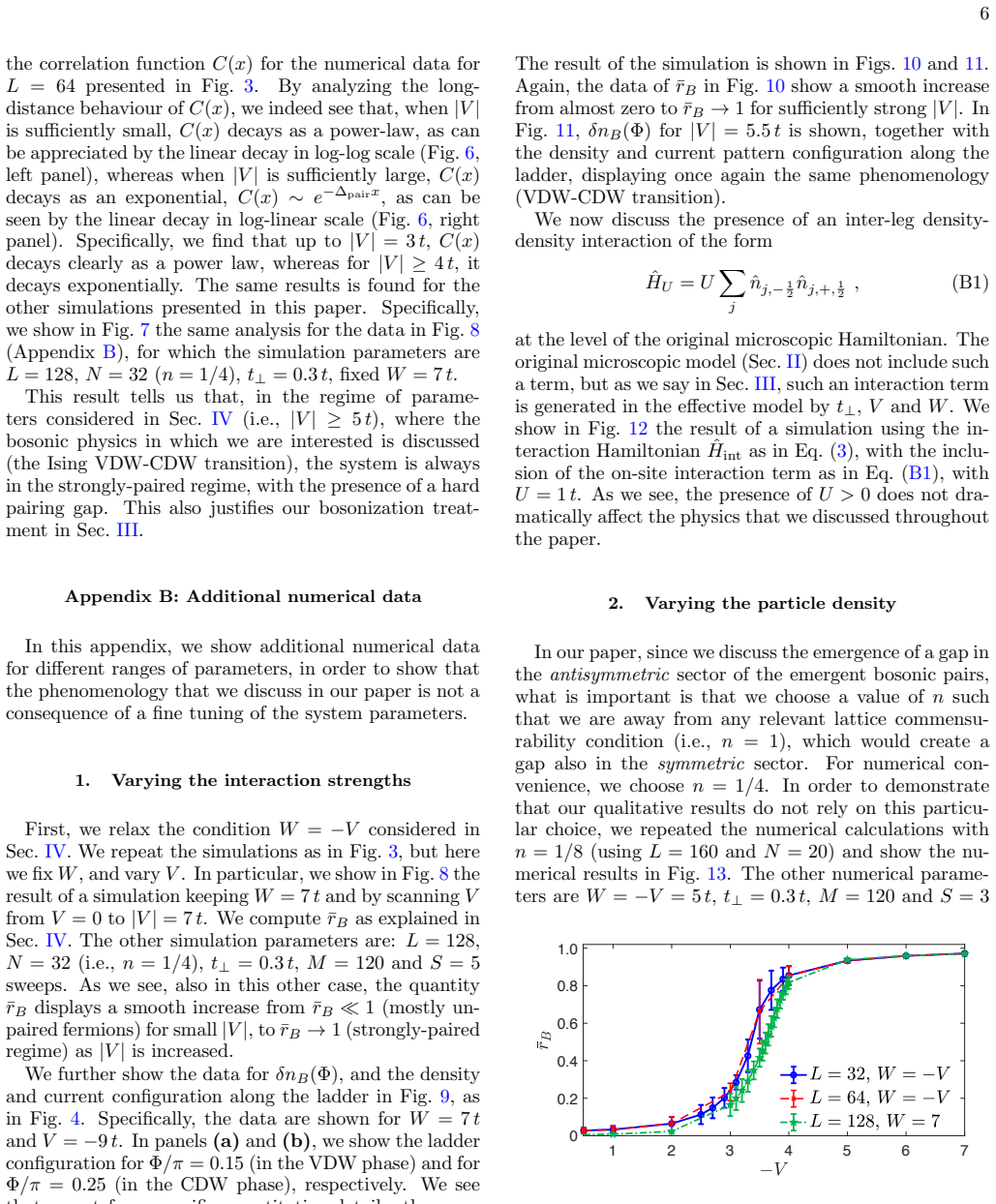
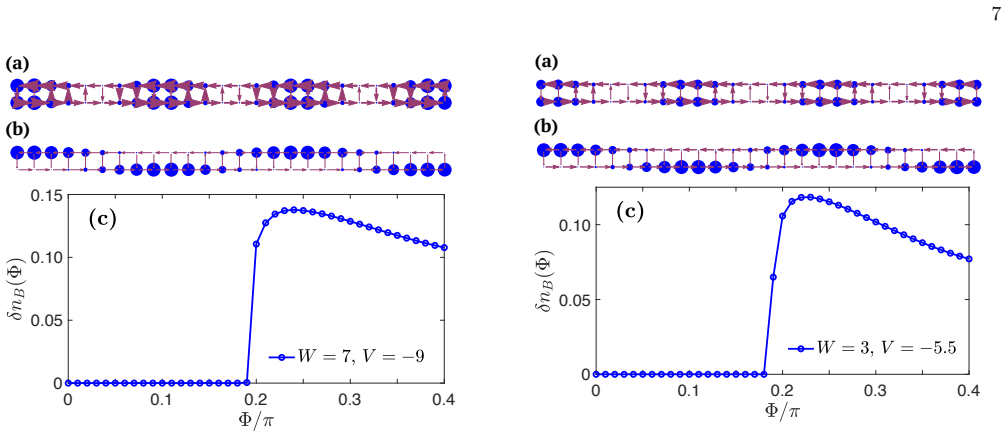
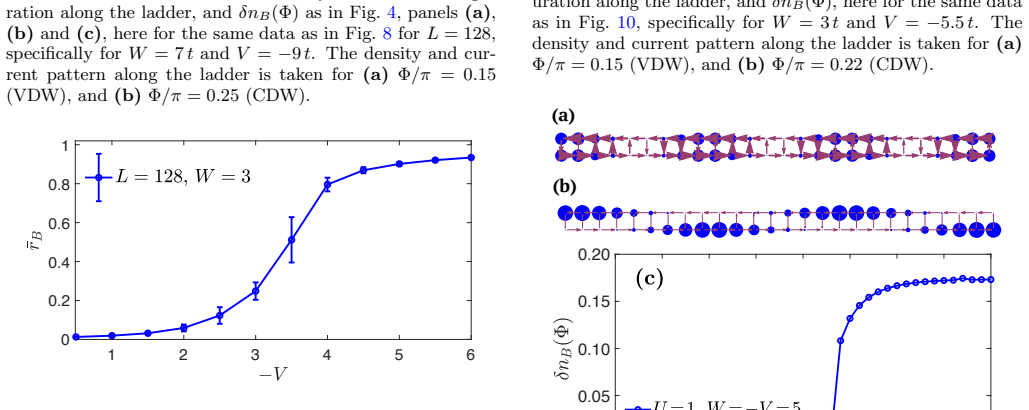
V arying the interaction strengths First, we relax the condition W =−V considered in Sec. IV. We repeat the simulations as in Fig. 3, but here we fixW , and varyV . In particular, we show in Fig. 8 the result of a simulation keepingW = 7t and by scanningV fromV = 0 to|V| = 7t. We compute ¯rB as explained in Sec. IV. The other simulation parameters are: L =...
-
[2]
For numerical con- venience, we choose n = 1/4
V arying the particle density In our paper, since we discuss the emergence of a gap in the antisymmetric sector of the emergent bosonic pairs, what is important is that we choose a value of n such that we are away from any relevant lattice commensu- rability condition (i.e., n = 1), which would create a gap also in the symmetric sector. For numerical con-...
-
[3]
V arying the inter-leg hopping parameter In the numerical simulations presented thus far, we use a single fixed value of t⊥, i.e., t⊥ = 0.3t. We now show the numerical data of ¯rB, density and current configu- ration along the ladder, and density difference δnB(Φ), for a different value of t⊥, namely t⊥ = 0.5t, in order to further show that the phenology disc...
- [4]
-
[5]
Lewenstein, A
M. Lewenstein, A. Sanpera, V. Ahufinger, B. Damski, A. Sen(De), and U. Sen, Adv. Phys. 56, 243 (2007)
2007
-
[6]
Bloch, J
I. Bloch, J. Dalibard, and W. Zwerger, Rev. Mod. Phys. 80, 885 (2008)
2008
-
[7]
Dalibard, F
J. Dalibard, F. Gerbier, G. Juzeli¯ unas, and P. ¨Ohberg, Rev. Mod. Phys. 83, 1523 (2011)
2011
- [8]
Show all 61 references
-
[9]
Goldman, J
N. Goldman, J. C. Budich, and P. Zoller, Nat. Phys. 12, 639 (2016)
2016
-
[10]
J. H. Kang, J. H. Han, and Y. Shin, Phys. Rev. Lett. 121, 150403 (2018)
2018
-
[11]
S. R. White, Phys. Rev. Lett. 69, 2863 (1992)
1992
-
[12]
Schollw¨ ock, Rev
U. Schollw¨ ock, Rev. Mod. Phys.77, 259 (2005)
2005
-
[13]
Schollw¨ ock, Ann
U. Schollw¨ ock, Ann. Phys.326, 96 (2011)
2011
-
[14]
A. O. Gogolin, A. A. Nersesyan, and A. M. Tsve- lik, Bosonization and Strongly Correlated Systems (Cam- bridge University Press, Cambridge, England, 2004)
2004
-
[15]
Giamarchi, Quantum Physics in One Dimension , In- ternational Series of Monographs on Physics (Oxford, New York, 2003)
T. Giamarchi, Quantum Physics in One Dimension , In- ternational Series of Monographs on Physics (Oxford, New York, 2003)
2003
-
[16]
Orignac and T
E. Orignac and T. Giamarchi, Phys. Rev. B 64, 144515 (2001)
2001
-
[17]
A. Dhar, M. Maji, T. Mishra, R. V. Pai, S. Mukerjee, and A. Paramekanti, Phys. Rev. A85, 041602(R) (2012)
2012
-
[18]
Cr´ epin, N
F. Cr´ epin, N. Laflorencie, G. Roux, and P. Simon, Phys. Rev. B 84, 054517 (2011)
2011
-
[19]
Atzmon and E
Y. Atzmon and E. Shimshoni, Phys. Rev. B 83, 220518(R) (2011)
2011
-
[20]
Petrescu and K
A. Petrescu and K. Le Hur, Phys. Rev. Lett. 111, 150601 (2013)
2013
-
[21]
A. Dhar, T. Mishra, M. Maji, R. V. Pai, S. Mukerjee, and A. Paramekanti, Phys. Rev. B 87, 174501 (2013)
2013
-
[22]
Wei and E
R. Wei and E. J. Mueller, Phys. Rev. A 89, 063617 (2014)
2014
-
[23]
Tokuno and A
A. Tokuno and A. Georges, New J. Phys. 16, 073005 (2014)
2014
-
[24]
Di Dio, R
M. Di Dio, R. Citro, S. De Palo, E. Orignac, and M.-L. Chiofalo, Eur. Phys. J. Spec. Top. 224, 525 (2015)
2015
-
[25]
Piraud, F
M. Piraud, F. Heidrich-Meisner, I. P. McCulloch, S. Greschner, T. Vekua, and U. Schollw¨ ock, Phys. Rev. B 91, 140406(R) (2015)
2015
-
[26]
Di Dio, S
M. Di Dio, S. De Palo, E. Orignac, R. Citro, and M.-L. Chiofalo, Phys. Rev. B 92, 060506(R) (2015)
2015
-
[27]
Kolley, M
F. Kolley, M. Piraud, I. P. McCulloch, U. Schollw¨ ock, and F. Heidrich-Meisner, New J. Phys. 17, 092001 (2015)
2015
-
[28]
S. S. Natu, Phys. Rev. A 92, 053623 (2015)
2015
-
[29]
Greschner, M
S. Greschner, M. Piraud, F. Heidrich-Meisner, I. P. Mc- Culloch, U. Schollw¨ ock, and T. Vekua, Phys. Rev. Lett. 115, 190402 (2015)
2015
-
[30]
Greschner, M
S. Greschner, M. Piraud, F. Heidrich-Meisner, I. P. Mc- Culloch, U. Schollw¨ ock, and T. Vekua, Phys. Rev. A94, 063628 (2016)
2016
-
[31]
Orignac, R
E. Orignac, R. Citro, M. Di Dio, S. De Palo, and M.-L. Chiofalo, New J. Phys. 18, 055017 (2016)
2016
-
[32]
Calvanese Strinati, F
M. Calvanese Strinati, F. Gerbier, and L. Mazza, New J. Phys. 20, 015004 (2018)
2018
-
[33]
Greschner and F
S. Greschner and F. Heidrich-Meisner, Phys. Rev. A 97, 033619 (2018)
2018
-
[34]
Loida, J.-S
K. Loida, J.-S. Bernier, R. Citro, E. Orignac, and C. Kol- lath, Phys. Rev. A 98, 033605 (2018)
2018
-
[35]
Buser, F
M. Buser, F. Heidrich-Meisner, and U. Schollw¨ ock, Phys. Rev. A 99, 053601 (2019)
2019
-
[36]
B. N. Narozhny, S. T. Carr, and A. A. Nersesyan, Phys. Rev. B 71, 161101(R) (2005)
2005
-
[37]
S. T. Carr, B. N. Narozhny, and A. A. Nersesyan, Phys. Rev. B 73, 195114 (2006)
2006
-
[38]
Mazza, M
L. Mazza, M. Aidelsburger, H.-H. Tu, N. Goldman, and M. Burrello, New J. Phys. 17, 105001 (2015)
2015
-
[39]
Barbarino, L
S. Barbarino, L. Taddia, D. Rossini, L. Mazza, and R. Fazio, Nat. Commun. 6, 8134 (2015)
2015
-
[40]
Barbarino, L
S. Barbarino, L. Taddia, D. Rossini, L. Mazza, and R. Fazio, New J. Phys. 18, 035010 (2016)
2016
-
[41]
S. K. Ghosh, S. Greschner, U. K. Yadav, T. Mishra, M. Rizzi, and V. B. Shenoy, Phys. Rev. A 95, 063612 (2017)
2017
-
[42]
Taddia, E
L. Taddia, E. Cornfeld, D. Rossini, L. Mazza, E. Sela, and R. Fazio, Phys. Rev. Lett. 118, 230402 (2017)
2017
-
[43]
Lacki, H
M. Lacki, H. Pichler, A. Sterdyniak, A. Lyras, V. E. Lem- bessis, O. Al-Dossary, J. C. Budich, and P. Zoller, Phys. Rev. A 93, 013604 (2016)
2016
-
[44]
Sun, Phys
G. Sun, Phys. Rev. A 93, 023608 (2016)
2016
-
[45]
Haller, M
A. Haller, M. Rizzi, and M. Burrello, New J. Phys. 20, 053007 (2018)
2018
-
[46]
Petrescu and K
A. Petrescu and K. Le Hur, Phys. Rev. B 91, 054520 (2015)
2015
-
[47]
Cornfeld and E
E. Cornfeld and E. Sela, Phys. Rev. B 92, 115446 (2015)
2015
-
[48]
Calvanese Strinati, E
M. Calvanese Strinati, E. Cornfeld, D. Rossini, S. Bar- barino, M. Dalmonte, R. Fazio, E. Sela, and L. Mazza, Phys. Rev. X 7, 021033 (2017)
2017
-
[49]
Petrescu, M
A. Petrescu, M. Piraud, G. Roux, I. P. McCulloch, and K. Le Hur, Phys. Rev. B 96, 014524 (2017)
2017
-
[50]
Calvanese Strinati, S
M. Calvanese Strinati, S. Sahoo, K. Shtengel, and E. Sela, Phys. Rev. B 99, 245101 (2019)
2019
-
[51]
S. T. Carr, B. N. Narozhny, and A. A. Nersesyan, Ann. Phys. 339, 22 (2013). 10
2013
-
[52]
Ruhman and E
J. Ruhman and E. Altman, Phys. Rev. B 96, 085133 (2017)
2017
- [53]
-
[54]
M. A. Cazalilla, R. Citro, T. Giamarchi, E. Orignac, and M. Rigol, Rev. Mod. Phys. 83, 1405 (2011)
2011
-
[55]
Lecheminant, A
P. Lecheminant, A. O. Gogolin, and A. A. Nersesyan, Nucl. Phys. B 639, 502 (2002)
2002
-
[56]
Rossini, M
D. Rossini, M. Carrega, M. Calvanese Strinati, and L. Mazza, Phys. Rev. B 99, 085113 (2019)
2019
-
[57]
Sachdev, Quantum Phase Transitions (Cambridge University Press, Cambridge, England, 2001)
S. Sachdev, Quantum Phase Transitions (Cambridge University Press, Cambridge, England, 2001)
2001
-
[58]
Calabrese and J
P. Calabrese and J. Cardy, J. Stat. Mech. 2004, P06002 (2004)
2004
-
[59]
D. J. Clarke, J. Alicea, and K. Shtengel, Nat. Commun. 4, 1348 (2013)
2013
-
[60]
N. H. Lindner, E. Berg, G. Refael, and A. Stern, Phys. Rev. X 2, 041002 (2012)
2012
-
[61]
Vaezi, Phys
A. Vaezi, Phys. Rev. B 87, 035132 (2013)
2013
Reviewed August 14, 2026 · model on record in the stance chip above.
Discussion (0). Continue with ORCID to comment.