Reduced Order Model for a Convective Rotating Annulus with Localized Forcing
Pith reviewed 2026-06-28 08:25 UTC · model grok-4.3
The pith
A 10-variable Galerkin model reproduces Nu ~ Ra^{1/4} scaling and explicit critical Rayleigh numbers in a rotating annulus.
A machine-rendered reading of the paper's core claim, the machinery that carries it, and where it could break.
Core claim
Galerkin projection onto the leading radial Bessel eigenfunctions and vertical basis functions yields a 10-variable dynamical system governing mean meridional overturning, thermal wind, baroclinic wave amplitudes, and their nonlinear interactions; linear stability analysis of this system gives explicit critical Rayleigh numbers for mean and wave instabilities, with rotation raising Ra_c in proportion to T^2, while the nonlinear solutions reproduce the Nu ~ Ra^{1/4} scaling and boundary-layer-dominated structure observed in axisymmetric simulations.
What carries the argument
The 10-variable dynamical system obtained by Galerkin projection onto leading radial and vertical basis functions, which governs the mean meridional overturning, thermal wind, baroclinic wave amplitudes, and nonlinear interactions.
If this is right
- The model reproduces the Nu ~ Ra^{1/4} scaling for heat transport.
- Rotation raises the critical Rayleigh number for both mean and wave instabilities proportionally to T^2.
- Rotational suppression of convection occurs at low Ra.
- The flow structure remains boundary-layer dominated at higher Ra.
- Explicit formulas are obtained for the onset thresholds of mean and wave instabilities.
Where Pith is reading between the lines
- The same projection technique could be applied to annuli with different aspect ratios or heating distributions to test generality.
- Adding a few more vertical modes might allow the model to capture secondary instabilities without losing the low-order advantage.
- Laboratory experiments with controlled rotation rates could directly test the predicted T^2 scaling of Ra_c.
Load-bearing premise
Truncation to the leading radial and vertical basis functions is sufficient to capture the essential dynamics and nonlinear interactions.
What would settle it
Direct numerical comparison of the 10-variable system's predicted critical Rayleigh numbers and time-dependent Nusselt numbers against full axisymmetric simulations at identical Ra and T values, checking for agreement within a few percent.
Figures
read the original abstract
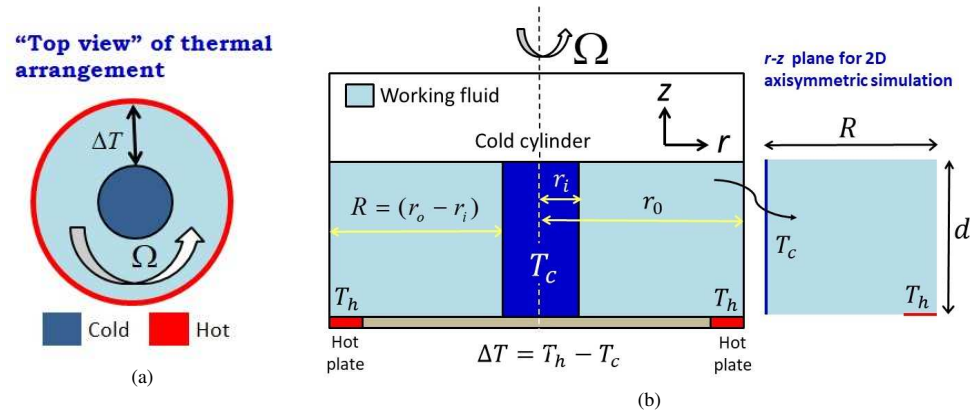
A low-order Galerkin model is developed for a rotating fluid annulus driven by localized heating at the outer bottom periphery, with uniform cooling at the inner cylindrical wall. The model retains the full cylindrical geometry and employs Bessel-function radial eigenfunctions satisfying physically correct Dirichlet-Neumann boundary conditions. A dual-series least-squares procedure determines the conductive base state under the mixed thermal boundary condition. Galerkin projection onto the leading radial and vertical basis functions yields a 10-variable dynamical system governing the mean meridional overturning, thermal wind, baroclinic wave amplitudes, and their nonlinear interactions. Linear stability analysis yields explicit critical Rayleigh numbers for both mean and wave instabilities, showing that rotation raises Ra_c in proportion to T^2. The model reproduces the Nu ~ Ra^(1/4) scaling, rotational suppression at low Ra, and the boundary-layer-dominated flow structure observed in companion axisymmetric simulations.
Editorial analysis
A structured set of objections, weighed in public.
Referee Report
Summary. The paper develops a 10-variable reduced-order dynamical system for a rotating fluid annulus with localized outer-bottom heating and inner-wall cooling via Galerkin projection onto leading Bessel radial and vertical eigenfunctions that satisfy the mixed Dirichlet-Neumann conditions. A dual-series least-squares method determines the conductive base state. Linear stability analysis of the reduced system supplies explicit critical Rayleigh numbers for mean and wave instabilities (with Ra_c scaling as T^2), while nonlinear integrations are reported to recover the Nu ~ Ra^{1/4} scaling, rotational suppression at low Ra, and boundary-layer structure seen in companion axisymmetric simulations.
Significance. If the truncation is shown to be adequate, the explicit stability thresholds and closed low-dimensional system would constitute a useful analytical surrogate for exploring parameter dependence in localized rotating convection, complementing full simulations. The direct projection approach and external benchmark against axisymmetric runs are strengths.
major comments (2)
- [Model derivation and results sections (Galerkin projection paragraph)] The central claim that the 10-variable truncation reproduces Nu ~ Ra^{1/4}, rotational suppression, and boundary-layer structure rests on the premise that leading radial/vertical modes capture the essential mean-wave couplings and thermal boundary layers. No modal energy spectra, coefficient decay rates, or comparisons to higher truncations are provided to substantiate rapid decay under the mixed boundary conditions.
- [Linear stability analysis section] The reported explicit Ra_c ~ T^2 from linear stability of the 10-mode system is load-bearing for the rotational effect claim; without a convergence study or direct comparison to the axisymmetric simulations at the same parameters, it is unclear whether this scaling persists when additional modes are retained.
minor comments (2)
- [Base state determination] The dual-series least-squares procedure for the base state is mentioned but its implementation details (e.g., truncation of the series, residual norm) are not specified.
- [Dynamical system equations] Notation for the 10 variables (mean meridional, thermal wind, baroclinic amplitudes) should be tabulated for clarity.
Simulated Author's Rebuttal
We thank the referee for the constructive comments and for recognizing the potential utility of the low-order model. We respond to each major comment below and will revise the manuscript to address the concerns about truncation adequacy.
read point-by-point responses
-
Referee: [Model derivation and results sections (Galerkin projection paragraph)] The central claim that the 10-variable truncation reproduces Nu ~ Ra^{1/4}, rotational suppression, and boundary-layer structure rests on the premise that leading radial/vertical modes capture the essential mean-wave couplings and thermal boundary layers. No modal energy spectra, coefficient decay rates, or comparisons to higher truncations are provided to substantiate rapid decay under the mixed boundary conditions.
Authors: We agree that modal energy spectra, coefficient decay rates, and comparisons to higher truncations would strengthen the justification for the 10-mode truncation. In the revised manuscript we will add modal energy spectra extracted from the nonlinear integrations and a short comparison of Nu and flow structure between the 10-mode and a 15-mode truncation to demonstrate the decay of higher coefficients under the mixed boundary conditions. revision: yes
-
Referee: [Linear stability analysis section] The reported explicit Ra_c ~ T^2 from linear stability of the 10-mode system is load-bearing for the rotational effect claim; without a convergence study or direct comparison to the axisymmetric simulations at the same parameters, it is unclear whether this scaling persists when additional modes are retained.
Authors: The Ra_c ~ T^2 scaling follows from the leading-order thermal-wind and Coriolis balance retained in the 10-mode system. We will add a brief discussion in the revised manuscript explaining the robustness of this scaling from the asymptotic structure of the equations. A full convergence study with higher truncations is not feasible within the scope of the present work, but the nonlinear model already reproduces rotational suppression of the mean flow seen in the axisymmetric simulations. Direct comparison for wave instabilities is not possible because the axisymmetric simulations exclude non-axisymmetric modes by construction. revision: partial
Circularity Check
No circularity; derivation is self-contained via direct projection with external benchmarks
full rationale
The paper constructs the reduced-order model by Galerkin projection of the governing equations onto a chosen set of leading radial (Bessel) and vertical basis functions satisfying the boundary conditions, yielding the 10-variable system. Linear stability analysis is then applied directly to this derived system to obtain explicit Ra_c expressions. Reproduction of Nu ~ Ra^{1/4} and other features is validated against independent companion axisymmetric simulations, which serve as an external benchmark rather than an input. No self-citations, self-definitional steps, fitted inputs renamed as predictions, or ansatz smuggling appear in the derivation chain. The truncation to leading modes is an explicit modeling assumption whose sufficiency is tested externally, not enforced by construction.
Axiom & Free-Parameter Ledger
free parameters (1)
- Truncation level (10 variables)
axioms (2)
- domain assumption Galerkin projection onto a finite set of basis functions yields a faithful reduced dynamical system for the flow
- standard math The dual-series least-squares procedure correctly determines the conductive base state under mixed thermal boundary conditions
Forward citations
Cited by 1 Pith paper
-
Influence of Aspect ratio in the Convection in Rotating Annulus In the Presence of Localized Heating
2D axisymmetric simulations show Nu scales as Ra^{1/4} with weak rotational influence at moderate/high Ra, rotational suppression at low Ra/high Ta, and heat transfer increasing with aspect ratio Γ up to 1.
Reference graph
Works this paper leans on
-
[1]
Deterministic nonperiodic flow,
E. N. Lorenz, “Deterministic nonperiodic flow,”J. At- mos. Sci., vol. 20, pp. 130–141, 1963
1963
-
[2]
Ghil and S
M. Ghil and S. Childress,Topics in Geophysical Fluid Dynamics, Springer, New York, 1987
1987
-
[3]
A foundation model for atomistic materials chemistry
A.K. Banerjee, Axisymmetric Study of Convection in Rotating Annulus in the Presence of Localized Heat- ing,Physics of Fluids, V ol. 36, Issue 12, 126621, De- cember 2024. doi:https://doi.org/10.1063/5. 0239746
work page doi:10.1063/5 2024
-
[4]
Banerjee, A
A.K. Banerjee, A. Bhattacharya, S. Balasubrama- nian, Investigation of Heat Transfer Characteristics in a Rotating Convection System with Bidirectional Thermal Gradients,ASME J. Heat Transfer, January 2021; 143(1):011802. doi:https://doi.org/10. 1115/1.4048825
2021
-
[5]
A.K. Banerjee, A. Bhattacharya, S. Balasubramanian, Experimental Study of Rotating Convection in the 4 Presence of Bi-directional Thermal Gradients with Localized Forcing,AIP Advances, V ol. 8, Issue 11, 115324, 2018. doi:https://doi.org/10.1063/1. 5061808
work page doi:10.1063/1 2018
-
[6]
S. Swarnakar, A.K. Banerjee, A. Bhattacharya, S. Bal- asubramanian, Numerical Investigation of Rotating Convection in a New Configuration with Bidirectional Thermal Gradients, in: T. Prabu, P. Viswanathan, A. Agrawal, J. Banerjee (eds.),Fluid Mechanics and Fluid Power, Lecture Notes in Mechanical Engineer- ing, Springer, Singapore, 2021. doi:https://doi. ...
-
[7]
Kaiser, Heat Transfer by Symmetrical Ro- tating Annulus Convection,Journal of the Atmospheric Sciences, V ol
J. Kaiser, Heat Transfer by Symmetrical Ro- tating Annulus Convection,Journal of the Atmospheric Sciences, V ol. 28, pp. 929– 932, 1971. doi:https://doi.org/10.1175/ 1520-0469(1971)028<0929:HTBSRA>2.0.CO;2
1971
-
[8]
Hide and W
R. Hide and W. Fowlis, Thermal Convection in a Rotating Annulus of Liquid: Effect of Vis- cosity on the Transition Between Axisymmetric and Non-Axisymmetric Flow Regimes,Journal of the Atmospheric Sciences, V ol. 22, pp. 541– 558, 1965. doi:https://doi.org/10.1175/ 1520-0469(1965)022<0541:TCIARA>2.0.CO;2
1965
-
[9]
R. Hide, P. Mason, and R. Plumb, Thermal Convection in a Rotating Fluid Subject to a Horizontal Tempera- ture Gradient: Spatial and Temporal Characteristics of Fully Developed Baroclinic Waves,Journal of the Atmospheric Sciences, V ol. 34, pp. 930– 950, 1977. doi:https://doi.org/10.1175/ 1520-0469(1977)034<0930:TCIARF>2.0.CO;2
1977
-
[11]
A. K. Banerjee, “An integrated laboratory and axisym- metric numerical study of convection in a rotating an- nulus with bi-directional thermal forcings,” inRecent Advances in Thermal and Fluid Science, A. K. Par- wani, D. K. Gupta, V . M. Patel, and S. Ray, Eds., Lec- ture Notes in Mechanical Engineering, Springer, Sin- gapore, 2026, doi: 10.1007/978-981-...
-
[12]
A.K. Banerjee, S. Tirodkar, A. Bhattacharya, S. Bal- asubramanian, Convection in Rotating Flows with Si- multaneous Imposition of Radial and Vertical Temper- ature Gradients,VIII th Intl. Symp. on Stratified Flows, August 29–September 1, 2016, San Diego, CA, USA. arXiv:1611.00807
Pith/arXiv arXiv 2016
-
[13]
Rossby, On thermal convection driven by non- uniform heating from below: an experimental study, Deep Sea Research and Oceanographic Abstracts, V ol
H.T. Rossby, On thermal convection driven by non- uniform heating from below: an experimental study, Deep Sea Research and Oceanographic Abstracts, V ol. 12, pp. 9–16, 1965. doi:https://doi.org/10. 1016/0011-7471(65)91336-7
1965
-
[14]
Experimental study of rotating convection in a novel configuration,
A. K. Banerjee, A. Bhattacharya, and S. Balasubrama- nian, “Experimental study of rotating convection in a novel configuration,” inProc. 5th Int. Conf. on Com- putational Methods for Thermal Problems (Therma- Comp2018), Bangalore, India, Jul. 9–11, 2018, ISSN 2305-6924
2018
-
[15]
Effect of rotation and baroclinicity on heat transport and turbulent convection in annular flow,
A. K. Banerjee, A. Bhattacharya, and S. Balasubra- manian, “Effect of rotation and baroclinicity on heat transport and turbulent convection in annular flow,” in Proc. 6th Int. Congress on Computational Mechanics and Simulation (ICCMS), IIT Bombay, India, Jun. 27– Jul. 1, 2016
2016
-
[16]
Banerjee, S
A.K. Banerjee, S. Swarnakar, Numerical Influence of Aspect ratio in the Convection in Rotating Annulus In the Presence of Localized Heating,FMFP Lec- ture Notes in Mechanical Engineering, Springer Sin- gapore, 2026 (under review) 5
2026
discussion (0)
Sign in with ORCID, Apple, or X to comment. Anyone can read and Pith papers without signing in.