Quantitative analysis of resonant ionization by smooth laser pulses: Connection between effective Hamiltonian theory and strong-field dressed continua
Pith reviewed 2026-06-26 12:28 UTC · model grok-4.3
The pith
Asymmetric Autler-Townes doublets in resonant photoionization arise from coherent interplay of resonant and nonresonant pathways in an effective Hamiltonian framework.
A machine-rendered reading of the paper's core claim, the machinery that carries it, and where it could break.
Core claim
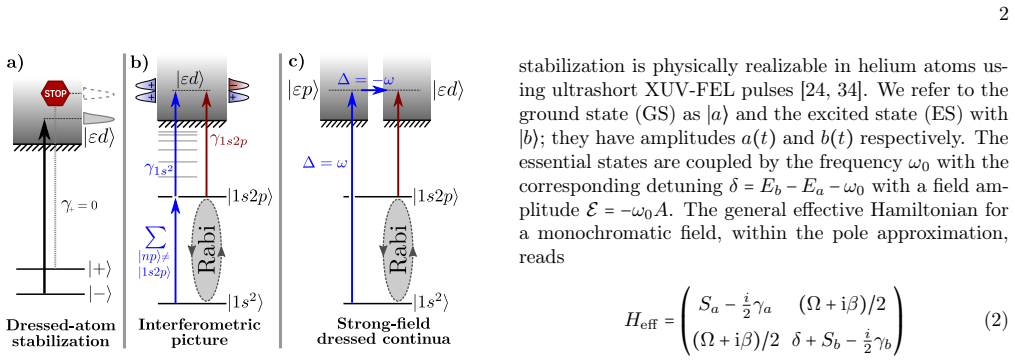
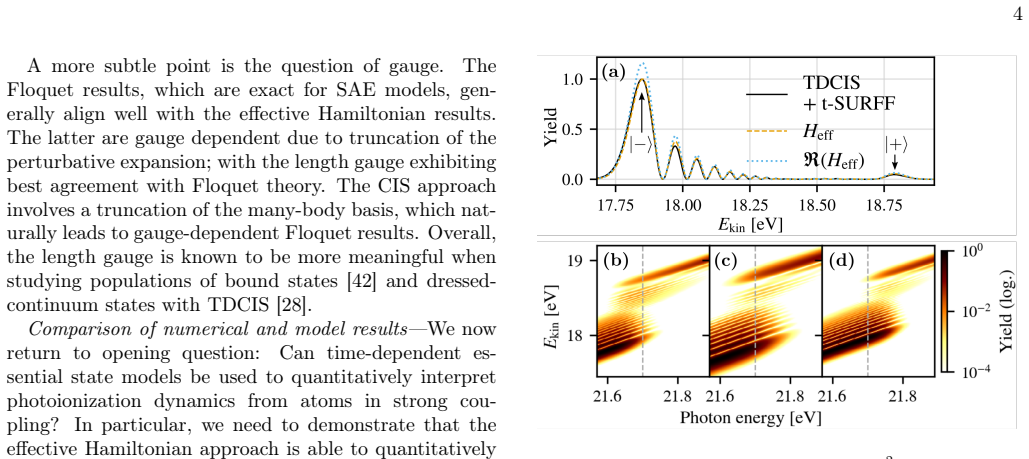
These interpretations arise from a common effective Hamiltonian framework, in which dressed-state stabilization is governed by the coherent interplay of resonant and nonresonant pathways. We demonstrate that further simplification, using the strong-field approximation, obscures this mechanism. In contrast, our time-dependent essential-state model, where electrons are rigorously coupled to the continuum, achieves excellent agreement with ab initio simulations of the time-dependent Schrödinger equation for helium.
What carries the argument
The effective Hamiltonian framework that connects perturbative pathway interference with non-perturbative continuum dressing via coherent resonant and nonresonant pathways.
If this is right
- Dressed-state stabilization in resonant ionization results from the coherent balance of resonant and nonresonant pathways rather than a single isolated effect.
- The strong-field approximation alone cannot capture the full stabilization dynamics when resonant pathways are active.
- Time-dependent essential-state models that retain continuum coupling serve as reliable intermediaries between simplified theories and complete numerical simulations.
- The observed asymmetry of Autler-Townes doublets can be traced quantitatively to specific pathway interferences under smooth laser pulses.
Where Pith is reading between the lines
- The same framework may apply to other atoms or molecules, offering a route to test when multi-electron or additional continuum effects begin to dominate.
- Analogous coherent pathway mixing could underlie asymmetries in related strong-field processes such as high-harmonic generation or above-threshold ionization.
- Varying pulse duration or intensity in experiments could isolate the contribution of nonresonant pathways to the observed doublet asymmetry.
Load-bearing premise
The effective Hamiltonian and essential-state model capture the essential physics of resonant photoionization in the intense high-frequency regime without missing important continuum or multi-electron effects that would alter the asymmetry.
What would settle it
A mismatch between essential-state model predictions and full time-dependent Schrödinger equation calculations for an atom other than helium or in a regime with stronger multi-electron contributions would indicate that key effects have been omitted.
Figures
read the original abstract
Resonant photoionization in the intense high-frequency regime can exhibit extremely asymmetric Autler-Townes doublets whose origin remains debated. It has been attributed either to interference between perturbative ionization pathways or to a non-perturbative dressing of the continuum. Here we show that these interpretations arise from a common effective Hamiltonian framework, in which dressed-state stabilization is governed by the coherent interplay of resonant and nonresonant pathways. We demonstrate that further simplification, using the strong-field approximation, obscures this mechanism. In contrast, our time-dependent essential-state model, where electrons are rigorously coupled to the continuum, achieves excellent agreement with ab initio simulations of the time-dependent Schr\"odinger equation for helium.
Editorial analysis
A structured set of objections, weighed in public.
Referee Report
Summary. The paper claims that asymmetric Autler-Townes doublets observed in resonant photoionization under intense high-frequency laser pulses originate from a common effective Hamiltonian framework, where dressed-state stabilization results from the coherent interplay between resonant and nonresonant pathways. It argues that the strong-field approximation obscures this mechanism, while a time-dependent essential-state model (with electrons rigorously coupled to the continuum) reproduces ab initio TDSE results for helium with excellent agreement, thereby unifying perturbative and non-perturbative interpretations.
Significance. If the quantitative agreement with TDSE holds under the reported conditions, the work would clarify the origin of asymmetric doublets in strong-field resonant ionization and validate the essential-state truncation as sufficient for capturing the relevant continuum coupling without significant multi-electron alterations. This provides a unified theoretical lens for such processes and could guide future modeling in atomic strong-field physics.
major comments (1)
- [Abstract] Abstract: the assertion of 'excellent agreement' between the essential-state model and TDSE simulations is presented without any quantitative metrics (e.g., integrated error, overlap integrals, or parameter ranges), error analysis, or explicit comparison details. This directly affects verifiability of the central claim that the model captures the asymmetry without missing important continuum effects.
Simulated Author's Rebuttal
We thank the referee for the constructive comment and positive recommendation of minor revision. We address the point on the abstract below.
read point-by-point responses
-
Referee: [Abstract] Abstract: the assertion of 'excellent agreement' between the essential-state model and TDSE simulations is presented without any quantitative metrics (e.g., integrated error, overlap integrals, or parameter ranges), error analysis, or explicit comparison details. This directly affects verifiability of the central claim that the model captures the asymmetry without missing important continuum effects.
Authors: We agree that the abstract would benefit from explicit quantitative support. In the revised manuscript we will add a concise clause referencing the quantitative measures already used in the main text (e.g., integrated absolute deviation of the photoelectron spectra and state-overlap fidelities across the reported intensity range), thereby making the claim of agreement directly verifiable while preserving the original wording and conclusions. revision: yes
Circularity Check
No significant circularity identified
full rationale
The manuscript derives an effective Hamiltonian framework connecting resonant and nonresonant pathways to explain asymmetric Autler-Townes doublets, then validates it via a time-dependent essential-state model against independent ab initio TDSE simulations for helium. No quoted equation or step reduces a claimed prediction to a fitted parameter or self-citation by construction; the TDSE benchmark is external and falsifiable. The derivation chain remains self-contained against the stated benchmarks.
Axiom & Free-Parameter Ledger
Reference graph
Works this paper leans on
-
[1]
Thomaset al., Ground-State Chemical Reactivity un- der Vibrational Coupling to the Vacuum Electromag- netic Field, Angewandte Chemie International Edition 55, 11462 (2016)
A. Thomaset al., Ground-State Chemical Reactivity un- der Vibrational Coupling to the Vacuum Electromag- netic Field, Angewandte Chemie International Edition 55, 11462 (2016)
2016
-
[2]
F. J. Garcia-Vidal, C. Ciuti, and T. W. Ebbesen, Ma- nipulating matter by strong coupling to vacuum fields, Science373, eabd0336 (2021)
2021
-
[3]
Y. H. Wang, H. Steinberg, P. Jarillo-Herrero, and N. Gedik, Observation of Floquet-Bloch States on the Surface of a Topological Insulator, Science342, 453 (2013)
2013
-
[4]
Eckardt, Colloquium: Atomic quantum gases in pe- riodically driven optical lattices, Reviews of Modern Physics89, 011004 (2017)
A. Eckardt, Colloquium: Atomic quantum gases in pe- riodically driven optical lattices, Reviews of Modern Physics89, 011004 (2017)
2017
-
[5]
Weitenberg and J
C. Weitenberg and J. Simonet, Tailoring quantum gases by Floquet engineering, Nature Physics17, 1342 (2021)
2021
-
[6]
Merboldtet al., Observation of Floquet states in graphene, Nature Physics21, 1093 (2025)
M. Merboldtet al., Observation of Floquet states in graphene, Nature Physics21, 1093 (2025)
2025
-
[7]
D. Choi, M. Mogi, U. De Giovannini, D. Azoury, B. Lv, Y. Su, H. Hübener, A. Rubio, and N. Gedik, Observation of Floquet–Bloch states in monolayer graphene, Nature Physics21, 1100 (2025)
2025
-
[8]
Allariaet al., Highly coherent and stable pulses from the FERMI seeded free-electron laser in the extreme ul- traviolet, Nature Photonics6, 699 (2012)
E. Allariaet al., Highly coherent and stable pulses from the FERMI seeded free-electron laser in the extreme ul- traviolet, Nature Photonics6, 699 (2012)
2012
-
[9]
Emmaet al., First lasing and operation of an ångstrom-wavelength free-electron laser, Nature Photon- ics4, 641 (2010)
P. Emmaet al., First lasing and operation of an ångstrom-wavelength free-electron laser, Nature Photon- ics4, 641 (2010)
2010
-
[10]
Nandiet al., Generation ofentanglement usingashort- wavelength seeded free-electron laser, Science Advances 10, eado0668 (2024)
S. Nandiet al., Generation ofentanglement usingashort- wavelength seeded free-electron laser, Science Advances 10, eado0668 (2024)
2024
-
[11]
T. M. Linkeret al., Attosecond inner-shell lasing at ångström wavelengths, Nature642, 934 (2025)
2025
-
[12]
Vismarraet al., Dynamic Interference of Chirped Pho- toelectrons, Physical Review Letters135, 033202 (2025)
F. Vismarraet al., Dynamic Interference of Chirped Pho- toelectrons, Physical Review Letters135, 033202 (2025)
2025
-
[13]
I. I. Rabi, Space Quantization in a Gyrating Magnetic Field, Physical Review51, 652 (1937)
1937
-
[14]
R. J. Morris, Theory of Adiabatic Rapid Passage for ThreeEquallySpacedLevels,PhysicalReview133,A740 (1964)
1964
-
[15]
B. W. Shore,The Theory of Coherent Atomic Excitation (Wiley VCH, New York, 1990)
1990
-
[16]
W. H. Zurek, Decoherence, einselection, and the quan- tum origins of the classical, Reviews of Modern Physics 75, 715 (2003)
2003
-
[17]
Nandiet al., Observation of Rabi dynamics with a short-wavelength free-electron laser, Nature608, 488 (2022)
S. Nandiet al., Observation of Rabi dynamics with a short-wavelength free-electron laser, Nature608, 488 (2022)
2022
-
[18]
Richteret al., Strong-field quantum control in the extreme ultraviolet domain using pulse shaping, Nature 636, 337 (2024)
F. Richteret al., Strong-field quantum control in the extreme ultraviolet domain using pulse shaping, Nature 636, 337 (2024)
2024
-
[19]
Saalmann, S
U. Saalmann, S. K. Giri, and J. M. Rost, Adiabatic Passage to the Continuum: Controlling Ionization with Chirped Laser Pulses, Physical Review Letters121, 153203 (2018)
2018
-
[20]
K. J. LaGattuta, Above-threshold ionization of atomic hydrogen via resonant intermediate states, Physical Re- view A47, 1560 (1993)
1993
-
[21]
M. G. Girju, K. Hristov, O. Kidun, and D. Bauer, Non- perturbative resonant strong field ionization of atomic hydrogen, Journal of Physics B: Atomic, Molecular and 6 Optical Physics40, 4165 (2007)
2007
-
[22]
K. J. Schafer, B. Yang, L. F. DiMauro, and K. C. Ku- lander, Above threshold ionization beyond the high har- monic cutoff, Physical Review Letters70, 1599 (1993)
1993
-
[23]
H. G. Muller and F. C. Kooiman, Bunching and Focus- ing of Tunneling Wave Packets in Enhancement of High- Order Above-Threshold Ionization, Physical Review Let- ters81, 1207 (1998)
1998
-
[24]
Olofsson, E
E. Olofsson, E. L. Fulton, R. Tahouri, M. Bertolino, J. M. N. Djiokap, and J. M. Dahlström, Coherent con- trol of ionization via stabilization by resonant pulse pairs, Physical Review Research8, 013199 (2026)
2026
-
[25]
J. B. Foresman, M. Head-Gordon, J. A. Pople, and M. J. Frisch, Toward a systematic molecular orbital theory for excited states, The Journal of Physical Chemistry96, 135 (1992)
1992
-
[26]
Dreuw and M
A. Dreuw and M. Head-Gordon, Single-Reference ab Ini- tioMethodsfortheCalculationofExcitedStatesofLarge Molecules, Chemical Reviews105, 4009 (2005)
2005
-
[27]
Greenman, P
L. Greenman, P. J. Ho, S. Pabst, E. Kamarchik, D. A. Mazziotti, and R. Santra, Implementation of the time- dependent configuration-interaction singles method for atomic strong-field processes, Physical Review A82, 023406 (2010)
2010
-
[28]
Bertolino, S
M. Bertolino, S. Carlström, J. Peschel, F. Zapata, E. Lin- droth, and J. M. Dahlström, Thomas–Reiche–Kuhn cor- rection for truncated configuration-interaction spaces: Case of laser-assisted dynamical interference, Physical Review A106, 043108 (2022)
2022
-
[29]
J. H. Shirley, Solution of the Schrödinger Equation with a Hamiltonian Periodic in Time, Physical Review138, B979 (1965)
1965
-
[30]
B. L. Beers and L. Armstrong, Exact solution of a realis- tic model for two-photon ionization, Physical Review A 12, 2447 (1975)
1975
-
[31]
C. R. Holt, M. G. Raymer, and W. P. Reinhardt, Time dependences of two-, three-, and four-photon ionization of atomic hydrogen in the ground 12S and metastable 22S states, Physical Review A27, 2971 (1983)
1983
-
[32]
M. Dörr, O. Latinne, and C. J. Joachain, Time evolution of two-photon population transfer between the 1s and 2s states of a hydrogen atom, Physical Review A55, 3697 (1997)
1997
-
[33]
J. N. Bruhnke, E. Olofsson, A. Stenquist, and J. M. Dahlström, Giant counter-rotating oscillations on the at- tosecondtimescale,PhysicalReviewResearch7,L042019 (2025)
2025
-
[34]
Olofsson and J
E. Olofsson and J. M. Dahlström, Photoelectron signa- ture of dressed-atom stabilization in an intense XUV field, Physical Review Research5, 043017 (2023)
2023
-
[35]
K. L. Ishikawa and K. Ueda, Competition of Reso- nant and Nonresonant Paths in Resonance-Enhanced Two-Photon Single Ionization of He by an Ultrashort Extreme-Ultraviolet Pulse, Physical Review Letters108, 033003 (2012)
2012
-
[36]
Cohen-Tannoudji, G
C. Cohen-Tannoudji, G. Grynberg, and J. Dupont-Roc, Atom-Photon Interactions: Basic Processes and Applica- tions(Wiley-VCH, New York, 1998)
1998
-
[37]
Friedmann and A
H. Friedmann and A. D. Wilson-Gordon, Effective two- level Hamiltonian for coherent multiphoton processes, Optics Communications24, 5 (1978)
1978
-
[38]
Csehi, Exact analytic characterization of the Autler- Townes doublet via the extended semiclassical Rabi model, Physical Review A113, 033121 (2026)
A. Csehi, Exact analytic characterization of the Autler- Townes doublet via the extended semiclassical Rabi model, Physical Review A113, 033121 (2026)
2026
-
[39]
Zhang, Y
X. Zhang, Y. Zhou, Y. Liao, Y. Chen, J. Liang, Q. Ke, M.Li, A.Csehi,andP.Lu,Effectofnonresonantstatesin near-resonant two-photon ionization of hydrogen, Physi- cal Review A106, 063114 (2022)
2022
-
[40]
See Supplemental Material at[ URL will be inserted by publisher]for a more detailed derivation of the dressed- continua stabilization condition from the decay rates, a derivation of the first- and second-order photoelectron amplitudes, and comparisons of photoelectron spectra for varying intensities
-
[41]
H. R. Reiss, Theoretical methods in quantum optics: S- matrix and Keldysh techniques for strong-field processes, Progress in Quantum Electronics16, 1 (1992)
1992
-
[42]
D. H. Kobe and A. L. Smirl, Gauge invariant formula- tion of the interaction of electromagnetic radiation and matter, American Journal of Physics46, 624 (1978)
1978
-
[43]
Simon, The definition of molecular resonance curves by the method of exterior complex scaling, Physics Let- ters A71, 211 (1979)
B. Simon, The definition of molecular resonance curves by the method of exterior complex scaling, Physics Let- ters A71, 211 (1979)
1979
-
[44]
J. N. Bruhnke and J. M. Dahlström, Reconciliation of ef- fective Hamiltonians for intense light-matter interaction (2026), arXiv:2606.04835 [quant-ph]
Pith/arXiv arXiv 2026
-
[45]
More details on the time-dependent methodology will be provided in upcoming work
-
[46]
M.Baghery, U.Saalmann,andJ.M.Rost,EssentialCon- ditions for Dynamic Interference, Physical Review Let- ters118, 143202 (2017)
2017
-
[47]
Tao and A
L. Tao and A. Scrinzi, Photo-electron momentum spectra from minimal volumes: The time-dependent surface flux method, New Journal of Physics14, 013021 (2012)
2012
-
[48]
Bertolino, D
M. Bertolino, D. Busto, F. Zapata, and J. M. Dahlström, Propensity rules and interference effects in laser-assisted photoionization of helium and neon, Journal of Physics B: Atomic, Molecular and Optical Physics53, 144002 (2020)
2020
-
[49]
Rogus and M
D. Rogus and M. Lewenstein, Resonant ionisation by smooth laser pulses, Journal of Physics B: Atomic and Molecular Physics19, 3051 (1986)
1986
-
[50]
N. S. Simonović, D. B. Popović, and A. Bunjac, Manifes- tations of Rabi Dynamics in the Photoelectron Energy Spectra at Resonant Two-Photon Ionization of Atom by Intense Short Laser Pulses, Atoms11, 20 (2023)
2023
discussion (0)
Sign in with ORCID, Apple, or X to comment. Anyone can read and Pith papers without signing in.