REVIEW 2 major objections 5 minor 16 references
Coherent structures in long range FPUT lattices, Part I: Solitary Waves
T0 review · 2 major / 5 minor · reviewed 2026-08-07 · deepseek-v4-flash
Pith's one-line read This paper proves that infinite-range FPUT lattices with Type I dispersion carry small supersonic solitary waves, built from a $\operatorname{sech}^2$ profile.
desk verdict Clean, honest solitary-wave existence for infinite-range FPUT lattices with a genuinely new Calogero-Moser range; a few presentation gaps, nothing load-bearing. read the letter →
The pith
A machine-rendered reading of the paper's core claim, the machinery that carries it, and where it could break.
The reading
What carries the argument
The load-bearing object is the dispersion function $\lambda(k)$, the $k^{-2}$-scaled Fourier symbol of the linearized lattice, together with the formal long-wave limit of the traveling-wave equation. At $\varepsilon=0$ the equation reduces to a scalar ODE whose unique even homoclinic is the $\operatorname{sech}^2$ profile $W_0$, and the argument shows the true linearized operator $B_\varepsilon$ is uniformly invertible with $B_\varepsilon^{-1}-B_0^{-1}$ of order $\varepsilon^\sigma$ in operator norm. That uniformity removes the derivative loss that would otherwise make the problem singularly perturbed, so a contraction mapping around $W_0$ closes in $H^1$ and a bootstrap puts the correction in $H^3$.
What would settle it
Numerically solve the traveling-wave equation for the Calogero-Moser case $a=4$ and measure the wave-speed correction; a mismatch at order $\varepsilon^2$ with the formula $c^2=a(a+1)\zeta(a)+\frac{a(a+1)}{12}\zeta(a-2)\varepsilon^2$ would falsify Corollary 8.
Extended reading notes
Core claim
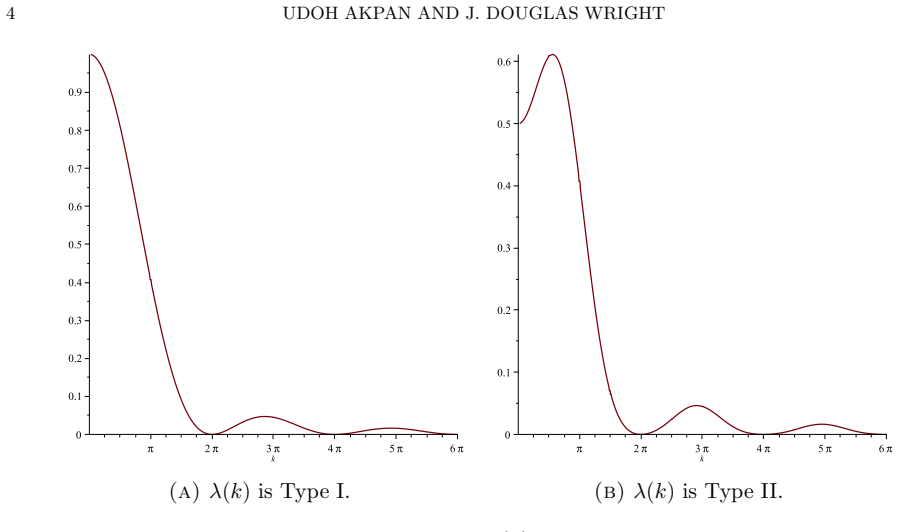
The central claim is Theorem 6: if the dispersion function is Type I (bounded below, with a strict local maximum at $k=0$, a H\"older-type gap near zero, and a spectral gap at larger wave numbers) and the potentials are $C^{3,1}$ with the weighted sums of the quadratic and cubic coefficients finite and $b=\sum_{m\geq1}\beta_m m^3$ nonzero, then for each sufficiently small $\varepsilon$ there is a unique correction $V_\varepsilon$ in the even Sobolev space $E_3$ with small $H^1$ norm such that $W=W_0+\varepsilon^\sigma V_\varepsilon$ and $c^2=c_0^2-\frac{1}{2}\lambda''(0)\varepsilon^2$ solve the traveling-wave equation, where $W_0$ is the explicit $\operatorname{sech}^2$ homoclinic. Corollary 8 applies this to $\Phi_m(r)=1/r^a$ with $r_*=1$ for every $a>3$, giving supersonic solitary waves in generalized Calogero-Moser lattices where only formal asymptotics were previously available. Negative profiles and smoothness follow from the same construction, and the case $a=3$ is left open.
Load-bearing premise
The construction depends on the weighted quadratic coefficient not being zero and on the dispersion having a strict maximum at zero; if either fails, the limiting equation loses its bell-shaped seed solution and the whole contraction argument collapses.
Editorial extensions
If this is right
- Every Type I lattice satisfying the coefficient summability has near-sonic solitary waves whose speed correction is exactly $\frac{1}{2}|\lambda''(0)|\varepsilon^2$ above the speed of sound.
- For Calogero-Moser potentials $1/r^a$ with $r_*=1$ and $a>3$, Corollary 8 yields unique solitary waves with $\sigma=\min\{a-3,2\}$ (and $\sigma=2-\delta$ at $a=5$), while $a=3$ remains open.
- The theorem recovers the finite-range KdV-wave result of reference [4] with $\sigma=2$ and the next-nearest-neighbor solitary waves for $g>-1/16$ with $\beta_1\neq -8\beta_2$.
- The companion Type II classification is reserved for a sequel, where subsonic periodic waves and nanoptera are announced.
Reading between the lines
- The method suggests a broader principle: any infinite-range lattice whose dispersion relation has a strict local maximum at zero and whose weighted quadratic coefficient does not vanish should admit near-sonic solitary waves, regardless of how slowly the interaction range decays, as long as the weighted sums converge.
- The restriction $a>3$ is probably not the true threshold for Calogero-Moser lattices; the argument degenerates as $a$ approaches $3$ because the dispersion curvature diverges, but formal KdV asymptotics suggest waves persist, so a different scaling may close the gap.
- A testable extension is to let the weighted quadratic coefficient vanish while higher-order terms dominate; then the limiting ODE becomes a higher-order KdV-type equation and the contraction scheme would need a different seed profile.
Editorial analysis
A structured set of objections, weighed in public.
Referee Report
Summary. The paper develops a long-wave existence theory for solitary waves in infinite-range FPUT lattices. It introduces a dispersion-based classification (Type I/Type II), expands the infinite-range traveling wave equation around a spatially homogeneous equilibrium, and constructs small-amplitude supersonic solitary waves as perturbations of the sech-squared homoclinic of the formal KdV-type limit (14). The main abstract result, Theorem 6, asserts existence and uniqueness of the correction term V_ε in E3 for small ε under Type I dispersion and Assumptions 1-2. The paper then verifies these hypotheses for finite-range lattices, for next-nearest-neighbor lattices, and for generalized Calogero-Moser power-law potentials with a > 3, the last case being one where only formal asymptotics were previously available.
Significance. If the main result stands, it is a substantive extension of the FPUT traveling-wave literature from finite range to genuinely infinite-range interactions, and it gives the first rigorous existence proof for power-law Calogero-Moser lattices in the regime a > 3. The proof strategy is largely self-contained and has attractive features: the speed relation (10) is selected so that the ε→0 limit is the integrable ODE (14), the core operator estimates in Propositions 2, 4, and 5 are written out in detail, and the contraction argument in Section 4 is explicit and parameter-free. The paper also correctly identifies and isolates the role of the non-degeneracy condition b ≠ 0 (Assumption 2) and of λ''(0) < 0 (Type I(ii)). These strengths make the manuscript a strong candidate for publication once the technical gaps described below are addressed.
major comments (2)
- [§2.1, Eq. (11); Theorem 6] The definition of Λ_ε as the operator series Σ_{m≥1} α_m m² A_{εm}² and the symbol identity used in Proposition 2 require Σ_{m≥1} |α_m| m² < ∞. Neither the Type I definition nor Assumptions 1-2 implies this summability. Lemma 1 shows that α_m can be the cosine coefficients of a merely piecewise C¹ dispersion function θ, in which case α_m = O(1/m) and Σ |α_m| m² can diverge even though λ(0)=Σ α_m m² is conditionally finite. In such a lattice the series defining Λ_ε need not converge in L(H^s), so B_ε may not be a well-defined operator by (11), and the Fourier-multiplier computation in Proposition 2 is not justified. All three worked examples have nonnegative α_m with finite weighted sum, so Corollary 8 is not affected. The fix is to add an explicit hypothesis such as Σ |α_m| m² < ∞, or to define Λ_ε directly as the Fourier multiplier with symbol λ(εk) and justify the estimates under a weaker convergence assumption.
- [§3.1, Eq. (18)] The operator estimate (18), ‖(B_ε − B_0)F‖_{H^s} ≤ C_B ε^σ ‖F‖_{H^{s+σ}}, is false as stated. The proof's symbol bound |ε^{-2} T_2(εk)| ≤ μ ε^σ |k|^{2+σ} implies at most ‖(B_ε − B_0)F‖_{H^s} ≤ C ε^σ ‖F‖_{H^{s+2+σ}}, because the multiplier grows like |k|^{2+σ} at large frequencies. For a Type I λ with T_2(k) ∼ |k|^{2+σ} near k=0 and a test function F with Fourier support at |k| = ε^{-1/2}, the ratio ‖(B_ε − B_0)F‖_{H^s}/‖F‖_{H^{s+σ}} is of order ε^{σ−1}, not ε^σ. Thus the displayed inference "This implies (18)" is invalid. The later use of (18) in Section 4 is on the smooth profile W_0, so replacing (18) by the correct estimate with H^{s+2+σ} does not break the contraction argument, but Proposition 2 and the R_ε estimate in Section 4 must be corrected.
minor comments (5)
- [§5.3, Eq. (47)] The integral representation (47) appears to be missing the subtraction θ''''_a(k_4) − θ''''_a(0). As written, integrating θ'''' alone would give |η_a(k)| ≤ C|k|⁴, not the stated |η_a(k)| ≤ C|k|^{a+1}, because θ''''_a(0) is nonzero for a > 3. The intended cancellation is clear from the definition of η_a, but the displayed formula should be corrected.
- [Corollary 8] The leading-order profile is written as −ζ(a−2)/(4(a+2)ζ(a)) sech²(x), but by Eq. (15) and the values of λ''(0) and b it should be sech²(x/2). In addition, the quantifier "for ε ∈ (0, 1)" should read "for ε ∈ (0, ε_a)".
- [Theorem 6] The statement says "the following hold for ε ∈ (0, ε_1)" but the quantifier introduces ε_I; this should be ε ∈ (0, ε_I).
- [§4, near Eq. (46)] In the fixed-point estimates the map is denoted M_ε, but the display uses M_1[V]; this notational slip should be fixed.
- [Proposition 2, first line] The phrase "Suppose that (1) is Type I" should be "Suppose that λ(k) is Type I", since Type I is a property of the dispersion function λ, not of the equation itself.
Circularity Check
No circularity: the solitary-wave theorem is a parameter-free bifurcation proof; the only self-citation is for a standard invertibility lemma with independent support.
full rationale
The derivation chain is self-contained. The speed normalization (10) is a bifurcation ansatz, not an output fitted to data: the paper states "we assume that c_epsilon has the form" (Section 2.2), and Theorem 6 then proves persistence of W0 under that speed law. The homoclinic seed (15) solves the epsilon-to-zero ODE (14) by direct computation, and the nondegeneracy condition b != 0 is an explicit hypothesis (Assumption 2, with the remark "Obviously this is nonsense if b = 0"), not a consequence manufactured from the conclusion. Propositions 2, 4, and 5 obtain the needed estimates (16)-(19), (31)-(35), and (37)-(39) from the stated Type I and summability assumptions, so the fixed-point argument in Section 4 does not assume the theorem it proves. The only reference to work by a co-author is [11] for the invertibility of L0 on E1, which is simultaneously cited to [2] and [4] and is an elementary spectral fact; that citation is not load-bearing in the sense of replacing an argument with a self-asserted uniqueness theorem. The skeptical concern that Type I and Assumptions 1-2 may not imply Sum |alpha_m| m^2 < infinity, needed for convergence of Lambda_epsilon, is a hypothesis/regularity gap rather than a circular reduction. Therefore no circular step is present.
Assumptions & free parameters
free parameters (3)
- ε (long-wave scaling parameter)
- σ (correction exponent) =
σ = 2 (FR, NNN); σ = a−3 (CM, 3<a<5); σ = 2 (a>5); σ = 2−δ (a=5, δ>0 arbitrary)
- r* (equilibrium spacing) =
1 (Calogero-Moser section)
assumptions (8)
- domain assumption Assumption 1: Φ'_m(r*m + η) = ςm + αmη + βmη² + Ψ'_m(η) with Ψ'_m(0)=0 and |Ψ'_m(η)| ≤ γm|η|³, |Ψ''_m(η)| ≤ 3γm|η|² on |η| ≤ mδ*; γm = Lip(Φ'''_m)/6
- domain assumption Assumption 2: Σ|β_m|m⁵ < ∞, Σ|γ_m|m⁴ < ∞, and b := Σβ_m m³ ≠ 0
- domain assumption Type I conditions (i)-(iv) on λ(k): bounded below; λ''(0) < 0; λ(k)−λ(0) ≤ −μ*k² and |λ(k)−λ(0)−(1/2)λ''(0)k²| ≤ μ*|k|^{2+σ} near 0; sup_{|k|≥k*} λ(k) < λ(0)
- ad hoc to paper Speed ansatz (10): c²_ε = c0² − (1/2)λ''(0)ε²
- standard math L0 = I − 2B0^{-1}Q0(W0,·) is invertible on E1 (even H¹)
- standard math Eq. (9) is the traveling wave equation for (1) in the long-wave scaling (derivation deferred to [4], Lemma 2)
- standard math Theorem 7 (Nissilä [7]): sup_m |f_m||m|^{r+q} < ∞ implies f ∈ C^{r−1,q}
- standard math Explicit solution W0(x) = −3λ''(0)/(4b) sech²(x/2) of (14)
Cite this review
Pith. "Pith review of Coherent structures in long range FPUT lattices, Part I: Solitary Waves." pith.science (2026). https://pith.science/paper/SXZ6VT54
@misc{pith2026250524828,
  author       = {Pith},
  title        = {Pith review of: Coherent structures in long range FPUT lattices, Part I: Solitary Waves},
  year         = {2026},
  howpublished = {\url{https://pith.science/paper/SXZ6VT54}},
  note         = {Machine review of arXiv:2505.24828}
}
read the original abstract
We consider long range variants of Fermi-Pasta-Ulam-Tsingou lattice and in particular allow for particles to interact over arbitrarily long distances. We develop sufficient conditions which allow for the construction of solitary wave solutions.
Figures
Reference graph
Works this paper leans on
-
[4]
KdV waves in atomic ch ains with nonlocal interactions
Michael Herrmann and Alice Mikikits-Leitner. KdV waves in atomic ch ains with nonlocal interactions. Discrete Contin. Dyn. Syst. , 36(4):2047–2067, 2016
work page 2016
-
[1]
Lawrence C. Evans. Partial differential equations , volume 19 of Graduate Studies in Mathematics . Amer- ican Mathematical Society, Providence, RI, 1998
work page 1998
-
[2]
G. Friesecke and R. L. Pego. Solitary waves on FPU lattices. I. Qu alitative properties, renormalization and continuum limit. Nonlinearity, 12(6):1601–1627, 1999
work page 1999
-
[3]
Gero Friesecke and Jonathan A. D. Wattis. Existence theorem f or solitary waves on lattices. Comm. Math. Phys. , 161(2):391–418, 1994
work page 1994
-
[5]
Benjamin Ingimarson and Robert L. Pego. Existence of solitary w aves in particle lattices with power-law forces. Nonlinearity, 37(12):Paper No. 125016, 28, 2024
work page 2024
-
[6]
Benjamin Ingimarson and Robert L. Pego. On long waves and solito ns in particle lattices with forces of infinite range. SIAM J. Appl. Math. , 84(3):808–830, 2024
work page 2024
-
[7]
Juhani Nissil¨ a. Fourier decay of absolutely and h¨ older continuo us functions with infinitely or finitely many oscillations. arXiv preprint arXiv:1805.02445 , 2018. Submitted 27 October 2021; originally an- nounced May 2018
-
[8]
D. Smets and M. Willem. Solitary waves with prescribed speed on infin ite lattices. J. Funct. Anal. , 149(1):266–275, 1997
work page 1997
Show all 16 references
-
[9]
On the existence of solitary traveling waves for generalized Hertzian chains
Atanas Stefanov and Panayotis Kevrekidis. On the existence of solitary traveling waves for generalized Hertzian chains. J. Nonlinear Sci. , 22(3):327–349, 2012
2012
-
[10]
Traveling waves fo r monomer chains with precompression
Atanas Stefanov and Panayotis Kevrekidis. Traveling waves fo r monomer chains with precompression. Nonlinearity, 26(2):539–564, 2013
2013
-
[11]
Douglas Wright
Atanas Stefanov and J. Douglas Wright. Small amplitude travelin g waves in the full-dispersion Whitham equation. J. Dynam. Differential Equations , 32(1):85–99, 2020
2020
-
[12]
Theory of nonlinear lattices , volume 20 of Springer Series in Solid-State Sciences
Morikazu Toda. Theory of nonlinear lattices , volume 20 of Springer Series in Solid-State Sciences . Springer-Verlag, Berlin, second edition, 1989
1989
-
[13]
Solitary waves in FPU-type lattices
Anna Vainchtein. Solitary waves in FPU-type lattices. Phys. D , 434:Paper No. 133252, 22, 2022
2022
-
[14]
Solitary waves and kinks in FPU lattices with soft-hard-soft trilinear interactions
Anna Vainchtein and Lev Truskinovsky. Solitary waves and kinks in FPU lattices with soft-hard-soft trilinear interactions. J. Nonlinear Sci. , 34(6):Paper No. 113, 38, 2024
2024
-
[15]
Venney and Johannes Zimmer
Christine R. Venney and Johannes Zimmer. Travelling lattice wave s in a toy model of Lennard-Jones interaction. Quart. Appl. Math. , 72(1):65–84, 2014
2014
-
[16]
Jonathan A. D. Wattis. Approximations to solitary waves on latt ices. III. The monatomic lattice with second-neighbour interactions. J. Phys. A , 29(24):8139–8157, 1996. Mathematics Department, West Texas A&M, uakpan@wtamu.edu Department of Mathematics, Drexel University, jdw6...
1996
Reviewed August 7, 2026 · model on record in the stance chip above.
Discussion (0). Continue with ORCID to comment.