Convergence and non-asymptotic error analysis for kinetic Langevin samplers using the exact harmonic Langevin integrator
Pith reviewed 2026-06-30 14:59 UTC · model grok-4.3
The pith
A splitting scheme for kinetic Langevin sampling matches the contraction rate of the continuous dynamics.
A machine-rendered reading of the paper's core claim, the machinery that carries it, and where it could break.
Core claim
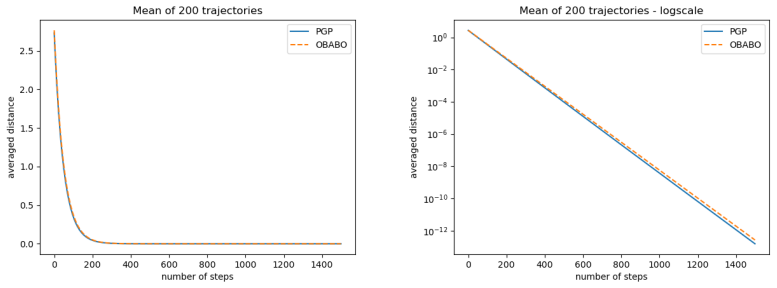
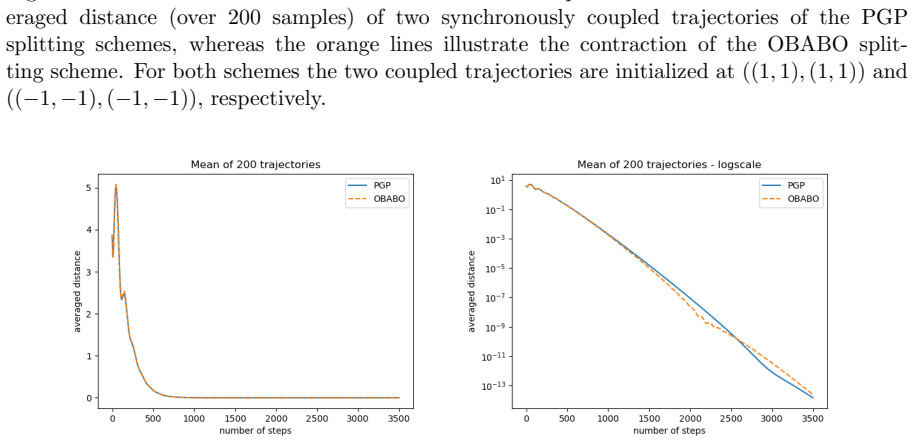
For strongly log-concave target measures, the first- and second-order splitting schemes associated with the exact harmonic Langevin integrator establish convergence rates in L²-Wasserstein distance as well as non-asymptotic error bounds, with the contraction rate being of the same order as that of the underlying continuous dynamics.
What carries the argument
The splitting scheme that incorporates the exact harmonic Langevin integrator and exploits the quadratic-convex decomposition of the strongly convex potential.
If this is right
- The required step size for the second-order scheme to achieve ε-accuracy is comparable to that of OBABO or UBU.
- The contraction rate matches the order of the continuous kinetic Langevin dynamics.
- The approach applies to sampling in machine learning and molecular dynamics contexts.
- Explicit non-asymptotic error bounds are available for the discrete schemes.
Where Pith is reading between the lines
- If the continuous contraction rate is known for a given potential, this method provides a discrete sampler with matching performance without additional degradation.
- The technique might extend to other Langevin-type dynamics or integrators beyond the harmonic case.
- In high-dimensional settings where the Lipschitz constant of the perturbation is controlled, the method could offer practical efficiency gains over generic integrators.
Load-bearing premise
The target measures must be strongly log-concave to allow decomposition of the potential into a quadratic part plus a convex perturbation whose gradient is Lipschitz continuous.
What would settle it
A counterexample where the L2-Wasserstein contraction rate of the discrete scheme is strictly slower than that of the continuous dynamics by more than a multiplicative constant independent of dimension would disprove the claim.
Figures
read the original abstract
We propose a novel kinetic Langevin sampler based on a specific splitting scheme using the exact harmonic Langevin integrator. For strongly log-concave target measures, the sampler exploits a decomposition of the strongly convex potential into a quadratic part and a convex perturbation with Lipschitz continuous gradient. For the resulting first- and second-order schemes associated with this splitting we establish convergence rates in $L^2$-Wasserstein distance as well as non-asymptotic error bounds. In particular, the contraction rate is of the same order as that of the underlying continuous dynamics. To achieve $\varepsilon$-accuracy, the required step size for the second-order scheme is comparable to that of established splitting schemes such as OBABO or UBU, which are widely used in machine learning and molecular dynamics.
Editorial analysis
A structured set of objections, weighed in public.
Referee Report
Summary. The manuscript proposes a novel kinetic Langevin sampler based on a splitting scheme that uses the exact harmonic Langevin integrator. For strongly log-concave targets, the potential is decomposed into a quadratic part plus a convex perturbation with Lipschitz gradient. The authors establish L²-Wasserstein convergence rates and non-asymptotic error bounds for the resulting first- and second-order schemes, claiming that the contraction rate matches the order of the underlying continuous dynamics. They further state that the step size needed for ε-accuracy with the second-order scheme is comparable to that of OBABO and UBU.
Significance. If the stated rates and bounds hold, the work adds a rigorously analyzed splitting integrator to the kinetic Langevin literature. The matching contraction order and comparable step-size requirement position the method as competitive with existing schemes used in machine learning and molecular dynamics. The analysis relies on the standard quadratic-plus-Lipschitz-perturbation decomposition, allowing direct comparison to prior OBABO/UBU results.
minor comments (2)
- [Abstract] Abstract: the splitting scheme and the precise definition of the first- and second-order integrators are not described, making it difficult to assess novelty from the abstract alone.
- The manuscript should include a short comparison table of step-size restrictions and contraction constants versus OBABO and UBU to substantiate the 'comparable' claim.
Simulated Author's Rebuttal
We thank the referee for the positive assessment of our work, the recognition of its novelty in the kinetic Langevin literature, and the recommendation for minor revision. The report correctly identifies the key contributions regarding the splitting scheme, L2-Wasserstein rates matching the continuous dynamics, and comparable step-size requirements to OBABO/UBU.
Circularity Check
No significant circularity identified
full rationale
The paper's central results establish L²-Wasserstein convergence rates and non-asymptotic bounds for first- and second-order splitting schemes that employ the exact harmonic Langevin integrator. These rates are shown to match the order of the underlying continuous kinetic Langevin dynamics under the standard structural assumption that the target is strongly log-concave, allowing decomposition of the potential into a quadratic term plus a convex perturbation whose gradient is Lipschitz. The analysis proceeds by controlling the perturbation term via its Lipschitz constant, exactly as in prior analyses of comparable splittings (OBABO, UBU). No load-bearing step reduces by definition to its own inputs, renames a fitted quantity as a prediction, or rests on a self-citation chain whose validity is internal to the paper. The derivation is therefore self-contained and draws on externally verifiable techniques from the sampling literature.
Axiom & Free-Parameter Ledger
axioms (1)
- domain assumption Target distribution is strongly log-concave
Reference graph
Works this paper leans on
-
[1]
Ableidinger, E
M. Ableidinger, E. Buckwar, and H. Hinterleitner , A stochastic version of the jansen and rit neural mass model: analysis and numerics , The Journal of Mathematical Neuroscience, 7 (2017), p. 8
2017
-
[2]
Andrieu, N
C. Andrieu, N. De Freitas, A. Doucet, and M. I. Jordan , An introduction to mcmc for machine learning , Machine learning, 50 (2003), pp. 5--43
2003
-
[3]
Bakry, P
D. Bakry, P. Cattiaux, and A. Guillin , Rate of convergence for ergodic continuous markov processes: Lyapunov versus poincar \'e , Journal of Functional Analysis, 254 (2008), pp. 727--759
2008
-
[4]
D. Bakry, I. Gentil, and M. Ledoux , Analysis and geometry of M arkov diffusion operators , vol. 348 of Grundlehren der mathematischen Wissenschaften [Fundamental Principles of Mathematical Sciences], Springer, Cham, 2014, https://doi.org/10.1007/978-3-319-00227-9, https://doi.org/10.1007/978-3-319-00227-9
-
[5]
N. Bou-Rabee, A. Eberle, and R. Zimmer , Coupling and convergence for H amiltonian M onte C arlo , Ann. Appl. Probab., 30 (2020), pp. 1209--1250, https://doi.org/10.1214/19-AAP1528, https://doi.org/10.1214/19-AAP1528
-
[6]
Bou-Rabee and K
N. Bou-Rabee and K. Schuh , Convergence of unadjusted hamiltonian monte carlo for mean-field models , Electronic Journal of Probability, 28 (2023), pp. 1--40
2023
-
[7]
H. J. Brascamp and E. H. Lieb , On extensions of the B runn- M inkowski and P r\'ekopa- L eindler theorems, including inequalities for log concave functions, and with an application to the diffusion equation , J. Functional Analysis, 22 (1976), pp. 366--389, https://doi.org/10.1016/0022-1236(76)90004-5, https://doi.org/10.1016/0022-1236(76)90004-5
-
[8]
Bussi and M
G. Bussi and M. Parrinello , Accurate sampling using langevin dynamics , Physical Review E—Statistical, Nonlinear, and Soft Matter Physics, 75 (2007), p. 056707
2007
- [9]
-
[10]
Y. Cao, J. Lu, and L. Wang , On explicit l 2-convergence rate estimate for underdamped langevin dynamics , Archive for Rational Mechanics and Analysis, 247 (2023), p. 90
2023
-
[11]
P. Cattiaux and A. Guillin , Trends to equilibrium in total variation distance , Ann. Inst. Henri Poincar\'e Probab. Stat., 45 (2009), pp. 117--145, https://doi.org/10.1214/07-AIHP152, https://doi.org/10.1214/07-AIHP152
-
[12]
Chak and P
M. Chak and P. Monmarch \'e , Reflection coupling for unadjusted generalized hamiltonian monte carlo in the nonconvex stochastic gradient case , IMA Journal of Numerical Analysis, (2025), p. draf045
2025
- [13]
-
[14]
Chen and S
Z. Chen and S. S. Vempala , Optimal convergence rate of hamiltonian monte carlo for strongly logconcave distributions , Theory of Computing, 18 (2022), pp. 1--18
2022
-
[15]
Cheng, N
X. Cheng, N. S. Chatterji, P. L. Bartlett, and M. I. Jordan , Underdamped langevin mcmc: A non-asymptotic analysis , in Conference on learning theory, PMLR, 2018, pp. 300--323
2018
-
[16]
A. S. Dalalyan , Theoretical guarantees for approximate sampling from smooth and log-concave densities , J. R. Stat. Soc. Ser. B. Stat. Methodol., 79 (2017), pp. 651--676, https://doi.org/10.1111/rssb.12183, https://doi.org/10.1111/rssb.12183
-
[17]
A. S. Dalalyan and L. Riou-Durand , On sampling from a log-concave density using kinetic L angevin diffusions , Bernoulli, 26 (2020), pp. 1956--1988, https://doi.org/10.3150/19-BEJ1178
-
[18]
G. Deligiannidis, D. Paulin, A. Bouchard-C\^ o t\' e , and A. Doucet , Randomized H amiltonian M onte C arlo as scaling limit of the bouncy particle sampler and dimension-free convergence rates , Ann. Appl. Probab., 31 (2021), pp. 2612--2662, https://doi.org/10.1214/20-aap1659, https://doi.org/10.1214/20-aap1659
-
[19]
Dolbeault, C
J. Dolbeault, C. Mouhot, and C. Schmeiser , Hypocoercivity for kinetic equations with linear relaxation terms , Comptes Rendus. Math \'e matique, 347 (2009), pp. 511--516
2009
-
[20]
Dolbeault, C
J. Dolbeault, C. Mouhot, and C. Schmeiser , Hypocoercivity for linear kinetic equations conserving mass , Transactions of the American Mathematical Society, 367 (2015), pp. 3807--3828
2015
-
[21]
A. Durmus and E. Moulines , Nonasymptotic convergence analysis for the unadjusted L angevin algorithm , Ann. Appl. Probab., 27 (2017), pp. 1551--1587, https://doi.org/10.1214/16-AAP1238, https://doi.org/10.1214/16-AAP1238
-
[22]
A. Durmus and E. Moulines , High-dimensional B ayesian inference via the unadjusted L angevin algorithm , Bernoulli, 25 (2019), pp. 2854--2882, https://doi.org/10.3150/18-BEJ1073, https://doi.org/10.3150/18-BEJ1073
-
[23]
Eberle , Reflection couplings and contraction rates for diffusions , Probab
A. Eberle , Reflection couplings and contraction rates for diffusions , Probab. Theory Related Fields, 166 (2016), pp. 851--886, https://doi.org/10.1007/s00440-015-0673-1, https://doi.org/10.1007/s00440-015-0673-1
-
[24]
‘Couplings and quantitative contraction rates for Langevin dy- namics’
A. Eberle, A. Guillin, and R. Zimmer , Couplings and quantitative contraction rates for L angevin dynamics , Ann. Probab., 47 (2019), pp. 1982--2010, https://doi.org/10.1214/18-AOP1299, https://doi.org/10.1214/18-AOP1299
-
[25]
Gelman, J
A. Gelman, J. B. Carlin, H. S. Stern, and D. B. Rubin , Bayesian data analysis , Chapman and Hall/CRC, 1995
1995
-
[26]
N. Gouraud, P. L. Bris, A. Majka, and P. Monmarch\' e , Hmc and underdamped langevin united in the unadjusted convex smooth case , SIAM/ASA Journal on Uncertainty Quantification, 13 (2025), pp. 278--303, https://doi.org/10.1137/23M1608963, https://doi.org/10.1137/23M1608963
-
[27]
W. K. Hastings , Monte carlo sampling methods using markov chains and their applications , (1970)
1970
-
[28]
P. E. Kloeden and E. Platen , Numerical solution of stochastic differential equations , vol. 23 of Applications of Mathematics (New York), Springer-Verlag, Berlin, 1992, https://doi.org/10.1007/978-3-662-12616-5, https://doi.org/10.1007/978-3-662-12616-5
-
[29]
B. Leimkuhler and C. Matthews , Rational construction of stochastic numerical methods for molecular sampling , Appl. Math. Res. Express. AMRX, (2013), pp. 34--56, https://doi.org/10.1093/amrx/abs010, https://doi.org/10.1093/amrx/abs010
-
[30]
B. Leimkuhler, C. Matthews, and G. Stoltz , The computation of averages from equilibrium and nonequilibrium L angevin molecular dynamics , IMA J. Numer. Anal., 36 (2016), pp. 13--79, https://doi.org/10.1093/imanum/dru056, https://doi.org/10.1093/imanum/dru056
-
[31]
B. Leimkuhler, D. Paulin, and P. A. Whalley , Contraction rate estimates of stochastic gradient kinetic L angevin integrators , ESAIM Math. Model. Numer. Anal., 58 (2024), pp. 2255--2286, https://doi.org/10.1051/m2an/2024038, https://doi.org/10.1051/m2an/2024038
-
[32]
B. J. Leimkuhler, D. Paulin, and P. A. Whalley , Contraction and convergence rates for discretized kinetic L angevin dynamics , SIAM J. Numer. Anal., 62 (2024), pp. 1226--1258, https://doi.org/10.1137/23M1556289, https://doi.org/10.1137/23M1556289
-
[33]
Lelievre and G
T. Lelievre and G. Stoltz , Partial differential equations and stochastic methods in moleculardynamics , Acta Numerica, 25 (2016), pp. 681--880
2016
-
[34]
O. Mangoubi and A. Smith , Mixing of H amiltonian M onte C arlo on strongly log-concave distributions: continuous dynamics , Ann. Appl. Probab., 31 (2021), pp. 2019--2045, https://doi.org/10.1214/20-aap1640, https://doi.org/10.1214/20-aap1640
-
[35]
R. I. McLachlan and G. R. W. Quispel , Splitting methods , Acta Numerica, 11 (2002), pp. 341--434
2002
-
[36]
Metropolis, A
N. Metropolis, A. W. Rosenbluth, M. N. Rosenbluth, A. H. Teller, and E. Teller , Equation of state calculations by fast computing machines , The journal of chemical physics, 21 (1953), pp. 1087--1092
1953
-
[37]
P. Monmarch\'e , High-dimensional MCMC with a standard splitting scheme for the underdamped L angevin diffusion. , Electron. J. Stat., 15 (2021), pp. 4117--4166, https://doi.org/10.1214/21-ejs1888, https://doi.org/10.1214/21-ejs1888
-
[38]
R. M. Neal , Bayesian learning for neural networks , vol. 118, Springer Science & Business Media, 2012
2012
-
[39]
Nesterov,Lectures on Convex Optimization, vol
Y. Nesterov , Lectures on convex optimization , vol. 137 of Springer Optimization and Its Applications, Springer, Cham, second ed., 2018, https://doi.org/10.1007/978-3-319-91578-4, https://doi.org/10.1007/978-3-319-91578-4
-
[40]
wasserstein distance estimates for the distributions of numerical approximations to ergodic stochastic differential equations
D. Paulin and P. A. Whalley , Correction to" wasserstein distance estimates for the distributions of numerical approximations to ergodic stochastic differential equations" , Journal of Machine Learning Research, 25 (2024), pp. 1--9
2024
-
[41]
G. A. Pavliotis , Stochastic processes and applications , Texts in applied mathematics, 60 (2014), pp. 41--43
2014
-
[42]
J. M. Sanz-Serna and K. C. Zygalakis , Wasserstein distance estimates for the distributions of numerical approximations to ergodic stochastic differential equations , J. Mach. Learn. Res., 22 (2021), pp. Paper No. 242, 37
2021
-
[43]
K. Schuh , Global contractivity for L angevin dynamics with distribution-dependent forces and uniform in time propagation of chaos , Ann. Inst. Henri Poincar\'e Probab. Stat., 60 (2024), pp. 753--789, https://doi.org/10.1214/22-aihp1337, https://doi.org/10.1214/22-aihp1337
-
[44]
K. Schuh and P. A. Whalley , Convergence of kinetic langevin samplers for non-convex potentials , arXiv preprint arXiv:2405.09992, (2024)
-
[45]
Villani , Hypocoercivity , vol
C. Villani , Hypocoercivity , vol. 202, American Mathematical Society, 2009
2009
-
[46]
Welling and Y
M. Welling and Y. W. Teh , Bayesian learning via stochastic gradient L angevin dynamics , in Proceedings of the 28th international conference on machine learning (ICML-11), 2011, pp. 681--688
2011
-
[47]
A. A. Zapatero , Word series for the numerical integration of stochastic differential equations , PhD thesis, Universidad de Valladolid, 2017
2017
discussion (0)
Sign in with ORCID, Apple, or X to comment. Anyone can read and Pith papers without signing in.