REVIEW 2 major objections 5 minor 1 cited by
Direct Evidence for AGN Feedback from Fast Molecular Outflows in Reionization-Era Quasars
T0 review · 2 major / 5 minor · reviewed 2026-08-08 · deepseek-v4-flash
Pith's one-line read Blueshifted OH absorption in 8 of 11 infrared-luminous z>6 quasars reveals cold molecular outflows ~300 km s−1 faster than in star-forming galaxies, with kinetic power beyond supernovae alone, implicating AGN energy injection.
desk verdict First systematic OH 119um survey in z>6 quasars: the detection rate and fast outflows are robust, but the AGN-required energetics lean on an extrapolated low-z calibration with a large additive constant. read the letter →
The pith
A machine-rendered reading of the paper's core claim, the machinery that carries it, and where it could break.
The reading
What carries the argument
The workhorse tracer is the ground-state OH $2\Pi_{3/2}\,J=3/2\rightarrow5/2$ doublet at rest-frame 119 µm, observed in absorption against the quasar host's far-infrared continuum. Because OH 119 µm is optically thick even in the line wings, blueshifted absorption directly signals outflowing cold gas, and the absorption depth yields the covering fraction of the outflow. To convert observed equivalent widths into outflow properties, the analysis uses an empirical calibration (Eq. 2), $\dot{M}_{\rm out} = m\,\mathrm{EW}_{v<-200}\,\sqrt{L/10^{12}\,L_\odot} + b$, trained on low-redshift galaxies with CO- or OH-detected outflows, together with a time-averaged thin-shell geometry relating outflow rate, momentum, and kinetic power.
What would settle it
Take one or two of these quasars and measure the outflow rate independently — for example with spatially resolved CO emission or additional OH transitions — and compare with the calibration of Eq. 2. If the independent rates come out several times lower, or if a $z\sim5$ dusty galaxy with a confirmed AGN shows the same fast velocities once matched in AGN luminosity, the kinetic-power argument that AGN drive the winds would lose its footing.
Extended reading notes
Core claim
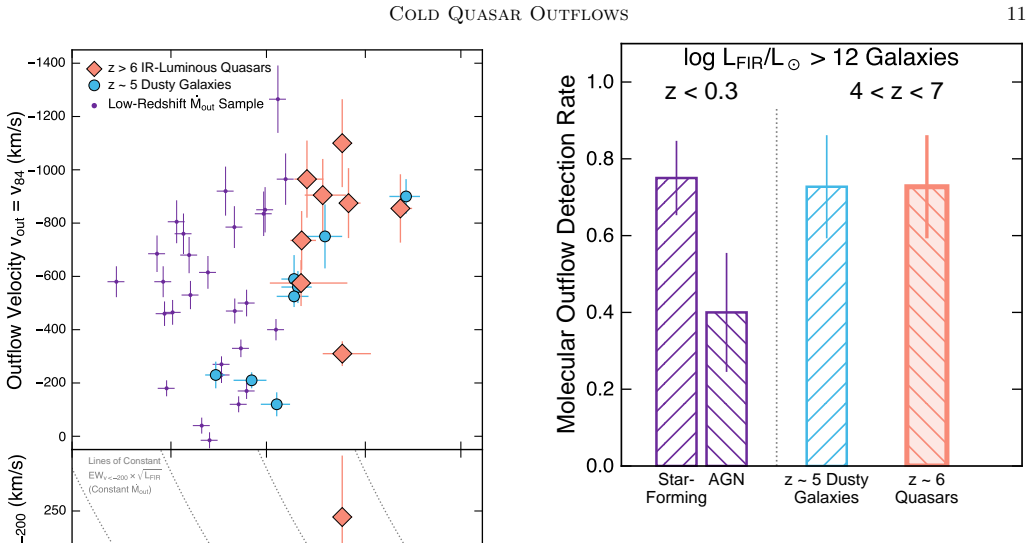
The central claim is that cold molecular outflows are very common and unusually fast in the most infrared-luminous quasars at $z>6$, and that the fastest outflows carry enough kinetic energy to require AGN driving. The evidence is blueshifted OH 119 µm absorption seen in 8/11 quasars ($73\%\pm13\%$), with median outflow velocity $v_{84}$ near $900~\mathrm{km\,s^{-1}}$, roughly $300~\mathrm{km\,s^{-1}}$ faster than the $z\sim5$ non-quasar dusty-galaxy comparison sample. The implied outflow rates, roughly $300$–$1500~\mathrm{M}_{\odot}\,\mathrm{yr}^{-1}$, give a median mass-loading factor near 0.5, so the outflows are not extreme in rate but are fast. The outflow momentum is consistent with momentum-driven winds with boosts of order a few times $L/c$, but the kinetic power would require about 30% of available supernova energy to couple to cold gas, considered unrealistic, whereas about 0.1% of the AGN luminosity suffices. The paper therefore concludes that the AGN must at least partially drive the winds.
Load-bearing premise
The outflow rates come from an empirical calibration fit to low-redshift galaxies, and the paper assumes this relation keeps working when extrapolated to the far higher luminosities and different physical conditions of $z>6$ quasars; if that calibration fails, the derived outflow rates, kinetic powers, and the case for AGN driving would all change.
Editorial extensions
If this is right
- Cold molecular outflows are common (at least 73%) in the most infrared-luminous $z>6$ quasars, so AGN feedback on cold gas appears to be in place within the first billion years of cosmic time.
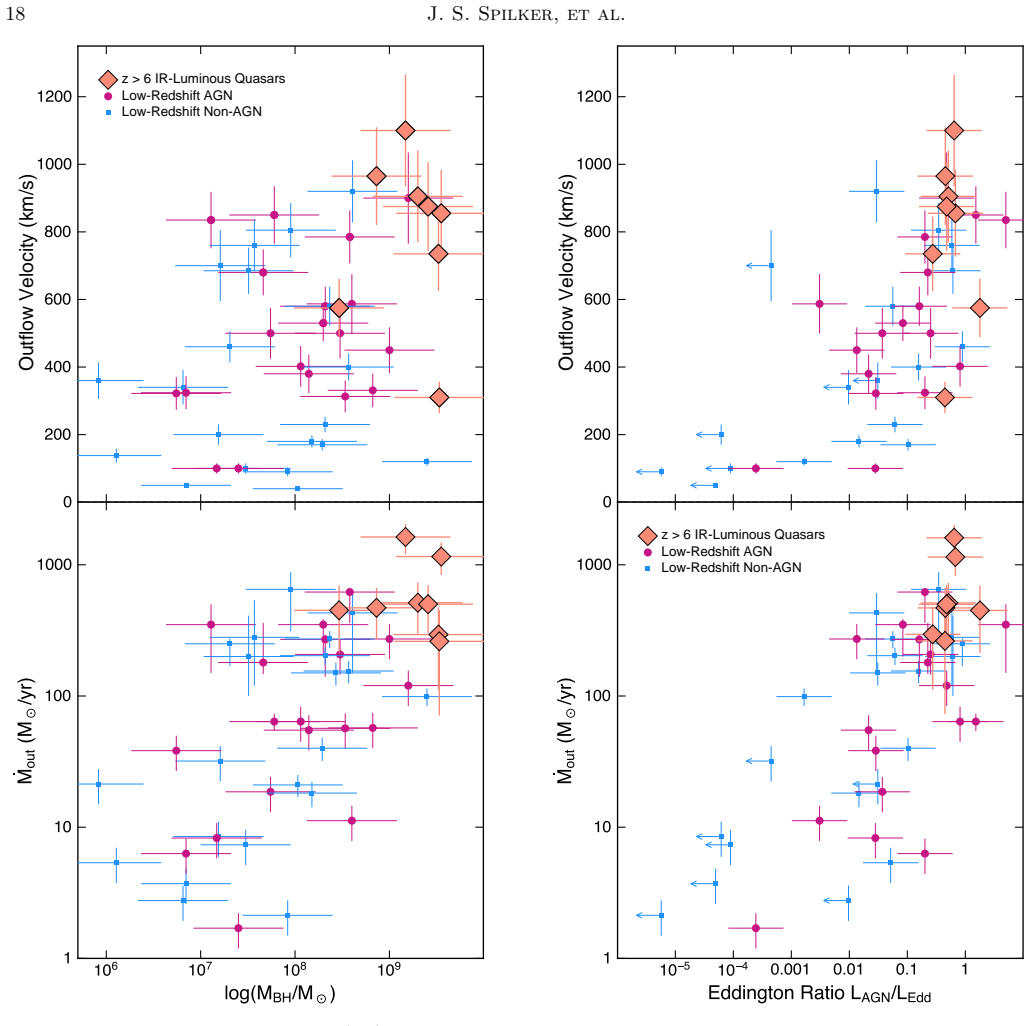
- Outflow velocity correlates with AGN luminosity across four orders of magnitude and shows no similar trend with star-formation luminosity, tying the wind speed to black-hole accretion.
- The outflow kinetic power, typically about 0.1% of $L_\mathrm{AGN}$, is within theoretical AGN coupling limits but far above what supernovae can supply at realistic efficiency, so the AGN must contribute energy even if star formation helps launch the wind.
- Momentum boosts of order $L/c$ place these outflows in the momentum-driven regime, so energy-conserving wind phases are not required to explain them.
- OH 119 µm emission appears in roughly 82% of the quasars but in none of the $z\sim5$ dusty galaxies, offering a kiloparsec-scale tracer of warm dense gas tied to AGN activity.
Reading between the lines
- Inference: The absolute outflow rates rest on a low-redshift calibration, so an independent measurement of outflow rate in one or two $z>6$ quasars (e.g., via resolved CO or multiple OH transitions) would be the sharpest test; if the calibration fails, the magnitude of the required AGN energy changes accordingly.
- Inference: The ~300 km/s velocity gap between quasars and non-quasars predicts a systematic trend: fainter $z>6$ quasars, with lower AGN luminosity, should show slower outflows; deeper observations of less luminous quasars could confirm this.
- Inference: The smaller covering fractions measured for the quasar outflows suggest they may be more collimated than starburst-driven winds, which means part of the velocity difference could be geometric rather than energetic; inclination-selected samples would disentangle these.
- Inference: The absence of broad [C II] wings in the fastest OH outflows calls into question past claims of molecular outflows inferred from [C II] stacking at $z>6$, suggesting OH should be treated as the primary cold-gas outflow tracer.
Signed reviews
Editorial analysis
A structured set of objections, weighed in public.
Referee Report
Summary. The paper presents ALMA OH 119 µm observations of 11 IR-luminous quasars at z>6 (8 new targets plus 3 reanalyzed from the literature) and reports a 73%±13% detection rate of blueshifted molecular outflows, outflow velocities typically ~300 km/s faster than the z~5 non-quasar DSFGs and low-redshift ULIRGs, modest mass-loading factors (~0.5), and kinetic powers of order 0.1% of the AGN luminosity. The authors conclude that cold molecular outflows are ubiquitous in the most IR-luminous reionization-era quasars and that AGN energy injection is required to explain their kinetic power, based primarily on the high outflow velocities and the comparison of outflow kinetic power to available supernova and AGN energy budgets.
Significance. If the conclusions are robust, this is the first statistical sample of cold molecular outflows in z>6 quasars and provides the strongest current evidence that AGN feedback operates on the cold ISM during reionization. The paper has clear strengths: the outflow classification is conservative (blueshifted OH absorption beyond the [CII] systemic velocity), the spectral detections appear visually unambiguous, the literature data are reanalyzed in a self-consistent way, and the authors explicitly cross-check their SFR and LAGN estimates with independent tracers. They also honestly flag the circularity in their outflow-rate calibration and the model dependence of the derived energetics. However, the central AGN-energy argument rests on an empirical outflow-rate calibration that contains a large additive constant fitted to low-redshift galaxies; the paper does not demonstrate that the conclusion survives plausible variations of that calibration.
major comments (2)
- [§3.3, Eq. (2); Table 3; §4.5] The additive constant b≈180–190 M☉/yr in the empirical outflow-rate calibration contributes substantially to the derived outflow rates for several quasars. For example, for J1319+0950 the multiplicative term m×EW_{v<-200}×√(L/10^12 L☉) is roughly 60 M☉/yr, so b contributes about 75% of the 260 M☉/yr quoted in Table 3. Because both momentum flux and kinetic power scale linearly with Mdot, the claim in §4.5 that supernovae cannot power the outflows without an unrealistically high coupling fraction is directly contingent on this low-redshift constant. The internal inconsistency is also apparent: for EW→0, Eq. (2) predicts a constant ~190 M☉/yr outflow, which contradicts the authors' own classification of P009-10 and J0305-3150 as non-outflows in Table 2. The paper should demonstrate that the AGN-energy conclusion is robust to the calibration: for instance, repeat the energy budget analysis with b set to zero, with the multiplicative term only, or with an independent estimate of Mdot from column density and radius. As written, the central claim is calibration-dependent rather than a direct inference from the data.
- [§3.3, §4.4, Fig. 8] The paper correctly acknowledges a partial circularity between Mdot and the IR-based SFR, since Mdot uses sqrt(L) through Eq. (2) while LSF is derived from the same far-IR photometry. However, the impact on the derived mass-loading factors and on the Edot/SFR comparison in the right panels of Fig. 8 is not quantified. The statement that the relation is not totally circular because Mdot is not proportional to SFR^1/2 is insufficient, because the normalization (m and b) is still set by the same photometry. The authors should provide a quantitative sensitivity test, e.g., recompute η and Edot using only the [CII]-based SFRs, or using the IR-based LAGN values (which they note are ~2× lower), and state how the conclusions in §4.4 and §4.5 shift. Without such a test, the conclusion that the mass-loading factors are 'modest' and that supernovae are insufficient remains coupled to the assumed SED decomposition.
minor comments (5)
- [§2.2] The statement that the flux-scale discrepancy with Butler et al. (2023b) 'appears to be in the data and not in any analysis steps' is vague; please clarify what tests were performed (e.g., comparing with the ALMA sensitivity calculator and other observations) and whether any of the literature values used in the analysis rely on the discrepant absolute flux scale.
- [§3.1, Fig. 1] The spectral fits are described as 'certainly not unique'; please describe how the systematic uncertainties on v50, v84, vmax, and EW_{v<-200} were estimated, for example by repeating the fits with different initial conditions or different numbers of Gaussian components, so that the 10–20% uncertainties quoted in Table 2 are reproducible.
- [§4.2, Fig. 5] The KS tests comparing the vout distributions are reported only as p<0.05; please report the sample sizes, the test statistic, and whether the result survives exclusion of the most extreme object (e.g., J2054-0005), given the small number of quasars in the sample.
- [§3.2, Appendix A] The adopted mid-IR power-law index α=1.0 is a fixed choice for all quasars, and the paper states that varying α between 0.5 and 2.0 changes LFIR by ≲15%; consider showing this range explicitly for a representative source in the main text, since the appendix only compares fits with limited versus full photometry.
- [Abstract, §5] The abstract's phrase 'Direct Evidence for AGN Feedback' is stronger than the paper's own concluding caveat that the result is 'far from smoking gun' evidence. Consider tempering the title or abstract (e.g., 'strong evidence' or 'consistent with') so that the presentation matches the calibrated, assumption-dependent nature of the energetics argument.
Circularity Check
Partial circularity, admitted in Sec. 4.4: the outflow-rate estimator (Eq. 2) and the IR-based SFR share the same far-IR luminosity, so the derived mass-loading factors are partly built into the comparison; the detection-rate and velocity-based AGN argument remain independent.
-
fitted input called prediction
[Section 4.4, 'Quasar molecular outflow rates are modest'; Eq. (2) in Section 3.3]
"We caution here that there is some circularity in our comparisons. The outflow rates depend on the total√LIR (Sec. 3.3), but we also use IR-based SFRs after subtracting the AGN contribution."
In Eq. (2), ˙Mout = m(EW_{v<-200} sqrt(L/10^12 L_sun)) + b, with L = L_IR or L_FIR. The SFR used in the mass-loading factor η = ˙Mout/SFR is obtained from the same far-IR SED: 'We assume the luminosity in the modified blackbody component is the result of star formation heating the cold dust, i.e. L_IR,mbb ≡ L_SF' (Sec. 3.2), converted with SFR = 1.4e-10 L_IR,mbb/L_sun. Both ˙Mout and SFR therefore scale with the same rest-frame 120/160 µm photometry, so the reported η ≈ 0.2–1 is partly a relation between two luminosity-dependent estimates rather than an independent measurement.
full rationale
The paper's central empirical results—8/11 unambiguous blueshifted OH outflows (73% ± 13%) and outflow velocities roughly 300 km/s faster than z ∼ 5 non-quasar DSFGs—are based directly on the OH spectra and systemic [C II] redshifts, with no dependence on the outflow-rate calibration, so they are not circular. The AGN-energetics argument in Sec. 4.5 also retains independent content: ˙Eout = 0.5 ˙Mout v^2 is compared with LAGN estimated from rest-UV (LAGN = 5.15 L3000), which is independent of the far-IR photometry used in Eq. (2), and the required supernova coupling (~30%) versus AGN coupling (~0.1%) is a genuine comparison. The one genuine circularity is the one the authors themselves flag in Sec. 4.4: because ˙Mout is a fitted function of sqrt(L_FIR)/sqrt(L_IR) and the IR-based SFR comes from the same far-IR SED, the mass-loading factors η = ˙Mout/SFR are partly constructed from the shared luminosity input. This affects the secondary claim that cold outflow rates are 'modest relative to SFR' but does not drive the primary velocity/detection-rate findings. The additional concern raised by a skeptic—that the additive intercept b ≈ 180–190 M_sun/yr in Eq. (2) dominates several z > 6 outflow rates—is a calibration-extrapolation risk rather than circularity: the calibration is an external, empirical fit to low-redshift data, and the paper does not fit it to the z > 6 targets. Overall score 4: one admitted partial circularity in a secondary comparison, with the central claims still self-contained.
Assumptions & free parameters
free parameters (4)
- Outflow rate calibration slope m and intercept b =
m = 1.40, b = 180 (L_IR version); m = 1.56, b = 190 (L_FIR version)
- Mid-infrared power-law index alpha =
1.0
- Modified blackbody dust slope beta =
2.0
- Dust optical-depth unity wavelength lambda0 =
100 micrometers
assumptions (8)
- domain assumption OH 119 micrometer is extremely optically thick, so the fractional absorption depth directly traces the covering fraction of the outflowing gas.
- domain assumption The empirical outflow-rate relation calibrated on low-redshift galaxies (Eq. 2) holds for z>6 quasars at higher luminosities.
- domain assumption The outflow geometry is a time-averaged thin shell with v_out = v84 and R_out = r_dust.
- domain assumption The far-IR SED decomposes cleanly into an AGN-heated power-law component and a star-formation-heated modified blackbody component.
- domain assumption The UV-based bolometric correction L_AGN = 5.15 L_3000 is valid for these quasars.
- domain assumption Supernovae couple at most about 10 percent of their energy to cold outflow kinetic motion, while AGN winds can couple up to 2 to 5 percent of L_AGN.
- domain assumption [C II] line centroids define the systemic redshift of each quasar.
- domain assumption The 120 micrometer dust continuum radius r_dust approximates the outflow radius.
Cite this review
Pith. "Pith review of Direct Evidence for AGN Feedback from Fast Molecular Outflows in Reionization-Era Quasars." pith.science (2026). https://pith.science/paper/SZK6JWRX
@misc{pith2026250205283,
  author       = {Pith},
  title        = {Pith review of: Direct Evidence for AGN Feedback from Fast Molecular Outflows in Reionization-Era Quasars},
  year         = {2026},
  howpublished = {\url{https://pith.science/paper/SZK6JWRX}},
  note         = {Machine review of arXiv:2502.05283}
}
abstract
Galactic outflows driven by rapidly-accreting quasars at high redshift are widely expected to play a key role in the short- and long-term future evolution of their host galaxies. Using new and archival ALMA data, we observed the OH 119um doublet lines in order to search for cold molecular outflows in a sample of 11 unobscured, IR-luminous quasars at z>6. This represents the first survey for molecular winds in reionization-era quasars, and we detect unambiguous outflows in 8/11 (73%) of the quasars. The outflows we find are substantially faster, by ~300km/s on average, than outflows observed in a roughly co-eval sample of non-quasar IR-luminous galaxies, suggesting that the AGN drive the winds to higher velocities. On the other hand, the implied molecular outflow rates are relatively modest given the high luminosities, suggesting typical mass loading factors ~0.5 in the cold gas. The outflows are consistent with expectations for momentum-driven winds regardless of the driving source, but the kinetic energy in the outflows suggests that the AGN must be at least partially responsible for driving the winds. Accordingly, we find trends between the outflow properties and the Eddington ratio of the black hole accretion, though this may be linked to the underlying trend with AGN luminosity. We find that the kinetic power carried in the cold outflow phase is typically only ~0.1% of the total AGN luminosity. Our study provides evidence in favor of AGN feedback on the cold molecular gas in $z>6$ quasar host galaxies, demonstrating that cold outflows are very common and powerful in the most extreme reionization-era quasars.
Figures


Figures from the paper (7 more)



Forward citations
Cited by 1 Pith paper
-
Survival is not Enough: Dust Sputtering, Growth, and H$_2$ Formation in Galactic Winds
Entrained clouds form high H2 fractions only with dust growth at densities ≳10–30 times the cloud-survival critical density; without growth, DGR dilution and sputtering keep them atomic.
Reference graph
Works this paper leans on
-
[1]
, " * write output.state after.block = add.period write newline
ENTRY address archivePrefix author booktitle chapter doi edition editor eprint howpublished institution journal key month number organization pages publisher school series title misctitle type volume year version url label extra.label sort.label short.list INTEGERS output.state before.all mid.sentence after.sentence after.block FUNCTION init.state.consts ...
-
[2]
write newline
" write newline "" before.all 'output.state := FUNCTION format.url url empty "" new.block "" url * "" * if FUNCTION format.eprint eprint empty "" archivePrefix empty "" archivePrefix "arXiv" = new.block " " eprint * " " * new.block " " eprint * " " * if if if FUNCTION format.doi doi empty "" " " doi * " " * if FUNCTION format.pid doi empty eprint empty ur...
-
[3]
DP +Rjw+p (D;ipWV95@h aP [JL nI> i` p :7_ׁB' zZ2f STkIS ħA c:a ;F893 =@l
thebibliography [1] 20pt to REFERENCES 6pt =0pt -12pt 10pt plus 3pt =0pt =0pt =1pt plus 1pt =0pt =0pt -12pt =13pt plus 1pt =20pt =13pt plus 1pt \@M =10000 =-1.0em =0pt =0pt 0pt =0pt =1.0em @enumiv\@empty 10000 10000 `\.\@m \@noitemerr \@latex@warning Empty `thebibliography' environment \@ifnextchar \@reference \@latexerr Missing key on reference command E...
2021
-
[4]
T., Jahnke, K., Onoue, M., et al
Andika, I. T., Jahnke, K., Onoue, M., et al. 2020, , 903, 34, 10.3847/1538-4357/abb9a6
-
[5]
T., Jahnke, K., Ba \ n ados, E., et al
Andika, I. T., Jahnke, K., Ba \ n ados, E., et al. 2022, , 163, 251, 10.3847/1538-3881/ac6422
-
[6]
Astropy Collaboration , Price-Whelan , A. M., Sip o cz, B. M., et al. 2018, , 156, 123, 10.3847/1538-3881/aabc4f
-
[7]
2015, , 805, L8, 10.1088/2041-8205/805/1/L8
Ba \ n ados, E., Decarli, R., Walter, F., et al. 2015, , 805, L8, 10.1088/2041-8205/805/1/L8
-
[8]
Barcos-Mu \ n oz , L., Aalto, S., Thompson, T. A., et al. 2018, , 853, L28, 10.3847/2041-8213/aaa28d
Show all 122 references
-
[9]
L., et al
Belli, S., Park, M., Davies, R. L., et al. 2024, , 630, 54, 10.1038/s41586-024-07412-1
2024 doi
-
[10]
E., Hutchison, T
Birkin, J. E., Hutchison, T. A., Welch, B., et al. 2023, , 958, 64, 10.3847/1538-4357/acf712
2023 doi
-
[11]
2019, , 630, A59, 10.1051/0004-6361/201833557
Bischetti, M., Maiolino, R., Carniani, S., et al. 2019, , 630, A59, 10.1051/0004-6361/201833557
2019 doi
-
[12]
2018, , 612, A29, 10.1051/0004-6361/201731641
Brusa, M., Cresci, G., Daddi, E., et al. 2018, , 612, A29, 10.1051/0004-6361/201731641
2018 doi
-
[13]
M., van der Werf , P
Butler, K. M., van der Werf , P. P., Omont, A., & Cox, P. 2023 a , , 674, L5, 10.1051/0004-6361/202346271
2023 doi
-
[14]
M., van der Werf , P
Butler, K. M., van der Werf , P. P., Topkaras, T., et al. 2023 b , , 944, 134, 10.3847/1538-4357/acad03
2023 doi
-
[15]
E., Veilleux, S., et al
Calder \'o n, D., Bauer, F. E., Veilleux, S., et al. 2016, , 460, 3052, 10.1093/mnras/stw1210
2016 doi
-
[16]
2019, , 489, 3939, 10.1093/mnras/stz2410
Carniani, S., Gallerani, S., Vallini, L., et al. 2019, , 489, 3939, 10.1093/mnras/stz2410
2019 doi
-
[17]
2024, , 685, A99, 10.1051/0004-6361/202347230
Carniani, S., Venturi, G., Parlanti, E., et al. 2024, , 685, A99, 10.1051/0004-6361/202347230
2024 doi
-
[18]
Casey, C. M. 2012, , 425, 3094, 10.1111/j.1365-2966.2012.21455.x
2012
- [19]
-
[20]
2015, , 574, A14, 10.1051/0004-6361/201424980
Cicone, C., Maiolino, R., Gallerani, S., et al. 2015, , 574, A14, 10.1051/0004-6361/201424980
2015 doi
-
[21]
2018, , 620, A82, 10.1051/0004-6361/201833520
Circosta, C., Mainieri, V., Padovani, P., et al. 2018, , 620, A82, 10.1051/0004-6361/201833520
2018 doi
-
[22]
Costa, T., Rosdahl, J., Sijacki, D., & Haehnelt, M. G. 2018, , 479, 2079, 10.1093/mnras/sty1514
2018 doi
-
[23]
2014, , 568, A62, 10.1051/0004-6361/201322489
De Looze, I., Cormier, D., Lebouteiller, V., et al. 2014, , 568, A62, 10.1051/0004-6361/201322489
2014 doi
-
[24]
P., et al
Decarli, R., Walter, F., Venemans, B. P., et al. 2017, , 545, 457, 10.1038/nature22358
2017 doi
- [25]
-
[26]
2022, , 662, A60, 10.1051/0004-6361/202142871
Decarli, R., Pensabene, A., Venemans, B., et al. 2022, , 662, A60, 10.1051/0004-6361/202142871
2022 doi
-
[27]
2023, , 673, A157, 10.1051/0004-6361/202245674
Decarli, R., Pensabene, A., Diaz-Santos , T., et al. 2023, , 673, A157, 10.1051/0004-6361/202245674
2023 doi
- [28]
-
[29]
Fan, X., Ba \ n ados, E., & Simcoe, R. A. 2023, , 61, 373, 10.1146/annurev-astro-052920-102455
2023 doi
-
[30]
2019, , 870, L11, 10.3847/2041-8213/aaeffe
Fan, X., Wang, F., Yang, J., et al. 2019, , 870, L11, 10.3847/2041-8213/aaeffe
2019 doi
-
[31]
P., Schindler, J.-T., Walter, F., et al
Farina, E. P., Schindler, J.-T., Walter, F., et al. 2022, , 941, 106, 10.3847/1538-4357/ac9626
2022 doi
-
[32]
2017, , 601, A143, 10.1051/0004-6361/201629478
Fiore, F., Feruglio, C., Shankar, F., et al. 2017, , 601, A143, 10.1051/0004-6361/201629478
2017 doi
-
[33]
2010, , 518, L41, 10.1051/0004-6361/201014676
Fischer, J., Sturm, E., Gonz \'a lez-Alfonso , E., et al. 2010, , 518, L41, 10.1051/0004-6361/201014676
2010 doi
-
[34]
2019, , 483, 4586, 10.1093/mnras/sty3449
Fluetsch, A., Maiolino, R., Carniani, S., et al. 2019, , 483, 4586, 10.1093/mnras/sty3449
2019 doi
-
[35]
2012, , 543, A114, 10.1051/0004-6361/201118705
Gallerani, S., Neri, R., Maiolino, R., et al. 2012, , 543, A114, 10.1051/0004-6361/201118705
2012 doi
-
[36]
Gaskell, C. M. 1982, , 263, 79, 10.1086/160481
1982 doi
-
[37]
S., Krumholz, M
Gentry, E. S., Krumholz, M. R., Dekel, A., & Madau, P. 2017, , 465, 2471, 10.1093/mnras/stw2746
2017 doi
-
[38]
Gonz \'a lez-Alfonso , E., Fischer, J., Spoon, H. W. W., et al. 2017, , 836, 11, 10.3847/1538-4357/836/1/11
2017 doi
-
[39]
M., & Ramos Almeida, C
Harrison, C. M., & Ramos Almeida, C. 2024, Galaxies, 12, 17, 10.3390/galaxies12020017
2024 doi
-
[40]
K., Mawatari, K., et al
Hashimoto, T., Inoue, A. K., Mawatari, K., et al. 2019, , 71, 71, 10.1093/pasj/psz049
2019 doi
-
[41]
M., Armus, L., & Miley, G
Heckman, T. M., Armus, L., & Miley, G. K. 1990, , 74, 833, 10.1086/191522
1990 doi
-
[42]
2020, , 633, L4, 10.1051/0004-6361/201937109
Herrera-Camus , R., Sturm, E., Graci \'a -Carpio , J., et al. 2020, , 633, L4, 10.1051/0004-6361/201937109
2020 doi
-
[43]
2021, , 649, A31, 10.1051/0004-6361/202039704
Herrera-Camus , R., F \"o rster Schreiber, N., Genzel, R., et al. 2021, , 649, A31, 10.1051/0004-6361/202039704
2021 doi
-
[44]
F., Hernquist, L., Cox, T
Hopkins, P. F., Hernquist, L., Cox, T. J., & Kere s , D. 2008, , 175, 356, 10.1086/524362
2008 doi
-
[45]
Hunter, J. D. 2007, Computing in Science and Engineering, 9, 90, 10.1109/MCSE.2007.55
2007 doi
-
[46]
Ishibashi, W., & Fabian, A. C. 2022, , 516, 4963, 10.1093/mnras/stac2614
2022 doi
-
[47]
C., & Maiolino, R
Ishibashi, W., Fabian, A. C., & Maiolino, R. 2018, , 476, 512, 10.1093/mnras/sty236
2018 doi
-
[48]
Kim, C.-G., & Ostriker, E. C. 2015, , 802, 99, 10.1088/0004-637X/802/2/99
2015 doi
-
[49]
2015, , 53, 115, 10.1146/annurev-astro-082214-122316
King, A., & Pounds, K. 2015, , 53, 115, 10.1146/annurev-astro-082214-122316
2015 doi
-
[50]
2022, , 668, A45, 10.1051/0004-6361/202244054
Lamperti, I., Pereira-Santaella , M., Perna, M., et al. 2022, , 668, A45, 10.1051/0004-6361/202244054
2022 doi
-
[51]
2014, , 785, 154, 10.1088/0004-637X/785/2/154
Leipski, C., Meisenheimer, K., Walter, F., et al. 2014, , 785, 154, 10.1088/0004-637X/785/2/154
2014 doi
-
[52]
D., et al
Leitherer, C., Schaerer, D., Goldader, J. D., et al. 1999, , 123, 3, 10.1086/313233
1999 doi
-
[53]
P., Walter, F., et al
Li, J., Venemans, B. P., Walter, F., et al. 2022, , 930, 27, 10.3847/1538-4357/ac61d7
2022 doi
-
[54]
2016, , 591, A136, 10.1051/0004-6361/201527706
Lutz, D., Berta, S., Contursi, A., et al. 2016, , 591, A136, 10.1051/0004-6361/201527706
2016 doi
-
[55]
2020, , 633, A134, 10.1051/0004-6361/201936803
Lutz, D., Sturm, E., Janssen, A., et al. 2020, , 633, A134, 10.1051/0004-6361/201936803
2020 doi
-
[56]
H., & Alberts, S
Lyu, J., Rieke, G. H., & Alberts, S. 2016, , 816, 85, 10.3847/0004-637X/816/2/85
2016 doi
-
[57]
2012, , 425, L66, 10.1111/j.1745-3933.2012.01303.x
Maiolino, R., Gallerani, S., Neri, R., et al. 2012, , 425, L66, 10.1111/j.1745-3933.2012.01303.x
2012
-
[58]
2023, , 676, A71, 10.1051/0004-6361/202346317
Mazzucchelli, C., Bischetti, M., D'Odorico, V., et al. 2023, , 676, A71, 10.1051/0004-6361/202346317
2023 doi
-
[59]
P., Waters, B., Schiebel, D., Young, W., & Golap, K
McMullin, J. P., Waters, B., Schiebel, D., Young, W., & Golap, K. 2007, 376, 127. http://adsabs.harvard.edu/abs/2007ASPC..376..127M
2007
-
[60]
2015, , 804, 46, 10.1088/0004-637X/804/1/46
Mel \'e ndez, M., Veilleux, S., Martin, C., et al. 2015, , 804, 46, 10.1088/0004-637X/804/1/46
2015 doi
-
[61]
A., Walter, F., Cicone, C., et al
Meyer, R. A., Walter, F., Cicone, C., et al. 2022, , 927, 152, 10.3847/1538-4357/ac4e94
2022 doi
-
[62]
2017, Frontiers in Astronomy and Space Sciences, 4, 42, 10.3389/fspas.2017.00042
Morganti, R. 2017, Frontiers in Astronomy and Space Sciences, 4, 42, 10.3389/fspas.2017.00042
2017
-
[63]
A., & Voit, G
Murray, N., Chiang, J., Grossman, S. A., & Voit, G. M. 1995, , 451, 498, 10.1086/176238
1995 doi
-
[64]
Nesvadba, N. P. H., Lehnert, M. D., De Breuck, C., Gilbert, A. M., & van Breugel , W. 2008, , 491, 407, 10.1051/0004-6361:200810346
2008 doi
-
[65]
Nesvadba, N. P. H., Polletta, M., Lehnert, M. D., et al. 2011, , 415, 2359, 10.1111/j.1365-2966.2011.18862.x
2011
-
[66]
P., Walter, F., et al
Novak, M., Venemans, B. P., Walter, F., et al. 2020, , 904, 131, 10.3847/1538-4357/abc33f
2020 doi
-
[67]
J., Bianchi, S., et al
Pappalardo, C., Bendo, G. J., Bianchi, S., et al. 2015, , 573, A129, 10.1051/0004-6361/201424549
2015 doi
- [68]
-
[69]
2021, , 652, A66, 10.1051/0004-6361/202039696
Pensabene, A., Decarli, R., Ba \ n ados, E., et al. 2021, , 652, A66, 10.1051/0004-6361/202039696
2021 doi
-
[70]
2015, , 574, A82, 10.1051/0004-6361/201425035
Perna, M., Brusa, M., Cresci, G., et al. 2015, , 574, A82, 10.1051/0004-6361/201425035
2015 doi
-
[71]
Planck Collaboration , Ade, P. A. R., Aghanim, N., et al. 2016, , 594, A13, 10.1051/0004-6361/201525830
2016 doi
-
[72]
T., Lacy, M., Storrie-Lombardi , L
Richards, G. T., Lacy, M., Storrie-Lombardi , L. J., et al. 2006, , 166, 470, 10.1086/506525
2006 doi
-
[73]
T., Kruczek, N
Richards, G. T., Kruczek, N. E., Gallagher, S. C., et al. 2011, , 141, 167, 10.1088/0004-6256/141/5/167
2011 doi
-
[74]
N., Malkan, M
Runco, J. N., Malkan, M. A., Fern \'a ndez-Ontiveros , J. A., Spinoglio, L., & Pereira-Santaella , M. 2020, , 905, 57, 10.3847/1538-4357/abb8e0
2020 doi
-
[75]
S., Veilleux, S., & Sanders, D
Rupke, D. S., Veilleux, S., & Sanders, D. B. 2005, , 632, 751, 10.1086/444451
2005 doi
-
[76]
Rupke, D. S. N., G \"u ltekin, K., & Veilleux, S. 2017, , 850, 40, 10.3847/1538-4357/aa94d1
2017 doi
-
[77]
Rupke, D. S. N., & Veilleux, S. 2013, , 775, L15, 10.1088/2041-8205/775/1/L15
2013 doi
-
[78]
K., et al
Salak, D., Hashimoto, T., Inoue, A. K., et al. 2024, , 962, 1, 10.3847/1538-4357/ad0df5
2024 doi
-
[79]
Schawinski, K., Koss, M., Berney, S., & Sartori, L. F. 2015, , 451, 2517, 10.1093/mnras/stv1136
2015 doi
-
[80]
P., Ba \ n ados, E., et al
Schindler, J.-T., Farina, E. P., Ba \ n ados, E., et al. 2020, , 905, 51, 10.3847/1538-4357/abc2d7
2020 doi
-
[81]
E., Robertson, B
Schneider, E. E., Robertson, B. E., & Thompson, T. A. 2018, , 862, 56, 10.3847/1538-4357/aacce1
2018 doi
-
[82]
M., Rosario, D
Scholtz, J., Harrison, C. M., Rosario, D. J., et al. 2020, , 492, 3194, 10.1093/mnras/staa030
2020 doi
-
[83]
S., & Dav \'e , R
Somerville, R. S., & Dav \'e , R. 2015, , 53, 51, 10.1146/annurev-astro-082812-140951
2015 doi
-
[84]
S., Marrone, D
Spilker, J. S., Marrone, D. P., Aravena, M., et al. 2016, , 826, 112, 10.3847/0004-637X/826/2/112
2016 doi
-
[85]
S., Aravena, M., B \'e thermin, M., et al
Spilker, J. S., Aravena, M., B \'e thermin, M., et al. 2018, Science, 361, 1016, 10.1126/science.aap8900
2018 doi
-
[86]
S., Phadke, K
Spilker, J. S., Phadke, K. A., Aravena, M., et al. 2020 a , , 905, 85, 10.3847/1538-4357/abc47f
2020 doi
-
[87]
S., Aravena, M., Phadke, K
Spilker, J. S., Aravena, M., Phadke, K. A., et al. 2020 b , , 905, 86, 10.3847/1538-4357/abc4e6
2020 doi
-
[88]
S., Phadke, K
Spilker, J. S., Phadke, K. A., Aravena, M., et al. 2023, , 618, 708, 10.1038/s41586-023-05998-6
2023 doi
-
[89]
A., Smith, H
Spinoglio, L., Malkan, M. A., Smith, H. A., Gonz \'a lez-Alfonso , E., & Fischer, J. 2005, , 623, 123, 10.1086/428495
2005 doi
-
[90]
Spoon, H. W. W., Farrah, D., Lebouteiller, V., et al. 2013, , 775, 127, 10.1088/0004-637X/775/2/127
2013 doi
-
[91]
R., Costa, T., McKean, J
Stacey, H. R., Costa, T., McKean, J. P., et al. 2022, , 517, 3377, 10.1093/mnras/stac2765
2022 doi
-
[92]
B., K \"o nig, S., & Knudsen, K
Stanley, F., Jolly, J. B., K \"o nig, S., & Knudsen, K. K. 2019, , 631, A78, 10.1051/0004-6361/201834530
2019 doi
-
[93]
2016, , 826, 111, 10.3847/0004-637X/826/2/111
Stone, M., Veilleux, S., Mel \'e ndez, M., et al. 2016, , 826, 111, 10.3847/0004-637X/826/2/111
2016 doi
-
[94]
2011, , 733, L16, 10.1088/2041-8205/733/1/L16
Sturm, E., Gonz \'a lez-Alfonso , E., Veilleux, S., et al. 2011, , 733, L16, 10.1088/2041-8205/733/1/L16
2011 doi
-
[95]
A., Fabian, A
Thompson, T. A., Fabian, A. C., Quataert, E., & Murray, N. 2015, , 449, 147, 10.1093/mnras/stv246
2015 doi
- [96]
-
[97]
2022, , 665, A107, 10.1051/0004-6361/202243920
Tripodi, R., Feruglio, C., Fiore, F., et al. 2022, , 665, A107, 10.1051/0004-6361/202243920
2022 doi
- [98]
-
[99]
E., Richards, G
Vanden Berk, D. E., Richards, G. T., Bauer, A., et al. 2001, , 122, 549, 10.1086/321167
2001 doi
-
[100]
A., et al
Vayner, A., Zakamska, N., Wright, S. A., et al. 2021 a , , 923, 59, 10.3847/1538-4357/ac2b9e
2021 doi
-
[101]
L., Riffel, R
Vayner, A., Zakamska, N. L., Riffel, R. A., et al. 2021 b , , 504, 4445, 10.1093/mnras/stab1176
2021 doi
-
[102]
L., Ishikawa, Y., et al
Vayner, A., Zakamska, N. L., Ishikawa, Y., et al. 2024, , 960, 126, 10.3847/1538-4357/ad0be9
2024 doi
-
[103]
2005, , 43, 769, 10.1146/annurev.astro.43.072103.150610
Veilleux, S., Cecil, G., & Bland-Hawthorn , J. 2005, , 43, 769, 10.1146/annurev.astro.43.072103.150610
2005 arXiv
-
[104]
D., & Aalto, S
Veilleux, S., Maiolino, R., Bolatto, A. D., & Aalto, S. 2020, , 28, 2, 10.1007/s00159-019-0121-9
2020 doi
-
[105]
Veilleux, S., Rupke, D. S. N., Kim, D. C., et al. 2009 a , , 182, 628, 10.1088/0067-0049/182/2/628
2009 doi
-
[106]
C., Rupke, D
Veilleux, S., Kim, D. C., Rupke, D. S. N., et al. 2009 b , , 701, 587, 10.1088/0004-637X/701/1/587
2009 doi
-
[107]
2013, , 776, 27, 10.1088/0004-637X/776/1/27
Veilleux, S., Mel \'e ndez, M., Sturm, E., et al. 2013, , 776, 27, 10.1088/0004-637X/776/1/27
2013 doi
-
[108]
P., Neeleman, M., Walter, F., et al
Venemans, B. P., Neeleman, M., Walter, F., et al. 2019, , 874, L30, 10.3847/2041-8213/ab11cc
2019 doi
-
[109]
P., Decarli, R., Walter, F., et al
Venemans, B. P., Decarli, R., Walter, F., et al. 2018, , 866, 159, 10.3847/1538-4357/aadf35
2018 doi
-
[110]
P., Walter, F., Neeleman, M., et al
Venemans, B. P., Walter, F., Neeleman, M., et al. 2020, , 904, 130, 10.3847/1538-4357/abc563
2020 doi
-
[111]
2014, , 509, 177, 10.1038/nature13316
Vogelsberger, M., Genel, S., Springel, V., et al. 2014, , 509, 177, 10.1038/nature13316
2014 doi
- [112]
-
[113]
L., Wagg, J., et al
Wang, R., Carilli, C. L., Wagg, J., et al. 2008, , 687, 848, 10.1086/591076
2008 doi
-
[114]
L., et al
Wang, R., Wagg, J., Carilli, C. L., et al. 2011, , 142, 101, 10.1088/0004-6256/142/4/101
2011 doi
-
[115]
2013, , 773, 44, 10.1088/0004-637X/773/1/44
---. 2013, , 773, 44, 10.1088/0004-637X/773/1/44
2013 doi
-
[116]
2016, , 830, 53, 10.3847/0004-637X/830/1/53
Wang, R., Wu, X.-B., Neri, R., et al. 2016, , 830, 53, 10.3847/0004-637X/830/1/53
2016 doi
-
[117]
J., Coil, A
Weiner, B. J., Coil, A. L., Prochaska, J. X., et al. 2009, , 692, 187, 10.1088/0004-637X/692/1/187
2009 doi
-
[118]
2019, , 880, 153, 10.3847/1538-4357/ab2a02
Yang, J., Venemans, B., Wang, F., et al. 2019, , 880, 153, 10.3847/1538-4357/ab2a02
2019 doi
-
[119]
2021, , 923, 262, 10.3847/1538-4357/ac2b32
Yang, J., Wang, F., Fan, X., et al. 2021, , 923, 262, 10.3847/1538-4357/ac2b32
2021 doi
- [120]
-
[121]
2021, , 917, 99, 10.3847/1538-4357/ac0af4
Yue, M., Yang, J., Fan, X., et al. 2021, , 917, 99, 10.3847/1538-4357/ac0af4
2021 doi
-
[122]
L., Hamann, F., P \^a ris, I., et al
Zakamska, N. L., Hamann, F., P \^a ris, I., et al. 2016, , 459, 3144, 10.1093/mnras/stw718
2016 doi
Reviewed August 8, 2026 · model on record in the stance chip above.
Discussion (0). Continue with ORCID to comment.