Kernel transformations and bounds for smeared spectral functions
Pith reviewed 2026-06-26 18:09 UTC · model grok-4.3
The pith
Analytic conditions enable exact transformations between spectral functions smeared by different kernels, with direct error bounds when exact maps are unavailable.
A machine-rendered reading of the paper's core claim, the machinery that carries it, and where it could break.
Core claim
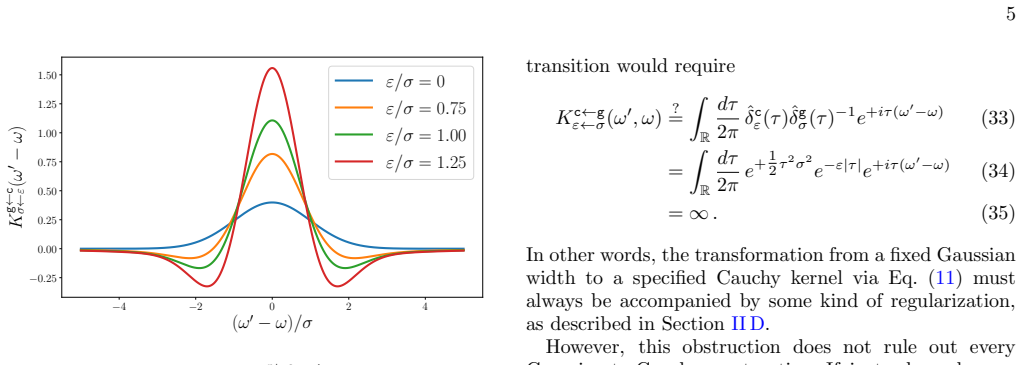
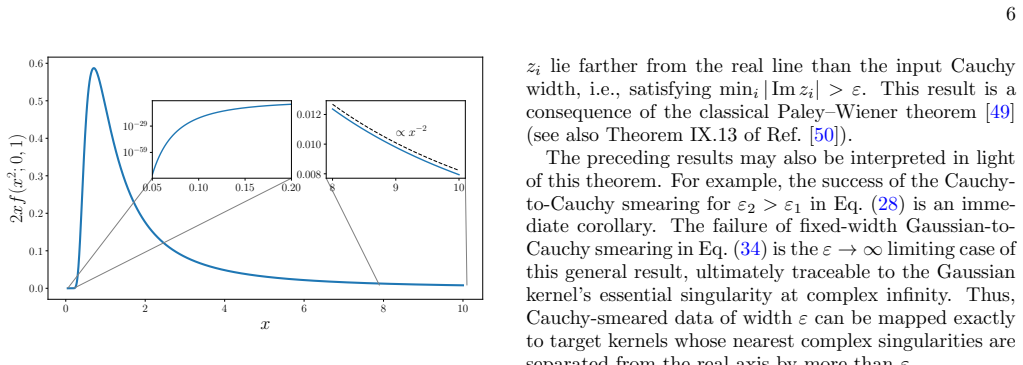
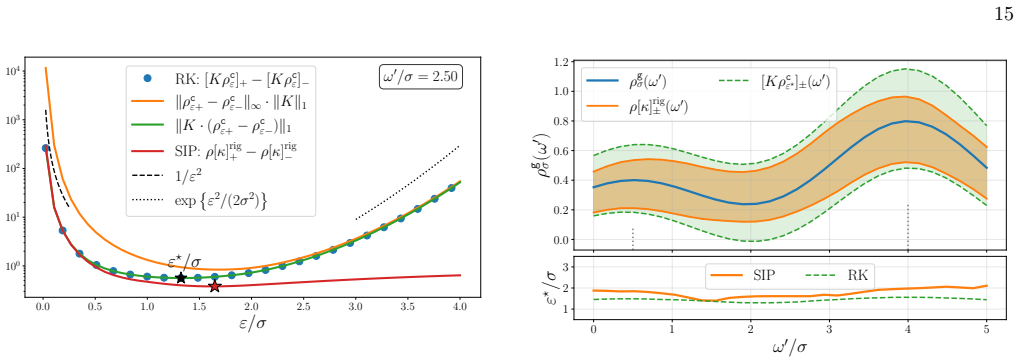
A framework is developed for transforming between smeared spectral functions computed using different smearing kernels. Analytic conditions are established for the maps to exist and converge without arbitrary regularization. Explicit expressions are provided for several kernel classes of interest, including Cauchy-to-Gaussian transformations and Gaussian-to-Cauchy width mixtures. When exact transformations are unavailable, the inverse problem is tackled through regulated maps paired with bounds on the associated systematic error, directly computable from the given input data. Errors on the input smeared spectral functions, either statistical or in the form of pointwise rigorous bounds, are t
What carries the argument
Kernel transformation maps between different smearing functions, defined under analytic conditions on the spectral function that guarantee convergence without extra regularization.
If this is right
- Exact maps exist between certain kernel families once the spectral function satisfies the required analyticity.
- Systematic-error bounds for regulated maps are obtained directly from the supplied smeared data without additional modeling.
- Input uncertainties, statistical or rigorous, propagate to the final transformed observables.
- Positivity constraints on the spectrum reduce the size of the allowed error intervals.
Where Pith is reading between the lines
- Lattice results obtained with one smearing choice can be compared directly with results or phenomenology that use a different choice.
- The same transformation machinery may apply to other inverse problems that involve energy smearing or resolution functions.
- If the analytic conditions can be verified on a given ensemble, multiple kernel computations become redundant.
Load-bearing premise
The spectral functions possess enough analyticity and positivity that the kernel maps remain well-defined and the derived bounds stay useful.
What would settle it
An explicit spectral function obeying positivity whose Cauchy-smeared version cannot be mapped to a Gaussian-smeared version within the stated analytic conditions, or for which the computed error bound is violated by the actual difference.
Figures
read the original abstract
This work develops a framework for transforming between smeared spectral functions computed using different smearing kernels. The kernel-transformation problem naturally arises when information is available for one family of energy-smeared observables, while phenomenology or comparison with other calculations require a different smearing. For exact transformations, analytic conditions are established for the maps to exist and converge without arbitrary regularization. Explicit expressions are provided for several kernel classes of interest, including Cauchy-to-Gaussian transformations and Gaussian-to-Cauchy width mixtures. When exact transformations are unavailable, the inverse problem is tackled through regulated maps paired with bounds on the associated systematic error, directly computable from the given input data. Errors on the input smeared spectral functions, either statistical or in the form of pointwise rigorous bounds, are then propagated to the target observables. Enforcing spectral positivity can be used to tighten the bounds.
Editorial analysis
A structured set of objections, weighed in public.
Referee Report
Summary. The manuscript develops a framework for transforming smeared spectral functions between different kernels. Analytic conditions are established under which exact transformations exist and converge without regularization. Explicit expressions are derived for several kernel classes, including Cauchy-to-Gaussian maps and Gaussian-to-Cauchy width mixtures. When exact transformations are unavailable, the work introduces regulated maps together with directly computable bounds on the systematic error; input errors (statistical or rigorous pointwise bounds) are propagated to the target, and spectral positivity is used to tighten the resulting bounds.
Significance. If the analytic conditions hold for the spectral functions that arise in lattice QCD, the framework would supply a controlled route to convert between different smearing prescriptions and to obtain rigorous bounds on the inverse problem without ad-hoc regularization. The explicit kernel expressions and the computable error bounds constitute concrete, reusable tools that could reduce systematic uncertainty when comparing smeared observables across calculations.
major comments (2)
- The central claim that exact kernel transformations exist and converge under stated analytic conditions (abstract) is load-bearing for the entire framework. The manuscript does not verify that the analyticity and positivity properties required by these conditions are satisfied by spectral functions reconstructed from finite Euclidean lattice correlators, whose analytic continuation is limited by volume, discretization, and statistical noise. Without such verification or a concrete counter-example test, the applicability to hep-lat data remains unestablished.
- When exact transformations are unavailable, the regulated maps are paired with bounds on the systematic error that are asserted to be computable directly from the input data (abstract). No explicit derivation or numerical demonstration is supplied showing that these bounds remain finite and useful when the input spectral function only approximately satisfies the analyticity premise; this gap directly affects the claimed utility of the regulated procedure.
minor comments (2)
- Notation for the various kernels and their widths should be introduced with a single consolidated table or figure early in the text to aid readability.
- The propagation of input errors to the target observables is described at a high level; a short worked example with explicit formulas would clarify the procedure.
Simulated Author's Rebuttal
We thank the referee for the careful reading and constructive comments. We address each major comment below, clarifying the scope of the work and indicating revisions where appropriate.
read point-by-point responses
-
Referee: The central claim that exact kernel transformations exist and converge under stated analytic conditions (abstract) is load-bearing for the entire framework. The manuscript does not verify that the analyticity and positivity properties required by these conditions are satisfied by spectral functions reconstructed from finite Euclidean lattice correlators, whose analytic continuation is limited by volume, discretization, and statistical noise. Without such verification or a concrete counter-example test, the applicability to hep-lat data remains unestablished.
Authors: The manuscript derives the precise analytic conditions (analyticity in a strip of the complex plane together with positivity) under which exact, convergent kernel transformations exist without regularization. These conditions are stated explicitly and are the central contribution; the framework applies whenever they hold. We agree that spectral functions reconstructed from finite-volume, discretized Euclidean correlators satisfy the conditions only approximately. The regulated maps and associated bounds are introduced exactly for this practical regime. Because the paper develops the general mathematical framework rather than applying it to specific lattice ensembles, no numerical verification on lattice data is included. We will add a paragraph in the introduction and conclusions relating the stated conditions to typical lattice reconstructions and noting that the regulated procedure is designed for approximate satisfaction of analyticity. revision: partial
-
Referee: When exact transformations are unavailable, the regulated maps are paired with bounds on the systematic error that are asserted to be computable directly from the input data (abstract). No explicit derivation or numerical demonstration is supplied showing that these bounds remain finite and useful when the input spectral function only approximately satisfies the analyticity premise; this gap directly affects the claimed utility of the regulated procedure.
Authors: Sections 4 and 5 contain the explicit derivation of the regulated maps and the error bounds, showing that the bounds are obtained directly from the input smeared spectral function, its statistical or rigorous pointwise errors, and the chosen regulation parameter. The regulation is constructed so that the bounds remain finite even when analyticity holds only approximately; the truncation error induced by regulation is included in the bound. We acknowledge that an explicit numerical illustration would strengthen the claim of utility and will add a short example in the revised manuscript using a model spectral function that satisfies the analyticity condition only approximately. revision: yes
Circularity Check
No significant circularity; mathematical framework is self-contained
full rationale
The paper develops a mathematical framework establishing analytic conditions for kernel transformations between smeared spectral functions and provides explicit expressions for specific kernel classes. When exact maps are unavailable, it uses regulated maps with bounds computed directly from input data. No steps reduce by construction to fitted parameters, self-definitions, or load-bearing self-citations; the derivation relies on stated analyticity and positivity assumptions applied to external inputs rather than internal redefinitions. This is the standard case of a self-contained mathematical construction.
Axiom & Free-Parameter Ledger
axioms (1)
- domain assumption Smeared spectral functions admit analytic kernel transformations under stated convergence conditions and possess positivity that can be used to tighten bounds.
Reference graph
Works this paper leans on
-
[1]
(81) is satisfied for allωand all positiveε
Positivity: Eq. (81) is satisfied for allωand all positiveε
-
[2]
Divergence asε→0 +:ρ c ε+(ω)−ρ c ε−(ω) diverges polynomially in 1/ε, with the lower and upper bounds saturating the trivial bounds of 0 and∞, respectively
-
[3]
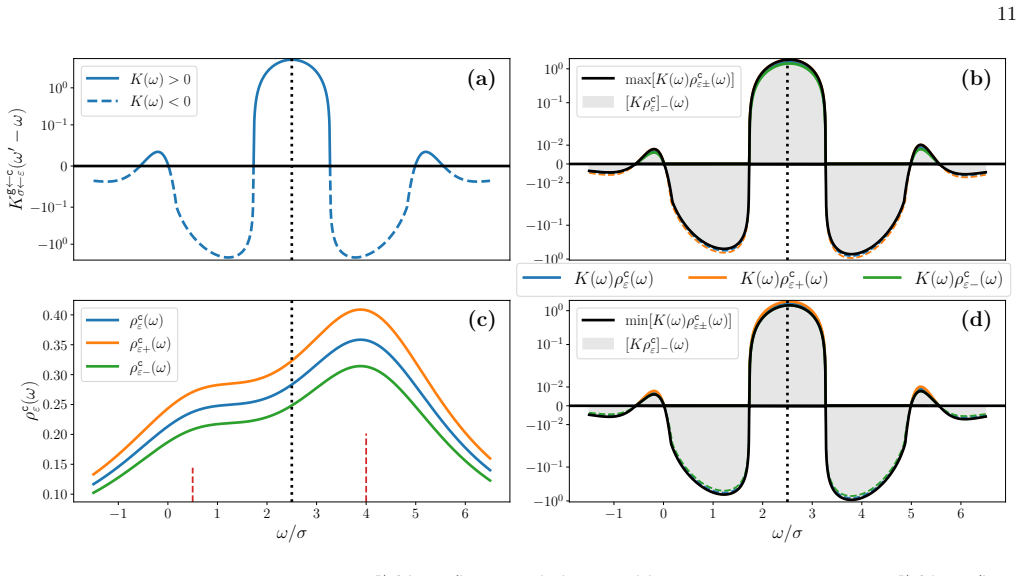
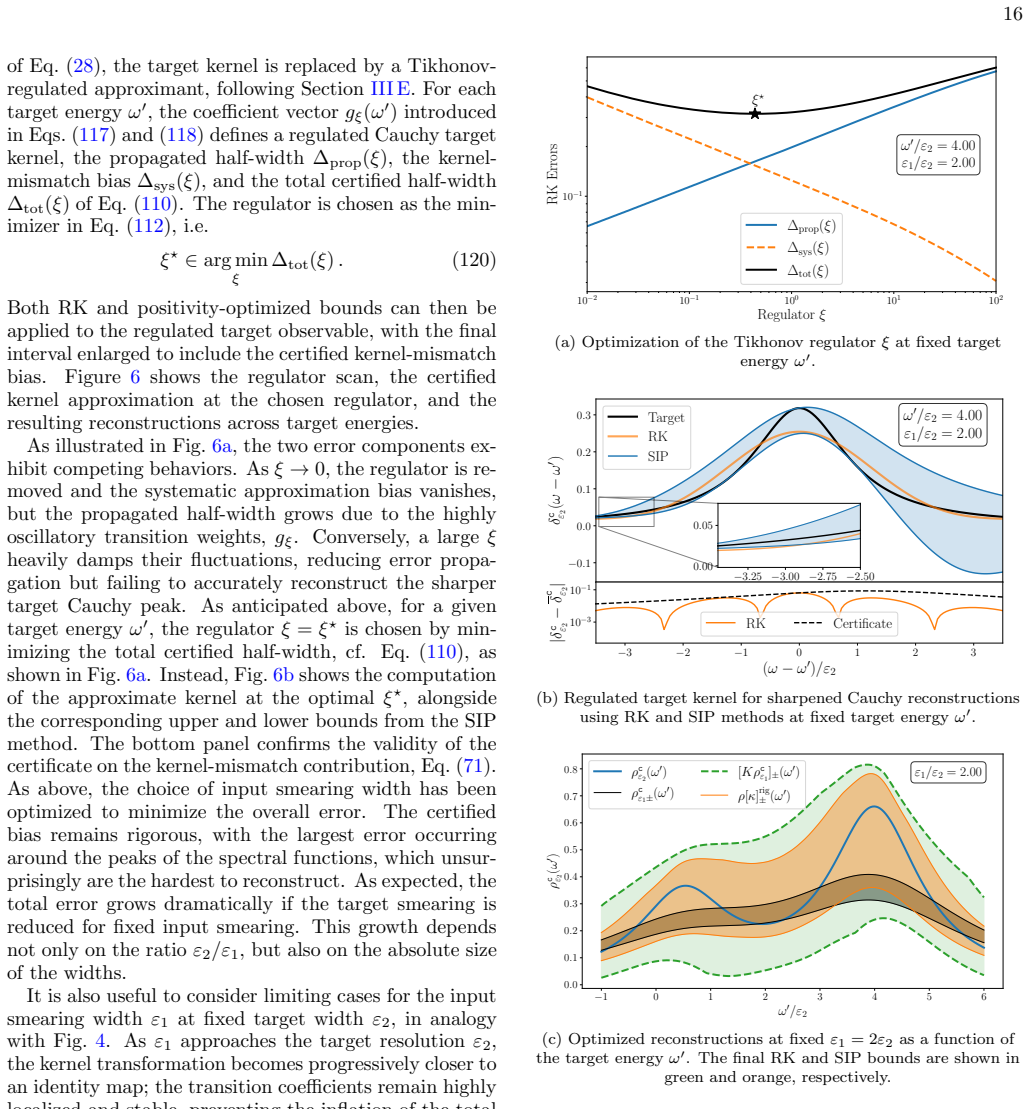
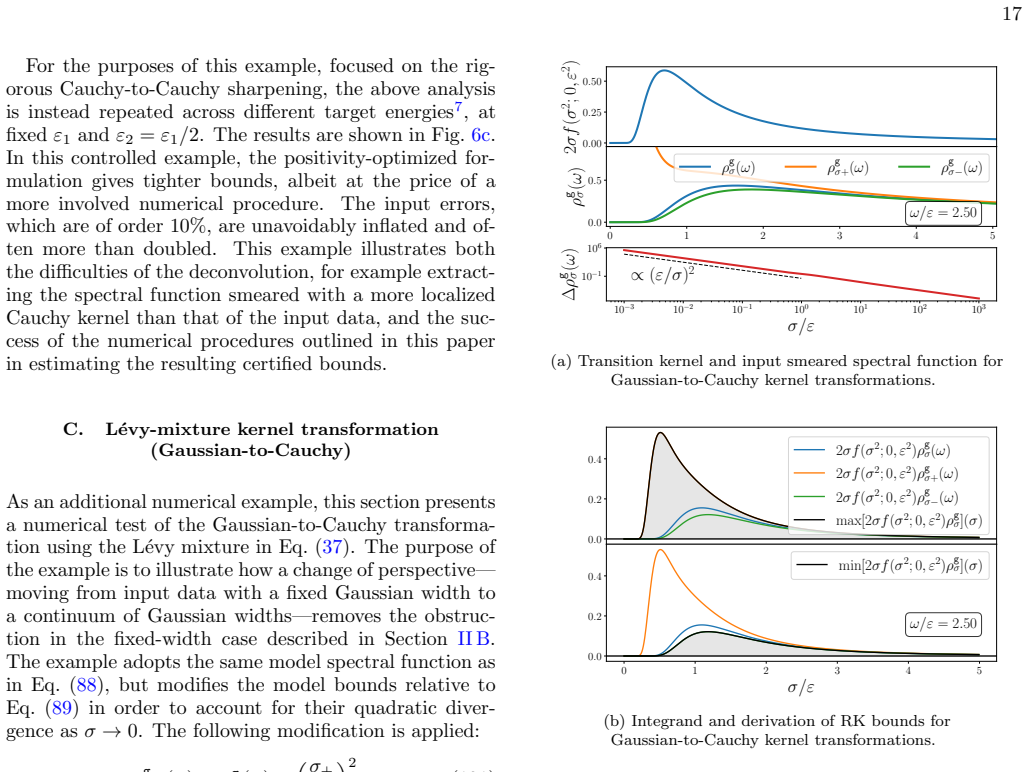
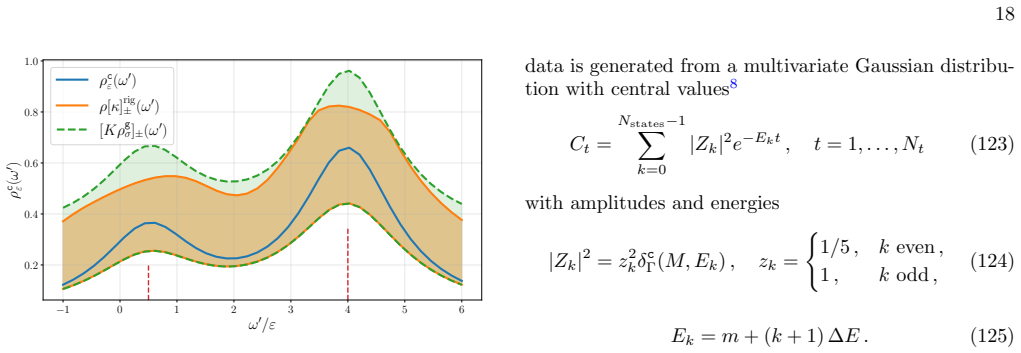
Convergence of the bounds for largeε: asε→+∞, the bounds approach the true resultρ c ε±(ω)→ ρc ε(ω) polynomially inε. 11 −100 −10−1 0 10−1 100 K g←c σ←ε(ω′ − ω) (a)K(ω) > 0 K(ω) < 0 −100 −10−1 −10−2 0 10−2 10−1 100 (b)max[K(ω)ρc ε±(ω)] [Kρ c ε]−(ω) −1 0 1 2 3 4 5 6 ω/σ 0.10 0.15 0.20 0.25 0.30 0.35 0.40 ρc ε(ω) (c)ρc ε(ω) ρc ε+(ω) ρc ε−(ω) −1 0 1 2 3 4 5 ...
-
[4]
relaxations
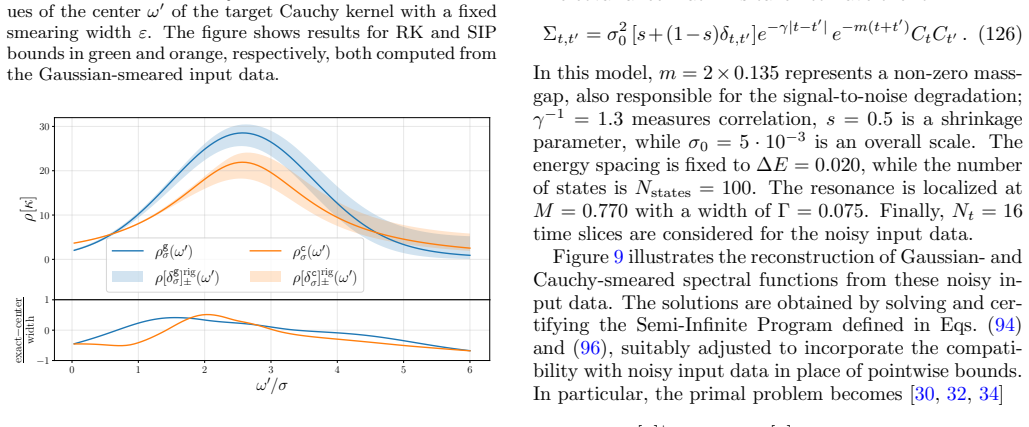
For simplicity, and since the ex- act values are known in this example,χ 2 0/Nt ≈0.8 was chosen to match theχ 2 between the noisy and exact cor- relator values. As emphasized in Refs. [32–34], this choice has a statistical interpretation. In phenomenological ap- plications, care must be taken in choosingχ 2 0 appropri- ately. 8 All quantities are given in...
-
[5]
Alibertiet al., The anomalous magnetic moment of the muon in the Standard Model: an update, Phys
R. Alibertiet al., The anomalous magnetic moment of the muon in the Standard Model: an update, Phys. Rept. 1143, 1 (2025), arXiv:2505.21476 [hep-ph]
Pith/arXiv arXiv 2025
- [6]
-
[7]
P. Gambino and S. Hashimoto, Inclusive Semileptonic Decays from Lattice QCD, Phys. Rev. Lett.125, 032001 (2020), arXiv:2005.13730 [hep-lat]
arXiv 2020
-
[8]
A. Evangelista, R. Frezzotti, N. Tantalo, G. Gagliardi, F. Sanfilippo, S. Simula, and V. Lubicz (Extended Twisted Mass), Inclusive hadronic decay rate of theτlep- ton from lattice QCD, Phys. Rev. D108, 074513 (2023), arXiv:2308.03125 [hep-lat]
arXiv 2023
-
[9]
C. Alexandrouet al.(Extended Twisted Mass), Inclusive Hadronic Decay Rate of theτLepton from Lattice QCD: The u¯s Flavor Channel and the Cabibbo Angle, Phys. Rev. Lett.132, 261901 (2024), arXiv:2403.05404 [hep- lat]
arXiv 2024
-
[10]
A. J¨ uttner, Standard Model tests with smeared experi- ment and theory (2026), arXiv:2603.15487 [hep-lat]
arXiv 2026
-
[11]
M. Davier, A. Hocker, and Z. Zhang, The Physics of Hadronic Tau Decays, Rev. Mod. Phys.78, 1043 (2006), arXiv:hep-ph/0507078
Pith/arXiv arXiv 2006
-
[12]
E. C. Poggio, H. R. Quinn, and S. Weinberg, Smearing the Quark Model, Phys. Rev. D13, 1958 (1976)
1958
-
[13]
Luscher, SELECTED TOPICS IN LATTICE FIELD THEORY, Conf
M. Luscher, SELECTED TOPICS IN LATTICE FIELD THEORY, Conf. Proc. C880628, 451 (1988)
1988
-
[14]
Maiani and M
L. Maiani and M. Testa, Final state interactions from Euclidean correlation functions, Phys. Lett. B245, 585 (1990)
1990
-
[15]
J. C. A. Barata and K. Fredenhagen, Particle scattering in Euclidean lattice field theories, Commun. Math. Phys. 138, 507 (1991)
1991
-
[16]
M. T. Hansen, H. B. Meyer, and D. Robaina, From deep inelastic scattering to heavy-flavor semileptonic decays: Total rates into multihadron final states from lattice QCD, Phys. Rev. D96, 094513 (2017), arXiv:1704.08993 [hep-lat]
Pith/arXiv arXiv 2017
-
[17]
J. Bulava and M. T. Hansen, Scattering amplitudes from finite-volume spectral functions, Phys. Rev. D100, 034521 (2019), arXiv:1903.11735 [hep-lat]
arXiv 2019
-
[18]
M. Bruno and M. T. Hansen, Variations on the Maiani- Testa approach and the inverse problem, JHEP06, 043, arXiv:2012.11488 [hep-lat]
arXiv 2012
-
[19]
A. Patella and N. Tantalo, Scattering amplitudes from Euclidean correlators: Haag-Ruelle theory and approxi- mation formulae, JHEP01, 091, arXiv:2407.02069 [hep- lat]
-
[20]
Cabibbo and R
N. Cabibbo and R. Gatto, Electron Positron Colliding Beam Experiments, Phys. Rev.124, 1577 (1961)
1961
-
[21]
Cabibbo, G
N. Cabibbo, G. Parisi, and M. Testa, Hadron Production in e+ e- Collisions, Lett. Nuovo Cim.4S1, 35 (1970)
1970
-
[22]
C. Alexandrouet al.(Extended Twisted Mass Collabo- ration (ETMC)), Probing the Energy-Smeared R Ratio Using Lattice QCD, Phys. Rev. Lett.130, 241901 (2023), arXiv:2212.08467 [hep-lat]
arXiv 2023
-
[23]
F. A. Bresciani, M. Bruno, and M. T. Hansen, Finite- volume effects on smeared spectral densities (2026), arXiv:2606.14349 [hep-lat]
arXiv 2026
- [24]
-
[25]
Luscher, Volume Dependence of the Energy Spectrum in Massive Quantum Field Theories
M. Luscher, Volume Dependence of the Energy Spectrum in Massive Quantum Field Theories. 1. Stable Particle States, Commun. Math. Phys.104, 177 (1986)
1986
-
[26]
Luscher, Volume Dependence of the Energy Spectrum in Massive Quantum Field Theories
M. Luscher, Volume Dependence of the Energy Spectrum in Massive Quantum Field Theories. 2. Scattering States, Commun. Math. Phys.105, 153 (1986)
1986
-
[27]
Luscher, Two particle states on a torus and their re- lation to the scattering matrix, Nucl
M. Luscher, Two particle states on a torus and their re- lation to the scattering matrix, Nucl. Phys. B354, 531 (1991)
1991
-
[28]
K. Rummukainen and S. A. Gottlieb, Resonance scatter- ing phase shifts on a nonrest frame lattice, Nucl. Phys. B450, 397 (1995), arXiv:hep-lat/9503028
Pith/arXiv arXiv 1995
-
[29]
L. Lellouch and M. Luscher, Weak transition matrix ele- ments from finite volume correlation functions, Commun. Math. Phys.219, 31 (2001), arXiv:hep-lat/0003023
Pith/arXiv arXiv 2001
-
[30]
C. h. Kim, C. T. Sachrajda, and S. R. Sharpe, Finite- volume effects for two-hadron states in moving frames, Nucl. Phys. B727, 218 (2005), arXiv:hep-lat/0507006
Pith/arXiv arXiv 2005
-
[31]
M. T. Hansen and S. R. Sharpe, Relativistic, model- independent, three-particle quantization condition, Phys. Rev. D90, 116003 (2014), arXiv:1408.5933 [hep-lat]
Pith/arXiv arXiv 2014
-
[32]
R. A. Briceno, J. J. Dudek, and R. D. Young, Scattering processes and resonances from lattice QCD, Rev. Mod. Phys.90, 025001 (2018), arXiv:1706.06223 [hep-lat]
Pith/arXiv arXiv 2018
-
[33]
M. T. Hansen and S. R. Sharpe, Lattice QCD and Three- particle Decays of Resonances, Ann. Rev. Nucl. Part. Sci. 69, 65 (2019), arXiv:1901.00483 [hep-lat]
arXiv 2019
- [34]
-
[35]
I. V. Kovalishina, Analytic theory of a class of interpo- lation problems, Mathematics of the USSR-Izvestiya22, 419 (1984)
1984
-
[36]
S. Lawrence, Model-free spectral reconstruction via La- grange duality (2024), arXiv:2408.11766 [hep-lat]
arXiv 2024
-
[37]
R. Abbott, S. Fields, W. I. Jay, P. Oare, and M. Sac- cardi, The Causal Bootstrap: Bounding Smeared Spec- tral Functions from Non-Perturbative Euclidean Data (2026), arXiv:2605.20509 [hep-lat]
Pith/arXiv arXiv 2026
-
[38]
S. Mutzel and A. Tilloy, Certified spectral functions from lattice Monte Carlo data (2026), arXiv:2606.09791 [hep- lat]
Pith/arXiv arXiv 2026
- [39]
-
[40]
M. Di Carlo, F. Erben, and M. T. Hansen, Long dis- tance contributions to neutral D-meson mixing from lat- tice QCD, JHEP07, 229, arXiv:2504.16189 [hep-lat]
-
[41]
A. Candido, L. Del Debbio, T. Giani, and G. Petrillo, Bayesian inference with Gaussian processes for the de- termination of parton distribution functions, Eur. Phys. J. C84, 716 (2024), arXiv:2404.07573 [hep-ph]
arXiv 2024
-
[42]
L. Del Debbio, A. Lupo, M. Panero, and N. Tantalo, Multi-representation dynamics of SU(4) composite Higgs models: chiral limit and spectral reconstructions, Eur. Phys. J. C83, 220 (2023), arXiv:2211.09581 [hep-lat]
arXiv 2023
-
[43]
P. Gambino, S. Hashimoto, S. M¨ achler, M. Panero, 24 F. Sanfilippo, S. Simula, A. Smecca, and N. Tantalo, Lat- tice QCD study of inclusive semileptonic decays of heavy mesons, JHEP07, 083, arXiv:2203.11762 [hep-lat]
- [44]
-
[45]
R. Kellermann, Z. Hu, A. Barone, A. Elgaziari, S. Hashimoto, T. Kaneko, and A. J¨ uttner, Inclusive semileptonic decays from lattice QCD: Analysis of sys- tematic effects, Phys. Rev. D112, 014501 (2025), arXiv:2504.03358 [hep-lat]
arXiv 2025
-
[46]
R. Kellermann, A. Barone, A. Elgaziari, S. Hashimoto, Z. Hu, A. J¨ uttner, and T. Kaneko, Inclusive semileptonic Ds →X sℓ¯νdecays from lattice QCD: continuum and chiral extrapolation (2026), arXiv:2604.22201 [hep-lat]
Pith/arXiv arXiv 2026
-
[47]
A. De Santiset al., Inclusive Semileptonic Decays of the Ds Meson: Lattice QCD Confronts Experiments, Phys. Rev. Lett.135, 121901 (2025), arXiv:2504.06064 [hep- lat]
arXiv 2025
-
[48]
A. De Santiset al., Inclusive semileptonic decays of the Ds meson: A first-principles lattice QCD calculation, Phys. Rev. D112, 054503 (2025), arXiv:2504.06063 [hep- lat]
arXiv 2025
-
[49]
J. Bulava, The spectral reconstruction of inclusive rates, PoSLATTICE2022, 231 (2023), arXiv:2301.04072 [hep-lat]
arXiv 2023
-
[50]
Saccardiet al., transker,https://github.com/ MatteoSaccardi/transker(2026)
M. Saccardiet al., transker,https://github.com/ MatteoSaccardi/transker(2026)
2026
-
[51]
D. Bernecker and H. B. Meyer, Vector Correlators in Lat- tice QCD: Methods and applications, Eur. Phys. J. A47, 148 (2011), arXiv:1107.4388 [hep-lat]
Pith/arXiv arXiv 2011
-
[52]
M. Hansen, A. Lupo, and N. Tantalo, Extraction of spec- tral densities from lattice correlators, Phys. Rev. D99, 094508 (2019), arXiv:1903.06476 [hep-lat]
Pith/arXiv arXiv 2019
-
[53]
Raymond E. A. C. Paley and Wiener Norbert, Fourier Transforms in the Complex Domain, The Mathematical Gazette19, 147 (1934)
1934
-
[54]
Reed and B
M. Reed and B. Simon,Methods of Modern Mathemati- cal Physics. 2. Fourier Analysis, Self-adjointness, 1st ed., Vol. 2 (Academic Press, 1975)
1975
-
[55]
R. Tsuji and S. Hashimoto, Spectral reconstruction from Euclidean lattice correlators through singular value de- composition (2026), arXiv:2605.15674 [hep-lat]
Pith/arXiv arXiv 2026
-
[56]
Backus and F
G. Backus and F. Gilbert, The Resolving Power of Gross Earth Data, Geophysical Journal International16, 169 (1968)
1968
-
[57]
A. Lupo and N. Tantalo, Extraction of spectral densi- ties from lattice correlators: decoupling signal from noise (2026), arXiv:2605.14652 [hep-lat]
Pith/arXiv arXiv 2026
- [58]
-
[59]
C. D. Aliprantis and O. Burkinshaw,Positive Operators, 2nd ed., Springer Monographs in Mathematics (Springer Dordecht, 2006)
2006
-
[60]
T. Bergamaschi, W. I. Jay, and P. R. Oare, Hadronic structure, conformal maps, and analytic continuation, Phys. Rev. D108, 074516 (2023), arXiv:2305.16190 [hep- lat]
arXiv 2023
-
[61]
S. Fields and N. Christ, Nevanlinna-Pick interpolation from uncertain data (2025), arXiv:2510.12136 [hep-lat]
Pith/arXiv arXiv 2025
-
[62]
S. van der Walt, S. C. Colbert, and G. Varoquaux, The NumPy Array: A Structure for Efficient Numer- ical Computation, Comput. Sci. Eng.13, 22 (2011), arXiv:1102.1523 [cs.MS]
Pith/arXiv arXiv 2011
-
[63]
C. R. Harriset al., Array programming with NumPy, Nature585, 357 (2020), arXiv:2006.10256 [cs.MS]
Pith/arXiv arXiv 2020
-
[64]
The mpmath development team,mpmath: a Python library for arbitrary-precision floating-point arithmetic (version 1.3.0)(2023),http://mpmath.org/
2023
-
[65]
J. D. Hunter, Matplotlib: A 2D graphics environment, Computing in Science & Engineering9, 90 (2007)
2007
-
[66]
M. L. Waskom, Seaborn: Statistical Data Visualization, Journal of Open Source Software6, 3021 (2021)
2021
-
[67]
Diamond and S
S. Diamond and S. Boyd, CVXPY: A Python-embedded modeling language for convex optimization, Journal of Machine Learning Research17, 1 (2016)
2016
-
[68]
Agrawal, R
A. Agrawal, R. Verschueren, S. Diamond, and S. Boyd, A rewriting system for convex optimization problems, Jour- nal of Control and Decision5, 42 (2018)
2018
discussion (0)
Sign in with ORCID, Apple, or X to comment. Anyone can read and Pith papers without signing in.