REVIEW 3 major objections 5 minor 12 references
Target Considerations for a Very Cold Neutron Source
T0 review · 3 major / 5 minor · reviewed 2026-08-14 · deepseek-v4-flash
Pith's one-line read The long-wavelength neutron flux per unit of peak cold-moderator heating is essentially independent of proton energy from 1 to 10 GeV, so an 8 GeV accelerator can test the target.
desk verdict Honest 2007 parameter scan for a very cold neutron target; the energy-independence claim is a trend from the only available cold kernel, not a validated design basis. read the letter →
The pith
A machine-rendered reading of the paper's core claim, the machinery that carries it, and where it could break.
The reading
What carries the argument
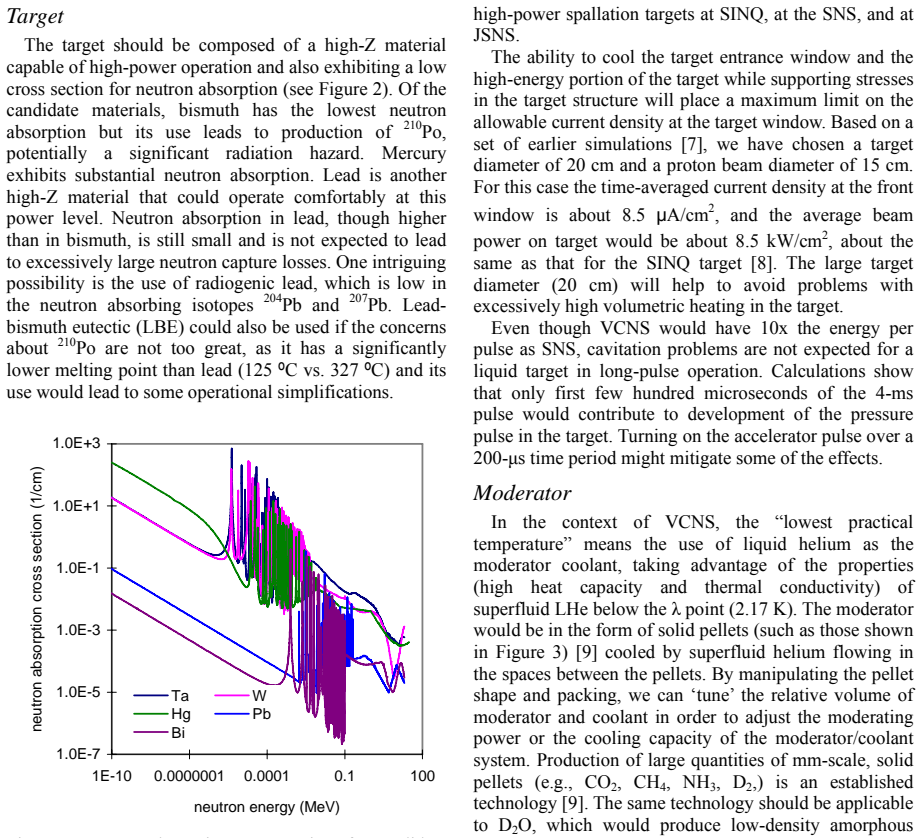
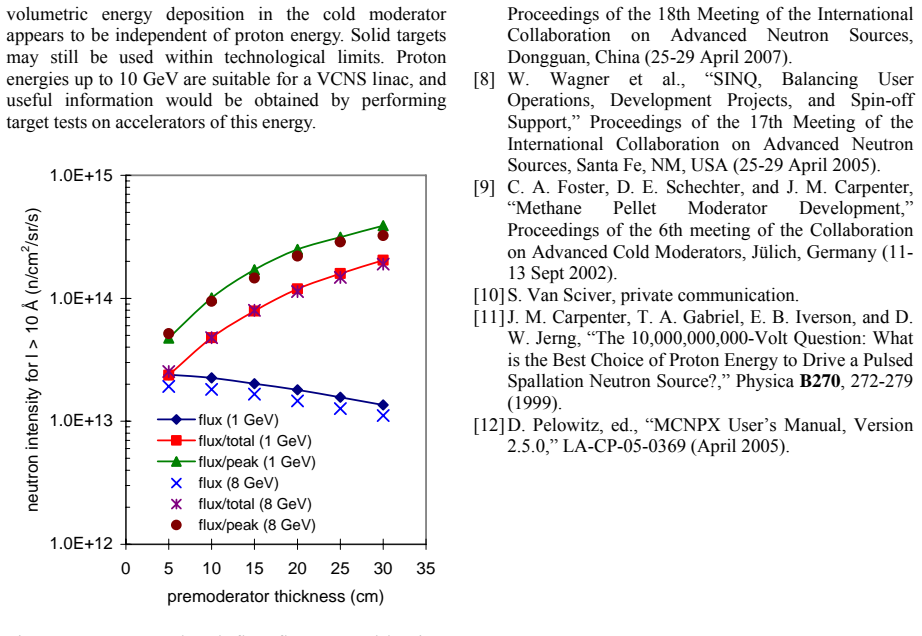
The load-bearing machinery is a set of MCNPX radiation-transport simulations built around a 20 cm diameter lead target in a liquid D2O moderator/reflector, with a 20 cm × 20 cm × 10 cm liquid D2 cold moderator at 20 K enclosed in a magnesium vacuum jacket. The premoderator thickness between target and cold moderator is varied, and the curves of long-wavelength flux, total heating, and peak volumetric heating are compared at 1 and 8 GeV. The argument runs on the ratio of long-wavelength flux to peak volumetric energy deposition as the optimization target: heating falls exponentially with distance while flux falls slowly, so the optimum moderator position is set by the heating limit, not by raw flux. The liquid D2 scattering kernel is the only low-temperature kernel available among candidate materials, and the paper explicitly flags that realistic VCNS simulations would require kernels that are largely unavailable.
What would settle it
Re-run the premoderator scans at 1, 3, 8, and 10 GeV using a validated low-temperature scattering kernel for liquid D2 (or, where possible, for solid D2O and CD4) and check whether the long-wavelength flux per peak volumetric heating remains flat in proton energy; a measured cold-neutron spectrum from a prototype moderator at two beam energies would settle the same question.
Extended reading notes
Core claim
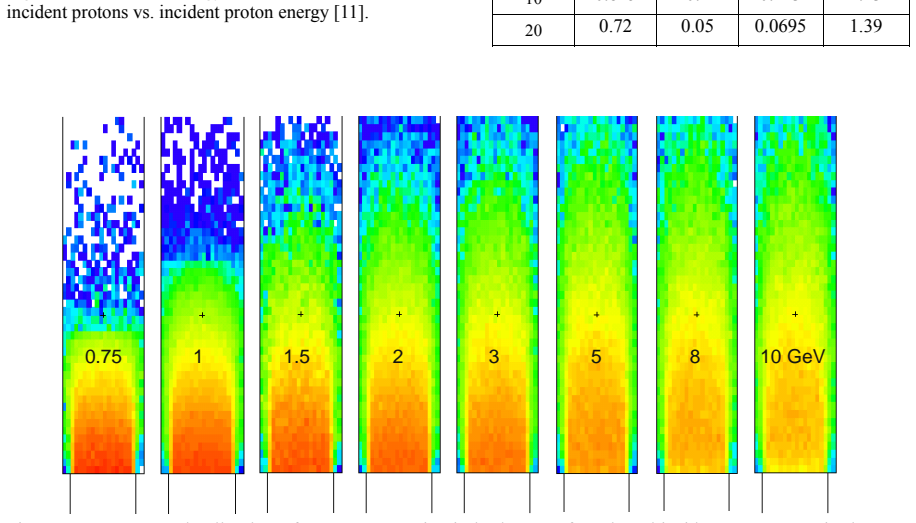
The paper's central claim is a scaling result from radiation-transport simulations: when a lead spallation target is surrounded by a D2O moderator/reflector and a liquid D2 cold moderator is placed at the position of maximum thermal flux, the cold-neutron output per unit of peak volumetric heating in the moderator is essentially the same for incident proton energies from 1 to 10 GeV. The simulations show that higher proton energy spreads both neutron production and power deposition deeper and more uniformly through the target, lowering peak heating, while the long-wavelength flux available at a given radial distance stays roughly constant. Since the design constraint is the local heating limit of the cryogenic moderator (about 50–100 mW/cm$^3$), the relevant figure of merit is flux per peak heating, and that ratio is proton-energy independent. This is why the paper concludes that an 8 GeV accelerator, despite producing fewer neutrons per joule than a 1 GeV beam, remains a valid test bed for VCNS target technology.
Load-bearing premise
The results stand on the 20 K liquid-deuterium scattering kernel used in the simulations: if that kernel misrepresents how neutrons slow down below a few meV, the flux and heating ratios that make 1 and 8 GeV interchangeable would change, and the paper itself notes that realistic kernels for the candidate materials are largely unavailable.
Editorial extensions
If this is right
- An 8 GeV accelerator with modest average power can be used to test VCNS target and moderator concepts before a dedicated 1 GeV high-current linac is built.
- Peak power density in the target drops by about a factor of two from 1 to 10 GeV, which may allow a solid target to operate above 1 MW if thermal-hydraulic limits can be met.
- The cold moderator should be placed far enough from the target that peak heating falls below 100 mW/cm$^3$; for the studied geometry this requires roughly 17 cm of premoderator.
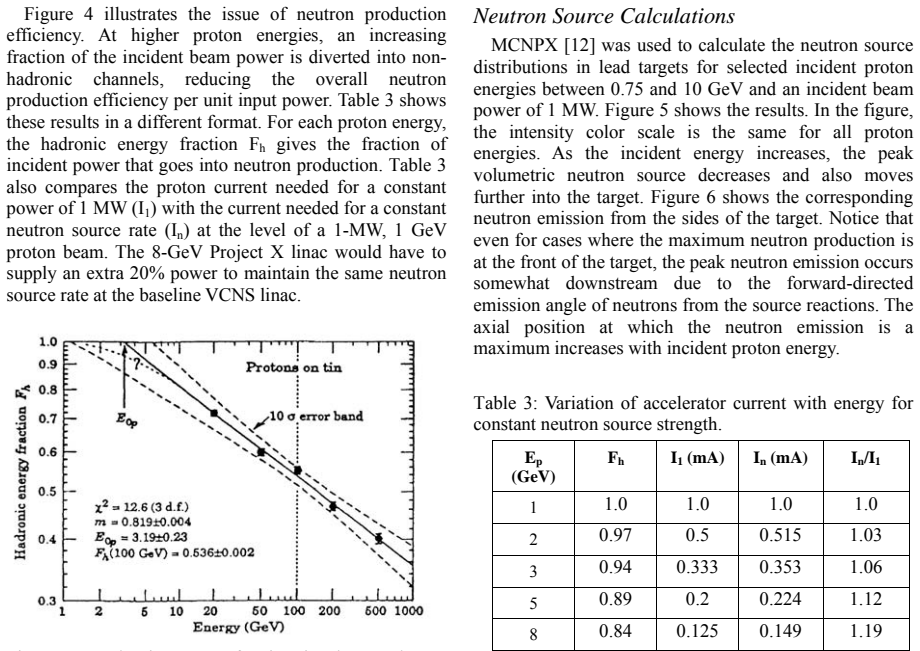
- Maintaining the same neutron source rate at 8 GeV instead of 1 GeV requires roughly 20% more beam power, reflecting the lower hadronic energy fraction at higher energy.
- A proposed 8 GeV linac could interleave additional longer or higher-current pulses for a VCNS with its primary physics program if the RF power is installed from the start.
Reading between the lines
- If the energy independence of flux per peak heating holds beyond the simulated range, the VCNS target test could be performed at any conveniently available high-energy proton facility, not only at 8 GeV; this is an extension the paper only hints at.
- The same normalized figure of merit could be applied to other cold-moderator materials; the conclusion would be stronger if repeated for solid D2O or CD4 pellets once scattering kernels exist, since those are the practical moderator candidates.
- A subtle corollary is that adding accelerator power does not buy a closer moderator position: the paper's curves imply that doubling power still yields lower cold flux than running farther away under the same heating limit, so source power is a second-order lever compared to geometry.
- The independence claim suggests a target-testing program could measure only relative changes in cold flux and heating when swapping beam energy, rather than absolute spectra, making the test less demanding on instrumentation.
Signed reviews
Editorial analysis
A structured set of objections, weighed in public.
Referee Report
Summary. The paper describes target, moderator, and accelerator considerations for a proposed Very Cold Neutron Source (VCNS) operating with 4 ms pulses at 5 Hz and 1 GeV protons. Using MCNPX, the author computes neutron production, power deposition, thermal-neutron flux, and long-wavelength neutron emission from lead targets at proton energies between 0.75 and 10 GeV, with primary attention to comparing the baseline 1 GeV VCNS linac with an 8 GeV Fermilab Project X / Proton Driver linac. The central conclusion is that the long-wavelength neutron flux normalized to the maximum volumetric energy deposition in the cold moderator appears to be independent of proton energy, so that an 8 GeV accelerator could be used to test the VCNS target. The paper also discusses target material selection, moderator pellet cooling, and a heat-removal limit of 50-100 mW/cm3 in the moderator.
Significance. If the energy-independence result holds, the practical payoff is significant: a proposed 8 GeV Fermilab linac could serve as a test bed for a VCNS target, reducing accelerator development risk. The MCNPX calculations are independent simulations with no parameter fitting to the claimed output quantities, and the paper is transparent about the scarcity of low-temperature scattering kernels and thermal property data. The central ratio (cold flux over peak heating) is a falsifiable prediction that could be checked at intermediate proton energies and with improved scattering laws. However, the evidence is thin: the flux/heating ratio is computed at only two proton energies, and the moderator is modeled with a 20 K liquid-D2 kernel rather than the intended ~2 K moderator, a limitation the paper itself acknowledges.
major comments (3)
- [Neutron Emission Calculations] The central conclusion in the Conclusions section, that the long-wavelength neutron flux normalized to the maximum volumetric energy deposition is independent of proton energy, rests on Figure 15, which compares only 1 GeV and 8 GeV and uses the lowest-temperature scattering kernel available, liquid D2 at 20 K. The paper states explicitly that 'realistic neutronic simulations for a VCNS require scattering kernels that are largely unavailable for the materials and temperatures of interest.' Since the VCNS moderator is intended to operate near 2 K and the target wavelengths (10-20 Å) correspond to 0.2-0.8 meV, the equilibrium spectrum is precisely in the energy range where the scattering law determines the result. If a realistic 2-5 K solid-D2 or D2O kernel changes the cold-neutron production or its spatial distribution differently at 1 GeV versus 8 GeV, the claimed energy independence would not hold. No sensitivity analysis or uncertainty quantification is provided for this ratio.
- [Figure 15 and Conclusions] The energy-independence conclusion is supported by only two computed proton energies (1 and 8 GeV) for the flux/heating ratio. With two points it is impossible to distinguish a true energy-independent plateau from a coincidence or from a smooth trend that happens to pass through the same values. The manuscript should either add calculations at intermediate energies (e.g., 2, 3, 5 GeV) or explicitly restrict the conclusion to the tested energies. This is especially important because the paper recommends proton energies up to 10 GeV on the basis of the apparent independence.
- [Moderator, heat transfer paragraph] The quantitative design limit of 50-100 mW/cm3 for energy deposition in the moderator is attributed to a private communication [10] rather than to a documented calculation. While this limit does not directly enter the ratio that is claimed to be energy independent, it is load-bearing for the recommendation that a premoderator thickness of about 17 cm is acceptable and for the statement that a moderator farther from the target is preferred. The private communication should be replaced by a reproducible thermal model or, at minimum, by a public report.
minor comments (5)
- [Fermilab Proton Accelerator] The text uses '8-Gev' in the section heading and elsewhere; it should read '8-GeV'.
- [Figure 12 caption] The caption repeats '1 GeV 3 GeV 8 GeV' without explaining which panels correspond to which energy; the figure appears to contain six mesh plots, but the mapping between panels and energies is unclear.
- [Figure 15] The y-axis label reads 'neutron intensity for l > 10 Å' while the text and legend refer to 'flux'; the units (n/cm2/sr/s) are intensity-like and should be defined consistently in the text and figure.
- [Table 3] The hadronic energy fractions Fh are listed without a source or uncertainty; a citation to the calculation or a brief description of how they were obtained would improve reproducibility.
- [References] References [3] and [4] are URLs that may not be stable; consider providing archival or published versions where available.
Circularity Check
No circular reduction; central result is an independent MCNPX comparison, with minor non-load-bearing self-citations and an explicit (non-circular) scattering-kernel caveat.
full rationale
The central conclusion, that long-wavelength neutron flux normalized to peak volumetric heating in the cold moderator is approximately independent of proton energy, is based on direct MCNPX calculations at 1 and 8 GeV reported in Figures 14 and 15. These runs involve no fitted parameters and no equation in which the output is defined as the input. The paper's earlier self-citations are design inputs rather than proof of the conclusion: [7] supplies the 20 cm target/15 cm beam diameters and [2] supplies the 5 Hz rep rate; neither is load-bearing for the flux/heating ratio. The limitation in the 'Neutron Emission Calculations' section is explicitly flagged by the paper: 'The scattering kernel for liquid D2 is the lowest temperature scattering kernel available for the candidate materials... Realistic neutronic simulations for a VCNS require scattering kernels that are largely unavailable for the materials and temperatures of interest.' That is a substantive validity/uncertainty caveat about the physics model, not a circular step; the same 20 K kernel is used for both energies, and the energy-independence claim is an output of the simulation, not an input. No uniqueness theorem, fitted-input-as-prediction, or renaming of a known result appears. The only circularity-adjacent feature is the presence of minor self-citations, which are not load-bearing, so the score is 2 rather than 0.
Assumptions & free parameters
free parameters (3)
- Target diameter =
20 cm
- Proton beam diameter =
15 cm
- Moderator heating limit =
50-100 mW/cm3
assumptions (3)
- domain assumption MCNPX spallation and neutron transport models accurately predict neutron production and energy deposition for proton energies from 1 to 10 GeV.
- ad hoc to paper The liquid D2 scattering kernel at 20 K is adequate to estimate the dependence of long-wavelength neutron flux on premoderator thickness.
- domain assumption Superfluid helium cooling can maintain the moderator below the lambda point and remove the computed heat loads.
Cite this review
Pith. "Pith review of Target Considerations for a Very Cold Neutron Source." pith.science (2026). https://pith.science/paper/T2RYAHJ6
@misc{pith2026190803550,
  author       = {Pith},
  title        = {Pith review of: Target Considerations for a Very Cold Neutron Source},
  year         = {2026},
  howpublished = {\url{https://pith.science/paper/T2RYAHJ6}},
  note         = {Machine review of arXiv:1908.03550}
}
read the original abstract
A proposed Very Cold Neutron Source (VCNS) would operate with 4 ms long pulses at 5 Hz and 1 GeV. The energy per pulse would be 300 kJ, much higher than the Spallation Neutron Source (33 kJ/pulse) or the present IPNS (0.3 kJ/pulse), and the peak power on target would be 75 MW. This paper discusses ideas for the VCNS target and examines the possibility of conducting target tests at an 8-GeV proton linear accelerator which is being studied for construction at Fermilab.
Figures


Figures from the paper (10 more)


Reference graph
Works this paper leans on
- [10]
-
[1]
SNS Second Target Station Scoping Workshop – Final Report,
R. K. Crawford, G. S. Smith, G. Ehlers, and L. Robertson, “SNS Second Target Station Scoping Workshop – Final Report,” ORNL/SNS report 107000000-TR0006-R00, (October 2006)
work page 2006
-
[2]
Proceedings of the Workshop on Applications of a Very Cold Neutron Source,
B. J. Micklich and J. M. Carpenter, “Proceedings of the Workshop on Applications of a Very Cold Neutron Source,” ANL-05/42 (December 2005)
work page 2005
-
[3]
http://protondriver.fnal.gov
-
[4]
http://projectx.fnal.gov; http://www-bdnew.fnal.gov/ hq/mcginnis/projectx/Report/ProjectX.pdf
-
[5]
TRIUMF Thermal Neutron Facility,
I. M. Thorson, J. J. Burger jon, R. E. Blaby, and T. A. Hodges, “TRIUMF Thermal Neutron Facility,” Proceedings of the 7th Meeting of the International Collaboration on Advanced Neutron Sources, Chalk River, Ontario, Canada (13-16 Sept. 1983)
work page 1983
-
[6]
Design and Neutronic Performance of the Spallation Target of the Ultra-Cold Neutron Source at PSI,
M. Wohlmuther and G. Heidenreich, “Design and Neutronic Performance of the Spallation Target of the Ultra-Cold Neutron Source at PSI,” Proceedings of the 17th Meeting of the International Collaboration on Advanced Neutron Sources, Santa Fe, NM, USA (25-29 April 2005)
work page 2005
-
[7]
Slower, Colder, Longer: Prospects for a Very Cold Neutron Source,
B. J. Micklich and J. M. Carpenter, “Slower, Colder, Longer: Prospects for a Very Cold Neutron Source,” Proceedings of the 18th Meeting of the International Collaboration on Advanced Neutron Sources, Dongguan, China (25-29 April 2007)
work page 2007
Show all 12 references
-
[8]
SINQ, Balancing User Operations, Development Projects, and Spin-off Support,
W. Wagner et al., “SINQ, Balancing User Operations, Development Projects, and Spin-off Support,” Proceedings of the 17th Meeting of the International Collaboration on Advanced Neutron Sources, Santa Fe, NM, USA (25-29 April 2005)
2005
-
[9]
Methane Pellet Moderator Development,
C. A. Foster, D. E. Schechter, and J. M. Carpenter, “Methane Pellet Moderator Development,” Proceedings of the 6th meeting of the Collaboration on Advanced Cold Moderators, Jülich, Germany (11- 13 Sept 2002)
2002
-
[11]
The 10,000,000,000-Volt Question: What is the Best Choice of Proton Energy to Drive a Pulsed Spallation Neutron Source?,
J. M. Carpenter, T. A. Ga briel, E. B. Iverson, and D. W. Jerng, “The 10,000,000,000-Volt Question: What is the Best Choice of Proton Energy to Drive a Pulsed Spallation Neutron Source?,” Physica B270, 272-279 (1999)
1999
-
[12]
MCNPX User’s Manual, Version 2.5.0,
D. Pelowitz, ed., “MCNPX User’s Manual, Version 2.5.0,” LA-CP-05-0369 (April 2005)
2005
Reviewed August 14, 2026 · model on record in the stance chip above.
Discussion (0). Continue with ORCID to comment.