REVIEW 3 major objections 4 minor 31 references
Imprint of the galactic acceleration scale on globular cluster systems
T0 review · 3 major / 4 minor · reviewed 2026-08-14 · deepseek-v4-flash
Pith's one-line read Density profiles of globular cluster systems break at the radius where the gravitational acceleration of the stars equals the galactic acceleration scale $a_0$.
desk verdict A new, honestly reported coincidence between GC system break radii and the a0 acceleration radius, but the breaks' reality is not yet established because no smooth-profile null is tested. read the letter →
The pith
A machine-rendered reading of the paper's core claim, the machinery that carries it, and where it could break.
The reading
What carries the argument
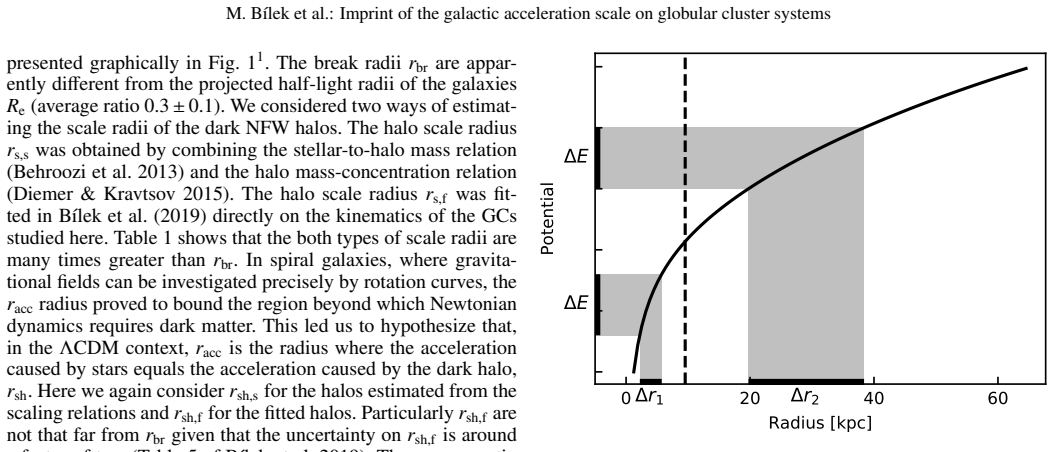
The carrying object is a broken power law for the globular cluster volume density, $\rho(r)=\rho_0 r^a$ inside the break and $\rho(r)=\rho_0 r_{\rm br}^{a-b} r^b$ outside it, with $r_{\rm br}$ the break radius. The identity doing the work is $r_{\rm br}\approx r_{\rm acc}$, where $r_{\rm acc}$ is the radius at which the gravitational acceleration from the stars equals $a_0$ under Newtonian gravity ($r_{\rm acc,N}$) or under the MOND interpolation ($r_{\rm acc,M}$); the average ratios are $0.8\pm0.3$ and $1.2\pm0.5$, respectively. The proposed mechanism behind the identity is framework-dependent: in the Lambda-CDM reading the gravitational potential changes its slope at the radius where stellar and dark-halo accelerations are equal, so infalling satellites are tidally stripped at the same radius but deposit their globular clusters with different radial spreads inside and outside that point; in MOND the break sits at $r_{\rm acc}$ because the dynamics change regime there, with external-field effects and enhanced dynamical friction acting only beyond the transition.
What would settle it
Fit the same archival globular cluster profiles with a single power law and with a Sérsic profile and compare the fits statistically; if the broken power law is not clearly preferred, or if the recovered $r_{\rm br}$ moves outside its quoted errors when red and blue subpopulations are fitted separately or when incompleteness is modeled, the reported match would be an artifact rather than an imprint of $a_0$.
Extended reading notes
Core claim
In the sample of 17 early-type galaxies, plus three projections of one simulated galaxy, the number density profiles of the globular cluster systems are well described by a broken power law that steepens beyond a break radius $r_{\rm br}$. The paper's central discovery is that $r_{\rm br}$ is nearly equal to $r_{\rm acc}$, the radius where the gravitational acceleration generated by the stars equals $a_0=1.2\times10^{-10}\,\mathrm{m\,s^{-2}}$: the average ratio is $0.8\pm0.3$ for Newtonian gravity and $1.2\pm0.5$ for the MOND interpolation. The match with the galaxy's effective radius, halo scale radius, and the red-blue crossover radius is substantially worse. The paper interprets this as an imprint of the acceleration scale on the globular cluster system, proposing that in the Lambda-CDM picture the break marks the radius where the dark halo starts to dominate the potential, and in MOND it marks the Newtonian-to-deep-MOND transition. The authors also note tentative evidence that globular cluster systems can reveal halo concentration as well as halo mass.
Load-bearing premise
The claim rests on the break radii $r_{\rm br}$ being real, sharp features of the globular cluster density profiles rather than artifacts of fitting a broken power law to an intrinsically smooth profile, of survey incompleteness, or of the superposition of red and blue cluster subpopulations.
Editorial extensions
If this is right
- Photometry alone would provide the acceleration-scale radius: a confirmed $r_{\rm br}\approx r_{\rm acc}$ relation lets the globular cluster break radius stand in for kinematic tracers in galaxies where spectroscopy is impractical.
- In the Lambda-CDM interpretation, combining the break radius with the standard relation between globular cluster number and halo mass would estimate both the mass and the concentration of the dark halo from imaging.
- In the MOND interpretation, the break at $r_{\rm acc}$ is a prediction, and the outer slopes of globular cluster density profiles should approach the predicted $r^{-\alpha_\infty}$ behavior with $\alpha_\infty$ between about 3.5 and 4.5.
- The match provides a new observational constraint on galaxy formation, and current Lambda-CDM galaxy formation simulations do not reproduce it: the simulated galaxy's break radii differ from both $r_{\rm acc}$ and $r_{\rm sh}$ by factors of a few.
Reading between the lines
- If the correlation is confirmed on an independent sample spanning a wider mass range, the globular cluster break radius could become a distance-free observable that tracks $a_0$ in galaxies where the stellar mass profile is known, effectively turning globular cluster systems into a gravitational-field probe.
- A clean discrimination test between the two explanations would compare break radii in galaxies with similar stellar masses but very different dark halo concentrations: the Lambda-CDM version predicts $r_{\rm br}$ to track $r_{\rm sh}$, while the MOND version predicts it to track $r_{\rm acc}$.
- The red-versus-blue globular cluster dichotomy remains the most obvious alternative driver of a break; separating the two color populations in each galaxy and measuring whether the break tracks the red-blue crossover radius would directly test that alternative.
- The same argument should extend to globular-cluster-rich ultra-diffuse galaxies, where imaging-based estimates of halo concentration could be checked against independent dynamical measurements.
Signed reviews
Editorial analysis
A structured set of objections, weighed in public.
Referee Report
Summary. This paper reports that the break radii of the radial number density profiles of globular cluster (GC) systems in 17 early-type galaxies coincide with the radius at which the gravitational acceleration from the stellar mass equals the galactic acceleration scale a0, both under Newtonian and MOND gravity. The authors compare the break radii rbr with other characteristic radii and find that rbr matches racc more closely than the effective radius, NFW scale radii, or the red/blue GC equality radius. They propose possible explanations in the ΛCDM and MOND frameworks and suggest that GC breaks could be used to estimate dark halo concentrations. The analysis uses previously published break radii from Bílek et al. (2019) and independently computed a0 radii, with no constant fitted to force agreement.
Significance. If the reported coincidence is real, it would add a new empirical manifestation of the acceleration scale in early-type galaxies and potentially offer a purely photometric probe of dark halo structure. The paper's main strengths are the parameter-free nature of the rbr–racc comparison and the checks against survey incompleteness and red/blue GC segregation. However, the significance is conditional: the central claim requires that the breaks are genuine features of the density profiles rather than fitting artifacts, and the statistical support for the rbr–racc match is not yet demonstrated. The proposed ΛCDM interpretation of a link between rbr and halo concentration also lacks quantitative backing.
major comments (3)
- [Section 2, Eq. (1), Appendix A] The central claim that GC systems exhibit density breaks at rbr rests entirely on the broken power-law fits from Bílek et al. (2019), but the paper gives no evidence that the broken power-law model is statistically preferred over a single power law or a Sérsic profile for any of the 17 galaxies. A broken power law can absorb the smooth curvature of a Sérsic profile, placing an artificial break at a radius that scales with the effective radius Re; since racc also correlates with galaxy mass, the reported rbr–racc agreement could then be a by-product of the mass–size relation rather than a physical break. I ask the authors to add model-comparison tests (e.g., likelihood-ratio or ΔAIC) against single power-law and Sérsic models, and to show the distribution of recovered rbr/Re for Sérsic-only synthetic profiles for comparison.
- [Section 2, Table A.1] The average ratios rbr/racc,N = 0.8 ± 0.3 and rbr/racc,M = 1.2 ± 0.5 are quoted without any measure of statistical significance. With only 17 galaxies and many rbr uncertainties spanning factors of 2–3, the reader cannot tell whether the agreement with unity is meaningful; please provide a formal test (e.g., a bootstrap confidence interval for the mean ratio, the number of galaxies within 1σ or 2σ of equality, or a correlation coefficient between rbr and racc). The paper also excludes the three simulated galaxies from the averages because they disagree; since that disagreement is relevant to the proposed explanations, the exclusion should be justified and its impact on the conclusions discussed.
- [Section 3, Table 1] The tentative ΛCDM claim that GC break radii can reveal halo concentrations is not quantitatively supported. The average ratio of fitted halo scale radii to break radii, rsh,f/rbr = 0.8 ± 0.7, and the large scatter indicate that the relation is not established, particularly because the illustrative example NGC 3115 was selected for its good match. I recommend a quantitative test of whether the rbr values are consistent with the fitted rsh values within the factor-of-two uncertainties on rs,f, or a statement that this part remains speculative.
minor comments (4)
- [Footnote 3] The phrase 'The breaks in the GC system profiles at racc can thus be taken as a MOND prediction' overstates the predictive status, because the comparison was made after the break radii were already known; please clarify that the MOND interpretation is a post-hoc identification rather than an a priori prediction.
- [Appendix A heading and abstract] The Appendix A heading 'Fits of radial number density profiles the GC systems' is missing the word 'of'; also, the abstract contains 'Lambda cold dark matter ( ΛCDM)' with an extra space after 'Lambda'.
- [Section 2] The statement that the acceleration profiles have no local maxima near the break radii is not accompanied by any figure or table; please specify the method and stellar mass profile used, or refer to a specific analysis in Bílek et al. (2019).
- [Table A.1] The meaning of the quoted error bars as 1σ limits is stated in the Appendix, but the table itself does not indicate this; consider adding a note to the table caption.
Circularity Check
The rbr–racc correlation is independently measured and not fitted, but the paper retroactively labels the already-fitted break radii as a MOND prediction (footnote 3), partially compromising that framing.
-
fitted input called prediction
[Section 3, footnote 3 (MOND paragraph)]
"This consideration actually led MB to compare the break radii with racc, and after that with all the other characteristic radii. The breaks in the GC system profiles at racc can thus be taken as a MOND prediction."
The rbr values are fitted parameters from the broken-power-law fits of Eq. (1) in Bílek et al. (2019). The footnote explicitly states that the MOND-motivated comparison was made only after the breaks were already known. Presenting the fitted breaks as 'a MOND prediction' turns the confirming quantity into the same fitted input that motivated the hypothesis, so the prediction is post hoc rather than independent. The underlying rbr–racc correlation is not statistically forced, because no parameter is fitted to make them agree, but the paper's 'prediction' wording overstates the independence of the evidence.
full rationale
The core empirical claim is not circular: rbr comes from fits to GC number-density profiles in the companion paper, while racc,N and racc,M are computed from stellar masses, distances, and the external constant a0 using Newtonian gravity or the McGaugh et al. (2016) MOND interpolation. No free parameter is adjusted to force rbr = racc, so the comparison is not equivalent to its inputs by construction. The reliance on Bílek et al. (2019) is a legitimate same-author prior fit rather than an unverified self-citation, and the ΛCDM halo radii are independent fitting products, not definitions of the target relation. The one genuinely circular element is the MOND-prediction framing exposed by footnote 3: the authors admit the MOND comparison was motivated after seeing the breaks, yet call the breaks a MOND prediction. That is a fitted parameter relabeled as a prediction. Whether a broken power law is statistically preferred over a smooth Sérsic profile is a real correctness risk about the reality of the breaks, but it is not a circularity of the present derivation and is therefore not scored here.
Assumptions & free parameters
free parameters (3)
- rbr (break radius) per galaxy from broken power-law fits =
Table A.1 (e.g., N821: 2.3 +2 -0.8 arcmin)
- Stellar masses (via M/L) and distances of the sample galaxies =
Table 1 (log M, d)
- NFW halo scale radii rs,s and rs,f =
Table 1
assumptions (5)
- domain assumption The globular cluster system behaves as a relaxed tracer population whose number density profile reflects the gravitational potential (Jeans equation applies).
- domain assumption The stellar mass distribution is known and can be approximated as spherical to compute the acceleration field.
- domain assumption The MOND interpolation function of McGaugh et al. (2016) (their Eq. 4) is valid for these early-type galaxies.
- domain assumption The external field effect is negligible for the MOND acceleration calculations.
- standard math Standard mathematical tools (Abel transform, hypergeometric functions, Gaussian likelihood) are used for profile fitting and uncertainty estimation.
Cite this review
Pith. "Pith review of Imprint of the galactic acceleration scale on globular cluster systems." pith.science (2026). https://pith.science/paper/T3DZROOM
@misc{pith2026190804783,
  author       = {Pith},
  title        = {Pith review of: Imprint of the galactic acceleration scale on globular cluster systems},
  year         = {2026},
  howpublished = {\url{https://pith.science/paper/T3DZROOM}},
  note         = {Machine review of arXiv:1908.04783}
}
abstract
We report that the density profiles of globular cluster (GC) systems in a sample of 17 early-type galaxies (ETGs) show breaks at the radii where the gravitational acceleration exerted by the stars equals the galactic acceleration scale $a_0$ known from the radial acceleration relation or MOND. The match with the other characteristic radii in the galaxy is not that close. We propose possible explanations in the frameworks of the $\Lambda$CDM model and MOND. We find tentative evidence that in the $\Lambda$CDM context, GCs reveal not only the masses of the dark halos through the richness of the GC systems but also the concentrations through the break radii of the GC systems.
Figures

Reference graph
Works this paper leans on
-
[1]
S., Wechsler, R
Behroozi, P. S., Wechsler, R. H., & Conroy, C. 2013, ApJ, 770, 57
2013
-
[2]
& Milgrom, M
Bekenstein, J. & Milgrom, M. 1984, ApJ, 286, 7
1984
-
[3]
Bekki, K., Forbes, D. A., Beasley, M. A., & Couch, W. J. 2003, MNRAS, 344, 1334 Bílek, M., Samurovi´c, S., & Renaud, F. 2019, A&A, 625, A32 Bílek, M., Thies, I., Kroupa, P., & Famaey, B. 2018, A&A, 614, A59
work page 2003
-
[4]
Brodie, J. P. & Strader, J. 2006, ARA&A, 44, 193
work page 2006
-
[5]
Burkert, A. & Forbes, D. 2019, arXiv e-prints, arXiv:1901.00900
work page Pith review arXiv 2019
-
[6]
Combes, F. & Tiret, O. 2010, in American Institute of Physics Conference Series, V ol. 1241, American Institute of Physics Conference Series, ed. J.-M. Alimi & A. Fuözfa, 154–161 Côté, P., Marzke, R. O., & West, M. J. 1998, ApJ, 501, 554
work page 2010
- [7]
-
[8]
Durazo, R., Hernandez, X., Cervantes Sodi, B., & Sánchez, S. F. 2017, ApJ, 837, 179
work page 2017
Show all 31 references
-
[9]
Durazo, R., Hernandez, X., Cervantes Sodi, B., & Sanchez, S. F. 2018, ApJ, 863, 107
2018
-
[10]
& McGaugh, S
Famaey, B. & McGaugh, S. S. 2012, Living Reviews in Relativity, 15, 10
2012
-
[11]
Forbes, D. A. 2017, MNRAS, 472, L104
2017
-
[12]
E., Harris, G
Harris, W. E., Harris, G. L., & Hudson, M. J. 2015, ApJ, 806, 36
2015
-
[13]
Hernandez, X., Cortés, R. A. M., & Scarpa, R. 2017, MNRAS, 464, 2930
2017
-
[14]
& Jiménez, M
Hernandez, X. & Jiménez, M. A. 2012, ApJ, 750, 9
2012
-
[15]
2015, Canadian Journal of Physics, 93, 169
Kroupa, P. 2015, Canadian Journal of Physics, 93, 169
2015
-
[16]
S., Lelli, F., & Schombert, J
McGaugh, S. S., Lelli, F., & Schombert, J. M. 2016, Physical Review Letters, 117, 201101
2016
-
[17]
1983, ApJ, 270, 365
Milgrom, M. 1983, ApJ, 270, 365
1983
-
[18]
1984, ApJ, 287, 571
Milgrom, M. 1984, ApJ, 287, 571
1984
-
[19]
2012, Physical Review Letters, 109, 131101
Milgrom, M. 2012, Physical Review Letters, 109, 131101
2012
-
[20]
2014, MNRAS, 437, 2531
Milgrom, M. 2014, MNRAS, 437, 2531
2014
-
[21]
F., Benítez-Llambay, A., Fattahi, A., et al
Navarro, J. F., Benítez-Llambay, A., Fattahi, A., et al. 2017, MNRAS, 471, 1841
2017
-
[22]
F., Frenk, C
Navarro, J. F., Frenk, C. S., & White, S. D. M. 1996, ApJ, 462, 563
1996
-
[23]
2008, MNRAS, 386, 2194
Nipoti, C., Ciotti, L., Binney, J., & Londrillo, P. 2008, MNRAS, 386, 2194
2008
-
[24]
2007, MNRAS, 381, L104
Nipoti, C., Londrillo, P., & Ciotti, L. 2007, MNRAS, 381, L104
2007
-
[25]
W., Forbes, D
Pota, V ., Graham, A. W., Forbes, D. A., et al. 2013, MNRAS, 433, 235
2013
-
[26]
2017, MNRAS, 465, 3622 Samurovi´c, S
Renaud, F., Agertz, O., & Gieles, M. 2017, MNRAS, 465, 3622 Samurovi´c, S. 2014, A&A, 570, A132
2017
-
[27]
& Falomo, R
Scarpa, R. & Falomo, R. 2010, A&A, 523, A43
2010
-
[28]
2003, A&A, 405, L15
Scarpa, R., Marconi, G., & Gilmozzi, R. 2003, A&A, 405, L15
2003
-
[29]
2007, A&A, 462, L9
Scarpa, R., Marconi, G., Gilmozzi, R., & Carraro, G. 2007, A&A, 462, L9
2007
-
[30]
& Combes, F
Tiret, O. & Combes, F. 2008, in Astronomical Society of the Pacific Conference
2008
-
[31]
2013, ApJ, 762, 39 van Dokkum, P., Abraham, R., Brodie, J., et al
Tonini, C. 2013, ApJ, 762, 39 van Dokkum, P., Abraham, R., Brodie, J., et al. 2016, ApJ, 828, L6 Article number, page 4 of 6 M. Bílek et al.: Imprint of the galactic acceleration scale on globular cluster systems Appendix A: Fits of radial number density profiles the GC systems...
2019
Reviewed August 14, 2026 · model on record in the stance chip above.
Discussion (0). Continue with ORCID to comment.