REVIEW 3 major objections 5 minor 45 references
When Truth Is Distributed: Misinformation Derails Collective Fact Recovery in LLM-Based Multi-Agent Systems
T0 review · 3 major / 5 minor · reviewed 2026-08-08 · deepseek-v4-flash
Pith's one-line read This paper establishes that one false testimony from a key evidence holder drops aggregate truth recovery in LLM-based multi-agent systems from 72.50% to 14.17%, and shows the mechanism is preferential adoption and deeper propagation of…
desk verdict A solid paired benchmark with a large, robust main effect, but the headline mechanism claim—that falsity itself drives adoption—is confounded with the decoy's recency and lawful support, so the paper overreaches slightly in its causal reading. read the letter →
The pith
A machine-rendered reading of the paper's core claim, the machinery that carries it, and where it could break.
The reading
What carries the argument
The carrier of the argument is Hi-Agreement, a controlled evaluation framework that pairs an all-honest condition with one where a key evidence holder testifies falsely, over 120 five-agent object-movement scenarios where the pooled local observations uniquely determine a terminal location. The framework's central instrumentation is evidence-root lineage tracing: every public statement is checked for whether it cites the true testimony or the false testimony, whether it adopts that root's endpoint, and how many message-to-message relays deep the root has traveled. This yields the key measurements — testimony reference rate, adoption rate, and propagation order — that expose the asymmetry between true and false evidence. The companion protocol also includes exit ablations and observer interventions to isolate the testimony's effect from the deceiver's continued presence.
What would settle it
Re-run the 120 deceived environments with the shared instruction modified to allow any number of unreliable sources, or with a decoy endpoint that no honest report supports, and measure the R3 truth-majority rate; a substantial rise from the reported 14.17% toward the honest-condition level would show the collapse depends on that prior and on lawful surface support for the lie rather than on falsity alone.
Extended reading notes
Core claim
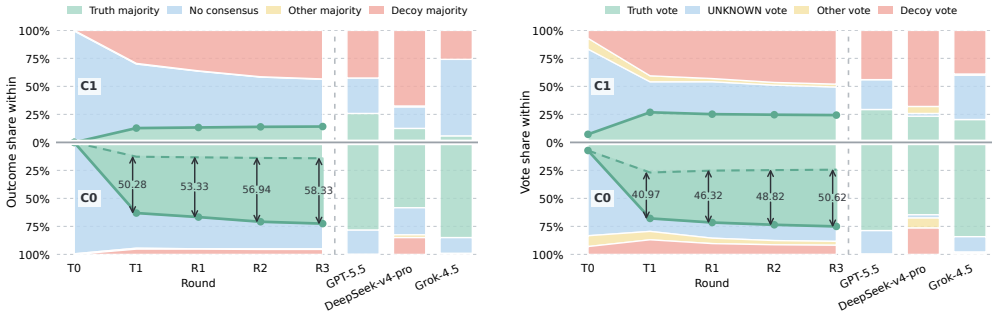
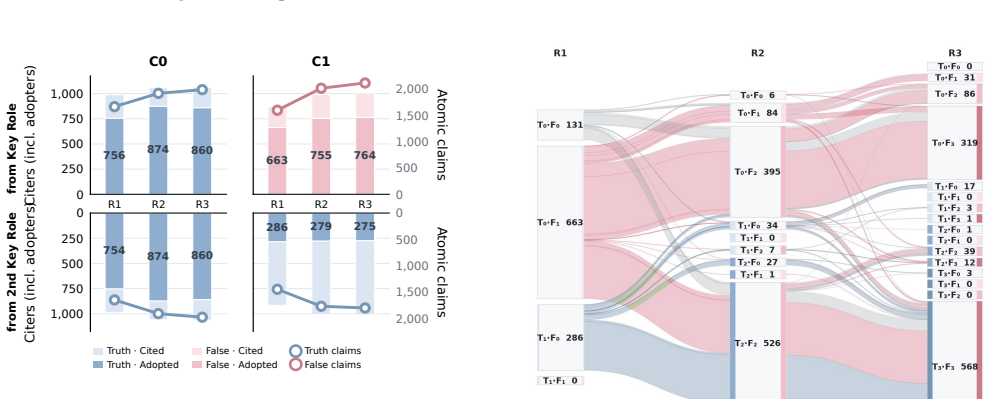
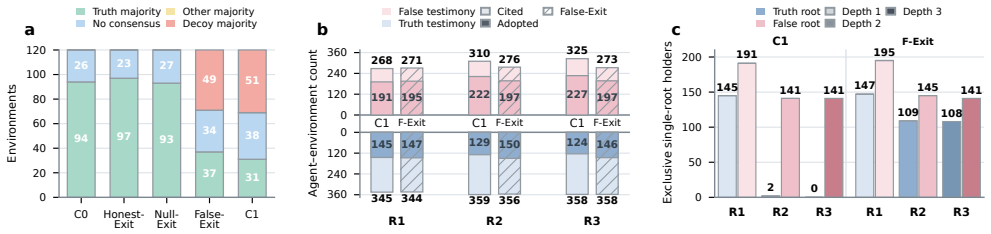
The paper claims that contamination of distributed evidence by a single false testimony is sufficient to derail collective fact recovery even when the pooled honest evidence uniquely determines the answer. On its own terms, the false testimony is not just noise: it becomes the dominant root of the group's reasoning. Under the deceptive condition, 70.7% of statements referencing the key role's testimony adopt its target, versus 25.4% for the matched truthful testimony from an equally well-placed honest witness; the false root's mean propagation order reaches 2.66 at the final round while the true root reaches only 1.33, and 82.87% of members who initially hold only the true root acquire the false root in the next round. Exit ablations show that removing the deceiver after the testimony does not remove the effect: honest agents continue to relay and adopt the false claim. The paper concludes that false evidence gains collective influence through adoption and continued propagation by other agents after entering communication, so robustness depends on how the group propagates and sustains evidence, not only on the deceiver's own behavior.
Load-bearing premise
The result rests on the instruction given to every agent that at most one participant may be an unreliable source, combined with a decoy endpoint that some honest witnesses lawfully report as their last sighting; if either condition changes, the false testimony's adoption advantage could shrink.
Editorial extensions
If this is right
- System designers should treat consensus as a risk signal, not a correctness signal: the same discussion process that integrates true evidence also amplifies false evidence.
- Robustness evaluation of multi-agent reasoning should include process-level metrics like testimony adoption and propagation depth, which reveal failure before the final vote.
- Strengthening the evidential weight of first-hand truthful testimony (e.g., provenance labeling and source-independence checks) is a direct design target implied by the asymmetry.
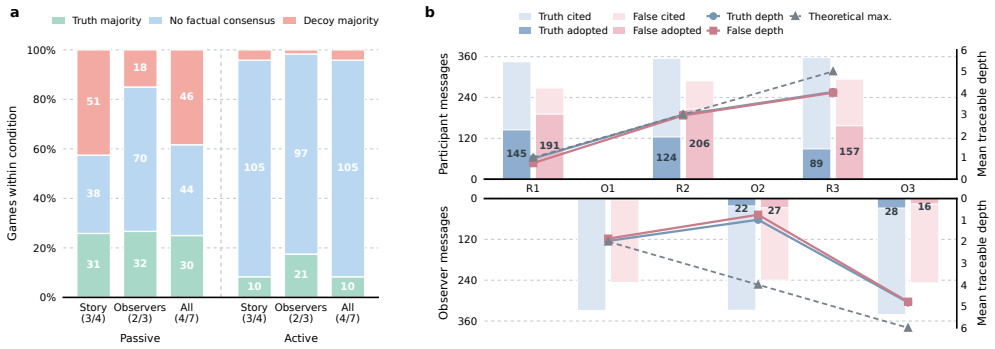
- Adding non-expert observers or external validators can reduce the risk of wrong consensus but will not restore truth recovery by itself, since observers in this study mainly converted decoy majorities into uncertainty.
- A single compromised evidence holder is enough to invert the majority: even with four honest agents holding jointly sufficient evidence, truth majorities fall from 72.50% to 14.17%.
Reading between the lines
- The one-liar prior embedded in the instructions may be the mechanism's fuel: under a prior that allows multiple unreliable sources, agents would have to weigh source independence more carefully and the adoption asymmetry could weaken; this is a direct but untested implication of the paper's design.
- Because the decoy is deliberately constructed as a lawful last sighting, the measured 14.17% truth-recovery rate characterizes a well-crafted lie, not an arbitrary falsehood; real-world misinformation that contradicts first-hand reports may propagate less easily.
- The paper's evidence-root lineage tracing could be turned into a detection tool: monitor adoption-to-reference ratios in real time and flag any root whose adoption rate exceeds its source's first-hand reliability.
- The homogeneous-agent design (same model, temperature zero) leaves open whether heterogeneous teams, where members have different priors or calibration, would be more or less susceptible to a single false testimony.
Editorial analysis
A structured set of objections, weighed in public.
Referee Report
Summary. The paper introduces Hi-Agreement, a paired experimental framework in which 120 object-movement environments are run with five-agent LLM systems under an all-honest condition (C0) and a one-deceiver condition (C1), using three LLMs (GPT-5.5, DeepSeek-v4-pro, and Grok-4.5). The central empirical claim is that a single false testimony from a key evidence holder reduces aggregate truth-majority recovery at the R3 checkpoint from 72.50% to 14.17% across 360 paired runs, with significant declines for all three models. Process tracing of testimony reference, adoption, and evidence-root lineage is used to argue that false testimony is adopted more readily than a matched truthful testimony, propagates to higher orders, and persists through honest agents after the deceiver exits; observer experiments show that uninformed observers reduce decoy consensus but not truth recovery.
Significance. The contribution is a carefully controlled, process-level benchmark for misinformation propagation in LLM-based multi-agent systems. The design has real strengths: paired C0/C1 runs on the same environments, structural validation of individual insufficiency and collective sufficiency (Appendix A.3), fixed communication topology, canonical testimony cards with typed evidential interpretation (Table A.5), a frozen result archive (Appendix E.4), and three heterogeneous model families. If the mechanism claim were fully established, the findings would be a useful caution for consensus-oriented multi-agent protocols and would justify provenance-aware discussion designs. However, the paper's central mechanism claim is not cleanly isolated from the structural design of the deception, as detailed below; the outcome-level effect is robust, but the interpretation of the adoption asymmetry as an effect of falsity per se requires additional control conditions.
major comments (3)
- [Appendix A.2, A.3, B.2, Table A.6] The design confounds falsity with temporal recency and lawful corroboration. The decoy d is always the preterminal location l_{m-1}, honest roles with windows ending at d truthfully report it as their last sighting ('Lawful support for the decoy'), and the shared instruction 'At most one participant may be an unreliable source' forces exactly two coherent candidate worlds in C1. The false testimony is therefore not merely false; it is a later-than-truth, independently corroborated rival. This design feature plausibly explains the adoption asymmetry (70.7% vs 25.4%, Section 4.2, Figure 3) and the propagation-depth asymmetry (2.66 vs 1.33, Section 4.2, Figure 4) without requiring that LLM agents are biased toward falsity per se. The manuscript should either restrict its claims to 'plausible misinformation that is temporally later and lawfully supported' or add control conditions with (i) an impossible decoy contradicted by all honest reports, (ii) removal of the 'at most one unreliable source' instruction, and (iii) counterbalanced assignment of which role is deceptive. The stress-test concern therefore lands.
- [Section 4.2, Figure 3] The 'matched truthful counterpart' is not matched on source. In C1, the false testimony always comes from the key role and the truthful testimony from the 2nd-key role; the reported adoption comparison (70.7% vs 25.4%) confounds truth status with source identity, role, and message content. The only within-source comparison available (key-role truth adoption under C0 vs key-role false adoption under C1) is not reported as the matched test. Without such a comparison, or without a counterbalanced design, the statement that 'false testimony is adopted more readily than truthful testimony' is not fully supported.
- [Section 4.2, Figure 4] The asymmetric transition rates (82.87% of true-root-only holders acquire the false root by R2 vs 38.31% in the reverse direction) are not conditioned on the differing base rates of the two roots. If the false root is already more prevalent among single-root holders, the raw transition asymmetry can arise even with symmetric per-exposure adoption. Report per-stage transition probabilities normalized by the number of agents at risk in each root-only state, or logistic-regression estimates controlling for root prevalence, before concluding that the false root enters true-root paths 'more readily'.
minor comments (5)
- [Section 4.2 and Figure 5(b)] Clarify the denominator for adoption rates; the main text says rates are 'calculated over the 1080 statements' while Figure 5(b) reports 'approximately 70%–72% adopt it' conditional on referencing. These definitions should be stated consistently.
- [Figure 4] The node-label encoding (presence of true/false roots plus maximum propagation order) is not defined in the text; add a legend or an explanatory table.
- [Figure 2] The small numeric labels (e.g., 50.28, 53.33) are unexplained; indicate explicitly what these numbers denote.
- [Section 3, 'Communication Content'] The claim that 'each role sends one message per story, yielding two private and three public communications' is consistent with Table A.4, but the Appendix should make explicit that the mandatory testimony board is separate from these five communication slots; the relationship is currently only implicit.
- [Appendix D.8, Figure D.12] Root-depth counts for observer stages include dual-root holders in both roots; state this in the main text when the six-stage depths are discussed.
Circularity Check
No circularity: all headline quantities are direct measurements of recorded agent behavior, with no fitted parameter or self-citation serving as the load-bearing derivation.
full rationale
This is an empirical measurement study. Every headline quantity—truth-majority rate, truth-vote share, testimony reference/adoption rate, propagation order, and evidence-root lineage transition—is operationally defined from recorded agent outputs and counted directly; none is a fitted parameter that is then reported as a prediction. The C0/C1 pairing holds state chains, observation windows, and communication topology fixed and changes only the key role's registered account, so the reported contrasts (72.50% to 14.17% truth recovery; 70.7% vs. 25.4% adoption) are measured differences, not values forced by the framework's equations. No load-bearing equation in the paper reduces to its own input: the structural requirements (partial observability, information sufficiency, candidate-world validation) are pre-experiment design checks, not quantities recovered from the experimental outcomes. The paper's citations to Hi-ToM and the hidden-profile literature are external sources used for dataset provenance and background, and no same-author citation is invoked as evidence for the central claim. The skeptic's concern that the decoy is always the preterminal location is a substantive experimental-design/confounding question about external validity, not a circularity in which a prediction reduces to its inputs by definition. Therefore, no circular steps are present.
Assumptions & free parameters
assumptions (4)
- domain assumption Agents are instructed that 'at most one participant may be an unreliable source' (Appendix B.2, shared task instructions).
- domain assumption No unreported movement may be invented, and repeated location names denote distinct occurrences unless connected by reported transitions (Appendix B.2).
- domain assumption The pooled local observations uniquely determine the endpoint for all 120 environments (collective sufficiency, Appendix A.3).
- domain assumption Each C1 environment admits exactly two coherent candidate worlds: one in which the key role is unreliable, and one in which the honest terminal witness is unreliable (Appendix A.3).
Cite this review
Pith. "Pith review of When Truth Is Distributed: Misinformation Derails Collective Fact Recovery in LLM-Based Multi-Agent Systems." pith.science (2026). https://pith.science/paper/T5MMWRMU
@misc{pith2026260803421,
  author       = {Pith},
  title        = {Pith review of: When Truth Is Distributed: Misinformation Derails Collective Fact Recovery in LLM-Based Multi-Agent Systems},
  year         = {2026},
  howpublished = {\url{https://pith.science/paper/T5MMWRMU}},
  note         = {Machine review of arXiv:2608.03421}
}
read the original abstract
LLM-based multi-agent systems promise effective collaborative reasoning, but communication may amplify local errors into collective risks. Existing evaluations emphasize final outcomes, leaving the reliability and propagation dynamics of distributed information aggregation unclear. We introduce Hi-Agreement, a controlled evaluation framework that strictly pairs all-honest collaboration with controlled deception by a key evidence holder and analyzes the aggregation process through multi-stage voting, testimony adoption, and evidence-root lineage propagation. Using 120 five-agent object-movement environments where partial observations jointly determine a unique endpoint, we evaluate 3 homogeneous LLM-based multi-agent systems. Across these paired conditions, aggregate truth recovery falls from 72.50% to 14.17%, with significant declines for every system. Process tracing and exit ablations show that a single false testimony is adopted more readily than truthful testimony, propagates to higher orders, and persists through honest agents after the deceiver exits. Observers without first-hand evidence suppress incorrect consensus but do not improve truth recovery. Together, these findings reveal both the fragility of distributed fact recovery and its underlying mechanism: false evidence gains collective influence through its adoption and continued propagation by other agents after entering communication.
Figures

Figures from the paper (2 more)
Reference graph
Works this paper leans on
-
[1]
2026 , month = apr, howpublished =
2026
-
[2]
doi:10.48550/arXiv.2606.19348 , url =
arXiv preprint arXiv:2606.19348 , year =. doi:10.48550/arXiv.2606.19348 , url =
- [3]
-
[4]
Findings of the Association for Computational Linguistics: EMNLP 2023 , pages=
Hi-tom: A benchmark for evaluating higher-order theory of mind reasoning in large language models , author=. Findings of the Association for Computational Linguistics: EMNLP 2023 , pages=
work page 2023
-
[5]
Advances in Neural Information Processing Systems , volume=
CAMEL: Communicative Agents for" Mind" Exploration of Large Language Model Society , author=. Advances in Neural Information Processing Systems , volume=
-
[6]
First conference on language modeling , year=
Autogen: Enabling next-gen LLM applications via multi-agent conversations , author=. First conference on language modeling , year=
-
[7]
LLM Agents for Deliberative Collaboration: A Study on Joint Decision Making Under Partial Observability , author=. arXiv preprint arXiv:2607.06157 , year=
-
[8]
Proceedings of the 41st International Conference on Machine Learning , pages=
Improving factuality and reasoning in language models through multiagent debate , author=. Proceedings of the 41st International Conference on Machine Learning , pages=
Show all 45 references
-
[9]
Personality and Social Psychology Review , volume=
Twenty-five years of hidden profiles in group decision making: A meta-analysis , author=. Personality and Social Psychology Review , volume=. 2012 , publisher=
2012
-
[10]
, author=
Pooling of unshared information in group decision making: Biased information sampling during discussion. , author=. Journal of personality and social psychology , volume=. 1985 , publisher=
1985
-
[11]
, author=
Group decision making under conditions of distributed knowledge: The information asymmetries model. , author=. Academy of Management Review , volume=. 2007 , publisher=
2007
-
[12]
Findings of the Association for Computational Linguistics: ACL 2025 , pages=
Red-teaming llm multi-agent systems via communication attacks , author=. Findings of the Association for Computational Linguistics: ACL 2025 , pages=
2025
-
[13]
Proceedings of the 2025 Conference on Empirical Methods in Natural Language Processing , pages=
Understanding the information propagation effects of communication topologies in llm-based multi-agent systems , author=. Proceedings of the 2025 Conference on Empirical Methods in Natural Language Processing , pages=
2025
-
[14]
Forty-third International Conference on Machine Learning , year=
Systematic failures in collective reasoning under distributed information in multi-agent llms , author=. Forty-third International Conference on Machine Learning , year=
-
[15]
arXiv preprint arXiv:2606.16710 , year=
Misinformation Propagation in Benign Multi-Agent Systems , author=. arXiv preprint arXiv:2606.16710 , year=
-
[16]
Proceedings of the 2025 Conference on Empirical Methods in Natural Language Processing: System Demonstrations , pages=
Mallm: Multi-agent large language models framework , author=. Proceedings of the 2025 Conference on Empirical Methods in Natural Language Processing: System Demonstrations , pages=
2025
-
[17]
Proceedings of the 62nd Annual Meeting of the Association for Computational Linguistics (Volume 1: Long Papers) , pages=
Reconcile: Round-table conference improves reasoning via consensus among diverse llms , author=. Proceedings of the 62nd Annual Meeting of the Association for Computational Linguistics (Volume 1: Long Papers) , pages=
-
[18]
Proceedings of the 62nd Annual Meeting of the Association for Computational Linguistics (Volume 1: Long Papers) , pages=
Rethinking the bounds of llm reasoning: Are multi-agent discussions the key? , author=. Proceedings of the 62nd Annual Meeting of the Association for Computational Linguistics (Volume 1: Long Papers) , pages=
-
[19]
Proceedings of the 2024 conference on empirical methods in natural language processing , pages=
Encouraging divergent thinking in large language models through multi-agent debate , author=. Proceedings of the 2024 conference on empirical methods in natural language processing , pages=
2024
-
[20]
2024 , booktitle=
ChatEval: Towards Better LLM-based Evaluators through Multi-Agent Debate , author=. 2024 , booktitle=
2024
-
[21]
Findings of the Association for Computational Linguistics: EMNLP 2024 , pages=
Improving multi-agent debate with sparse communication topology , author=. Findings of the Association for Computational Linguistics: EMNLP 2024 , pages=
2024
-
[22]
Findings of the Association for Computational Linguistics: ACL 2025 , pages=
Voting or consensus? decision-making in multi-agent debate , author=. Findings of the Association for Computational Linguistics: ACL 2025 , pages=
2025
-
[23]
International Conference on Machine Learning , pages=
Should we be going MAD? A Look at Multi-Agent Debate Strategies for LLMs , author=. International Conference on Machine Learning , pages=. 2024 , organization=
2024
-
[24]
Proceedings of the 63rd Annual Meeting of the Association for Computational Linguistics (Volume 1: Long Papers) , pages=
Beyond frameworks: Unpacking collaboration strategies in multi-agent systems , author=. Proceedings of the 63rd Annual Meeting of the Association for Computational Linguistics (Volume 1: Long Papers) , pages=
-
[25]
, author=
Information sharing and team performance: a meta-analysis. , author=. Journal of applied psychology , volume=. 2009 , publisher=
2009
-
[26]
Communication Monographs , volume=
Decision-making groups attenuate the discussion bias in favor of shared information: A meta-analysis , author=. Communication Monographs , volume=. 2010 , publisher=
2010
-
[27]
Communication monographs , volume=
From cooperative to motivated information sharing in groups: Moving beyond the hidden profile paradigm , author=. Communication monographs , volume=
-
[28]
Reimer, Torsten and Reimer, Andrea and Hinsz, Verlin B , journal=. Na. 2010 , publisher=
2010
-
[29]
Findings of the Association for Computational Linguistics: EMNLP 2024 , pages=
Multiagent collaboration attack: Investigating adversarial attacks in large language model collaborations via debate , author=. Findings of the Association for Computational Linguistics: EMNLP 2024 , pages=
2024
-
[30]
Proceedings of the 2nd Workshop on Cross-Cultural Considerations in NLP , pages=
Conformity, confabulation, and impersonation: Persona inconstancy in multi-agent LLM collaboration , author=. Proceedings of the 2nd Workshop on Cross-Cultural Considerations in NLP , pages=
-
[31]
Findings of the Association for Computational Linguistics: ACL 2025 , pages=
CONSENSAGENT: Towards efficient and effective consensus in multi-agent LLM interactions through sycophancy mitigation , author=. Findings of the Association for Computational Linguistics: ACL 2025 , pages=
2025
-
[32]
Findings of the Association for Computational Linguistics: ACL 2026 , pages=
Free-mad: Consensus-free multi-agent debate , author=. Findings of the Association for Computational Linguistics: ACL 2026 , pages=
2026
-
[33]
arXiv preprint arXiv:2505.21588 , year=
Herd behavior: Investigating peer influence in llm-based multi-agent systems , author=. arXiv preprint arXiv:2505.21588 , year=
-
[34]
arXiv preprint arXiv:2410.07283 , year=
Prompt infection: Llm-to-llm prompt injection within multi-agent systems , author=. arXiv preprint arXiv:2410.07283 , year=
-
[35]
Communication, Simulation, and Intelligent Agents: Implications of Personal Intelligent Machines for Medical Education
Clancey, William J. Communication, Simulation, and Intelligent Agents: Implications of Personal Intelligent Machines for Medical Education. Proceedings of the Eighth International Joint Conference on Artificial Intelligence (IJCAI-83)
-
[36]
Classification Problem Solving
Clancey, William J. Classification Problem Solving. Proceedings of the Fourth National Conference on Artificial Intelligence
-
[37]
, title =
Robinson, Arthur L. , title =. 1980 , doi =. https://science.sciencemag.org/content/208/4447/1019.full.pdf , journal =
1980
-
[38]
New Ways to Make Microcircuits Smaller---Duplicate Entry
Robinson, Arthur L. New Ways to Make Microcircuits Smaller---Duplicate Entry. Science
-
[39]
Clancey and Glenn Rennels , abstract =
Diane Warner Hasling and William J. Clancey and Glenn Rennels , abstract =. Strategic explanations for a diagnostic consultation system , journal =. 1984 , issn =. doi:https://doi.org/10.1016/S0020-7373(84)80003-6 , url =
1984 doi
-
[40]
and Rennels, Glenn R
Hasling, Diane Warner and Clancey, William J. and Rennels, Glenn R. and Test, Thomas. Strategic Explanations in Consultation---Duplicate. The International Journal of Man-Machine Studies
-
[41]
Poligon: A System for Parallel Problem Solving
Rice, James. Poligon: A System for Parallel Problem Solving
-
[42]
Transfer of Rule-Based Expertise through a Tutorial Dialogue
Clancey, William J. Transfer of Rule-Based Expertise through a Tutorial Dialogue
-
[43]
The Engineering of Qualitative Models
Clancey, William J. The Engineering of Qualitative Models
-
[44]
2023 , eprint=
Attention Is All You Need , author=. 2023 , eprint=
2023
-
[45]
Pluto: The 'Other' Red Planet
NASA. Pluto: The 'Other' Red Planet
Reviewed August 8, 2026 · model on record in the stance chip above.
Discussion (0). Continue with ORCID to comment.