REVIEW 3 major objections 5 minor 13 references
More Relationships between a Central Quadrilateral and its Reference Quadrilateral
T0 review · 3 major / 5 minor · reviewed 2026-08-07 · deepseek-v4-flash
Pith's one-line read This paper catalogs, for 28 quadrilateral shapes and 1000 triangle centers, exactly how the quadrilateral formed from the four half-triangle centers relates to the original—congruence, similarity, area, circles, and more.
desk verdict A useful, honestly-reported extension of a computer-discovered geometry catalog, but the proof-status convention breaks down in §32 and needs fixing before it can be used as a reliable reference. read the letter →
The pith
A machine-rendered reading of the paper's core claim, the machinery that carries it, and where it could break.
The reading
What carries the argument
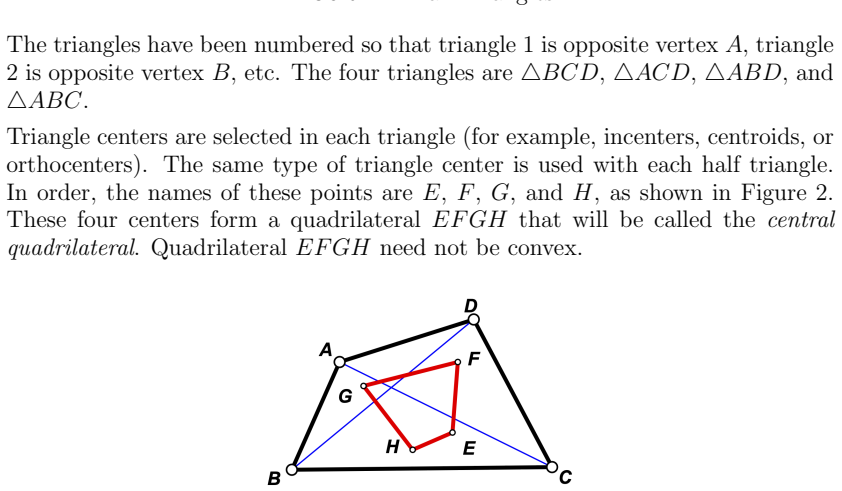
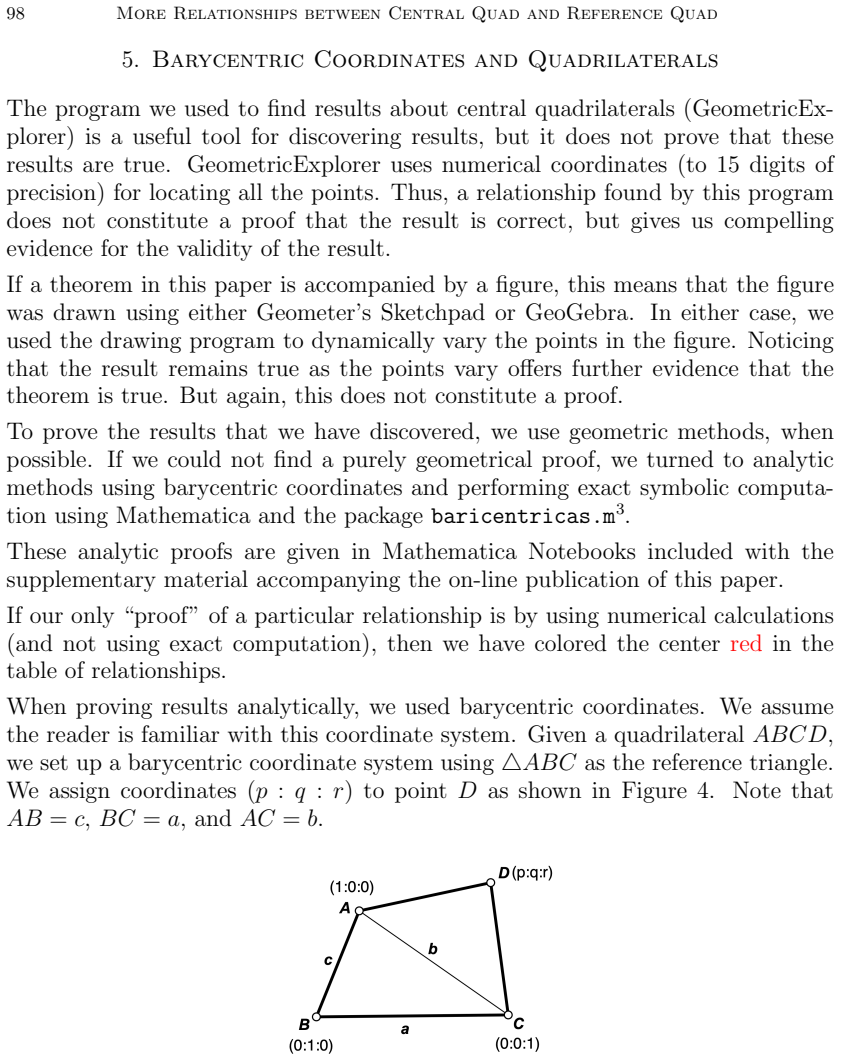
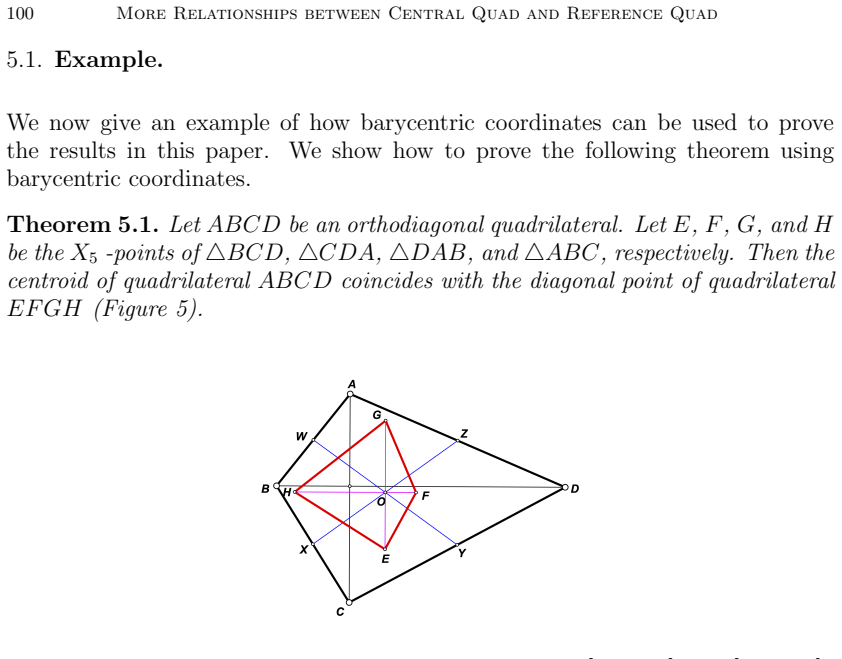
The construction is the half-triangle device: the diagonals of a quadrilateral $ABCD$ divide it into four triangles $\triangle BCD$, $\triangle ACD$, $triangle ABD$, and $\triangle ABC$; placing the same indexed center $X_n$ in each gives points $E,F,G,H$, and the quadrilateral $EFGH$ is the central quadrilateral. The proof machinery is barycentric coordinates with $\triangle ABC$ as reference and $D=(p:q:r)$; each quadrilateral shape becomes an algebraic condition on $a,b,c,p,q,r$ (cyclicity, for example, is $a^2qr+b^2pr+c^2pq=0$), and each center's coordinates come from its center function. Claims are checked by exact symbolic simplification under these constraints, with numerical computer search as the discovery engine and, when no exact proof was found, as the only evidence. The named identities that carry the arguments include the Euler-Poncelet point, the common point of the nine-point circles of the half-triangles, and the Gergonne-Steiner point.
What would settle it
Pick any entry colored red in the tables, write out the two quadrilaterals' coordinates in the barycentric system of Section 5, and compute the claimed equality as a rational function of the side lengths and shape parameters; if that function is not identically zero under the shape condition, the entry is false.
Extended reading notes
Core claim
On the paper's own terms, the central claim is that for each of the 28 listed quadrilateral classes and each of the first 1000 indexed triangle centers, the relationship between the reference quadrilateral $ABCD$ and the central quadrilateral $EFGH$ is a definite geometric fact, and the paper's tables state which of the tested relationships hold for which centers. The flagship proved cases are: $X_2$ (centroid) yields similarity with ratio $3$, homothety at the centroid, and area ratio $9:1$ for any quadrilateral; $X_4$ (orthocenter) preserves area and gives a common rectangular-hyperbola circumconic with center at the Euler-Poncelet point; $X_{399}$ on a cyclic quadrilateral gives concentric circumcircles with radii in ratio $1:2$; and $X_1$ on a tangential quadrilateral makes $ABCD$ and $GHEF$ perspective at the incenter. For cyclic quadrilaterals, centers lying on the reference triangle's circumcircle automatically give the same circumcircle. Where the authors could not provide a synthetic or symbolic proof, they mark the center red and rely on 15-digit numerical checks; the paper is explicit that these are discoveries, not proofs.
Load-bearing premise
The unproved table entries depend on the assumption that numerical checks to 15 digits, plus visual variation of a diagram as points move, are reliable signs that an exact relationship holds for every quadrilateral of that type.
Editorial extensions
If this is right
- For any quadrilateral, the centroid-centered central quadrilateral is a $1/3$-scale homothetic copy centered at the original quadrilateral's centroid, so the area is divided by $9$.
- For any quadrilateral, the orthocenter-centered central quadrilateral has the same area as the original, even though its shape generally differs.
- For a cyclic quadrilateral, any triangle center that lies on the circumcircle of the reference triangle produces the same circumcircle for the central quadrilateral, which transfers a whole list of centers into quadrilateral statements.
- For a tangential quadrilateral, the four lines from the vertices to the incenters of the opposite half-triangles concur at the incenter, giving a new perspectivity.
- The red, numerically verified table entries are asserted as conjectured geometric facts; if they hold exactly, they extend the catalogue of center-to-quadrilateral relations well beyond the proved cases.
Reading between the lines
- A natural next step the paper does not take is to treat the parameter $k$ in families like $\cos B\cos C+k\cos A$ as a continuous variable and compute the central quadrilateral's invariants as rational functions of $k$, turning isolated center entries into full continuous families.
- Because the search only tested rational area ratios with denominators below 10, relationships with ratios such as $7/13$ or with expressions involving square roots would have been missed; a symbolic-area-search extension would likely reveal further table entries.
- The same half-triangle construction could be applied to triangle points that are not triangle centers, such as the Brocard points the paper tests for squares, suggesting a broader theory of 'central figures' beyond the first 1000 indexed centers.
- The red entries form a concrete testbed for automated theorem proving: each is a single exact algebraic identity waiting to be confirmed or refuted by symbolic computation, independent of the numerical evidence that found it.
Editorial analysis
A structured set of objections, weighed in public.
Referee Report
Summary. The paper studies central quadrilaterals: for a reference quadrilateral ABCD, the four triangles formed by its sides and diagonals (half-triangles) host the same triangle center X_n, and the four resulting points E,F,G,H form the central quadrilateral EFGH. For 28 quadrilateral shapes and the first 1000 triangle centers, the authors use the GeometricExplorer program to detect relationships such as congruence, similarity, equal area, equal perimeter, common circumconics, perspectivity, and homothety between ABCD and EFGH. Some results are proved exactly via barycentric coordinates (e.g., Theorems 5.1, 6.1, 7.1, 14.4, 14.5), while many others are supported only by 15-digit numerical computation. The paper's Section 5 states that numerical evidence is not proof and that unproved results are colored red in tables, but this convention is not applied consistently, particularly in Section 32 where several statements labeled 'Theorem' are only computer discoveries and are followed by open questions asking for proofs. The paper is an extension of the authors' earlier work [4,5] and includes many tables of newly found relationships.
Significance. If the catalog of relationships is reliable, this is a useful contribution to computer-discovered geometry: it provides exact symbolic proofs for several theorems (e.g., Theorem 5.1, 7.1, 14.4, 14.5), a reproducible computational search methodology, and a systematic map of how central quadrilaterals behave across a wide range of triangle centers and quadrilateral shapes. The paper is also commendably explicit about the difference between numerical evidence and proof in its methodology section. However, the central claim that the listed relationships are genuine geometric facts is undermined by the inconsistent application of that very distinction: several 'Theorem' statements in Section 32 rest solely on computer search, and the tables in Sections 6-31 do not visibly carry the red/proved status markers described in Section 5. The paper also leaves undefined the notions of area and perimeter for the non-convex or self-intersecting central quadrilaterals that it explicitly allows. These issues are load-bearing for the catalog's usability and must be repaired before the results can be reliably used as a reference.
major comments (3)
- [§5 vs §32] The proof-status convention stated in Section 5 (numerical evidence is not proof; unproved results are colored red) is not applied in Section 32. Theorems 32.2, 32.3, 32.4, 32.6, 32.7, 32.8, and 32.9 are all presented as 'Theorem' but are introduced as 'found by computer' with no proof, no red marking, and no pointer to a symbolic notebook. Several of these are immediately followed by Open Questions 9, 11, and 13 asking for 'purely geometrical' proofs, confirming that no analytic proof is supplied. Because the reader cannot distinguish established theorems from numerical conjectures within the same document, the central claim that the listed relationships are genuine geometric facts is not reliably supported. The authors should either provide exact symbolic proofs or explicit notebook references for every statement labeled Theorem, or re-label these results as conjectures/computer discoveries and apply the color convention consistently.
- [§1, §4, §6] The paper does not define 'area' and 'perimeter' for the central quadrilateral EFGH, although it explicitly states in Section 1 that EFGH need not be convex. The relationships table in Section 4 includes entries such as '[ABCD] = k[EFGH]' and '∂ABCD = ∂EFGH', and theorems such as Theorem 6.2 ([ABCD] = 9[EFGH]) and Theorem 6.6 ([ABCD] = [EFGH]) assert exact area equalities. If EFGH is concave or self-intersecting, the shoelace formula yields a signed area while the usual polygon area is the absolute value, and these give different values for self-intersecting cases. The perimeter of a self-intersecting quadrilateral also needs a convention (e.g., sum of side lengths of the polygonal path, or perimeter of the convex hull). The truth of the area and perimeter claims can depend on these choices, so the paper must specify precisely how these quantities are computed.
- [§6–§31 tables] The red/proved status marker described in Section 5 is not visible in the tables as presented in the text. For example, the Central Quadrilaterals of Cyclic Quadrilaterals tables in Section 14 list centers such as 5, 550, 376, 140, etc. for area ratios and other relationships, but there is no per-entry indication of whether the entry is a proved theorem, an analytic proof from a notebook, or a purely numerical discovery. The legend in Section 5 says numerically verified centers are colored red and proved centers are not, but no colors are reproduced in the manuscript text. This is not merely a visual issue: it is the mechanism by which the paper itself says a reader should distinguish reliable from conjectural results. The authors should add an explicit per-entry marker (e.g., bold for proved, red for numerical, or a footnote referencing the specific notebook) so that each table entry carries its proof status.
minor comments (5)
- [§4] The footnote that only rational area ratios k with denominators less than 10 were checked is a significant limitation and should be stated in the Introduction or Abstract, since later sections report ratios such as 144/25 and 100/9 (Section 14) and 25/4 (Section 30).
- [§32.6] In the list of n for which a cyclic quadrilateral has a common non-circular circumconic, the number '11738' appears twice; one occurrence is likely a typo for another ETC index such as 1173, and the list should be corrected.
- [§5.1] For reproducibility, the example proof should state the exact version of the baricentricas.m package used and include the precise Mathematica commands that generate the final simplification result, since the displayed code shows the definitions of the routines but not the full session output.
- [§32.2] The term 'orthoptic quadrilateral' is defined only in the future-work section (32.2); if it is a new class of quadrilaterals, it should be defined and listed in the table of quadrilateral types in Section 2 rather than introduced informally in a later section.
- [References] Some references are informal, such as [6] ('personal correspondence') and [13] ('submitted'); for any theorem attributed to such a source, a precise statement or proof should be included in the paper to keep the catalog self-contained.
Circularity Check
No significant circularity: the catalog is produced by independent computer search and symbolic barycentric verification, with only minor reliance on the authors' prior proved results.
full rationale
The derivation chain is not circular. The central quadrilateral is a geometric construction defined independently of the claims, and the claimed relationships (similarity, area ratios, homothety, perspectivity, common conics) are nontrivial outputs of a search over the first 1000 triangle centers and 28 quadrilateral shapes, not parameters fitted to force the conclusions. Section 5 explicitly states that 15-digit numerical checks are not proofs and that unproved entries are colored red; symbolic barycentric proofs are supplied for many statements (e.g., Theorem 5.1 and the analytic proof of Theorem 14.4 in the supplementary material). The paper does cite the authors' own prior papers [4] and [5] for several base theorems (Theorem 6.1, Theorem 6.6, Theorem 30.1, and part of Theorem 23.1), but those are independently published with proofs and are not used to fit the new catalog entries, so this is minor self-citation rather than a circular reduction. The main caveat is epistemic, not circular: §5's red-coloring rule is not consistently applied in §32, where Theorems 32.2, 32.3, 32.4, 32.6–32.8, and 32.9 are labeled 'Theorem' but are described only as 'found by computer' with no red marking or supplied analytic proof, and Open Questions 9, 11, and 13 ask for 'purely geometrical' proofs. That is an inconsistency in proof-status labeling and a correctness risk, but it does not make any claimed result equivalent to its inputs.
Assumptions & free parameters
assumptions (5)
- standard math Standard axioms of Euclidean geometry and barycentric coordinates.
- domain assumption The coordinates and definitions of the 1000 triangle centers X_n are taken as correct from the Encyclopedia of Triangle Centers [2].
- domain assumption The baricentricas.m Mathematica package performs exact symbolic barycentric computations correctly.
- domain assumption The 15-digit numerical results from GeometricExplorer reliably indicate exact geometric relationships.
- domain assumption The quadrilateral shape conditions (e.g., orthodiagonal, cyclic, tangential) are correctly translated into algebraic constraints on the barycentric coordinates p, q, r.
Cite this review
Pith. "Pith review of More Relationships between a Central Quadrilateral and its Reference Quadrilateral." pith.science (2026). https://pith.science/paper/T662IBN7
@misc{pith2026250617240,
  author       = {Pith},
  title        = {Pith review of: More Relationships between a Central Quadrilateral and its Reference Quadrilateral},
  year         = {2026},
  howpublished = {\url{https://pith.science/paper/T662IBN7}},
  note         = {Machine review of arXiv:2506.17240}
}
read the original abstract
The diagonals of a quadrilateral form four associated triangles, called half triangles. Each half triangle is bounded by two sides of the quadrilateral and one diagonal. If we locate a triangle center (such as the incenter, centroid, orthocenter, etc.) in each of these triangles, the four triangle centers form another quadrilateral called a central quadrilateral. For each of various shaped quadrilaterals, and each of 1000 different triangle centers, we compare the reference quadrilateral to the central quadrilateral. Using a computer, we determine how the two quadrilaterals are related. For example, we test to see if the two quadrilaterals are congruent, similar, have the same area, or have the same perimeter.
Figures


Figures from the paper (17 more)




Reference graph
Works this paper leans on
-
[1]
https://www.jstor.org/stable/2690608
Clark Kimberling,Central Points and Central Lines in the Plane of a Triangle, Mathemat- ics Magazine,67(1994)163–187. https://www.jstor.org/stable/2690608
-
[2]
http://faculty.evansville.edu/ck6/encyclopedia/ETC.html
Clark Kimberling,Encyclopedia of Triangle Centers, 2025. http://faculty.evansville.edu/ck6/encyclopedia/ETC.html
work page 2025
-
[3]
Arrangement of Central Points on the Faces of a Tetrahedron
Stanley Rabinowitz,Arrangement of Central Points on the Faces of a Tetrahedron, Inter- national Journal of Computer Discovered Mathematics.5(2020)13–41. https://arxiv.org/abs/2101.02592
work page Pith review arXiv 2020
-
[4]
The Shape of Central Quadrilaterals
Stanley Rabinowitz and Ercole Suppa,The Shape of Central Quadrilaterals. International Journal of Computer Discovered Mathematics.7(2022)131–180. https://arxiv.org/abs/2205.00870
work page Pith review arXiv 2022
-
[5]
Relationships between a Central Quadrilateral and its Reference Quadrilateral
Stanley Rabinowitz and Ercole Suppa,Relationships between a Central Quadrilateral and its Reference Quadrilateral. International Journal of Computer Discovered Mathematics. 7(2022)214–287. https://arxiv.org/abs/2209.06008
work page Pith review arXiv 2022
- [6]
-
[7]
https://chrisvantienhoven.nl/mathematics/encyclopedia
Chris van Tienhoven, Encyclopedia of Quadri-Figures. https://chrisvantienhoven.nl/mathematics/encyclopedia
-
[8]
From Encyclopedia of Quadri-Figures
Chris van Tienhoven,QA-P1: Quadrangle Centroid. From Encyclopedia of Quadri-Figures. https://www.chrisvantienhoven.nl/qa-items/qa-points/qa-p1
Show all 13 references
-
[9]
From Encyclopedia of Quadri-Figures
Chris van Tienhoven,QA-P2: Euler-Poncelet Point. From Encyclopedia of Quadri-Figures. https://www.chrisvantienhoven.nl/qa-items/qa-points/qa-p2
-
[10]
From Encyclopedia of Quadri-Figures
Chris van Tienhoven,QA-P34: Euler-Poncelet Point of the Centroid Quadrangle. From Encyclopedia of Quadri-Figures. https://www.chrisvantienhoven.nl/qa-items/qa-points/qa-p34
-
[11]
Weisstein,Circumcircle
Eric W. Weisstein,Circumcircle. From MathWorld–A Wolfram Web Resource. https://mathworld.wolfram.com/Circumcircle.html
-
[12]
In Wikipedia, The Free Encyclopedia
Wikipedia contributors,Harmonic Quadrilateral. In Wikipedia, The Free Encyclopedia. https://en.wikipedia.org/w/index.php?title=Harmonic_quadrilateral&oldid= 1260983024
-
[13]
Dylan Wyrzykowski,On a Family of Circumconics, submitted to International Journal of Computer Discovered Mathematics, 2025
2025
Reviewed August 7, 2026 · model on record in the stance chip above.
Discussion (0). Sign in to comment.