REVIEW 2 major objections 5 minor 42 references
A thermodynamically consistent Johnson-Segalman-Giesekus model: numerical simulation of the rod climbing effect
T0 review · 2 major / 5 minor · reviewed 2026-08-03 · deepseek-v4-flash
Pith's one-line read A thermodynamically consistent Johnson–Segalman–Giesekus model reproduces rod-climbing experiments better than the engineering version, which the paper argues is incompatible with the second law of thermodynamics.
desk verdict Solid thermodynamic core and usable open-source solver; empirical 'superiority' is a per-point fit, and the abstract overstates the Model II inconsistency. read the letter →
The pith
A machine-rendered reading of the paper's core claim, the machinery that carries it, and where it could break.
The reading
What carries the argument
The machinery centres on the conformation tensor B (a symmetric positive-definite tensor tracking elastic polymer deformation) and the reduced dissipation identity ξ=T:D−ρψ̇. The paper pairs a neo-Hookean free energy ψ(B)=G/(2ρ)(tr B−ln det B−d) with a Gordon–Schowalter objective time derivative (frame-indifferent, slip parameter a; a=1 gives the Oldroyd upper-convected derivative) and a Giesekus-type relaxation. The central algebraic identity (I−B⁻¹):(B−I)=Σ_i(λ_i^{1/2}−λ_i^{−1/2})²≥0 makes Model I's dissipation manifestly non-negative. This machinery converts two scalar constitutive choices—energy storage and dissipation—into one tensorial law, and it exposes Model II's flaw: its extra str
What would settle it
Attempt to find a Helmholtz free energy for Model II that makes its dissipation non-negative for all admissible B and D with a≠1; success would directly refute the paper's claim that the engineering Johnson–Segalman model is incompatible with the second law.
Extended reading notes
Core claim
The paper claims a structural distinction between two similar-looking constitutive equations. Model I writes the Cauchy stress with a factor a multiplying the elastic term and evolves a symmetric positive-definite conformation tensor B through a Gordon–Schowalter derivative with Giesekus-type relaxation; its dissipation is non-negative for all a∈[−1,1], α∈[0,1]. Model II has the same evolution but no factor a in the stress, producing an indefinite cross term G(1−a)(B+B⁻¹):D; for a≠1 its dissipation can go negative. In rotating-rod simulations, Model I matches experimental climbing heights and trends across rotation speeds; Model II predicts exaggerated rod descent and fits poorly. The author
Load-bearing premise
The charge that the engineering Johnson–Segalman model violates the second law presupposes that it must be judged by the same neo-Hookean free energy as the new model; if a different free energy is allowed, the indefinite term only shows incompatibility with one chosen thermodynamic structure, not with thermodynamics as such.
Editorial extensions
If this is right
- Outside the upper-convected limit (a=1), the engineering Johnson–Segalman model should not be trusted for free-surface flows; the thermodynamically consistent variant gives physically plausible surfaces across a∈[0,1].
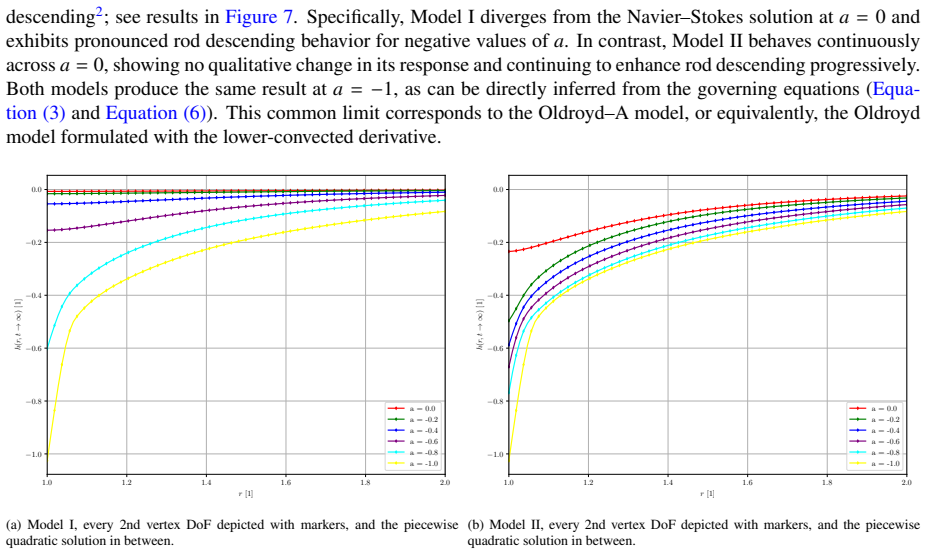
- Model I has a clean Newtonian limit as a→0, with elastic stresses and stored energy vanishing continuously; Model II lacks this limit, which explains its anomalous rod-descent predictions.
- The non-negative dissipation result holds for all a∈[−1,1] and α∈[0,1], so the thermodynamically consistent construction covers the whole Gordon–Schowalter family, not just the Oldroyd-B case.
- Higher-order finite-element ALE simulations of the rotating-rod viscometer reach mesh- and p-converged free-surface shapes at a fraction of the cost of low-order simulations, making quantitative rod-climbing comparisons routine.
- The numerical results for the Giesekus case show the analytical climb/descent criterion is conservative and systematically offset from the actual transition, so asymptotic criteria should be used with caution beyond their formal limits.
Reading between the lines
- The second-law critique of Model II is conditional: the indefinite cross term appears when the engineering model is tested against the same neo-Hookean free energy used for Model I. A different free energy could in principle restore non-negative dissipation, so the paper's 'incompatible with the second law' wording is stronger than the calculation alone supports.
- The slip parameter a is fitted separately at each rotation speed, drifting from about 0.83 at lower speeds to about 0.805 at higher speeds. A sharper test of the model would fix a single value across all speeds and check whether the experimental trend still matches, since a should be a material parameter.
- The same construction likely transfers to other rate-type models: putting the free energy and dissipation on the same footing and scaling the elastic stress by the objective-derivative parameter eliminates the indefinite cross term, which suggests a general recipe for thermodynamically admissible viscoelasticity.
- The systematic offset between the asymptotic Giesekus transition criterion and the numerical transition suggests comparable asymptotic criteria for other free-surface effects may inherit a conservative bias.
Editorial analysis
A structured set of objections, weighed in public.
Referee Report
Summary. The paper introduces a thermodynamically consistent Johnson–Segalman–Giesekus model (Model I, Eq. 3) in which the slip parameter multiplies the elastic stress contribution, and contrasts it with the classical engineering JSG model (Model II, Eqs. 4/6) in which it does not. The authors prove non-negativity of the rate of dissipation for Model I under a neo-Hookean free energy (Eqs. 16–21), show that Model II has an indefinite cross term under the same free energy (Eq. 30), and derive Model I in the a=1 case from the Rajagopal–Srinivasa framework. They then develop a high-order finite-element ALE scheme, validate it against mesh and p-refinement studies and against earlier Oldroyd-B results, and compare rod climbing predictions with the Beavers–Joseph experiments and prior numerical studies. The central empirical claim is that Model I captures the experimental climbing heights 'exceedingly well' and is therefore superior to Model II and other models in the class.
Significance. If the empirical claim were fully supported, the paper would deliver a thermodynamically admissible JSG-type model with a clear advantage over the widely used engineering version, plus an open-source, reusable computational tool for free-surface viscoelastic flows. The thermodynamic part is genuinely strong: the positivity proof in Section 2.1 is transparent, parameter-free, and correct for Model I, and the derivation in Section 3 connects the model to evolving natural configurations. The numerical sections show careful convergence studies and release code on GitHub. However, the headline claim of empirical superiority is currently under-supported because the slip parameter is fitted separately at each rotation speed, and the abstract overstates the Model II thermodynamic result. These issues are fixable but they are load-bearing for the paper's main selling points.
major comments (2)
- [§7.3, Figure 8] The abstract states that the engineering Johnson–Segalman model is 'incompatible with the second law of thermodynamics,' but the analysis in Section 2.2 only shows that, for the neo-Hookean free energy (7), the rate of dissipation in Eq. (30) contains an indefinite term G(1−a)(B+B^{−1}):D that can become negative. This does not prove incompatibility with the second law in general, because another choice of free energy and dissipation structure might generate the same stress/evolution equations with non-negative dissipation. The paper's own Section 2.2 wording ('does not guarantee non-negative rate of dissipation') is appropriately conditional; the abstract and conclusion should be aligned with that weaker, defensible statement.
- [§7.4, Figure 9] The text claims that the Giesekus implementation 'reproduce[s] the analytical condition for the presence of fluid climbing ... achieving good agreement,' but the following discussion reports a systematic quantitative offset that persists even in the asymptotic regime We≪1, Re≪1, G≫1, and larger deviations as the assumptions are relaxed. This internal tension should be resolved: either state explicitly that the comparison is qualitative, quantify the offset, or discuss whether the offset reflects the finite domain, the contact line treatment, or limitations of the asymptotic criterion. Since this comparison is used as a validation of the numerical method, the discrepancy merits a clearer presentation.
minor comments (5)
- [§3] The derivation in Section 3 is restricted to the case a=1, while Model I in Eq. (3) is defined for general a. The positivity proof in Section 2.1 covers general a, but the derivation of the general-a structure is attributed to [9]. Please clarify this division explicitly in the text.
- [Eq. (5) and Eq. (6)] The derivation of Eq. (6) from Eq. (4) via S=G(B−I), μ_p=τG is terse. It is correct, but a reader may be confused by the fact that the Gordon–Schowalter derivative of the identity tensor contributes −2aD. A one-line remark would help.
- [§7.2, Figure 4] The comparison with the reference results is clear, but the captions do not state the extraction procedure for the literature data except a general reference to automeris.io. Please state this in the main text once and note the uncertainty associated with digitized data.
- [§7.1] The statement 'The fluid parameters specified in the simulations ... are the slip parameter a, the mobility parameter α, and the dimensionless numbers' is slightly misleading, because a and α are material parameters while Re, We, St, Ca are flow/dimensionless parameters. Reword to avoid confusion.
- [General] There are occasional language issues (e.g., 'does not guarantee non-negative rate of dissipation fora,1' should be 'for a≠1') and inconsistent use of 'a' as both the slip parameter and the rod radius in the definition H:=h(r=a,t→∞) in Section 7.2. Please check notation consistency.
Circularity Check
Empirical superiority claim reduces to per-rotation-speed fit of slip parameter a; thermodynamic proof itself is self-contained.
-
fitted input called prediction
[Section 7.3, Figure 8 (a)–(d) and accompanying text; model equations (3)]
"More importantly, the thermodynamically consistent Model I (cyan color in the plot) provides significantly better agreement with the experimental measurements of rod climbing reported in [15, 16]. ... Present work, Model I, with a = 0.830 (a) ω=1.7 rev/s ... Present work, Model I, with a = 0.815 (b) ω=2.1 rev/s ... Present work, Model I, with a = 0.805 (c) ω=2.6 rev/s ... Present work, Model I, with a = 0.805 (d) ω=2.9 rev/s"
Model I's stress is T=-pI+2μ_s D+aG(B-I) (Eq. 3), so a is a material parameter scaling the elastic stress and directly controlling the climbing height. The figure labeled 'Predictions' uses a different a for each rotation speed (0.830, 0.815, 0.805, 0.805), with no fixed-a set reported. With one free parameter per experimental curve, the 'exceedingly well' agreement is an interpolation exercise; the claimed superiority over the fixed-a Model II curves is not a parameter-free prediction. The text's admission that τ and γ could be further adjusted to improve agreement confirms the comparison is not a fixed-material-parameter test.
full rationale
The thermodynamic-consistency analysis is not circular: given ψ(B)=G/(2ρ)(trB−ln detB−d) and Model I's evolution, Eqs. (16)–(21) prove ξ≥0 algebraically for all a and α∈[0,1]; no fitted or external input enters. The Section 3 construction from prescribed ψ and dissipation is a constitutive derivation, not a prediction, and the non-negativity of ξ follows from the chosen dissipation, which is standard in this framework. The Giesekus comparison (§7.4) is checked against an external analytical condition (Ruangkriengsin et al.), so it is independently falsifiable. The only load-bearing reduction I find is the empirical 'superiority' claim: Model I's agreement in Figure 8 is achieved with a different slip parameter a at each rotation speed, and the paper even notes further improvement could be obtained by varying τ and γ. Since a is a material parameter in Eq. (3), per-ω selection makes the 'captures experimental data exceedingly well' statement equivalent to fitting one parameter per data set rather than a fixed-parameter prediction. Separately, the abstract's 'incompatible with the second law' for Model II is stronger than the paper's own §2.2 conclusion ('does not guarantee non-negative rate of dissipation'); that is an overstatement, not a circular step. Self-citations ([8], [10]) are used as background/derivation references, not as the sole justification for the central empirical claim. Score 6 reflects partial circularity: the thermodynamic derivation stands, but the headline empirical comparison reduces, at least in part, to a per-datum fit.
Assumptions & free parameters
free parameters (4)
- Gordon–Schowalter slip parameter a (Model I experimental fit) =
0.830 (ω=1.7 rev/s), 0.815 (ω=2.1 rev/s), 0.805 (ω=2.6, 2.9 rev/s)
- Slip parameter a (Model II comparison) =
0.716 and 0.682
- Giesekus mobility parameter α =
scanned (α∈[0,1]; chosen to set Λ in [0.53, 2.14])
- Relaxation time τ and surface tension γ =
τ=0.0162/(1−μ_s/μ_p), γ=0.0308 N m−1
assumptions (4)
- domain assumption Model II is judged using the neo-Hookean free energy ψ(B)=G/(2ρ)(trB−ln detB−d) of Eq. (7), i.e. the same thermodynamic variable structure as Model I.
- ad hoc to paper The rate of dissipation for Model I is prescribed as ξ=2μs|D|^2+2μp D_{κp(t)} M(C_{κp(t)}):D_{κp(t)} with M(C)=((1−α)C^{-1}+αI)^{-1} (Eq. 44).
- domain assumption The principle of maximal rate of entropy production selects the unique relation (48) between D_{κp(t)} and C_{κp(t)}.
- domain assumption Standard incompressible balance laws (1), smooth single-valued free surfaces, and no-slip/free-slip boundary choices hold.
Cite this review
Pith. "Pith review of A thermodynamically consistent Johnson-Segalman-Giesekus model: numerical simulation of the rod climbing effect." pith.science (2026). https://pith.science/paper/T6ABH7M3
@misc{pith2026260201142,
  author       = {Pith},
  title        = {Pith review of: A thermodynamically consistent Johnson-Segalman-Giesekus model: numerical simulation of the rod climbing effect},
  year         = {2026},
  howpublished = {\url{https://pith.science/paper/T6ABH7M3}},
  note         = {Machine review of arXiv:2602.01142}
}
read the original abstract
Viscoelastic rate-type fluids represent a popular class of non-Newtonian fluid models due to their ability to describe phenomena such as stress relaxation, non-linear creep, and normal stress differences. The presence of normal stress differences in a simple shear flow gives rise to forces acting in directions orthogonal to the primary flow direction. The rod climbing effect, i.e. the rise of a fluid along a rod rotating about its axis, is associated with this phenomenon. Within the class of viscoelastic rate-type fluids that includes the Oldroyd-B and Giesekus models with Gordon--Schowalter convected derivatives, we show -- by means of thermodynamical analysis and numerical simulations -- that a thermodynamically consistent variant of the Johnson--Segalman model captures experimental data exceedingly well and is therefore superior to other models in this class, including the standard Johnson--Segalman model, which is widely used in engineering applications but is shown here to be incompatible with the second law of thermodynamics. We release a robust and computationally efficient higher-order finite-element implementation as open-source software on GitHub. The implementation is based on an arbitrary Lagrangian--Eulerian (ALE) formulation of the governing equations and is developed using the Firedrake library.
Figures


Figures from the paper (6 more)




Reference graph
Works this paper leans on
-
[1]
J. G. Oldroyd, On the formulation of rheological equations of state, Proceedings of the Royal Society A 200 (1063) (1950) 523–541
1950
-
[2]
Weissenberg, A continuum theory of rheological phenomena, Nature 159 (4035) (1947) 310–311
K. Weissenberg, A continuum theory of rheological phenomena, Nature 159 (4035) (1947) 310–311
1947
-
[3]
Weissenberg, Rheological phenomena in terms of the tensor theory, in: Proceedings of the International Congress on Rheology, V ol
K. Weissenberg, Rheological phenomena in terms of the tensor theory, in: Proceedings of the International Congress on Rheology, V ol. 1, Holland, 1948, pp. 29–44
1948
-
[4]
Wapperom, M
P. Wapperom, M. A. Hulsen, A consistent description of molecularly based constitutive equations for polymer melts, Journal of Rheology 42 (5) (1998) 999–1019
1998
-
[5]
Grmela, H
M. Grmela, H. C. Öttinger, Dynamics and thermodynamics of complex fluids. I. Development of a general formalism, Physical Review E 56 (6) (1997) 6620–6632
1997
-
[6]
K. R. Rajagopal, A. R. Srinivasa, A thermodynamic framework for rate type fluid models, Journal of Non- Newtonian Fluid Mechanics 88 (3) (2000) 207–227
2000
-
[7]
K. R. Rajagopal, A. R. Srinivasa, On thermomechanical restrictions of continua, Proceedings of the Royal Society A 460 (2042) (2004) 631–651
-
[8]
Málek, K
J. Málek, K. Rajagopal, K. T˚ uma, On a variant of the Maxwell and Oldroyd-B models within the context of a thermodynamic basis, International Journal of Non-Linear Mechanics 76 (2015) 42–47. 24
2015
Show all 42 references
-
[9]
Dostálík, V
M. Dostálík, V . Pr˚ uša, T. Skˇrivan, On diffusive variants of some classical viscoelastic rate-type models, AIP Conference Proceedings 2107 (1) (2019) 020002
2019
-
[10]
Málek, K
J. Málek, K. Rajagopal, K. T˚ uma, Derivation of the variants of the Burgers model using a thermodynamic approach and appealing to the concept of evolving natural configurations, Fluids 3 (4) (2018)
2018
-
[11]
Dostalík, V
M. Dostalík, V . Pr˚ uša, K. T˚ uma, Finite amplitude stability of internal steady flows of the Giesekus viscoelastic rate-type fluid, Entropy 21 (12) (2019)
2019
-
[12]
Masmoudi, Global existence of weak solutions to macroscopic models of polymeric flows, J
N. Masmoudi, Global existence of weak solutions to macroscopic models of polymeric flows, J. Math. Pures Appl. (9) 96 (5) (2011) 502–520
2011
-
[13]
Bulí ˇcek, T
M. Bulí ˇcek, T. s. Los, Y . Lu, J. Málek, On planar flows of viscoelastic fluids of Giesekus type, Nonlinearity 35 (12) (2022) 6557–6604
2022
-
[14]
Bulí ˇcek, T
M. Bulí ˇcek, T. s. Los, J. Málek, On three-dimensional flows of viscoelastic fluids of Giesekus type, Nonlin- earity 38 (1) (2025) Paper No. 015004, 42
2025
-
[15]
G. S. Beavers, D. D. Joseph, The rotating rod viscometer, Journal of Fluid Mechanics 69 (3) (1975) 475–511
1975
-
[16]
Debbaut, B
B. Debbaut, B. Hocq, On the numerical simulation of axisymmetric swirling flows of differential viscoelastic liquids: the rod climbing effect and the Quelleffekt, Journal of Non-Newtonian Fluid Mechanics 43 (1) (1992) 103–126
1992
-
[17]
Figueiredo, C
R. Figueiredo, C. Oishi, A. Afonso, I. Tasso, J. Cuminato, A two-phase solver for complex fluids: Studies of the Weissenberg effect, International Journal of Multiphase Flow 84 (2016) 98–115
2016
-
[18]
Luo, Numerical simulation of Weissenberg phenomena—the rod-climbing of viscoelastic fluids, Com- puter Methods in Applied Mechanics and Engineering 180 (3) (1999) 393–412
X.-L. Luo, Numerical simulation of Weissenberg phenomena—the rod-climbing of viscoelastic fluids, Com- puter Methods in Applied Mechanics and Engineering 180 (3) (1999) 393–412
1999
-
[19]
Ruangkriengsin, R
T. Ruangkriengsin, R. Brandão, K. Wu, J. Hwang, E. Boyko, H. A. Stone, Transient rod climbing in a vis- coelastic fluid, Journal of Fluid Mechanics 1021 (2025) A10
2025
-
[20]
M. W. Johnson, D. Segalman, A model for viscoelastic fluid behavior which allows non-affine deformation, Journal of Non-Newtonian Fluid Mechanics 2 (3) (1977) 255–270
1977
-
[21]
R. B. Bird, R. C. Armstrong, O. Hassager, Dynamics of Polymeric Liquids, V olume 1: Fluid Mechanics, 2nd Edition, Wiley, 1987
1987
-
[22]
I. J. Rao, K. R. Rajagopal, Some simple flows of a Johnson–Segalman fluid, Acta Mechanica 132 (1–4) (1999) 209–219
1999
-
[23]
R. R. Huilgol, N. Phan-Thien, Fluid mechanics of viscoelasticity: General principles, constitutive modelling, analytical and numerical techniques, in: D. M. Binding, R. C. Armstrong (Eds.), Rheology Reviews 1997, The British Society of Rheology, Aberdeen, UK, 1997, pp. 228–229...
1997
-
[24]
Málek, V
J. Málek, V . Pr˚ uša, Derivation of equations for continuum mechanics and thermodynamics of fluids, in: Hand- book of mathematical analysis in mechanics of viscous fluids, Springer, Cham, 2018, pp. 3–72
2018
-
[25]
R. V . More, R. Patterson, E. Pashkovski, G. H. McKinley, Rod-climbing rheometry revisited, Soft Matter 19 (2023) 4073–4087
2023
-
[26]
Donea, S
J. Donea, S. Giuliani, J. P. Halleux, An arbitrary Lagrangian-Eulerian finite element method for transient dynamic fluid-structure interactions, Computer Methods in Applied Mechanics and Engineering 33 (1) (1982) 689–723. 25
1982
-
[27]
J. Hron, S. Turek, A monolithic FEM/multigrid solver for an ALE formulation of fluid-structure interaction with applications in biomechanics, in: H.-J. Bungartz, M. Schäfer (Eds.), Fluid-Structure Interaction, Springer Berlin Heidelberg, Berlin, Heidelberg, 2006, pp. 146–170
2006
-
[28]
Turek, J
S. Turek, J. Hron, M. Razzaq, H. Wobker, M. Schäfer, Numerical benchmarking of fluid-structure interaction: A comparison of different discretization and solution approaches, in: Fluid Structure Interaction II, Springer, 2010, pp. 413–424
2010
-
[29]
J. Hron, K. R. Rajagopal, K. T˚ uma, Flow of a Burgers fluid due to time varying loads on deforming boundaries, Journal of Non-Newtonian Fluid Mechanics 210 (2014) 66–77
2014
-
[30]
Richter, Fluid-structure interactions: models, analysis and finite elements, Springer, 2017
T. Richter, Fluid-structure interactions: models, analysis and finite elements, Springer, 2017
2017
-
[31]
D. A. Ham, P. H. J. Kelly, L. Mitchell, C. J. Cotter, R. C. Kirby, K. Sagiyama, N. Bouziani, S. V orderwuel- becke, T. J. Gregory, J. Betteridge, D. R. Shapero, R. W. Nixon-Hill, C. J. Ward, P. E. Farrell, P. D. Brubeck, I. Marsden, T. H. Gibson, M. Homolya, T. Sun, A. T. T. M...
2023
-
[32]
C. W. Parker, High order 2d finite element methods with extra smoothness, Ph.d. thesis, Brown University (2022)
2022
-
[33]
P. E. Farrell, L. Mitchell, F. Wechsung, An augmented Lagrangian preconditioner for the 3D stationary incom- pressible Navier–Stokes equations at high Reynolds number, SIAM Journal on Scientific Computing 41 (5) (2019) A3073–A3096
2019
-
[34]
Ainsworth, C
M. Ainsworth, C. W. Parker, Statically condensed iterated penalty method for high order finite element dis- cretizations of incompressible flow, SIAM Journal on Scientific Computing 45 (6) (2023) A3095–A3120
2023
-
[35]
Betteridge, P
J. Betteridge, P. E. Farrell, M. Hochsteger, C. Lackner, J. Schöberl, S. Zampini, U. Zerbinati, ngsPETSc: A coupling between NETGEN/NGSolve and PETSc, Journal of Open Source Software 9 (104) (2024) 7359
2024
-
[36]
Glowinski, Finite element methods for incompressible viscous flow, in: Numerical Methods for Fluids (Part 3), V ol
R. Glowinski, Finite element methods for incompressible viscous flow, in: Numerical Methods for Fluids (Part 3), V ol. 9 of Handbook of Numerical Analysis, Elsevier, 2003, pp. 3–1176
2003
-
[37]
Garcia-Villalba, T
M. Garcia-Villalba, T. Colonius, O. Desjardins, D. Lucas, A. Mani, D. Marchisio, O. K. Matar, F. Picano, S. Zaleski, Numerical methods for multiphase flows, International Journal of Multiphase Flow 191 (2025) 105285
2025
-
[38]
Cach, A thermodynamically consistent Johnson–Segalman–Giesekus model: numerical simulation of the rod climbing effect: Research code, code accompanying this manuscript (2026)
J. Cach, A thermodynamically consistent Johnson–Segalman–Giesekus model: numerical simulation of the rod climbing effect: Research code, code accompanying this manuscript (2026). URLhttps://github.com/cachja/rod-climbing
2026
-
[39]
Taylor, P
C. Taylor, P. Hood, A numerical solution of the Navier–Stokes equations using the finite element technique, Computers & Fluids 1 (1) (1973) 73–100
1973
-
[40]
Rohatgi, Webplotdigitizer (2011)
A. Rohatgi, Webplotdigitizer (2011). URLhttps://automeris.io
2011
-
[41]
J. Cach, K. T˚ uma, J. Blechta, S. Schwarzacher, On bifurcations and traction forces on an obstacle in incom- pressible flow (2025).arXiv:2512.15424
2025 arXiv
-
[42]
Hinch, O
J. Hinch, O. Harlen, Oldroyd B, and not A?, Journal of Non-Newtonian Fluid Mechanics 298 (2021) 104668. 26
2021
Reviewed August 3, 2026 · model on record in the stance chip above.
Discussion (0). Continue with ORCID to comment.