REVIEW 3 major objections 4 minor 116 references
Star-formation rates of two GRB host galaxies at z~2 and a [CII] deficit observed with ALMA
T0 review · 3 major / 4 minor · reviewed 2026-08-14 · deepseek-v4-flash
Pith's one-line read ALMA far-infrared photometry places two z~2 GRB hosts on the galaxy main sequence and reports the first [C II] 158 micron detection in a GRB host at z>2.
desk verdict Solid FIR-based SFR update for two z~2 GRB hosts; the headline [C II] deficit rests on a S/N~4 line and should be treated as tentative. read the letter →
The pith
A machine-rendered reading of the paper's core claim, the machinery that carries it, and where it could break.
The reading
What carries the argument
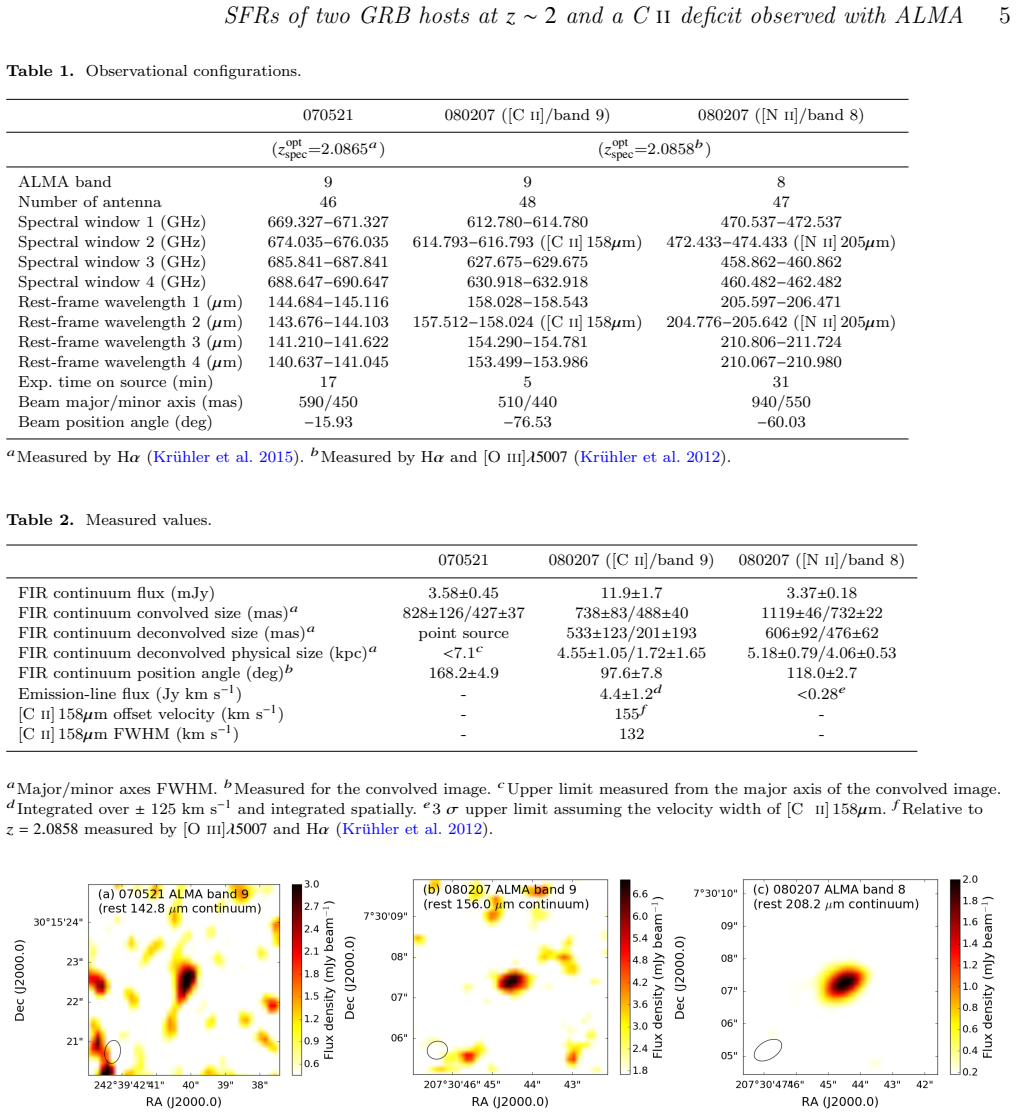
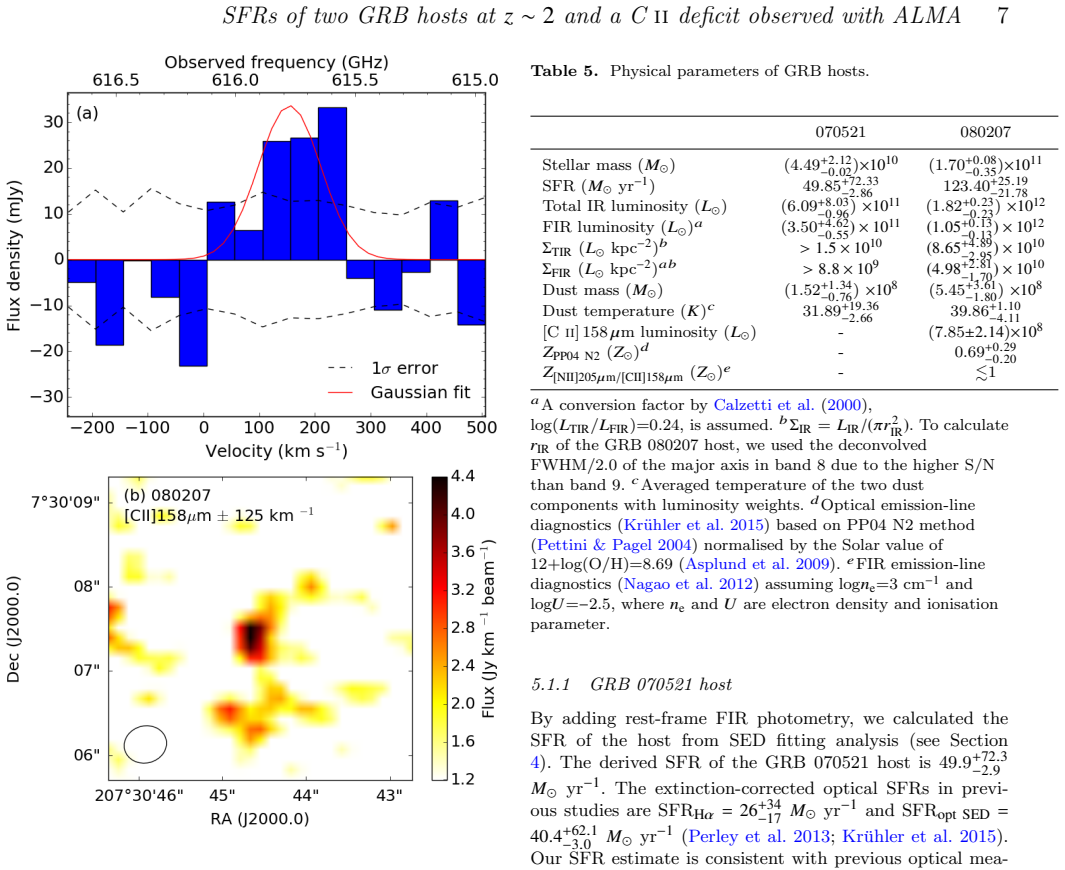
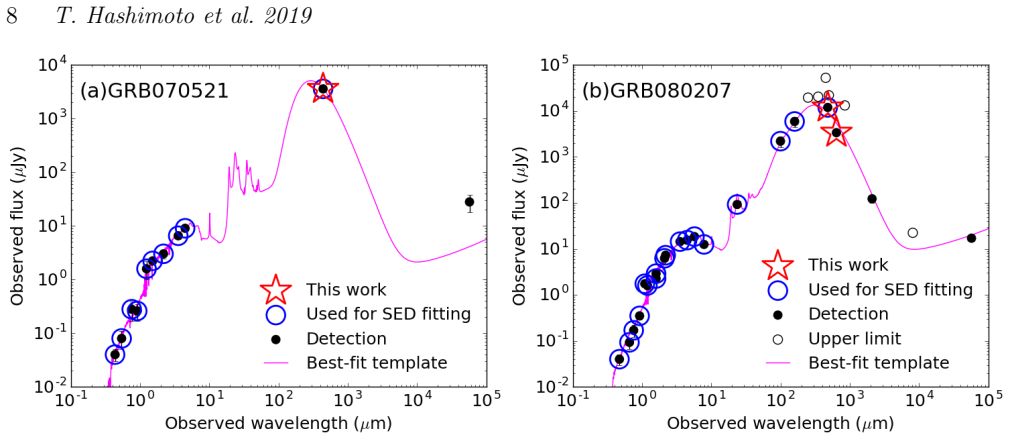
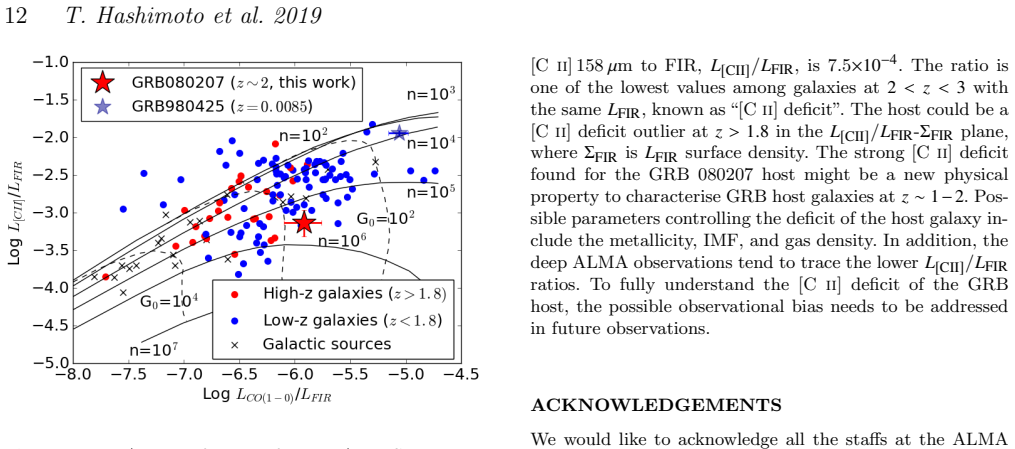
The argument is carried by rest-frame far-infrared photometry that covers the peak of the dust emission, in combination with an energy-balance SED-fitting model that re-distributes energy absorbed by dust in the UV/optical into mid- and far-infrared dust templates. This yields dust-unbiased obscured star-formation rates. The second device is the [C II] 158 micron fine-structure line, the main coolant of neutral gas: after continuum subtraction, its velocity-integrated flux defines $L_{\rm [C\,II]}$, and the ratio $L_{\rm [C\,II]}/L_{\rm FIR}$, plotted against FIR luminosity and FIR surface density, locates the host on the known [C II] deficit trend. The paper also uses the observed ratio of [N II] 205 micron to [C II] to set a metallicity upper limit of about one solar metallicity for the host.
What would settle it
A longer ALMA observation of the GRB 080207 host reaching S/N > 8 in [C II] 158 micron would settle the matter: reproducing the line flux of $4.4\,\mathrm{Jy\,km\,s^{-1}}$ at the same velocity offset would confirm the deficit, while a non-detection or a much weaker line would refute it.
Extended reading notes
Core claim
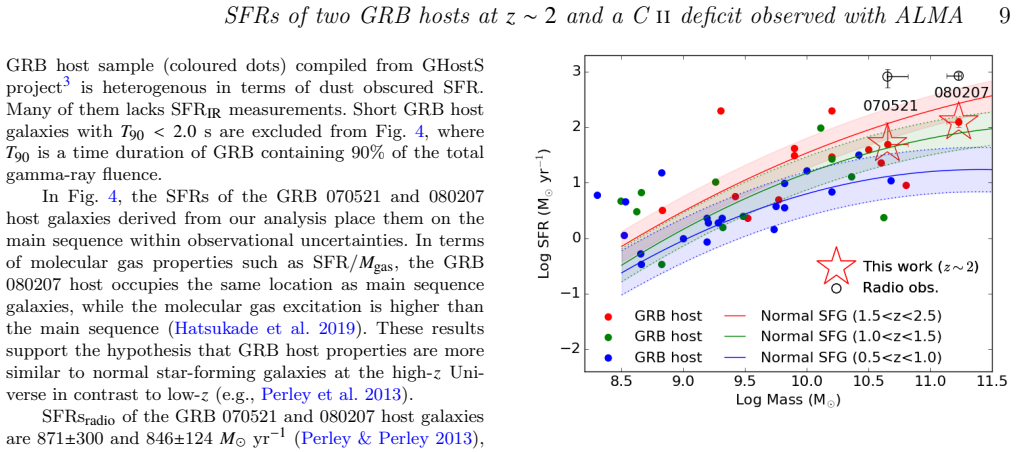
The central claim is that rest-frame far-infrared continuum detections of the GRB 070521 and 080207 host galaxies provide reliable obscured star-formation rates: $49.85^{+72.33}_{-2.86}$ and $123.4^{+25.19}_{-21.78}\,M_\odot\,\mathrm{yr}^{-1}$. These SED-based rates agree with optical estimates, place both systems on the mass--SFR main sequence at $z\sim2$, and are far below the radio-derived rates of about 817 and 846 $M_\odot\,\mathrm{yr}^{-1}$, which the paper argues are inflated by long-lived radio afterglows or by the radio SFR calibration. In addition, a marginal [C II] 158 micron line detection (S/N~4) in the 080207 host, the first for a GRB host at $z>2$, yields $L_{\rm [C\,II]}/L_{\rm FIR}=7.5\times10^{-4}$. That ratio is one of the smallest among galaxies at $z\sim1$-$2$ with the same FIR luminosity, so the host shows a [C II] deficit; the paper identifies metallicity, a top-heavy IMF, and high gas density as possible drivers.
Load-bearing premise
The load-bearing premise is that the marginal [C II] 158 micron detection in the GRB 080207 host is real; if the S/N~4 line is dominated by noise or by continuum-subtraction systematics, the claimed [C II] deficit collapses.
Editorial extensions
If this is right
- The host galaxies of GRB 070521 and 080207 are consistent with the main sequence of star-forming galaxies at $z\sim2$, so GRB hosts at this redshift do not have to be extreme starbursts.
- Radio-based star-formation rates for these hosts are overestimated by factors of about 7 to 16, meaning afterglow contamination must be accounted for in GRB host studies that rely on radio continuum.
- Rest-frame far-infrared observations should become a standard tool for measuring star-formation rates of GRB hosts at $z\sim1$-$2$, because they avoid dust extinction and afterglow contamination.
- The [C II] deficit, quantified by $L_{\rm [C\,II]}/L_{\rm FIR}=7.5\times10^{-4}$, is a candidate new dust-extinction-free diagnostic of GRB host environments at $z\sim1$-$2$.
Reading between the lines
- If these two hosts are representative of the $z\sim2$ GRB population, GRB event rates may trace ordinary main-sequence star-forming galaxies, which would strengthen the use of long GRBs as tracers of cosmic star-formation history.
- Because deep ALMA observations favor the detection of faint [C II] emitters, the low $L_{\rm [C\,II]}/L_{\rm FIR}$ ratio found here may turn out to be common among $z\sim2$ galaxies; a complete survey of [C II] in main-sequence galaxies at the same depth could show whether the "deficit" is specific to GRB hosts.
- The relative roles of metallicity, IMF, and gas density could be separated by measuring [N II] 205 micron and CO line ratios in a larger sample of GRB hosts; the paper provides only an upper limit for one host.
Signed reviews
Editorial analysis
A structured set of objections, weighed in public.
Referee Report
Summary. The paper reports ALMA band 8/9 rest-frame far-infrared (FIR) continuum observations of two GRB host galaxies at z~2, GRB 070521 and GRB 080207, and a marginal detection of [C ii] 158 μm emission from the latter. The FIR detections are used with the public MAGPHYS high-z SED-fitting code to derive star-formation rates of 49.85(+72.33,-2.86) and 123.4(+25.19,-21.78) M_sun/yr, respectively, which place both hosts on the z~2 main sequence and well below earlier radio-derived SFRs. The paper further reports L[CII]/LFIR = 7.5e-4 for GRB 080207, interprets this as one of the smallest values at z~1-2 and as a possible '[C ii] deficit' characteristic of GRB hosts, and argues that the previous radio SFRs are overestimated by afterglow contamination. The two main scientific claims are therefore (1) that FIR-based SFRs revise these hosts from extreme starbursts to normal star-forming galaxies, and (2) that the first z>2 GRB-host [C ii] detection reveals a strong [C ii] deficit.
Significance. If the FIR-based SFRs hold, the paper makes a useful and timely contribution: it demonstrates that ALMA FIR photometry can correct radio-based SFR estimates that may be biased by afterglow contamination, and it strengthens the view that high-z GRB hosts are not necessarily extreme starbursts. The continuum detections are high signal-to-noise (S/N ~7-19), the SED fitting uses a standard public code, and the authors include several appropriate caveats, including a discussion of observational bias toward low L[CII]/LFIR in deep ALMA observations. The [C ii] deficit claim is novel and potentially important, but it rests on the weakest measurement in the paper, a S/N~4 line detection. The SFR results are largely independent of the [C ii] claim and should survive even if the line is questioned; the deficit interpretation, however, is not on the same footing without a robustness analysis.
major comments (3)
- [Section 3, Table 2, Section 5.3] The entire [C ii] deficit claim rests on a single marginal line detection: S/N ~4, velocity-integrated flux 4.4 ± 1.2 Jy km/s, integrated over ±125 km/s after continuum subtraction and at a velocity offset of 155 km/s from the optical redshift (Table 2, Fig. 2). The paper itself calls the detection 'marginal' in Section 3, yet Section 5.3 and the Conclusions treat the resulting L[CII]/LFIR = 7.5e-4 as one of the smallest values at z~1-2. Because this is the paper's most novel claim, I request a quantitative robustness analysis: noise statistics of the continuum-subtracted cube, significance as a function of the chosen integration window, checks for a posteriori selection effects, and a bootstrap or jackknife estimate of the line flux. If the line cannot be established against plausible correlated-noise or continuum-subtraction systematics, the 'first detection' and 'deficit' claims should be explicitly downgraded to tentative. The quoted L[CII]/LFIR ratio also needs a propagated uncertainty.
- [Section 5.1.2 vs Abstract/Conclusions] The abstract and Conclusions state that the radio fluxes of both hosts are contaminated by long-lived afterglows, but Section 5.1.2 concludes for GRB 080207 that the radio excess is probably due to an overestimated radio SFR conversion factor, 'rather than the afterglow/AGN contamination.' These statements are contradictory. Because the paper's central message includes the origin of the radio discrepancy, the authors should harmonize the text and state explicitly which host(s) support the afterglow-contamination scenario.
- [Section 4, Table 5] For GRB 070521, the SED fit is anchored by a single rest-frame FIR photometric point, and the authors acknowledge in Section 4 that the MAGPHYS dust parameters are likely more uncertain than quoted. The derived SFR 49.85(+72.33,-2.86) M_sun/yr and its placement on the main sequence in Section 5.2 inherit this limitation. The paper should either quantify how the SFR changes under alternative dust-temperature or emissivity assumptions, or explicitly label the 070521 SFR as less secure than the formal MAGPHYS error bars, rather than presenting it in the abstract as a 'reliable' FIR-based SFR.
minor comments (4)
- [Sections 5.1.1 and 5.1.2] The FIR flux values are swapped: the GRB 070521 continuum flux is 3.58 ± 0.45 mJy and the GRB 080207 band 9 flux is 11.9 ± 1.7 mJy (Table 2). The sentences citing 11.9 mJy in Section 5.1.1 and 3.58 mJy in Section 5.1.2 should be reversed; the conclusion that afterglow contamination is negligible is unchanged, but the text is internally inconsistent.
- [Section 5.3.1, Table 5] The ratio L[CII]/LFIR = 7.5e-4 is quoted without an uncertainty; it should be computed by propagating the errors on L[CII] and LFIR.
- [Section 5.3.1] The phrase 'one of the smallest values' should be supported by a quantitative rank or percentile among the comparison sample shown in Fig. 5, rather than left as a visual impression.
- [Abstract and Section 5.3.2] There are minor typographical issues: 'an useful' in the abstract should be 'a useful', and 'the the GRB 980425 host' appears in Section 5.3.2.
Circularity Check
No significant circularity: the SFRs and the [C ii]/FIR ratio are measured outputs fitted to new ALMA photometry and compared with external relations and samples, not re-statements of the paper's own inputs.
full rationale
The paper's central results are measurement-driven rather than definitional. The SFRs (49.85 and 123.4 M_sun/yr) are outputs of MAGPHYS fitted to multi-wavelength photometry that includes new ALMA rest-frame FIR continuum detections; MAGPHYS is an external public code with published assumptions (Bruzual & Charlot 2003 stellar models, Charlot & Fall 2000 attenuation, Chabrier 2003 IMF), and the FIR points are independent observational inputs, not constructed from the claimed SFRs or from the authors' prior conclusions. The main-sequence placement is a comparison against the external Whitaker et al. (2014) relation, so it is not tautological. The claimed L[CII]/LFIR = 7.5e-4 combines a measured [C ii] line flux with an LFIR obtained from the MAGPHYS fit and an external Calzetti et al. (2000) conversion; no equation defines this ratio as its own input. The '[C ii] deficit' label is an application of an established literature phenomenon to a new galaxy, and the authors explicitly discuss a possible ALMA observational bias in Section 5.3.4, which weakens the claim but is not circular. Self-citations (e.g., Hashimoto et al. 2018) are contextual and not load-bearing; the CO data from Hatsukade et al. (2019) are independent observational constraints used only for a secondary gas-density discussion. The marginal S/N~4 [C ii] detection and the apparent swapping of continuum flux values between Sections 5.1.1 and 5.1.2 (11.9 versus 3.58 mJy) are genuine data-quality and presentation concerns, but they do not make the derivation equivalent to its inputs. No circular step or self-citation chain forces any central result.
Assumptions & free parameters
free parameters (1)
- MAGPHYS SED-fitting parameters =
posterior distributions, not reported individually
assumptions (6)
- domain assumption The MAGPHYS high-z model correctly describes the hosts' UV-to-FIR emission.
- domain assumption The observed FIR continuum is dominated by star-formation-heated dust, with negligible afterglow or AGN contamination at ALMA wavelengths.
- domain assumption The radio afterglow spectral slopes of Sari et al. (1998) are applicable for extrapolating 5 GHz flux to 600 GHz.
- domain assumption The conversion log(LTIR/LFIR)=0.24 (Calzetti et al. 2000) applies to these galaxies.
- domain assumption The Chabrier (2003) IMF is appropriate for the SFR and stellar-mass calibrations.
- domain assumption The comparison samples in Figures 5-7 are representative and consistently measured.
Cite this review
Pith. "Pith review of Star-formation rates of two GRB host galaxies at z~2 and a [CII] deficit observed with ALMA." pith.science (2026). https://pith.science/paper/T6JT4BQD
@misc{pith2026190801541,
  author       = {Pith},
  title        = {Pith review of: Star-formation rates of two GRB host galaxies at z~2 and a [CII] deficit observed with ALMA},
  year         = {2026},
  howpublished = {\url{https://pith.science/paper/T6JT4BQD}},
  note         = {Machine review of arXiv:1908.01541}
}
abstract
Event rate of long Gamma-Ray Bursts (GRBs) is expected to be an useful tracer of the cosmic star-formation history. For this purpose, it is necessary to understand what kind of star formations/galaxies are traced by GRBs. Here we report rest-frame far-infrared (FIR) continuum detections of GRB 070521 and 080207 host galaxies at $z\sim2$ with ALMA band 8 and 9. The FIR photometries provide the reliable star-formation rates (SFRs), because FIR emission is free from dust extinction and possible radio contamination from long-lived afterglows of GRBs. The spectral energy distribution fittings indicate 49.85$^{+72.33}_{-2.86}$ and 123.4$^{+25.19}_{-21.78}$ $M_{\odot}$ yr$^{-1}$ for the 070521 and 080207 hosts, respectively. The derived SFRs place them on the \lq \lq main sequence\rq \rq\ of normal star-forming galaxies at $z\sim2$. The derived SFRs are significantly lower than that of radio observations. It is inferred that the observed radio fluxes in a previous study are contaminated by the afterglows. ALMA marginally detected [C~{\sc ii}]\,158\,$\mu$m emission line from the GRB 080207 host galaxy with S/N $\sim$ 4. This is the first detection of [C~{\sc ii}]\,158\,$\mu$m of a GRB host at $z>2$, and the second detection among known GRBs. The luminosity ratio of [C~{\sc~ii}]\,158$\mu$m to FIR is 7.5$\times 10^{-4}$, which is one of the smallest values among galaxies at $z\sim 1-2$ with the same FIR luminosity. The \lq \lq [C~{\sc ii}] deficit\rq \rq\ could be a new physical property to characterise GRB hosts at $z\sim1-2$. Possible parameters controlling the deficit include the metallicity, initial mass function, and gas density.
Figures
Figures from the paper (3 more)

Reference graph
Works this paper leans on
-
[1]
Arabsalmani M., et al., 2018, @doi [ ] 10.1093/mnras/sty194 , http://adsabs.harvard.edu/abs/2018MNRAS.476.2332A 476, 2332
-
[2]
Asplund M., Grevesse N., Sauval A. J., Scott P., 2009, @doi [ ] 10.1146/annurev.astro.46.060407.145222 , http://adsabs.harvard.edu/abs/2009ARA
arXiv 2009
-
[3]
Baldwin J. A., Phillips M. M., Terlevich R., 1981, @doi [ ] 10.1086/130766 , http://adsabs.harvard.edu/abs/1981PASP...93....5B 93, 5
doi:10.1086/130766 1981
-
[4]
Bonzini M., et al., 2015, @doi [ ] 10.1093/mnras/stv1675 , https://ui.adsabs.harvard.edu/abs/2015MNRAS.453.1079B 453, 1079
-
[5]
Brisbin D., Ferkinhoff C., Nikola T., Parshley S., Stacey G. J., Spoon H., Hailey-Dunsheath S., Verma A., 2015, @doi [ ] 10.1088/0004-637X/799/1/13 , http://adsabs.harvard.edu/abs/2015ApJ...799...13B 799, 13
-
[6]
Bruzual G., Charlot S., 2003, @doi [ ] 10.1046/j.1365-8711.2003.06897.x , https://ui.adsabs.harvard.edu/abs/2003MNRAS.344.1000B 344, 1000
arXiv 2003
-
[7]
Calzetti D., Armus L., Bohlin R. C., Kinney A. L., Koornneef J., Storchi-Bergmann T., 2000, @doi [ ] 10.1086/308692 , http://adsabs.harvard.edu/abs/2000ApJ...533..682C 533, 682
doi:10.1086/308692 2000
-
[8]
Carniani S., et al., 2013, @doi [ ] 10.1051/0004-6361/201322320 , http://adsabs.harvard.edu/abs/2013A
Show all 116 references
-
[9]
Chabrier G., 2003, @doi [ ] 10.1086/376392 , http://adsabs.harvard.edu/abs/2003PASP..115..763C 115, 763
2003 doi
-
[10]
M., 2000, @doi [ ] 10.1086/309250 , https://ui.adsabs.harvard.edu/abs/2000ApJ...539..718C 539, 718
Charlot S., Fall S. M., 2000, @doi [ ] 10.1086/309250 , https://ui.adsabs.harvard.edu/abs/2000ApJ...539..718C 539, 718
2000 doi
-
[11]
Cormier D., et al., 2010, @doi [ ] 10.1051/0004-6361/201014699 , http://adsabs.harvard.edu/abs/2010A
2010 doi
-
[12]
Cormier D., et al., 2014, @doi [ ] 10.1051/0004-6361/201322096 , http://adsabs.harvard.edu/abs/2014A
2014 doi
-
[13]
B., 2008, GRB Coordinates Network, http://adsabs.harvard.edu/abs/2008GCN..7276....1C 7276
Cucchiara A., Fox D. B., 2008, GRB Coordinates Network, http://adsabs.harvard.edu/abs/2008GCN..7276....1C 7276
2008
-
[14]
De Breuck C., et al., 2014, @doi [ ] 10.1051/0004-6361/201323331 , http://adsabs.harvard.edu/abs/2014A
2014 doi
-
[15]
D \' az-Santos T., et al., 2013, @doi [ ] 10.1088/0004-637X/774/1/68 , http://adsabs.harvard.edu/abs/2013ApJ...774...68D 774, 68
2013 doi
-
[16]
D \' az-Santos T., et al., 2016, @doi [ ] 10.3847/2041-8205/816/1/L6 , http://adsabs.harvard.edu/abs/2016ApJ...816L...6D 816, L6
2016 doi
-
[17]
D \' az-Santos T., et al., 2017, @doi [ ] 10.3847/1538-4357/aa81d7 , http://adsabs.harvard.edu/abs/2017ApJ...846...32D 846, 32
2017 doi
-
[18]
Erfanianfar G., et al., 2016, @doi [ ] 10.1093/mnras/stv2485 , http://adsabs.harvard.edu/abs/2016MNRAS.455.2839E 455, 2839
2016 doi
-
[19]
A., et al., 2007, @doi [ ] 10.1051/0004-6361:20077530 , https://ui.adsabs.harvard.edu/abs/2007A&A...469..379E 469, 379
Evans P. A., et al., 2007, @doi [ ] 10.1051/0004-6361:20077530 , https://ui.adsabs.harvard.edu/abs/2007A&A...469..379E 469, 379
2007 doi
-
[20]
Farrah D., et al., 2013, @doi [ ] 10.1088/0004-637X/776/1/38 , http://adsabs.harvard.edu/abs/2013ApJ...776...38F 776, 38
2013 doi
-
[21]
S., et al., 2006, @doi [ ] 10.1038/nature04787 , http://adsabs.harvard.edu/abs/2006Natur.441..463F 441, 463
Fruchter A. S., et al., 2006, @doi [ ] 10.1038/nature04787 , http://adsabs.harvard.edu/abs/2006Natur.441..463F 441, 463
2006 doi
-
[22]
Fugazza D., D'Elia V., D'Avanzo P., Covino S., Tagliaferri G., 2008, GRB Coordinates Network, http://adsabs.harvard.edu/abs/2008GCN..7293....1F 7293
2008
-
[23]
Fynbo J. P. U., et al., 2009, @doi [ ] 10.1088/0067-0049/185/2/526 , http://adsabs.harvard.edu/abs/2009ApJS..185..526F 185, 526
2009 doi
-
[24]
Gehrels N., et al., 2004, @doi [ ] 10.1086/422091 , https://ui.adsabs.harvard.edu/\#abs/2004ApJ...611.1005G 611, 1005
2004 doi
-
[25]
F., Langer W
Goldsmith P. F., Langer W. D., Pineda J. L., Velusamy T., 2012, @doi [ ] 10.1088/0067-0049/203/1/13 , https://ui.adsabs.harvard.edu/abs/2012ApJS..203...13G 203, 13
2012 doi
-
[26]
Goto T., et al., 2010, @doi [ ] 10.1051/0004-6361/200913182 , https://ui.adsabs.harvard.edu/abs/2010A&A...514A...6G 514, A6
2010 doi
-
[27]
F., Fruchter A
Graham J. F., Fruchter A. S., 2013, @doi [ ] 10.1088/0004-637X/774/2/119 , http://adsabs.harvard.edu/abs/2013ApJ...774..119G 774, 119
2013 doi
-
[28]
Greiner J., et al., 2007, GRB Coordinates Network, http://adsabs.harvard.edu/abs/2007GCN..6449....1G 6449
2007
-
[29]
Guidorzi C., et al., 2007a, GRB Coordinates Network, http://adsabs.harvard.edu/abs/2007GCN..6431....1G 6431
-
[30]
A., Moretti A., 2007b, GRB Coordinates Network, http://adsabs.harvard.edu/abs/2007GCN..6452....1G 6452
Guidorzi C., Romano P., Hill J., Beardmore A., Evans P. A., Moretti A., 2007b, GRB Coordinates Network, http://adsabs.harvard.edu/abs/2007GCN..6452....1G 6452
-
[31]
Gullberg B., et al., 2015, @doi [ ] 10.1093/mnras/stv372 , http://adsabs.harvard.edu/abs/2015MNRAS.449.2883G 449, 2883
2015 doi
-
[32]
Hailey-Dunsheath S., 2009, PhD thesis, Cornell University
2009
-
[33]
J., Oberst T
Hailey-Dunsheath S., Nikola T., Stacey G. J., Oberst T. E., Parshley S. C., Benford D. J., Staguhn J. G., Tucker C. E., 2010, @doi [ ] 10.1088/2041-8205/714/1/L162 , https://ui.adsabs.harvard.edu/abs/2010ApJ...714L.162H 714, L162
2010 doi
-
[34]
Hashimoto T., et al., 2010, @doi [ ] 10.1088/0004-637X/719/1/378 , http://adsabs.harvard.edu/abs/2010ApJ...719..378H 719, 378
2010 doi
-
[35]
A., Ohta K., Aoki K., Tanaka I., Niino Y., Yabe K., Kawai N., 2015, @doi [ ] 10.1088/0004-637X/806/2/250 , http://adsabs.harvard.edu/abs/2015ApJ...806..250H 806, 250
Hashimoto T., Perley D. A., Ohta K., Aoki K., Tanaka I., Niino Y., Yabe K., Kawai N., 2015, @doi [ ] 10.1088/0004-637X/806/2/250 , http://adsabs.harvard.edu/abs/2015ApJ...806..250H 806, 250
2015 doi
-
[36]
Hashimoto T., Chaudhary R., Ohta K., Goto T., Hammer F., Kong A. K. H., Nomoto K., Mao J., 2018, @doi [ ] 10.3847/1538-4357/aad2d1 , http://adsabs.harvard.edu/abs/2018ApJ...863...95H 863, 95
2018 doi
-
[37]
Hatsukade B., Ohta K., Endo A., Nakanishi K., Tamura Y., Hashimoto T., Kohno K., 2014, @doi [ ] 10.1038/nature13325 , http://adsabs.harvard.edu/abs/2014Natur.510..247H 510, 247
2014 doi
-
[38]
V., 2019, arXiv e-prints, http://adsabs.harvard.edu/abs/2019arXiv190402292H
Hatsukade B., Hashimoto T., Kohno K., Nakanishi K., Ohta K., Niino Y., Tamura Y., Toth L. V., 2019, arXiv e-prints, http://adsabs.harvard.edu/abs/2019arXiv190402292H
2019
-
[39]
Hayashi M., et al., 2009, @doi [ ] 10.1088/0004-637X/691/1/140 , https://ui.adsabs.harvard.edu/abs/2009ApJ...691..140H 691, 140
2009 doi
-
[40]
Hunt L., Palazzi E., Rossi A., Savaglio S., Cresci G., Klose S., Micha owski M., Pian E., 2011, @doi [ ] 10.1088/2041-8205/736/2/L36 , http://adsabs.harvard.edu/abs/2011ApJ...736L..36H 736, L36
2011 doi
-
[41]
K., et al., 2014, @doi [ ] 10.1051/0004-6361/201323340 , http://adsabs.harvard.edu/abs/2014A
Hunt L. K., et al., 2014, @doi [ ] 10.1051/0004-6361/201323340 , http://adsabs.harvard.edu/abs/2014A
2014 doi
-
[42]
K., et al., 2019, @doi [ ] 10.1051/0004-6361/201834212 , https://ui.adsabs.harvard.edu/abs/2019A&A...621A..51H 621, A51
Hunt L. K., et al., 2019, @doi [ ] 10.1051/0004-6361/201834212 , https://ui.adsabs.harvard.edu/abs/2019A&A...621A..51H 621, A51
2019 doi
-
[43]
J., et al., 2010, @doi [ ] 10.1051/0004-6361/201014548 , http://adsabs.harvard.edu/abs/2010A
Ivison R. J., et al., 2010, @doi [ ] 10.1051/0004-6361/201014548 , http://adsabs.harvard.edu/abs/2010A
2010 doi
-
[44]
Jakobsson P., Hjorth J., Fynbo J. P. U., Watson D., Pedersen K., Bj \"o rnsson G., Gorosabel J., 2004, @doi [ ] 10.1086/427089 , http://adsabs.harvard.edu/abs/2004ApJ...617L..21J 617, L21
2004 doi
-
[45]
J., Wolfire M
Kaufman M. J., Wolfire M. G., Hollenbach D. J., Luhman M. L., 1999, @doi [ ] 10.1086/308102 , https://ui.adsabs.harvard.edu/abs/1999ApJ...527..795K 527, 795
1999 doi
-
[46]
Kennicutt Jr. R. C., 1998a, @doi [ ] 10.1146/annurev.astro.36.1.189 , http://adsabs.harvard.edu/abs/1998ARA
-
[47]
J., 1998b, @doi [ ] 10.1086/305588 , https://ui.adsabs.harvard.edu/abs/1998ApJ...498..541K 498, 541
Kennicutt Robert C. J., 1998b, @doi [ ] 10.1086/305588 , https://ui.adsabs.harvard.edu/abs/1998ApJ...498..541K 498, 541
-
[48]
J., Dopita M
Kewley L. J., Dopita M. A., Sutherland R. S., Heisler C. A., Trevena J., 2001, @doi [ ] 10.1086/321545 , http://adsabs.harvard.edu/abs/2001ApJ...556..121K 556, 121
2001 doi
-
[49]
J., Groves B., Kauffmann G., Heckman T., 2006, @doi [ ] 10.1111/j.1365-2966.2006.10859.x , http://adsabs.harvard.edu/abs/2006MNRAS.372..961K 372, 961
Kewley L. J., Groves B., Kauffmann G., Heckman T., 2006, @doi [ ] 10.1111/j.1365-2966.2006.10859.x , http://adsabs.harvard.edu/abs/2006MNRAS.372..961K 372, 961
2006
-
[50]
Kroupa P., 2001, @doi [ ] 10.1046/j.1365-8711.2001.04022.x , http://adsabs.harvard.edu/abs/2001MNRAS.322..231K 322, 231
2001
-
[51]
Kr \"u hler T., et al., 2012, @doi [ ] 10.1088/0004-637X/758/1/46 , http://adsabs.harvard.edu/abs/2012ApJ...758...46K 758, 46
2012 doi
-
[52]
Kr \"u hler T., et al., 2015, @doi [ ] 10.1051/0004-6361/201425561 , https://ui.adsabs.harvard.edu/abs/2015A&A...581A.125K 581, A125
2015 doi
-
[53]
Kuepcue Yoldas A., Yoldas A., Greiner J., Kruehler T., Klose S., Szokoly G., 2008, GRB Coordinates Network, http://adsabs.harvard.edu/abs/2008GCN..7279....1K 7279
2008
-
[54]
Lagache G., Cousin M., Chatzikos M., 2018, @doi [ ] 10.1051/0004-6361/201732019 , http://adsabs.harvard.edu/abs/2018A
2018 doi
-
[55]
M., Kewley L
Levesque E. M., Kewley L. J., Berger E., Zahid H. J., 2010, @doi [ ] 10.1088/0004-6256/140/5/1557 , http://adsabs.harvard.edu/abs/2010AJ....140.1557L 140, 1557
2010 doi
-
[56]
L., et al., 1998, @doi [ ] 10.1086/311562 , http://adsabs.harvard.edu/abs/1998ApJ...504L..11L 504, L11
Luhman M. L., et al., 1998, @doi [ ] 10.1086/311562 , http://adsabs.harvard.edu/abs/1998ApJ...504L..11L 504, L11
1998 doi
-
[57]
L., Satyapal S., Fischer J., Wolfire M
Luhman M. L., Satyapal S., Fischer J., Wolfire M. G., Sturm E., Dudley C. C., Lutz D., Genzel R., 2003, @doi [ ] 10.1086/376965 , http://adsabs.harvard.edu/abs/2003ApJ...594..758L 594, 758
2003 doi
-
[58]
Madau P., Dickinson M., 2014, @doi [ ] 10.1146/annurev-astro-081811-125615 , https://ui.adsabs.harvard.edu/abs/2014ARA&A..52..415M 52, 415
2014 doi
-
[59]
E., et al., 2014, @doi [ ] 10.1088/0004-637X/796/1/63 , http://adsabs.harvard.edu/abs/2014ApJ...796...63M 796, 63
Magdis G. E., et al., 2014, @doi [ ] 10.1088/0004-637X/796/1/63 , http://adsabs.harvard.edu/abs/2014ApJ...796...63M 796, 63
2014 doi
-
[60]
Maiolino R., Caselli P., Nagao T., Walmsley M., De Breuck C., Meneghetti M., 2009, @doi [ ] 10.1051/0004-6361/200912265 , https://ui.adsabs.harvard.edu/abs/2009A&A...500L...1M 500, L1
2009 doi
-
[61]
Malhotra S., et al., 1997, @doi [ ] 10.1086/311044 , https://ui.adsabs.harvard.edu/abs/1997ApJ...491L..27M 491, L27
1997 doi
-
[62]
Malhotra S., et al., 2001, @doi [ ] 10.1086/323046 , http://adsabs.harvard.edu/abs/2001ApJ...561..766M 561, 766
2001 doi
-
[63]
Mancuso C., Lapi A., Shi J., Cai Z.-Y., Gonzalez-Nuevo J., B \'e thermin M., Danese L., 2016, @doi [ ] 10.3847/1538-4357/833/2/152 , http://adsabs.harvard.edu/abs/2016ApJ...833..152M 833, 152
2016 doi
-
[64]
E., Guidorzi C., 2007, GRB Coordinates Network, http://adsabs.harvard.edu/abs/2007GCN..6454....1M 6454
Marshall F. E., Guidorzi C., 2007, GRB Coordinates Network, http://adsabs.harvard.edu/abs/2007GCN..6454....1M 6454
2007
-
[65]
J., et al., 2014, @doi [ ] 10.1051/0004-6361/201322843 , http://adsabs.harvard.edu/abs/2014A
Micha owski M. J., et al., 2014, @doi [ ] 10.1051/0004-6361/201322843 , http://adsabs.harvard.edu/abs/2014A
2014 doi
-
[66]
J., et al., 2016, @doi [ ] 10.1051/0004-6361/201629441 , https://ui.adsabs.harvard.edu/\#abs/2016A&A...595A..72M 595, A72
Micha owski M. J., et al., 2016, @doi [ ] 10.1051/0004-6361/201629441 , https://ui.adsabs.harvard.edu/\#abs/2016A&A...595A..72M 595, A72
2016 doi
-
[67]
J., et al., 2018, @doi [ ] 10.1051/0004-6361/201833250 , http://adsabs.harvard.edu/abs/2018A
Micha owski M. J., et al., 2018, @doi [ ] 10.1051/0004-6361/201833250 , http://adsabs.harvard.edu/abs/2018A
2018 doi
-
[68]
Modjaz M., et al., 2008, @doi [ ] 10.1088/0004-6256/135/4/1136 , http://adsabs.harvard.edu/abs/2008AJ....135.1136M 135, 1136
2008 doi
-
[69]
N., et al., 2014, @doi [ ] 10.1093/mnras/stu344 , http://adsabs.harvard.edu/abs/2014MNRAS.440.1810M 440, 1810
Morgan A. N., et al., 2014, @doi [ ] 10.1093/mnras/stu344 , http://adsabs.harvard.edu/abs/2014MNRAS.440.1810M 440, 1810
2014 doi
-
[70]
J., et al., 2011, @doi [ ] 10.1088/0004-637X/737/2/67 , https://ui.adsabs.harvard.edu/abs/2011ApJ...737...67M 737, 67
Murphy E. J., et al., 2011, @doi [ ] 10.1088/0004-637X/737/2/67 , https://ui.adsabs.harvard.edu/abs/2011ApJ...737...67M 737, 67
2011 doi
-
[71]
Nagao T., Maiolino R., De Breuck C., Caselli P., Hatsukade B., Saigo K., 2012, @doi [ ] 10.1051/0004-6361/201219518 , http://adsabs.harvard.edu/abs/2012A
2012 doi
-
[72]
Neri R., Downes D., Cox P., Walter F., 2014, @doi [ ] 10.1051/0004-6361/201322528 , http://adsabs.harvard.edu/abs/2014A
2014 doi
-
[73]
Niino Y., et al., 2017, @doi [ ] 10.1093/pasj/psw133 , http://adsabs.harvard.edu/abs/2017PASJ...69...27N 69, 27
2017 doi
-
[74]
Oteo I., et al., 2016, @doi [ ] 10.3847/0004-637X/827/1/34 , http://adsabs.harvard.edu/abs/2016ApJ...827...34O 827, 34
2016 doi
-
[75]
P \'e rez-Montero E., et al., 2009, @doi [ ] 10.1051/0004-6361:200810558 , https://ui.adsabs.harvard.edu/abs/2009A&A...495...73P 495, 73
2009 doi
-
[76]
A., Perley R
Perley D. A., Perley R. A., 2013, @doi [ ] 10.1088/0004-637X/778/2/172 , http://adsabs.harvard.edu/abs/2013ApJ...778..172P 778, 172
2013 doi
-
[77]
A., et al., 2008, @doi [ ] 10.1086/523929 , http://adsabs.harvard.edu/abs/2008ApJ...672..449P 672, 449
Perley D. A., et al., 2008, @doi [ ] 10.1086/523929 , http://adsabs.harvard.edu/abs/2008ApJ...672..449P 672, 449
2008 doi
-
[78]
A., et al., 2013, @doi [ ] 10.1088/0004-637X/778/2/128 , http://adsabs.harvard.edu/abs/2013ApJ...778..128P 778, 128
Perley D. A., et al., 2013, @doi [ ] 10.1088/0004-637X/778/2/128 , http://adsabs.harvard.edu/abs/2013ApJ...778..128P 778, 128
2013 doi
-
[79]
A., et al., 2015, @doi [ ] 10.1088/0004-637X/801/2/102 , http://adsabs.harvard.edu/abs/2015ApJ...801..102P 801, 102
Perley D. A., et al., 2015, @doi [ ] 10.1088/0004-637X/801/2/102 , http://adsabs.harvard.edu/abs/2015ApJ...801..102P 801, 102
2015 doi
-
[80]
A., et al., 2016a, @doi [ ] 10.3847/0004-637X/817/1/7 , http://adsabs.harvard.edu/abs/2016ApJ...817....7P 817, 7
Perley D. A., et al., 2016a, @doi [ ] 10.3847/0004-637X/817/1/7 , http://adsabs.harvard.edu/abs/2016ApJ...817....7P 817, 7
-
[81]
A., et al., 2016b, @doi [ ] 10.3847/0004-637X/817/1/8 , http://adsabs.harvard.edu/abs/2016ApJ...817....8P 817, 8
Perley D. A., et al., 2016b, @doi [ ] 10.3847/0004-637X/817/1/8 , http://adsabs.harvard.edu/abs/2016ApJ...817....8P 817, 8
-
[82]
A., Hjorth J., Tanvir N
Perley D. A., Hjorth J., Tanvir N. R., Perley R. A., 2017, @doi [ ] 10.1093/mnras/stw2789 , http://adsabs.harvard.edu/abs/2017MNRAS.465..970P 465, 970
2017 doi
-
[83]
Pettini M., Pagel B. E. J., 2004, @doi [ ] 10.1111/j.1365-2966.2004.07591.x , http://adsabs.harvard.edu/abs/2004MNRAS.348L..59P 348, L59
2004
-
[84]
Planck Collaboration et al., 2016, @doi [ ] 10.1051/0004-6361/201525830 , https://ui.adsabs.harvard.edu/\#abs/2016A&A...594A..13P 594, A13
2016 doi
-
[85]
L., et al., 2008, GRB Coordinates Network, http://adsabs.harvard.edu/abs/2008GCN..7264....1R 7264
Racusin J. L., et al., 2008, GRB Coordinates Network, http://adsabs.harvard.edu/abs/2008GCN..7264....1R 7264
2008
-
[86]
D., et al., 2014, @doi [ ] 10.1088/0004-637X/783/1/59 , https://ui.adsabs.harvard.edu/abs/2014ApJ...783...59R 783, 59
Rawle T. D., et al., 2014, @doi [ ] 10.1088/0004-637X/783/1/59 , https://ui.adsabs.harvard.edu/abs/2014ApJ...783...59R 783, 59
2014 doi
-
[87]
A., et al., 2013, @doi [ ] 10.1038/nature12050 , http://adsabs.harvard.edu/abs/2013Natur.496..329R 496, 329
Riechers D. A., et al., 2013, @doi [ ] 10.1038/nature12050 , http://adsabs.harvard.edu/abs/2013Natur.496..329R 496, 329
2013 doi
-
[88]
A., et al., 2014, @doi [ ] 10.1088/0004-637X/796/2/84 , http://adsabs.harvard.edu/abs/2014ApJ...796...84R 796, 84
Riechers D. A., et al., 2014, @doi [ ] 10.1088/0004-637X/796/2/84 , http://adsabs.harvard.edu/abs/2014ApJ...796...84R 796, 84
2014 doi
-
[89]
Salvaterra R., et al., 2009, @doi [ ] 10.1038/nature08445 , http://adsabs.harvard.edu/abs/2009Natur.461.1258S 461, 1258
2009 doi
-
[90]
Sargsyan L., et al., 2012, @doi [ ] 10.1088/0004-637X/755/2/171 , http://adsabs.harvard.edu/abs/2012ApJ...755..171S 755, 171
2012 doi
-
[91]
Sari R., Piran T., Narayan R., 1998, @doi [ ] 10.1086/311269 , https://ui.adsabs.harvard.edu/abs/1998ApJ...497L..17S 497, L17
1998 doi
-
[92]
Savaglio S., Glazebrook K., Le Borgne D., 2009, @doi [ ] 10.1088/0004-637X/691/1/182 , http://adsabs.harvard.edu/abs/2009ApJ...691..182S 691, 182
2009 doi
-
[93]
Schaerer D., et al., 2015, @doi [ ] 10.1051/0004-6361/201425542 , http://adsabs.harvard.edu/abs/2015A
2015 doi
-
[94]
L., Bressan A., Danese L., 1998, @doi [ ] 10.1086/306476 , https://ui.adsabs.harvard.edu/abs/1998ApJ...509..103S 509, 103
Silva L., Granato G. L., Bressan A., Danese L., 1998, @doi [ ] 10.1086/306476 , https://ui.adsabs.harvard.edu/abs/1998ApJ...509..103S 509, 103
1998 doi
-
[95]
Smith J. D. T., et al., 2017, @doi [ ] 10.3847/1538-4357/834/1/5 , http://adsabs.harvard.edu/abs/2017ApJ...834....5S 834, 5
2017 doi
-
[96]
S., et al., 2016, @doi [ ] 10.3847/0004-637X/826/2/112 , http://adsabs.harvard.edu/abs/2016ApJ...826..112S 826, 112
Spilker J. S., et al., 2016, @doi [ ] 10.3847/0004-637X/826/2/112 , http://adsabs.harvard.edu/abs/2016ApJ...826..112S 826, 112
2016 doi
-
[97]
J., Geis N., Genzel R., Lugten J
Stacey G. J., Geis N., Genzel R., Lugten J. B., Poglitsch A., Sternberg A., Townes C. H., 1991, @doi [ ] 10.1086/170062 , https://ui.adsabs.harvard.edu/abs/1991ApJ...373..423S 373, 423
1991 doi
-
[98]
J., et al., 2007, in Baker A
Stacey G. J., et al., 2007, in Baker A. J., Glenn J., Harris A. I., Mangum J. G., Yun M. S., eds, Astronomical Society of the Pacific Conference Series Vol. 375, From Z-Machines to ALMA: (Sub)Millimeter Spectroscopy of Galaxies. p. 52
2007
-
[99]
J., Hailey-Dunsheath S., Ferkinhoff C., Nikola T., Parshley S
Stacey G. J., Hailey-Dunsheath S., Ferkinhoff C., Nikola T., Parshley S. C., Benford D. J., Staguhn J. G., Fiolet N., 2010, @doi [ ] 10.1088/0004-637X/724/2/957 , http://adsabs.harvard.edu/abs/2010ApJ...724..957S 724, 957
2010 doi
-
[100]
R., Levan A
Stanway E. R., Levan A. J., Tanvir N., Wiersema K., van der Horst A., Mundell C. G., Guidorzi C., 2015, @doi [ ] 10.1093/mnras/stu2286 , http://adsabs.harvard.edu/abs/2015MNRAS.446.3911S 446, 3911
2015 doi
-
[101]
C., et al., 2014, @doi [ ] 10.1088/0004-637X/795/2/165 , http://adsabs.harvard.edu/abs/2014ApJ...795..165S 795, 165
Steidel C. C., et al., 2014, @doi [ ] 10.1088/0004-637X/795/2/165 , http://adsabs.harvard.edu/abs/2014ApJ...795..165S 795, 165
2014 doi
-
[102]
M., et al., 2012, @doi [ ] 10.1111/j.1365-2966.2011.19811.x , http://adsabs.harvard.edu/abs/2012MNRAS.421...25S 421, 25
Svensson K. M., et al., 2012, @doi [ ] 10.1111/j.1365-2966.2011.19811.x , http://adsabs.harvard.edu/abs/2012MNRAS.421...25S 421, 25
2012
-
[103]
T., Buat V., Burgarella D., 2005, @doi [ ] 10.1051/0004-6361:200500158 , http://adsabs.harvard.edu/abs/2005A
Takeuchi T. T., Buat V., Burgarella D., 2005, @doi [ ] 10.1051/0004-6361:200500158 , http://adsabs.harvard.edu/abs/2005A
2005 doi
-
[104]
R., et al., 2009, @doi [ ] 10.1038/nature08459 , http://adsabs.harvard.edu/abs/2009Natur.461.1254T 461, 1254
Tanvir N. R., et al., 2009, @doi [ ] 10.1038/nature08459 , http://adsabs.harvard.edu/abs/2009Natur.461.1254T 461, 1254
2009 doi
-
[105]
M., Shull J
Trenti M., Perna R., Levesque E. M., Shull J. M., Stocke J. T., 2012, @doi [ ] 10.1088/2041-8205/749/2/L38 , http://adsabs.harvard.edu/abs/2012ApJ...749L..38T 749, L38
2012 doi
-
[106]
Walter F., Riechers D., Cox P., Neri R., Carilli C., Bertoldi F., Weiss A., Maiolino R., 2009, @doi [ ] 10.1038/nature07681 , http://adsabs.harvard.edu/abs/2009Natur.457..699W 457, 699
2009 doi
-
[107]
Wang R., et al., 2013, @doi [ ] 10.1088/0004-637X/773/1/44 , http://adsabs.harvard.edu/abs/2013ApJ...773...44W 773, 44
2013 doi
-
[108]
E., et al., 2014, @doi [ ] 10.1088/0004-637X/795/2/104 , http://adsabs.harvard.edu/abs/2014ApJ...795..104W 795, 104
Whitaker K. E., et al., 2014, @doi [ ] 10.1088/0004-637X/795/2/104 , http://adsabs.harvard.edu/abs/2014ApJ...795..104W 795, 104
2014 doi
-
[109]
G., Hollenbach D., Tielens A
Wolfire M. G., Hollenbach D., Tielens A. G. G. M., 1989, @doi [ ] 10.1086/167841 , https://ui.adsabs.harvard.edu/abs/1989ApJ...344..770W 344, 770
1989 doi
-
[110]
E., Heger A., 2006, @doi [ ] 10.1086/498500 , http://adsabs.harvard.edu/abs/2006ApJ...637..914W 637, 914
Woosley S. E., Heger A., 2006, @doi [ ] 10.1086/498500 , http://adsabs.harvard.edu/abs/2006ApJ...637..914W 637, 914
2006 doi
-
[111]
Yabe K., et al., 2012, @doi [ ] 10.1093/pasj/64.3.60 , https://ui.adsabs.harvard.edu/abs/2012PASJ...64...60Y 64, 60
2012 doi
-
[112]
K., Ioka K., 2004, @doi [ ] 10.1086/421285 , https://ui.adsabs.harvard.edu/abs/2004ApJ...609..935Y 609, 935
Yonetoku D., Murakami T., Nakamura T., Yamazaki R., Inoue A. K., Ioka K., 2004, @doi [ ] 10.1086/421285 , https://ui.adsabs.harvard.edu/abs/2004ApJ...609..935Y 609, 935
2004 doi
-
[113]
J., et al., 2014, @doi [ ] 10.1088/0004-637X/792/1/75 , https://ui.adsabs.harvard.edu/abs/2014ApJ...792...75Z 792, 75
Zahid H. J., et al., 2014, @doi [ ] 10.1088/0004-637X/792/1/75 , https://ui.adsabs.harvard.edu/abs/2014ApJ...792...75Z 792, 75
2014 doi
-
[114]
J., Papadopoulos P
Zhang Z.-Y., Romano D., Ivison R. J., Papadopoulos P. P., Matteucci F., 2018, @doi [ ] 10.1038/s41586-018-0196-x , https://ui.adsabs.harvard.edu/abs/2018Natur.558..260Z 558, 260
2018 doi
-
[115]
da Cunha E., Charlot S., Elbaz D., 2008, @doi [ ] 10.1111/j.1365-2966.2008.13535.x , http://adsabs.harvard.edu/abs/2008MNRAS.388.1595D 388, 1595
2008
-
[116]
da Cunha E., et al., 2015, @doi [ ] 10.1088/0004-637X/806/1/110 , http://adsabs.harvard.edu/abs/2015ApJ...806..110D 806, 110
2015 doi
Reviewed August 14, 2026 · model on record in the stance chip above.
Discussion (0). Continue with ORCID to comment.