REVIEW 3 major objections 6 minor 57 references
Measuring the redshift-space distortions by cross-correlating the density fields before and after reconstruction
T0 review · 3 major / 6 minor · reviewed 2026-08-08 · deepseek-v4-flash
Pith's one-line read This paper claims that the redshift-space cross-power spectrum between pre- and post-reconstruction density fields can be modeled at one loop in perturbation theory and used to extract the linear growth rate.
desk verdict A solid one-loop model for the reconstruction cross-spectrum, honestly validated, but the headline f-recovery rests on an untested finite-volume correction and the practical gain over post-reconstruction spectra is marginal. read the letter →
The pith
A machine-rendered reading of the paper's core claim, the machinery that carries it, and where it could break.
The reading
What carries the argument
The load-bearing object is the one-loop SPT expression for $P_x$, Eq. (20), with the effective cross-kernels $F_2^{(x)}$ and $F_3^{(x)}$ defined in Eqs. (24)–(25), together with the analytic angular integrals in Appendix B. The shift field of standard BAO reconstruction enters through its perturbation kernel $S_z^{(n)}$ (Eq. 14), computed from the Zel'dovich displacement; the paper's reconstruction convention effectively sets the reconstruction growth rate $f_{\rm rec}=0$, which removes an extra line-of-sight denominator and simplifies the kernels. The model is completed by adding lowest-order EFT counterterms $\alpha_\ell k^2 P_L$ (Eq. 45) to absorb unresolved UV physics, whose dominant contribution is argued to match the pre-reconstruction case.
What would settle it
Measure the cross-power spectrum directly from the eight $4\,h^{-1}{\rm Gpc}$ boxes (or an equivalent large-volume set) and compare it with the grid-corrected $500\,h^{-1}{\rm Mpc}$ measurements: if $P_x^{\rm large}/P_x^{\rm small}$ differs from $P_{\rm pre}^{\rm large}/P_{\rm pre}^{\rm small}$, the fitted growth rate is biased by the correction. A second decisive check is to replace the counterterm-absorbed damping with an explicit IR-resummed model for $P_x$ and see whether the best-fit $f$ shifts relative to the fiducial value.
Extended reading notes
Core claim
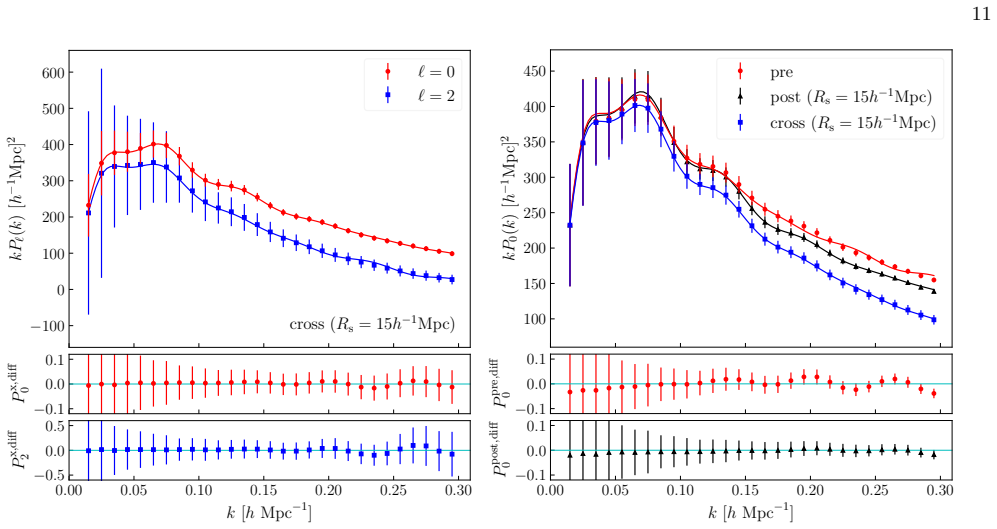
The central claim is that the redshift-space cross-power spectrum $P_x(k,\mu)$ between pre- and post-reconstructed density fields can be predicted at one loop by reusing SPT with effective kernels: the $P_{22}$ term uses the geometric mean $\sqrt{F_2 F_2^{\rm rec}}$ and the $P_{13}$ term uses the arithmetic mean $(F_3+F_3^{\rm rec})/2$ (Eqs. 24–25). Because reconstruction leaves the linear field unchanged, the tree-level term is the same Kaiser spectrum $(1+f\mu^2)^2 P_L(k)$, and all reconstruction effects enter through the nonlinear corrections. A distinctive feature is that, unlike the auto-spectra, the one-loop $P_{22}$ and $P_{13}$ do not cancel in the infrared limit; the shift-field term $P_{s^2}$ survives, producing a net negative correction and an exponential damping that reflects decorrelation between the two fields. The paper argues this is a feature, not a flaw: it is why the cross-spectrum carries complementary information, and with EFT counterterms the model fits the simulated monopole and quadrupole well enough to recover $f$ without bias over the quoted $k$-ranges.
Load-bearing premise
The load-bearing premise is that the fractional suppression of large-scale modes in the small simulation box is identical for the cross-spectrum and the pre-reconstruction power spectrum, so Eq. (42) can correct the measured $P_x$ using the pre-reconstruction ratio; the paper does not validate this for the cross-spectrum directly.
Editorial extensions
If this is right
- The cross-power spectrum can be added to $P_{\rm pre}$ and $P_{\rm post}$ in joint cosmological analyses, providing a two-point statistic that carries part of the information normally found in higher-order statistics.
- With smoothing scale $R_s=15$ or $20\,h^{-1}{\rm Mpc}$, the model supports unbiased growth-rate measurements to $k_{\rm max}=0.29\,h/{\rm Mpc}$ at $z=1.02$, extending the usable range relative to the smallest smoothing scale.
- The cross-spectrum improves the uncertainty on $f$ by roughly 14–22% at $k\le 0.20\,h/{\rm Mpc}$ compared with the pre-reconstruction spectrum alone.
- Counterterm parameters are constrained more tightly by $P_x$ than by either auto-spectrum, which may help anchor nuisance parameters in joint fits once relations between the counterterms are established.
Reading between the lines
- The grid correction in Eq. (42) assumes the fractional large-scale deficit is the same for the cross-spectrum and the pre-reconstruction spectrum; this can be checked directly in the $4\,h^{-1}{\rm Gpc}$ boxes, and if it fails, the reported $k$-ranges would shrink.
- An explicit IR-resummed version of the model, rather than absorbing the damping into the counterterm, could change the fitted counterterms and give a sharper test of whether $f$ stays unbiased.
- Applied to galaxy surveys, the model would need galaxy bias, Alcock–Paczynski geometric distortions, survey window functions, and a treatment of the hexadecapole (omitted here); the paper's fixed-cosmology validation is the first step, not the last.
- If the counterterm relations across $P_{\rm pre}$, $P_{\rm post}$, and $P_x$ can be derived, the better-constrained counterterms of $P_x$ would propagate into tighter joint constraints on $f$ and cosmological parameters.
Editorial analysis
A structured set of objections, weighed in public.
Referee Report
Summary. The paper develops a one-loop standard perturbation theory (SPT) model for the redshift-space cross-power spectrum P^x between the pre-reconstruction and post-reconstruction matter density fields, motivated by the idea that P^x encodes part of the bispectrum information otherwise lost to two-point statistics. The model expresses the one-loop P22 and P13 contributions in terms of effective kernels built from the pre- and post-reconstruction SPT kernels, and the paper derives analytic IR and UV asymptotics, presents the full integrals in Appendix B, and validates the model against N-body simulations at z = 1.02. Using 4000 small-box (500 h^{-1} Mpc) realizations, with an additional correction from eight large-box (4 h^{-1} Gpc) simulations, the authors fit the linear growth rate f and two EFT counterterms α0 and α2 for reconstruction smoothing scales Rs = 10, 15, 20 h^{-1} Mpc. The headline result is that f is recovered without significant bias up to kmax = 0.29 h/Mpc for Rs = 15 and 20 h^{-1} Mpc, and up to kmax = 0.20 h/Mpc for Rs = 10 h^{-1} Mpc, with P^x giving tighter f constraints than the pre-reconstruction power spectrum.
Significance. If the proposed model is correct, it provides a new analytic two-point observable that captures information beyond the pre-reconstruction power spectrum and complements existing post-reconstruction models. The paper's strengths are its explicit one-loop derivation, the analytic integrals in Appendix B, the use of 4000 independent N-body realizations with a Hartlap-corrected covariance, and its honest reporting of the Rs = 10 degradation and the missing IR resummation. The result is a plausible and useful step toward joint analyses of P^{pre}, P^{post}, and P^x, and the authors are careful to frame the validation as a matter-density test rather than a full galaxy-survey forecast. The main caveat is that the finite-volume grid correction used to assemble the data vector is not directly validated for the cross-spectrum, and this issue is load-bearing for the headline unbiased-f claim.
major comments (3)
- [Sec. 3, Eq. (42)] The grid-correction step rescales the measured small-box cross-spectrum by the ratio P^{pre,4h}/P^{pre,500}. This assumes that the fractional finite-volume bias of the cross-spectrum equals that of the pre-reconstruction auto-spectrum, but the one-loop kernels in Eqs. (24)-(25) mix pre- and post-reconstruction kernels, so missing large-scale modes couple to P^x differently from how they couple to P^{pre}. Appendix C (Fig. 7) shows that the correction changes the best-fit f, but it does not demonstrate that the corrected P^x equals the directly measured P^x from the 4 h^{-1} Gpc boxes. Please validate Eq. (42) at the multipole level for P^x using the eight large-box realizations, or state the approximation explicitly and propagate its systematic uncertainty into the fitted f. As written, the headline unbiased-f claim rests on an untested proportionality.
- [Sec. 3, Eqs. (43) and (51)] The covariance matrix in Eq. (43) is computed from the uncorrected 500 h^{-1} Mpc box measurements, while the data vector entering the likelihood in Eq. (51) is the grid-corrected product from Eq. (42). Unless the covariance is transformed consistently under that correction, and the uncertainty in the ratio from only eight large-box realizations is included, the quoted 1σ uncertainties on f in Figure 4 are not the true errors of the likelihood. Please state explicitly whether Cov was computed from corrected multipoles; if not, apply the appropriate transformation and rerun the fits.
- [Sec. 3, after Eq. (45)] The model omits explicit IR resummation, and the text acknowledges that only the leading-order damping contribution, degenerate with the counterterm, is absorbed. Since the cross-spectrum lacks the IR cancellation present in the auto-spectra and retains BAO features (Fig. 1), the unmodeled BAO damping is scale-dependent and could bias f when the fit extends to kmax = 0.29 h/Mpc. Please quantify this limitation, for example by comparing with an IR-resummed model or by testing the fit residuals against the BAO wiggle region over the quoted kmax range. This would make the claimed improvement over pre-reconstruction more robust.
minor comments (6)
- [Sec. 2, Eq. (24)] The definition F_2^{(x)} = sqrt(F_2^z F_2^{z(rec)}) is not well defined when the product of the two kernels is negative; since Eq. (22) uses the product directly, the square-root notation is purely cosmetic and should be clarified or replaced.
- [Sec. 3, Eq. (50)] The first expression for the bin-averaged power spectrum is garbled; the intended weighted average with k^2 weights should be written cleanly as the integral ratio shown in the second line.
- [Fig. 1 caption] The caption states that the linear power spectrum is given at z = 0, while the rest of the paper validates at z = 1.02; please clarify whether the growth-factor prefactor D^2(z) is applied consistently in the plotted one-loop terms.
- [Abstract] The abstract refers to the galaxy density field, but the validation is entirely for the matter density field with no bias model; please change the abstract wording or add a sentence explaining the intended galaxy extension.
- [Sec. 3, after Eq. (42)] The notation '4 h−1Gpc' and '500 h−1Mpc' should be typeset as 4 h^{-1} Mpc and 500 h^{-1} Mpc for consistency with the rest of the paper.
- [General] The use of 'counterterm' and 'counter-term' is inconsistent; please unify the spelling.
Circularity Check
No significant circularity: the cross-spectrum model is a Wick-theorem expansion tested against independent N-body simulations; the self-citations are not load-bearing.
full rationale
The central claim is that the one-loop SPT model for the pre/post-reconstruction cross-power spectrum, Eqs. (20)-(25), recovers the linear growth rate from N-body simulations. This claim is not circular: the model is an analytic perturbative expansion derived from the definitions of the pre- and post-reconstructed density fields via Wick contractions in Appendix A, and the effective kernels in Eqs. (24)-(25) are exact identities, not fitted parameters. The only free parameters are f, alpha_0, and alpha_2, which are estimated from the data; this is parameter estimation, not a prediction forced by construction. The self-citations to Hikage et al. for the post-reconstruction kernels are load-bearing inputs, but they are independently derived, code-reproduced, and externally validated against N-body simulations, so they do not constitute circular support. The Wang et al. and Zhao et al. self-citations are motivational or contextual and are not needed for the derivation. The grid correction in Eq. (42) is an untested proportionality assumption and a correctness risk, but it is a data-vector correction based on measured pre-reconstruction spectra, not a fitted quantity renamed as a prediction; the agreement of the final model with corrected simulation data is an external check. The analysis also openly notes modeling limitations, such as absorbing part of IR-resummation effects into counterterms, but that is a modeling caveat rather than circularity. Overall, no step reduces the claimed prediction to its own inputs.
Assumptions & free parameters
free parameters (4)
- linear growth rate f =
~0.8796 (fiducial), best-fit near fiducial for Rs=15,20
- EFT counterterm coefficient alpha_0 =
roughly -4 to -6 h^-1 Mpc^2 in Fig. 6, varies with data vector
- EFT counterterm coefficient alpha_2 =
roughly -10 to -12 h^-1 Mpc^2 in Fig. 6
- Reconstruction smoothing scale Rs =
10, 15, 20 h^-1 Mpc, chosen not fitted
assumptions (6)
- domain assumption Einstein-de Sitter growth scaling Psi^(n) proportional to D^n is used for the LPT kernels at z=1.02 in a Lambda-CDM cosmology.
- domain assumption The velocity field is irrotational and the distant observer approximation applies, so RSD is described by the tensor R^(n)_ij = delta_ij + n f z_i z_j.
- domain assumption The shift field for reconstruction is modeled with the Zel'dovich approximation and frec = 0, with the same shift applied to data and random particles.
- ad hoc to paper EFT counterterms of the same form as the pre-reconstruction case, alpha_l k^2 P_L, are sufficient for the cross-power spectrum.
- ad hoc to paper The small-box cross-power spectrum can be corrected with the ratio of large-box to small-box pre-reconstruction power spectra (Eq. 42).
- standard math Initial density field is Gaussian, so Wick's theorem applies to the correlators in Eq. (A2).
Cite this review
Pith. "Pith review of Measuring the redshift-space distortions by cross-correlating the density fields before and after reconstruction." pith.science (2026). https://pith.science/paper/T6NQ5RUT
@misc{pith2026250208186,
  author       = {Pith},
  title        = {Pith review of: Measuring the redshift-space distortions by cross-correlating the density fields before and after reconstruction},
  year         = {2026},
  howpublished = {\url{https://pith.science/paper/T6NQ5RUT}},
  note         = {Machine review of arXiv:2502.08186}
}
abstract
In this work, we develop a theoretical model for the cross-power spectrum of the galaxy density field before and after standard baryonic acoustic oscillation (BAO) reconstruction. Using this model, we extract the redshift-space distortion (RSD) parameter from the cross-power spectrum. The model is validated against a suite of high-resolution $N$-body simulations, demonstrating its accuracy and robustness for cosmological analyses.
Figures


Figures from the paper (4 more)


Reference graph
Works this paper leans on
-
[1]
, " * write output.state after.block = add.period write newline
ENTRY address archivePrefix author booktitle chapter doi edition editor eprint howpublished institution journal key month number organization pages publisher school series title misctitle type volume year version url label extra.label sort.label short.list INTEGERS output.state before.all mid.sentence after.sentence after.block FUNCTION init.state.consts ...
-
[2]
write newline
" write newline "" before.all 'output.state := FUNCTION format.url url empty "" new.block "" url * "" * if FUNCTION format.eprint eprint empty "" archivePrefix empty "" archivePrefix "arXiv" = new.block " " eprint * " " * new.block " " eprint * " " * if if if FUNCTION format.doi doi empty "" " " doi * " " * if FUNCTION format.pid doi empty eprint empty ur...
-
[3]
- [1] #1 = = ^ ^ ^ .\!\!^ d .\!\!^ h .\!\!^ m .\!\!^ s .\!\!^ @mss
thebibliography [1] 20pt to REFERENCES 6pt =0pt -12pt 10pt plus 3pt =0pt =0pt =1pt plus 1pt =0pt =0pt -12pt =13pt plus 1pt =20pt =13pt plus 1pt \@M =10000 =-1.0em =0pt =0pt 0pt =0pt =1.0em @enumiv\@empty 10000 10000 `\.\@m \@noitemerr \@latex@warning Empty `thebibliography' environment \@ifnextchar \@reference \@latexerr Missing key on reference command E...
2021
-
[4]
Ade, P. A. R., et al. 2016, Astron. Astrophys., 594, A13, 10.1051/0004-6361/201525830
-
[5]
1979, Nature, 281, 358, 10.1038/281358a0
Alcock, C., & Paczynski, B. 1979, Nature, 281, 358, 10.1038/281358a0
doi:10.1038/281358a0 1979
-
[6]
2015, JCAP, 05, 007, 10.1088/1475-7516/2015/05/007
Baldauf, T., Mercolli, L., Mirbabayi, M., & Pajer, E. 2015, JCAP, 05, 007, 10.1088/1475-7516/2015/05/007
-
[7]
Bernardeau, F., Colombi, S., Gaztanaga, E., & Scoccimarro, R. 2002, Phys. Rept., 367, 1, 10.1016/S0370-1573(02)00135-7
-
[8]
R., Colombi, S., Hivon, E., & Juszkiewicz, R
Bouchet, F. R., Colombi, S., Hivon, E., & Juszkiewicz, R. 1995, Astron. Astrophys., 296, 575. astro-ph/9406013
arXiv 1995
Show all 57 references
-
[9]
1989, Astronomy and Astrophysics (ISSN 0004-6361), vol
Buchert, T. 1989, Astronomy and Astrophysics (ISSN 0004-6361), vol. 223, no. 1-2, Oct. 1989, p. 9-24., 223, 9
1989
-
[10]
2019, ACM Transactions on Mathematical Software (TOMS), 45, 1
Cartis, C., Fiala, J., Marteau, B., & Roberts, L. 2019, ACM Transactions on Mathematical Software (TOMS), 45, 1
2019
-
[11]
2022, Optimization, 71, 2343
Cartis, C., Roberts, L., & Sheridan-Methven, O. 2022, Optimization, 71, 2343
2022
-
[12]
1995, Monthly Notices of the Royal Astronomical Society, 276, 115
Catelan, P. 1995, Monthly Notices of the Royal Astronomical Society, 276, 115
1995
-
[13]
1996, Mon
Catelan, P., & Theuns, T. 1996, Mon. Not. Roy. Astron. Soc., 282, 455, 10.1093/mnras/282.2.455
1996 doi
-
[14]
2019, Journal of Cosmology and Astroparticle Physics, 2019, 017–017, 10.1088/1475-7516/2019/09/017
Chen, S.-F., Vlah, Z., & White, M. 2019, Journal of Cosmology and Astroparticle Physics, 2019, 017–017, 10.1088/1475-7516/2019/09/017
2019 doi
-
[15]
2024, Mon
Chen, X., & Padmanabhan, N. 2024, Mon. Not. Roy. Astron. Soc., 534, 1490, 10.1093/mnras/stae2180
2024 doi
-
[16]
D., White, M., Chang, T.-C., et al
Cohn, J. D., White, M., Chang, T.-C., et al. 2016, Mon. Not. Roy. Astron. Soc., 457, 2068, 10.1093/mnras/stw108
2016 doi
-
[17]
2008, Phys
Crocce, M., & Scoccimarro, R. 2008, Phys. Rev. D, 77, 023533, 10.1103/PhysRevD.77.023533
2008 doi
-
[18]
2021, Mon
de Mattia, A., et al. 2021, Mon. Not. Roy. Astron. Soc., 501, 5616, 10.1093/mnras/staa3891
2021 doi
-
[19]
J., Seo, H.-j., Sirko, E., & Spergel, D
Eisenstein, D. J., Seo, H.-j., Sirko, E., & Spergel, D. 2007, Astrophys. J., 664, 675, 10.1086/518712
2007 doi
-
[20]
2022, JCAP, 05, 040, 10.1088/1475-7516/2022/05/040
Gil-Mar\' n, H. 2022, JCAP, 05, 040, 10.1088/1475-7516/2022/05/040
2022 doi
-
[21]
Hada, R., & Eisenstein, D. J. 2018, Mon. Not. Roy. Astron. Soc., 478, 1866, 10.1093/mnras/sty1203
2018 doi
-
[22]
2021, , 2021, 029, 10.1088/1475-7516/2021/04/029
Hahn , C., & Villaescusa-Navarro , F. 2021, , 2021, 029, 10.1088/1475-7516/2021/04/029
2021 doi
-
[23]
2007, Astron
Hartlap, J., Simon, P., & Schneider, P. 2007, Astron. Astrophys., 464, 399, 10.1051/0004-6361:20066170
2007 doi
-
[24]
2017, Physical Review D, 96, 043513
Hikage, C., Koyama, K., & Heavens, A. 2017, Physical Review D, 96, 043513
2017
-
[25]
2020 a , Phys
Hikage, C., Koyama, K., & Takahashi, R. 2020 a , Phys. Rev. D, 101, 043510, 10.1103/PhysRevD.101.043510
2020 doi
-
[26]
2020 b , Phys
Hikage, C., Takahashi, R., & Koyama, K. 2020 b , Phys. Rev. D, 102, 083514, 10.1103/PhysRevD.102.083514
2020 doi
-
[27]
1994, arXiv preprint astro-ph/9407049
Hivon, E., Bouchet, F., Colombi, S., & Juszkiewicz, R. 1994, arXiv preprint astro-ph/9407049
1994 arXiv
-
[28]
Jing, Y. P. 2005, Astrophys. J., 620, 559, 10.1086/427087
2005 doi
- [29]
-
[30]
Lewis, A. 2019. 1910.13970
2019 arXiv
-
[31]
2000, Astrophys
Lewis, A., Challinor, A., & Lasenby, A. 2000, Astrophys. J., 538, 473, 10.1086/309179
2000 doi
-
[32]
2008, Physical Review D, 77, 10.1103/physrevd.77.063530
Matsubara, T. 2008, Physical Review D, 77, 10.1103/physrevd.77.063530
2008 doi
-
[33]
2011, Physical Review D, 83, 10.1103/physrevd.83.083518
---. 2011, Physical Review D, 83, 10.1103/physrevd.83.083518
2011 doi
-
[34]
2021, Phys
Ota, A., Seo, H.-J., Saito, S., & Beutler, F. 2021, Phys. Rev. D, 104, 123508, 10.1103/PhysRevD.104.123508
2021 doi
-
[35]
Peebles, P. J. 1980, The Large-Scale Structure of the Universe (Princeton University Press)
1980
-
[36]
Perko, A., Senatore, L., Jennings, E., & Wechsler, R. H. 2016. 1610.09321
2016 arXiv
-
[37]
Philcox, O. H. E., Hou, J., & Slepian, Z. 2021 a . 2108.01670
2021 arXiv
-
[38]
Philcox, O. H. E., Slepian, Z., Hou, J., et al. 2021 b , Mon. Not. Roy. Astron. Soc., 509, 2457, 10.1093/mnras/stab3025
2021 doi
-
[39]
J., et al
Powell, M. J., et al. 2009, Cambridge NA Report NA2009/06, University of Cambridge, Cambridge, 26, 26
2009
-
[40]
2017, Phys
Schmittfull, M., Baldauf, T., & Zaldarriaga, M. 2017, Phys. Rev. D, 96, 023505, 10.1103/PhysRevD.96.023505
2017 doi
-
[41]
Schmittfull, M., Feng, Y., Beutler, F., Sherwin, B., & Chu, M. Y. 2015, Physical Review D, 92, 10.1103/physrevd.92.123522
2015 doi
-
[42]
J., & Saito, S
Seo, H.-J., Beutler, F., Ross, A. J., & Saito, S. 2016, Monthly Notices of the Royal Astronomical Society, 460, 2453–2471, 10.1093/mnras/stw1138
2016 doi
-
[43]
2022, Mon
Seo, H.-J., Ota, A., Schmittfull, M., Saito, S., & Beutler, F. 2022, Mon. Not. Roy. Astron. Soc., 511, 1557, 10.1093/mnras/stac082
2022 doi
-
[44]
R., Eisenstein, D
Seo, H.-J., Siegel, E. R., Eisenstein, D. J., & White, M. 2008, Astrophys. J., 686, 13, 10.1086/589921
2008 doi
-
[45]
J., et al
Seo, H.-J., Eckel, J., Eisenstein, D. J., et al. 2010, Astrophys. J., 720, 1650, 10.1088/0004-637X/720/2/1650
2010 doi
-
[46]
2005, Mon
Springel, V. 2005, Mon. Not. Roy. Astron. Soc., 364, 1105, 10.1111/j.1365-2966.2005.09655.x
2005
-
[47]
Sugiyama, N. 2024 a . 2406.01001
2024 arXiv
- [48]
-
[49]
---. 2024 c . 2403.18262
2024 arXiv
-
[50]
2021, JCAP, 05, 057, 10.1088/1475-7516/2021/05/057
Torrado, J., & Lewis, A. 2021, JCAP, 05, 057, 10.1088/1475-7516/2021/05/057
2021 doi
-
[51]
2020, , 250, 2, 10.3847/1538-4365/ab9d82
Villaescusa-Navarro , F., Hahn , C., Massara , E., et al. 2020, , 250, 2, 10.3847/1538-4365/ab9d82
2020 doi
-
[52]
2024 a , Commun
Wang, Y., et al. 2024 a , Commun. Phys., 7, 130, 10.1038/s42005-024-01624-7
2024 doi
- [53]
- [54]
-
[55]
Zel'Dovich, Y. B. 1970, Astronomy and astrophysics, 5, 84
1970
-
[56]
Zhang, W., Zhao, R., Mu, X., et al. 2025. 2503.20574
2025 arXiv
-
[57]
2024, Res
Zhao, R., Koyama, K., Wang, Y., & Zhao, G.-B. 2024, Res. Astron. Astrophys., 24, 125015, 10.1088/1674-4527/ad8ba1
2024 doi
Reviewed August 8, 2026 · model on record in the stance chip above.
Discussion (0). Continue with ORCID to comment.