Bridging the gap between SLSNe and SE-SNe. Multi-wavelength analysis of the SLSN-Ib SN 2024jlc
Pith reviewed 2026-07-02 07:34 UTC · model grok-4.3
The pith
SN 2024jlc bridges super-luminous supernovae to stripped-envelope events via its powering mechanism.
A machine-rendered reading of the paper's core claim, the machinery that carries it, and where it could break.
Core claim
Our analysis suggests that SN 2024jlc could bridge the gap between SLSNe and classical stripped-envelope supernovae. While still poorly populated, this bridge could consist of all SLSN-Ib supernovae, with the key difference residing in the powering mechanism.
What carries the argument
Multi-wavelength light-curve modeling that simultaneously accommodates circumstellar interaction and magnetar spin-down plus nickel decay, together with a marginal Fermi-LAT gamma-ray signal whose efficiency ratio supports a central-engine interpretation.
If this is right
- SLSN-Ib events may form a continuous sequence connecting the two supernova classes.
- The primary distinction between the classes is the dominant energy source rather than differences in progenitor structure.
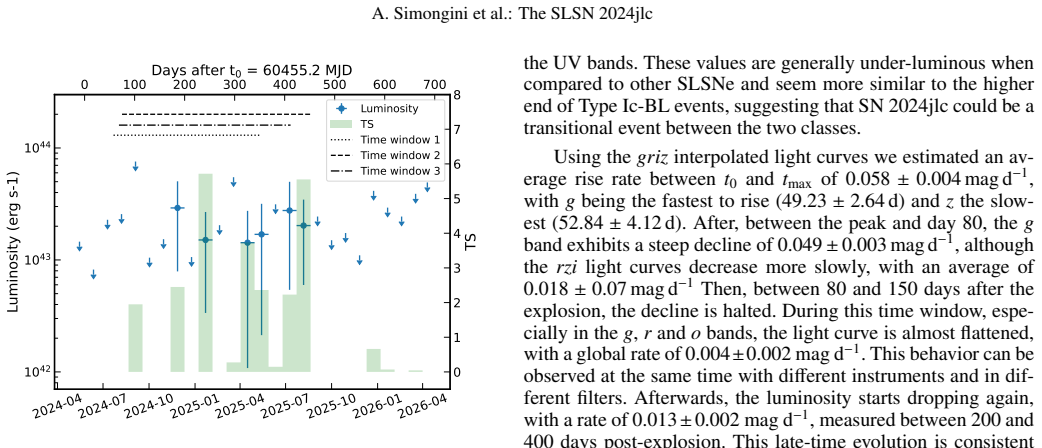
- The marginal gamma-ray efficiency of 0.38 is consistent with a central-engine contribution similar to that inferred for SN 2017egm.
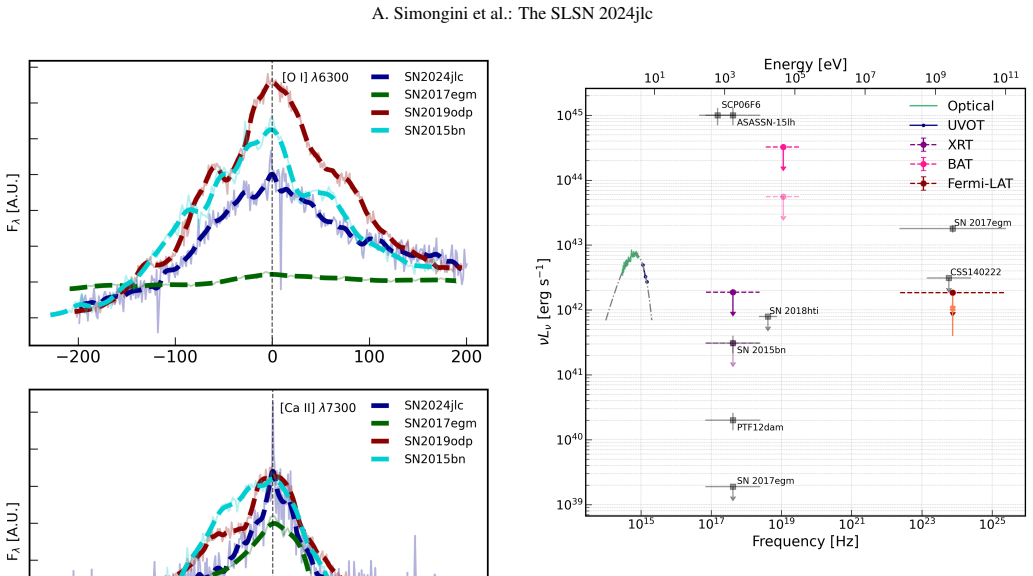
- Upper limits on soft and hard X-ray flux constrain any non-thermal emission from the same central engine.
Where Pith is reading between the lines
- Discovery of more SLSN-Ib events with comparable multi-wavelength coverage would test whether the bridge population is larger than currently observed.
- Systematic comparison of gamma-ray upper limits across the SLSN-Ib sample could quantify how often a central engine is required.
- If the powering mechanism alone accounts for the luminosity gap, then hydrodynamic models that vary only the energy-injection channel should reproduce the observed range of peak magnitudes.
Load-bearing premise
The light-curve shapes are compatible with both interaction and central-engine models and the marginal gamma-ray hint reliably signals a central engine that distinguishes the powering mechanism.
What would settle it
A firm non-detection of gamma rays from additional SLSN-Ib events or a statistical sample showing that their light curves cannot be reproduced by central-engine models would undermine the proposed bridge.
Figures
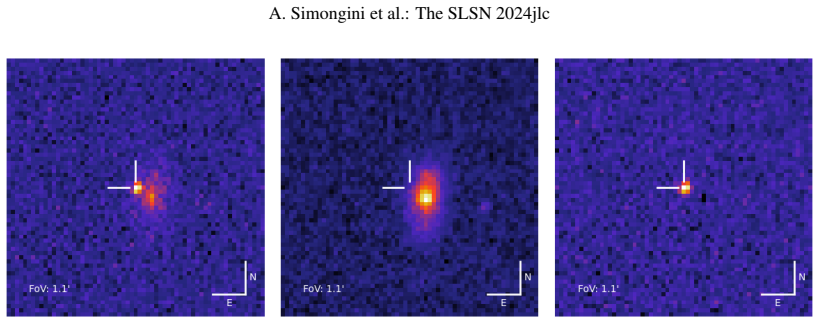
read the original abstract
The Type I super-luminous supernova SN~2024jlc (ZTF24aapadbb) exploded on the 25th of May 2024 at $z = 0.039$. Being the closest supernova of this class discovered in recent years and one of the closest ever, represented a rare opportunity to study in detail this type of objects. We performed a multi-wavelength analysis, spanning ten orders of magnitude in frequency, including optical/UV photometry and spectroscopy, soft and hard X-rays, and high-energy $\gamma$-rays. We characterized the event as a slow-evolving and He-rich supernova, with one of the lowest peak luminosities reported for a super-luminous event $M_g\sim-19.37$ mag, and a light curve evolution compatible with both circumstellar interaction and magnetar spin-down models, with noticeable contribution from $^{56}$Ni decay. No significant excess was found in the soft and hard X-ray bands, for which we provide upper-limits on the flux. Additionally, we analyzed two years of \textit{Fermi}-LAT data, from which we report an intriguing hint of a $\gamma$-ray signal at the $\sim 3.6 \sigma$ level, although no firm detection can be claimed. The gamma to optical efficiency ratio, $\eta = 0.38$, is suggestive of the presence of a central-engine scenario, similar to SN~2017egm. Our analysis suggests that SN~2024jlc could bridge the gap between SLSNe and classical stripped-envelope supernovae. While still poorly populated, this bridge could consist of all SLSN-Ib supernovae, with the key difference residing in the powering mechanism.
Editorial analysis
A structured set of objections, weighed in public.
Referee Report
Summary. The paper reports multi-wavelength observations (optical/UV photometry/spectroscopy, X-ray upper limits, and Fermi-LAT gamma-ray analysis) of the nearby (z=0.039) SLSN-Ib SN 2024jlc, classifying it as slow-evolving and He-rich with low peak luminosity (M_g ~ -19.37). The light curve is compatible with both circumstellar-interaction and magnetar spin-down (plus 56Ni) models; no X-ray excess is found, but a ~3.6σ gamma-ray hint yields η=0.38 suggestive of a central engine. The authors conclude that SN 2024jlc bridges SLSNe and SE-SNe, with all SLSN-Ib objects sharing central-engine powering as the distinguishing feature.
Significance. A well-substantiated bridge population between SLSNe and classical stripped-envelope SNe would be significant for understanding explosion mechanisms and diversity in core-collapse events. The multi-wavelength dataset on one of the closest SLSNe provides useful constraints and upper limits, but the central interpretive claim rests on marginal evidence.
major comments (2)
- [Abstract] Abstract and final paragraph: the claim that 'the key difference residing in the powering mechanism' (central engine for all SLSN-Ib) is not supported, because the light-curve evolution is explicitly compatible with both CSI and magnetar+56Ni models and the gamma-ray signal is only a ~3.6σ hint described as 'suggestive' with no firm detection, no model preference, and no exclusion of CSI.
- [Final paragraph] Abstract and final paragraph: the bridging interpretation requires that central-engine powering distinguishes the SLSN-Ib class, yet the provided data show only dual compatibility plus a non-firm gamma-ray excess (η=0.38); this under-constrains the central claim that the bridge 'could consist of all SLSN-Ib supernovae'.
minor comments (2)
- [Abstract] The abstract and methods sections lack detailed fitting procedures, error analysis, or data tables, making the model-compatibility statements difficult to verify quantitatively.
- Consider adding a quantitative comparison (e.g., chi-squared or Bayesian evidence) between the CSI and magnetar models to assess relative preference rather than stating compatibility with both.
Simulated Author's Rebuttal
We thank the referee for their detailed and constructive report. We agree that the interpretive claims in the abstract and final paragraph regarding the powering mechanism as the key difference and the potential composition of the bridge population are not strongly supported by the data, which show model compatibility and only a marginal gamma-ray signal. We will revise these sections to adopt more cautious phrasing.
read point-by-point responses
-
Referee: [Abstract] Abstract and final paragraph: the claim that 'the key difference residing in the powering mechanism' (central engine for all SLSN-Ib) is not supported, because the light-curve evolution is explicitly compatible with both CSI and magnetar+56Ni models and the gamma-ray signal is only a ~3.6σ hint described as 'suggestive' with no firm detection, no model preference, and no exclusion of CSI.
Authors: We acknowledge this point. The manuscript already states that the light-curve evolution is compatible with both circumstellar-interaction and magnetar spin-down (plus 56Ni) models and describes the gamma-ray signal as a ~3.6σ 'hint' with no firm detection. We will revise the abstract to remove any implication that central-engine powering is definitively the distinguishing feature, instead noting that the data are consistent with a central-engine contribution but do not exclude CSI. revision: yes
-
Referee: [Final paragraph] Abstract and final paragraph: the bridging interpretation requires that central-engine powering distinguishes the SLSN-Ib class, yet the provided data show only dual compatibility plus a non-firm gamma-ray excess (η=0.38); this under-constrains the central claim that the bridge 'could consist of all SLSN-Ib supernovae'.
Authors: We agree that the current dataset under-constrains the suggestion that the bridge population could consist of all SLSN-Ib events. We will revise the final paragraph to present SN 2024jlc as a possible bridge object whose properties are compatible with central-engine powering, while emphasizing that extension to the full SLSN-Ib class is speculative and requires further multi-wavelength observations of additional events. revision: yes
Circularity Check
No circularity; bridging claim is interpretive suggestion from model compatibility and marginal detection
full rationale
The paper performs multi-wavelength observations and light-curve modeling for a single event, reporting compatibility with both CSI and magnetar+56Ni models plus a ~3.6σ gamma-ray hint (η=0.38) described as suggestive but not firm. No equations, fitted parameters, or self-citations reduce the bridging interpretation to inputs by construction; the claim remains an external inference from data rather than a self-referential derivation. This is the standard non-circular outcome for observational classification papers.
Axiom & Free-Parameter Ledger
Reference graph
Works this paper leans on
-
[1]
Simongini, Andrea and Ragosta, F and Piranomonte, S and Di Palma, I , title = ". , volume =. 2024 , month =. doi:10.1093/mnras/stae1911 , url =
-
[2]
Planck 2018 results. VI. Cosmological parameters. , keywords =. doi:10.1051/0004-6361/201833910 , archivePrefix =. 1807.06209 , primaryClass =
work page internal anchor Pith review Pith/arXiv arXiv doi:10.1051/0004-6361/201833910 2018
-
[3]
SN 2006tf: Precursor Eruptions and the Optically Thick Regime of Extremely Luminous Type IIn Supernovae. , keywords =. doi:10.1086/591021 , archivePrefix =. 0804.0042 , primaryClass =
work page internal anchor Pith review Pith/arXiv arXiv doi:10.1086/591021
-
[4]
Ground-based Telescopes , volume=
The Liverpool Telescope: performance and first results , author=. Ground-based Telescopes , volume=. 2004 , organization=
2004
-
[5]
Transient Name Server Discovery Report , keywords =
ZTF Transient Discovery Report for 2024-05-28. Transient Name Server Discovery Report , keywords =
2024
-
[6]
Transient Name Server Classification Report , keywords =
SGLF Transient Classification Report for 2024-07-08. Transient Name Server Classification Report , keywords =
2024
-
[7]
Transient Name Server AstroNote , keywords =
Shane Kast classification of 2 superluminous supernovae 2024-07-08. Transient Name Server AstroNote , keywords =
2024
-
[8]
, volume=
On the diversity of superluminous supernovae: ejected mass as the dominant factor , author=. , volume=. 2015 , publisher=
2015
-
[9]
, volume=
Super-luminous type Ic supernovae: catching a magnetar by the tail , author=. , volume=. 2013 , publisher=
2013
-
[10]
WISeREP - An Interactive Supernova Data Repository
WISeREP An Interactive Supernova Data Repository. , keywords =. doi:10.1086/666656 , archivePrefix =. 1204.1891 , primaryClass =
work page internal anchor Pith review Pith/arXiv arXiv doi:10.1086/666656
-
[11]
On Determining Extinction from Reddening. , keywords =. doi:10.1086/424933 , adsurl =
-
[12]
, volume=
SN 2017egm: A helium-rich superluminous supernova with multiple bumps in the light curves , author=. , volume=. 2023 , publisher=
2023
-
[13]
Space Science Reviews , volume=
Superluminous supernovae , author=. Space Science Reviews , volume=. 2018 , publisher=
2018
-
[14]
arXiv preprint arXiv:2407.12302 , year=
Superluminous supernovae , author=. arXiv preprint arXiv:2407.12302 , year=
-
[15]
Nature Astronomy , volume=
Observational properties of extreme supernovae , author=. Nature Astronomy , volume=. 2019 , publisher=
2019
-
[16]
Astro-COLIBRI-The COincidence LIBrary for Real-time Inquiry for Multimessenger Astrophysics. , keywords =. doi:10.3847/1538-4365/ac1517 , archivePrefix =. 2109.01672 , primaryClass =
-
[17]
, volume=
The Swift gamma-ray burst mission , author=. , volume=. 2004 , publisher=
2004
-
[18]
The Zwicky Transient Facility: System Overview, Performance, and First Results
The Zwicky Transient Facility: System Overview, Performance, and First Results. , keywords =. doi:10.1088/1538-3873/aaecbe , archivePrefix =. 1902.01932 , primaryClass =
work page internal anchor Pith review Pith/arXiv arXiv doi:10.1088/1538-3873/aaecbe 1902
-
[19]
The Hydrogen-poor Superluminous Supernovae from the Zwicky Transient Facility Phase I Survey. I. Light Curves and Measurements , author=. , volume=. 2023 , publisher=
2023
-
[20]
, volume=
Results from a systematic survey of X-ray emission from hydrogen-poor superluminous SNe , author=. , volume=. 2018 , publisher=
2018
-
[21]
Space Science Reviews , volume=
The burst alert telescope (BAT) on the SWIFT midex mission , author=. Space Science Reviews , volume=. 2005 , publisher=
2005
-
[22]
Methodology , author=
The Palermo Swift-BAT hard X-ray catalogue-I. Methodology , author=. A & A , volume=. 2010 , publisher=
2010
-
[23]
1994 , institution=
Lick Obs , author=. 1994 , institution=
1994
-
[24]
Space Science Reviews , volume=
The Swift ultra-violet/optical telescope , author=. Space Science Reviews , volume=. 2005 , publisher=
2005
-
[25]
A & A , volume=
HI4PI: a full-sky H i survey based on EBHIS and GASS , author=. A & A , volume=. 2016 , publisher=
2016
-
[26]
Space science reviews , volume=
The Swift X-ray telescope , author=. Space science reviews , volume=. 2005 , publisher=
2005
-
[27]
, volume=
Where is the engine hiding its missing energy? Constraints from a deep X-ray non-detection of the Superluminous SN 2015bn , author=. , volume=. 2018 , publisher=
2018
-
[28]
, volume=
Hard X-Ray Observations of the Hydrogen-poor Superluminous Supernova SN 2018hti with NuSTAR , author=. , volume=. 2022 , publisher=
2022
-
[29]
, volume=
Core-collapse supernovae in dense environments--particle acceleration and non-thermal emission , author=. , volume=. 2022 , publisher=
2022
-
[30]
, volume=
The first days of Type II-P core collapse supernovae in the gamma-ray range , author=. , volume=. 2022 , publisher=
2022
-
[31]
, volume=
The Pan-STARRS1 database and data products , author=. , volume=. 2020 , publisher=
2020
-
[32]
The Astrophysical Journal , volume=
Fermi LAT gamma-ray detection of the recurrent nova RS ophiuchi during its 2021 outburst , author=. The Astrophysical Journal , volume=. 2022 , publisher=
2021
-
[33]
The Astrophysical Journal , volume=
Gamma-Ray Thermalization and Leakage from Millisecond Magnetar Nebulae: Toward a Self-consistent Model for Superluminous Supernovae , author=. The Astrophysical Journal , volume=. 2021 , publisher=
2021
-
[34]
A superluminous supernova lightened by collisions with pulsational pair-instability shells. Nature Astronomy , keywords =. doi:10.1038/s41550-023-01957-3 , archivePrefix =. 2304.10416 , primaryClass =
-
[35]
, volume=
The Type I superluminous supernova catalogue I: light-curve properties, models, and catalogue description , author=. , volume=. 2024 , publisher=
2024
-
[36]
Thornton, I. and Villar, V. A. and Gomez, S. and Hosseinzadeh, G. , title =. doi:10.5281/zenodo.10652250 , url =
-
[37]
, volume=
Supernova 2020wnt: An Atypical Superluminous Supernova with a Hidden Central Engine , author=. , volume=. 2023 , publisher=
2023
-
[38]
, volume=
Helium-rich superluminous supernovae from the Zwicky transient facility , author=. , volume=. 2020 , publisher=
2020
-
[39]
, volume=
Spectra of hydrogen-poor superluminous supernovae from the palomar transient factory , author=. , volume=. 2018 , publisher=
2018
-
[40]
, volume=
A Detection of Helium in the Bright Superluminous Supernova SN 2024rmj , author=. , volume=. 2025 , publisher=
2025
-
[41]
arXiv preprint arXiv:2501.01485 , year=
A Near-IR Search for Helium in the Superluminous Supernova SN 2024ahr , author=. arXiv preprint arXiv:2501.01485 , year=
-
[42]
A & A , volume=
A nearby super-luminous supernova with a long pre-maximum & “plateau” and strong C II features , author=. A & A , volume=. 2018 , publisher=
2018
-
[43]
Transient Name Server Classification Report , keywords =
ZTF Transient Classification Report for 2019-07-26. Transient Name Server Classification Report , keywords =
2019
-
[44]
, volume=
Supernova light curves powered by young magnetars , author=. , volume=. 2010 , publisher=
2010
-
[45]
, volume=
Luminous supernovae: unveiling a population between superluminous and normal core-collapse supernovae , author=. , volume=. 2022 , publisher=
2022
-
[46]
, volume=
MOSFiT: modular open source fitter for transients , author=. , volume=. 2018 , publisher=
2018
-
[47]
, volume=
The large area telescope on the Fermi gamma-ray space telescope mission , author=. , volume=. 2009 , publisher=
2009
-
[48]
The Astronomer's Telegram , keywords =
Spectroscopic classification of AT 2020oio and SN 2020qef with MMT and Binospec. The Astronomer's Telegram , keywords =
-
[49]
, volume=
SN 2005ap: A most brilliant explosion , author=. , volume=. 2007 , publisher=
2007
-
[50]
, volume=
X-ray emission from supernovae in dense circumstellar matter environments: a search for collisionless shocks , author=. , volume=. 2013 , publisher=
2013
-
[51]
, volume=
Complexity in the light curves and spectra of slow-evolving superluminous supernovae , author=. , volume=. 2017 , publisher=
2017
-
[52]
The hydrogen-poor superluminous supernovae from the Zwicky Transient Facility phase I survey. II. Light-curve modeling and characterization of undulations , author=. , volume=. 2023 , publisher=
2023
-
[53]
, volume=
Hydrogen-poor superluminous supernovae in the nebular phase: spectral diversity due to ejecta ionization as a probe of the power source , author=. , volume=. 2026 , publisher=
2026
-
[54]
, volume=
Superluminous X-rays from a superluminous supernova , author=. , volume=. 2013 , publisher=
2013
-
[55]
, volume=
A radio source coincident with the superluminous supernova PTF10hgi: Evidence for a central engine and an analog of the repeating FRB 121102? , author=. , volume=. 2019 , publisher=
2019
-
[56]
, volume=
SN 2015BN: a detailed multi-wavelength view of a nearby superluminous supernova , author=. , volume=. 2016 , publisher=
2016
-
[57]
, volume=
Gaia17biu/SN 2017egm in NGC 3191: the closest hydrogen-poor superluminous supernova to date is in a “normal,” massive, metal-rich spiral galaxy , author=. , volume=. 2018 , publisher=
2018
-
[58]
, volume=
Jets in hydrogen-poor superluminous supernovae: constraints from a comprehensive analysis of radio observations , author=. , volume=. 2018 , publisher=
2018
-
[59]
A & A , volume=
Search for -ray emission from superluminous supernovae with the Fermi-LAT , author=. A & A , volume=. 2018 , publisher=
2018
-
[60]
Physical Review Letters , volume=
Evidence for GeV Emission from the Superluminous Supernova SN 2017egm , author=. Physical Review Letters , volume=. 2026 , publisher=
2026
-
[61]
, volume=
VERITAS and Fermi-LAT constraints on the gamma-ray emission from superluminous supernovae SN2015bn and SN2017egm , author=. , volume=. 2023 , publisher=
2023
-
[62]
, volume=
X-Rays from the Location of the Double-humped Transient ASASSN-15lh , author=. , volume=. 2017 , publisher=
2017
-
[63]
Nature Astronomy , volume=
The superluminous transient ASASSN-15lh as a tidal disruption event from a Kerr black hole , author=. Nature Astronomy , volume=. 2016 , publisher=
2016
-
[64]
, volume=
Luminous radio emission from the superluminous supernova 2017ens at 3.3 yr after explosion , author=. , volume=. 2023 , publisher=
2023
-
[65]
, volume=
Superluminous supernovae from the Dark Energy Survey , author=. , volume=. 2019 , publisher=
2019
-
[66]
, volume=
Light curves of hydrogen-poor Superluminous Supernovae from the Palomar Transient Factory , author=. , volume=. 2018 , publisher=
2018
-
[67]
, volume=
The most luminous supernovae , author=. , volume=. 2019 , publisher=
2019
-
[68]
Handbook of Supernovae , pages=
Superluminous Supernovae , author=. Handbook of Supernovae , pages=. 2017 , publisher=
2017
-
[69]
, volume=
A spectroscopically normal type Ic supernova from a very massive progenitor , author=. , volume=. 2012 , publisher=
2012
-
[70]
, volume=
Type I superluminous supernovae as explosions inside non-hydrogen circumstellar envelopes , author=. , volume=. 2016 , publisher=
2016
-
[71]
, volume=
Circumstellar interaction models for the bolometric light curve of Type I superluminous SN 2017egm , author=. , volume=. 2017 , publisher=
2017
-
[72]
, volume=
Analytical light curve models of superluminous supernovae: 2-minimization of parameter fits , author=. , volume=. 2013 , publisher=
2013
-
[73]
The properties of NI to CO to Fe decay , author=. , vol. 92, no. 2, p. 527-531 , volume=
-
[74]
, volume=
Inverse Compton X-ray emission from supernovae with compact progenitors: application to SN2011fe , author=. , volume=. 2012 , publisher=
2012
-
[75]
, volume=
Relativistic supernovae have shorter-lived central engines or more extended progenitors: the case of SN 2012ap , author=. , volume=. 2014 , publisher=
2014
-
[76]
Physical Review D—Particles, Fields, Gravitation, and Cosmology , volume=
New class of high-energy transients from crashes of supernova ejecta with massive<? format?> circumstellar material shells , author=. Physical Review D—Particles, Fields, Gravitation, and Cosmology , volume=. 2011 , publisher=
2011
-
[77]
, volume=
Gamma-ray and hard X-ray emission from pulsar-aided supernovae as a probe of particle acceleration in embryonic pulsar wind nebulae , author=. , volume=. 2015 , publisher=
2015
-
[78]
, volume=
SN 2006gy: An extremely luminous supernova in the galaxy NGC 1260 , author=. , volume=. 2007 , publisher=
2007
-
[79]
, volume=
High-energy emission from interacting supernovae: New constraints on cosmic-ray acceleration in dense circumstellar environments , author=. , volume=. 2019 , publisher=
2019
-
[80]
Simulations of ion acceleration at non-relativistic shocks. I. Acceleration efficiency , author=. , volume=. 2014 , publisher=
2014
discussion (0)
Sign in with ORCID, Apple, or X to comment. Anyone can read and Pith papers without signing in.