REVIEW 4 major objections 5 minor 12 references
Dichoptic Opacity: Managing Occlusion in Stereoscopic Displays via Dichoptic Presentation
T0 review · 4 major / 5 minor · reviewed 2026-08-06 · deepseek-v4-flash
Pith's one-line read Dichoptic opacity—different transparency in each eye—lets users see both occluder and occluded at once.
desk verdict Genuinely novel dichoptic occlusion technique, but the user study is too small and too confounded to support the claimed 'clear preference' or any depth-preservation conclusion. read the letter →
The pith
A machine-rendered reading of the paper's core claim, the machinery that carries it, and where it could break.
The reading
What carries the argument
The load-bearing mechanism is the per-eye alpha value: a fragment shader reads the GPU's current eye index and uses it to interpolate between a left-eye and a right-eye transparency setting for the same surface, so the occluder is drawn with different opacity to each eye in a single rendering pass. The authors chose this shader approach over duplicating every object's mesh per eye because the shader version keeps the scene simple and gives immediate interactive feedback. The perceptual work is done by binocular fusion, the same visual process that combines the two offset images in ordinary stereoscopy into one coherent depth picture.
What would settle it
Present viewers with layered surfaces under dichoptic and uniform opacity and ask them to report the depth order or adjust a probe to the apparent depth of the occluded surface; if accuracy is worse under dichoptic opacity, the preservation claim fails. Equally, asking viewers whether the occluder percept switches or flickers would test the fusion assumption directly.
Extended reading notes
Core claim
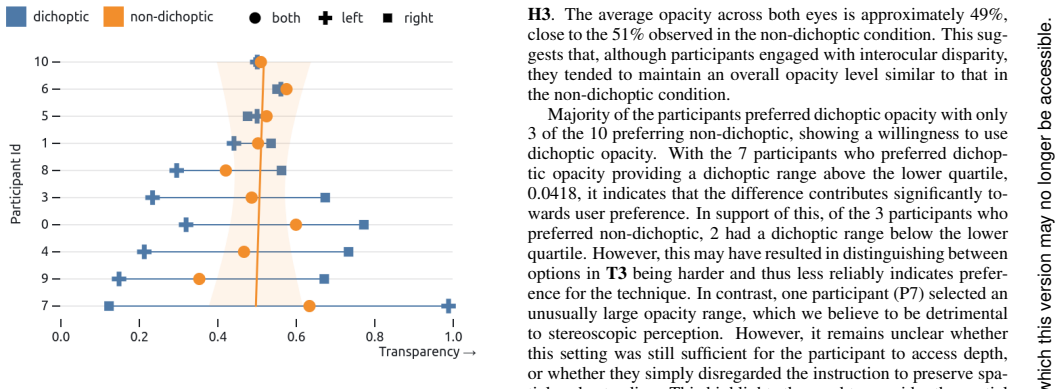
The paper's central claim is that opacity can be treated like stereoscopic disparity: by rendering an occluder with a higher transparency in one eye and a lower transparency in the other, the visual system fuses the two views into a single percept that carries more information about both the occluding and the occluded surface. In the study, the average uniform opacity selected was 0.507 (SD = 0.084), while the dichoptic selections had an average midpoint of 0.490 (SD = 0.0512) and an average range of 0.320 (SD = 0.289). The close midpoint values suggest participants kept the overall amount of transparency roughly constant and instead shifted how it was distributed between eyes. Seven of ten participants preferred the dichoptic presentation for perceiving shape, detail, and spatial understanding, which the authors read as evidence that the technique works as intended even though no optimal range was established.
Load-bearing premise
The technique assumes that the visual system fuses different left- and right-eye opacities into a stable single view without rivalry or depth distortion.
Editorial extensions
If this is right
- Stereoscopic occlusion management can preserve the occluder as a single coherent object rather than erasing it, because the two eyes carry complementary views of front and back surfaces.
- Users appear to keep total opacity roughly constant, so the advantage of dichoptic opacity is about distributing transparency across eyes rather than simply increasing it.
- Because the preferred interocular difference varied widely, a practical deployment would likely need user controls or adaptive per-user settings.
- The technique can be implemented at the shader level in existing per-eye render pipelines, so it transfers to head-mounted displays and autostereoscopic screens with little extra cost.
Reading between the lines
- The authors stop at subjective preference; an objective follow-up could measure depth-order accuracy and stereoacuity under dichoptic opacity against matched uniform transparency.
- If the fusion assumption holds across a wider population, dichoptic opacity could be combined with selective dynamic transparency to reveal occluded structure while keeping the occluder entirely intact.
- The large variance in chosen ranges hints at individual differences in fusion tolerance, which would make a fixed recommended opacity range less useful than an interactive or personalised one.
- Very large interocular opacity differences may cross into binocular rivalry; identifying that boundary would define the usable parameter space of the technique.
Editorial analysis
A structured set of objections, weighed in public.
Referee Report
Summary. The paper proposes dichoptic opacity, a technique for presenting different transparency values to each eye for an occluding surface in a stereoscopic display, with the goal of letting users perceive both the occluder and the occluded object while retaining spatial understanding. The authors describe a fragment-shader implementation in Unity and report a user study with 11 participants (10 after a post-hoc exclusion) in which participants selected preferred opacity levels under non-dichoptic (T1) and dichoptic (T2) conditions and then made a binary preference judgment between the two settings (T3). The results are reported as a consensus for a non-dichoptic opacity near 0.5 (M = 0.507, SD = 0.084), a large but highly variable dichoptic range (M = 0.320, SD = 0.289), and a 7/10 preference for the dichoptic condition. The paper interprets these findings as evidence of engagement and preference for dichoptic opacity, while acknowledging that spatial understanding was not directly measured.
Significance. The core idea is novel and timely: using interocular differences in opacity as an occlusion-management tool is a natural extension of dichoptic presentation that has not been explored in the visualization literature. The shader-level implementation is concrete and the experimental data and code are made publicly available, which are clear strengths. The paper is also appropriately framed as exploratory in its hypotheses, and the authors are transparent about several limitations. However, the evidence presented does not currently support the abstract's claims of a "clear preference" or of "better simultaneous understanding of both occluder and occluded": the preference result is not statistically evaluated, the sample is small, one participant is excluded post hoc, and the experimental design cannot separate depth preservation from the strong motion-parallax cue provided by the continuously rotating scene. If the claims are tempered and the statistical and confound issues are addressed, the paper would make a useful contribution to stereoscopic visualization research.
major comments (4)
- [Abstract and Sec. 4.3] The claim of a "clear preference for dichoptic opacity" is not supported by the data. Seven out of ten participants preferred the dichoptic condition; under a two-sided binomial test this is not significant at the conventional 0.05 level (p ≈ 0.34). No inferential statistic is reported for this or any other result in Sec. 4.3, yet the abstract and the conclusion both state the preference as if it were established. The wording should be changed to a "majority preference" or "preliminary indication," and a formal test should be reported if the claim is retained.
- [Sec. 4.2 and Sec. 5] The experimental design cannot support the claim that dichoptic opacity preserves spatial understanding. Both meshes rotate continuously around an origin (Sec. 4.2), supplying motion parallax as an independent and powerful depth cue, so participants could maintain depth perception even if the dichoptic presentation induced rivalry or distorted stereoscopic depth. Task T3 asks a single binary question about shape, detail, and spatial understanding with no objective measure of depth or fusion, and the paper itself concedes in Sec. 5 that "spatial understanding" needs "more careful" consideration in future work. This is a load-bearing limitation because the central claim of the technique is that it preserves depth relationships; without a static or motion-isolated condition, the study cannot distinguish a technique that preserves depth from one that merely tolerates depth degradation masked by motion.
- [Sec. 4.3 and Sec. 5] The post-hoc exclusion of one participant's data is not adequately justified. The participant is removed based on a Z-score of 2.25 and being outside the IQR, but with n = 11 these criteria are not a principled outlier rule, and the exclusion changes the reported sample size to 10, materially affecting both the consensus estimate and the preference proportion. No pre-registered exclusion criterion or sensitivity analysis is provided. Since the participant's non-dichoptic opacity of 0.91 is near the edge of the scale, it could also be re-examined as a meaningful individual preference rather than an error. The authors should justify the exclusion more rigorously or report results with and without this participant.
- [Sec. 4.3, H2 and H3] Hypothesis H2 is stated as "assigning significantly different transparency values to each eye" and is claimed to be supported by the high average dichoptic range, but no statistical test is reported. The reported standard deviation of the range (SD = 0.289) is nearly as large as the mean (M = 0.320), which, as the authors note, leads to rejection of H3. This high variability also weakens the inference that participants engaged with the technique in a consistent way. A formal test of whether the left–right difference is reliably above zero (e.g., a Wilcoxon signed-rank or t-test on the range) should be reported, and the interpretation of H2 should be tempered accordingly.
minor comments (5)
- [Sec. 3.2] The shader code uses a variable `_DisplayIndex` that is not defined in the text. The relationship between `unity_StereoEyeIndex` and `_DisplayIndex` should be explained, otherwise the code snippet is difficult to follow.
- [Sec. 4.2] The phrase "proceeded with on-screen written instructions" should be "preceded by" (or similarly corrected). Also, the paper alternates between "DeadEye" (Sec. 1) and "Deadeye" (Sec. 2.3); one spelling should be used consistently.
- [Sec. 4.2] No ethics-approval or informed-consent statement is included beyond the brief mention of a consent form. For a user study involving human participants, the authors should state whether ethical approval was obtained or why it was not required.
- [Sec. 2.2] The claim that dichoptic opacity "retain[s] the occluder as a cohesive whole due to more available information" is stated without supporting evidence or a perceptual rationale. It would be helpful to separate this speculation from the empirical results.
- [Figure 1] Figure 1 is described as showing a "blend of colours for both objects presented to the screen," but the caption does not clarify how the left- and right-eye images are combined in the figure. Adding an explicit description of the layout (e.g., side-by-side vs. anaglyph) would improve readability.
Circularity Check
No circularity: the study reports empirical user-preference measurements and does not derive predictions from the technique's definition.
full rationale
The paper makes no derivation-chain claim; its central results are descriptive statistics of user-selected opacity values and a binary preference count. The technique 'dichoptic opacity' is defined by construction as different transparency per eye, but the evaluated claims (H1 consensus on non-dichoptic opacity, H2 engagement as interocular range, H3 consistency) are empirical measurements of participant behavior. H2's operationalization ('engage with dichoptic opacity by assigning significantly different transparency values to each eye') is admittedly close to its own measure: the evidence for 'engagement' is the measured range itself. However, this is an operational definition of the dependent variable, not a fitted input relabeled as a prediction, and it does not pretend to derive the range from the technique's parameters. The stated limitation in Sec. 5 — that one participant's large range may have been detrimental to stereoscopic perception and that spatial understanding 'needs to be considered more carefully in future work' — is an acknowledged validity gap, not a circular step. The 7/10 majority is not statistically significant under a binomial test, and the rotating stimuli introduce motion parallax as a confound, but statistical weakness and confounds are correctness risks, not circularity. No self-citations are load-bearing; the related work (Krekhov et al., Elmqvist et al., Livingston et al.) is external and used only for framing. Therefore no step reduces to its own input.
Assumptions & free parameters
assumptions (3)
- domain assumption Binocular fusion can merge images with different alpha values into a coherent percept
- domain assumption Participants' opacity selections reflect their ability to perceive both meshes and preserve spatial understanding
- domain assumption The sample of 10 participants is representative enough to reveal the technique's potential
Cite this review
Pith. "Pith review of Dichoptic Opacity: Managing Occlusion in Stereoscopic Displays via Dichoptic Presentation." pith.science (2026). https://pith.science/paper/T7JBF3GQ
@misc{pith2026250622841,
  author       = {Pith},
  title        = {Pith review of: Dichoptic Opacity: Managing Occlusion in Stereoscopic Displays via Dichoptic Presentation},
  year         = {2026},
  howpublished = {\url{https://pith.science/paper/T7JBF3GQ}},
  note         = {Machine review of arXiv:2506.22841}
}
read the original abstract
Adjusting transparency is a common method of mitigating occlusion but is often detrimental for understanding the relative depth relationships between objects as well as removes potentially important information from the occluding object. We propose using dichoptic opacity, a novel method for occlusion management that contrasts the transparency of occluders presented to each eye. This allows for better simultaneous understanding of both occluder and occluded. A user study highlights the technique's potential, showing strong user engagement and a clear preference for dichoptic opacity over traditional presentations. While it does not determine optimal transparency values, it reveals promising trends in both percentage and range that merit further investigation.
Figures


Reference graph
Works this paper leans on
-
[1]
B. Alper, T. Hollerer, J. Kuchera-Morin, and A. Forbes. Stereoscopic Highlighting: 2D Graph Visualization on Stereo Displays. IEEE Transactions on Visualization and Computer Graphics , 17(12):2325– 2333, Dec. 2011. doi: 10.1109/TVCG.2011.234
-
[2]
Y . Chen, J. Sun, Q. Xu, E. Lank, P. Irani, and W. Li. Global Scene Filtering, Exploration, and Pointing in Occluded Virtual Space. In Human-Computer Interaction – INTERACT 2021 , pp. 156–176. Springer International Publishing, Cham, 2021. doi: 10.1007/978-3 -030-85607-6 11
doi:10.1007/978-3 2021
-
[3]
N. Elmqvist, U. Assarsson, and P. Tsigas. Employing Dynamic Trans- parency for 3D Occlusion Management: Design Issues and Evalua- tion. In Human-Computer Interaction – INTERACT 2007 , pp. 532–
work page 2007
-
[4]
N. Elmqvist and P. Tsigas. A Taxonomy of 3D Occlusion Management Techniques. In 2007 IEEE Virtual Reality Conference, pp. 51–58. IEE, Charlotte, 2007. doi: 10.1109/VR.2007.352463
-
[5]
N. Gerig, J. Mayo, K. Baur, F. Wittmann, R. Riener, and P. Wolf. Missing depth cues in virtual reality limit performance and quality of three dimensional reaching movements. PLOS ONE, 13(1), Jan. 2018. doi: 10.1371/journal.pone.0189275
-
[6]
A. Krekhov and J. Kruger. Deadeye: A Novel Preattentive Visualiza- tion Technique Based on Dichoptic Presentation. IEEE Transactions on Visualization & Computer Graphics , 25(1):936–945, Jan. 2019. doi: 10.1109/TVCG.2018.2864498
arXiv 2019
-
[7]
M. Livingston, J. Swan, J. Gabbard, T. Hollerer, D. Hix, S. Julier, Y . Baillot, and D. Brown. Resolving multiple occluded layers in aug- mented reality. In The Second IEEE and ACM International Sympo- sium on Mixed and Augmented Reality, 2003. Proceedings. , pp. 56– 65, 2003. doi: 10.1109/ISMAR.2003.1240688
arXiv 2003
-
[8]
J. P. McIntire, P. R. Havig, and E. E. Geiselman. Stereoscopic 3D displays and human performance: A comprehensive review.Displays, 35(1):18–26, Jan. 2014. doi: 10.1016/j.displa.2013.10.004
Show all 12 references
-
[9]
Pietroszek, J
K. Pietroszek, J. R. Wallace, and E. Lank. Tiltcasting: 3D Interaction on Large Displays using a Mobile Device. In Proceedings of the 28th Annual ACM Symposium on User Interface Software & Technology , pp. 57–62. Association for Computing Machinery, New York, 2015. doi: 10.114...
2015
-
[10]
B. W. van Schooten, E. M. A. G. van Dijk, E. Zudilova-Seinstra, A. Suinesiaputra, and J. H. C. Reiber. The effect of stereoscopy and motion cues on 3D interpretation task performance. In Proceedings of the International Conference on Advanced Visual Interfaces, pp. 167–
-
[170]
doi: 10 .1145/1842993.1843023
Association for Computing Machinery, New York, 2010. doi: 10 .1145/1842993.1843023
2010
-
[545]
doi: 10.1007/978-3-540-74796-3 54
Springer, Berlin, 2007. doi: 10.1007/978-3-540-74796-3 54
2007 doi
Reviewed August 6, 2026 · model on record in the stance chip above.
Discussion (0). Sign in to comment.