REVIEW 3 major objections 4 minor 109 references
SN 2022erq: A Superluminous Thermonuclear Supernova with Escalating Preexplosion Mass Loss
T0 review · 3 major / 4 minor · reviewed 2026-08-02 · deepseek-v4-flash
Pith's one-line read SN 2022erq's extraordinary luminosity and slow decline are powered by ejecta–CSM interaction, not radioactive decay, and its progenitor's mass-loss rate escalated from about 0.04 to 0.6 solar masses per year in the final decades before expl
desk verdict SN 2022erq is the earliest confirmed Ia-CSM with dense multi-band data to 1350 d; the central interaction-powered claim is solid, but the headline 0.04→0.6 M_sun/yr escalation rests on bolometric inversion assumptions that need systematic sensitivity tests. read the letter →
The pith
A machine-rendered reading of the paper's core claim, the machinery that carries it, and where it could break.
The reading
What carries the argument
The central device is the inversion of the bolometric light curve, L = ε dEkin/dt = 2πε ρ(r) r² v³, which converts the observed luminosity into a circumstellar density profile. The shock velocity is taken from the width of the broad Hα component, parameterized as v_sh ∝ t^{0.15}, and the kinetic-to-radiative efficiency ε is set to about 50 percent, consistent with the ratio of radiated energy to the canonical ejecta kinetic energy of about 1.4 foe. Independent density estimates come from the narrow Hα flux, which probes the outer, unshocked wind. The steep power-law density profile (index ~3.6) is then translated into a mass-loss history by assuming a constant wind speed of 180 km/s, so that
What would settle it
A direct measurement of the circumstellar density profile, for example from late-time radio or X-ray emission of the shock, would test the claim: if that profile does not match the steep ρ ∝ r^{-3.7} power law inferred from the bolometric light curve, the escalating-path-to-explosion interpretation would be wrong. Alternatively, detecting resolved absorption features from the wind at multiple epochs could reveal whether the wind speed was constant.
Extended reading notes
Core claim
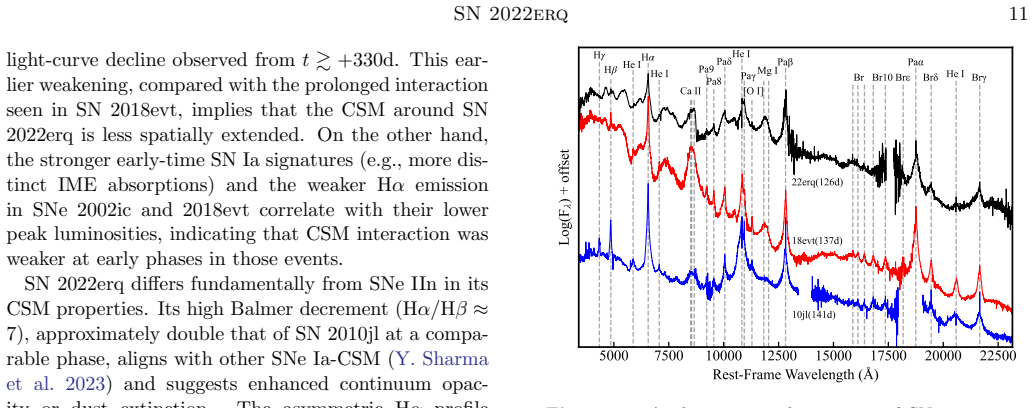
The central claim is that SN 2022erq is an Ia-CSM event, a thermonuclear supernova interacting with hydrogen-rich circumstellar material, and that its light curve is dominated by long-lived ejecta–circumstellar interaction rather than radioactive decay. Applying the standard peak-luminosity–nickel-mass relation would require an implausible nickel mass of about 6 solar masses, ruling out radioactive decay as the power source. Instead, the authors model the post-peak decline as the shock's kinetic energy being converted into radiation with roughly 50 percent efficiency. Inverting the bolometric light curve yields a circumstellar density profile that steeply declines with radius (ρ ∝ r^{-3.7}),
Load-bearing premise
The reconstruction of the mass-loss history rests on assuming that the circumstellar wind had a constant speed of 180 km/s and was spherically symmetric; if the wind velocity evolved with time or the shell is clumpy or asymmetric, the derived escalation and total mass could change substantially.
Editorial extensions
If this is right
- If true, the brightest Type Ia-like supernovae can be powered mainly by circumstellar interaction, so luminosity-based cosmological calibrations must account for such contamination.
- The derived mass-loss escalation of about a factor of 15 over decades places strong constraints on binary evolution models, favoring a brief, violent ejection episode shortly before explosion.
- The young host environment (about 100 Myr) and the massive shell point to a white dwarf with an intermediate-mass companion, a channel that current population synthesis may underestimate.
- The event demonstrates that early spectroscopic classification (within days) can identify Ia-CSM events, so future wide-field surveys should find more such objects.
- The success of this analytic inversion suggests that bolometric light curves of interacting supernovae can be used to reconstruct progenitor mass-loss histories.
Reading between the lines
- If the wind speed varied with time, the absolute timing of the mass-loss escalation would shift, so the 0.04→0.6 M_sun/yr history is model-dependent; a direct measurement of velocity stratification could resolve this.
- The steep density profile could also be produced by an asymmetric or clumpy shell, which would change the mass estimate; polarimetric observations during the interaction phase could test sphericity.
- The same inversion method could be applied to other Ia-CSM events to see whether escalating mass loss is common or unique to this event.
- If the underlying explosion is super-Chandrasekhar, the assumed ejecta kinetic energy and efficiency would change, which would alter the absolute density scale.
Signed reviews
Editorial analysis
A structured set of objections, weighed in public.
Referee Report
Summary. SN 2022erq is presented as the earliest spectroscopically confirmed Type Ia-CSM supernova, discovered about 1.8 days after explosion and followed for about 1350 days. From multi-band photometry and spectroscopy the authors derive a peak bolometric luminosity of about 8e43 erg/s, an unusually slow post-peak decline, and an IGE-rich/IME-weak spectrum with persistent narrow H-alpha. They argue that Arnett's law would require roughly 6 Msun of 56Ni, ruling out radioactive decay as the dominant power source, and that ejecta-CSM interaction supplies most of the luminosity. Using the Ofek et al. (2013) narrow-H-alpha formula they infer a wind velocity of about 180 km/s and a mass-loss rate near 0.04 Msun/yr; inverting the bolometric light curve they derive rho proportional to r^-3.66, which they translate into an escalating mass-loss rate reaching about 0.6 Msun/yr in the final years and a total CSM mass of about 3 Msun. They conclude that the progenitor is a white dwarf with an intermediate-mass companion that underwent escalating late-stage mass loss.
Significance. If the quantitative reconstruction holds, the paper is a valuable addition to the rare Ia-CSM class: it has the earliest spectra, dense photometry, a clean host environment, and one of the few attempts to reconstruct a pre-explosion mass-loss history for this class. The central claim that CSM interaction, not 56Ni decay, dominates the luminosity is well supported by three independent observational arguments: the Arnett-limit inconsistency, the persistent narrow Balmer lines, and the slow post-peak decline. The extensive dataset and the machine-readable tables and spectra are concrete assets. The quantitative mass-loss history is the least secure part because it depends on a single-zone inversion with several hand-tuned parameters, and the H-alpha data do not independently corroborate the steep density profile as presented. This weakness does not undermine the classification or the interaction-dominance claim, but it does affect the headline 'escalating mass loss' result.
major comments (3)
- [Sections 5.2 and 5.3] The claimed 'broad consistency' between the H-alpha and bolometric diagnostics is not supported when the H-alpha emission is referred to the instantaneous shock radius. The Ofek et al. formula used in Section 5.2 is the recombination luminosity of a wind outside an inner radius r; for a local mass-loss rate Mdot_eff = 4 pi r^2 rho v_wind it gives L_Halpha proportional to Mdot_eff^2 / (r v_wind^2). At tau about 77 d, the adopted v_sh(t) = 2800 t^0.15 gives r_sh about 3e15 cm, so the H-alpha point at this epoch measures Mdot_eff about 0.04 Msun/yr at that radius, i.e. rho about 1.2e-14 g/cm3. The bolometric profile rho proportional to r^-3.66 normalized to the quoted inner value (about 0.6 Msun/yr near 1.5e15 cm) implies Mdot_eff proportional to r^-1.66 and predicts Mdot_eff(3e15 cm) about 0.1-0.2 Msun/yr, a factor 3-5 above the H-alpha value. Moreover, the two H-alpha epochs (4.5e-2 and 3
- [Section 5.3] The derivation of s = 3.59 from the post-peak slope alpha = -1.46 is called an 'independent check,' but it is not independent: both quantities are derived from the same bolometric light curve, and the Moriya et al. (2013) relation is an analytic approximation of the same inversion with an assumed ejecta index n about 10. It verifies only internal consistency of the power-law model. In addition, the inversion of Eq. (2) assumes a single, time-independent epsilon = 0.5. That value is calibrated from the total radiated energy divided by a canonical 1.4 foe, but the instantaneous conversion efficiency is not measured; the two-epoch v_sh(t) parameterization and the 40-330 d phase boundaries are also unquantified inputs. The resulting 0.04 to 0.6 Msun/yr escalation therefore has no formal error budget. The authors should either propagate these systematic uncertainties or present the mass-loss
- [Sections 5.2 and 5.3] The total CSM mass and outer radius are derived with two different velocity assumptions. The H-alpha mass of about 2.4 Msun assumes a constant 180 km/s wind over about 60 yr, while the bolometric mass of about 3 Msun comes from the r^-3.66 profile; the near-agreement of the two numbers is therefore not an independent confirmation. Also, the outer CSM radius of about 3.5e16 cm is obtained from an 'ejecta velocity' of 10,000 km/s, whereas the CDS velocities used in Section 5.3 are 5,400-5,900 km/s; the latter gives r about 2e16 cm over 400 d, closer to the 1.6e16 cm bolometric extent. A single, clearly defined interaction radius should be used consistently in both diagnostics.
minor comments (4)
- [Section 5.2] The parameter beta in the Ofek et al. formula is not defined; please state its assumed value or give the reference for the adopted normalization.
- [Figure 13] Please specify the phase range over which the L proportional to t^-1.46 fit is performed; 'post-peak' is ambiguous for a light curve with such a long, nearly flat evolution.
- [Section 5.1] The SED-derived stellar metallicity log(Z/Zsun) = -2.13 (about 0.7% solar) is remarkably low, far below the gas-phase R23 value; a sentence discussing whether this result is robust to the BayeSED prior choices would be helpful.
- [Section 2.3] Minor typographical issues: 'NaiD' should read 'Na I D'; in Section 4.1, 'overlay Hbeta and Hgamma absorption' would read more clearly as 'overlaid by Hbeta and Hgamma absorption.'
Circularity Check
Mild circularity in the 'independent check' of the density slope: it reuses the same bolometric light curve; the main mass-loss reconstruction is otherwise a disclosed model inversion.
-
fitted input called prediction
[Section 5.3, after Eq. (2) inversion, paragraph 'A power-law fit to these numerical results...']
"As an independent check, we fit the post-peak bolometric luminosity with L∝t^α, obtaining α=−1.46. Using the analytic model of T. J. Moriya et al. (2013)... we derive s=3.59, corresponding to ρ_CSM ∝ r^{−3.59}, in good agreement with the numerical result."
The 'numerical result' s=3.66 is obtained by inverting Eq. (2) with the same observed bolometric L(t), v_sh(t), and r_sh(t). The 'independent check' fits a power law to the same post-peak L(t) and converts that fitted α into s via the Moriya et al. scaling relation. Both routes use the same light curve as input under the same interaction model, so the agreement is a self-consistency test rather than an independent confirmation. It cannot independently validate the steep density slope or the derived escalation of the mass-loss rate.
full rationale
The central mass-loss reconstruction is a model inversion rather than a circular derivation: Eq. (2) combines an assumed kinetic-to-radiative efficiency ε≈50%, a shock-velocity parameterization v_sh(t)=v1 t^0.15 calibrated from two measured broad-Hα FWHMs, and the observed bolometric L(t) to infer ρ_CSM(r); the Mdot history then follows from the stated steady-wind assumption v_wind=180 km/s with an explicit caveat that a time-varying wind would change the absolute timing. The Hα narrow-line flux is an independent observable and is not used to set the bolometric density normalization. No load-bearing self-citation or uniqueness argument is present. The only notable circular element is the 'independent check' in Section 5.3: the analytic s=3.59 is derived from a power-law fit to the same post-peak bolometric light curve that produced the numerical density profile, so the agreement adds no new evidence. This is a minor overstatement, not a central circularity; the headline escalation could stand or fall on the bolometric inversion alone.
Assumptions & free parameters
free parameters (5)
- ε (kinetic-to-radiative conversion efficiency) =
0.5
- v_wind =
180 km/s
- v_sh(t) parameterization =
v1=2800 km/s, exponent 0.15
- Interaction phase boundaries =
τ≈40 d to τ≈330 d
- Host SED stellar-population age =
log(t_age/yr)=8.02
assumptions (7)
- domain assumption CSM is spherically symmetric for mass estimates.
- domain assumption Forward-shock kinetic energy dissipation is the sole power source with constant efficiency ε.
- domain assumption Ejecta follow a standard Chandrasekhar-mass SN Ia density profile with n≈10 and total kinetic energy 1.4 foe.
- domain assumption The narrow H-alpha luminosity follows the Ofek et al. (2013) recombination relation for a steady wind with constant velocity.
- domain assumption The CSM was produced by a steady wind with constant velocity, so pre-explosion time is t=r/v_wind and Mdot=4πr^2ρv_wind.
- domain assumption Host SED modeling assumptions (BC03 SSP, Chabrier IMF, exponentially declining SFH, Calzetti dust, nebular emission) are valid for the dwarf host.
- domain assumption R23 index calibrations yield reliable gas-phase metallicity.
Cite this review
Pith. "Pith review of SN 2022erq: A Superluminous Thermonuclear Supernova with Escalating Preexplosion Mass Loss." pith.science (2026). https://pith.science/paper/TA6TZGYU
@misc{pith2026260706338,
  author       = {Pith},
  title        = {Pith review of: SN 2022erq: A Superluminous Thermonuclear Supernova with Escalating Preexplosion Mass Loss},
  year         = {2026},
  howpublished = {\url{https://pith.science/paper/TA6TZGYU}},
  note         = {Machine review of arXiv:2607.06338}
}
read the original abstract
We present a photometric and spectroscopic study of the superluminous Type Ia supernova SN 2022erq. Its early spectra, dominated by iron-group elements with weak intermediate-mass features, might indicate highly efficient nuclear burning, broadly similar to that inferred for some overluminous SNe Ia. The rapid emergence and persistence of narrow Balmer emission lines superposed on this iron-rich spectrum provide clear evidence of long-lived interaction with a hydrogen-rich circumstellar medium (CSM), establishing SN 2022erq as a member of the rare Ia-CSM class. SN 2022erq reached a peak bolometric luminosity of about 8 x 10^43 erg/s and exhibited an exceptionally slow post-peak decline, indicating that its light curve is dominated by long-duration ejecta-CSM interaction. By combining H-alpha diagnostics with bolometric light-curve modeling, we reconstruct the pre-explosion mass-loss history of the progenitor. The mass-loss rate escalated by one order of magnitude over the final decades, rising from about 0.04 to about 0.6 solar masses per year. This surge produced a massive, extended CSM shell of about 3 solar masses out to about 3.5 x 10^16 cm. The young stellar environment (about 100 Myr) together with this substantial, extensive CSM points to a progenitor system consisting of a white dwarf and an intermediate-mass companion that underwent increasing mass loss prior to explosion.
Figures


Figures from the paper (14 more)




Reference graph
Works this paper leans on
-
[1]
Aldering , G., Antilogus , P., Bailey , S., et al. 2006, title Nearby Supernova Factory Observations of SN 2005gj: Another Type Ia Supernova in a Massive Circumstellar Envelope , , 650, 510, 10.1086/507020
doi:10.1086/507020 2006
-
[2]
Arcavi , I., Howell , D. A., Kasen , D., et al. 2017, title Energetic eruptions leading to a peculiar hydrogen-rich explosion of a massive star , , 551, 210, 10.1038/nature24030
-
[3]
Arnett , W. D. 1982, title Type I supernovae. I - Analytic solutions for the early part of the light curve , , 253, 785, 10.1086/159681
doi:10.1086/159681 1982
-
[4]
Asplund , M., Grevesse , N., Sauval , A. J., & Scott , P. 2009, title The Chemical Composition of the Sun , Annual Review of Astronomy and Astrophysics, 47, 481, 10.1146/annurev.astro.46.060407.145222
arXiv 2009
-
[5]
Bellm , E. C., Kulkarni , S. R., Graham , M. J., et al. 2019, title The Zwicky Transient Facility: System Overview, Performance, and First Results , , 131, 018002, 10.1088/1538-3873/aaecbe
-
[6]
Blondin , S., Dessart , L., & Hillier , D. J. 2015, title A one-dimensional Chandrasekhar-mass delayed-detonation model for the broad-lined Type Ia supernova 2002bo , , 448, 2766, 10.1093/mnras/stv188
-
[7]
Blondin , S., Dessart , L., & Hillier , D. J. 2018, title The detonation of a sub-Chandrasekhar-mass white dwarf at the origin of the low-luminosity Type Ia supernova 1999by , , 474, 3931, 10.1093/mnras/stx3058
-
[8]
Bloom , J. S., Kasen , D., Shen , K. J., et al. 2012, title A Compact Degenerate Primary-star Progenitor of SN 2011fe , , 744, L17, 10.1088/2041-8205/744/2/L17
Show all 109 references
-
[9]
J., Huang , C., Chevalier , R
Borish , H. J., Huang , C., Chevalier , R. A., et al. 2015, title Near-infrared Spectroscopy of the Type IIn SN 2010jl: Evidence for High Velocity Ejecta , , 801, 7, 10.1088/0004-637X/801/1/7
2015 doi
-
[10]
2003, title Stellar Population Synthesis at the Resolution of 2003, Monthly Notices of the Royal Astronomical Society, 344, 1000, 10.1046/j.1365-8711.2003.06897.x
Bruzual, G., & Charlot, S. 2003, title Stellar Population Synthesis at the Resolution of 2003, Monthly Notices of the Royal Astronomical Society, 344, 1000, 10.1046/j.1365-8711.2003.06897.x
2003
-
[11]
, Conroy, C., & Johnson, B
Byler, N., Dalcanton, J. ., Conroy, C., & Johnson, B. . 2017, title Nebular Continuum and Line Emission in Stellar Population Synthesis Models , apj, 840, 44, 10.3847/1538-4357/aa6c66
2017 doi
-
[12]
, et al
Calzetti, D., Armus, L., Bohlin, R. ., et al. 2000, title The Dust Content and Opacity of Actively Star-forming Galaxies , apj, 533, 682, 10.1086/308692
2000 doi
-
[13]
A., & Fransson , C
Chevalier , R. A., & Fransson , C. 1994, title Emission from Circumstellar Interaction in Normal Type II Supernovae , , 420, 268, 10.1086/173557
1994 doi
-
[14]
2011, title Keck Observations of the Young Metal-poor Host Galaxy of the Super-Chandrasekhar-mass Type Ia Supernova SN 2007if , , 733, 3, 10.1088/0004-637X/733/1/3
Childress , M., Aldering , G., Aragon , C., et al. 2011, title Keck Observations of the Young Metal-poor Host Galaxy of the Super-Chandrasekhar-mass Type Ia Supernova SN 2007if , , 733, 3, 10.1088/0004-637X/733/1/3
2011 doi
-
[15]
J., Scalzo , R
Childress , M. J., Scalzo , R. A., Sim , S. A., et al. 2013, title Spectroscopic Observations of SN 2012fr: A Luminous, Normal Type Ia Supernova with Early High-velocity Features and a Late Velocity Plateau , , 770, 29, 10.1088/0004-637X/770/1/29
2013 doi
-
[16]
Chugai , N. N. 2001, title Broad emission lines from the opaque electron-scattering environment of SN 1998S , , 326, 1448, 10.1111/j.1365-2966.2001.04717.x
2001
-
[18]
N., & Yungelson , L
Chugai , N. N., & Yungelson , L. R. 2004, title Type-Ia Supernovae in Dense Circumstellar Gas , Astronomy Letters, 30, 65, 10.1134/1.1646691
2004 doi
-
[19]
S., Ohyama , Y., et al
Deng , J., Kawabata , K. S., Ohyama , Y., et al. 2004, title Subaru Spectroscopy of the Interacting Type Ia Supernova SN 2002ic: Evidence of a Hydrogen-rich, Asymmetric Circumstellar Medium , , 605, L37, 10.1086/420698
2004 doi
-
[20]
2015, title Rapid instrument exchanging system for the Cassegrain focus of the Lijiang 2.4-m Telescope , RAA, 15, 918, 10.1088/1674-4527/15/6/014
Fan , Y.-F., Bai , J.-M., Zhang , J.-J., et al. 2015, title Rapid instrument exchanging system for the Cassegrain focus of the Lijiang 2.4-m Telescope , RAA, 15, 918, 10.1088/1674-4527/15/6/014
2015 doi
-
[21]
Filippenko , A. V. 1982, title The importance of atmospheric differential refraction in spectrophotometry. , , 94, 715, 10.1086/131052
1982 doi
-
[22]
V., Richmond , M
Filippenko , A. V., Richmond , M. W., Matheson , T., et al. 1992, title The Peculiar Type IA SN 1991T: Detonation of a White Dwarf? , , 384, L15, 10.1086/186252
1992 doi
-
[23]
E., Sullivan , M., Gal-Yam , A., et al
Firth , R. E., Sullivan , M., Gal-Yam , A., et al. 2015, title The rising light curves of Type Ia supernovae , , 446, 3895, 10.1093/mnras/stu2314
2015 doi
-
[24]
J., et al
Fransson , C., Ergon , M., Challis , P. J., et al. 2014, title High-density Circumstellar Interaction in the Luminous Type IIn SN 2010jl: The First 1100 Days , , 797, 118, 10.1088/0004-637X/797/2/118
2014 doi
-
[25]
J., Kulkarni , S
Graham , M. J., Kulkarni , S. R., Bellm , E. C., et al. 2019, title The Zwicky Transient Facility: Science Objectives , , 131, 078001, 10.1088/1538-3873/ab006c
2019 doi
-
[26]
1999, title A Wide Symbiotic Channel to Type IA Supernovae , , 522, 487, 10.1086/307608
Hachisu , I., Kato , M., & Nomoto , K. 1999, title A Wide Symbiotic Channel to Type IA Supernovae , , 522, 487, 10.1086/307608
1999 doi
-
[27]
M., Suntzeff , N
Hamuy , M., Phillips , M. M., Suntzeff , N. B., et al. 2003, title An asymptotic-giant-branch star in the progenitor system of a type Ia supernova , , 424, 651, 10.1038/nature01854
2003 doi
-
[28]
Z., Bai , J.-M., & Han , Z
Han , Y., Fan , L., Zheng , X. Z., Bai , J.-M., & Han , Z. 2023, title BayeSED-GALAXIES. I. Performance Test for Simultaneous Photometric Redshift and Stellar Population Parameter Estimation of Galaxies in the CSST Wide-field Multiband Imaging Survey , , 269, 39, 10.3847/1538-...
2023 doi
-
[29]
2004, title The single-degenerate channel for the progenitors of Type Ia supernovae , , 350, 1301, 10.1111/j.1365-2966.2004.07713.x
Han , Z., & Podsiadlowski , P. 2004, title The single-degenerate channel for the progenitors of Type Ia supernovae , , 350, 1301, 10.1111/j.1365-2966.2004.07713.x
2004
-
[30]
2006, title A single-degenerate model for the progenitor of the Type Ia supernova 2002ic , , 368, 1095, 10.1111/j.1365-2966.2006.10185.x
Han , Z., & Podsiadlowski , P. 2006, title A single-degenerate model for the progenitor of the Type Ia supernova 2002ic , , 368, 1095, 10.1111/j.1365-2966.2006.10185.x
2006
-
[31]
M., Prieto , J
Hicken , M., Garnavich , P. M., Prieto , J. L., et al. 2007, title The Luminous and Carbon-rich Supernova 2006gz: A Double Degenerate Merger? , , 669, L17, 10.1086/523301
2007 doi
-
[32]
P., et al
Hicken , M., Challis , P., Kirshner , R. P., et al. 2012, title CfA4: Light Curves for 94 Type Ia Supernovae , , 200, 12, 10.1088/0067-0049/200/2/12
2012 doi
-
[33]
A., & R \"o pke , F
Hillebrandt , W., Sim , S. A., & R \"o pke , F. K. 2007, title Off-center explosions of Chandrasekhar-mass white dwarfs: an explanation of super-bright type Ia supernovae? , , 465, L17, 10.1051/0004-6361:20077100
2007 doi
-
[34]
Howell , D. A. 2011, title Type Ia supernovae as stellar endpoints and cosmological tools , Nature Communications, 2, 350, 10.1038/ncomms1344
2011 doi
-
[35]
A., Sullivan , M., Nugent , P
Howell , D. A., Sullivan , M., Nugent , P. E., et al. 2006, title The type Ia supernova SNLS-03D3bb from a super-Chandrasekhar-mass white dwarf star , , 443, 308, 10.1038/nature05103
2006 doi
-
[36]
Y., Conley , A., Howell , D
Hsiao , E. Y., Conley , A., Howell , D. A., et al. 2007, title K-Corrections and Spectral Templates of Type Ia Supernovae , , 663, 1187, 10.1086/518232
2007 doi
-
[37]
2022, title Spectroscopic Studies of Type Ia Supernovae Using LSTM Neural Networks , , 930, 70, 10.3847/1538-4357/ac5c48
Hu , L., Chen , X., & Wang , L. 2022, title Spectroscopic Studies of Type Ia Supernovae Using LSTM Neural Networks , , 930, 70, 10.3847/1538-4357/ac5c48
2022 doi
-
[38]
2010, title Seeing the Collision of a Supernova with Its Companion Star , , 708, 1025, 10.1088/0004-637X/708/2/1025
Kasen , D. 2010, title Seeing the Collision of a Supernova with Its Companion Star , , 708, 1025, 10.1088/0004-637X/708/2/1025
2010 doi
-
[39]
2011, title A circumbinary disc in the final stages of common envelope and the core-degenerate scenario for Type Ia supernovae , , 417, 1466, 10.1111/j.1365-2966.2011.19361.x
Kashi , A., & Soker , N. 2011, title A circumbinary disc in the final stages of common envelope and the core-degenerate scenario for Type Ia supernovae , , 417, 1466, 10.1111/j.1365-2966.2011.19361.x
2011
-
[40]
A., & Kewley , L
Kobulnicky , H. A., & Kewley , L. J. 2004, title Metallicities of 0.3<z<1.0 Galaxies in the GOODS-North Field , , 617, 240, 10.1086/425299
2004 doi
-
[41]
Landolt , A. U. 1992, title UBVRI Photometric Standard Stars in the Magnitude Range 11.5 < V < 16.0 Around the Celestial Equator , , 104, 340, 10.1086/116242
1992 doi
-
[42]
S., Hill , G
Lee , H., Chonis , T. S., Hill , G. J., et al. 2010, in Society of Photo-Optical Instrumentation Engineers (SPIE) Conference Series, Vol. 7735, Ground-based and Airborne Instrumentation for Astronomy III, ed. I. S. McLean , S. K. Ramsay , & H. Takami , 77357H, 10.1117/12.857201
2010 doi
-
[43]
Leonard , D. C. 2007, title Constraining the Type Ia Supernova Progenitor: The Search for Hydrogen in Nebular Spectra , , 670, 1275, 10.1086/522367
2007 doi
-
[44]
2022, title LiONS Transient Classification Report for 2022-03-13 , Transient Name Server Classification Report, 2022-701, 1
Li , L., Zhai , Q., Zhang , J., & Wang , X. 2022, title LiONS Transient Classification Report for 2022-03-13 , Transient Name Server Classification Report, 2022-701, 1
2022
-
[45]
2018, title The double-degenerate model for the progenitors of Type Ia supernovae , , 473, 5352, 10.1093/mnras/stx2756
Liu , D., Wang , B., & Han , Z. 2018, title The double-degenerate model for the progenitors of Type Ia supernovae , , 473, 5352, 10.1093/mnras/stx2756
2018 doi
-
[46]
2009, title Subaru and Keck Observations of the Peculiar Type Ia Supernova 2006GZ at Late Phases , , 690, 1745, 10.1088/0004-637X/690/2/1745
Maeda , K., Kawabata , K., Li , W., et al. 2009, title Subaru and Keck Observations of the Peculiar Type Ia Supernova 2006GZ at Late Phases , , 690, 1745, 10.1088/0004-637X/690/2/1745
2009 doi
-
[47]
A., Schlafly , E
Magnier , E. A., Schlafly , E. F., Finkbeiner , D. P., et al. 2020, title Pan-STARRS Photometric and Astrometric Calibration , , 251, 6, 10.3847/1538-4365/abb82a
2020 doi
-
[48]
2014, title Observational Clues to the Progenitors of Type Ia Supernovae , , 52, 107, 10.1146/annurev-astro-082812-141031
Maoz , D., Mannucci , F., & Nelemans , G. 2014, title Observational Clues to the Progenitors of Type Ia Supernovae , , 52, 107, 10.1146/annurev-astro-082812-141031
2014 doi
-
[49]
D., & McKee, C
Matzner, C. D., & McKee, C. F. 1999, title The Expulsion of Stellar Envelopes in Core-Collapse Supernovae, The Astrophysical Journal, 510, 379, 10.1086/306571
1999 doi
-
[50]
2018, title Do SN 2002cx-like and SN Ia-CSM Objects Share the Same Origin? , , 861, 127, 10.3847/1538-4357/aac81f
Meng , X., & Podsiadlowski , P. 2018, title Do SN 2002cx-like and SN Ia-CSM Objects Share the Same Origin? , , 861, 127, 10.3847/1538-4357/aac81f
2018 doi
-
[51]
2009, title WD+MS Systems as Progenitors of Type Ia Supernovae with Different Metallicities , , 61, 1251, 10.1093/pasj/61.6.1251
Meng , X., Yang , W., & Geng , X. 2009, title WD+MS Systems as Progenitors of Type Ia Supernovae with Different Metallicities , , 61, 1251, 10.1093/pasj/61.6.1251
2009 doi
-
[52]
1994, title Lick Obs, , Tech
Miller, J., & Stone, R. 1994, title Lick Obs, , Tech. rep., Tech. Rep. 66. Lick Obs., Santa Cruz
1994
-
[53]
J., Maeda , K., Taddia , F., et al
Moriya , T. J., Maeda , K., Taddia , F., et al. 2013, title An analytic bolometric light curve model of interaction-powered supernovae and its application to Type IIn supernovae , , 435, 1520, 10.1093/mnras/stt1392
2013 doi
-
[54]
2013, title BVRI lightcurves of supernovae SN 2011fe in M101, SN 2012aw in M95, and SN 2012cg in NGC 4424 , , 20, 30, 10.1016/j.newast.2012.09.003
Munari , U., Henden , A., Belligoli , R., et al. 2013, title BVRI lightcurves of supernovae SN 2011fe in M101, SN 2012aw in M95, and SN 2012cg in NGC 4424 , , 20, 30, 10.1016/j.newast.2012.09.003
2013 doi
-
[55]
2013, title Nucleosynthesis in Stars and the Chemical Enrichment of Galaxies , , 51, 457, 10.1146/annurev-astro-082812-140956
Nomoto , K., Kobayashi , C., & Tominaga , N. 2013, title Nucleosynthesis in Stars and the Chemical Enrichment of Galaxies , , 51, 457, 10.1146/annurev-astro-082812-140956
2013 doi
-
[56]
E., Sullivan , M., Cenko , S
Nugent , P. E., Sullivan , M., Cenko , S. B., et al. 2011, title Supernova SN 2011fe from an exploding carbon-oxygen white dwarf star , , 480, 344, 10.1038/nature10644
2011 doi
-
[57]
O., Lin , L., Kouveliotou , C., et al
Ofek , E. O., Lin , L., Kouveliotou , C., et al. 2013, title SN 2009ip: Constraints on the Progenitor Mass-loss Rate , The Astrophysical Journal, 768, 47, 10.1088/0004-637X/768/1/47
2013 doi
-
[58]
O., Sullivan , M., Shaviv , N
Ofek , E. O., Sullivan , M., Shaviv , N. J., et al. 2014, title Precursors Prior to Type IIn Supernova Explosions are Common: Precursor Rates, Properties, and Correlations , , 789, 104, 10.1088/0004-637X/789/2/104
2014 doi
-
[59]
2013, title Helium-ignited Violent Mergers as a Unified Model for Normal and Rapidly Declining Type Ia Supernovae , , 770, L8, 10.1088/2041-8205/770/1/L8
Pakmor , R., Kromer , M., Taubenberger , S., & Springel , V. 2013, title Helium-ignited Violent Mergers as a Unified Model for Normal and Rapidly Declining Type Ia Supernovae , , 770, L8, 10.1088/2041-8205/770/1/L8
2013 doi
-
[60]
T., Howell , D
Parrent , J. T., Howell , D. A., Friesen , B., et al. 2012, title Analysis of the Early-time Optical Spectra of SN 2011fe in M101 , , 752, L26, 10.1088/2041-8205/752/2/L26
2012 doi
-
[61]
2007, title Detection of Circumstellar Material in a Normal Type Ia Supernova , Science, 317, 924, 10.1126/science.1143005
Patat , F., Chandra , P., Chevalier , R., et al. 2007, title Detection of Circumstellar Material in a Normal Type Ia Supernova , Science, 317, 924, 10.1126/science.1143005
2007 doi
-
[62]
1999, title Measurements of and from 42 High-Redshift Supernovae , , 517, 565, 10.1086/307221
Perlmutter , S., Aldering , G., Goldhaber , G., et al. 1999, title Measurements of and from 42 High-Redshift Supernovae , , 517, 565, 10.1086/307221
1999 doi
-
[63]
Phillips , M. M. 1993, title The Absolute Magnitudes of Type IA Supernovae , , 413, L105, 10.1086/186970
1993 doi
-
[64]
M., Wells , L
Phillips , M. M., Wells , L. A., Suntzeff , N. B., et al. 1992, title SN 1991T: Further Evidence of the Heterogeneous Nature of Type IA Supernovae , , 103, 1632, 10.1086/116177
1992 doi
-
[65]
M., Ashall , C., Brown , P
Phillips , M. M., Ashall , C., Brown , P. J., et al. 2024, title 1991T-like Supernovae , , 273, 16, 10.3847/1538-4365/ad4f7e
2024 doi
- [66]
-
[67]
G., Filippenko , A
Riess , A. G., Filippenko , A. V., Challis , P., et al. 1998, title Observational Evidence from Supernovae for an Accelerating Universe and a Cosmological Constant , , 116, 1009, 10.1086/300499
1998 doi
-
[68]
G., Yuan , W., Macri , L
Riess , A. G., Yuan , W., Macri , L. M., et al. 2022, title A Comprehensive Measurement of the Local Value of the Hubble Constant with 1 km s ^ -1 Mpc ^ -1 Uncertainty from the Hubble Space Telescope and the SH0ES Team , , 934, L7, 10.3847/2041-8213/ac5c5b
2022 doi
-
[69]
A., Pian , E., et al
Sasdelli , M., Mazzali , P. A., Pian , E., et al. 2014, title Abundance stratification in Type Ia supernovae - IV. The luminous, peculiar SN 1991T , , 445, 711, 10.1093/mnras/stu1777
2014 doi
-
[70]
A., Aldering , G., Antilogus , P., et al
Scalzo , R. A., Aldering , G., Antilogus , P., et al. 2010, title Nearby Supernova Factory Observations of SN 2007if: First Total Mass Measurement of a Super-Chandrasekhar-Mass Progenitor , , 713, 1073, 10.1088/0004-637X/713/2/1073
2010 doi
-
[71]
F., & Finkbeiner , D
Schlafly , E. F., & Finkbeiner , D. P. 2011, title Measuring Reddening with Sloan Digital Sky Survey Stellar Spectra and Recalibrating SFD , , 737, 103, 10.1088/0004-637X/737/2/103
2011 doi
-
[72]
P., Kirshner , R
Schmidt , B. P., Kirshner , R. P., Leibundgut , B., et al. 1994, title SN 1991T: Reflections of Past Glory , , 434, L19, 10.1086/187562
1994 doi
-
[73]
2023, title A Systematic Study of Ia-CSM Supernovae from the ZTF Bright Transient Survey , , 948, 52, 10.3847/1538-4357/acbc16
Sharma , Y., Sollerman , J., Fremling , C., et al. 2023, title A Systematic Study of Ia-CSM Supernovae from the ZTF Bright Transient Survey , , 948, 52, 10.3847/1538-4357/acbc16
2023 doi
-
[75]
M., Foley , R
Silverman , J. M., Foley , R. J., Filippenko , A. V., et al. 2012, title Berkeley Supernova Ia Program - I. Observations, data reduction and spectroscopic sample of 582 low-redshift Type Ia supernovae , , 425, 1789, 10.1111/j.1365-2966.2012.21270.x
2012
-
[76]
M., Nugent , P
Silverman , J. M., Nugent , P. E., Gal-Yam , A., et al. 2013, title Type Ia Supernovae Strongly Interacting with Their Circumstellar Medium , , 207, 3, 10.1088/0067-0049/207/1/3
2013 doi
-
[77]
F., Cutri , R
Skrutskie , M. F., Cutri , R. M., Stiening , R., et al. 2006, title The Two Micron All Sky Survey (2MASS) , , 131, 1163, 10.1086/498708
2006 doi
-
[78]
W., Smartt , S
Smith , K. W., Smartt , S. J., Young , D. R., et al. 2020, title Design and Operation of the ATLAS Transient Science Server , , 132, 085002, 10.1088/1538-3873/ab936e
2020 doi
-
[79]
2017, in Handbook of Supernovae, ed
Smith , N. 2017, in Handbook of Supernovae, ed. A. W. Alsabti & P. Murdin , 403, 10.1007/978-3-319-21846-5_38
2017 doi
-
[80]
M., Filippenko , A
Smith , N., Silverman , J. M., Filippenko , A. V., et al. 2012, title Systematic Blueshift of Line Profiles in the Type IIn Supernova 2010jl: Evidence for Post-shock Dust Formation? , , 143, 17, 10.1088/0004-6256/143/1/17
2012 doi
- [81]
-
[82]
E., Zheng , W., de Jaeger , T., et al
Stahl , B. E., Zheng , W., de Jaeger , T., et al. 2019, title Lick Observatory Supernova Search follow-up program: photometry data release of 93 Type Ia supernovae , , 490, 3882, 10.1093/mnras/stz2742
2019 doi
-
[83]
D., et al
Sternberg , A., Gal-Yam , A., Simon , J. D., et al. 2011, title Circumstellar Material in Type Ia Supernovae via Sodium Absorption Features , Science, 333, 856, 10.1126/science.1203836
2011 doi
-
[84]
L., Stanek , K
Stoll , R., Prieto , J. L., Stanek , K. Z., et al. 2011, title SN 2010jl in UGC 5189: Yet Another Luminous Type IIn Supernova in a Metal-poor Galaxy , , 730, 34, 10.1088/0004-637X/730/1/34
2011 doi
-
[85]
2005, title Lower limits on the Hubble constant from models of type Ia supernovae , , 431, 423, 10.1051/0004-6361:20041630
Stritzinger , M., & Leibundgut , B. 2005, title Lower limits on the Hubble constant from models of type Ia supernovae , , 431, 423, 10.1051/0004-6361:20041630
2005 doi
-
[86]
2012, title Multi-wavelength Observations of the Enduring Type IIn Supernovae 2005ip and 2006jd , , 756, 173, 10.1088/0004-637X/756/2/173
Stritzinger , M., Taddia , F., Fransson , C., et al. 2012, title Multi-wavelength Observations of the Enduring Type IIn Supernovae 2005ip and 2006jd , , 756, 173, 10.1088/0004-637X/756/2/173
2012 doi
-
[87]
S., Yamanaka , M., et al
Tanaka , M., Kawabata , K. S., Yamanaka , M., et al. 2010, title Spectropolarimetry of Extremely Luminous Type Ia Supernova 2009dc: Nearly Spherical Explosion of Super-Chandrasekhar Mass White Dwarf , , 714, 1209, 10.1088/0004-637X/714/2/1209
2010 doi
-
[88]
2011, title High luminosity, slow ejecta and persistent carbon lines: SN 2009dc challenges thermonuclear explosion scenarios , , 412, 2735, 10.1111/j.1365-2966.2010.18107.x
Taubenberger , S., Benetti , S., Childress , M., et al. 2011, title High luminosity, slow ejecta and persistent carbon lines: SN 2009dc challenges thermonuclear explosion scenarios , , 412, 2735, 10.1111/j.1365-2966.2010.18107.x
2011
-
[89]
2022, title ATLAS Transient Discovery Report for 2022-03-11 , Transient Name Server Discovery Report, 2022-679, 1
Tonry , J., Denneau , L., Weiland , H., et al. 2022, title ATLAS Transient Discovery Report for 2022-03-11 , Transient Name Server Discovery Report, 2022-679, 1
2022
-
[90]
L., Denneau , L., Heinze , A
Tonry , J. L., Denneau , L., Heinze , A. N., et al. 2018, title ATLAS: A High-cadence All-sky Survey System , , 130, 064505, 10.1088/1538-3873/aabadf
2018 doi
-
[91]
2023 a , title SN 2020uem: a Possible Thermonuclear Explosion within a Dense Circumstellar Medium
Uno , K., Maeda , K., Nagao , T., et al. 2023 a , title SN 2020uem: a Possible Thermonuclear Explosion within a Dense Circumstellar Medium. I. The Nature of Type IIn/Ia-CSM SNe from Photometry and Spectroscopy , , 944, 203, 10.3847/1538-4357/acb5ec
2023 doi
-
[92]
2023 b , title SN 2020uem: a Possible Thermonuclear Explosion within a Dense Circumstellar Medium (II)
Uno , K., Nagao , T., Maeda , K., et al. 2023 b , title SN 2020uem: a Possible Thermonuclear Explosion within a Dense Circumstellar Medium (II). The Properties of the CSM from Polarimetry and Light-curve Modeling , , 944, 204, 10.3847/1538-4357/acb5eb
2023 doi
-
[93]
van Zee , L., & Haynes , M. P. 2006, title Oxygen and Nitrogen in Isolated Dwarf Irregular Galaxies , , 636, 214, 10.1086/498017
2006 doi
-
[94]
2018, title Mass-accreting white dwarfs and type Ia supernovae , Research in Astronomy and Astrophysics, 18, 049, 10.1088/1674-4527/18/5/49
Wang , B. 2018, title Mass-accreting white dwarfs and type Ia supernovae , Research in Astronomy and Astrophysics, 18, 049, 10.1088/1674-4527/18/5/49
2018 doi
-
[95]
2014, title On the evolution of rotating accreting white dwarfs and Type Ia supernovae , , 445, 2340, 10.1093/mnras/stu1891
Wang , B., Justham , S., Liu , Z.-W., et al. 2014, title On the evolution of rotating accreting white dwarfs and Type Ia supernovae , , 445, 2340, 10.1093/mnras/stu1891
2014 doi
-
[96]
2017, title The core-degenerate scenario for the progenitors of Type Ia supernovae , , 464, 3965, 10.1093/mnras/stw2646
Wang , B., Zhou , W.-H., Zuo , Z.-Y., et al. 2017, title The core-degenerate scenario for the progenitors of Type Ia supernovae , , 464, 3965, 10.1093/mnras/stw2646
2017 doi
-
[97]
2019, title Lijiang 2.4-meter Telescope and its instruments , RAA, 19, 149, 10.1088/1674-4527/19/10/149
Wang , C.-J., Bai , J.-M., Fan , Y.-F., et al. 2019, title Lijiang 2.4-meter Telescope and its instruments , RAA, 19, 149, 10.1088/1674-4527/19/10/149
2019 doi
-
[98]
2004, title On the Hydrogen Emission from the Type Ia Supernova SN 2002ic , , 604, L53, 10.1086/383411
Wang , L., Baade , D., H \"o flich , P., et al. 2004, title On the Hydrogen Emission from the Type Ia Supernova SN 2002ic , , 604, L53, 10.1086/383411
2004 doi
-
[99]
2024, title Newly formed dust within the circumstellar environment of SN Ia-CSM 2018evt , Nature Astronomy, 8, 504, 10.1038/s41550-024-02197-9
Wang , L., Hu , M., Wang , L., et al. 2024, title Newly formed dust within the circumstellar environment of SN Ia-CSM 2018evt , Nature Astronomy, 8, 504, 10.1038/s41550-024-02197-9
2024 doi
-
[100]
V., et al
Wang , X., Li , W., Filippenko , A. V., et al. 2009, title The Golden Standard Type Ia Supernova 2005cf: Observations from the Ultraviolet to the Near-Infrared Wavebands , , 697, 380, 10.1088/0004-637X/697/1/380
2009 doi
-
[101]
M., Wang , L., & Aldering , G
Wood-Vasey , W. M., Wang , L., & Aldering , G. 2004, title Photometry of SN 2002ic and Implications for the Progenitor Mass-Loss History , , 616, 339, 10.1086/424826
2004 doi
-
[102]
S., Kinugasa , K., et al
Yamanaka , M., Kawabata , K. S., Kinugasa , K., et al. 2009, title Early Phase Observations of Extremely Luminous Type Ia Supernova 2009dc , , 707, L118, 10.1088/0004-637X/707/2/L118
2009 doi
-
[103]
2023, title The interaction of supernova 2018evt with a substantial amount of circumstellar matter - An SN 1997cy-like event , , 519, 1618, 10.1093/mnras/stac3477
Yang , Y., Baade , D., Hoeflich , P., et al. 2023, title The interaction of supernova 2018evt with a substantial amount of circumstellar matter - An SN 1997cy-like event , , 519, 1618, 10.1093/mnras/stac3477
2023 doi
-
[104]
2012, title WISeREP An Interactive Supernova Data Repository , , 124, 668, 10.1086/666656
Yaron , O., & Gal-Yam , A. 2012, title WISeREP An Interactive Supernova Data Repository , , 124, 668, 10.1086/666656
2012 doi
-
[105]
M., Wheeler , J
Yuan , F., Quimby , R. M., Wheeler , J. C., et al. 2010, title The Exceptionally Luminous Type Ia Supernova 2007if , , 715, 1338, 10.1088/0004-637X/715/2/1338
2010 doi
-
[106]
2025, title SN 2014C: A Metamorphic Supernova Exploded in the Intricate and Hydrogen-rich Surroundings , , 978, 163, 10.3847/1538-4357/ad9c76
Zhai , Q., Zhang , J.-J., Lin , W., et al. 2025, title SN 2014C: A Metamorphic Supernova Exploded in the Intricate and Hydrogen-rich Surroundings , , 978, 163, 10.3847/1538-4357/ad9c76
2025 doi
-
[107]
2016, title The Night Sky Spectrum of Xinglong Observatory: Changes from 2004 to 2015 , , 128, 105004, 10.1088/1538-3873/128/968/105004
Zhang , J.-C., Fan , Z., Yan , J.-Z., et al. 2016, title The Night Sky Spectrum of Xinglong Observatory: Changes from 2004 to 2015 , , 128, 105004, 10.1088/1538-3873/128/968/105004
2016 doi
-
[108]
2016, title A Luminous Peculiar Type Ia Supernova SN 2011hr: More Like SN 1991T or SN 2007if? , , 817, 114, 10.3847/0004-637X/817/2/114
Zhang , J.-J., Wang , X.-F., Sasdelli , M., et al. 2016, title A Luminous Peculiar Type Ia Supernova SN 2011hr: More Like SN 1991T or SN 2007if? , , 817, 114, 10.3847/0004-637X/817/2/114
2016 doi
-
[109]
2020, title SN 2018zd: an unusual stellar explosion as part of the diverse Type II Supernova landscape , , 498, 84, 10.1093/mnras/staa2273
Zhang , J.-J., Wang , X., J \'o zsef , V., et al. 2020, title SN 2018zd: an unusual stellar explosion as part of the diverse Type II Supernova landscape , , 498, 84, 10.1093/mnras/staa2273
2020 doi
-
[110]
2016, title Optical Observations of the Type Ia Supernova SN 2011fe in M101 for Nearly 500 Days , , 820, 67, 10.3847/0004-637X/820/1/67
Zhang , K., Wang , X., Zhang , J.-J., et al. 2016, title Optical Observations of the Type Ia Supernova SN 2011fe in M101 for Nearly 500 Days , , 820, 67, 10.3847/0004-637X/820/1/67
2016 doi
-
[111]
2012, title Type IIn Supernova SN 2010jl: Optical Observations for over 500 Days after Explosion , , 144, 131, 10.1088/0004-6256/144/5/131
Zhang , T., Wang , X., Wu , C., et al. 2012, title Type IIn Supernova SN 2010jl: Optical Observations for over 500 Days after Explosion , , 144, 131, 10.1088/0004-6256/144/5/131
2012 doi
Reviewed August 2, 2026 · model on record in the stance chip above.
Discussion (0). Continue with ORCID to comment.