REVIEW 3 major objections 4 minor 66 references
Molecular envelope around the HII region RCW 120
T0 review · 3 major / 4 minor · reviewed 2026-08-14 · deepseek-v4-flash
Pith's one-line read RCW 120, one of the most studied infrared bubbles in the Milky Way, is an oblate ring-like molecular envelope seen face-on rather than a spherical expanding shell.
desk verdict Solid, honest phenomenological case that RCW 120's molecular envelope is a face-on torus rather than a sphere, but the untested foreground-absorption alternative leaves a real gap that a referee should ask them to close. read the letter →
The pith
A machine-rendered reading of the paper's core claim, the machinery that carries it, and where it could break.
The reading
What carries the argument
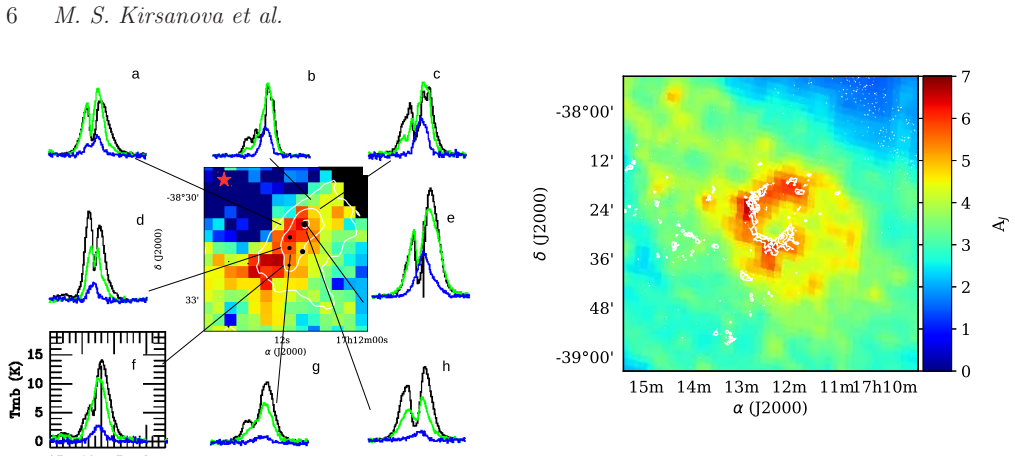
The argument is carried by synthetic emission-line modelling: the MARION code provides a one-dimensional spherical model of an expanding H II region with a dense compressed molecular shell, and the URAN(IA) code solves the two-dimensional non-LTE line transfer to produce synthetic 13CO and C18O position–velocity diagrams. The decisive geometric move is cutting the conical caps off the spherical dense shell to form a face-on torus; the synthetic PV diagrams of the torus, viewed along its axis, lose the bright interior emission that the intact sphere cannot avoid, and match the observed ring-like maps. A supporting layer is the LTE column-density analysis of 13CO and C18O, and near-infrared extinction mapping that reveals the foreground diffuse cloud invoked for self-absorption.
What would settle it
Measure the foreground cloud's 13CO(2–1) opacity toward the centre of RCW 120 in absorption against the free-free continuum: if the cloud is thick enough to absorb the central emission predicted by the spherical model, the ring interpretation is not forced; a deep, high-resolution C18O(2–1) map of the centre should then show no near/far wall velocity components if the torus is real.
Extended reading notes
Core claim
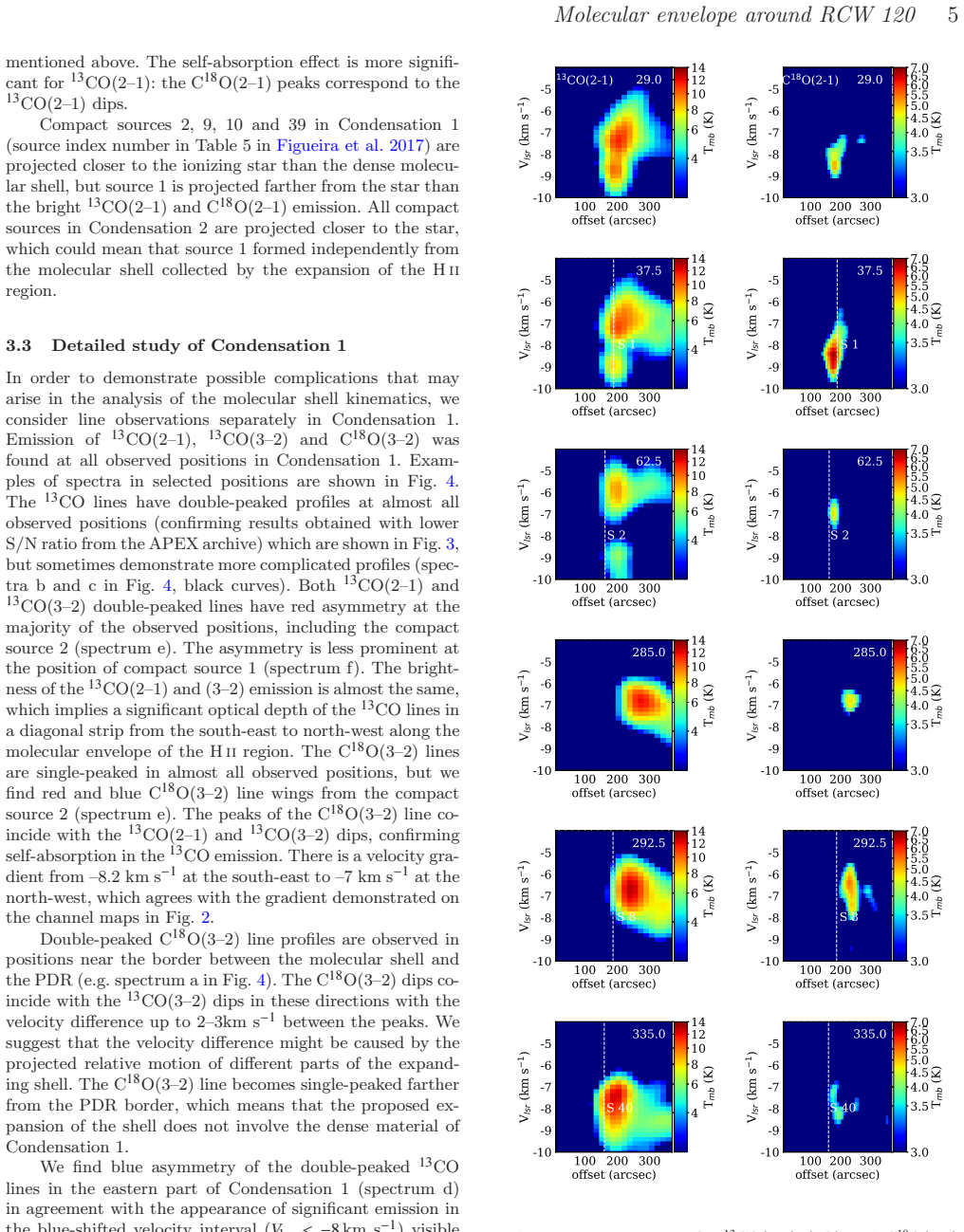
The central claim is that RCW 120's surrounding neutral material is a flattened, ring-like molecular envelope, a torus seen nearly face-on, rather than a spherical bubble. The evidence is that the observed integrated intensities of the 13CO(2–1) and C18O(2–1) lines, together with their position–velocity diagrams, are reproduced by a two-dimensional model in which the conical parts of the dense shell are removed and the line of sight runs parallel to the polar axis; the spherical model cannot remove the predicted bright, double-peaked CO emission from the interior that is not seen. A diffuse foreground molecular cloud, traced in near-infrared extinction maps over a region about 11.3 pc across, is invoked to explain the deep self-absorption dips in the 13CO lines. The paper also finds that optically thick tracers, 13CO and the 8 µm PAH band, show a continuous ring, while optically thin tracers, C18O and far-infrared dust, break the envelope into separate clumps and reveal discontinuities where ionizing radiation leaks out.
Load-bearing premise
The diffuse foreground cloud invoked to explain the self-absorption dips is not so optically thick at the 13CO frequencies that it would also absorb the bright central emission that a spherical shell would produce; if it were, the observed absence of central CO emission would be an absorption artifact rather than evidence for a ring.
Editorial extensions
If this is right
- If RCW 120 is a face-on torus, its H II region is expanding into a flattened parent cloud, and line-of-sight velocity measurements will systematically miss most of the expansion.
- The fitted torus has a molecular shell thickness of about 16% of the H II region radius, with the extent along the line of sight varying from about 50% to 90% of the radius depending on impact parameter.
- The deep self-absorption dips in the 13CO(2–1) and 13CO(3–2) lines require foreground gas rather than the torus alone, and the proposed diffuse cloud of density about 50 cm^-3 and sky-plane size about 11.3 pc is independently visible in extinction maps.
- Optically thick tracers, 13CO(2–1) and the 8 µm PAH band, show a continuous neutral ring around RCW 120, while optically thin tracers, C18O(2–1) and far-infrared dust, resolve the same envelope into separate clumps and reveal discontinuities where ultraviolet radiation leaks out.
- If RCW 120 is typical, infrared bubbles catalogued as three-dimensional shells may generally be rings in flattened clouds, which would change how the collected mass and the potential for triggered star formation are inferred from images.
Reading between the lines
- The optically thick versus optically thin tracer comparison could be applied to other Spitzer bubbles with existing molecular-line and far-infrared data, offering a geometric screen that does not require full hydrodynamic modelling of each object.
- A face-on torus geometry would change the interpretation of the dense condensations around RCW 120: they would sit in a flattened disc-like cloud rather than in a spherical swept-up shell, so gravitational-instability and triggering analyses would need to be reworked.
- A direct test of the torus picture is to search, in the centre of RCW 120, for the second velocity component that a spherical shell would put on the far side of the H II region; high-sensitivity observations in an optically thin tracer such as C18O should find no such component.
- The foreground-cloud explanation predicts that 13CO self-absorption should also appear in absorption against the H II region's radio continuum, a signature that could be checked with existing or new interferometric observations.
Signed reviews
Editorial analysis
A structured set of objections, weighed in public.
Referee Report
Summary. This paper presents new APEX observations of 13CO(2–1), C18O(2–1), 13CO(3–2), and C18O(3–2) toward the HII region RCW 120, together with analysis of archival data and infrared extinction maps. The authors use the spherically symmetric MARION hydrodynamic model and the URAN(IA) non-LTE radiative transfer code to compute synthetic PV diagrams. They show that a spherical expanding shell model predicts bright double-peaked CO emission from the central region, which is not observed. By manually truncating the spherical shell into a face-on torus (removing the conical caps), the synthetic PV diagrams become consistent with the observed absence of central emission and with the observed line shapes in the envelope. To explain self-absorption dips in 13CO lines, the authors introduce a diffuse foreground molecular cloud and claim support from a 2MASS/NICEST extinction map. They conclude that RCW 120 is a face-on torus/ring-like structure rather than a spherical shell.
Significance. The paper addresses a long-standing question about the geometry of infrared bubbles and HII regions. If the face-on torus interpretation is correct, it would support the idea that many Spitzer bubbles are flattened/ring-like structures, with implications for triggered star formation and for interpreting column density maps. The work benefits from new APEX observations and a clear presentation of the spherical-versus-torus discrepancy. A notable strength is the authors' transparency: they explicitly acknowledge that the torus is a manually imposed geometry, not a self-consistent hydrodynamic model, and that the foreground cloud is a phenomenological addition. However, the central claim is not yet quantitatively established, primarily because the foreground cloud is not tested against the spherical model and because the model comparison is qualitative.
major comments (3)
- [§4.1 and §4.2] The rejection of the spherical shell model is incomplete because the foreground absorbing cloud introduced in §4.2 is never inserted into the spherical model. The spherical model is rejected on the basis of bright central CO emission that is absent in the observations (Fig. 7), but the quoted foreground cloud parameters (N13CO up to 1e17 cm^-2, Tgas=10 K, Vnth=1 km/s) can produce large optical depth in 13CO(2-1), as the authors' own RADEX calculation shows (Tex below the observed 14-16 K, the condition for absorption). If such a cloud lies in front of the HII region, it could attenuate the front and back walls of a spherical shell by a factor e^-τ and hide the central emission, making the observed hole an absorption artifact rather than evidence for torus geometry. The authors must either include the foreground cloud in the spherical model and show that the central emission remains above the observed threshold, or quantify the cloud's optical depth and rule out this degeneracy.
- [§3.4 and §4.2] The adopted foreground cloud parameters appear inconsistent with the extinction data used to support the cloud's existence. Toward the ionizing star the authors measure AV=8-12 mag and infer an extended cloud of 11.3 pc (§3.4). A foreground column of even a fraction of this AV corresponds to a molecular hydrogen column far exceeding that of the tested 50 cm^-3 × 1 pc cloud (N(H2) ≈ 1.5e20 cm^-2, giving N13CO ≈ 3e14 cm^-2 at the adopted 13C abundance, well below the 1e17 cm^-2 upper limit used in the RADEX calculation). The paper does not demonstrate that a cloud consistent with the extinction map has sufficiently low 13CO optical depth to preserve the spherical model's central emission, nor does it explore the allowed parameter space. The self-absorption interpretation—and the geometry conclusion that depends on it—therefore needs a self-consistent column-density budget.
- [§4.2 and Abstract] The comparison between observed and synthetic PV diagrams is qualitative. The abstract states that the lines 'are fitted' by a 2D model, but no quantitative goodness-of-fit measure (e.g., χ², residual maps, or profile comparison at fixed positions) is provided. Observed profiles vary strongly across the region (§3.3), and the model is compared by eye with selected cuts (Figs. 3, 8). Given the foreground-absorption degeneracy, a quantitative test is needed to determine whether the torus model is actually preferred over a spherical model with a foreground screen.
minor comments (4)
- [§2.4 and §4] In §2.4, 'ngas = 3 · 103 cm−1' should be '10^3 cm^-3'; in §4, 'nH+ ≈ 102 cm−2' should be 'cm^-3'.
- [§4.2] 'testified' should be 'tested'.
- [§3.4] The sentence 'Sharp linear absorption across the face of the H ii region is visible at optical wavelengths (see also H α images by ...) might be a part of the absorbing cloud' is a fragment and should be rephrased.
- [§2.4] 'adopted as a the age' should be 'adopted as the age'.
Circularity Check
No significant circularity: the torus conclusion is a model comparison against independent APEX/SEDIGISM and extinction data, and the torus is explicitly phenomenological rather than a derived prediction.
full rationale
The paper's central geometric claim is not obtained by circular reduction. The spherical MARION model is a forward model whose parameters are set before comparing with the CO data; its failure to reproduce the observed absence of central emission is a nontrivial falsification of that model. The torus model is then introduced openly as an illustration: the authors state they 'illustrate the associated geometrical effects by manually modifying our simpler spherically symmetric model' and remove 'conical parts of the dense layer.' This means the absence of central emission in the torus model is an input property, not a prediction from first principles; the paper does not disguise the manual construction as independent confirmation. The self-citations to MARION, URAN(IA), and prior Pavlyuchenkov/Akimkin simulations are tool provenance and parameter choices, not load-bearing external theorems; the models are tested against observational data in the present paper. The foreground cloud invoked for self-absorption is supported by an independent extinction map. The skeptical concern that the foreground cloud could also absorb the spherical model's central emission is a genuine untested degeneracy and a correctness risk, but it is not a circularity because the paper never claims to have excluded that scenario. Overall, the derivation is largely self-contained against external data, with only minor self-citation weight, so the circularity score is low.
Assumptions & free parameters
free parameters (9)
- Initial hydrogen number density in MARION model =
10^4 cm^-3
- Age of the HII region =
590 kyr
- Microturbulent velocity Vnth =
0.3 and 1.0 km/s
- Foreground cloud gas density =
50 cm^-3
- Foreground cloud thickness =
1 pc
- Foreground cloud temperature =
10 K
- Outer radius of undisturbed envelope =
1.6 pc
- Torus geometry (removal of conical caps)
- Distance to RCW 120 =
1.3 kpc
assumptions (6)
- domain assumption MARION hydrodynamic and chemical model correctly describes the expansion of an HII region into a molecular cloud.
- domain assumption URAN(IA) non-LTE radiative transfer code correctly computes line profiles given density, temperature, velocity and abundance fields.
- domain assumption A constant excitation temperature along the line of sight for 13CO and C18O in the LTE column density analysis.
- domain assumption The diffuse extinction cloud visible in the 2MASS/NICEST map is physically associated with RCW 120 rather than an unrelated foreground or background cloud.
- ad hoc to paper The self-absorption dip in 13CO lines is caused by the foreground diffuse cloud rather than by local clumps or condensations.
- ad hoc to paper The face-on torus geometry is a valid representation of the actual 3D structure, with the line of sight parallel to the symmetry axis.
invented entities (1)
-
Diffuse foreground molecular cloud
independent evidence
Cite this review
Pith. "Pith review of Molecular envelope around the HII region RCW 120." pith.science (2026). https://pith.science/paper/TAIBDTPN
@misc{pith2026190805394,
  author       = {Pith},
  title        = {Pith review of: Molecular envelope around the HII region RCW 120},
  year         = {2026},
  howpublished = {\url{https://pith.science/paper/TAIBDTPN}},
  note         = {Machine review of arXiv:1908.05394}
}
read the original abstract
The H II region RCW120 is a well-known object, which is often considered as a target to verify theoretical models of gas and dust dynamics in the interstellar medium. However, the exact geometry of RCW120 is still a matter of debate. In this work, we analyse observational data on molecular emission in RCW120 and show that 13CO(2-1) and C18O(2-1) lines are fitted by a 2D model representing a ring-like face-on structure. The changing of the C18O(3-2) line profile from double-peaked to single-peaked from the dense molecular Condensation 1 might be a signature of stalled expansion in this direction. In order to explain a self-absorption dip of the 13CO(2-1) and 13CO(3-2) lines, we suggest that RCW120 is surrounded by a diffuse molecular cloud, and find confirmation of this cloud on a map of interstellar extinction. Optically thick 13CO(2-1) emission and the infrared 8 um PAH band form a neutral envelope of the H II region resembling a ring, while the envelope breaks into separate clumps on images made with optically thin C18O(2-1) line and far-infrared dust emission.
Figures

Figures from the paper (5 more)


Reference graph
Works this paper leans on
-
[1]
Akimkin V. V., Kirsanova M. S., Pavlyuchenkov Y. N., Wiebe D. S., 2015, @doi [ ] 10.1093/mnras/stv187 , http://esoads.eso.org/abs/2015MNRAS.449..440A 449, 440
-
[2]
Akimkin V. V., Kirsanova M. S., Pavlyuchenkov Y. N., Wiebe D. S., 2017, @doi [ ] 10.1093/mnras/stx797 , http://esoads.eso.org/abs/2017MNRAS.469..630A 469, 630
-
[3]
D., et al., 2010, @doi [ ] 10.1051/0004-6361/201014657 , http://adsabs.harvard.edu/abs/2010A
Anderson L. D., et al., 2010, @doi [ ] 10.1051/0004-6361/201014657 , http://adsabs.harvard.edu/abs/2010A
-
[4]
Anderson L. D., Bania T. M., Balser D. S., Rood R. T., 2011, @doi [ ] 10.1088/0067-0049/194/2/32 , http://adsabs.harvard.edu/abs/2011ApJS..194...32A 194, 32
-
[5]
Anderson L. D., Zavagno A., Barlow M. J., Garc \' a-Lario P., Noriega-Crespo A., 2012, @doi [ ] 10.1051/0004-6361/201117640 , http://esoads.eso.org/abs/2012A
-
[6]
Anderson L. D., Bania T. M., Balser D. S., Cunningham V., Wenger T. V., Johnstone B. M., Armentrout W. P., 2014, @doi [ ] 10.1088/0067-0049/212/1/1 , http://adsabs.harvard.edu/abs/2014ApJS..212....1A 212, 1
-
[7]
Anderson L. D., et al., 2015, @doi [ ] 10.1088/0004-637X/800/2/101 , http://esoads.eso.org/abs/2015ApJ...800..101A 800, 101
-
[8]
Arthur S. J., Henney W. J., Mellema G., de Colle F., V \'a zquez-Semadeni E., 2011, @doi [ ] 10.1111/j.1365-2966.2011.18507.x , http://adsabs.harvard.edu/abs/2011MNRAS.414.1747A 414, 1747
arXiv 2011
Show all 66 references
-
[9]
Astropy Collaboration et al., 2013, @doi [ ] 10.1051/0004-6361/201322068 , http://adsabs.harvard.edu/abs/2013A
2013 doi
-
[10]
N., Williams J
Beaumont C. N., Williams J. P., 2010, @doi [ ] 10.1088/0004-637X/709/2/791 , http://adsabs.harvard.edu/abs/2010ApJ...709..791B 709, 791
2010 doi
-
[11]
Belitsky V., et al., 2006, in Society of Photo-Optical Instrumentation Engineers (SPIE) Conference Series. p. 62750G, @doi 10.1117/12.671383
2006 doi
-
[12]
G., et al., 2015, @doi [ ] 10.1093/mnras/stv1659 , http://adsabs.harvard.edu/abs/2015MNRAS.453.1324B 453, 1324
Bisbas T. G., et al., 2015, @doi [ ] 10.1093/mnras/stv1659 , http://adsabs.harvard.edu/abs/2015MNRAS.453.1324B 453, 1324
2015 doi
-
[13]
C.-J., Large M
Bock D. C.-J., Large M. I., Sadler E. M., 1999, @doi [ ] 10.1086/300786 , http://adsabs.harvard.edu/abs/1999AJ....117.1578B 117, 1578
1999 doi
-
[14]
Bonnarel F., et al., 2000, @doi [ ] 10.1051/aas:2000331 , https://ui.adsabs.harvard.edu/abs/2000A&AS..143...33B 143, 33
2000 doi
-
[15]
A., Clayton G
Cardelli J. A., Clayton G. C., Mathis J. S., 1989, @doi [ ] 10.1086/167900 , https://ui.adsabs.harvard.edu/\#abs/1989ApJ...345..245C 345, 245
1989 doi
-
[16]
Churchwell E., et al., 2006, @doi [ ] 10.1086/507015 , http://adsabs.harvard.edu/abs/2006ApJ...649..759C 649, 759
2006 doi
-
[17]
Churchwell E., et al., 2007, @doi [ ] 10.1086/521646 , http://adsabs.harvard.edu/abs/2007ApJ...670..428C 670, 428
2007 doi
-
[18]
J., Cotton W
Condon J. J., Cotton W. D., Greisen E. W., Yin Q. F., Perley R. A., Taylor G. B., Broderick J. J., 1998, @doi [ ] 10.1086/300337 , http://esoads.eso.org/abs/1998AJ....115.1693C 115, 1693
1998 doi
-
[19]
Deharveng L., Zavagno A., Caplan J., 2005, @doi [ ] 10.1051/0004-6361:20041946 , http://adsabs.harvard.edu/abs/2005A
2005 doi
-
[20]
Deharveng L., Zavagno A., Schuller F., Caplan J., Pomar \`e s M., De Breuck C., 2009, @doi [ ] 10.1051/0004-6361/200811337 , http://adsabs.harvard.edu/abs/2009A
2009 doi
-
[21]
Deharveng L., et al., 2010, @doi [ ] 10.1051/0004-6361/201014422 , http://adsabs.harvard.edu/abs/2010A
2010 doi
-
[22]
G., Lada C
Elmegreen B. G., Lada C. J., 1977, @doi [ ] 10.1086/155302 , http://adsabs.harvard.edu/abs/1977ApJ...214..725E 214, 725
1977 doi
-
[23]
E., Churchwell E., 2010, @doi [ ] 10.1088/0004-637X/713/1/592 , http://adsabs.harvard.edu/abs/2010ApJ...713..592E 713, 592
Everett J. E., Churchwell E., 2010, @doi [ ] 10.1088/0004-637X/713/1/592 , http://adsabs.harvard.edu/abs/2010ApJ...713..592E 713, 592
2010 doi
-
[24]
Figueira M., et al., 2017, @doi [ ] 10.1051/0004-6361/201629379 , http://esoads.eso.org/abs/2017A
2017 doi
-
[25]
Figueira M., Bronfman L., Zavagno A., Louvet F., Lo N., Finger R., Rod \'o n J., 2018, @doi [ ] 10.1051/0004-6361/201832930 , http://adsabs.harvard.edu/abs/2018A
2018 doi
-
[26]
Gaia Collaboration 2018, VizieR Online Data Catalog, https://ui.adsabs.harvard.edu/#abs/2018yCat.1345....0G p. I/345
2018
-
[27]
F., Langer W
Goldsmith P. F., Langer W. D., 1999, @doi [ ] 10.1086/307195 , http://adsabs.harvard.edu/abs/1999ApJ...517..209G 517, 209
1999 doi
-
[28]
Hanaoka M., et al., 2019, @doi [ ] 10.1093/pasj/psy126 , http://adsabs.harvard.edu/abs/2019PASJ...71....6H 71, 6
2019 doi
-
[29]
Hosokawa T., Inutsuka S.-i., 2006, @doi [ ] 10.1086/504789 , http://adsabs.harvard.edu/abs/2006ApJ...646..240H 646, 240
2006 doi
-
[30]
Juvela M., Montillaud J., 2016, @doi [ ] 10.1051/0004-6361/201425112 , http://adsabs.harvard.edu/abs/2016A
2016 doi
-
[31]
S., Wiebe D
Kirsanova M. S., Wiebe D. S., Sobolev A. M., 2009, @doi [ ] 10.1134/S106377290907004X , http://adsabs.harvard.edu/abs/2009ARep...53..611K 53, 611
2009 doi
-
[32]
L., 1984, , http://adsabs.harvard.edu/abs/1984A
Leger A., Puget J. L., 1984, , http://adsabs.harvard.edu/abs/1984A
1984
-
[33]
J., Gvaramadze V
Mackey J., Haworth T. J., Gvaramadze V. V., Mohamed S., Langer N., Harries T. J., 2016, @doi [ ] 10.1051/0004-6361/201527569 , http://adsabs.harvard.edu/abs/2016A
2016 doi
-
[34]
G., Shirley Y
Mangum J. G., Shirley Y. L., 2015, @doi [ ] 10.1086/680323 , http://adsabs.harvard.edu/abs/2015PASP..127..266M 127, 266
2015 doi
-
[35]
A., Whitworth A
Marsh K. A., Whitworth A. P., 2019, @doi [ ] 10.1093/mnras/sty3186 , http://adsabs.harvard.edu/abs/2019MNRAS.483..352M 483, 352
2019 doi
-
[36]
J., 2005, @doi [ ] 10.1051/0004-6361:20042386 , http://adsabs.harvard.edu/abs/2005A
Martins F., Schaerer D., Hillier D. J., 2005, @doi [ ] 10.1051/0004-6361:20042386 , http://adsabs.harvard.edu/abs/2005A
2005 doi
-
[37]
C., 2010, @doi [ ] 10.1051/0004-6361/200913158 , http://adsabs.harvard.edu/abs/2010A
Martins F., Pomar \`e s M., Deharveng L., Zavagno A., Bouret J. C., 2010, @doi [ ] 10.1051/0004-6361/200913158 , http://adsabs.harvard.edu/abs/2010A
2010 doi
-
[38]
M., Dickey J
McClure-Griffiths N. M., Dickey J. M., Gaensler B. M., Green A. J., Haverkorn M., Strasser S., 2005, @doi [ ] 10.1086/430114 , http://adsabs.harvard.edu/abs/2005ApJS..158..178M 158, 178
2005 doi
-
[39]
B., Verdolini S., Cox N
Ochsendorf B. B., Verdolini S., Cox N. L. J., Bern \'e O., Kaper L., Tielens A. G. G. M., 2014, @doi [ ] 10.1051/0004-6361/201423545 , http://adsabs.harvard.edu/abs/2014A
2014 doi
-
[40]
N., Shustov B
Pavlyuchenkov Y. N., Shustov B. M., 2004, @doi [Astronomy Reports] 10.1134/1.1704676 , https://ui.adsabs.harvard.edu/\#abs/2004ARep...48..315P 48, 315
2004 doi
-
[41]
Pavlyuchenkov Y., Wiebe D., Shustov B., Henning T., Launhardt R., Semenov D., 2008, @doi [ ] 10.1086/592564 , https://ui.adsabs.harvard.edu/\#abs/2008ApJ...689..335P 689, 335
2008 doi
-
[42]
N., Kirsanova M
Pavlyuchenkov Y. N., Kirsanova M. S., Wiebe D. S., 2013, @doi [ ] 10.1134/S1063772913070056 , http://adsabs.harvard.edu/abs/2013ARep...57..573P 57, 573
2013 doi
-
[43]
C., Cant \'o J., Rodr \' guez L
Raga A. C., Cant \'o J., Rodr \' guez L. F., 2012, , http://adsabs.harvard.edu/abs/2012RMxAA..48..149R 48, 149
2012
-
[44]
Robitaille T., Bressert E., 2012, APLpy: Astronomical Plotting Library in Python , Astrophysics Source Code Library ( @eprint ascl 1208.017 )
2012
-
[45]
P., Churchwell E., Benjamin R
Robitaille T. P., Churchwell E., Benjamin R. A., Whitney B. A., Wood K., Babler B. L., Meade M. R., 2012, @doi [ ] 10.1051/0004-6361/201219073 , http://adsabs.harvard.edu/abs/2012A
2012 doi
-
[46]
Russeil D., 2003, @doi [ ] 10.1051/0004-6361:20021504 , http://adsabs.harvard.edu/abs/2003A
2003 doi
-
[47]
R., Deharveng L., Zavagno A., Anderson L
Samal M. R., Deharveng L., Zavagno A., Anderson L. D., Molinari S., Russeil D., 2018, @doi [ ] 10.1051/0004-6361/201833015 , http://adsabs.harvard.edu/abs/2018A
2018 doi
-
[48]
S \'a nchez-Cruces M., Castellanos-Ram \' rez A., Rosado M., Rodr \' guezGonz \'a lez A., Reyes-Iturbide J., 2018, , http://adsabs.harvard.edu/abs/2018RMxAA..54..375S 54, 375
2018
-
[49]
Schuller F., et al., 2009, @doi [ ] 10.1051/0004-6361/200811568 , https://ui.adsabs.harvard.edu/\#abs/2009A&A...504..415S 504, 415
2009 doi
-
[50]
Schuller F., et al., 2017, @doi [ ] 10.1051/0004-6361/201628933 , http://esoads.eso.org/abs/2017A
2017 doi
-
[51]
Sellgren K., 1984, @doi [ ] 10.1086/161733 , http://adsabs.harvard.edu/abs/1984ApJ...277..623S 277, 623
1984 doi
-
[52]
J., et al., 2012, @doi [ ] 10.1111/j.1365-2966.2012.20770.x , http://adsabs.harvard.edu/abs/2012MNRAS.424.2442S 424, 2442
Simpson R. J., et al., 2012, @doi [ ] 10.1111/j.1365-2966.2012.20770.x , http://adsabs.harvard.edu/abs/2012MNRAS.424.2442S 424, 2442
2012
-
[53]
New York Wiley-Interscience, 1978
Spitzer L., 1978, Physical processes in the interstellar medium . New York Wiley-Interscience, 1978. 333 p., @doi 10.1002/9783527617722
1978 doi
-
[54]
P., Wiebe D
Topchieva A. P., Wiebe D. S., Kirsanova M. S., Krushinskii V. V., 2017, @doi [Astronomy Reports] 10.1134/S1063772917120083 , http://adsabs.harvard.edu/abs/2017ARep...61.1015T 61, 1015
2017 doi
-
[55]
S., 2018a, @doi [Research in Astronomy and Astrophysics] 10.1088/1674-4527/18/8/91 , http://adsabs.harvard.edu/abs/2018RAA....18...91T 18, 091
Topchieva A., Wiebe D., Kirsanova M. S., 2018a, @doi [Research in Astronomy and Astrophysics] 10.1088/1674-4527/18/8/91 , http://adsabs.harvard.edu/abs/2018RAA....18...91T 18, 091
-
[56]
P., Kirsanova M
Topchieva A. P., Kirsanova M. S., Sobolev A. M., 2018b, @doi [Astronomy Reports] 10.1134/S1063772918110082 , http://adsabs.harvard.edu/abs/2018ARep...62..764T 62, 764
-
[57]
P., Akimkin V
Topchieva A. P., Akimkin V. V., Smirnov-Pinchukov G. V., 2019, arXiv e-prints, https://ui.adsabs.harvard.edu/abs/2019arXiv190511077T p. arXiv:1905.11077
2019 arXiv
-
[58]
Tremblin P., et al., 2014, @doi [ ] 10.1051/0004-6361/201322700 , http://adsabs.harvard.edu/abs/2014A
2014 doi
-
[59]
Vassilev V., et al., 2008, @doi [ ] 10.1051/0004-6361:200810459 , http://adsabs.harvard.edu/abs/2008A
2008 doi
-
[60]
P., Bisbas T
Walch S., Whitworth A. P., Bisbas T. G., Hubber D. A., W \"u nsch R., 2015, @doi [ ] 10.1093/mnras/stv1427 , https://ui.adsabs.harvard.edu/\#abs/2015MNRAS.452.2794W 452, 2794
2015 doi
-
[61]
Wenger M., et al., 2000, @doi [ ] 10.1051/aas:2000332 , http://adsabs.harvard.edu/abs/2000A
2000 doi
-
[62]
L., 1999, @doi [Reports on Progress in Physics] 10.1088/0034-4885/62/2/002 , http://adsabs.harvard.edu/abs/1999RPPh...62..143W 62, 143
Wilson T. L., 1999, @doi [Reports on Progress in Physics] 10.1088/0034-4885/62/2/002 , http://adsabs.harvard.edu/abs/1999RPPh...62..143W 62, 143
1999 doi
-
[63]
Zavagno A., Pomar \`e s M., Deharveng L., Hosokawa T., Russeil D., Caplan J., 2007, @doi [ ] 10.1051/0004-6361:20077474 , http://adsabs.harvard.edu/abs/2007A
2007 doi
-
[64]
Zavagno A., et al., 2010, @doi [ ] 10.1051/0004-6361/201014623 , http://adsabs.harvard.edu/abs/2010A
2010 doi
-
[65]
van der Tak F. F. S., Black J. H., Sch \"o ier F. L., Jansen D. J., van Dishoeck E. F., 2007, , 468, 627
2007
-
[66]
write newline
" write newline "" before.all 'output.state := FUNCTION fin.entry write newline FUNCTION new.block output.state before.all = 'skip after.block 'output.state := if FUNCTION new.sentence output.state after.block = 'skip output.state before.all = 'skip after.sentence 'output.stat...
Reviewed August 14, 2026 · model on record in the stance chip above.
Discussion (0). Continue with ORCID to comment.