REVIEW 2 major objections 3 minor 17 references
Extremal functions for real convex bodies: simplices, strips, and ellipses
T0 review · 2 major / 3 minor · reviewed 2026-08-14 · deepseek-v4-flash
Pith's one-line read Every point outside a real convex body lies on an extremal complex ellipse.
desk verdict Solid, mostly elementary paper with a genuinely new polytope decomposition and a minor but easily patched gap in the final approximation argument. read the letter →
The pith
A machine-rendered reading of the paper's core claim, the machinery that carries it, and where it could break.
The reading
What carries the argument
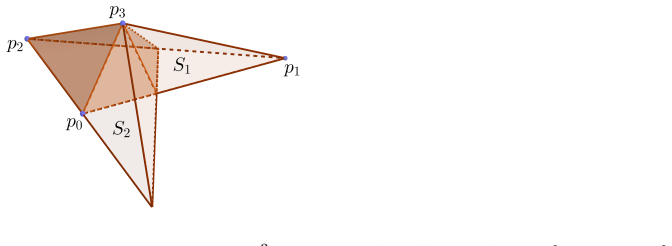
The load-bearing identity is $V_K(z)=\max\{V_S(z):S\in\mathcal S(K)\}$ (Theorem 5.4), where $\mathcal S(K)$ is the finite collection of supporting simplices and strips whose intersection is $K$. For a simplex, the extremal function is $V_S(z)=\log h(|\lambda_0(z)|+\cdots+|\lambda_d(z)|)$, with $\lambda_j$ the barycentric coordinates and $h(\eta)=\eta+\sqrt{\eta^2-1}$ the inverse Joukowski map. Strips are handled by the reduction $V_{K\times \mathbb R^{d-j}}(z',z'')=V_K(z')$, proved by a ball-limit argument. The ellipse side is carried by the Robin exponential map $R_K(c\zeta)=a(c)+c\zeta+c/\zeta$, where $a(c)$ is the center of the unique inscribed ellipse of shape $c$; for the ball this is a generalized Joukowski map, and for the simplex it is obtained from the ball case by the square map.
What would settle it
For a concrete test, take the unit square in $\mathbb R^2$, choose an exterior point such as $z=(2+i,3)$, solve the equations $z=a+c\zeta+c/\zeta$ numerically for $a\in\mathbb R^2$, $c\in\mathbb C^2$, and $|\zeta|>1$, and compare $\log|\zeta|$ with a high-degree polynomial-envelope approximation of $V_K(a+c\zeta+c/\zeta)$. A nonzero difference for every such solution would falsify the theorem.
Extended reading notes
Core claim
The central claim is that the extremal function $V_K$ of a compact convex polytope is fully determined by supporting simplices and strips: $V_K(z)=\max\{V_S(z): S\in\mathcal S(K)\}$, where the sets in $\mathcal S(K)$ are finitely many simplices and strips whose common intersection is $K$. For a simplex, $V_S$ has the closed form $\log h(|\lambda_0(z)|+\cdots+|\lambda_d(z)|)$ in terms of barycentric coordinates and the inverse Joukowski function; for a strip, $V_S$ reduces to the extremal function of a lower-dimensional cross-section. From this the paper constructs, first for the ball, then for a simplex, then for a polytope, a foliation of $\mathbb C^d\setminus K$ by complexified ellipses on which $V_K=\log|\zeta|$, and obtains the general convex-body case by decreasing polytopal approximation.
Load-bearing premise
The proof assumes that the extremal functions of the approximating polytopes converge, point by point, to the extremal function of the convex body they shrink to, and that the corresponding inscribed ellipses have a locally uniform limit; the entire convex-body theorem rests on that convergence.
Editorial extensions
If this is right
- For every compact convex polytope, the extremal function is explicitly computable as a maximum of barycentric-coordinate formulas over a finite list of supporting simplices and strips.
- For polytopes satisfying the face-normal independence condition, the Robin exponential map is a homeomorphism from $\mathbb C^d\setminus K_\rho$ to $\mathbb C^d\setminus K$ whose leaves are complexified ellipses on which $V_K=\log|\zeta|$.
- For any compact convex body, each exterior point lies on a complex ellipse whose real part is an inscribed real ellipse and on which the extremal function is exactly $\log|\zeta|$.
- The paper notes that known results on the regularity of $V_K$ and on the complex equilibrium measure $(dd^c V_K)^d$ follow from this self-contained theorem.
Reading between the lines
- Editorial inference: the construction is algorithmic in nature: given the half-space description of a polytope, the list of supporting simplices and strips is produced by rank checks on normal vectors, so $V_K$ and the equilibrium measure could be evaluated symbolically for any polytope.
- Editorial inference: the strip factorisation suggests that when face normals are linearly dependent, the computation genuinely lowers dimension; the polytope problem projects to a lower-dimensional simplex problem, which may explain why strips require no separate analytic machinery beyond the simplex formula.
- Editorial inference: the identity $\log|\zeta|=V_K(a+c\zeta+c/\zeta)$ is concrete enough to be a numerical check of the theory for arbitrary bodies: choose a body, choose an exterior point, solve for the ellipse data, and compare the two sides by polynomial approximation.
Signed reviews
Editorial analysis
A structured set of objections, weighed in public.
Referee Report
Summary. The paper develops an explicit method for computing the Siciak–Zaharjuta extremal function of a compact convex polytope in R^d in terms of a finite family of supporting simplices and strips, and uses this to reprove the existence of extremal ellipses for general real convex bodies. The main theorems are Theorem 5.4, asserting V_K(z)=max{V_S(z): S∈S(K)} for polytopes, and Theorem 13.1, asserting that for every z outside a compact convex body K there is a complexified ellipse through z on which V_K equals log|ζ| and whose real trace is inscribed in K. The proof route goes through geometric lemmas on simplices and strips, explicit extremal functions for balls and simplices, Hooke and Newton ellipses, the Robin exponential map for polytopes, and a final approximation argument from polytopes to general convex bodies.
Significance. If the main results are correct, the paper provides a self-contained and largely elementary route to structural facts about extremal functions for real convex bodies that were previously obtained using Lempert theory. The explicit barycentric-coordinate formulas and the constructive polytope algorithm in Section 7 are valuable, as is the new derivation of Lundin and Baran formulas through the square map. The Robin exponential map for polytopes and the approximation scheme for general convex bodies are potentially useful tools. However, the proof of the central polytope formula contains a false convex-geometric step, and the approximation step in Theorem 13.1 has a gap; both need to be addressed before the main claims are established.
major comments (2)
- [Section 5, proof of Theorem 5.4] The step 'The set Π is a product of convex sets, hence convex, and therefore Π⊂π_Δ^{-1}(K_Δ)' is false: orthogonal projection of a convex set onto a subspace need not be contained in the set. The paper's own Section 7 example gives a concrete counterexample. Let S_3={x_1≥0, x_2≥0, 3−x_1−3x_2≥0} and S_4={x_1≥0, x_2≥0, 3−3x_1−x_2≥0}; these are the two supporting triangles in S(K) for the quadrilateral of Section 7. The points x=(2,0.2)∈S_3 and y=(0.2,2)∈S_4 satisfy π_Δ(x,y)=((1.1,1.1),(1.1,1.1)), and (1.1,1.1) lies in neither S_3 nor S_4, so π_Δ(x,y)∉K_Δ even though (x,y)∈Π. Thus the claimed inclusion Π⊂π_Δ^{-1}(K_Δ) fails in the exact class of examples considered. Since the reverse inequality V_K≤max_j V_{S_j} is the core of Theorem 5.4 and is used later in Lemma 8.2 and in the Robin exponential map construction, this is a load-bearing gap in the proof.
- [Section 13, proof of Theorem 13.1] The normal-families argument proves V_K(f(ζ_z))=log|ζ_z| only at the single parameter value ζ_z, whereas condition (ii) requires equality for every ζ with |ζ|>1. The sentence 'Hence (i) and (ii) hold' is not justified by pointwise convergence alone. The gap is repairable: since the sets K_j and K are regular by Lemma 5.2, the functions V_{K_j} and V_K are continuous, and Proposition 5.1(3) gives monotone pointwise convergence V_{K_j}↗V_K; Dini's theorem on compact sets then gives locally uniform convergence, and combined with f_j→f locally uniformly this yields V_K(f(ζ))=log|ζ| for all |ζ|>1. As written, however, the proof is incomplete at a point that is essential for all applications of Theorem 13.1.
minor comments (3)
- [Section 5, Proposition 5.1(2)] The statement says 'polynomial mapping of degree d' and gives the formula V_{P^{-1}(K)}(z)=1/d V_K(P(z)), but the correct factor is the reciprocal of the degree of the polynomial mapping, not the dimension d. As stated, the proposition is false for a linear map when d>1. The later use in Corollary 6.4 correctly uses the factor 1/2 for the degree-2 square map, so this is likely a typographical error, but it should be corrected.
- [Section 7] The labels l_3 and l_4 for the two non-axis supporting lines are interchanged between Remark 3.8 and Section 7: Remark 3.8 has l_3(x)=3−3x_1−x_2 and l_4(x)=3−x_1−3x_2, while Section 7 defines l_3(z)=3−z_1−3z_2 and l_4(z)=3−3z_1−z_2. Please align the notation to avoid confusion in checking the example.
- [Section 13] The existence of a decreasing sequence of polytopes K_j satisfying the linear independence condition of Theorem 3.9 and converging to K is asserted without proof. This is a standard genericity/refinement argument, but since the convergence step of Theorem 13.1 depends on it, a brief justification would improve the exposition.
Circularity Check
No significant circularity: the derivation is self-contained given standard pluripotential theory, and the same-author citations are parameter-free ingredients rather than repackaged conclusions.
full rationale
The central derivation chain is not circular. Theorem 5.4 proves VK = max VS for supporting simplices and strips using Lemma 5.3 and Proposition 5.1; the reverse inequality is obtained by embedding K as a diagonal slice of a product of strips and applying the product formula, not by assuming the conclusion. The simplex extremal formula (Theorem 6.2) is cited from [4], which has overlapping authorship, but it is a parameter-free external theorem with its own stated assumptions and does not include the target ellipse-existence result, so under the stated rules it counts as independent support rather than circularity. Likewise, the use of [3] for continuity of WK across the hyperplane at infinity is an ingredient, not the result being derived. Theorem 13.1 does contain a genuine proof gap: the line 'By the pointwise convergence VKj↗VK (Proposition 5.1(3)) we have VK(f(ζz)) = ... Hence (i) and (ii) hold' establishes equality only at the single parameter value ζz, while condition (ii) requires equality for all |ζ| > 1; a maximum-principle or locally-uniform convergence argument is needed to propagate the equality. This is an incompleteness in the proof, not a circularity, and no equation in the paper reduces a claimed prediction to an input by construction. Therefore the circularity score is 0.
Assumptions & free parameters
Cite this review
Pith. "Pith review of Extremal functions for real convex bodies: simplices, strips, and ellipses." pith.science (2026). https://pith.science/paper/TAM72TPW
@misc{pith2026190807118,
  author       = {Pith},
  title        = {Pith review of: Extremal functions for real convex bodies: simplices, strips, and ellipses},
  year         = {2026},
  howpublished = {\url{https://pith.science/paper/TAM72TPW}},
  note         = {Machine review of arXiv:1908.07118}
}
read the original abstract
We present an explicit method to compute the (Siciak-Zaharjuta) extremal function of a real convex polytope in terms of supporting simplices and strips. We use this to give a new proof of the existence of extremal ellipses associated to the extremal function of a real convex body.
Figures


Reference graph
Works this paper leans on
-
[4]
L. Bos, S. Ma‘u, and S. Waldron. Extremal growth of polynomials. Anal. Math., 46(2):195–224, 2020
work page 2020
- [6]
-
[1]
M. Baran. Plurisubharmonic extremal functions and complex foliations for the complement of convex sets in Rn. Michigan Math. J. , 39(3):395–404, 1992
work page 1992
-
[2]
E. Bedford and B. A. Taylor. The Dirichlet problem for a complex Monge- Amp` ere equation.Invent. Math., 37:1–44, 1976
work page 1976
- [3]
- [5]
- [7]
- [8]
Show all 17 references
-
[9]
M. Klimek. Pluripotential Theory. Oxford University Press, 1991. 36
1991
-
[10]
L. Lempert. La m´ etrique de Kobayashi et la repr´ esentation des domaines sur la boule. Bull. Soc. Math. France, 109(4):427–424, 1981
1981
-
[11]
L. Lempert. Intrinsic distances and holomorphic retracts. In Complex analysis and applications ’81 (Varna, 1981), pages 341–364. Publ. House Bulgar. Acad. Sci., 1984
1981
-
[12]
L. Lempert. Symmetries and other transformations of the complex Monge- Amp` ere equation.Duke Math. J. , 52(4):869–885, 1985
1985
-
[13]
Levenberg and M
N. Levenberg and M. Perera. A global domination principle forP -pluripotential theory. In Complex analysis and spectral theory, volume 743 ofContemp. Math., pages 11–19. Amer. Math. Soc., Providence, RI, 2020
2020
-
[14]
M. Lundin. The extremal PSH for the complement of convex, symmetric sub- sets of Rn. Michigan Math. J. , 32(2):197–201, 1985
1985
-
[15]
Matt J. Analyze N-dimensional Polyhedra in terms of Vertices or (In)Equalities (https://www.mathworks.com/matlabcentral/fileexchange/ 30892-analyze-n-dimensional-polyhedra-in-terms-of-vertices-or-in-equalities ). MATLAB Central File Exchange , 2020
2020
-
[16]
F. Piazzon. The extremal plurisubharmonic function of the torus. Dolomites Res. Notes Approx., 11(Special Issue Norm Levenberg):62–72, 2018
2018
-
[17]
L. N. Trefethen. Multivariate polynomial approximation in the hypercube. Proc. Amer. Math. Soc., 145(11):4837–4844, 2017. 37
2017
Reviewed August 14, 2026 · model on record in the stance chip above.
Discussion (0). Continue with ORCID to comment.