REVIEW 4 major objections 5 minor 38 references
Pulse dependence of prevalent pathways in xenon driven by an x-ray free-electron-laser pulse
T0 review · 4 major / 5 minor · reviewed 2026-08-14 · deepseek-v4-flash
Pith's one-line read This paper shows that equal-energy 850 eV FEL pulses produce different xenon ion yields depending on pulse duration, with longer pulses boosting Xe^{9+} and Xe^{10+} through Auger cascades that replenish the n=4 shell between…
desk verdict A useful computational study with a plausible but under-validated pulse-duration claim; worth refereeing if the authors quantify the missing benchmarks. read the letter →
The pith
A machine-rendered reading of the paper's core claim, the machinery that carries it, and where it could break.
The reading
What carries the argument
The mechanism that carries the argument is the Auger-replenished n=4 shell, embedded in the Monte-Carlo pathway simulation. In the simulation, every state is an electronic configuration, and between two single-photon ionisations a variable number of Auger transitions can occur. The decisive rate is the Auger rate for an n=4 electron filling a 3d or 4d hole, which scales with the instantaneous occupation of the n=4 shell. The 150 fs pulse allows enough time between absorptions for 5s and 5p electrons to refill 4d holes, so the n=4 population does not drop as far as it does under the 10 fs pulse; this is what the authors identify as the cause of the higher $Xe^{{9+}}$ and $Xe^{{10+}}$ yields.
What would settle it
An experiment measuring $Xe^{{9+}}$ and $Xe^{{10+}}$ yields for 850 eV pulses of equal energy at 10 fs and 150 fs durations would settle the claim: the paper predicts higher yields for the longer pulse. A calculation rerunning the Monte-Carlo with the reference cross sections of Ref. [33] in place of the computed ones would also test whether the ordering survives the known cross-section discrepancy.
Extended reading notes
Core claim
On the paper's own terms, the discovery is that pulse duration is a control knob for the charge-state distribution even when the total pulse energy is fixed. Using a Monte-Carlo simulation that stochastically sequences single-photon ionisations, Auger decays, and shake-off transitions, the authors compute final ion yields for xenon at 850 eV and compare with experiment. The central comparison is between two equal-energy pulses: a 10 fs, 1.5×$10^{{16}}$ W $cm^{{-2}}$ pulse and a 150 fs, $10^{{15}}$ W $cm^{{-2}}$ pulse. The simulation gives larger yields for $Xe^{{9+}}$ and $Xe^{{10+}}$ for the longer pulse, and the pathway decomposition traces this to the number of Auger decays that occur between successive photon absorptions. With the longer pulse, 5s and 5p electrons have time to fill 4d holes, keeping the n=4 shell populated; because the Auger rate into 3d holes is proportional to n=4 occupation, the replenishment sustains the cascades that produce the higher charge states.
Load-bearing premise
The load-bearing premise is that the computed photoionisation cross sections and Auger rates are accurate enough that the difference in n=4-shell replenishment between a 10 fs and a 150 fs pulse is not an artifact of the roughly 20% underestimate of cross sections or of errors in valence-orbital rates.
Editorial extensions
If this is right
- Equal-energy FEL pulses with different durations should not be treated as interchangeable for inner-shell dynamics: the time interval between photoabsorptions, not just the total intensity, determines how much Auger replenishment occurs.
- The predicted ordering — higher Xe^{9+} and Xe^{10+} yields for 150 fs than for 10 fs at equal energy — is a direct experimental signature that can be looked for with time-of-flight ion spectroscopy.
- The Monte-Carlo pathway decomposition provides a map of the dominant intermediate configurations for each final charge state, which could be used to predict which transient hollow states are most populated during the pulse.
- Because the authors state their cross-section and Auger-rate formalism is general for multi-electron atoms, the same duration-sensitive Auger-replenishment effect should appear in other atoms with accessible d-shell holes, not only xenon.
Reading between the lines
- The paper does not pursue the obvious transfer: the same duration effect should appear in other heavy atoms with deep d-shell holes; krypton at a photon energy that opens a 3d hole would be a direct test.
- A natural experiment not suggested in the paper is a two-pulse sequence: a weak pre-pulse timed to refill the n=4 shell before the main 850 eV pulse should reproduce the longer-duration enhancement, isolating the replenishment mechanism from pulse-shape effects.
- If the replenishment picture is correct, the yield-versus-duration curve should saturate: once the interval between photoabsorptions exceeds the Auger cascade time, further lengthening should not change Xe^{9+} or Xe^{10+} yields.
Signed reviews
Editorial analysis
A structured set of objections, weighed in public.
Referee Report
Summary. Banks et al. compute single-photon ionisation cross sections and Auger rates for xenon by adapting a previously developed molecular formalism to atoms, and feed these rates into a Monte-Carlo scheme to obtain ion yields and prevalent pathways for Xe driven by 850 eV FEL pulses. They benchmark total cross sections and Auger rates against earlier calculations (Refs. [33, 35, 17]), compare yields with the experiment of Thomas et al. (Ref. [20]), and analyse the pathways leading to each final charge state. The central claim is that for equal-energy pulses, a longer, lower-intensity pulse produces higher yields of Xe^{9+} and Xe^{10+} than a shorter, higher-intensity pulse, because the longer pulse allows more Auger transitions between successive photoionisations, replenishing the n=4 shell.
Significance. If the pulse-duration effect is robust, the paper offers a falsifiable prediction about charge-state control in x-ray FEL experiments and demonstrates a generalisable computational tool for complex multi-electron atoms. The work is transparent about its Monte-Carlo scheme and benchmarks summed Auger rates against independent calculations in Tables 2 and 3, which strengthens the method. However, the headline mechanism relies on subshell-resolved Auger rates that are not reported, the agreement with experiment is not quantified, and the generalised duration-ordering claim is only shown for two charge states.
major comments (4)
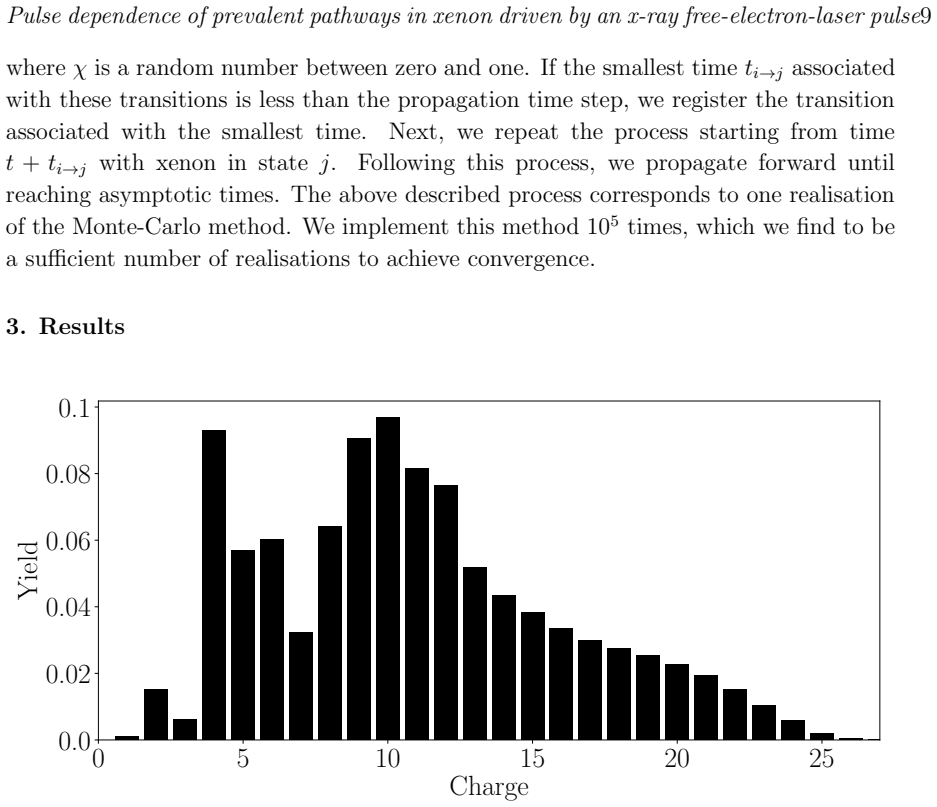
- [Section 3, Fig. 1] The statement 'These results are in agreement with the experimental results in Ref. [20]' is not supported by any displayed comparison: Fig. 1 shows only computed yields, and no experimental yields, error bars, or quantitative metric (e.g., relative deviations or chi-squared) are provided. Since comparison with experiment is a stated goal, please add a direct comparison figure or table and quantify the level of agreement.
- [Section 2.2, Tables 2 and 3] The pulse-duration mechanism hinges on the branching between specific Auger channels: 4d electrons filling 3d holes (creating 4d holes) and, subsequently, 5s/5p electrons filling those 4d holes. Tables 2 and 3 list only rates summed over all valence subshells for holes in u=3s, 3p, 3d, 2s, and 2p; no rates for u=4d are tabulated or benchmarked against Refs. [17,35]. Since the deciding competition is the speed of the second Auger step relative to the next photoionisation, an unquantified error in these unbenchmarked rates—or in the branching between 4d and 5s/5p filling of 3d holes—could plausibly reverse the predicted yield ordering in Fig. 3. Please provide subshell-resolved rates or a sensitivity analysis demonstrating robustness.
- [Section 3, Fig. 3 and Abstract] The claim that 'higher-charged ion states have higher yields when xenon is driven by longer-duration pulses' is supported in Fig. 3 only for q=9 and q=10; for q=11 and q=12 the computed yields do not exhibit the same clear ordering. The abstract and conclusions state the effect without this q-range qualification. Please either extend the demonstration to the full charge range or qualify the claim to the charges for which the ordering is actually shown.
- [Section 2.1, Table 1] The computed 3d photoionisation cross section is about 20% below the reference value of Ref. [33], and the valence-orbital cross sections are even further from the reference values. Since the duration effect depends on the relative rates of photoionisation and Auger decay, the paper should show that the yield ordering in Fig. 3 is insensitive to a ±20% shift in cross sections and to the quoted rate uncertainties. Without such a sensitivity analysis, the robustness of the central claim to known input errors is not established.
minor comments (5)
- [Table 1] The scientific notation is inconsistent: entries such as '1.27-19' and '2.34-19' should be '1.27e-19' and '2.34e-19' to match the format of other entries.
- [Section 2.4] The statement that 10^5 Monte-Carlo realisations are sufficient for convergence is not accompanied by any convergence diagnostic; a brief plot or a table showing how yields stabilise with the number of realisations would strengthen reproducibility.
- [Fig. 3(a)] The legend entry 'SPI /w SO' is ambiguous; please spell out as 'single-photon ionisation with shake-off' for consistency with the other figures.
- [Throughout] There are formatting artifacts such as 'Eq.Eq. (2)', '10 5', and '10 3' (missing superscripts and repeated labels) that should be corrected in the final version.
- [Section 2.3] The text states that shake-up processes are neglected but does not discuss whether they are expected to be significant at 850 eV; a one-sentence justification would be helpful.
Circularity Check
No significant circularity; the derivation chain is self-contained and benchmarked against independent references.
full rationale
The paper's central claim is that for equal-energy 850 eV FEL pulses, longer-duration pulses enhance the yields of highly charged xenon ions because more Auger transitions occur between successive single-photon ionisations, replenishing the n=4 shell. This conclusion is an emergent output of a Monte-Carlo simulation, not an input assumption. The single-photon ionisation cross sections are computed from Eqs. (1)-(7) using bound orbitals from Molpro and continuum orbitals from a Hartree-Fock-Slater potential, then compared with the independent calculations of Yeh and Lindau in Table 1. The Auger rates are computed from Eqs. (9)-(10) and benchmarked against the independent calculations of McGuire and of Son and Santra in Tables 2 and 3, with agreement explicitly discussed. The Monte-Carlo yields are compared with experimental results from Ref. [20], and the pulse-duration comparison in Section 3 is obtained by running the same Monte-Carlo code for two equal-energy pulse envelopes (10 fs at 1.5e16 W/cm^2 and 150 fs at 1e15 W/cm^2) and classifying the simulated pathways by number of single-photon ionisations and Auger decays. The self-citation to Ref. [24] supplies the formalism for computing cross sections and Auger rates, but the numerical inputs are independently benchmarked; no fitted parameter is renamed as a prediction, and no uniqueness theorem or prior result by the authors is invoked to force the choice of mechanism. The acknowledged underestimation of valence single-photon cross sections and the absence of a subshell-resolved benchmark for the 4d-hole Auger step are quantitative accuracy concerns, not circularity, because the ordering of Xe^{9+} and Xe^{10+} yields is a simulated result rather than an input constraint.
Assumptions & free parameters
assumptions (5)
- domain assumption Each atomic state is described by an electronic configuration of independent orbitals; electron correlations beyond the mean field are neglected.
- domain assumption The Monte-Carlo method samples each allowed transition as an independent exponential decay with rate wi->j(t) (Eq. 14).
- domain assumption The sudden approximation is valid for shake-off following inner-shell ionisation (Eq. 12).
- domain assumption Fluorescence is negligible compared to Auger decay.
- domain assumption At 850 eV photon energy, multi-photon ionisation is negligible; only single-photon processes are considered.
Cite this review
Pith. "Pith review of Pulse dependence of prevalent pathways in xenon driven by an x-ray free-electron-laser pulse." pith.science (2026). https://pith.science/paper/TBZF4IWX
@misc{pith2026190808728,
  author       = {Pith},
  title        = {Pith review of: Pulse dependence of prevalent pathways in xenon driven by an x-ray free-electron-laser pulse},
  year         = {2026},
  howpublished = {\url{https://pith.science/paper/TBZF4IWX}},
  note         = {Machine review of arXiv:1908.08728}
}
read the original abstract
We study the interaction of xenon with an 850 eV photon energy FEL pulse. We do so by employing a Monte-Carlo technique. We compute the single-photon ionisation cross sections and Auger rates, used in the Monte-Carlo technique, by adopting to atoms a formalism we previously developed for diatomic molecules. We determine the yields of the ion states of driven xenon and compare with previously obtained experimental results. To better understand the yields obtained, we identify the prevalent pathways leading to the formation of each final ion state of xenon. We gain further insight into the high yields of highly-charged ion states by comparing the yields and dominant pathways of these ion states of xenon when driven by different FEL pulses that have the same energy. We show that higher-charged ion states have higher yields when xenon is driven by longer-duration pulses due to Auger cascades taking place between subsequent single-photon ionisations.
Figures


Figures from the paper (1 more)

Reference graph
Works this paper leans on
-
[20]
Thomas H, Helal A, Hoffmann K, Kandadai N, Keto J, Andreasson J, Iwan B, Seibert M, Timneanu N, Hajdu J, Adolph M, Gorkhover T, Rupp D, Schorb S, M¨ oller T, Doumy G, DiMauro L F, Hoener M, Murphy B, Berrah N, Messerschmidt REFERENCES 15 M, Bozek J, Bostedt C and Ditmire T 2012 Phys. Rev. Lett. 108(13) 133401 URL Link
work page 2012
- [33]
-
[1]
Pellegrini C 2012 Eur. Phys. J. H 37 659–708
work page 2012
-
[2]
Bostedt C, Bozek J, Bucksbaum P H, Coffee R, B Hastings J, Huang Z, Lee R, Schorb S, Corlett J N, Denes P, Emma P, Falcone R, Schoenlein R W, Doumy G, Kanter E, Kraessig B, Southworth S, Young L, Fang L, Hoener M, Berrah N, Roedig C and DiMauro L 2013 J. Phys. B: At., Mol. Opt. Phys. 46 164003
work page 2013
-
[3]
Photonics 4 641–647 ISSN 1749-4885
Emma P, Akre R, Arthur J, Bionta R, Bostedt C, Bozek J, Brachmann A, Bucksbaum P, Coffee R, Decker F, Ding Y, Dowell D, Edstrom S, Fisher A, Frisch J, Gilevich S, Hastings J, Hays G, Hering P, Huang Z, Iverson R, Loos H, Messerschmidt M, Miahnahri A, Moeller S, Nuhn H, Pile G, Ratner D, Rzepiela J, Schultz D, Smith T, Stefan P, Tompkins H, Turner J, Welch ...
work page 2010
-
[4]
Marangos J P 2011 Contemp. Phys. 52 551–569 (Preprint Link) URL Link
work page 2011
-
[5]
Ullrich J, Rudenko A and Moshammer R 2012 Annu. Rev. Phys. Chem. 63 635–660
work page 2012
-
[6]
Schlichting I and Miao J 2012 Curr. Opin. Struct. Biol. 22 613 – 626 ISSN 0959- 440X URL Link REFERENCES 14
work page 2012
Show all 38 references
-
[7]
Neutze R, Wouts R, van der Spoel D, Weckert E and Hajdu J 2000 Nature 406(6797) 752–757
2000
-
[8]
Redecke L, Nass K, DePonte D P, White T A, Rehders D, Barty A, Stellato F, Liang M, Barends T R, Boutet S, Williams G J, Messerschmidt M, Seibert M M, Aquila A, Arnlund D, Bajt S, Barth T, Bogan M J, Caleman C, Chao T C, Doak R B, Fleckenstein H, Frank M, Fromme R, Galli L, Gr...
2013
-
[9]
Santra R, Kryzhevoi N V and Cederbaum L S 2009 Phys. Rev. Lett. 103(1) 013002 URL Link
2009
-
[10]
Cederbaum L S, Tarantelli F, Sgamellotti A and Schirmer J 1986 J. Chem. Phys. 85 6513–6523 (Preprint Link) URL Link
1986
-
[11]
Cederbaum L S, Tarantelli F, Sgamellotti A and Schirmer J 1987 J. Chem. Phys. 86 2168–2175 (Preprint Link) URL Link
1987
-
[12]
Sorokin A A, Bobashev S V, Feigl T, Tiedtke K, Wabnitz H and Richter M 2007 Phys. Rev. Lett. 99(21) 213002 URL Link
2007
-
[13]
Photonics 6 858–865
Rudek B, Son S K, Foucar L, Epp S W, Erk B, Hartmann R, Adolph M, Andritschke R, Aquila A, Berrah N, Bostedt C, Bozek J, Coppola N, Filsinger F, Gorke H, Gorkhover T, Graafsma H, Gumprecht L, Hartmann A, Hauser G, Herrmann S, Hirsemann H, Holl P, H¨ omke A, Journel L, Kaiser C...
2012
-
[14]
Makris M G, Lambropoulos P and Miheliˇ c A 2009 Phys. Rev. Lett. 102(3) 033002 URL Link
2009
-
[15]
Lambropoulos P, Papamihail K and Decleva P 2011 J. Phys. B: At., Mol. Opt. Phys. 44 175402
2011
-
[16]
Toyota K, Son S K and Santra R 2017 Physical Review A 95
2017
-
[17]
Son S K and Santra R 2012 Phys. Rev. A 85(6) 063415 URL Link
2012
-
[18]
Madsen L and Lambropoulos P 1999 Phys. Rev. A 59
1999
-
[19]
Jurek Z, Son S K, Ziaja B and Santra R 2016 J. Appl. Crystallogr. 49 1048–1056 URL Link
2016
-
[21]
Wallis A O G, Lodi L and Emmanouilidou A 2014 Phys. Rev. A 89(6) 063417 URL Link
2014
-
[22]
Wallis A O G, Banks H I B and Emmanouilidou A 2015 Phys. Rev. A 91(6) 063402
2015
-
[23]
Robert C P and Casella G 2005 Monte Carlo Statistical Methods (Springer Texts in Statistics) (Berlin, Heidelberg: Springer-Verlag) ISBN 0387212396
2005
-
[24]
Banks H I B, Little D A, Tennyson J and Emmanouilidou A 2017 Phys. Chem. Chem. Phys. 19(30) 19794–19806 URL Link
2017
-
[25]
Jonauskas V, Partanen L, Kuˇ cas S, Karazija R, Huttula M, Aksela S and Aksela H 2003 J. Phys. B: At., Mol. Opt. Phys. 36 4403
2003
-
[26]
Sakurai J J 1994 Modern Quantum Mechanics (Addison-Wesley)
1994
-
[27]
2010 MOLPRO, a package of ab initio programs see http://www.molpro.net/
Werner H J, Knowles P J, Lindh R, Manby F R, Sch¨ utz M et al. 2010 MOLPRO, a package of ab initio programs see http://www.molpro.net/
2010
-
[28]
Martins L, de Souza F, Ceolin G, Jorge F, de Berrˆ edo R and Campos C 2013 Comput. Theor. Chem. 1013 62 – 69 ISSN 2210-271X URL Link
2013
-
[29]
Notices Royal Astron
Noumerov B V 1924 Mon. Notices Royal Astron. Soc. 84 592–602 URL Link
1924
-
[30]
Herman F and Skillman S 1963 Atomic structure calculations (Prentice-Hall, New Jersey)
1963
-
[31]
Pauli M D Herman-Skillman program hermes.phys.uwm.edu/projects/elecstruct/elecstruct.html URL Link
-
[32]
Edmonds A R 1960 Angular Momentum in Quantum Mechanics (Princeton University Press)
1960
-
[34]
Pauli W 2000 Wave Mechanics: Volume 5 of Pauli Lectures on Physics (Wiley)
2000
-
[35]
McGuire E J 1972 Phys. Rev. A 5(3) 1043–1047 URL Link
1972
-
[36]
˚Aberg T 1969 Ann. Acad. Sci. Fenn., Ser A VI 308 1
1969
-
[37]
Carlson T A and Nestor C W 1973 Phys. Rev. A 8(6) 2887–2894 URL Link
1973
-
[38]
Buth C, Liu J C, Chen M H, Cryan J P, Fang L, Glownia J M, Hoener M, Coffee R N and Berrah N 2012 J. Chem. Phys. 136 214310 (Preprint Link) URL Link
2012
Reviewed August 14, 2026 · model on record in the stance chip above.
Discussion (0). Continue with ORCID to comment.