Detecting Hierarchical Clusters and Estimating their Modularity Directly from Dendrograms
Pith reviewed 2026-06-29 19:01 UTC · model grok-4.3
The pith
Balancing the merging density function from a dendrogram followed by peak detection recovers hierarchical clusters and their modularity values.
A machine-rendered reading of the paper's core claim, the machinery that carries it, and where it could break.
Core claim
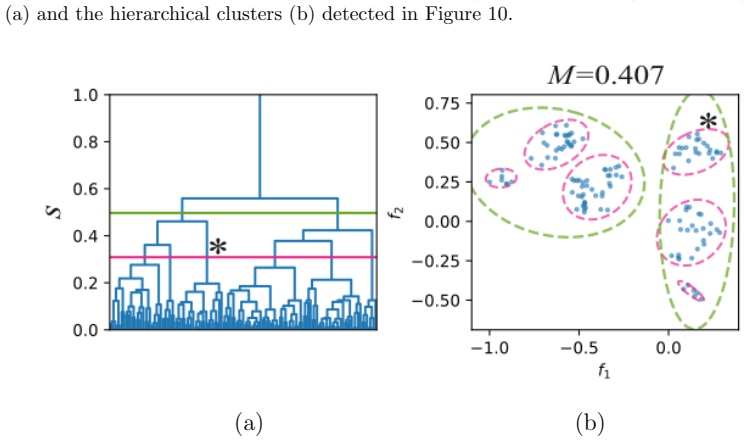
After the mergings of subclusters along the scale variable are obtained to form a merging density function, balancing that function along the scale and applying peak detection estimates the respective hierarchical clusters and their hierarchical modularity within a specified resolution. The method is illustrated on example data and dendrograms, and the possibility of applying the procedure recursively is noted.
What carries the argument
The merging density function obtained by counting subclusters merges along the scale variable; balancing it and locating peaks extracts both cluster boundaries and modularity values.
If this is right
- The same dendrogram can be processed at multiple resolutions to obtain nested cluster descriptions.
- Modularity estimates become available directly from the hierarchy without separate community-detection passes.
- Recursive application of the peak-detection step can refine clusters at finer scales.
- The procedure applies to any dendrogram regardless of the original data type.
Where Pith is reading between the lines
- The method could reduce computational cost for very large networks by operating only on the already-computed dendrogram.
- It may extend naturally to settings where the scale variable represents time or another ordered parameter.
- Handling of ties or plateaus in the merging density would need explicit rules if the method is to be applied automatically.
Load-bearing premise
Balancing the merging density function and detecting its peaks will correctly recover the true hierarchical clusters and modularity from the dendrogram alone.
What would settle it
Generate a dendrogram from data whose true hierarchical clusters are already known, apply the balancing-plus-peak procedure, and check whether the detected peaks and their modularity values match the known structure.
Figures






read the original abstract
Identifying possible clusters in datasets and estimating their hierarchical modularity are central tasks in pattern recognition. In the present work, concepts and methodologies are described for performing these tasks while considering only the density of mergings obtained from hierarchical representations (dendrograms) of data inter-relationship along a scale variable. More specifically, the mergings of subclusters along the scale variable are obtained, yielding a respective merging density function. After this function is balanced along the scale variable, peak detection is applied in order to estimate, within a specified resolution, the respective hierarchical clusters and their hierarchical modularity. The potential of the reported approach is illustrated for some types of data and dendrograms, and the possibility of recursive cluster detection is also considered.
Editorial analysis
A structured set of objections, weighed in public.
Referee Report
Summary. The manuscript describes a heuristic procedure to detect hierarchical clusters and estimate their modularity directly from dendrograms: a merging density function is computed from the sequence of subclusters along the scale variable; this function is balanced; peak detection is then applied at a chosen resolution to recover the clusters and their modularity values. The approach is illustrated on selected data types, and recursive application is discussed.
Significance. If the procedure can be shown to recover ground-truth structure reliably, it would supply a practical, dendrogram-only route to hierarchical modularity estimation that bypasses the original data matrix. The absence of any quantitative validation or comparison against known partitions, however, leaves the practical utility and accuracy of the estimates unestablished.
major comments (2)
- [Abstract and method description] The central claim rests on the balancing step of the merging density function followed by peak detection, yet no mathematical definition, pseudocode, or parameter specification for balancing is supplied (abstract and method description). Without this, it is impossible to determine whether the subsequent peak detection yields reproducible or meaningful modularity estimates.
- [Illustrations and results] No validation results, error metrics, or comparisons against ground-truth partitions are reported for any of the illustrated data types. This omission is load-bearing because the weakest assumption—that balancing plus peak detection recovers the true hierarchical clusters and modularity—remains untested.
minor comments (1)
- The abstract refers to “some types of data and dendrograms” without naming the specific datasets or dendrogram construction methods used in the illustrations, which hinders reproducibility.
Simulated Author's Rebuttal
We thank the referee for the detailed comments. We address each major point below and describe the revisions that will be incorporated.
read point-by-point responses
-
Referee: [Abstract and method description] The central claim rests on the balancing step of the merging density function followed by peak detection, yet no mathematical definition, pseudocode, or parameter specification for balancing is supplied (abstract and method description). Without this, it is impossible to determine whether the subsequent peak detection yields reproducible or meaningful modularity estimates.
Authors: We agree that the absence of an explicit mathematical definition for the balancing operation prevents full reproducibility. The revised manuscript will add the precise formula used to balance the merging density function along the scale variable, together with pseudocode for the complete procedure and specification of the resolution parameter employed in peak detection. revision: yes
-
Referee: [Illustrations and results] No validation results, error metrics, or comparisons against ground-truth partitions are reported for any of the illustrated data types. This omission is load-bearing because the weakest assumption—that balancing plus peak detection recovers the true hierarchical clusters and modularity—remains untested.
Authors: The present manuscript emphasizes the methodological framework and provides illustrative applications rather than a comprehensive validation study. We acknowledge that quantitative assessment against known partitions is necessary to substantiate the recovery claims. The revision will include a dedicated validation section using synthetic datasets with planted hierarchical structure, reporting error metrics and direct comparisons to established hierarchical clustering methods. revision: yes
Circularity Check
No significant circularity
full rationale
The paper describes a heuristic procedure that computes a merging density function directly from a given dendrogram, balances that function along the scale variable, and applies peak detection to identify clusters and modularity values. No equations, definitions, or self-citations are presented that reduce the output modularity estimates or cluster detections to fitted parameters or inputs defined from the same data by construction. The method operates on the dendrogram structure as an external input and makes no claim of a first-principles derivation that collapses into its own assumptions. This is a standard non-circular empirical technique.
Axiom & Free-Parameter Ledger
axioms (1)
- domain assumption Balancing the merging density function along the scale variable followed by peak detection recovers the hierarchical clusters and their modularity.
Reference graph
Works this paper leans on
-
[1]
R. O. Duda, P. E. Hart, and D. G. Stork.Pattern Classification. Wiley- Interscience New York, 2nd edition, 2000
2000
-
[2]
Theodoridis and K
S. Theodoridis and K. Koutroumbas.Pattern Recognition. Elsevier, 2006
2006
-
[3]
A. K. Jain and R. C. Dubes.Algorithms for Clustering Data. Prentice- Hall, Inc., 1988
1988
-
[4]
A. K. Jain, M. N. Murty, and P. J. Flynn. Data Clustering: A review. ACM Computing Surveys (CSUR), 31(3):264–323, 1999
1999
-
[5]
M. Z. Rodriguez, C. H. Comin, D. Casanova, O. M. Bruno, D. R. Aman- cio, L. da F. Costa, and F A. Rodrigues. Clustering Algorithms: A comparative approach.PloS One, 14(1):e0210236, 2019
2019
-
[6]
R. S. Hill. A Stopping Rule for Partitioning Dendrograms.Botanical Gazette, 141(3):321–324, 1980
1980
-
[7]
de Ridder, J
D. de Ridder, J. De Ridder, and M. J. T. Reinders. Pattern Recognition in Bioinformatics.Briefings in Bioinformatics, 14(5):633–647, 2013
2013
-
[8]
Karna and K
A. Karna and K. Gibert. Automatic identification of the number of clusters in hierarchical clustering.Neural Computing and Applications, 34(1):119–134, 2022
2022
-
[9]
E. O. Brigham.The Fast Fourier Transform and Its Applications. Pren- tice Hall, Englewood Cliffs, NJ, 2 edition, 1988
1988
-
[10]
Perona, T
P. Perona, T. Shiota, and J. Malik. Anisotropic Diffusion. InGeometry- Driven Diffusion in Computer Vision, pages 73–92. Springer, 1994
1994
-
[11]
M. J. Black, G. Sapiro, D. H. Marimont, and D. Heeger. Ro- bust Anisotropic Diffusion.IEEE Transactions on Image Processing, 7(3):421–432, 1998
1998
-
[12]
Weickert.Anisotropic Diffusion in Image Processing
J. Weickert.Anisotropic Diffusion in Image Processing. Teubner, 1998
1998
-
[13]
scipy.signal.find peaks, 2025
SciPy Community. scipy.signal.find peaks, 2025. Accessed: 2026-05-15
2025
-
[14]
R. R. Sokal and F. J. Rohlf. The Comparison of Dendrograms by Ob- jective Methods.Taxon, 11(2):33–40, 1962
1962
-
[15]
T. M. J. Fruchterman and E. M. Reingold. Graph Drawing by Force- Directed Placement.Software: Practice and Experience, 21(11):1129– 1164, 1991. 19
1991
discussion (0)
Sign in with ORCID, Apple, or X to comment. Anyone can read and Pith papers without signing in.