REVIEW 4 major objections 6 minor 76 references
Robust impact localisation on composite aerostructures using kernel design and Bayesian fusion under environmental and operational uncertainties
T0 review · 4 major / 6 minor · reviewed 2026-08-09 · deepseek-v4-flash
Pith's one-line read The paper claims that impact location on a composite panel can be inferred from sensor arrival-time differences without explicit temperature, mass, or angle compensation, provided the regression model compares the order of the…
desk verdict Useful engineering result with a real internal inconsistency about what sample standardization does to the RBF kernel; worth refereeing after the mass-robustness and generalization evidence are strengthened. read the letter →
The pith
A machine-rendered reading of the paper's core claim, the machinery that carries it, and where it could break.
The reading
What carries the argument
The load-bearing object is the composite kernel $k_{\mathrm{comp}}(x,x')=k_{\mathrm{rbf}}(x,x')\,k_{\mathrm{cos}}(x,x')$, where the radial-basis factor $\exp(-\|x-x'\|^2/2l_{\mathrm{rbf}}^2)$ measures distance between TDOA vectors and the cosine factor $l_{\mathrm{cos}}^2\,x^{T}x'/(|x||x'|)$ measures their angular alignment. Because TDOA vectors are non-negative, the product stays in $[0,1]$ and is high only when two impacts' sensor time-difference vectors are close in both magnitude and ordering. Sample standardisation $x\mapsto x/\|x\|$ is the preprocessing that preserves this ordering while removing the global scale, which is exactly the ambiguity that temperature and frequency changes introduce. Bayesian model averaging then weights each kernel by the product of its marginal likelihood and the inverse predictive variance at the query point, so the method can switch between distance-like and order-like behaviour automatically.
What would settle it
Measure the six TDOA values at every grid location at 24 °C and 70 °C and check whether the ratio between any two entries stays constant; if any location shows a changed ordering or non-uniform rescaling, as the paper's own Fig. 6 hints, then the cosine kernel's justification fails and the claimed mean error should be recomputed on a continuous temperature ramp rather than a single hot case.
Extended reading notes
Core claim
The central claim is that the order of time differences of arrival between sensors is invariant under the uncertainties studied: temperature changes and shifts in the dominant frequency each rescale all TDOA values by one positive factor, because low-frequency flexural group velocity is proportional to the square root of frequency. On that basis the authors construct a Gaussian process whose composite kernel is the product of an RBF kernel (sensitive to the magnitude of the TDOA vector) and a cosine kernel (sensitive only to its direction), and they fuse the COS, RBF, and COMP kernels with Bayesian model averaging. The experimental claim is that this combination locates impacts across the plate under a 46 °C temperature rise, a change of impact height, a 45 degree angle change, and a 5.5 kg drop tower impact, using only 24 °C reference impacts as training data, with no explicit compensation. The reported numbers are a mean error of 6.1 mm for the COMP kernel and 7.2 mm for BMA on 70 °C impacts, and the paper states the framework 'achieves accurate localisation without requiring compensation strategies for variations in temperature or impact mass.'
Load-bearing premise
The argument assumes that changing temperature, impact mass, or dominant frequency multiplies every sensor's arrival-time difference by the same positive number, so the ordering of the time differences never changes; the paper itself reports that this is only approximate for temperature.
Editorial extensions
If this is right
- A model trained once at 24 °C can localise impacts at 70 °C with mean errors of about 6 to 7 mm when six sensors are used, so thermal compensation may not be needed in practice.
- Sample standardisation of the TDOA input beats feature standardisation for every kernel tested, because it keeps the order of arrival differences intact while removing the scale that the uncertainties alter.
- Fewer reference impacts still give reasonable interpolation: reducing the training grid from 35 to 15 to 9 points raises the mean temperature-case error from 7.2 mm to 10.9 mm to 12.9 mm, while extrapolation with 9 inner points gives 14.2 mm.
- The method also transfers across boundary conditions and a 55-fold change in impact mass: a 5.5 kg drop-tower impact is localised from 100 g guided-drop training data with 16.1 mm error using the composite kernel and 19.7 mm using Bayesian model averaging under sample standardisation.
Reading between the lines
- If the single-scaling premise holds for a wider class of changes, such as uniform stiffness reduction, thickness change, or global heating, the same cosine component should transfer the model across those conditions without retraining; a direct test would heat the plate over several temperatures and check that mean error stays near the 6 to 7 mm range.
- The paper's own temperature measurements in Section 6.2 show the scaling is not uniform at every location, with roughly one-third of impacts deviating from the expected monotonic TDOA increase, so a natural stress test is a continuous temperature ramp rather than a single 70 °C condition.
- Because the cosine kernel discards magnitude information, the method is insensitive to global scale but also blind to information carried by absolute arrival-time sizes; local stiffness changes or sensor faults that rescale only one channel would need a distance-based component, a case the paper does not examine.
Editorial analysis
A structured set of objections, weighed in public.
Referee Report
Summary. The paper proposes a Gaussian process regression framework for impact localisation on composite plates using TDOA features. The framework introduces a composite kernel (product of RBF and cosine kernels), a multitask output kernel, Bayesian model averaging over kernels, and sample standardisation of input TDOA vectors. The central premise is that the order of TDOA values across sensors is preserved under variations in temperature, impact mass, and extraction frequency, so that a model trained on 24°C reference impacts can localise impacts under other conditions without explicit compensation. Validation is carried out on a 290×200 mm composite plate with 35 reference locations and additional impacts varying height, angle, temperature (70°C), and impact mass. Reported mean localisation errors under a 46°C temperature shift are 6.1 mm for the COMP kernel and 7.2 mm for BMA with six sensors and 35 references.
Significance. If the order-invariance premise holds, the proposed method is practically attractive for structural health monitoring: it avoids explicit temperature or mass compensation, provides probabilistic predictions, and is validated on a broader experimental grid than many comparable studies, including sensor-count sweeps, reference-density ablations, and interpolation/extrapolation comparisons. The BMA weights are computed from training-data marginal likelihood and test-input predictive variance only, not from test outputs, so the validation is not circular. The paper also usefully demonstrates that sample standardisation outperforms feature standardisation for TDOA inputs and explains the ratio-scale issue behind that result. The main caveat is that the implemented sample standardisation discards input amplitude information, so the method's actual signal is TDOA ordering; the evidence for order preservation under mass and temperature is incomplete and partially contradicted by the paper's own Section 6.2. These issues are fixable with additional analysis or more carefully scoped claims, rather than being fatal to the empirical approach.
major comments (4)
- [§4.2 and §7.2, Eq. (17)] With sample standardisation, every input TDOA vector is normalised to unit length: Xss(i,:) = X(i,:)/||X(i,:)||. For unit-norm vectors, the RBF kernel in Eq. (8) becomes exp(-||x-x'||^2/(2 l_rbf^2)) = exp(-(1 - cosθ)/l_rbf^2), a strictly monotone function of the cosine similarity, and the COMP kernel k_comp = k_rbf * k_cos is likewise a function of the angle alone. Therefore the statement in §4.2 item 4 that the RBF kernel 'relies on the magnitudes of TDOA values' is not realised in the experiments, which all use sample standardisation. The paper's interpretation that COMP combines distance/amplitude similarity with order similarity is thus unsupported by the implemented preprocessing; the authors should either run a comparison without sample standardisation or reframe the claims and the interpretation of Sections 7.1, 7.3, and 7.4 as being about pure order-based similarity.
- [§6.2 and Eq. (4)] The central theoretical premise, Eq. (4), is that temperature and frequency variations scale all TDOA values by one positive factor, preserving their order. The paper's own data in §6.2 show that the temperature effect is not uniform: only about two-thirds of the 35 impact locations show the expected increase in TDOA at 70°C, and the cosine similarity to REF falls below 0.9 at some central locations with four sensors. Since the implemented preprocessing makes TDOA order the only source of signal, the paper needs a direct analysis of order preservation, such as the fraction of pairwise sensor-order inversions between REF and each of TEM, HEI, ANG, and DT, together with how localisation error varies with those inversions. As written, the order-invariance premise is partially contradicted rather than established.
- [§6.1 and §7.4, Table 1 and Fig. 11] The mass-robustness claim is supported by a single drop-tower impact at location D and a single hammer impact at the same location. The errors reported in §7.4 (16.1 mm for COMP and 19.7 mm for BMA with SSI) are point estimates with no repeatability information, so they cannot establish generalisation over impact mass. The authors should either add multi-location, repeated drop-tower and hammer tests, or explicitly scope the mass claim as a single-case demonstration rather than a robust generalisation result.
- [§8 and §7.5/§7.6] The conclusion states that 'with four passive sensors and nine reference impacts' the method achieves a mean localisation error of approximately 12.9 mm under temperature variations. However, the 12.9 mm figure is the Int-9RI result reported in §7.5, which appears to use the full six-sensor configuration; Section 7.1 shows that reducing from six to four sensors with 35 reference impacts already increases the BMA mean error to 16.2 mm. No four-sensor/nine-reference experiment is described anywhere in Section 7, so the headline accuracy quoted in the conclusion is not supported by the reported experiments. This should be corrected or the missing experiment should be added.
minor comments (6)
- [§5.2 and Table 2] The text says the reference drop height is 1 cm and the HEI height is 2 cm, while Table 2 lists 2.5 cm and 5 cm respectively; please reconcile the text with the table.
- [§6.1 and Fig. 5] The text describes TDOA extraction at 0.5 kHz and 1 kHz, but the Figure 5 caption labels panels (b) and (c) as 1 kHz and 2 kHz; also, §6.1 states a threshold of 2.5% of the maximum amplitude, while §6.2 states 0.25%.
- [Fig. 11 caption] The caption for Figure 11(b) says 'sample standardisation (FSI)', but the context and the comparison with Figure 11(a) indicate that (b) should be 'feature standardisation (FSI)'.
- [§1] The roadmap paragraph contains a duplicated phrase: 'Building on this foundation, Building on this foundation, Section 4 introduces the GPR model'.
- [§7.3, Fig. 10 caption] The caption uses the abbreviation SDI without defining it; elsewhere the paper uses SSI for sample-standardised inputs, so the caption should use the consistent abbreviation.
- [Table 1 heading] The heading contains the typo 'T able 1'; also, the table formatting for the caption is inconsistent with the rest of the paper.
Circularity Check
No significant circularity: the order-invariance premise is physically motivated and independently inspected, and kernel/BMA predictions never use test-location labels.
full rationale
The derivation chain is not circular in the prohibited sense. The central premise, TDOA order invariance under temperature and mass variations, is introduced as a physics-based assumption via Eq. (4), grounded in the standard flexural-wave relation vg ∝ √ω (Eq. 3, citing Abrate [53] as well as the authors' prior [33]), and is then separately checked against measured TEM/HEI/ANG TDOA data in Sections 6.1 and 6.2 using cosine similarity. The kernel and BMA weights are fitted only to REF training data (marginal likelihood) and test-input predictive variance (Eqs. 12-14), never to TEM/HEI/ANG location labels, so there is no fitted-input-called-prediction reduction. The COMP kernel does formally combine RBF and COS terms by Eq. (9); although sample standardisation in Section 7.1 makes the RBF term a monotone function of cosine similarity for unit inputs, which is a legitimate correctness concern about whether the RBF component adds true distance information, it is not a circular claim that the prediction is equivalent to an input by construction. BMA fusion is also not circular: the COMP kernel receives higher weight because of training-data marginal likelihood and test-input predictive variance, not because test outputs are used. The TEM data were produced within the same research group ([26,44]), but this is data provenance, not a self-citation that carries the argument; the localisation results are independent experimental evaluations. No uniqueness theorem is imported from the authors, and no ansatz is smuggled solely through self-citation, since the scaling relation is standard flexural-wave dispersion also supported by an external reference. Score 0 is therefore appropriate.
Assumptions & free parameters
free parameters (4)
- GPR kernel lengthscales (l_rbf, l_cos) =
Optimized with Adam on training data (Section 4.2)
- Task covariance matrix parameters (ktasks) =
Learned during training
- Observation noise variance (sigma_n^2) =
Learned during training
- NSET TDOA extraction threshold =
2.5 percent (Sec. 6.1) or 0.25 percent (Sec. 6.2) of peak amplitude
assumptions (5)
- domain assumption Flexural wave group velocity is proportional to the square root of frequency at low frequencies, vg proportional to sqrt(omega) (Eq. 3).
- domain assumption Temperature changes uniformly scale material properties and hence all TDOA values by a common factor.
- domain assumption TDOA order is preserved under large impact mass variations.
- ad hoc to paper The composite kernel k_comp = k_rbf * k_cos is an appropriate similarity measure for TDOA vectors under uncertainty.
- standard math Standard GPR inference equations (Eq. 7) and Bayesian model averaging (Eqs. 11-15) are valid.
Cite this review
Pith. "Pith review of Robust impact localisation on composite aerostructures using kernel design and Bayesian fusion under environmental and operational uncertainties." pith.science (2026). https://pith.science/paper/TCFS2UQS
@misc{pith2026250118393,
  author       = {Pith},
  title        = {Pith review of: Robust impact localisation on composite aerostructures using kernel design and Bayesian fusion under environmental and operational uncertainties},
  year         = {2026},
  howpublished = {\url{https://pith.science/paper/TCFS2UQS}},
  note         = {Machine review of arXiv:2501.18393}
}
read the original abstract
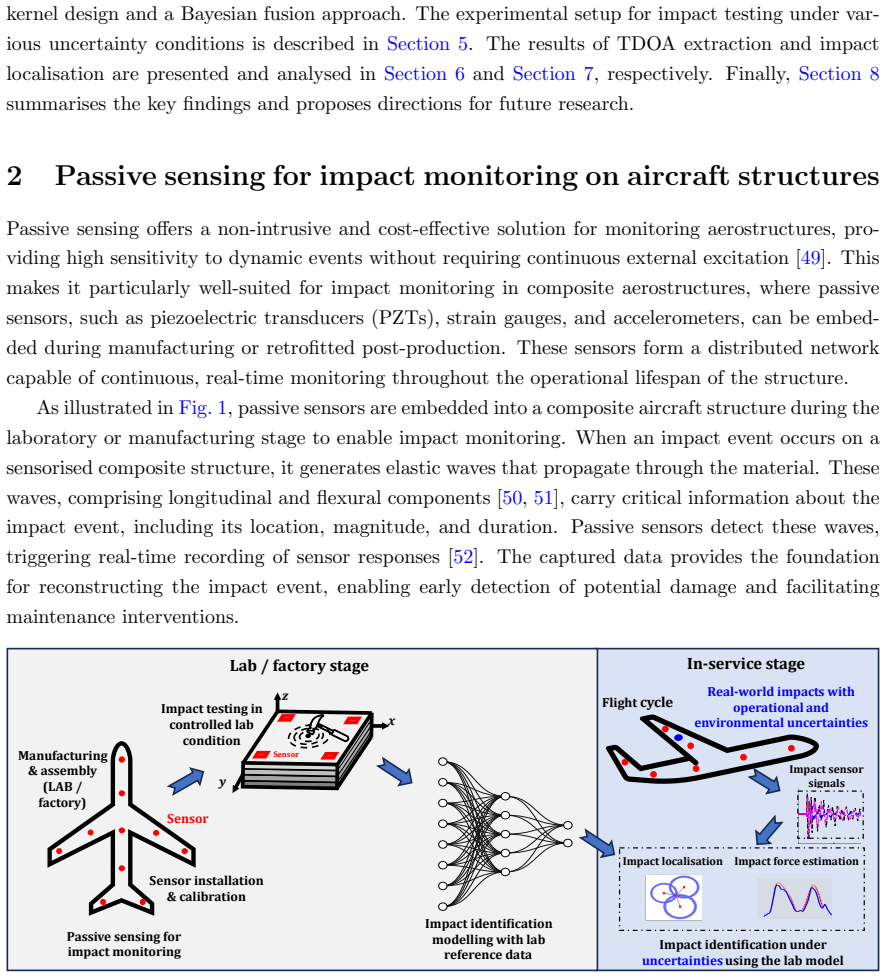
Impact localisation on composite aircraft structures remains a significant challenge due to operational and environmental uncertainties, such as variations in temperature, impact mass, and energy levels. This study proposes a novel Gaussian Process Regression framework that leverages the order invariance of time difference of arrival (TDOA) inputs to achieve probabilistic impact localisation under such uncertainties. A composite kernel function, combining radial basis function and cosine similarity kernels, is designed based on wave propagation dynamics to enhance adaptability to diverse conditions. Additionally, a task covariance kernel is introduced to enable multitask learning, facilitating the joint prediction of spatial coordinates while capturing interdependencies between outputs. To further improve robustness and accuracy, Bayesian model averaging is employed to dynamically fuse kernel predictions, assigning adaptive weights that account for varying conditions. Extensive experimental validation on a composite plate, including scenarios with large-mass drop tower impacts and small-mass guided drop mass impacts, demonstrates the proposed method's robustness and generalisability. Notably, the framework achieves accurate localisation without requiring compensation strategies for variations in temperature or impact mass, highlighting its suitability for real-world applications. The study also highlights the critical role of sample standardisation for preprocessing TDOA inputs, demonstrating its superiority over feature standardisation by preserving TDOA order invariance and enhancing model compatibility. These advancements establish the proposed method as a reliable and effective solution for structural health monitoring in complex and uncertain operational environments.
Figures


Figures from the paper (11 more)


Reference graph
Works this paper leans on
-
[1]
Damage tolerant composite fuselage sizing, characterization of accidental damage threat
Faivre Vincent and Morteau Emilie. Damage tolerant composite fuselage sizing, characterization of accidental damage threat. Airbus Tech Mag (F AST), 48:10–16, 2011
work page 2011
-
[2]
G. a. O. Davies and R. Olsson. Impact on composite structures. The Aeronautical Journal , 108(1089): 541–563, November 2004. ISSN 0001-9240, 2059-6464. doi: 10.1017/S0001924000000385
-
[3]
George J. Dvorak and Norman Laws. Analysis of Progressive Matrix Cracking In Composite Laminates II. First Ply Failure. Journal of Composite Materials , 21(4):309–329, April 1987. ISSN 0021-9983. doi: 10.1177/002199838702100402. Publisher: SAGE Publications Ltd STM
-
[4]
Robin Olsson, Mauricio V. Donadon, and Brian G. Falzon. Delamination threshold load for dynamic impact on plates. International Journal of Solids and Structures , 43(10):3124–3141, May 2006. ISSN 0020-7683. doi: 10.1016/j.ijsolstr.2005.05.005
-
[5]
S. Z. H. Shah, S. Karuppanan, P. S. M. Megat-Yusoff, and Z. Sajid. Impact resistance and damage tolerance of fiber reinforced composites: A review. Composite Structures, 217:100–121, June 2019. ISSN 0263-8223. doi: 10.1016/j.compstruct.2019.03.021
-
[6]
Impact identification of stiffened composite panels: I
Robert Seydel and Fu-Kuo Chang. Impact identification of stiffened composite panels: I. Sys- tem development. Smart Materials and Structures , 10(2):354–369, 2001. ISSN 0964-1726. doi: 10.1088/0964-1726/10/2/323
-
[7]
Zexing Yu, Chao Xu, Jiaying Sun, and Fei Du. Impact localization and force reconstruction for composite plates based on virtual time reversal processing with time-domain spectral finite element method. Structural Health Monitoring , 22(6):4149–4170, November 2023. ISSN 1475-9217. doi: 10.1177/14759217231164297
-
[8]
Quantification, localization, and reconstruction of impact force on interval composite structures
Yaru Liu and Lei Wang. Quantification, localization, and reconstruction of impact force on interval composite structures. International Journal of Mechanical Sciences , 239:107873, February 2023. ISSN 0020-7403. doi: 10.1016/j.ijmecsci.2022.107873
Show all 76 references
-
[9]
Impact Identification Based on Surrogate- assisted Efficient Global Optimisation
Dong Xiao, Zahra Sharif Khodaei, and M H Ferri Aliabadi. Impact Identification Based on Surrogate- assisted Efficient Global Optimisation. Procedia Structural Integrity, 52:667–678, January 2024. ISSN 2452-3216. doi: 10.1016/j.prostr.2023.12.067
2024 doi
-
[10]
Accelerated strategies for impact identi- fication of composite laminate using sparse sensor networks and model-based virtual time rever- sal
Zexing Yu, Jiaying Sun, Maoling Yue, and Chao Xu. Accelerated strategies for impact identi- fication of composite laminate using sparse sensor networks and model-based virtual time rever- sal. Structural Health Monitoring , page 14759217241290260, November 2024. ISSN 1475-9217...
2024 doi
-
[11]
Impulse identification technique by estimating specific modal ponderations from vibration measurements
Dimitri Goutaudier, Didier Gendre, V´ eronique Kehr-Candille, and Roger Ohayon. Impulse identification technique by estimating specific modal ponderations from vibration measurements. Journal of Sound and Vibration, 474:115263, May 2020. ISSN 0022-460X. doi: 10.1016/j.jsv.2020...
2020
-
[12]
Single-sensor approach for impact localization and force reconstruction by using discriminating vibration modes
Dimitri Goutaudier, Didier Gendre, V´ eronique Kehr-Candille, and Roger Ohayon. Single-sensor approach for impact localization and force reconstruction by using discriminating vibration modes. Mechanical Systems and Signal Processing , 138:106534, April 2020. ISSN 0888-3270. d...
2020 doi
-
[13]
An efficient impact force identification methodology via a single sensor utilizing the concept of generalized transmissibility
Li Zhang, Mingyao Liu, Liu Hong, Zechao Wang, Zude Zhou, and Wenlin Liao. An efficient impact force identification methodology via a single sensor utilizing the concept of generalized transmissibility. Mechanical Systems and Signal Processing , 211:111222, April 2024. ISSN 088...
2024
-
[14]
Assessing impact force localization by using a particle swarm optimization algorithm
Abdelali El-Bakari, Abdellatif Khamlichi, Eric Jacquelin, and Rachid Dkiouak. Assessing impact force localization by using a particle swarm optimization algorithm. Journal of Sound and Vibration , 333(6): 1554–1561, March 2014. ISSN 0022-460X. doi: 10.1016/j.jsv.2013.11.032
2014 doi
-
[15]
Impact damage monitoring of FRP pressure vessels based on impact force identification
Satoshi Atobe, Sunao Sugimoto, Ning Hu, and Hisao Fukunaga. Impact damage monitoring of FRP pressure vessels based on impact force identification. Advanced Composite Materials , 23(5-6):491–505, September 2014. ISSN 0924-3046. doi: 10.1080/09243046.2014.915112. Publisher: Tayl...
2014
-
[16]
Impact detection in anisotropic materials using a time reversal approach
F Ciampa and M Meo. Impact detection in anisotropic materials using a time reversal approach. Struc- tural Health Monitoring, 11(1):43–49, 2012. ISSN 1475-9217. doi: 10.1177/1475921710395815. Publisher: SAGE Publications
2012 doi
-
[17]
A hierarchical method for the impact force reconstruction in composite structures
Mario Emanuele De Simone, Francesco Ciampa, and Michele Meo. A hierarchical method for the impact force reconstruction in composite structures. Smart Materials and Structures , 28(8):085022, 2019. ISSN 0964-1726. doi: 10.1088/1361-665X/aae11c
2019 doi
-
[18]
Impact source identification in finite isotropic plates using a time-reversal method: experimental study
Chunlin Chen, Yulong Li, and Fuh-Gwo Yuan. Impact source identification in finite isotropic plates using a time-reversal method: experimental study. Smart Materials and Structures , 21(10):105025, August 2012. ISSN 0964-1726. doi: 10.1088/0964-1726/21/10/105025
2012 doi
-
[19]
A novel strategy for response and force reconstruction under impact excitation
Jie Liu and Bing Li. A novel strategy for response and force reconstruction under impact excitation. Journal of Mechanical Science and Technology , 32(8):3581–3596, August 2018. ISSN 1976-3824. doi: 10.1007/s12206-018-0709-4
2018 doi
-
[20]
Material parameter optimization of flax/epoxy composite laminates under low-velocity impact
Valentina Giammaria, Giulia Del Bianco, Elena Raponi, Dario Fiumarella, Raffaele Ciardiello, Simon- etta Boria, Fabian Duddeck, and Giovanni Belingardi. Material parameter optimization of flax/epoxy composite laminates under low-velocity impact. Composite Structures, 321:11730...
2023
-
[21]
A FEM-based direct method for identification of Young’s modulus and boundary conditions in three-dimensional linear elasticity from local observation
Tian Xu, Zhen Wang, Yingda Hu, Shilun Du, Ao Du, Zhenyang Yu, and Yong Lei. A FEM-based direct method for identification of Young’s modulus and boundary conditions in three-dimensional linear elasticity from local observation. International Journal of Mechanical Sciences , 237...
-
[22]
Review of finite element model updating methods for structural applications
Suzana Ereiz, Ivan Duvnjak, and Javier Fernando Jim´ enez-Alonso. Review of finite element model updating methods for structural applications. Structures, 41:684–723, July 2022. ISSN 2352-0124. doi: 10.1016/j.istruc.2022.05.041
2022 doi
-
[23]
John Wiley & Sons, June 2021
Barna Szab´ o and Ivo Babuˇ ska.Finite Element Analysis: Method, Verification and Validation . John Wiley & Sons, June 2021. ISBN 978-1-119-42642-4
2021
-
[24]
Sharif-Khodaei, M
Z. Sharif-Khodaei, M. Ghajari, and M. H. Aliabadi. Determination of impact location on composite stiffened panels. Smart Materials and Structures , 21(10):105026, 2012. ISSN 0964-1726. doi: 10.1088/ 0964-1726/21/10/105026. 27
2012
-
[25]
Ghajari, Z
M. Ghajari, Z. Sharif-Khodaei, M. H. Aliabadi, and A. Apicella. Identification of impact force for smart composite stiffened panels. Smart Materials and Structures , 22(8):085014, 2013. ISSN 0964-1726. doi: 10.1088/0964-1726/22/8/085014
2013 doi
-
[26]
Uncertainty quantification for impact location and force estimation in composite structures
Aldyandra Hami Seno and MH Ferri Aliabadi. Uncertainty quantification for impact location and force estimation in composite structures. Structural Health Monitoring , page 147592172110202, June 2021. ISSN 1475-9217, 1741-3168. doi: 10.1177/14759217211020255
2021 doi
-
[27]
M. R. Jones, T. J. Rogers, K. Worden, and E. J. Cross. A Bayesian methodology for localising acoustic emission sources in complex structures. Mechanical Systems and Signal Processing, 163:108143, January
-
[28]
Detection and time-of-arrival estimation of impact-induced waves in composite laminates
Lukas Grasboeck, Alexander Humer, and Ayech Benjeddou. Detection and time-of-arrival estimation of impact-induced waves in composite laminates. Structural Health Monitoring , page 14759217241260848, July 2024. ISSN 1475-9217. doi: 10.1177/14759217241260848. Publisher: SAGE Pub...
2024 doi
-
[29]
Hybrid DoA- TDoA method for impact localization on thin-walled structures using sensor clusters
Xu Zeng, Deshuang Deng, Hongjuan Yang, Zhengyan Yang, Lei Yang, and Zhanjun Wu. Hybrid DoA- TDoA method for impact localization on thin-walled structures using sensor clusters. IEEE Sensors Journal, pages 1–1, 2025. ISSN 1558-1748. doi: 10.1109/JSEN.2024.3515461. Conference Na...
2025
-
[30]
Qing, and Bin Liu
Kaige Zhu, Xinlin P. Qing, and Bin Liu. A two-step impact localization method for composite structures with a parameterized laminate model. Composite Structures, 192:500–506, May 2018. ISSN 0263-8223. doi: 10.1016/j.compstruct.2018.03.052
2018 doi
-
[31]
Qing, Bin Liu, and Tiren He
Kaige Zhu, Xinlin P. Qing, Bin Liu, and Tiren He. A passive localization method for stiffened composite structures with a parameterized laminate model. Journal of Sound and Vibration , 489:115683, December
-
[32]
M. Meo, G. Zumpano, M. Piggott, and G. Marengo. Impact identification on a sandwich plate from wave propagation responses. Composite Structures, 71(3):302–306, December 2005. ISSN 0263-8223. doi: 10.1016/j.compstruct.2005.09.028
2005 doi
-
[33]
Dong Xiao, Francisco de S´ a Rodrigues, Zahra Sharif-Khodaei, and M. H. Aliabadi. A general probabilistic framework for impact localisation based on flexural wave propagation. Mechanical Systems and Signal Processing, 226:112320, March 2025. ISSN 0888-3270. doi: 10.1016/j.ymss...
2025
-
[34]
Dehghan Niri, A
E. Dehghan Niri, A. Farhidzadeh, and S. Salamone. Nonlinear Kalman Filtering for acoustic emission source localization in anisotropic panels. Ultrasonics, 54(2):486–501, February 2014. ISSN 0041-624X. doi: 10.1016/j.ultras.2013.07.016
2014 doi
-
[35]
Dehghan Niri and S
E. Dehghan Niri and S. Salamone. A probabilistic framework for acoustic emission source localization in plate-like structures. Smart Materials and Structures , 21(3):035009, 2012. ISSN 0964-1726. doi: 10.1088/0964-1726/21/3/035009
2012 doi
-
[36]
Multi-frequency probabilistic imaging fusion for impact localization on aircraft composite structures
Deshuang Deng, Xu Zeng, Zhengyan Yang, Yu Yang, Sheng Zhang, Shuyi Ma, Hao Xu, Lei Yang, and Zhanjun Wu. Multi-frequency probabilistic imaging fusion for impact localization on aircraft composite structures. Structural Health Monitoring , page 14759217241233181, March 2024. IS...
2024 doi
-
[37]
A Convolutional Neural Network for Impact Detection and Characterization of Complex Composite Structures
Iuliana Tabian, Hailing Fu, and Zahra Sharif Khodaei. A Convolutional Neural Network for Impact Detection and Characterization of Complex Composite Structures. Sensors, 19(22):4933, January 2019. ISSN 1424-8220. doi: 10.3390/s19224933. 28
2019 doi
-
[38]
Impact monitoring of large size complex metal structures based on sparse sensor array and transfer learning
Bowen Zhao, Yiliang Zhang, Qijian Liu, and Xinlin Qing. Impact monitoring of large size complex metal structures based on sparse sensor array and transfer learning. Ultrasonics, 140:107305, May 2024. ISSN 0041-624X. doi: 10.1016/j.ultras.2024.107305
2024
-
[39]
Impact force localization and reconstruction via gated temporal convolutional network
Rui Zhou, Baijie Qiao, Junjiang Liu, Wei Cheng, and Xuefeng Chen. Impact force localization and reconstruction via gated temporal convolutional network. Aerospace Science and Technology, 144:108819, January 2024. ISSN 1270-9638. doi: 10.1016/j.ast.2023.108819
2024
-
[40]
A hybrid FCN-BiGRU with trans- fer learning for low-velocity impact identification on aircraft structure
Chenhui Huang, Weilin Liao, Hu Sun, Yishou Wang, and Xinlin Qing. A hybrid FCN-BiGRU with trans- fer learning for low-velocity impact identification on aircraft structure. Smart Materials and Structures , 32(5):055012, April 2023. ISSN 0964-1726. doi: 10.1088/1361-665X/acc623....
2023 doi
-
[41]
Data-physics hybrid-driven deep learning method for impact force identification
Jiaming Zhou, Yinshan Cai, Longlei Dong, Bo Zhang, and Zhike Peng. Data-physics hybrid-driven deep learning method for impact force identification. Mechanical Systems and Signal Processing , 211:111238, April 2024. ISSN 0888-3270. doi: 10.1016/j.ymssp.2024.111238
2024
-
[42]
Spatial-temporal graph convolutional networks (STGCN) based method for localizing acoustic emission sources in composite panels
Zhimin Zhao and Nian-Zhong Chen. Spatial-temporal graph convolutional networks (STGCN) based method for localizing acoustic emission sources in composite panels. Composite Structures, 323:117496, November 2023. ISSN 0263-8223. doi: 10.1016/j.compstruct.2023.117496
2023
-
[43]
Impact force reconstruction and localization using Distance-assisted Graph Neural Network
Chun Huang, Chongcong Tao, Hongli Ji, and Jinhao Qiu. Impact force reconstruction and localization using Distance-assisted Graph Neural Network. Mechanical Systems and Signal Processing , 200:110606, October 2023. ISSN 0888-3270. doi: 10.1016/j.ymssp.2023.110606
2023
-
[44]
Aldyandra Hami Seno, Zahra Sharif Khodaei, and M. H. Ferri Aliabadi. Passive sensing method for im- pact localisation in composite plates under simulated environmental and operational conditions. Mechan- ical Systems and Signal Processing, 129:20–36, 2019. ISSN 0888-3270. doi:...
2019 doi
-
[45]
Aldyandra Hami Seno and M. H. Ferri Aliabadi. Impact Localisation in Composite Plates of Different Stiffness Impactors under Simulated Environmental and Operational Conditions. Sensors, 19(17):3659, January 2019. ISSN 1424-8220. doi: 10.3390/s19173659
2019 doi
-
[46]
Aldyandra Hami Seno and M. H. Ferri Aliabadi. Multifidelity data augmentation for data driven passive impact location and force estimation in composite structures under simulated environmental and oper- ational conditions. Mechanical Systems and Signal Processing , 195:110288,...
2023
-
[47]
Nur M. M. Kalimullah, Amit Shelke, and Anowarul Habib. A probabilistic framework for source localiza- tion in anisotropic composite using transfer learning based multi-fidelity physics informed neural network (mfPINN). Mechanical Systems and Signal Processing , 197:110360, Aug...
2023
-
[48]
Dong Xiao, Zahra Sharif-Khodaei, and M. H. Aliabadi. Hybrid physics-based and data-driven impact localisation for composite laminates. International Journal of Mechanical Sciences , 274:109222, July
-
[49]
Structural Health Monitoring for Advanced Composite Struc- tures, volume 08 of Computational and Experimental Methods in Structures
M H Ferri Aliabadi and Z Sharif Khodaei. Structural Health Monitoring for Advanced Composite Struc- tures, volume 08 of Computational and Experimental Methods in Structures . World Scientific (Europe), February 2018. ISBN 978-1-78634-392-5 978-1-78634-393-2. doi: 10.1142/q0114
2018 doi
-
[50]
F. C. Moon. A critical survey of wave propagation and impact in composite materials. Technical Report CR-121226, NASA, May 1973
1973
-
[51]
Impact Induced Stress Waves in an Anisotropic Plate
Byoung Sung Kim and Francis Moon. Impact Induced Stress Waves in an Anisotropic Plate. AIAA Journal, 17(10):1126–1133, October 1979. ISSN 0001-1452, 1533-385X. doi: 10.2514/3.61287. 29
1979 doi
-
[52]
Hailing Fu, Zahra Sharif Khodaei, and M. H. Ferri Aliabadi. An Event-Triggered Energy-Efficient Wireless Structural Health Monitoring System for Impact Detection in Composite Airframes. IEEE Internet of Things Journal , 6(1):1183–1192, 2019. ISSN 2327-4662. doi: 10.1109/JIOT.2...
2019
-
[53]
Impact on Composite Structures
Serge Abrate. Impact on Composite Structures . Cambridge University Press, Cambridge, 1998. ISBN 978-0-521-47389-7. doi: 10.1017/CBO9780511574504
1998 doi
-
[54]
F. C. Moon. Theoretical analysis of impact in composite plates. Technical Report AMS-1099, NASA, January 1973
1973
-
[55]
I. M. Daniel, T. Liber, and R. H. LaBedz. Wave propagation in transversely impacted composite lami- nates. Experimental Mechanics, 19(1):9, 1979. ISSN 0014-4851. doi: 10.1007/BF02327764
1979 doi
-
[56]
T. M. Tan and C. T. Sun. Wave propagation in graphite/epoxy laminates due to impact. Technical Report NASA-CR-168057, NASA, December 1982
1982
-
[57]
Acoustic source localization
Tribikram Kundu. Acoustic source localization. Ultrasonics, 54(1):25–38, January 2014. ISSN 0041-624X. doi: 10.1016/j.ultras.2013.06.009
2014 doi
-
[58]
Dong Xiao, Zahra Sharif-Khodaei, and M. H. Aliabadi. Impact force identification for composite struc- tures using adaptive wavelet-regularised deconvolution. Mechanical Systems and Signal Processing , 220: 111608, November 2024. ISSN 0888-3270. doi: 10.1016/j.ymssp.2024.111608
2024
-
[59]
R. Olsson. Mass criterion for wave controlled impact response of composite plates. Composites Part A: Applied Science and Manufacturing , 31(8):879–887, August 2000. ISSN 1359-835X. doi: 10.1016/ S1359-835X(00)00020-8
-
[60]
A tutorial on Gaussian process regression: Modelling, exploring, and exploiting functions
Eric Schulz, Maarten Speekenbrink, and Andreas Krause. A tutorial on Gaussian process regression: Modelling, exploring, and exploiting functions. Journal of Mathematical Psychology , 85:1–16, August
-
[61]
Alexander I. J. Forrester, Andrs Sbester, and Andy J. Keane. Engineering Design via Surrogate Mod- elling. John Wiley & Sons, Ltd, Chichester, UK, July 2008. ISBN 978-0-470-77080-1 978-0-470-06068-1. doi: 10.1002/9780470770801
2008 doi
-
[62]
Gaussian Process Surrogate Model with Composite Kernel Learning for Engineering Design
Pramudita Satria Palar, Lavi Rizki Zuhal, and Koji Shimoyama. Gaussian Process Surrogate Model with Composite Kernel Learning for Engineering Design. AIAA Journal , 58(4):1864–1880, 2020. ISSN 0001-1452. doi: 10.2514/1.J058807. Publisher: American Institute of Aeronautics and ...
2020 doi
-
[63]
JGPR: a computationally efficient multi- target Gaussian process regression algorithm
Mohammad Nabati, Seyed Ali Ghorashi, and Reza Shahbazian. JGPR: a computationally efficient multi- target Gaussian process regression algorithm. Machine Learning, 111(6):1987–2010, June 2022. ISSN 1573-0565. doi: 10.1007/s10994-022-06170-3
1987 doi
-
[64]
GPyTorch: Blackbox Matrix-Matrix Gaussian Process Inference with GPU Acceleration
Jacob Gardner, Geoff Pleiss, Kilian Q Weinberger, David Bindel, and Andrew G Wilson. GPyTorch: Blackbox Matrix-Matrix Gaussian Process Inference with GPU Acceleration. In Advances in Neural Information Processing Systems, volume 31, pages 1–11. Curran Associates, Inc., 2018
2018
-
[65]
PyTorch: An Imperative Style, High-Performance Deep Learning Library
Adam Paszke, Sam Gross, Francisco Massa, Adam Lerer, James Bradbury, Gregory Chanan, Trevor Killeen, Zeming Lin, Natalia Gimelshein, Luca Antiga, Alban Desmaison, Andreas Kopf, Edward Yang, Zachary DeVito, Martin Raison, Alykhan Tejani, Sasank Chilamkurthy, Benoit Steiner, Lu ...
2019
-
[66]
Bayesian Model Selection and Model Averaging
Larry Wasserman. Bayesian Model Selection and Model Averaging. Journal of Mathematical Psychology, 44(1):92–107, March 2000. ISSN 0022-2496. doi: 10.1006/jmps.1999.1278
-
[67]
Multiple Delaminations and their Severity in Circular Axisym- metric Plates Subjected to Transverse Loading
Hiroshi Suemasu and Osamu Majima. Multiple Delaminations and their Severity in Circular Axisym- metric Plates Subjected to Transverse Loading. Journal of Composite Materials , 30(4):441–453, March
-
[68]
Analytical prediction of large mass impact damage in composite laminates
Robin Olsson. Analytical prediction of large mass impact damage in composite laminates. Composites Part A: Applied Science and Manufacturing , 32(9):1207–1215, September 2001. ISSN 1359-835X. doi: 10.1016/S1359-835X(01)00073-2
2001 doi
-
[69]
Thiene, M
M. Thiene, M. Ghajari, U. Galvanetto, and M. H. Aliabadi. Effects of the transfer function evaluation on the impact force reconstruction with application to composite panels. Composite Structures, 114:1–9, August 2014. ISSN 0263-8223. doi: 10.1016/j.compstruct.2014.03.055
2014 doi
-
[70]
Dong Xiao, Zahra Sharif-Khodaei, and M. H. Aliabadi. Time of Arrival Extraction for Impact Lo- calisation on Composite Structures. e-Journal of Nondestructive Testing , 29(07), July 2024. doi: 10.58286/29601. 31
2024 doi
- [1996]
- [2018]
-
[2020]
doi: 10.1016/j.jsv.2020.115683
ISSN 0022-460X. doi: 10.1016/j.jsv.2020.115683
2020
-
[2022]
doi: 10.1016/j.ymssp.2021.108143
ISSN 0888-3270. doi: 10.1016/j.ymssp.2021.108143
2021
-
[2023]
doi: 10.1016/j.ijmecsci.2022.107797
ISSN 0020-7403. doi: 10.1016/j.ijmecsci.2022.107797
2022
-
[2024]
doi: 10.1016/j.ijmecsci.2024.109222
ISSN 0020-7403. doi: 10.1016/j.ijmecsci.2024.109222
2024
Reviewed August 9, 2026 · model on record in the stance chip above.
Discussion (0). Continue with ORCID to comment.