REVIEW 4 major objections 5 minor 56 references
Statistics of rigid fibers in strongly sheared turbulence
T0 review · 4 major / 5 minor · reviewed 2026-08-14 · deepseek-v4-flash
Pith's one-line read Millimetric fibers in turbulent shear flow align at a fixed −68° angle.
desk verdict A robust new experimental measurement of fiber alignment in strongly sheared turbulence, packaged with a Jeffery-based model that is honest but only qualitatively successful. read the letter →
The pith
A machine-rendered reading of the paper's core claim, the machinery that carries it, and where it could break.
The reading
What carries the argument
The central object is Jeffery's equation for the orientation vector $p_i$ of an ellipsoidal particle in a viscous shear flow, repurposed as a stochastic mean-field process: every time interval of order $\tau_\ell$, the fiber's orientation is randomly reset, and between resets it evolves under a simple shear with the bulk mean shear rate $\dot{\gamma} = \langle \partial u_\theta/\partial r \rangle$ over $\tilde{r} \in [0.25, 0.75]$. The aspect ratio $\Lambda = 5.3$ enters through the shape factor $(\Lambda^2 - 1)/(\Lambda^2 + 1)$. This machinery converts turbulent fluctuations into a discrete reorientation process and yields an orientation PDF whose peak and shape can be compared with experiment; agreement is best for an integration time near $2\tau_\ell$. A supporting step is the revised Stokes number estimate: using a drag-corrected response time $\tau_p$ and the fiber-scale eddy time $\tau_\ell$ gives $\mathrm{Stk}_p \approx 2$ to $3$, rather than the large values obtained with Kolmogorov scales, which explains why the fibers track the flow closely despite their size.
What would settle it
Measure the full three-dimensional orientation of the fibers with stereoscopic imaging: if out-of-plane angles are large, or if the peak of the orientation PDF shifts with a change in the mean shear rate by more than the Jeffery-based prediction allows, then the simple-shear-plus-random-reset model is not the right mechanism.
Extended reading notes
Core claim
The central claim is that finite-sized rigid fibers in high-Reynolds-number Taylor–Couette turbulence exhibit a statistically preferred orientation of $\theta_p = -0.38\pi \pm 0.05\pi$ with respect to the inner-cylinder wall, independent of $\mathrm{Re}_i$ ($8.3\times10^4$ to $2.5\times10^5$), volume fraction ($0.025\%$ to $0.100\%$), radial bin, and axial position. The same PDF shape is found everywhere, with a 40% difference between the most and least probable orientations. The authors further claim that a stochastic mean-field model based on Jeffery's equation, using only the bulk mean shear rate and a reorientation time of order $\tau_\ell$, predicts a peak near $-0.27\pi$, within about 15–18° of the measured value; they attribute the offset to inertia and to turbulence not captured by the model. They also find that the fiber angular velocity is Reynolds-number-independent and strongly intermittent, with kurtosis 34–40, which they interpret as evidence that even large fibers respond to local velocity gradients like small particles.
Load-bearing premise
The explanation assumes each fiber sees only the bulk mean shear while turbulent fluctuations act as an instantaneous randomizer every few eddy-turnover times, and that the measured in-plane angle captures the dominant rotation.
Editorial extensions
If this is right
- Fiber orientation statistics in strongly sheared turbulence can be approximated without resolving the fiber's finite size: the bulk mean shear rate and one eddy time scale suffice.
- The preferred angle $-0.38\pi \pm 0.05\pi$ is a robust, geometry-specific signature independent of Reynolds number, fiber concentration, and position in the Taylor–Couette gap.
- Finite-sized fibers with $\mathrm{Stk}_p \approx 2$ to $3$ still follow the local flow closely, so point-particle approaches may be extended to particles much larger than the Kolmogorov scale.
- Fiber angular velocity intermittency (kurtosis 34–40) is far stronger than for spheres of similar size, consistent with the low rotational inertia of elongated bodies.
- A single integration time of about $2\tau_\ell$ in the Jeffery-based model reproduces the measured orientation PDF shape, suggesting the fiber rotation is set by eddies comparable to the fiber length.
Reading between the lines
- If the alignment angle is set mainly by the bulk shear direction, the same stochastic Jeffery recipe might predict preferred orientations in other shear-dominated turbulent geometries, with the angle set by the local mean velocity gradient.
- The 15–18° offset between the measured peak and the model prediction is a testable handle: a systematic variation of fiber aspect ratio and density ratio should show whether the offset grows with particle inertia, as the paper qualitatively suggests.
- Because the experiment measures a 2D projection, the true 3D orientation distribution could be broader; comparing these PDFs with direct numerical simulations of finite-size fibers in shear turbulence would settle how much out-of-plane rotation matters.
- A practical consequence not pursued by the paper is that the stable, concentration-independent alignment angle could serve as a local flow-direction probe or as a constraint for rheological models of fiber suspensions.
Signed reviews
Editorial analysis
A structured set of objections, weighed in public.
Referee Report
Summary. This experimental letter studies rigid millimetric fibers in a strongly sheared Taylor-Couette turbulent flow. Using high-speed imaging with 64,000 images per case, the authors measure the two-dimensional projection of the fiber orientation onto the radial-azimuthal plane and report a preferred orientation of −0.38π ± 0.05π (−68 ± 9°) relative to the mean azimuthal flow direction, with the result essentially independent of Reynolds number, fiber volume fraction, radial position, and axial position. They also measure fiber velocities and angular velocities, finding that the fibers follow the local azimuthal flow closely and that their angular velocity is strongly intermittent. To explain the preferred orientation, they integrate Jeffery's equation for ellipsoidal particles in a simple shear flow with the bulk mean shear rate, assuming that turbulence randomly reorients the fibers on a timescale of order τ_l. The resulting model PDF has a peak at approximately −0.27π, which is within about 15 to 18 degrees of the measured value, and the model amplitude is matched by choosing an integration time of about 2τ_l. The authors conclude that finite-sized anisotropic particles can retain point-particle-like signatures of the local turbulent flow.
Significance. The empirical result is significant: if correct, it shows a robust, geometry-independent preferential alignment of large fibers in high-Reynolds-number turbulence, with a 40% contrast between the most and least probable orientations, and it supports the practical use of simplified point-particle modeling for orientation statistics. The strengths of the paper are its careful and extensive measurements, the consistency of the orientation PDF across parameter variations, the direct measurement of fiber velocities showing agreement with the mean flow, and the documentation of strongly intermittent angular velocities with high kurtosis. However, the explanatory part is currently qualitative rather than quantitative: the Jeffery-model peak lies outside the quoted experimental uncertainty, the integration-time constant C is tuned to match the PDF amplitude, and the model does not account for rotational inertia or three-dimensional projection effects.
major comments (4)
- [Section 'In order to understand the preferential alignment...' and Fig. 5] The measured headline orientation is −0.38π ± 0.05π, while the Jeffery-integration peak is reported as approximately −0.27π. The offset of roughly 0.11π (about 20°) is more than twice the quoted ±0.05π uncertainty, so the model does not quantitatively reproduce the central measurement. The text attributes the shift to inertial lag and turbulent fluctuations, but no calculation, model, or separate measurement quantifies either effect. Because the abstract and conclusions claim that Jeffery's equation explains the preferential alignment, this discrepancy is load-bearing; please either provide a quantitative account of the shift or reframe the claim as a qualitative shape comparison.
- [Section 'In order to understand the preferential alignment...', integration over t in [0, C τ_l]] The stochastic mean-field model rests on the premise that each fiber sees a simple shear with the bulk mean shear rate and that turbulence only randomly resets the orientation every interval of order τ_l. This premise is not derived from the measurements or from an independent model of the fiber's Lagrangian velocity-gradient history. Moreover, the constant C is chosen so that C = 2τ_l matches the PDF amplitude; because the same parameter does not control the model peak, the partial agreement cannot be separated from this tuning. Please justify C from a measured Lagrangian correlation time or show explicitly that the predicted peak is insensitive to C.
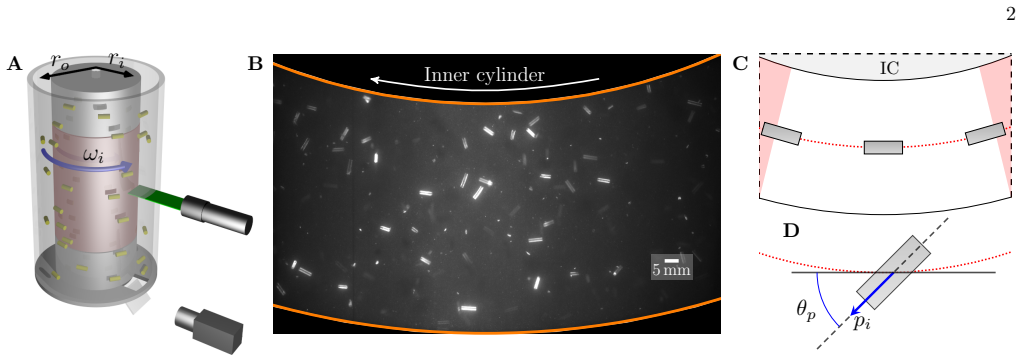
- [Fig. 1C,D and Fig. 5] The measured θ_p is the two-dimensional projection of the fiber orientation onto the r-θ plane, whereas the Jeffery integration is performed in full three-dimensional orientation space. The comparison in Fig. 5 therefore presupposes that out-of-plane orientation and rotation are negligible. Since the fibers are free to rotate in all directions and the flow has secondary axial and radial velocities, this assumption needs support: for example, an estimate or measurement of the out-of-plane polar-angle distribution, or a projection of the three-dimensional model PDF onto the measurement plane, should be provided.
- [Paragraph containing Stk_p and Stk_r] The manuscript acknowledges that the fibers are not in the strictly inertialess limit, noting that Stk_r is of order 0.1 Stk_p, but it does not provide a value or a model for Stk_r under the present conditions. Since the unexplained peak shift is attributed to small inertia, a quantitative statement of the rotational Stokes number or a simple inertial correction would be needed to make the point-particle claim defensible. Without this, the statement that finite-size fibers still retain point-particle-like orientation statistics remains an assertion rather than a demonstrated result.
minor comments (5)
- [Abstract] The name 'Jefferey's equation' is misspelled in the abstract; the correct spelling 'Jeffery' is used in the body and should be used consistently.
- [Summary, second paragraph] There are typographical errors in the text, including 'an strongly sheared turbulent flow' and 'prefered alignment'; these should be corrected.
- [Eq. (1) preceding text] The sentence says the equations are 'duplicated here'; this should read 'reproduced here'.
- [Fig. 6] The legend uses 'Re' while the text and other figures use 'Re_i'; please standardize the notation.
- [Fig. 3 caption] The caption states 'A representation of the fiber alignment is shown at the top of the figure,' but the schematic is small and its relation to θ_p could be clarified for readability.
Circularity Check
No significant circularity: the Jeffery-model peak is not produced by any fit to the measured orientation, and the main comparison is an independent (if imperfect) prediction.
full rationale
The paper's central orientation claim (-0.38π ± 0.05π) is an experimental measurement, not an output of the model. The explanatory model uses Jeffery's equation (external, 1922) with the aspect ratio Λ = 5.3 and a mean shear rate taken from the measured velocity profile; neither input is tuned to reproduce -0.38π. The integration time Cτ_l is the only free parameter, and it affects the PDF amplitude, not the peak position; the paper explicitly reports that the calculated peak is about -0.27π, outside the measured range, and attributes the offset to inertia and turbulence only qualitatively. That is a quantitative mismatch, which is a correctness/accuracy weakness, not circularity. The stochastic reorientation ansatz (randomize every ~τ_l, evolve in simple shear) is a modeling assumption introduced in this paper, not imported from a self-citation or defined in terms of the target result. No self-citation is load-bearing for the orientation claim: references to prior Taylor-Couette velocity profiles are independent experimental inputs, and Jeffery's equation is a classical external result. Because the predicted quantity (peak angle) is not equivalent by construction to any fitted parameter or cited result, there is no circular step under the stated criteria.
Assumptions & free parameters
free parameters (1)
- Integration time factor C in t in [0, C*tau_l] =
2
assumptions (4)
- domain assumption Jeffery's equation for ellipsoids in the viscous Stokes limit remains applicable to fibers with particle Reynolds number of order 1000 and length 44 to 95 Kolmogorov scales.
- ad hoc to paper The turbulent flow seen by a fiber is equivalent to a simple shear with the bulk mean shear rate, with turbulence acting only as a randomizing reset of orientation every interval of order tau_l.
- domain assumption The 2D projected orientation angle theta_p measured in the r-theta plane represents the dominant rotational dynamics of the fibers.
- ad hoc to paper The unexplained 15 to 18 degree model-experiment peak shift is caused by small inertia and turbulent fluctuations.
Cite this review
Pith. "Pith review of Statistics of rigid fibers in strongly sheared turbulence." pith.science (2026). https://pith.science/paper/TCVG6N6E
@misc{pith2026190807850,
  author       = {Pith},
  title        = {Pith review of: Statistics of rigid fibers in strongly sheared turbulence},
  year         = {2026},
  howpublished = {\url{https://pith.science/paper/TCVG6N6E}},
  note         = {Machine review of arXiv:1908.07850}
}
abstract
Practically all flows are turbulent in nature and contain some kind of irregularly-shaped particles, e.g. dirt, pollen, or life forms such as bacteria or insects. The effect of the particles on such flows and vice-versa are highly non-trivial and are not completely understood, particularly when the particles are finite-sized. Here we report an experimental study of millimetric fibers in a strongly sheared turbulent flow. We find that the fibers show a preferred orientation of $-0.38\pi \pm 0.05\pi$ ($-68 \pm 9^\circ$) with respect to the mean flow direction in high-Reynolds number Taylor-Couette turbulence, for all studied Reynolds numbers, fiber concentrations, and locations. Despite the finite-size of the anisotropic particles, we can explain the preferential alignment by using Jefferey's equation, which provides evidence of the benefit of a simplified point-particle approach. Furthermore, the fiber angular velocity is strongly intermittent, again indicative of point-particle-like behavior in turbulence. Thus large anisotropic particles still can retain signatures of the local flow despite classical spatial and temporal filtering effects.
Figures


Figures from the paper (3 more)


Reference graph
Works this paper leans on
-
[1]
Fluid Mechanics of Papermaking,
Fredrik Lundell, L. Daniel S¨ oderberg, and P. Henrik Alfredsson, “Fluid Mechanics of Papermaking,” Annu. Rev. Fluid Mech. 43, 195–217 (2011)
work page 2011
-
[2]
L. Sabban, A. Cohen, and R. van Hout, “Temporally resolved measurements of heavy, rigid fibre translation and rotation in nearly homogeneous isotropic turbulence,” J. Fluid Mech. 814, 42–68 (2017)
work page 2017
-
[3]
Suspended sediment transport dynamics in rivers: Multi-scale drivers of temporal variation,
Kim Vercruysse, Robert C. Grabowski, and R.J. Rickson, “Suspended sediment transport dynamics in rivers: Multi-scale drivers of temporal variation,” Earth-Sci. Rev. 166, 38–52 (2017)
work page 2017
-
[4]
Inertial effects on fibers settling in a vortical flow,
Diego Lopez and Elisabeth Guazzelli, “Inertial effects on fibers settling in a vortical flow,” Phys. Rev. Fluids 2, 024306 (2017)
work page 2017
-
[5]
Microstructural Dynamics and Rheology of Suspensions of Rigid Fibers,
Jason E. Butler and Braden Snook, “Microstructural Dynamics and Rheology of Suspensions of Rigid Fibers,” Annu. Rev. Fluid Mech. 50, 299–318 (2018)
work page 2018
-
[6]
Mohsen Daghooghi and Iman Borazjani, “The influence of inertia on the rheology of a periodic suspension of neutrally buoyant rigid ellipsoids,” J. Fluid Mech. 781, 506–549 (2015)
work page 2015
-
[7]
Michael Wilkinson, Vlad Bezuglyy, and Bernhard Mehlig, “Fingerprints of random flows?” Phys. Fluids 21, 043304 (2009)
work page 2009
-
[8]
Rotation and alignment of rods in two-dimensional chaotic flow,
Shima Parsa, Jeffrey S. Guasto, Monica Kishore, Nicholas T. Ouellette, J. P. Gollub, and Greg A. Voth, “Rotation and alignment of rods in two-dimensional chaotic flow,” Phys. Fluids 23, 043302 (2011)
work page 2011
Show all 56 references
-
[9]
Orientation statistics of small particles in turbulence,
Alain Pumir and Michael Wilkinson, “Orientation statistics of small particles in turbulence,” New. J. Phys. 13, 093030 (2011)
2011
-
[10]
Rotation Rate of Rods in Turbulent Fluid Flow,
Shima Parsa, Enrico Calzavarini, Federico Toschi, and Greg A. Voth, “Rotation Rate of Rods in Turbulent Fluid Flow,” Phys. Rev. Lett. 109, 134501 (2012)
2012
-
[11]
Anisotropic Particles in Turbulence,
Greg A. Voth and Alfredo Soldati, “Anisotropic Particles in Turbulence,” Annu. Rev. Fluid Mech. 49, 249–276 (2017)
2017
-
[12]
Alignment of vorticity and rods with Lagrangian fluid stretching in turbulence,
Rui Ni, Nicholas T. Ouellette, and Greg A. Voth, “Alignment of vorticity and rods with Lagrangian fluid stretching in turbulence,” J. Fluid Mech. 743, R3 (2014)
2014
-
[13]
Orientation of non-spherical particles in an axisymmetric random flow,
Dario Vincenzi, “Orientation of non-spherical particles in an axisymmetric random flow,” J. Fluid Mech. 719, 465–487 (2013)
2013
-
[14]
The motion of ellipsoidal particles immersed in a viscous fluid,
G. B. Jeffery, “The motion of ellipsoidal particles immersed in a viscous fluid,” Proc. Royal Soc. A 102, 161–179 (1922)
1922
-
[15]
Shear induced structures and transformations in complex fluids,
P. Butler, “Shear induced structures and transformations in complex fluids,” Curr. Opin. Colloid In. 4, 214–221 (1999)
1999
-
[16]
Ellipsoidal particles transport and deposition in turbulent channel flows,
Haifeng Zhang, Goodarz Ahmadi, Fa-Gung Fan, and John B. McLaughlin, “Ellipsoidal particles transport and deposition in turbulent channel flows,” Int. J. Multiph. Flow 27, 971–1009 (2001)
2001
-
[17]
Dynamics of prolate ellipsoidal particles in a turbulent channel flow,
P. H. Mortensen, H. I. Andersson, J. J. J. Gillissen, and B. J. Boersma, “Dynamics of prolate ellipsoidal particles in a turbulent channel flow,” Phys. Fluids 20, 093302 (2008)
2008
-
[18]
Orientation, distribution, and deposition of elongated, inertial fibers in turbulent channel flow,
Cristian Marchioli, Marco Fantoni, and Alfredo Soldati, “Orientation, distribution, and deposition of elongated, inertial fibers in turbulent channel flow,” Phys. Fluids 22, 033301 (2010)
2010
-
[19]
Rotation statistics of fibers in wall shear turbulence,
Cristian Marchioli and Alfredo Soldati, “Rotation statistics of fibers in wall shear turbulence,” Acta Mech. 224, 2311–2329 (2013)
2013
-
[20]
Orientation and rotation of inertial disk particles in wall turbulence,
Niranjan Reddy Challabotla, Lihao Zhao, and Helge I. Andersson, “Orientation and rotation of inertial disk particles in wall turbulence,” J. Fluid Mech. 766, R2 (2015)
2015
-
[21]
Four-way coupled simulations of small particles in turbulent channel flow: The effects of particle shape and Stokes number,
F. Zhao, W. K. George, and B. G. M. van Wachem, “Four-way coupled simulations of small particles in turbulent channel flow: The effects of particle shape and Stokes number,” Phys. Fluids 27, 083301 (2015)
2015
-
[22]
Rotation of Nonspherical Particles in Turbulent Channel Flow,
Lihao Zhao, Niranjan Reddy Challabotla, Helge I. Andersson, and Evan A. Variano, “Rotation of Nonspherical Particles in Turbulent Channel Flow,” Phys. Rev. Lett. 115, 244501 (2015)
2015
-
[23]
The local structure of turbulence in incompressible viscous fluid for very large reynolds numbers,
Andrey Nikolaevich Kolmogorov, “The local structure of turbulence in incompressible viscous fluid for very large reynolds numbers,” Dokl. Akad. Nauk. SSSR 30, 299–303 (1941). 7
1941
-
[24]
On degeneration of isotropic turbulence in an incompressible viscous liquid,
A. N. Kolmogorov, “On degeneration of isotropic turbulence in an incompressible viscous liquid,” Dokl. Akad. Nauk. SSSR 31, 538–540 (1941)
1941
-
[25]
Equation of motion for a small rigid sphere in a nonuniform flow,
Martin R. Maxey and James J. Riley, “Equation of motion for a small rigid sphere in a nonuniform flow,” Phys. Fluids 26, 883 (1983)
1983
-
[26]
Simulation of finite-size fibers in turbulent channel flows,
M. Do-Quang, G. Amberg, G. Brethouwer, and A. V. Johansson, “Simulation of finite-size fibers in turbulent channel flows,” Phys. Rev. E 89, 013006 (2014)
2014
-
[27]
Lagrangian Properties of Particles in Turbulence,
Federico Toschi and Eberhard Bodenschatz, “Lagrangian Properties of Particles in Turbulence,” Annu. Rev. Fluid Mech. 41, 375–404 (2009)
2009
-
[28]
Acceleration statistics of finite-sized particles in turbulent flow: the role of Fax´ en forces,
Enrico Calzavarini, Romain Volk, Micka¨ el Bourgoin, Emmanuel L´ evˆ eque, J-F Pinton, and Federico Toschi, “Acceleration statistics of finite-sized particles in turbulent flow: the role of Fax´ en forces,” J. Fluid Mech. 630, 179–189 (2009)
2009
-
[29]
Turbulent pair dispersion of inertial particles,
J Bec, L Biferale, AS Lanotte, Andrea Scagliarini, and F Toschi, “Turbulent pair dispersion of inertial particles,” J. Fluid Mech. 645, 497–528 (2010)
2010
-
[30]
Slip velocity of large neutrally buoyant particles in turbulent flows,
G. Bellani and E. A. Variano, “Slip velocity of large neutrally buoyant particles in turbulent flows,” new. J. Phys. 14, 125009 (2012)
2012
-
[31]
Shape effects on turbulent modulation by large nearly neutrally buoyant particles,
Gabriele Bellani, Margaret L. Byron, Audric G. Collignon, Colin R. Meyer, and Evan A. Variano, “Shape effects on turbulent modulation by large nearly neutrally buoyant particles,” J. Fluid Mech. 712, 41–60 (2012)
2012
-
[32]
Wake-Driven Dynamics of Finite-Sized Buoyant Spheres in Turbulence,
Varghese Mathai, Vivek N. Prakash, Jon Brons, Chao Sun, and Detlef Lohse, “Wake-Driven Dynamics of Finite-Sized Buoyant Spheres in Turbulence,” Phys. Rev. Lett. 115, 124501 (2015)
2015
-
[33]
Experimental investigation of the turbulence induced by a bubble swarm rising within incident turbulence,
Elise Alm´ eras, Varghese Mathai, Detlef Lohse, and Chao Sun, “Experimental investigation of the turbulence induced by a bubble swarm rising within incident turbulence,” J. Fluid Mech. 825, 1091–1112 (2017)
2017
-
[34]
Finite-sized rigid spheres in turbulent Taylor–Couette flow: effect on the overall drag,
Dennis Bakhuis, Ruben A. Verschoof, Varghese Mathai, Sander G. Huisman, Detlef Lohse, and Chao Sun, “Finite-sized rigid spheres in turbulent Taylor–Couette flow: effect on the overall drag,” J. Fluid Mech. 850, 246–261 (2018)
2018
-
[35]
Dispersion of Air Bubbles in Isotropic Turbulence,
Varghese Mathai, Sander G. Huisman, Chao Sun, Detlef Lohse, and Micka¨ el Bourgoin, “Dispersion of Air Bubbles in Isotropic Turbulence,” Phys. Rev. Lett. 121, 054501 (2018)
2018
-
[36]
See supplemental material at [url will be inserted by publisher] for a video of a typical recording
“See supplemental material at [url will be inserted by publisher] for a video of a typical recording.” ()
-
[37]
See supplemental material at [url will be inserted by publisher] for a video on movement and tracking of the fibers
“See supplemental material at [url will be inserted by publisher] for a video on movement and tracking of the fibers.” ()
-
[38]
Torque scaling in turbulent Taylor–Couette flow between independently rotating cylinders,
Bruno Eckhardt, Siegfried Grossmann, and Detlef Lohse, “Torque scaling in turbulent Taylor–Couette flow between independently rotating cylinders,” J. Fluid Mech. 581, 221–250 (2007)
2007
-
[39]
[High–Reynolds Number Taylor–Couette Turbulence],
Siegfried Grossmann, Detlef Lohse, and Chao Sun, “[High–Reynolds Number Taylor–Couette Turbulence],” Annu. Rev. Fluid Mech. 48, 53–80 (2016)
2016
-
[40]
The Twente turbulent Taylor-Couette (t3c) facility: strongly turbulent (multiphase) flow between independently rotating cylinders,
Dennis P.M. van Gils, Gert-Wim Bruggert, Daniel P. Lathrop, Chao Sun, and Detlef Lohse, “The Twente turbulent Taylor-Couette (t3c) facility: strongly turbulent (multiphase) flow between independently rotating cylinders,” Rev. Sci. Instr. 82, 025105 (2011)
2011
-
[41]
Turbulent flow between concentric rotating cylinders at large Reynolds number,
Daniel P. Lathrop, Jay Fineberg, and Harry L. Swinney, “Turbulent flow between concentric rotating cylinders at large Reynolds number,” Phys. Rev. Lett. 68, 1515 (1992)
1992
-
[42]
Ultimate turbulent Taylor–Couette flow,
Sander G. Huisman, Dennis P. M. van Gils, Siegfried Grossmann, Chao Sun, and Detlef Lohse, “Ultimate turbulent Taylor–Couette flow,” Phys. Rev. Lett. 108, 024501 (2012)
2012
-
[43]
Exploring the phase diagram of fully turbulent Taylor–Couette flow,
Rodolfo Ostilla-M´ onico, Erwin P van der Poel, Roberto Verzicco, Siegfried Grossmann, and Detlef Lohse, “Exploring the phase diagram of fully turbulent Taylor–Couette flow,” J. Fluid Mech. 761, 1–26 (2014)
2014
-
[44]
On predicting particle-laden turbulent flows,
S. Elghobashi, “On predicting particle-laden turbulent flows,” Appl. Sci. Res. 52, 309–329 (1994)
1994
-
[45]
Logarithmic Boundary Layers in Strong Taylor–Couette Turbulence,
Sander G. Huisman, Sven Scharnowski, Christian Cierpka, Christian J. K¨ ahler, Detlef Lohse, and Chao Sun, “Logarithmic Boundary Layers in Strong Taylor–Couette Turbulence,” Phys. Rev. Lett. 110, 264501 (2013)
2013
-
[46]
Quantifying Turbulence-Induced Segregation of Inertial Particles,
Enrico Calzavarini, Massimo Cencini, Detlef Lohse, and Federico Toschi, “Quantifying Turbulence-Induced Segregation of Inertial Particles,” Phys. Rev. Lett. 101, 084504 (2008)
2008
-
[47]
Clustering of finite-size particles in turbulence,
L. Fiabane, R. Zimmermann, R. Volk, J.-F. Pinton, and M. Bourgoin, “Clustering of finite-size particles in turbulence,” Phys. Rev. E 86, 035301(R) (2012)
2012
-
[48]
Turbulent Transport of Material Particles: An Experimental Study of Finite Size Effects,
Nauman M. Qureshi, Micka¨ ell Bourgoin, Christophe Baudet, Alain Cartellier, and Yves Gagne, “Turbulent Transport of Material Particles: An Experimental Study of Finite Size Effects,” Phys. Rev. Lett. 99, 184502 (2007)
2007
-
[49]
Motion of inertial particles with size larger than Kolmogorov scale in turbulent flows,
Haitao Xu and Eberhard Bodenschatz, “Motion of inertial particles with size larger than Kolmogorov scale in turbulent flows,” Physica D 237, 2095–2100 (2008)
2008
-
[50]
Clift, J.R
R. Clift, J.R. Grace, M.E. Weber, and M.F. Weber, Bubbles, Drops, and Particles (Academic Press, 1978)
1978
-
[51]
Multiple states in highly turbulent Taylor–Couette flow,
Sander G. Huisman, Roeland C. A. van der Veen, Chao Sun, and Detlef Lohse, “Multiple states in highly turbulent Taylor–Couette flow,” Nat. Comm. 5, 3820 (2014)
2014
-
[52]
Exploring the phase space of multiple states in highly turbulent taylor-couette flow,
Roeland C. A. van der Veen, Sander G. Huisman, On-Yu Dung, Ho L. Tang, Chao Sun, and Detlef Lohse, “Exploring the phase space of multiple states in highly turbulent taylor-couette flow,” Phys. Rev. Fluids 1, 024401 (2016)
2016
-
[53]
On rotational dynamics of inertial disks in creeping shear flow,
Niranjan Reddy Challabotla, Christopher Nilsen, and Helge I. Andersson, “On rotational dynamics of inertial disks in creeping shear flow,” Phys. Lett. A 379, 157–162 (2015)
2015
-
[54]
Rota- tional Intermittency and Turbulence Induced Lift Experienced by Large Particles in a Turbulent Flow,
Robert Zimmermann, Yoann Gasteuil, Micka¨ ell Bourgoin, Romain Volk, Alain Pumir, and Jean-Fran¸ cois Pinton, “Rota- tional Intermittency and Turbulence Induced Lift Experienced by Large Particles in a Turbulent Flow,” Phys. Rev. Lett. 106, 154501 (2011)
2011
-
[55]
Translational and rotational dynamics of a large buoyant sphere in turbulence,
Varghese Mathai, Matthijs W. M. Neut, Erwin P. van der Poel, and Chao Sun, “Translational and rotational dynamics of a large buoyant sphere in turbulence,” Exp. Fluids 57, 51 (2016)
2016
-
[56]
Flutter to tumble transition of buoyant spheres triggered by rotational inertia changes,
Varghese Mathai, Xiaojue Zhu, Chao Sun, and Detlef Lohse, “Flutter to tumble transition of buoyant spheres triggered by rotational inertia changes,” Nat. Commun. 9, 1792 (2018)
2018
Reviewed August 14, 2026 · model on record in the stance chip above.
Discussion (0). Continue with ORCID to comment.