REVIEW 5 major objections 7 minor 22 references
Middleman Bias in Advertising: Aligning Relevance of Keyphrase Recommendations with Search
T0 review · 5 major / 7 minor · reviewed 2026-08-09 · deepseek-v4-flash
Pith's one-line read The paper claims that auction-log clicks hide the negatives an ad-keyphrase model must learn, so it retrains on Search's own relevance labels and lifts bought items by 26 percent.
desk verdict Solid industrial paper: the middleman-bias framing is new but unverified at the gate; the production A/B test is the real contribution. read the letter →
The pith
A machine-rendered reading of the paper's core claim, the machinery that carries it, and where it could break.
The reading
What carries the argument
The central object is 'middleman bias,' a named form of sample-selection bias: the auction sits between Advertising and Search, and because the auction only logs keyphrases that passed Search's relevance filter, the click-based training set is missing all the negatives Advertising must catch. The fix is to realign Advertising's relevance filter with Search's, using 24 million item-keyphrase pairs labeled by Search's own pass/fail judgment as ground truth. The models that carry the argument are bi-encoders and cross-encoders; the deployed model is bert-tiny, a two-layer transformer cross-encoder with hidden size 128, chosen because its 1.5-hour differential batch inference latency matches the bi-encoders while its offline F1 of 0.80 beats the Jaccard baseline's 0.70.
What would settle it
A direct check is to inspect the auction logs and verify that every logged click or sale indeed came from an item-keyphrase pair that passed Search's relevance filter; if any logged outcome bypassed the filter, the asserted data-generation mechanism fails. A second check is to take a random sample of the 24 million training labels, have independent human annotators re-judge the same item-keyphrase pairs, and measure agreement with Search's pass/fail labels; low agreement would mean the alignment target is too noisy to serve as ground truth.
Extended reading notes
Core claim
The paper's central claim is that advertiser keyphrase relevance is not a property of the item-keyphrase pair alone, but of a two-system interaction in which Search acts as a middleman: keyphrases Search deems irrelevant never reach the auction, so click data only ever records pairs that passed Search's filter. Training on such data teaches the Advertising model to under-filter, since it never observes the negatives it should block. The paper's discovery is that relabelling the training data with Search's own pass/fail relevance judgments removes this bias, and that even a tiny cross-encoder trained on those labels agrees with Search far better than the token-overlap Jaccard baseline and improves real auction outcomes. Specifically, the deployed bert-tiny model raised impressions by 20.17 percent, clicks by 13.01 percent, bought items by 26.04 percent, and conversion rate by 11.6 percent, with click-through rate unchanged.
Load-bearing premise
The approach depends on treating Search's pass/fail relevance filter as correct ground truth for advertiser keyphrase relevance, and on the claim that auction logs only record keyphrases that passed that filter; if either premise fails, the debiasing story collapses.
Editorial extensions
If this is right
- Relevance filters in advertising platforms can be debiased by relabeling with the gate's own relevance decisions instead of downstream clicks, eliminating the missing-negative problem.
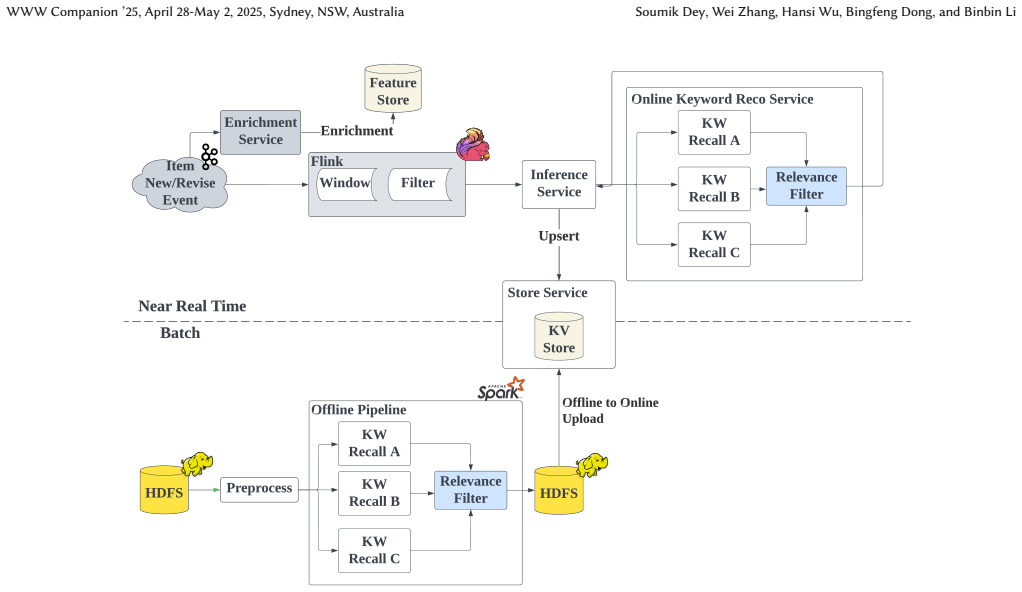
- A two-layer cross-encoder can deliver this alignment at production scale: 1.5 hours for the daily differential batch and near-real-time serving for new or revised items.
- Aligning Advertising with Search improves marketplace outcomes: in the reported A/B test, bought items rose 26.04 percent and impressions 20.17 percent while the number of keyphrases shown to sellers fell 7 percent.
- Cross-encoders, even very small ones, are the better model family for this agreement task, beating all bi-encoder training objectives on offline F1.
Reading between the lines
- The same gate-label alignment should transfer to any marketplace where an intermediate filter truncates logged outcomes before training; a direct test would compare gate-label-trained filters with click-trained filters on held-out human judgments.
- The paper's note that the new model restored short head keyphrases suggests a testable mechanism for the bought-item gain: releasing single-token keyphrases penalized by Jaccard may drive most of the improvement, so the benefit could be concentrated in head terms rather than spread across the tail.
- Since Search's relevance filter is itself a learned system, alignment labels will drift as Search updates; a rolling agreement metric between Advertising and Search would tell when the 24-million-pair training set needs refreshing.
- Independent human relevance judgments could separate two readings of the result: alignment with Search improves true relevance, or it merely conforms Advertising to a filter that Search itself should correct.
Signed reviews
Editorial analysis
A structured set of objections, weighed in public.
Referee Report
Summary. This industrial paper, authored by eBay researchers, introduces the notion of 'middleman bias' in advertiser keyphrase relevance: because the auction process allegedly logs only keyphrases that pass eBay Search's relevance filter, click/sales-based training data lack examples of Search-irrelevant keyphrases, and models trained on such data inherit a sample-selection bias. To mitigate this, the authors curate 24 million/3 million item-keyphrase pairs labeled by Search's relevance judgment, train several bi-encoders and small cross-encoders, and select a bert-tiny cross-encoder based on offline F1 and inference latency. The deployed model is reported to increase impressions, clicks, bought items, and CVR by 20.17%, 13.01%, 26.04%, and 11.6%, respectively, over the Jaccard production baseline, while CTR remained neutral.
Significance. The paper's main contribution is a large-scale industrial case study connecting sample-selection bias in ad relevance training to the 'middleman' role of search, together with a deployed remedy. The online A/B test against the production Jaccard baseline is the strongest evidence: it is a behavior-based, independent signal with reported p-values, and it supports the practical value of the proposed model. The paper also offers a useful latency-versus-quality comparison of bi-encoders and tiny cross-encoders at production scale. However, the middleman-bias mechanism is asserted rather than verified with logs, the Search labels used for both training and evaluation are not described, and offline metrics are reported without uncertainty quantification; these gaps currently prevent the paper from fully supporting its conceptual framing and its stronger comparative claims.
major comments (5)
- [Section 1] The assertion that 'the auction mechanism also ensures that the click data logged will only contain keyphrases which pass Search's relevance filter' is load-bearing for the middleman-bias mechanism, but no log-based evidence is provided. If click logs contain item-keyphrase pairs that did not pass Search's filter, for instance through other ad surfaces, post-filter logging, or filter bypass, the stated sample-selection mechanism is inaccurate. Please report the overlap between logged click/impression pairs and Search's filter decisions, and describe any exceptions.
- [Section 3] The provenance of the 24 million/3 million Search relevance labels is not described. The paper does not state how Search's relevance judgment is generated, its error rate, or whether the training and evaluation labels come from the same source. Because the models are trained and evaluated on the same label source, the offline 'alignment' F1 partly measures fit to that oracle rather than alignment with an independently validated notion of relevance. Please describe the label-generation process, quality-control measures, and add an independent evaluation set such as a human-judged sample or temporally held-out Search judgments.
- [Section 4, Table 1] Precision, recall, and F1 depend on a decision threshold, but the threshold used for each neural model is not given. Without this, the model comparison in Table 1 is under-specified. In addition, the F1 differences among bert-mini (0.81), bert-tiny (0.80), and the contrastive bi-encoder (0.79) are small, and the text calls one of these a 'significant margin' without confidence intervals or significance tests. Please report the threshold-selection procedure and provide bootstrap confidence intervals or significance tests for the offline metrics.
- [Section 3, IRNS data curation] The click-based IRNS dataset is curated with fixed thresholds of at least 30 impressions and a CTR lower bound of 0.05. These choices are presented without justification or sensitivity analysis. Because these thresholds determine which item-keyphrase pairs enter the in-batch negatives, they can materially affect the trained model. Please provide a sensitivity analysis or empirical justification for these cutoffs, and note whether the results are stable across reasonable variations.
- [Section 4, online A/B test] The online A/B test description is incomplete: there is no traffic split, duration, number of items/sellers, or specification of the statistical test used for the reported p-values. The text states that the model 'delivered on all fronts' while also reporting that CTR was neutral (p=0.17); please reconcile this wording and provide the A/B setup and metric definitions so that the headline claims can be properly interpreted.
minor comments (7)
- [Section 3] The phrase 'with a lower lower bound of 0.05 CTR' contains a typo; it should be 'with a lower bound of 0.05 CTR'.
- [Section 4] The text says 'the bi-encoders of IRNS and Constrative'; 'Constrative' should be 'Contrastive'.
- [Figure 2 caption] The caption contains the typo 'kephrases'; it should be 'keyphrases'.
- [Table 1] The note 'Darker colors represent more favorable scores' is not meaningful in a plain-text table; either add actual visual highlighting or remove the note.
- [Table 1] The column header 'Diff Full' is ambiguous; please make it explicit, for example 'Diff / Full latency (hours)', and state the benchmark configuration in the caption or a footnote.
- [Section 3] The sentence claiming the data 'guarantees proper representation of all categories while still maintaining preferential bias of models towards high performing categories' is self-contradictory; please rephrase to state the intended trade-off.
- [Section 4] Please define the online metrics exactly (e.g., CVR = bought items / clicks) and specify the statistical tests used to obtain the p-values, as the current description is insufficient for reproducibility.
Circularity Check
No significant circularity: the core evaluation is a supervised held-out task and the headline result is an online A/B test against a production baseline.
full rationale
The paper's central claim, that training keyphrase relevance on Search's pass/fail judgments aligns Advertising with Search, is supported by evidence that does not reduce to its inputs. Offline, models are trained on 24 million labeled item-keyphrase pairs and evaluated on a separate 3 million pair held-out set from the same label source; this is standard supervised classification, not a fitted prediction, because the evaluation set is not used in training and the F1 scores measure genuine generalization to unseen pairs. Online, the chosen bert-tiny model is A/B tested against the Jaccard production baseline, with statistically significant increases in impressions, clicks, bought items, and CVR; this behavior-based comparison is independent of the training labels and provides external grounding. The 'middleman bias' concept is explicitly framed as a form of sample selection bias with citations to prior work [7,18], and the auction-mechanism premise, while asserted rather than empirically verified, is an empirical assumption about eBay's system rather than a circular step. Self-citations [12,13,21] are used only to support minor design choices, such as including category information and citing MNAR biases, and they appear alongside independent references; no load-bearing argument in the paper reduces to a self-citation. The offline 'alignment with Search' metric is exactly the same label source used for training, but this is a supervised learning setup, not a tautology: the held-out F1 scores are genuine predictions of Search's judgments, and the paper's strongest claim rests on the online A/B test, which is not derived from the training labels. Therefore, no circular derivation chain is present.
Assumptions & free parameters
free parameters (3)
- IRNS data curation thresholds =
CTR > 0.05; minimum 30 impressions
- Training hyperparameters =
learning rate 2e-5; 4 epochs; batch sizes 384, 10240, 40960
- Jaccard production threshold =
not reported
assumptions (5)
- domain assumption Search relevance judgment is the correct ground truth for advertiser keyphrase relevance.
- domain assumption Click and sales signals are unreliable for negative relevance due to missing-not-at-random and position bias.
- domain assumption The auction mechanism guarantees that logged click data contains only keyphrases that pass Search's relevance filter.
- domain assumption Item title and category name are sufficient inputs for predicting keyphrase relevance.
- domain assumption The 24M/3M stratified sample is representative of the production item-keyphrase distribution.
Cite this review
Pith. "Pith review of Middleman Bias in Advertising: Aligning Relevance of Keyphrase Recommendations with Search." pith.science (2026). https://pith.science/paper/TDJF4ADN
@misc{pith2026250200131,
  author       = {Pith},
  title        = {Pith review of: Middleman Bias in Advertising: Aligning Relevance of Keyphrase Recommendations with Search},
  year         = {2026},
  howpublished = {\url{https://pith.science/paper/TDJF4ADN}},
  note         = {Machine review of arXiv:2502.00131}
}
read the original abstract
E-commerce sellers are recommended keyphrases based on their inventory on which they advertise to increase buyer engagement (clicks/sales). Keyphrases must be pertinent to items; otherwise, it can result in seller dissatisfaction and poor targeting -- towards that end relevance filters are employed. In this work, we describe the shortcomings of training relevance filter models on biased click/sales signals. We re-conceptualize advertiser keyphrase relevance as interaction between two dynamical systems -- Advertising which produces the keyphrases and Search which acts as a middleman to reach buyers. We discuss the bias of search relevance systems (middleman bias) and the need to align advertiser keyphrases with search relevance signals. We also compare the performance of cross encoders and bi-encoders in modeling this alignment and the scalability of such a solution for sellers at eBay.
Figures


Reference graph
Works this paper leans on
-
[1]
Prajjwal Bhargava, Aleksandr Drozd, and Anna Rogers. 2021. Generalization in NLI: Ways (Not) To Go Beyond Simple Heuristics. arXiv:2110.01518 [cs.CL]
arXiv 2021
-
[2]
Jiawei Chen, Hande Dong, Xiang Wang, Fuli Feng, Meng Wang, and Xiangnan He
-
[3]
Leonard Dahlmann and Tomer Lancewicki. 2021. Deploying a BERT-based Query- Title Relevance Classifier in a Production System: a View from the Trenches. arXiv:2108.10197 [cs.CL] https://arxiv.org/abs/2108.10197
work page Pith review arXiv 2021
-
[4]
Deepjavalibrary. [n. d.]. Deepjavalibrary/djl: An engine-agnostic deep learning framework in Java. https://github.com/deepjavalibrary/djl
-
[5]
ONNX Runtime developers. 2021. ONNX Runtime. https://onnxruntime.ai/. Version: 1.20.1
work page 2021
-
[6]
eBay Advertising. 2025. Promoted Listings Priority. https://www.ebayadvertising. com/en/ad-solutions/ad-types/promoted-listings-priority/
work page 2025
-
[7]
Jingyue Gao, Shuguang Han, Han Zhu, Siran Yang, Yuning Jiang, Jian Xu, and Bo Zheng. 2023. Rec4Ad: A Free Lunch to Mitigate Sample Selection Bias for Ads CTR Prediction in Taobao. In Proceedings of the 32nd ACM International Conference on Information and Knowledge Management (Birmingham, United Kingdom) (CIKM ’23). Association for Computing Machinery, New...
-
[8]
R. Hadsell, S. Chopra, and Y. LeCun. 2006. Dimensionality Reduction by Learning an Invariant Mapping. In 2006 IEEE Computer Society Conference on Computer Vision and Pattern Recognition (CVPR’06) , Vol. 2. 1735–1742. doi:10.1109/CVPR. 2006.100
doi:10.1109/cvpr 2006
Show all 22 references
-
[9]
Jin Huang, Harrie Oosterhuis, Maarten de Rijke, and Herke van Hoof. 2020. Keep- ing Dataset Biases out of the Simulation: A Debiased Simulator for Reinforcement Learning based Recommender Systems. InProceedings of the 14th ACM Conference on Recommender Systems (Virtual Event, ...
2020
- [10]
-
[11]
Paul Jaccard. 1901. Étude comparative de la distribution florale dans une portion des Alpes et des Jura. Bull Soc Vaudoise Sci Nat 37 (1901), 547–579
1901
-
[12]
Ashirbad Mishra, Soumik Dey, Marshall Wu, Jinyu Zhao, He Yu, Kaichen Ni, Binbin Li, and Kamesh Madduri. 2024. GraphEx: A Graph-based Extraction Method for Advertiser Keyphrase Recommendation. arXiv:2409.03140 [cs.IR] https://arxiv.org/abs/2409.03140
2024 arXiv
-
[13]
Ashirbad Mishra, Soumik Dey, Jinyu Zhao, Hansi Wu, Binbin Li, and Kamesh Madduri. 2024. Graphite: A Graph-based Extreme Multi-Label Short Text Classi- fier for Keyphrase Recommendation. In 27th European Conference on Artificial Intelligence, 19–24 October 2024, Santiago de Com...
2024
-
[14]
Jiarui Qin, Jiachen Zhu, Bo Chen, Zhirong Liu, Weiwen Liu, Ruiming Tang, Rui Zhang, Yong Yu, and Weinan Zhang. 2022. RankFlow: Joint Optimization of Multi- Stage Cascade Ranking Systems as Flows. In Proceedings of the 45th International ACM SIGIR Conference on Research and Dev...
2022
-
[15]
Nils Reimers and Iryna Gurevych. 2019. Sentence-BERT: Sentence Embeddings using Siamese BERT-Networks. InProceedings of the 2019 Conference on Empirical Methods in Natural Language Processing and the 9th International Joint Confer- ence on Natural Language Processing (EMNLP-IJ...
2019 doi
-
[16]
Nils Reimers and Iryna Gurevych. 2020. Making Monolingual Sentence Em- beddings Multilingual using Knowledge Distillation. In Proceedings of the 2020 Conference on Empirical Methods in Natural Language Processing (EMNLP), Bonnie Webber, Trevor Cohn, Yulan He, and Yang Liu (Eds...
2020 doi
-
[17]
Iulia Turc, Ming-Wei Chang, Kenton Lee, and Kristina Toutanova. 2019. Well- Read Students Learn Better: The Impact of Student Initialization on Knowledge Distillation. CoRR abs/1908.08962 (2019). arXiv:1908.08962 http://arxiv.org/abs/ 1908.08962
2019 arXiv
-
[18]
Francis Vella. 1998. Estimating Models with Sample Selection Bias: A Survey. The Journal of Human Resources 33, 1 (1998), 127–169. http://www.jstor.org/ stable/146317
1998
-
[19]
Thomas Wolf, Lysandre Debut, Victor Sanh, Julien Chaumond, Clement Delangue, Anthony Moi, Pierric Cistac, Tim Rault, Rémi Louf, Morgan Funtowicz, Joe Davison, Sam Shleifer, Patrick von Platen, Clara Ma, Yacine Jernite, Julien Plu, Canwen Xu, Teven Le Scao, Sylvain Gugger, Mari...
2020
-
[20]
Xin, Patrick Wendell, Tathagata Das, Michael Armbrust, Ankur Dave, Xiangrui Meng, Josh Rosen, Shivaram Venkataraman, Michael J
Matei Zaharia, Reynold S. Xin, Patrick Wendell, Tathagata Das, Michael Armbrust, Ankur Dave, Xiangrui Meng, Josh Rosen, Shivaram Venkataraman, Michael J. Franklin, Ali Ghodsi, Joseph Gonzalez, Scott Shenker, and Ion Stoica. 2016. Apache Spark: a unified engine for big data pro...
2016 doi
-
[21]
Ranran Haoran Zhang, Bensu Uçar, Soumik Dey, Hansi Wu, Binbin Li, and Rui Zhang. 2025. From Lazy to Prolific: Tackling Missing Labels in Open Vocabulary Extreme Classification by Positive-Unlabeled Sequence Learning. arXiv:2408.08981 [cs.IR] https://arxiv.org/abs/2408.08981
2025 arXiv
-
[2023]
ACM Trans
Bias and Debias in Recommender System: A Survey and Future Directions. ACM Trans. Inf. Syst. 41, 3, Article 67 (Feb. 2023), 39 pages. doi:10.1145/3564284
2023 doi
Reviewed August 9, 2026 · model on record in the stance chip above.
Discussion (0). Continue with ORCID to comment.