REVIEW 3 major objections 4 minor 93 references
Predissociation dynamics of charged long-range Rydberg molecules
T0 review · 3 major / 4 minor · reviewed 2026-08-16 · deepseek-v4-flash
Pith's one-line read Predissociation of a Rydberg-atom–ion molecule follows Stückelberg interference, with lifetimes of Rb*Li+ spanning 0.15 to 166 microseconds.
desk verdict A genuinely new calculation of predissociation in Rb*Li+ Rydberg atom-ion molecules with microsecond lifetimes and clear Stückelberg-interference structure; the main caveat is that the two-channel reduction of the 'almost dark' coupling is asserted rather than directly validated, and the unresolved Rb*Rb+ discrepancy with Ref. [32] means the quantitative lifetimes should be treated with care. read the letter →
The pith
A machine-rendered reading of the paper's core claim, the machinery that carries it, and where it could break.
The reading
What carries the argument
The key object is the Landau-Zener-Stückelberg (LZS) semiclassical two-channel model. The paper eliminates the "almost dark" third channel by interpolating the two strongly coupled adiabatic curves into a single effective lower potential $U_2$, leaving one bound channel $U_1$ and one dissociation continuum. The entire argument rides on the identity $\Gamma = 2 [P_{\mathrm{LZ}}/(1-P_{\mathrm{LZ}})] \sin^2\theta / Z'$, with $P_{\mathrm{LZ}} = \exp(-2\pi\delta)$, $\delta$ the Landau-Zener parameter, $Z'$ the energy derivative of the adiabatic phase, and $\theta$ the phase difference between the two classical pathways; when $\theta = m\pi$ the decay vanishes. This identity converts an intricate three-channel quantum scattering problem into a phase-condition problem on a single scalar $\theta$.
What would settle it
Measure the predissociation lifetime of a selected vibrational level of 87Rb*7Li+ (e.g., n=40, ν=6) using time-resolved ion detection; if the lifetime does not fall near the predicted 0.2–0.3 µs, or if adjacent vibrational levels do not show the predicted order-of-magnitude variation, the interference model (or the underlying coupling) is wrong.
Extended reading notes
Core claim
The paper's central claim is that predissociation of long-range Rydberg atom-ion molecules is governed by Stückelberg interference, not simply by the local Landau-Zener probability. In a two-channel picture (one bound channel and one dissociation continuum), the decay width is $\Gamma = 2 [P_{\mathrm{LZ}}/(1-P_{\mathrm{LZ}})] \sin^2\theta / Z'$, where $\theta$ is half the phase difference between an adiabatic and a diabatic scattering pathway; when $\theta$ is a multiple of $\pi$ the two pathways interfere destructively and the molecule becomes long-lived. This mechanism explains the rapid and periodic dependence of lifetimes on $n$ and $\nu$, the diagonal streaks of enhanced lifetimes in the $(n,\nu)$ plane, and the sign-reversing Fano $q$-parameter. The paper computes quantum lifetimes with the eigenchannel $R$-matrix method for $n = 32$–$65$ and finds that the lighter molecule $^{87}\mathrm{Rb}^*\,^{7}\mathrm{Li}^+$ is short-lived enough ($0.15$–$166\,\mu\mathrm{s}$) to be studied experimentally, while $^{87}\mathrm{Rb}^*\,^{87}\mathrm{Rb}^+$ remains stable with lifetimes above $10^{-3}\,\mathrm{s}$.
Load-bearing premise
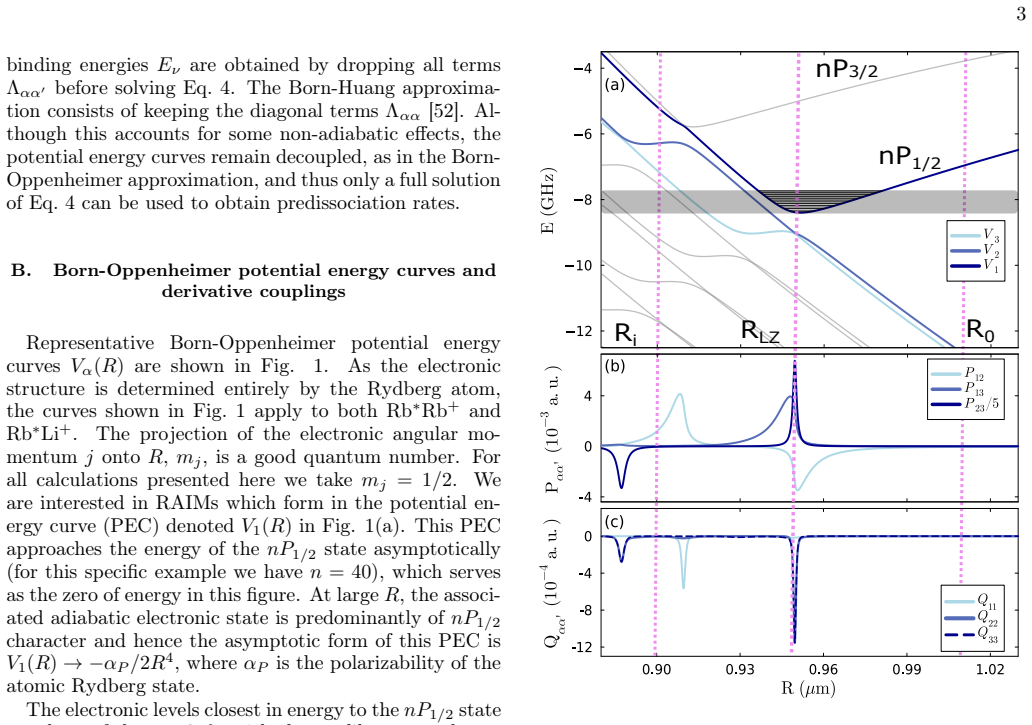
The effective two-channel model replaces the narrow avoided crossing between the V2 and V3 curves by a diabatic interpolation and fits the residual coupling to a Lorentzian, and the predicted lifetimes are extremely sensitive to that coupling: a 1% change in its peak value shifts Rb*Rb+ lifetimes by three orders of magnitude.
Editorial extensions
If this is right
- Experiments should see strong state-to-state lifetime variation in Rb*Li+, allowing a direct test of the $\theta = m\pi$ suppression.
- Predissociation must be included in models of Rb*Li+ formation and loss in hybrid traps, since it can be faster than radiative decay.
- Photo-predissociation spectra should show Fano lineshapes with $q$ reversing sign between adjacent levels, a spectroscopic fingerprint of the interference.
- If the mass scaling is right, intermediate-mass ions or heavier Rydberg species allow tuning the decay rate continuously over orders of magnitude.
Reading between the lines
- The same LZS phase argument could be used to predict predissociation in other mass-imbalanced Rydberg atom-ion pairs, not just the two isotopes considered here.
- The sensitivity of lifetimes to the $P_{23}$ coupling suggests that ab initio electronic structure at the avoided crossing must be accurate to better than 1% for quantitative predictions.
- The diagonal lifetime streaks in the $(n,\nu)$ plane may serve as a precision probe of the potential curve shape, since they map contours of constant $\theta$.
- Because the decay is predicted to follow a Fano profile with a $q$ that reverses, a pump-probe experiment could extract the phase $\theta$ directly from the line shape.
Signed reviews
Editorial analysis
A structured set of objections, weighed in public.
Referee Report
Summary. The paper studies predissociation of long-range Rydberg atom–ion molecules, specifically homonuclear 87Rb*87Rb+ and heteronuclear 87Rb*7Li+. It combines an eigenchannel R-matrix treatment of the coupled radial Schrödinger equation with a Landau-Zener-Stückelberg semiclassical analysis, and it reports that the heteronuclear system has predissociation lifetimes in the range 0.15–166 microseconds, varying strongly and periodically with principal quantum number n and vibrational quantum number ν. The variation is attributed to Stückelberg interference between adiabatic and diabatic decay pathways, which suppresses decay when the phase difference θ is an integer multiple of π. The semiclassical and quantum methods agree well for Rb*Li+ in the cases shown, while for Rb*Rb+ there is a factor-of-10-to-100 discrepancy with Ref. [32] that the authors state they cannot explain.
Significance. If the quantitative predictions hold, the paper is significant because it identifies a mechanism—Stückelberg interference—that can tune predissociation rates in long-range Rydberg molecules over several orders of magnitude, and it identifies a system, Rb*Li+, in which predissociation can compete with radiative and collisional decay and therefore be studied in situ. The semiclassical derivation is transparent, the closed-form expression for the width, Eq. (33), is useful and falsifiable, and the broad (n,ν) lifetime maps in Figs. 4–9 provide concrete predictions for experiment. The paper is also honest about its limitations, including the unresolved disagreement with Ref. [32] and the extreme sensitivity of the Rb*Rb+ lifetimes to a 1% change in the P23 coupling.
major comments (3)
- [Sec. IIC] The manuscript states that the converged three-channel results are reproduced well by the quasi-adiabatic two-channel model, but no such comparison is shown. Since the eigenchannel R-matrix calculation in Sec. IID and the semiclassical analysis in Sec. IIE both use the two-channel model exclusively, the agreement between the two methods in Figs. 3, 5, 6, 8, and 9 validates the semiclassical machinery but does not validate the two-channel reduction itself. Please provide a direct comparison of three-channel versus two-channel resonance widths or lifetimes for representative (n,ν) values, including the region around the narrow avoided crossing, and report numerical convergence with respect to the grid used for the near-singular P23 coupling.
- [Secs. IIC and IV] The reported sensitivity—a 1% change in the peak of P23 changes Rb*Rb+ lifetimes by three orders of magnitude—is a load-bearing concern for the quantitative claims. No sensitivity test is provided for Rb*Li+, yet the central result is the specific 0.15–166 microsecond lifetime range for that system. Please add a sensitivity analysis for Rb*Li+ in which the peak and width of the fitted Lorentzian coupling are varied by a few percent, and report the resulting spread in the lifetimes. This would address the possibility that the quoted absolute rates are controlled by the interpolation of an almost-dark coupling rather than by the physical dynamics.
- [Sec. IV, Fig. 7] The one-to-two-orders-of-magnitude disagreement with Ref. [32] for the homonuclear lifetimes, which the authors state they cannot explain, is not resolved. Because the same two-channel reduction and underlying PECs are used for both molecules, this discrepancy raises a correctness risk for the absolute Rb*Li+ rates as well, even though the heteronuclear rates are less sensitive by construction. Please provide a concrete diagnostic: either a detailed comparison of the PECs, derivative couplings, resonance positions, and numerical parameters with those of Ref. [32], or a direct three-channel versus two-channel convergence study for Rb*Rb+ that identifies the source of the factor-of-10-to-100 discrepancy. Without this, the absolute lifetimes cannot be regarded as quantitatively reliable.
minor comments (4)
- [Sec. V, Eq. (41)] The mass-scaling law and the predicted turnover at n*≈80 are obtained from separately fitted power-law exponents and amplitudes, but the text gives no fit residuals, fit ranges, or uncertainties for the parameters A, B, and b. Please state the fit quality or explicitly label Eq. (41) as a qualitative scaling estimate rather than a quantitative prediction.
- [Sec. III] The text contains several typographical errors, including 'St¨ ckelberg' in the paragraph after Fig. 4, 'inteference' in Sec. IIF, and 'parellel' in Sec. VI; these should be corrected.
- [Sec. IV] The statement that a full dataset is available in Ref. [92] is not sufficient because Ref. [92] is a submitted PhD thesis; please make the dataset available in a stable, findable repository or as supplementary material.
- [Figs. 5 and 6] The claim that semiclassical accuracy improves with increasing ν would be easier to evaluate if the figures reported a quantitative measure of quantum–semiclassical agreement, such as the typical fractional difference between the two lifetime sets, rather than relying only on visual inspection.
Circularity Check
No significant circularity: the predicted lifetimes are outputs of the coupled-channel and LZS equations, not re-labeled fit parameters; self-citations are not load-bearing.
full rationale
The central numerical lifetimes (Fig. 4) are obtained by solving the coupled-channel Schrödinger equation with the eigenchannel R-matrix method and extracting Wigner-Smith time delays; the LZS expressions (Eqs. 23, 33) are derived independently from the same potentials via standard scattering theory. Neither the effective two-channel P-matrix Lorentzian fit nor the mass-scaling power laws (Eq. 41) is adjusted to reproduce the target lifetimes; the former is fit to electronic-structure coupling wings, and the latter is presented transparently as a fit of scaling exponents for Δ, P12, v, and ΔE. The quantum/semiclassical agreement is an internal consistency check, not a circular validation. The paper's self-citations (e.g., Refs. [27], [31], [54]-[56], [92]) concern contextual statements and data availability, not the load-bearing derivation. The main weakness is that the claimed three-channel validation of the quasi-adiabatic two-channel reduction is not shown, and the admitted 1% sensitivity of P23 affects the quantitative reliability of the Rb*Rb+ lifetimes; however, this is an unverified-approximation/correctness risk, not a circularity, since the reduction is not defined in terms of the predicted lifetimes and the target lifetimes are not fitted inputs.
Assumptions & free parameters
free parameters (7)
- Exponent for Delta scaling =
-4.1
- Exponent for P12(RLZ) scaling =
-2
- Exponent for velocity scaling =
-1/7
- Exponent for vibrational frequency scaling =
-4
- Amplitude A =
~0.25
- Amplitude B =
~0.25
- Exponent b =
~0.4
assumptions (6)
- domain assumption The multipole expansion (Eq. 1), truncated at L=6, fully describes the Rydberg electron-ion interaction for R beyond the LeRoy radius.
- domain assumption The ion is structureless at molecular length scales, so electronic PECs are identical for Rb*Li+ and Rb*Rb+; only the reduced mass changes.
- ad hoc to paper The three-channel dynamics including the almost singular P23 coupling are reproduced by the quasi-adiabatic two-channel model with interpolated V2 and V3 and a Lorentzian fit to the residual coupling.
- standard math WKB connection formulas and the Landau-Zener-Stückelberg transfer matrix govern the radial wave function at the avoided crossing.
- domain assumption Resonance parameters are extracted by fitting a Lorentzian to the largest Wigner-Smith time-delay eigenvalue, which assumes exponential decay.
- domain assumption Zero total angular momentum (N=0) and mj=1/2 are sufficient, because rotational splitting is negligible at micron-scale bond lengths.
Cite this review
Pith. "Pith review of Predissociation dynamics of charged long-range Rydberg molecules." pith.science (2026). https://pith.science/paper/TDQXGTZF
@misc{pith2026260812716,
  author       = {Pith},
  title        = {Pith review of: Predissociation dynamics of charged long-range Rydberg molecules},
  year         = {2026},
  howpublished = {\url{https://pith.science/paper/TDQXGTZF}},
  note         = {Machine review of arXiv:2608.12716}
}
abstract
We investigate predissociation in homonuclear ($^{87}$Rb$^*$$^{87}$Rb$^+$) and heteronuclear ($^{87}$Rb$^*$$^{7}$Li$^+$) long-range Rydberg atom-ion molecules. Owing to their micron-scale bond lengths, these dissociate on time scales far removed from those of more tightly bound diatomic molecules. We employ the eigenchannel $R$-matrix method to compute predissociation rates for a broad range of principal quantum numbers $n$. The rates depend strongly on the mass, but more remarkably display a rapid and periodic variation as a function of $n$ as well as within a single vibrational ladder. A semiclassical Landau-Zener-St\"uckelberg analysis reveals that St\"uckelberg interference governs the decay process and produces the observed variation in the molecular lifetime. Although the heavy mass of the homonuclear Rb molecule constrains its predissociation rates to a sub-kHz level, the lighter molecule $^{87}$Rb$^*$$^{7}$Li$^+$ dissociates on time scales competitive with radiative and collisional decay. This can enable in situ study of non-adiabatic decay via ion microscopy.
Figures


Figures from the paper (7 more)


Reference graph
Works this paper leans on
-
[32]
A. Duspayev and G. Raithel, Nonadiabatic decay of Rydberg-atom–ion molecules, Physical Review A105, 012810 (2022)
work page 2022
-
[1]
Domcke, D
W. Domcke, D. R. Yarkony, and H. Köppel,Conical In- tersections: Electronic Structure, Dynamics and Spec- troscopy(World Scientific, 2004)
2004
-
[2]
M. S. Schuurman, W. Domcke, D. R. Yarkony, and H. Köppel,Conical Intersections: Theory, Computation and Experiment(World Scientific, 2011)
2011
-
[3]
Scheid, S
S. Scheid, S. Goswami, H.-D. Meyer, and H. Köppel, Fully quantal treatment of nonadiabatic molecular photo- dynamics: General considerations and application to the benzene cation, Comput. Theor. Chem.1150, 38 (2019)
2019
-
[4]
R. J. Donovan, A. Kirrander, and K. P. Lawley, Heavy Rydberg and ion-pair states: chemistry, spectroscopy and theory, Int. Rev. Phys. Chem.41, 97 (2022)
2022
-
[5]
Kirrander, Communication: Heavy Rydberg states: The H+H− system, J
A. Kirrander, Communication: Heavy Rydberg states: The H+H− system, J. Chem. Phys.133, 121103 (2010)
2010
-
[6]
Kirrander and C
A. Kirrander and C. Jungen, Molecular ion-pair states in ungerade H2, Phys. Rev. A84, 052512 (2011)
2011
-
[7]
Reinhold and W
E. Reinhold and W. Ubachs, Heavy Rydberg states, Mol. Phys.103, 1329 (2005)
2005
Show all 93 references
-
[8]
Kokouline, O
V. Kokouline, O. Dulieu, R. Kosloff, and F. Masnou- Seeuws, Theoretical treatment of channel mixing in ex- cited Rb2 and Cs2 ultracold molecules: Determination of predissociation lifetimes with coordinate mapping, Phys- ical Review A62, 032716 (2000)
2000
-
[9]
B. H. McGuyer, M. McDonald, G. Z. Iwata, M. G. Tarallo, W. Skomorowski, R. Moszynski, and T. Zelevin- sky, Precise study of asymptotic physics with subradiant ultracold molecules, Nature Physics11, 32 (2015)
2015
-
[10]
C. Chin, R. Grimm, P. Julienne, and E. Tiesinga, Fesh- bach resonances in ultracold gases, Reviews of Modern Physics82, 1225 (2010)
2010
-
[11]
C. H. Greene, A. S. Dickinson, and H. R. Sadeghpour, Creation of polar and nonpolar ultralong-range Rydberg molecules, Physical Review Letters85, 2458 (2000)
2000
-
[12]
Boisseau, I
C. Boisseau, I. Simbotin, and R. Côté, Macrodimers: Ul- tralong range Rydberg molecules, Physical Review Let- ters88, 133004 (2002)
2002
-
[13]
M. Deiß, S. Haze, and J. H. Denschlag, Long-range atom– ion Rydberg molecule: A novel molecular binding mech- anism, Atoms9, 34 (2021)
2021
-
[14]
Duspayev, X
A. Duspayev, X. Han, M. A. Viray, L. Ma, J. Zhao, and G. Raithel, Long-range Rydberg-atom–ion molecules of Rb and Cs, Physical Review Research3, 023114 (2021)
2021
-
[15]
M. T. Eiles, Trilobites, butterflies, and other exotic spec- imens of long-range Rydberg molecules, J. Phys. B: At. Mol. Opt. Phys.52, 113001 (2019)
2019
-
[16]
F. B. Dunning, S. K. Kanungo, and S. Yoshida, Ultralong- range Rydberg molecules, Journal of Physics B: Atomic, Molecular and Optical Physics57, 212002 (2024)
2024
-
[17]
J. P. Shaffer, S. T. Rittenhouse, and H. R. Sadeghpour, Ultracold Rydberg molecules, Nature Communications9, 1965 (2018)
2018
-
[18]
Deiglmayr, Long-range interactions between Rydberg atoms, Phys
J. Deiglmayr, Long-range interactions between Rydberg atoms, Phys. Scr.91, 104007 (2016)
2016
-
[19]
Saßmannshausen and J
H. Saßmannshausen and J. Deiglmayr, Observation of Rydberg-atom macrodimers: Micrometer-sized diatomic molecules, Physical Review Letters117, 083401 (2016)
2016
-
[20]
Hollerith and J
S. Hollerith and J. Zeiher, Rydberg macrodimers: Di- atomic molecules on the micrometer scale, The Journal of Physical Chemistry A127, 3865 (2023)
2023
-
[21]
Weber, C
S. Weber, C. Tresp, H. Menke, A. Urvoy, O. Firstenberg, H. P. Büchler, and S. Hofferberth, Calculation of Ryd- berg interaction potentials, Journal of Physics B: Atomic, Molecular and Optical Physics50, 133001 (2017)
2017
-
[22]
Baer,Beyond Born–Oppenheimer: Conical Intersec- tions and Electronic Nonadiabatic Coupling Terms(John Wiley & Sons, Hoboken, NJ, 2006)
M. Baer,Beyond Born–Oppenheimer: Conical Intersec- tions and Electronic Nonadiabatic Coupling Terms(John Wiley & Sons, Hoboken, NJ, 2006)
2006
-
[23]
D. R. Yarkony, Diabolical conical intersections, Reviews of Modern Physics68, 985 (1996)
1996
-
[24]
Bixon and J
M. Bixon and J. Jortner, Intramolecular radiationless transitions, The Journal of Chemical Physics48, 715 (1968)
1968
-
[25]
T. F. Gallagher,Rydberg Atoms(Cambridge University Press, Cambridge, 1994). 19
1994
-
[26]
C. E. Theodosiou, Lifetimes of alkali-metal-atom Rydberg states, Physical Review A30, 2881 (1984)
1984
-
[27]
A. A. T. Durst, M. Simić, N. Abraham, and M. T. Eiles, Nonadiabatic couplings as a stabilization mechanism in long-range Rydberg molecules, Physical Review A111, 032811 (2025)
2025
-
[28]
Srikumar, F
R. Srikumar, F. Hummel, and P. Schmelcher, Nonadia- batic interaction effects in the spectra of ultralong-range Rydberg molecules, Phys. Rev. A108, 012809 (2023)
2023
-
[29]
Mellado-Alcedo, A
D. Mellado-Alcedo, A. Guttridge, S. L. Cornish, H. R. Sadeghpour, and R. González-Férez, Ultralong-range Cs- RbCs Rydberg molecules: Nonadiabaticity of dipole mo- ments, Phys. Rev. A110, 013314 (2024)
2024
-
[30]
Schwettmann, K
A. Schwettmann, K. R. Overstreet, J. Tallant, and J. P. Shaffer, Analysis of long-range Cs Rydberg potential wells, J. Mod. Opt.54, 2551 (2007)
2007
-
[31]
D. J. Bosworth, M. T. Eiles, and P. Schmelcher, Metastable doubly charged Rydberg trimers, Physical Re- view Research6, 043164 (2024)
2024
-
[33]
M.S.Child,Curve-crossingandtheWKBapproximation, Molecular Physics20, 171 (1971)
1971
-
[34]
M. S. Child, Semiclassical theory of tunneling and curve- crossing problems: A diagrammatic approach, Journal of Molecular Spectroscopy53, 280 (1974)
1974
-
[35]
M. S. Child, Predissociation and photodissociation of IBr: A case of intermediate coupling strength, Molecu- lar Physics32, 1495 (1976)
1976
-
[36]
Knöckel, E
H. Knöckel, E. Tiemann, and D. Zoglowek, Line broaden- ing by predissociation in the spectrum of IBr, Journal of Molecular Spectroscopy85, 225 (1981)
1981
-
[37]
H. R. Sadeghpour, Channel interaction in alkali-halide photodissociation: Interferometric lineshapes and dy- namic switching, Int. J. Quantum Chem.80, 958 (2000)
2000
-
[38]
Balakrishnan, B
N. Balakrishnan, B. D. Esry, H. R. Sadeghpour, S. T. Cornett, and M. J. Cavagnero, Quantum wave-packet dy- namics of the photodissociation of LiF, Phys. Rev. A60 (1999)
1999
-
[39]
S. T. Cornett, H. R. Sadeghpour, and M. J. Cavagnero, Interferometric line shape modulation in alkali-halide photoabsorption, Phys. Rev. Lett.82(1999)
1999
-
[40]
Engel, H
V. Engel, H. Metiu, R. Almeida, R. A. Marcus, and A. H. Zewail, Molecular state evolution after excitation with an ultra-short laser pulse: A quantum analysis of NaI and NaBr dissociation, Chem. Phys. Lett.152, 1 (1988)
1988
-
[41]
S. E. Choi and J. C. Light, Use of the dis- crete variable representation in the quantum dynam- ics by a wave packet propagation: Predissociation of NaI(1σ+)→NaI(0+)→Na(2s)+I(2p), J. Chem. Phys.90, 2593 (1989)
1989
-
[42]
Mizuno and K
Y. Mizuno and K. Fukushima, Power-law decay in the nonadiabatic photodissociation dynamics of alkali halides due to quantum wavepacket interference, The Journal of Chemical Physics149, 174313 (2018)
2018
-
[43]
E. M. Liane, M. Simmermacher, and A. Kirrander, Ultra- fast x-ray scattering and electronic coherence at avoided crossings: Complete isotropic signals, Journal of Physics B: Atomic, Molecular and Optical Physics57, 145602 (2024)
2024
-
[44]
P. Cong, G. Roberts, J. L. Herek, A. Mokhtari, and A. H. Zewail, Femtosecond real-time probing of reactions. 18. experimental and theoretical mapping of trajectories and potentialsintheNaIdissociationreaction,J.Phys.Chem. 100, 7832 (1996)
1996
-
[45]
M. S. de Vries, N. J. A. van Veen, M. Hutchinson, and A. E. de Vries, Curve crossing and repulsive potentials probed by laser induced half collisions: ICl and IBr, Chemical Physics51, 159 (1980)
1980
-
[46]
Y.-Q. Zou, M. Berngruber, V. S. V. Anasuri, N. Zuber, F. Meinert, R. Löw, and T. Pfau, Observation of vibra- tional dynamics of oriented Rydberg-atom-ion molecules, Physical Review Letters130, 023002 (2023)
2023
-
[47]
Berngruber, D
M. Berngruber, D. J. Bosworth, O. A. Herrera-Sancho, V. S. V. Anasuri, N. Zuber, F. Hummel, J. Krauter, F. Meinert, R. Löw, P. Schmelcher, and T. Pfau, In situ observation of nonpolar to strongly polar atom-ion collision dynamics, Physical Review Letters133, 083001 (2024)
2024
-
[48]
Zuber, V
N. Zuber, V. S. V. Anasuri, M. Berngruber, Y.-Q. Zou, F. Meinert, R. Löw, and T. Pfau, Observation of a molec- ular bond between ions and Rydberg atoms, Nature605, 453 (2022)
2022
-
[49]
R. J. Le Roy, Long-range potential coefficients from rkr turning points:C 6 andC 8 forB( 3π+ 0u )-state Cl2, Br2, and I2, Canadian Journal of Physics52, 246 (1974)
1974
-
[50]
J. D. Jackson,Classical Electrodynamics, 3rd ed. (John Wiley & Sons, 1998)
1998
-
[51]
Born and R
M. Born and R. Oppenheimer, Zur quantentheorie der molekeln, Annalen der Physik389, 457 (1927)
1927
-
[52]
Born and K
M. Born and K. Huang,Dynamical Theory of Crystal Lat- tices(Oxford University Press, Oxford, 1954)
1954
-
[53]
C. W. Clark, The calculation of non-adiabatic transition probabilities, Physics Letters A70, 295 (1979)
1979
-
[54]
Srikumar, M
R. Srikumar, M. Exner, R. Blättner, P. Schmelcher, M. T. Eiles, and H. Ott, Vibrationally highly excited trilobite molecules stabilized by nonadiabatic coupling, Phys. Rev. Res.7, 043103 (2025)
2025
-
[55]
Exner, R
M. Exner, R. Srikumar, R. Blättner, P. Schmelcher, H. R. Sadeghpour, M. T. Eiles, and H. Ott, Observation of spin- singletbutterflyRydbergmoleculesinanultracoldatomic Rb gas, Phys. Rev. Lett.136, 243002 (2026)
2026
-
[56]
Guttridge, T
A. Guttridge, T. R. Hepworth, D. K. Ruttley, A. A. T. Durst, M. T. Eiles, and S. L. Cornish, Individual assembly of two-species Rydberg molecules using optical tweezers, Phys. Rev. Lett.134, 133401 (2025)
2025
-
[57]
Aymar, C
M. Aymar, C. H. Greene, and E. Luc-Koenig, Multichan- nel Rydberg spectroscopy of complex atoms, Reviews of Modern Physics68, 1015 (1996)
1996
-
[58]
A.M.LaneandR.G.Thomas,R-matrixtheoryofnuclear reactions, Reviews of Modern Physics30, 257 (1958)
1958
-
[59]
P. G. Burke,R-Matrix Theory of Atomic Collisions: Ap- plication to Atomic, Molecular and Optical Processes, 20 Springer Series on Atomic, Optical, and Plasma Physics, Vol. 61 (Springer-Verlag, Berlin, Heidelberg, 2011)
2011
-
[60]
Wang,Hyperspherical Approach to Quantal Three-body Theory, Ph.D
J. Wang,Hyperspherical Approach to Quantal Three-body Theory, Ph.D. thesis, University of Colorado (2012)
2012
-
[61]
J. P. B. Jr.,Theoretical Investigation of Cold Alkali Atom Collisions, Ph.D. thesis, University of Colorado (1999)
1999
-
[62]
G. N. Watson,A Treatise on the Theory of Bessel Func- tions(Cambridge University Press, Cambridge, 1922)
1922
-
[63]
E. P. Wigner, Lower limit for the energy derivative of the scattering phase shift, Physical Review98, 145 (1955)
1955
-
[64]
F. T. Smith, Lifetime matrix in collision theory, Physical Review118, 349 (1960)
1960
-
[65]
L. D. Landau, On the theory of transfer of energy at col- lisions ii, Physikalische Zeitschrift der Sowjetunion2, 46 (1932)
1932
-
[66]
Zener, Non-adiabatic crossing of energy levels, Pro- ceedings of the Royal Society of London A137, 696 (1932)
C. Zener, Non-adiabatic crossing of energy levels, Pro- ceedings of the Royal Society of London A137, 696 (1932)
1932
-
[67]
E. C. G. Stückelberg, Theorie der unelastischen Stösse zwischen Atomen, Helvetica Physica Acta5, 369 (1932)
1932
-
[68]
M. S. Child,Molecular Collision Theory, Theoretical Chemistry: A Series of Monographs (Academic Press, London, 1974)
1974
-
[69]
Zhu and H
C. Zhu and H. Nakamura, Usefulness of the newly com- pleted semiclassical theory of curve crossing: Multi- channel resonant scattering, Chemical Physics Letters 274, 205 (1997)
1997
-
[70]
Zhu and H
C. Zhu and H. Nakamura, Semiclassical theory of multi- channelcurvecrossingproblems: Landau–Zenercase,The Journal of Chemical Physics106, 2599 (1997)
1997
-
[71]
C. Zhu, H. Nakamura, N. Re, and V. Aquilanti, The two- state linear curve crossing problems revisited. I. Analysis of Stokes phenomenon and expressions for scattering ma- trices, The Journal of Chemical Physics97, 1892 (1992)
1992
-
[72]
Zhu and H
C. Zhu and H. Nakamura, The two-state linear curve crossing problems revisited. II. Analytical approxima- tions for the Stokes constant and scattering matrix: The Landau–Zener case, The Journal of Chemical Physics97, 8497 (1992)
1992
-
[73]
Nakamura,Nonadiabatic Transition: Concepts, Basic Theories and Applications(World Scientific, Singapore, 2002)
H. Nakamura,Nonadiabatic Transition: Concepts, Basic Theories and Applications(World Scientific, Singapore, 2002)
2002
-
[74]
Giannakeas and C
P. Giannakeas and C. H. Greene, Asymmetric lineshapes of efimov resonances in mass-imbalanced ultracold gases, Atoms8, 89 (2020)
2020
-
[75]
M. S. Child,Semiclassical Mechanics with Molecular Ap- plications, 2nd ed. (Oxford University Press, Oxford, 2014)
2014
-
[76]
L. D. Landau and E. M. Lifshitz,Quantum Mechanics: Non-Relativistic Theory, 3rd ed. (Pergamon Press, 1977)
1977
-
[77]
H. R. Sadeghpour, C. H. Greene, and M. Cavagnero, Ex- tensive eigenchannel R-matrix study of the H− photode- tachment spectrum, Physical Review A45, 1587 (1992)
1992
-
[78]
Giannakeas and C
P. Giannakeas and C. H. Greene, Ultracold heteronuclear three-body systems: How diabaticity limits the universal- ity of recombination into shallow dimers, Physical Review Letters120, 023401 (2018)
2018
-
[79]
Fano, Effects of configuration interaction on intensities and phase shifts, Physical Review124, 1866 (1961)
U. Fano, Effects of configuration interaction on intensities and phase shifts, Physical Review124, 1866 (1961)
1961
-
[80]
Feshbach, A unified theory of nuclear reactions, Annals of Physics19, 287 (1962)
H. Feshbach, A unified theory of nuclear reactions, Annals of Physics19, 287 (1962)
1962
-
[81]
complex resonances
is given by [57] σ= 4π2αω 3 X α=2 |dα|2,(34) whereαappearing in the prefactor is the fine structure constant and should not be confused with the channel in- dex.ωis the photon frequency. Here,d α are the dipole matrix elements corresponding to dissociation into the αth channel...
-
[82]
Thiscouldbetheelectronic ground-stateforadirecttran- sition to an electronicp-state, or a transition from an in- termediate state to the weaks- andd-state admixture in the molecular configuration as was done in Ref. [48]. The initial state of the nuclei is a low-energy scatter...
-
[83]
Connerade and A
J.-P. Connerade and A. M. Lane, Interacting resonances in atomic spectroscopy, Reports on Progress in Physics 51, 1439 (1988)
1988
-
[84]
J. P. Connerade and A. M. Lane,qreversals in a Rydberg series caused by an interloper level, Journal of Physics B: Atomic and Molecular Physics20, 1757 (1987)
1987
-
[85]
Mizuno and K
Y. Mizuno and K. Hukushima, Power-law decay in the nonadiabatic photodissociation dynamics of alkali halides due to quantum wavepacket interference, The Journal of Chemical Physics149(2018)
2018
-
[86]
[32] can be found in [92]
A full dataset to compare with the results of Ref. [32] can be found in [92]
-
[87]
Berngruber, D
M. Berngruber, D. J. Bosworth, O. A. Herrera-Sancho, V. S. V. Anasuri, N. Zuber, F. Hummel, J. Krauter, F. Meinert, R. Löw, P. Schmelcher, and T. Pfau, In situ observation of nonpolar to strongly polar atom-ion colli- sion dynamics, Phys. Rev. Lett.133, 083001 (2024)
2024
-
[88]
Génévriez, M
M. Génévriez, M. Jungers, C. Rosen, and U. Eichmann, Series of molecularlike doubly excited states of a quasi- three-body coulomb system, Phys. Rev. Lett.135, 153002 (2025)
2025
-
[89]
S. K. Tiwari, T. Karman, and V. Walther, Low-energy purification of crystal defects by Rydberg excitons, arXiv preprint arXiv:2604.27331 (2026)
2026 arXiv
-
[90]
M. V. Berry, Semi-classical scattering phase shifts in the presence of metastable states, Proceedings of the Physical Society88, 285 (1966)
1966
-
[91]
Zhu and H
C. Zhu and H. Nakamura, Theory of Nonadiabatic Tran- sition for General Two-State Curve Crossing Problems. II. Landau–Zener Case, The Journal of Chemical Physics 102, 7448 (1995)
1995
-
[92]
J. J. Sakurai and J. Napolitano,Modern Quantum Me- chanics, 2nd ed. (Addison-Wesley, Boston, 2011)
2011
-
[93]
Abraham,Non-adiabatic Predissociation of Ultralong- Range Rydberg Atom-Ion Molecules, Ph.D
N. Abraham,Non-adiabatic Predissociation of Ultralong- Range Rydberg Atom-Ion Molecules, Ph.D. thesis, Max Planck Institute for the Physics of Complex Systems (2026), Ph.D. thesis, submitted
2026
Reviewed August 16, 2026 · model on record in the stance chip above.
Discussion (0). Continue with ORCID to comment.