PowerAgentBench-SS: A Benchmark for Agentic AI in Power System Steady-State Studies
Pith reviewed 2026-06-26 19:52 UTC · model grok-4.3
The pith
A benchmark framework for power system agents requires evaluating full workflows including validation use and evidence reporting rather than just final answers.
A machine-rendered reading of the paper's core claim, the machinery that carries it, and where it could break.
Core claim
The benchmark defines an agent interface, tool contract, evidence log, and metrics such as submitted recall, evidence-backed recall, false-safe penalties, severity regret, residual violation score, action cost, and tool-use efficiency. When applied to the DC thermal N-2 contingency-search pilot, these elements show that agents are separated by validation-budget consumption, explicit submission behavior, type coercions, duplicate validations, evidence-backed reporting, and mitigation actions, demonstrating that solver-only or answer-only evaluation cannot capture the required capabilities.
What carries the argument
The agent interface together with the tool contract, evidence log, and risk-sensitive metrics that let a hidden evaluator score workflow execution instead of isolated results.
If this is right
- Agents must be scored on validation-budget efficiency and duplicate avoidance in addition to contingency discovery.
- Explicit submission and evidence-backed reporting become necessary components of any passing agent report.
- Mitigation proposals can be directly compared across agents using the residual violation and action cost metrics.
- Type-coercion errors and unvalidated actions receive explicit penalties that change final rankings.
Where Pith is reading between the lines
- The same interface could be reused for AC or stochastic contingency studies without changing the core scoring logic.
- Metrics focused on evidence trails may reduce the need for human review of agent outputs in operational settings.
- Agents that learn to minimize false-safe penalties on this benchmark could transfer to other safety-critical engineering domains.
Load-bearing premise
The defined interface, tool rules, evidence requirements, and metrics from the DC thermal N-2 pilot on deterministic IEEE 39-bus cases capture the abilities needed for actual power system operation and planning.
What would settle it
Running the identical agents on an AC power-flow version of the same benchmark and obtaining no correlation between their DC and AC scores would show that the pilot does not capture essential capabilities.
Figures
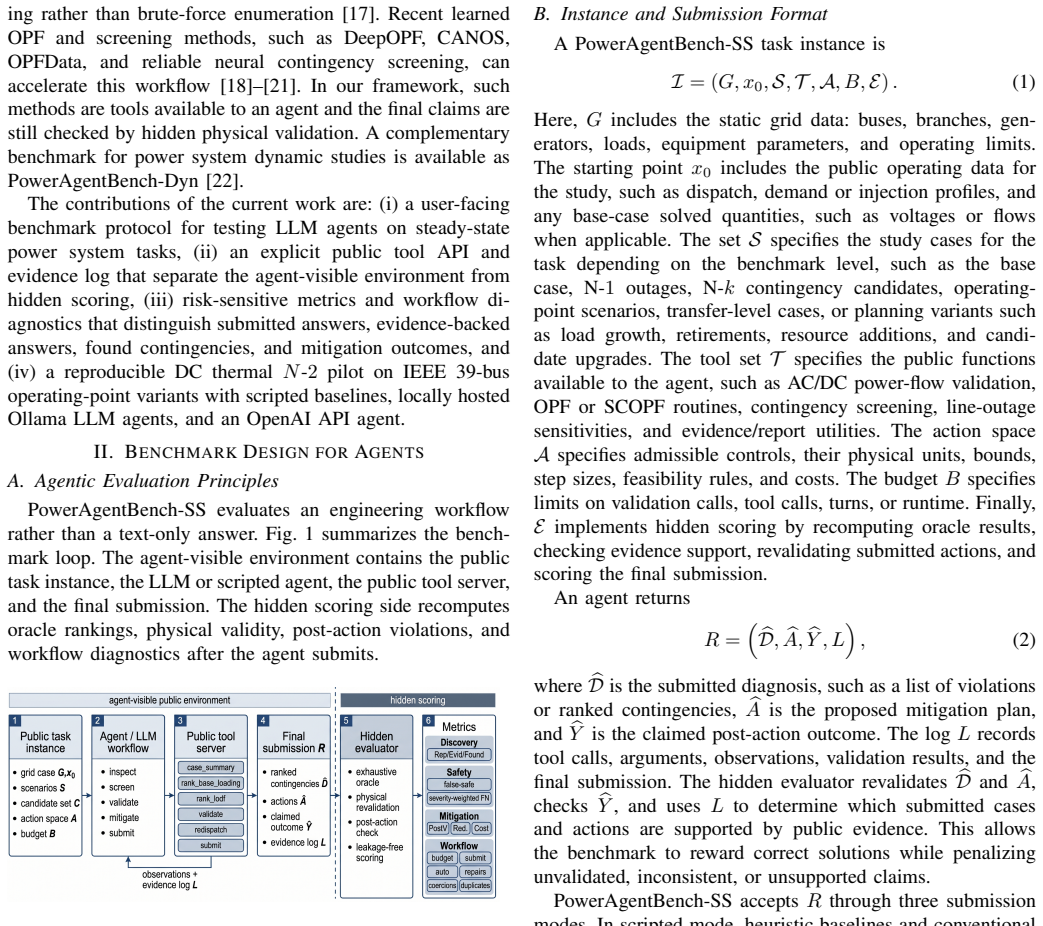
read the original abstract
Power system benchmarks usually evaluate numerical solvers, prediction models, or sequential controllers. These benchmarks are necessary, but they do not directly test whether a Large Language Model (LLM) agent can execute an engineering workflow: inspect a grid case, select tools, call simulators, screen contingencies, propose admissible mitigations, validate results, and produce an auditable evidence trail. This paper introduces PowerAgentBench-SS, a steady-state benchmark framework for evaluating tool-using agents in power system operation and planning studies. The benchmark exposes public case data, action constraints, a tool API, and a validation budget to an agent, while a hidden evaluator recomputes physical validity and scores the submitted report. We define the agent interface, tool contract, evidence log, and risk-sensitive metrics, including submitted recall, evidence-backed recall, found recall, false-safe penalties, severity regret, residual violation score, action cost, tool-use efficiency, and workflow diagnostics. To make the framework concrete, we instantiate the protocol in a reproducible DC thermal N-2 contingency-search pilot on deterministic IEEE 39-bus operating-point variants, with scripted baselines, an LLM JSON-command adapter, three locally hosted Ollama LLM agents, and one OpenAI API agent. The results show why solver-only or answer-only evaluation is insufficient: agents are distinguished not only by top-contingency discovery, but also by validation-budget use, explicit submission, type coercions, duplicate validations, evidence-backed reporting, and mitigation behavior.
Editorial analysis
A structured set of objections, weighed in public.
Referee Report
Summary. The paper introduces PowerAgentBench-SS, a benchmark framework for evaluating tool-using LLM agents on power system steady-state studies. It defines an agent interface, tool contract, evidence log, and risk-sensitive metrics (submitted recall, evidence-backed recall, false-safe penalties, severity regret, residual violation score, action cost, tool-use efficiency, workflow diagnostics). The framework is instantiated via a reproducible DC thermal N-2 contingency-search pilot on deterministic IEEE 39-bus operating-point variants, with scripted baselines, an LLM JSON adapter, three Ollama agents, and one OpenAI agent. The results are presented as showing that solver-only or answer-only evaluation is insufficient because agents differ on validation-budget use, explicit submission, type coercions, duplicate validations, evidence-backed reporting, and mitigation behavior.
Significance. If the metrics and distinctions hold under broader conditions, the framework would provide a valuable, process-oriented complement to existing solver and model benchmarks in power systems, with credit due for the explicit evidence-log requirement, risk-sensitive scoring, and the reproducible pilot setup that includes multiple agent types and baselines.
major comments (1)
- [Pilot instantiation] Pilot instantiation (abstract and associated results section): the central claim that the defined metrics demonstrate the insufficiency of solver-only or answer-only evaluation rests on distinctions observed in the DC thermal N-2 pilot. However, this pilot is restricted to deterministic DC power flow, thermal limits only, fixed small network, and N-2 search on operating-point variants; real steady-state studies routinely require AC models (voltage, reactive power, losses), load/generation uncertainty, larger systems, and multi-type contingencies. Without evidence that the reported distinctions (validation-budget use, duplicate validations, mitigation behavior) persist or are driven by these real-workflow demands rather than the deterministic DC setup, the load-bearing claim that the benchmark framework meaningfully captures required capabilities is at risk.
minor comments (1)
- [Abstract] Abstract: the statement that 'the results show' the listed distinctions is made without any quantitative values, tables, or error bars from the pilot agents, which reduces the reader's ability to assess the magnitude or statistical support for the claimed differences.
Simulated Author's Rebuttal
We thank the referee for the constructive feedback and for recognizing the potential value of the framework. We address the single major comment below.
read point-by-point responses
-
Referee: [Pilot instantiation] Pilot instantiation (abstract and associated results section): the central claim that the defined metrics demonstrate the insufficiency of solver-only or answer-only evaluation rests on distinctions observed in the DC thermal N-2 pilot. However, this pilot is restricted to deterministic DC power flow, thermal limits only, fixed small network, and N-2 search on operating-point variants; real steady-state studies routinely require AC models (voltage, reactive power, losses), load/generation uncertainty, larger systems, and multi-type contingencies. Without evidence that the reported distinctions (validation-budget use, duplicate validations, mitigation behavior) persist or are driven by these real-workflow demands rather than the deterministic DC setup, the load-bearing claim that the benchmark framework meaningfully captures required capabilities is at risk.
Authors: We agree that the pilot instantiation is deliberately restricted to a deterministic DC thermal N-2 search on IEEE 39-bus variants and does not yet include AC power flow, uncertainty, larger networks, or multi-type contingencies. The central claim is that the defined metrics (submitted recall, evidence-backed recall, false-safe penalties, etc.) distinguish agent behaviors—such as validation-budget allocation, duplicate tool calls, explicit submission, and mitigation reporting—that are invisible to answer-only or solver-only evaluation. These distinctions were observed even in the simplified deterministic setting. The framework (agent interface, tool contract, evidence log, and risk-sensitive scoring) is intentionally model- and contingency-agnostic; the DC pilot serves only as a reproducible, low-overhead proof-of-concept. We cannot, within the scope of the current manuscript, provide empirical evidence that the same distinctions appear under AC or stochastic conditions. We will revise the abstract, introduction, and discussion sections to (i) explicitly label the pilot as a minimal viable instantiation, (ii) state the limitations of the current results, and (iii) outline planned extensions to AC models and uncertainty. This revision clarifies the scope of the load-bearing claim without overstating generalizability. revision: partial
Circularity Check
No circularity: benchmark definitions and empirical pilot results are independent
full rationale
The paper defines the agent interface, tool contract, evidence log, and risk-sensitive metrics (submitted recall, evidence-backed recall, false-safe penalties, etc.) as new constructs before any evaluation. It then instantiates the protocol on a fixed DC thermal N-2 pilot using deterministic IEEE 39-bus variants and reports observed differences in agent behavior (validation-budget use, duplicate validations, mitigation behavior) as direct outputs of running the defined protocol. These distinctions are empirical measurements, not quantities that reduce by construction to the inputs or to any fitted parameters. No self-citations, uniqueness theorems, or ansatzes are invoked as load-bearing steps. The framework is self-contained; the pilot simply exercises the independently specified rules.
Axiom & Free-Parameter Ledger
axioms (1)
- domain assumption DC thermal approximations and deterministic operating-point variants are sufficient to evaluate agent workflows in the N-2 contingency pilot.
invented entities (1)
-
PowerAgentBench-SS benchmark framework
no independent evidence
Reference graph
Works this paper leans on
-
[1]
Agentbench: Evaluating llms as agents,
X. Liu, H. Yu, H. Zhang, Y . Xu, X. Lei, H. Lai, Y . Gu, H. Ding, K. Men, K. Yanget al., “Agentbench: Evaluating llms as agents,” inInternational Conference on Learning Representations, vol. 2024, 2024, pp. 52 989– 53 046
2024
-
[2]
SWE-bench: Can language models resolve real-world github issues?
C. E. Jimenez, J. Yang, A. Wettig, S. Yao, K. Pei, O. Press, and K. Narasimhan, “SWE-bench: Can language models resolve real-world github issues?” 2023
2023
-
[3]
WebArena: A realistic web environment for building autonomous agents,
S. Zhou, F. F. Xu, H. Zhu, X. Zhou, R. Lo, A. Sridhar, X. Cheng, T. Ou, Y . Bisk, D. Fried, U. Alon, and G. Neubig, “WebArena: A realistic web environment for building autonomous agents,” 2023
2023
-
[4]
OSWorld: Benchmarking multimodal agents for open-ended tasks in real computer environments,
T. Xie, D. Zhang, J. Chen, X. Li, S. Zhao, R. Cao, T. J. Hua, Z. Cheng, D. Shin, F. Lei, Y . Liu, Y . Xu, S. Zhou, S. Savarese, C. Xiong, V . Zhong, and T. Yu, “OSWorld: Benchmarking multimodal agents for open-ended tasks in real computer environments,” 2024
2024
-
[5]
τ-bench: A benchmark for tool-agent-user interaction in real-world domains,
S. Yao, N. Shinn, P. Razavi, and K. Narasimhan, “τ-bench: A benchmark for tool-agent-user interaction in real-world domains,” 2024
2024
-
[6]
MLAgentBench: Evalu- ating language agents on machine learning experimentation,
Q. Huang, J. V ora, P. Liang, and J. Leskovec, “MLAgentBench: Evalu- ating language agents on machine learning experimentation,” 2023
2023
-
[7]
PowerAgent: A road map toward agentic intel- ligence in power systems: Foundation model, model context protocol, and workflow,
Q. Zhang and L. Xie, “PowerAgent: A road map toward agentic intel- ligence in power systems: Foundation model, model context protocol, and workflow,”IEEE Power and Energy Magazine, vol. 23, no. 5, pp. 93–101, 2025
2025
-
[8]
Exploring the capabilities and limitations of large language models in the electric energy sector,
S. Majumder, L. Dong, F. Doudi, Y . Cai, C. Tian, D. Kalathil, K. Ding, A. A. Thatte, N. Li, and L. Xie, “Exploring the capabilities and limitations of large language models in the electric energy sector,”Joule, vol. 8, no. 6, pp. 1544–1549, 2024
2024
-
[9]
X-gridagent: An llm-powered agentic ai system for assisting power grid analysis,
X. Chenet al., “X-gridagent: An llm-powered agentic ai system for assisting power grid analysis,”arXiv preprint arXiv:2512.20789, 2025
arXiv 2025
-
[10]
Grid copilot: A large language model (llm) based framework for transforming long-term planning analyses,
S. Chaturvedi, S. Jin, S. Abhyankar, T. Thurber, K. Oikonomou, and N. V oisin, “Grid copilot: A large language model (llm) based framework for transforming long-term planning analyses,” in2025 IEEE Power & Energy Society General Meeting (PESGM). IEEE, 2025, pp. 1–5
2025
-
[11]
The power grid library for benchmarking AC optimal power flow algorithms,
S. Babaeinejadsarookolaee, A. Birchfield, R. D. Christie, C. Coffrin, C. DeMarco, R. Diao, M. Ferris, S. Fliscounakis, S. Greene, R. Huang et al., “The power grid library for benchmarking AC optimal power flow algorithms,” 2019
2019
-
[12]
Recent developments in security-constrained AC optimal power flow: Overview of challenge 1 in the ARPA-E grid optimization competition,
I. Aravena, D. K. Molzahn, S. Zhang, C. G. Petra, F. E. Curtis, S. Tu, A. W ¨achter, E. Wei, E. Wong, A. Gholami, K. Sun, X. A. Sun, S. T. Elbert, J. T. Holzer, and A. Veeramany, “Recent developments in security-constrained AC optimal power flow: Overview of challenge 1 in the ARPA-E grid optimization competition,” 2022
2022
-
[13]
State-of-the- art, challenges, and future trends in security constrained optimal power flow,
F. Capitanescu, J. L. Martinez Ramos, P. Panciatici, D. Kirschen, A. Marano Marcolini, L. Platbrood, and L. Wehenkel, “State-of-the- art, challenges, and future trends in security constrained optimal power flow,”Electric Power Systems Research, vol. 81, no. 8, pp. 1731–1741, 2011
2011
-
[14]
The N-K problem in power grids: New models, formulations and numerical experiments,
D. Bienstock and A. Verma, “The N-K problem in power grids: New models, formulations and numerical experiments,” 2009
2009
-
[15]
Optimization strategies for the vulnerability analysis of the electric power grid,
A. Pinar, J. Meza, V . Donde, and B. Lesieutre, “Optimization strategies for the vulnerability analysis of the electric power grid,”SIAM Journal on Optimization, vol. 20, no. 4, pp. 1786–1810, 2010
2010
-
[16]
Severe multiple contingency screening in electric power systems,
V . Donde, V . Lopez, B. C. Lesieutre, A. Pinar, C. Yang, and J. Meza, “Severe multiple contingency screening in electric power systems,”IEEE Transactions on Power Systems, vol. 23, no. 2, pp. 406–417, 2008
2008
-
[17]
Fast and reliable screening of N-2 contingencies,
P. Kaplunovich and K. Turitsyn, “Fast and reliable screening of N-2 contingencies,”IEEE Transactions on Power Systems, vol. 31, no. 6, pp. 4243–4252, 2016
2016
-
[18]
DeepOPF: A deep neural network approach for security-constrained DC optimal power flow,
X. Pan, T. Zhao, M. Chen, and S. Zhang, “DeepOPF: A deep neural network approach for security-constrained DC optimal power flow,” 2019
2019
-
[19]
CANOS: A fast and scalable neural AC-OPF solver robust to N-1 perturbations,
L. Piloto, S. Liguori, S. Madjiheurem, M. Zgubic, S. Lovett, H. Tom- linson, S. Elster, C. Apps, and S. Witherspoon, “CANOS: A fast and scalable neural AC-OPF solver robust to N-1 perturbations,” 2024
2024
-
[20]
OPFData: Large-scale datasets for AC optimal power flow with topological perturbations,
S. Lovett, M. Zgubic, S. Liguori, S. Madjiheurem, H. Tomlinson, S. Elster, C. Apps, S. Witherspoon, and L. Piloto, “OPFData: Large-scale datasets for AC optimal power flow with topological perturbations,” 2024
2024
-
[21]
Fast and reliable N-k contingency screening with input-convex neural networks,
N. Christianson, W. Cui, S. Low, W. Yang, and B. Zhang, “Fast and reliable N-k contingency screening with input-convex neural networks,” 2024
2024
-
[22]
PowerAgentBench-Dyn: A benchmark for agentic ai in power system dynamic studies,
Q. Zhang, A. Pomarico, C. Mylonas, M. Foti, A. Berizzi, and L. Xie, “PowerAgentBench-Dyn: A benchmark for agentic ai in power system dynamic studies,”arXiv, 2026
2026
-
[23]
Structural vulnerability assessment of electric power grids,
Y . Koc ¸, M. Warnier, R. Kooij, and F. Brazier, “Structural vulnerability assessment of electric power grids,” inProceedings of the 11th IEEE International Conference on Networking, Sensing and Control. IEEE, 2014, pp. 386–391
2014
-
[24]
Generalized contingency analysis based on graph theory and line outage distribution factor,
M. R. Narimani, H. Huang, A. Umunnakwe, Z. Mao, A. Sahu, S. Zonouz, and K. Davis, “Generalized contingency analysis based on graph theory and line outage distribution factor,”IEEE Systems Journal, vol. 16, no. 1, pp. 626–636, 2021
2021
discussion (0)
Sign in with ORCID, Apple, or X to comment. Anyone can read and Pith papers without signing in.