REVIEW 4 major objections 8 minor 45 references
Knowledge-aware Diffusion-Enhanced Multimedia Recommendation
T0 review · 4 major / 8 minor · reviewed 2026-08-06 · deepseek-v4-flash
Pith's one-line read KDiffE reports the best Recall@20 and NDCG@20 on TikTok, Amazon-Baby, and Amazon-Sports by combining an attention-aware graph encoder with a user-guided diffusion model that regenerates and prunes item–entity relations.
desk verdict KDiffE is a plausible new combination of RWR+Jaccard attention and user-guided diffusion for KG contrastive views, but the SOTA claim is built on margins that could be seed noise. read the letter →
The pith
A machine-rendered reading of the paper's core claim, the machinery that carries it, and where it could break.
The reading
What carries the argument
The argument is carried by two mechanisms. First, the attention-aware matrix $S(u,v)$, defined as the Jaccard index between the sets of nodes sampled by a random walk with restart from user $u$ and from item $v$, is added to the adjacency matrix inside the normalized Laplacian $\bar{L}=D_{(u)}^{-1/2}(A+\xi S)D_{(v)}^{-1/2}$; this lets the graph embedding layer weight each neighbor by topological importance rather than averaging all interactions. Second, the guided diffusion model treats each item's binary relation vector $r_j$ to knowledge-graph entities as a continuous signal, adds Gaussian noise in the forward process, and reconstructs $\hat{x}_0$ in the reverse process with an MLP conditioned on the average embedding of the users adjacent to the item; the reconstructed relations are pruned to the top-$q$ relations per item (with $q=1$) to form the denoised knowledge graph used to build the contrastive view. The role of this second mechanism is to produce a knowledge-aware contrastive view with less noise than the original multimedia graph.
What would settle it
Replace KDiffE's generated knowledge graph with the original knowledge graph while keeping the attention-aware matrix and contrastive loss, and rerun the three benchmarks; if Recall@20 and NDCG@20 do not fall, the guided-diffusion enhancement is not what produces the reported gains.
Extended reading notes
Core claim
KDiffE builds two views. In the main view, a simplified graph embedding layer aggregates neighbor features with a normalized Laplacian $\bar{L}=D_{(u)}^{-1/2}(A+\xi S)D_{(v)}^{-1/2}$, where $S(u,v)$ is the Jaccard index of the node sets visited by a random walk with restart starting from user $u$ and item $v$; this weights user–item edges by topological importance without trainable attention parameters. In the contrastive view, a guided diffusion model corrupts binary item–entity relation vectors $r_j$ with Gaussian noise and reconstructs them with an MLP conditioned on $\tilde{z}_i$, the average embedding of the users connected to the item; reconstructed relations are pruned to the top-$q$ (with $q=1$) per item, and the resulting knowledge graph is aggregated into items to produce augmented embeddings. The two views are aligned with an InfoNCE loss, and a pairwise ranking loss supervises the main task. The paper reports that KDiffE achieves the best Recall@20 and NDCG@20 on all three datasets—for example, TikTok Recall@20 of 0.112 versus 0.109 for MGCL, Amazon-Baby 0.095/0.040 versus 0.091/0.039 for MHGCF, and Amazon-Sports 0.102/0.046 versus 0.100/0.044 for MGCL.
Load-bearing premise
The method assumes that the knowledge graph reconstructed by the diffusion model, with each item pared to its single strongest relation, is better for recommendation than the original multimedia graph—a point the paper checks only through final accuracy numbers, not by evaluating the generated graph itself.
Editorial extensions
If this is right
- Weighting graph aggregation by random-walk-with-restart Jaccard similarity gives a recommender an edge over uniform message passing without trainable attention parameters, reducing both computation and opacity.
- User-guided diffusion with top-$q$ pruning can turn a noisy multimedia knowledge graph into a cleaner contrastive view, so contrastive learning remains useful when item content is sparse or noisy.
- The optimal pruning level at $q=1$ implies that keeping only the single strongest reconstructed item–entity relation is enough to improve ranking, suggesting that the generated knowledge graph is deliberately sparse.
- The architecture's training cost scales roughly linearly with the number of users on Amazon-Sports, so the diffusion component does not make the model impractical for large graphs.
Reading between the lines
- Beyond the paper, the same user-guided diffusion module could be attached to any graph-based recommender without the attention-aware matrix; if it still lifts Recall@20, the denoised contrastive view is independently useful, a test the paper does not run.
- Because the generated knowledge graph is never evaluated directly, a natural next experiment is to measure how well the reconstructed top-$q$ relations match held-out item–entity pairs and whether that match predicts the downstream ranking gain.
- The reported gains are small in absolute terms (up to +0.004 Recall@20), so an extension worth probing is whether the margin persists under different random seeds and statistical significance tests, and whether a cheaper co-occurrence-based similarity could replace the random-walk Jaccard matrix with the same result.
Editorial analysis
A structured set of objections, weighed in public.
Referee Report
Summary. The paper proposes KDiffE, a multimedia recommendation model that combines an attention-aware user-item graph encoder with a guided diffusion model for generating a denoised knowledge-graph-based contrastive view. The attention-aware matrix is built from Jaccard similarities of random-walk-with-restart sampled neighborhoods and is inserted into the graph Laplacian, while the reverse diffusion process is conditioned on user embeddings to reconstruct item-entity relations, and top-q pruning is used to keep the most task-relevant relations. The model is trained with a BPR loss plus InfoNCE contrastive losses and evaluated on TikTok, Amazon-Baby, and Amazon-Sports, where Table II reports the best Recall@20/NDCG@20 among the considered baselines. The authors also provide ablation studies, hyperparameter analyses, denoising effectiveness experiments, and a scalability analysis, and they release source code.
Significance. If the empirical claims are reliable, KDiffE would be a useful contribution: the attention-aware matrix is a cheap and interpretable alternative to learned attention weights, and the idea of using a user-embedding-guided diffusion model to construct a knowledge-aware contrastive view is novel and potentially transferable beyond multimedia recommendation. The paper also includes a reasonably comprehensive set of baselines, an ablation study, and publicly available code, which are strengths. However, the central state-of-the-art claim currently rests on very small margins over the strongest baselines, with no variance information or significance testing, and several hyperparameters are selected by observing performance on the same benchmark splits used for the headline results. The significance of the work is therefore conditional on the additional analyses requested below.
major comments (4)
- [Section VI-B, Table II] The claim that KDiffE 'performs the best performance' on all three datasets is supported only by average Recall@20/NDCG@20 values over ten runs, and the margins over the strongest baselines are very small: on TikTok, 0.112 vs. 0.109 (Recall) and 0.046 vs. 0.044 (NDCG); on Amazon-Baby, 0.095 vs. 0.091 and 0.040 vs. 0.039; on Amazon-Sports, 0.102 vs. 0.100 and 0.046 vs. 0.044. Without standard deviations, confidence intervals, or paired significance tests, these differences could be within run-to-run variation. Please report per-seed results, standard deviations, and paired tests (e.g., paired t-test or Wilcoxon signed-rank test) for each metric against MGCL, MHGCF, and DiffKG, and avoid wording like 'significantly improved' unless a test supports it.
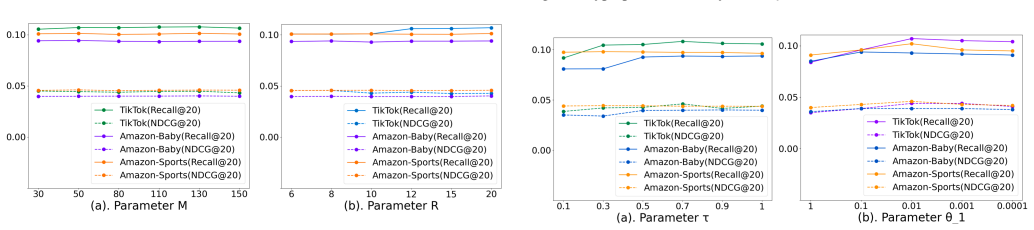
- [Section VI-D and VI-E] The hyperparameters q, M, R, ξ, t, τ, and θ1 are selected by observing Recall@20/NDCG@20 behavior in Figures 5-9, and these same benchmark splits are then used for the headline numbers in Table II. This is selection on the test set and can itself explain small margins. Please either use a held-out validation split for all hyperparameter choices, or report a nested/validation procedure and show that Table II results are not the result of test-set tuning. The paper should state explicitly which split was used for each choice.
- [Section V-B, Equations (8)-(12), and Section VI-D] A load-bearing assumption of the guided diffusion module is that reconstructing the binary item-entity relation vector r_j through continuous Gaussian diffusion, followed by top-q pruning, produces a knowledge graph whose remaining relations are more task-relevant than the original KG. The paper provides no direct evaluation of the generated knowledge graph, only downstream recommendation metrics. Please include direct measurements of generated-KG quality (e.g., precision/recall of reconstructed relations or overlap with held-out item-entity relations) and add an ablation that uses the original KG as the contrastive view without the diffusion process. This is necessary to attribute the reported gains to the diffusion component rather than to the attention-aware matrix alone, especially because the user embeddings used as guidance are trained jointly with the contrastive loss.
- [Section VI-C, Table III] The ablation study has inconsistencies and lacks variance information. The 'Ours' row in Table III differs from Table II on Amazon-Baby NDCG (0.041 vs. 0.040), and the text reports that on TikTok the NDCG of KDiffE is '0.5% higher' than KDiffE 1, while the table shows 0.046 vs. 0.041, an absolute difference of 0.005. Please clarify the percentage reporting, report standard deviations for the five runs, and ensure that the ablation numbers are consistent with the main table. These details matter because the ablation is the main evidence for the contribution of each component.
minor comments (8)
- [Section IV] Section IV appears as a bare 'IV.' with no title or content, and Section V then begins with 'METHODOLOGY'. The section numbering is broken and should be repaired.
- [Section V-C, Equation (13)] In the InfoNCE loss, the denominator is written as a sum over v ∈ U without explicitly excluding the positive user. If v = u is included, the positive pair appears both in the numerator and in the denominator; define the negative set explicitly (e.g., U \ {u}) and keep the positive term in the denominator only once.
- [Table I] The Amazon-Sports item count is written as '2,18,357'; this appears to be a typo for '218,357'. Please correct the formatting.
- [Section VI-E] The search range for τ is given as {0.1, 0.3, 0.5, 0.7, 0.9, 0.1}, with 0.1 duplicated and 1.0 likely intended; also, Section VI-A states that τ is searched from {0.5, 0.7}. Please reconcile these two statements.
- [Section VI-F] The text says 'the MHDiff model increases the computational cost' when it presumably means KDiffE; also, the complexity expression for MGCL, 'O((4|Y | ×L + 6 + 4(B + 1))ds|Y |/B)', needs better parentheses and a clear explanation of the constants.
- [Section II] The NCL baseline description contains a duplicated phrase: 'identifying neighboring nodes identifies neighboring nodes'. Please fix the wording.
- [References] Several reference strings contain typos: [33] has 'Multimediac' and [22] has 'Information Processing and ManagementC' with a trailing 'C'. Please proofread the bibliography.
- [Section V-B, Equation (11)] The notation 'zi' in Equation (11) should be 'z_i' to match the subscripted notation used elsewhere, and the formula should make explicit whether Avg denotes division by |N_j|.
Circularity Check
No significant circularity: KDiffE's central claims rest on held-out benchmark comparisons, and no load-bearing self-citation or definitional reduction is present.
full rationale
The paper's central claim is an empirical performance comparison on held-out interactions reported in Table II (Section VI-B), with KDiffE compared against baselines in Recall@20 and NDCG@20. These metrics are computed from predictions on user-item interactions, not from the model's own training targets or from the generated knowledge graph itself, so the claim does not reduce to an input by construction. The guided diffusion module (Eqs. 8-12) reconstructs the original item-entity relation vector and then selects top-q relations to form a contrastive view; this is a trainable augmentation component whose value is assessed only through downstream recommendation quality and ablations (Section VI-C), not by assuming the generated graph is superior. The use of user embeddings to guide the reverse process creates a joint training feedback loop, but it is not a definitional equivalence: the final recommendation scores are inner products of learned embeddings evaluated on held-out data, and the ablation removing the guidance (KDiffE 2) shows a measurable performance change. The paper contains no load-bearing self-citations; its references to prior diffusion, contrastive, and knowledge-graph methods are external prior work, and no uniqueness theorem or author-imported ansatz is used to force the architecture. Hyperparameters such as q, xi, and tau are tuned on benchmark splits, which is a test-set selection concern rather than circular reasoning. Overall, the derivation chain is self-contained as an empirical system: each component is defined from earlier components or external priors, and the stated results could in principle fail independently of those definitions.
Assumptions & free parameters
free parameters (7)
- xi (attention matrix weight) =
0.7
- q (top-q relations) =
1
- theta_1 (contrastive loss weight) =
1e-2
- theta_2 (weight decay) =
1e-5
- t (diffusion steps) =
10
- tau (temperature) =
unstated (searched 0.5-0.7)
- R and M (random walk paths and length) =
R=12, M=50
assumptions (4)
- ad hoc to paper Gaussian diffusion can be applied to binary item-entity relation vectors
- ad hoc to paper Jaccard similarity of random-walk-with-restart sampled neighbor sets measures user-item interaction importance
- ad hoc to paper User-embedding conditioning in the reverse diffusion improves task relevance of the generated KG
- domain assumption Standard DDPM training and ELBO maximization apply to the binary graph setting
Cite this review
Pith. "Pith review of Knowledge-aware Diffusion-Enhanced Multimedia Recommendation." pith.science (2026). https://pith.science/paper/TE73UZJK
@misc{pith2026250716396,
  author       = {Pith},
  title        = {Pith review of: Knowledge-aware Diffusion-Enhanced Multimedia Recommendation},
  year         = {2026},
  howpublished = {\url{https://pith.science/paper/TE73UZJK}},
  note         = {Machine review of arXiv:2507.16396}
}
read the original abstract
Multimedia recommendations aim to use rich multimedia content to enhance historical user-item interaction information, which can not only indicate the content relatedness among items but also reveal finer-grained preferences of users. In this paper, we propose a Knowledge-aware Diffusion-Enhanced architecture using contrastive learning paradigms (KDiffE) for multimedia recommendations. Specifically, we first utilize original user-item graphs to build an attention-aware matrix into graph neural networks, which can learn the importance between users and items for main view construction. The attention-aware matrix is constructed by adopting a random walk with a restart strategy, which can preserve the importance between users and items to generate aggregation of attention-aware node features. Then, we propose a guided diffusion model to generate strongly task-relevant knowledge graphs with less noise for constructing a knowledge-aware contrastive view, which utilizes user embeddings with an edge connected to an item to guide the generation of strongly task-relevant knowledge graphs for enhancing the item's semantic information. We perform comprehensive experiments on three multimedia datasets that reveal the effectiveness of our KDiffE and its components on various state-of-the-art methods. Our source codes are available https://github.com/1453216158/KDiffE.
Figures


Figures from the paper (4 more)



Reference graph
Works this paper leans on
-
[1]
End-to-end attention-based large vocabulary speech recognition
Dzmitry Bahdanau, Jan Chorowski, Dmitriy Serdyuk, Philemon Brakel, and Yoshua Bengio. End-to-end attention-based large vocabulary speech recognition. In Proceedings of the IEEE International Conference on 11 Acoustics, Speech and Signal Processing , pages 4945– 4949, 2016
work page 2016
-
[2]
Desheng Cai, Shengsheng Qian, Quan Fang, Jun Hu, and Changsheng Xu. Adaptive anti-bottleneck multi- modal graph learning network for personalized micro- video recommendation. In Proceedings of the 30th ACM International Conference on Multimedia, pages 581–590, 2022
work page 2022
-
[3]
Zhiyong Cheng, Xiaojun Chang, Lei Zhu, Rose Catherine Kanjirathinkal, and Mohan S. Kankanhalli. MMALFM: explainable recommendation by leveraging reviews and images. ACM Transactions on Information Systems , 37(2):16:1–16:28, 2019
work page 2019
-
[4]
Lightgcn: Simplifying and powering graph convolution network for recom- mendation
Xiangnan He, Kuan Deng, Xiang Wang, Yan Li, Yong- Dong Zhang, and Meng Wang. Lightgcn: Simplifying and powering graph convolution network for recom- mendation. In Proceedings of the 43rd International ACM SIGIR conference on research and development in Information Retrieval, pages 639–648, 2020
work page 2020
-
[5]
DiffMM: Multi-Modal Diffusion Model for Recommendation
Yangqin Jiang, Lianghao Xia, Wei Wei, Da Luo, Kangyi Lin, and Chao Huang. Diffmm: Multi-modal diffusion model for recommendation. CoRR, abs/2406.11781, 2024
work page Pith review arXiv 2024
-
[6]
Diffkg: Knowledge graph diffusion model for recommendation
Yangqin Jiang, Yuhao Yang, Lianghao Xia, and Chao Huang. Diffkg: Knowledge graph diffusion model for recommendation. In Proceedings of the 17th ACM Inter- national Conference on Web Search and Data Mining , pages 313–321, 2024
work page 2024
-
[7]
Yungi Kim, Taeri Kim, Won-Yong Shin, and Sang-Wook Kim. MONET: modality-embracing graph convolutional network and target-aware attention for multimedia rec- ommendation. In Proceedings of the 17th ACM Inter- national Conference on Web Search and Data Mining , pages 332–340, 2024
work page 2024
-
[8]
Spatial-temporal bi- partite graph attention network for traffic forecasting
Dimuthu Lakmal, Kushani Perera, Renata Borovica- Gajic, and Shanika Karunasekera. Spatial-temporal bi- partite graph attention network for traffic forecasting. In Proceedings of the 28th Pacific-Asia Conference on Knowledge Discovery and Data Mining , volume 14646, pages 68–80, 2024
work page 2024
Show all 45 references
-
[9]
Improving graph collaborative filtering with neighborhood-enriched contrastive learning
Zihan Lin, Changxin Tian, Yupeng Hou, and Wayne Xin Zhao. Improving graph collaborative filtering with neighborhood-enriched contrastive learning. In Proceed- ings of the 7th ACM Web Conference 2022 , pages 2320– 2329, 2022
2022
-
[10]
Yuille, Jonathan Huang, and Kevin Murphy
Chenxi Liu, Barret Zoph, Maxim Neumann, Jonathon Shlens, Wei Hua, Li-Jia Li, Li Fei-Fei, Alan L. Yuille, Jonathan Huang, and Kevin Murphy. Progressive neural architecture search. In Proceedings of the 15th European Conference on Computer Vision , volume 11205, pages 19–35, 2018
2018
-
[11]
Multimodal graph contrastive learning for multimedia-based recommendation
Kang Liu, Feng Xue, Dan Guo, Peijie Sun, Shengsheng Qian, and Richang Hong. Multimodal graph contrastive learning for multimedia-based recommendation. IEEE Transactions on Multimedia , 25:9343–9355, 2023
2023
-
[12]
MEGCF: multimodal entity graph collaborative filtering for personalized recommendation
Kang Liu, Feng Xue, Dan Guo, Le Wu, Shujie Li, and Richang Hong. MEGCF: multimodal entity graph collaborative filtering for personalized recommendation. ACM Transactions on Information Systems , 41(2):30:1– 30:27, 2023
2023
-
[13]
Multimodal hierarchical graph collab- orative filtering for multimedia-based recommendation
Kang Liu, Feng Xue, Shuaiyang Li, Sheng Sang, and Richang Hong. Multimodal hierarchical graph collab- orative filtering for multimedia-based recommendation. IEEE Transactions on Computational Social Systems , 11(1):216–227, 2024
2024
-
[14]
Diffusion augmentation for sequential recommendation
Qidong Liu, Fan Yan, Xiangyu Zhao, Zhaocheng Du, Huifeng Guo, Ruiming Tang, and Feng Tian. Diffusion augmentation for sequential recommendation. In Pro- ceedings of the 32td ACM International Conference on Information and Knowledge Management , pages 1576– 1586, 2023
2023
-
[15]
Multi-modal contrastive pre-training for recommendation
Zhuang Liu, Yunpu Ma, Matthias Schubert, Yuanxin Ouyang, and Zhang Xiong. Multi-modal contrastive pre-training for recommendation. In Proceedings of the International Conference on Multimedia Retrieval, pages 99–108, 2022
2022
-
[16]
Plug-in diffusion model for sequential recommendation
Haokai Ma, Ruobing Xie, Lei Meng, Xin Chen, Xu Zhang, Leyu Lin, and Zhanhui Kang. Plug-in diffusion model for sequential recommendation. In Proceedings of the 38th AAAI Conference on Artificial Intelligence, pages 8886–8894, 2024
2024
-
[17]
Weiqing Min, Shuqiang Jiang, and Ramesh C. Jain. Food recommendation: Framework, existing solutions, and challenges. IEEE Transactions on Multimedia , 22(10):2659–2671, 2020
2020
-
[18]
Jianmo Ni, Jiacheng Li, and Julian J. McAuley. Justi- fying recommendations using distantly-labeled reviews and fine-grained aspects. In Proceedings of the 9th International Joint Conference on Natural Language Processing, pages 188–197, 2019
2019
-
[19]
Invited talk: U-net convolutional networks for biomedical image segmentation
Olaf Ronneberger. Invited talk: U-net convolutional networks for biomedical image segmentation. In Pro- ceedings of the 2017 Bildverarbeitung f ¨ur die Medizin 2017 - Algorithmen - Systeme - Anwendungen , page 3, 2017
2017
-
[20]
Supervis- ing model attention with human explanations for robust natural language inference
Joe Stacey, Yonatan Belinkov, and Marek Rei. Supervis- ing model attention with human explanations for robust natural language inference. In Proceedings of the 36th AAAI Conference on Artificial Intelligence, pages 11349– 11357, 2022
2022
-
[21]
Self- supervised learning for multimedia recommendation
Zhulin Tao, Xiaohao Liu, Yewei Xia, Xiang Wang, Lifang Yang, Xianglin Huang, and Tat-Seng Chua. Self- supervised learning for multimedia recommendation. IEEE Transactions on Multimedia , 25:5107–5116, 2023
2023
-
[22]
MGAT: multimodal graph attention network for recommendation
Zhulin Tao, Yinwei Wei, Xiang Wang, Xiangnan He, Xianglin Huang, and Tat-Seng Chua. MGAT: multimodal graph attention network for recommendation. Informa- tion Processing and ManagementC, 57(5):102277, 2020
2020
-
[23]
Nation-wide touristic flow prediction with graph neural networks and heterogeneous open data
Fernando Terroso-S ´aenz, Francisco Arcas-T ´unez, and Andr´es Mu ˜noz. Nation-wide touristic flow prediction with graph neural networks and heterogeneous open data. Information Fusion, 91:582–597, 2023
2023
-
[24]
Rep- resentation learning with contrastive predictive coding
A ¨aron van den Oord, Yazhe Li, and Oriol Vinyals. Rep- resentation learning with contrastive predictive coding. CoRR, abs/1807.03748:1–13, 2018
2018 arXiv
-
[25]
Mul- 12 timodal entity linking with gated hierarchical fusion and contrastive training
Peng Wang, Jiangheng Wu, and Xiaohang Chen. Mul- 12 timodal entity linking with gated hierarchical fusion and contrastive training. In Proceedings of the 45th International ACM SIGIR Conference on Research and Development in Information Retrieval , pages 938–948, 2022
2022
-
[26]
Dualgnn: Dual graph neural network for multimedia recommendation
Qifan Wang, Yinwei Wei, Jianhua Yin, Jianlong Wu, Xuemeng Song, and Liqiang Nie. Dualgnn: Dual graph neural network for multimedia recommendation. IEEE Transactions on Multimedia , 25:1074–1084, 2023
2023
-
[27]
What your images reveal: Exploiting visual contents for point-of-interest recom- mendation
Suhang Wang, Yilin Wang, Jiliang Tang, Kai Shu, Suhas Ranganath, and Huan Liu. What your images reveal: Exploiting visual contents for point-of-interest recom- mendation. In Proceedings of the 26th International Conference on World Wide Web, pages 391–400, 2017
2017
-
[28]
KGAT: knowledge graph attention net- work for recommendation
Xiang Wang, Xiangnan He, Yixin Cao, Meng Liu, and Tat-Seng Chua. KGAT: knowledge graph attention net- work for recommendation. In Proceedings of the 25th ACM SIGKDD International Conference on Knowledge Discovery & Data Mining , pages 950–958, 2019
2019
-
[29]
Neural graph collaborative filtering
Xiang Wang, Xiangnan He, Meng Wang, Fuli Feng, and Tat-Seng Chua. Neural graph collaborative filtering. In Proceedings of the 42nd International ACM SIGIR Conference on Research and Development in Information Retrieval, pages 165–174, 2019
2019
-
[30]
Blaschko
Zifu Wang, Xuefei Ning, and Matthew B. Blaschko. Jaccard metric losses: Optimizing the jaccard index with soft labels. In Proceedings of the 36th Annual Conference on Advances in Neural Information Processing Systems , pages 1–15, 2023
2023
-
[31]
Hierarchical user intent graph network for multimedia recommendation
Yinwei Wei, Xiang Wang, Xiangnan He, Liqiang Nie, Yong Rui, and Tat-Seng Chua. Hierarchical user intent graph network for multimedia recommendation. IEEE Transactions on Multimedia , 24:2701–2712, 2022
2022
-
[32]
Contrastive learning for cold-start recommendation
Yinwei Wei, Xiang Wang, Qi Li, Liqiang Nie, Yan Li, Xuanping Li, and Tat-Seng Chua. Contrastive learning for cold-start recommendation. In Proceedings of the 30st ACM International Conference on Multimedia , pages 5382–5390, 2021
2021
-
[33]
Graph-refined convolutional network for multimedia recommendation with implicit feedback
Yinwei Wei, Xiang Wang, Liqiang Nie, Xiangnan He, and Tat-Seng Chua. Graph-refined convolutional network for multimedia recommendation with implicit feedback. In Proceedings of the 28th ACM International Confer- ence on Multimediac , pages 3541–3549, 2020
2020
-
[34]
MMGCN: multi- modal graph convolution network for personalized rec- ommendation of micro-video
Yinwei Wei, Xiang Wang, Liqiang Nie, Xiangnan He, Richang Hong, and Tat-Seng Chua. MMGCN: multi- modal graph convolution network for personalized rec- ommendation of micro-video. In Proceedings of the 27th ACM International Conference on Multimedia , pages 1437–1445, 2019
2019
-
[35]
Self-supervised graph learning for recommendation
Jiancan Wu, Xiang Wang, Fuli Feng, Xiangnan He, Liang Chen, Jianxun Lian, and Xing Xie. Self-supervised graph learning for recommendation. In Proceedings of the 44th International ACM SIGIR Conference on Research and Development in Information Retrieval , pages 726–735, 2021
2021
-
[36]
Diff4rec: Sequential rec- ommendation with curriculum-scheduled diffusion aug- mentation
Zihao Wu, Xin Wang, Hong Chen, Kaidong Li, Yi Han, Lifeng Sun, and Wenwu Zhu. Diff4rec: Sequential rec- ommendation with curriculum-scheduled diffusion aug- mentation. In Proceedings of the 31th ACM International Conference on Multimedia , pages 9329–9335, 2023
2023
-
[37]
Lianghao Xia, Chao Huang, Yong Xu, Jiashu Zhao, Dawei Yin, and Jimmy X. Huang. Hypergraph con- trastive collaborative filtering. In Proceedings of the 45th International ACM SIGIR Conference on Research and Development in Information Retrieval , pages 70–79, 2022
2022
-
[38]
Tian Xie, Chaoyang He, Xiang Ren, Cyrus Shahabi, and C.-C. Jay Kuo. L-BGNN: layerwise trained bipartite graph neural networks. IEEE Transactions on Neural Networks and Learning Systems , 34(12):10711–10723, 2023
2023
-
[39]
Modal-aware bias constrained contrastive learning for multimodal recommendation
Wei Yang, Zhengru Fang, Tianle Zhang, Shiguang Wu, and Chi Lu. Modal-aware bias constrained contrastive learning for multimodal recommendation. In Proceedings of the 31st ACM International Conference on Multime- dia, pages 6369–6378, 2023
2023
-
[40]
Multi-modal graph contrastive learning for micro- video recommendation
Zixuan Yi, Xi Wang, Iadh Ounis, and Craig MacDon- ald. Multi-modal graph contrastive learning for micro- video recommendation. In Proceedings of the 45th International ACM SIGIR Conference on Research and Development in Information Retrieval, pages 1807–1811, 2022
2022
-
[41]
Multi-view graph convolutional network for multi- media recommendation
Penghang Yu, Zhiyi Tan, Guanming Lu, and Bing-Kun Bao. Multi-view graph convolutional network for multi- media recommendation. In Proceedings of the 31st ACM International Conference on Multimedia , pages 6576– 6585, 2023
2023
-
[42]
Latent structure mining with contrastive modality fusion for multimedia recommen- dation
Jinghao Zhang, Yanqiao Zhu, Qiang Liu, Mengqi Zhang, Shu Wu, and Liang Wang. Latent structure mining with contrastive modality fusion for multimedia recommen- dation. IEEE Transactions on Knowledge and Data Engineering, 35(9):9154–9167, 2023
2023
-
[43]
Network representation learning via improved random walk with restart
Yanan Zhang, Jian Shen, Ruisheng Zhang, and Zhili Zhao. Network representation learning via improved random walk with restart. Knowledge-based-Systems, 263:110255, 2023
2023
-
[44]
Mixed-curvature knowledge- enhanced graph contrastive learning for recommendation
Yihao Zhang, Junlin Zhu, Ruizhen Chen, Weiwen Liao, Yulin Wang, and Wei Zhou. Mixed-curvature knowledge- enhanced graph contrastive learning for recommendation. Expert Systems With Applications , 237(Part B):121569, 2024
2024
-
[45]
Bootstrap latent representations for multi-modal recom- mendation
Xin Zhou, Hongyu Zhou, Yong Liu, Zhiwei Zeng, Chun- yan Miao, Pengwei Wang, Yuan You, and Feijun Jiang. Bootstrap latent representations for multi-modal recom- mendation. In Proceedings of the ACM Web Conference, pages 845–854, 2023
2023
Reviewed August 6, 2026 · model on record in the stance chip above.
Discussion (0). Continue with ORCID to comment.