High-Resolution Interferometric Synthetic Aperture Imaging in scattering media
Pith reviewed 2026-05-25 09:37 UTC · model grok-4.3
The pith
A new interferometric method recovers high-resolution reflectivity images through scattering media by estimating the Fourier modulus from cross-correlations and applying phase retrieval.
A machine-rendered reading of the paper's core claim, the machinery that carries it, and where it could break.
Core claim
The new method shows that, while mitigating the wave distortion, it is possible to obtain a robust and sharp estimate of the modulus of the Fourier transform of the reflectivity function. A high-resolution image can then be obtained by a phase retrieval algorithm.
What carries the argument
Empirical cross-correlations of the measurements, which estimate the modulus of the Fourier transform of the reflectivity function for input to a phase retrieval algorithm.
If this is right
- High-resolution images of reflectivity can be formed even when waves are distorted by an unknown scattering medium.
- The modulus estimate of the Fourier transform remains robust and sharp despite the distortions.
- Phase retrieval algorithms become applicable and effective once the modulus is recovered from the cross-correlations.
- The approach improves on standard cross-correlation methods that mitigate distortion at the cost of lower resolution.
Where Pith is reading between the lines
- The method could be tested in other wave-propagation settings such as medical ultrasound or seismic imaging where scattering is common.
- If the modulus estimate holds across different scattering strengths, acquisition times or sensor counts might be reduced while maintaining image quality.
- Stability of the phase retrieval step could be checked by varying the number of cross-correlation pairs or the sensor path length.
Load-bearing premise
The empirical cross-correlations preserve enough information about the modulus of the Fourier transform for stable phase retrieval to recover the reflectivity without unrecoverable ambiguities from the distortions.
What would settle it
A controlled test in a known scattering medium where the phase retrieval step produces an image that differs substantially from the true reflectivity, even though the modulus estimate from the cross-correlations matches the true modulus closely.
Figures
read the original abstract
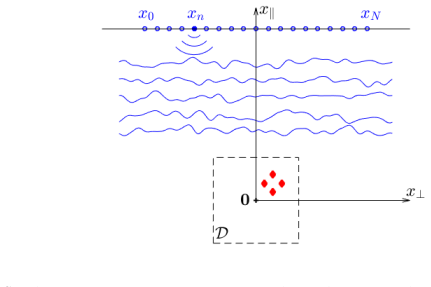
The goal of synthetic aperture imaging is to estimate the reflectivity of a remote region of interest by processing data gathered with a moving sensor which emits periodically a signal and records the backscattered wave. We introduce and analyze a high-resolution interferometric method for synthetic aperture imaging through an unknown scattering medium which distorts the wave. The method builds on the coherent interferometric (CINT) approach which uses empirical cross-correlations of the measurements to mitigate the distortion, at the expense of a loss of resolution of the image. The new method shows that, while mitigating the wave distortion, it is possible to obtain a robust and sharp estimate of the modulus of the Fourier transform of the reflectivity function. A high-resolution image can then be obtained by a phase retrieval algorithm.
Editorial analysis
A structured set of objections, weighed in public.
Referee Report
Summary. The paper introduces and analyzes a high-resolution interferometric synthetic aperture imaging method for use in unknown scattering media. Building on the coherent interferometric (CINT) framework, which uses empirical cross-correlations to mitigate wave distortions at the cost of resolution, the new approach claims to recover a robust and sharp estimate of the modulus of the Fourier transform of the reflectivity function; a high-resolution image is then obtained via a phase retrieval algorithm.
Significance. If the central claim holds, the method would enable stable high-resolution imaging through scattering media without knowledge of the medium, extending CINT in a way that preserves resolution for the modulus alone. This has potential value in radar, sonar, and related imaging applications where scattering is unavoidable.
major comments (2)
- [Abstract and main derivation] The central claim requires that empirical cross-correlations from the modified CINT processing recover |FT(reflectivity)| with sufficient accuracy, completeness, and absence of medium-induced multiplicative factors or missing frequencies to support stable phase retrieval. No independent verification of uniqueness or stability conditions for this phase-retrieval problem under the specific distortion model is provided; if the recovered modulus is only a smoothed or incomplete version, the subsequent phase-retrieval step cannot deliver the claimed high-resolution image.
- [Analysis of the interferometric estimator] The assumption that the interferometric processing overcomes the resolution loss inherent to standard CINT while preserving the modulus information is load-bearing; the manuscript must demonstrate (via analysis or controlled numerical experiments) that the cross-correlations do not introduce unrecoverable ambiguities despite the unknown scattering.
minor comments (1)
- [Abstract] The abstract would benefit from a concise statement of the key assumptions on the scattering medium (e.g., statistical properties or correlation length) that enable the modulus recovery.
Simulated Author's Rebuttal
We thank the referee for the careful reading of the manuscript and the constructive comments. We address each major comment below, clarifying the analysis already present and indicating revisions that will strengthen the presentation of the central claims.
read point-by-point responses
-
Referee: [Abstract and main derivation] The central claim requires that empirical cross-correlations from the modified CINT processing recover |FT(reflectivity)| with sufficient accuracy, completeness, and absence of medium-induced multiplicative factors or missing frequencies to support stable phase retrieval. No independent verification of uniqueness or stability conditions for this phase-retrieval problem under the specific distortion model is provided; if the recovered modulus is only a smoothed or incomplete version, the subsequent phase-retrieval step cannot deliver the claimed high-resolution image.
Authors: Section 3 of the manuscript derives that the modified CINT cross-correlations converge to the squared modulus of the Fourier transform of the reflectivity function, with the scattering-induced phase distortions canceling in the statistical average and without introducing multiplicative medium factors. Frequency coverage follows from the synthetic aperture geometry and is complete within the standard limits of the imaging setup. The phase-retrieval step then uses this recovered modulus with a standard algorithm. We agree that an explicit stability analysis tailored to the distortion model is not provided and will revise the manuscript to add a discussion of the conditions under which the phase-retrieval step is stable, together with references to existing results on Fourier phase retrieval. revision: partial
-
Referee: [Analysis of the interferometric estimator] The assumption that the interferometric processing overcomes the resolution loss inherent to standard CINT while preserving the modulus information is load-bearing; the manuscript must demonstrate (via analysis or controlled numerical experiments) that the cross-correlations do not introduce unrecoverable ambiguities despite the unknown scattering.
Authors: The analysis in Section 3 shows that the specific form of the cross-correlations eliminates the smoothing effect of standard CINT on the modulus while retaining full resolution information; the derivation proceeds in the high-frequency regime and establishes convergence to the true modulus without unrecoverable ambiguities from the unknown medium. This constitutes the analytical demonstration requested. To further address potential concerns, the revised manuscript will include controlled numerical experiments that illustrate recovery of the modulus in simulated scattering scenarios. revision: yes
Circularity Check
No significant circularity; derivation is self-contained
full rationale
The paper extends the prior CINT framework (cross-correlations to stabilize against scattering) by introducing modified interferometric processing that recovers a sharp estimate of |FT(reflectivity)|, followed by an independent phase-retrieval step. This chain does not reduce by construction to fitted inputs, self-definitions, or load-bearing self-citations; the modulus recovery and phase retrieval are presented as mathematically derived consequences of the wave model rather than re-labelings of the CINT output. No equations or steps in the abstract or described method equate the claimed high-resolution result to the input correlations by definition. External mathematical analysis of the scattering operator supplies the supporting structure.
Axiom & Free-Parameter Ledger
axioms (1)
- domain assumption Empirical cross-correlations of measurements mitigate unknown wave distortions from scattering media.
Lean theorems connected to this paper
-
IndisputableMonolith/Cost/FunctionalEquation.leanwashburn_uniqueness_aczel unclear?
unclearRelation between the paper passage and the cited Recognition theorem.
The new method shows that, while mitigating the wave distortion, it is possible to obtain a robust and sharp estimate of the modulus of the Fourier transform of the reflectivity function. A high-resolution image can then be obtained by a phase retrieval algorithm.
-
IndisputableMonolith/Foundation/RealityFromDistinction.leanreality_from_one_distinction unclear?
unclearRelation between the paper passage and the cited Recognition theorem.
We introduce and analyze a high-resolution interferometric method for synthetic aperture imaging through an unknown scattering medium which distorts the wave. The method builds on the coherent interferometric (CINT) approach which uses empirical cross-correlations...
What do these tags mean?
- matches
- The paper's claim is directly supported by a theorem in the formal canon.
- supports
- The theorem supports part of the paper's argument, but the paper may add assumptions or extra steps.
- extends
- The paper goes beyond the formal theorem; the theorem is a base layer rather than the whole result.
- uses
- The paper appears to rely on the theorem as machinery.
- contradicts
- The paper's claim conflicts with a theorem or certificate in the canon.
- unclear
- Pith found a possible connection, but the passage is too broad, indirect, or ambiguous to say the theorem truly supports the claim.
Reference graph
Works this paper leans on
- [1]
- [2]
-
[3]
L. Borcea and I. Kocyigit, Passive array imaging in random media, IEEE Trans. on Computa- tional Imaging 4, 459–469 (2018). 3, 5
work page 2018
-
[4]
Cheney, A mathematical tutorial on synthetic aperture radar, SIAM Rev
M. Cheney, A mathematical tutorial on synthetic aperture radar, SIAM Rev. 43, 301–312 (2001). 1, 2, 4, 9 19
work page 2001
-
[5]
J. C. Curlander and R. N. McDonough, Synthetic aperture radar, Wiley, New York, 1991. 1, 2, 4
work page 1991
-
[6]
J. R. Fienup, Reconstruction of an object from the modulus of its Fourier transform, Opt. Lett. 3, 27–29 (1978). 3, 6, 15
work page 1978
-
[7]
J. R. Fienup, Phase retrieval algorithms: a comparison, Appl. Opt. 21, 2758–2769 (1982). 3, 6, 15
work page 1982
-
[8]
J. R. Fienup, Reconstruction of a complex-valued object from the modulus of its Fourier trans- form using a support constraint, J. Opt. Soc. Am. A 4, 118–123 (1987). 3, 6, 15, 16
work page 1987
-
[9]
J. R. Fienup and A. M. Kowalczyk, Phase retrieval for a complex-valued object by using a low-resolution image, J. Opt. Soc. Am. A 7, 450-458 (1990). 3, 6, 15, 16
work page 1990
-
[10]
J. Garnier and G. Papanicolaou, Passive imaging with ambient noise, Cambridge University Press, Cambridge, 2016. 6
work page 2016
-
[11]
J. Garnier and K. Sølna, Coherent interferometric imaging for synthetic aperture radar in the presence of noise, Inverse Problems 24, 055001 (2008). 3
work page 2008
-
[12]
J. Garnier and K. Sølna, Fourth-moment analysis for wave propagation in the white-noise parax- ial regime, Archive for Rational Mechanics and Analysis 220, 37–81 (2016). 3
work page 2016
-
[13]
Ishimaru, Wave propagation and scattering in random media, Vol
A. Ishimaru, Wave propagation and scattering in random media, Vol. 2, Academic press, New York, 1978. 2
work page 1978
-
[14]
S. M. Rytov, Y. A. Kravtsov, and V. I. Tatarskii, Principles of statistical radiophysics. 4. Wave Propagation through random media, Springer Verlag, Berlin, 1989. 2
work page 1989
-
[15]
Y. Shechtman, Y. C. Eldar, O. Cohen, H. N. Chapman, J. Miao, and M. Segev, Phase retrieval with application to optical imaging: A contemporary overview, IEEE Signal Processing Magazine 32 87-109 (2015). 3, 6, 15, 16
work page 2015
-
[16]
V. I. Tatarski, Wave propagation in a turbulent medium, Dover, New York, 1961. 2
work page 1961
-
[17]
M. C. W. van Rossum and Th. M. Nieuwenhuizen, Multiple scattering of classical waves: mi- croscopy, mesoscopy, and diffusion, Reviews of Modern Physics 71, 313–370 (1999). 2 20
work page 1999
discussion (0)
Sign in with ORCID, Apple, or X to comment. Anyone can read and Pith papers without signing in.