REVIEW 2 major objections 4 minor 20 references
Real polynomials with constrained real divisors. I. Fundamental groups
T0 review · 2 major / 4 minor · reviewed 2026-08-14 · deepseek-v4-flash
Pith's one-line read Every closed family of forbidden real-root patterns yields an explicit presentation of the fundamental group of the polynomial complement, and in the maximal case the group is free of rank quadratic in the degree.
desk verdict Solid generalization of Arnold–Vassiliev fundamental-group computations to arbitrary closed root-multiplicity posets, with a clean graph presentation and only minor exposition blemishes. read the letter →
The pith
A machine-rendered reading of the paper's core claim, the machinery that carries it, and where it could break.
The reading
What carries the argument
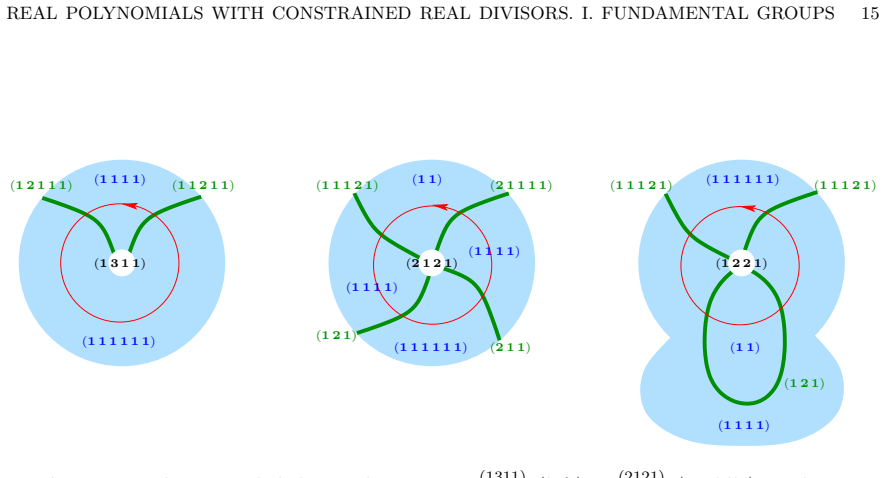
The machinery is a cell decomposition of the polynomial space by real-root multiplicity patterns. The stratum labeled by a composition $\omega=(\omega_1,\dots,\omega_l)$ is the set of monic polynomials whose ordered real roots have those multiplicities; this stratum is an open cell of codimension $|\omega|'=\sum_i(\omega_i-1)$, and the adjacency of cells is controlled by two operations: merging two adjacent real roots into one root, and inserting a new double root into the ordered list. The paper forms the dual graph $G_d$ whose vertices are the chambers of polynomials with all real roots simple and the walls with exactly one double root, with edges between a chamber and a wall when the wall lies on the chamber's boundary; the letters $\gamma_{i,j}$ are loops crossing the wall $(1^i,2,1^j)$. Around each codimension-two stratum of type $(1^i,3,1^j)$ or $(1^i,2,1^j,2,1^l)$, a small normal circle reads off a word in these letters, giving exactly the two families of relations. Applying Seifert--van Kampen as the present codimension-two strata are added back to the complement of the codimension-two skeleton turns these local readings into a presentation, and in the maximal case the wall-crossing words are in bijection with based loops in the graph, proving the wedge-of-circles homotopy type.
What would settle it
For $d=6$, take $\Theta$ to be the smallest closed poset containing the eight patterns $(3,1)$, $(1,3)$, $(1,3,1,1)$, $(1,1,3,1)$, $(2,2,1,1)$, $(1,2,2,1)$, $(1,1,2,2)$, and $(2,1,1,2)$; the paper's presentation predicts $\pi_1(P^{c\Theta}_6)\cong\mathbb{Z}/2\mathbb{Z}$. An independent computation of that fundamental group, say by building the cell complex directly or by another stratification, that yields any group not isomorphic to $\mathbb{Z}/2\mathbb{Z}$ would refute the presentation, and with it the cell-structure theorem it rests on.
Extended reading notes
Core claim
The central claim is that the fundamental group of $P^{c\Theta}_d$ is a purely combinatorial invariant of $\Theta$. For $\Theta$ downward closed under the merge and insertion operations and contained in the codimension-at-least-two patterns, $\pi_1(P^{c\Theta}_d)$ is the free group $G_d$ generated by letters $\gamma_{i,j}$ (one for each wall $(1^i,2,1^j)$ in the discriminant), factored by two families of relations. For each codimension-two pattern $(1^i,3,1^j)$ not in $\Theta$, the relation is $\gamma_{i,j+1}\gamma_{i+1,j}^{-1}=1$; for each pattern $(1^i,2,1^j,2,1^l)$ not in $\Theta$, the relation is $\gamma_{i+j,l}\gamma_{i+j+2,l}\gamma_{i,j+l+2}^{-1}\gamma_{i,j+l}^{-1}=1$. In the maximal case, the space $P^{c\Theta}_d$ is homotopy equivalent to a wedge of $d(d-2)/4$ circles for even $d$ and $(d-1)^2/4$ for odd $d$, so $\pi_1$ is free of that rank and $P^{c\Theta}_d$ is a $K(\pi,1)$. The paper further proves that these fundamental groups stabilize as the degree is increased by two, that in several natural families they are free of rank equal to the rank of $H_{d-2}(\overline{P}^{\Theta}_d;\mathbb{Z})$, and that the free group in the maximal case is isomorphic to a group of bordism classes of immersed $1$-manifolds in the cylinder $S^1\times\mathbb{R}$ avoiding the prescribed tangency patterns.
Load-bearing premise
The load-bearing premise is the cell-structure theorem that every fixed-pattern stratum is an open cell and that its boundary cells come exactly from merging two adjacent roots or inserting a double root; if that model is even slightly wrong, the graph, generators, and relations would not describe the fundamental group.
Editorial extensions
If this is right
- Every closed $\Theta$ of codimension at least two has its fundamental group encoded by the two relation families, so computing $\pi_1(P^{c\Theta}_d)$ becomes a finite combinatorial problem in the poset $\Theta$.
- For the maximal forbidden set, $P^{c\Theta}_d$ is a wedge of $d(d-2)/4$ circles for even $d$ and of $(d-1)^2/4$ for odd $d$; its fundamental group is free of that rank, and the space is a $K(\pi,1)$.
- Under either of the two hypotheses singled out in the paper, the fundamental group is free; in the family where the forbidden codimension-two patterns are exactly the $(1^i,3,1^j)$ patterns, it is $\mathbb{Z}$ for $d\ge 4$.
- For a fixed $\Theta$, the fundamental group does not change once the degree is raised by two: $\pi_1(P^{c\Theta_{d'}}_{d'})\cong\pi_1(P^{c\Theta_{d+2}}_{d+2})$ for all $d'\ge d+2$ of the same parity.
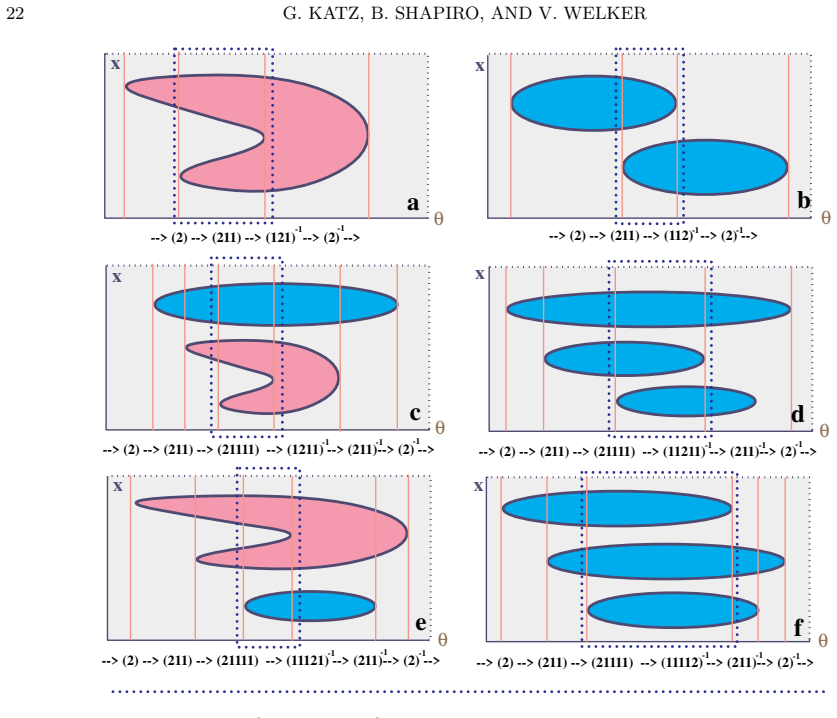
- In the maximal case and for even $d$, $\pi_1(P^{c\Theta}_d)$ is isomorphic to a cobordism group of immersed closed curves in $S^1\times\mathbb{R}$ whose vertical tangencies avoid the codimension-two patterns, giving a geometric face to the generators.
Reading between the lines
- Because the presentation is purely combinatorial, the natural next step not taken in this paper is algorithmic: enumerate closed posets $\Theta$ for small $d$ and decide computationally which presentations are free, which would test the paper's open question about freeness directly.
- The stabilization of $\pi_1$ suggests that the full homotopy type of $P^{c\Theta}_d$ may stabilize as $d$ grows with parity fixed; if so, the stable object could be described by a direct limit of the posets $\Theta_d$, in the spirit of configuration-space stabilization.
- The curve-bordism model, proved only in the maximal case, should extend to general $\Theta$ by permitting exactly the tangency patterns in the complement of $\Theta$; such an extension would give a geometric interpretation of the relations in the presentation.
- The wall-crossing mechanism is reminiscent of the way braid groups arise from configuration spaces, so these fundamental groups may admit faithful actions on or interpretations as subgroups of braid-like groups for special families of forbidden patterns.
Signed reviews
Editorial analysis
A structured set of objections, weighed in public.
Referee Report
Summary. The paper studies the spaces P^{cΘ}_d of real monic degree-d polynomials whose real root multiplicity patterns avoid a given closed poset Θ. The main results are an explicit presentation of π1(P^{cΘ}_d) as a quotient of a free group by relations associated to the removed codimension-two strata (Proposition 2.10), freeness and rank computations in several cases (Theorems 2.4 and 2.11), a stabilization theorem for large d (Theorem 2.15), and an interpretation of the fundamental group in the maximal case as a cobordism group of immersed 1-manifolds in the cylinder S^1 × R (Theorem 3.3). The paper thus generalizes classical results of Arnold and Vassiliev on spaces of real polynomials with bounded root multiplicities.
Significance. If the results are correct, the paper provides a complete, parameter-free combinatorial description of the fundamental groups for a broad family of real-polynomial spaces, together with a stabilization result and a geometric bordism interpretation. The main ideas are transparent and largely checkable: the graph model, the admissible-word calculus, and the van Kampen handle-attachment argument are explicit and do not rely on fitted data. The principal external input is the cell-structure theorem imported from the first author's earlier work [Ka, Theorem 4.1] (Proposition E); all subsequent statements inherit this dependency. I found no circular reasoning, but I did find two substantive proof issues in Section 2.2 that need to be repaired.
major comments (2)
- [Section 2.2 (Theorem 2.4)] The nerve-cover proof of Theorem 2.4 is not valid as written. The cover X = {X_ω} by unions of each codimension-one cell with its two adjacent d-cells is claimed to have only empty or contractible finite intersections, so that [Ha, Corollary 4G.3] applies. This is false when two different codimension-one cells lie between the same pair of d-cells. For d = 3, the two walls (2,1) and (1,2) both lie between the d-cells (1,1,1) and (1), so X_(2,1) ∩ X_(1,2) = R^(1,1,1)_3 ∪ R^(1)_3, a disjoint union of two open balls, which is not contractible. The nerve of this cover is a single edge, hence contractible, whereas P^{cΩ<3],|ω|'≥2}_3 is homotopy equivalent to S^1. Thus the stated hypotheses of the nerve theorem are not satisfied and the proof of homotopy equivalence to the graph G_d fails as written; the authors should replace this argument with a correct deformation-retraction argument, e.g., via a regular neighborhood of the dual graph.
- [Section 2.2 (Lemma 2.3)] The count of codimension-one compositions in Lemma 2.3 is incorrect for odd d. The displayed equality |Ω⟨d],|∼|′=1| = Σ_{k=1}^{⌊d/2⌋}(2k−1) = ⌊d/2⌋^2 holds for even d but not for odd d. For d = 2m+1, the codimension-one compositions (one part equal to 2 and the rest equal to 1) have total size 3, 5, ..., 2m+1, and their number is Σ_{r=1}^{m} 2r = m(m+1) = (d^2−1)/4, not m^2. If the stated count were used, the Euler-characteristic computation would give β_1(G_d) = (d−1)(d−3)/4 for odd d, contradicting the lemma's claimed (d−1)^2/4. The final rank formula is, in fact, correct when the count is repaired, but the proof as written must be corrected.
minor comments (4)
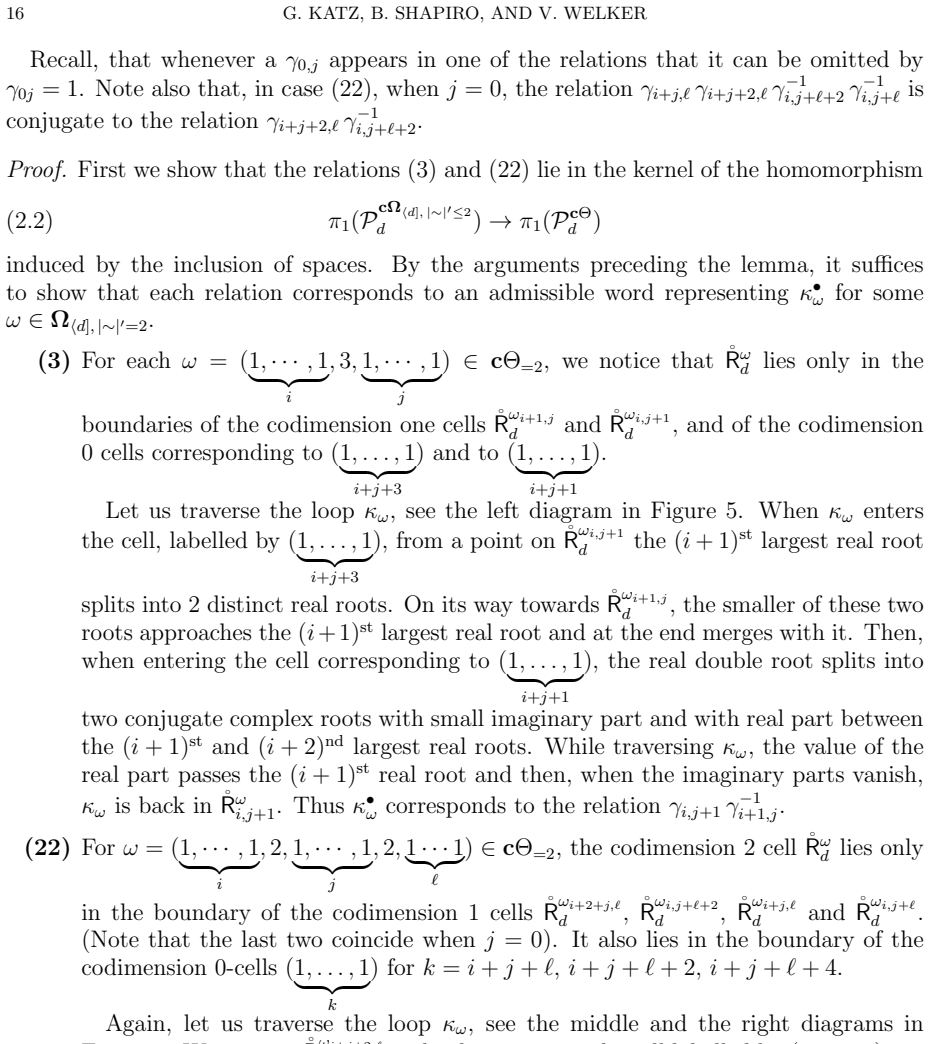
- [Section 2.3 (Proposition 2.10, proof of case (22))] In the proof of the (22) relations, the displayed word ends with a duplicated factor: it reads γ_{i+j,𝓁}γ_{i+j+2,𝓁}γ^{-1}_{i,j+𝓁+2}γ^{-1}_{i,j+𝓁+2} = 1. The second γ^{-1}_{i,j+𝓁+2} should be γ^{-1}_{i,j+𝓁}, matching the statement of the proposition.
- [Section 2.3 (Lemma 2.14)] The proof of Lemma 2.14 contains two apparent typos that make the stabilization argument hard to follow. The sentence 'The relations of type (22), corresponding to ω∈ cΘ_{=2} with |ω| = 2' should presumably read 'with |ω| = d', and the opening sentence listing '|ω|∈{d,d−2}' should be rephrased to distinguish the relations already present in the presentation for d−2 from the genuinely new relations of size d.
- [Section 2.1 (Lemma 2.1)] The map q is defined as q : P_d × [0,∞) → P_d, but one sentence restricts λ to [0,1]; the intended homotopy uses λ ∈ [0,1], so the domain should be P_d × [0,1] or the wording should be adjusted consistently.
- [Section 2.2] The graph G_d is described as a 1-dimensional simplicial complex, but later constructions allow several distinct edges with the same endpoints (e.g., for d=3 the two walls (2,1) and (1,2) give two edges between the same two d-cells). The paper should explicitly state that G_d is a 1-dimensional CW-complex or multigraph, not a simplicial complex, to avoid a technical inconsistency.
Circularity Check
No significant circularity: the central derivation is self-contained, with the one imported cell-structure theorem serving as independent structural input.
full rationale
The paper's central claim, Proposition 2.10, is a genuine topological derivation rather than a repackaging of its assumptions. It starts from a cell decomposition of the space of monic real polynomials imported from the first author's earlier work ([Ka, Theorem 4.1], quoted as Proposition E), which asserts that each stratum ˚R^ω_d is an open cell of codimension |ω|' and that boundary adjacency is generated by merge and insertion operations. This is a parameter-free structural theorem whose assumptions do not include the fundamental-group presentation being derived, so under the stated rules it counts as independent support even though it is a self-citation. The subsequent construction of the graph G_d, the admissible-word model for π1 of the complement of the codimension-2 skeleton, and the van Kampen argument imposing one relation per removed codimension-2 stratum are all carried out inside the paper with explicit geometric reasoning. In particular, the relations of type (3) and (22) are not assumed or fitted; they are computed from explicit loops κ_ω bounding normal disks to the strata in cΘ_{=2}. No fitted parameters are renamed as predictions, and no result is defined in terms of the quantity it purports to derive. The only externally imported ingredient is the cell-structure theorem, and its role, while load-bearing, is not circular because it does not presuppose the fundamental-group answer.
Assumptions & free parameters
assumptions (4)
- domain assumption The strata ˚R^ω_d form a cell decomposition of P_d with codim |ω|', and closure relations are generated by merge and insertion operations (Proposition E, from [Ka, Thm 4.1]).
- domain assumption Attaching maps of the d-cells are injective on the preimage of each open (d-1)-cell ([Ka, Lemma 2.4]).
- standard math The nerve lemma and van Kampen theorem apply in the stated settings ([Ha, Cor 4G.3], [Bj, Thm 10.6]).
- domain assumption Morin's classification of stable singularities is valid as used in Proposition 3.1.
Cite this review
Pith. "Pith review of Real polynomials with constrained real divisors. I. Fundamental groups." pith.science (2026). https://pith.science/paper/TFAW2N67
@misc{pith2026190807941,
  author       = {Pith},
  title        = {Pith review of: Real polynomials with constrained real divisors. I. Fundamental groups},
  year         = {2026},
  howpublished = {\url{https://pith.science/paper/TFAW2N67}},
  note         = {Machine review of arXiv:1908.07941}
}
read the original abstract
In the late 80s, V.~Arnold and V.~Vassiliev initiated the topological study of the space of real univariate polynomials of a given degree d and with no real roots of multiplicity exceeding a given positive integer. Expanding their studies, we consider the spaces of real monic univariate polynomials of degree d whose real divisors avoid sequences of root multiplicities taken from a given poset of compositions which is closed under certain natural combinatorial operations. In this paper, we concentrate on the fundamental group of such spaces. We find explicit presentations for the fundamental groups in terms of generators and relations and show that in a number of cases they are free with rank bounded from above by a quadratic function in d. We also show that the fundamental group stabilizes for d large. We further show that the fundamental groups admit an interpretation as special bordisms of immersions of 1-manifolds into the cylinder S^1 \times R, whose images avoid the tangency patterns from the poset with respect to the generators of the cylinder.
Figures


Figures from the paper (5 more)


Reference graph
Works this paper leans on
-
[1]
Arnold, V.I., Spaces of functions with moderate singularities , (Russian) Funktsional. Anal. i Prilozhen. 23 (1989) 1--10; translation in Funct. Anal. Appl. 23 (1989) 169--177 (1990)
work page 1989
-
[2]
Bj \"o rner, A., Topological methods , In:Handbook of combinatorics, V ol. 2, 1819--1872, Elsevier Sci. B. V., Amsterdam,1995
work page 1995
-
[3]
Katz, G., Convexity of Morse Stratifications and Gradient Spines of 3-Manifolds , JP Journal of Geometry and Topology, vol. 9, no 1 (2009), 1-119
work page 2009
-
[4]
Katz, G., Stratified Convexity & Concavity of Gradient Flows on Manifolds with Boundary , Applied Mathematics, 2014, vol. 5, 2823-2848
work page 2014
-
[5]
Katz, G., Traversally Generic & Versal Flows: Semi-algebraic Models of Tangency to the Boundary to appear in Asian J. of Math. (arXiv:1407.1345v1 [mathGT] (4 July, 2014))
work page Pith review arXiv 2014
-
[6]
With a view toward algebraic geometry , Graduate Texts in Mathematics, vol
Eisenbud, D., Commutative Algebra. With a view toward algebraic geometry , Graduate Texts in Mathematics, vol. 150, Springer-Verlag, New York, 1995. ISBN 0-387-94268-8
work page 1995
-
[7]
Hatcher, A., Algebraic Topology , Cambridge University Press, Cambridge, 2002
2002
-
[8]
Forman, Morse theory for cell complexes , Adv
R. Forman, Morse theory for cell complexes , Adv. Math. 134 (1998) 90--145
work page 1998
Show all 20 references
-
[9]
J \"o llenbeck, V
M. J \"o llenbeck, V. Welker, Resolution of the residue field via algebraic discrete Morse theory ,
-
[10]
Katz, G., The stratified spaces of real polynomials & trajectory spaces of traversing Flows , JP Journal of Geometry and Topology 19 (2016) 95--160
2016
-
[11]
Katz, G., Flows in Flatland: a romance of few dimensions , Arnold Math. J. 3 (2016) 281--317
2016
-
[12]
Katz, G., Transversally generic & versal vector flows: semi-algebraic models of tangency to the boundary , Asian J. Math. 21 (2017) 127--168
2017
-
[13]
Katz, G., Holography and Homology of Traversing Flows , (monograph) to be published by World Scientific
-
[14]
Katz, G., Shapiro B., Welker, V., Real polynomials with constrained real divisors. II. (Co)homology and stabilization , in preparation
-
[15]
Khovanov, M., Real K( , 1) arrangements from finite root systems , Mathematical Research Letters 3, 261-274 (1996)
1996
-
[16]
Sci., Paris 260 (1965), 5662--5665
Morin, B., Formes canoniques des singularities d'une application differentiable , Formes canoniques des singularities d'une application differentiable , Comptes Rendus Acad. Sci., Paris 260 (1965), 5662--5665
1965
-
[17]
Sci., Paris 260 (1965) 6503--6506
Morin, B., Formes canoniques des singularities d'une application differentiable , Comptes Rendus Acad. Sci., Paris 260 (1965) 6503--6506
1965
-
[18]
Shapiro B., Welker, V.,
-
[19]
Sk \"o ldberg, Morse theory from an algebraic viewpoint , Trans
E. Sk \"o ldberg, Morse theory from an algebraic viewpoint , Trans. Amer. Math. Soc., 358 (2006) 115--129
2006
-
[20]
98, Amer
Vasiliev, V.A., Complements of Discriminants of Smooth Maps: Topology and Applications , Translations of Mathematical Monographs, vol. 98, Amer. Math. Soc., Providence , 1994
1994
Reviewed August 14, 2026 · model on record in the stance chip above.
Discussion (0). Continue with ORCID to comment.