Can homophily explain public underestimation of climate policy support?
Pith reviewed 2026-07-01 07:57 UTC · model grok-4.3
The pith
Homophily in social networks explains why climate policy opponents underestimate public support more than supporters do.
A machine-rendered reading of the paper's core claim, the machinery that carries it, and where it could break.
Core claim
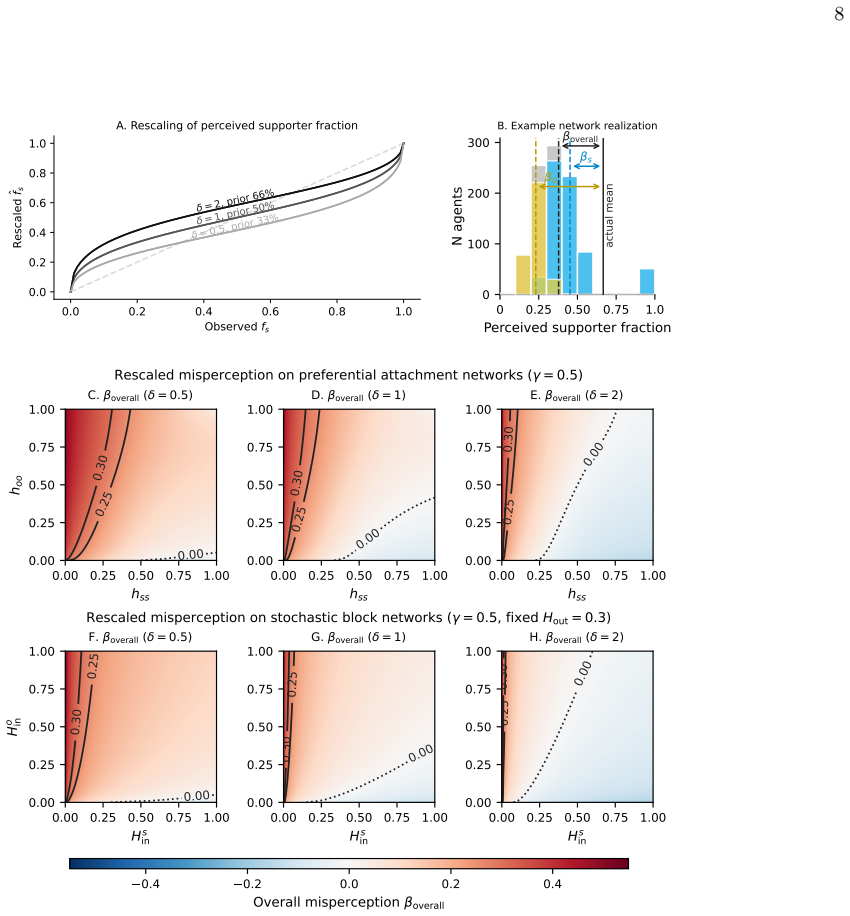
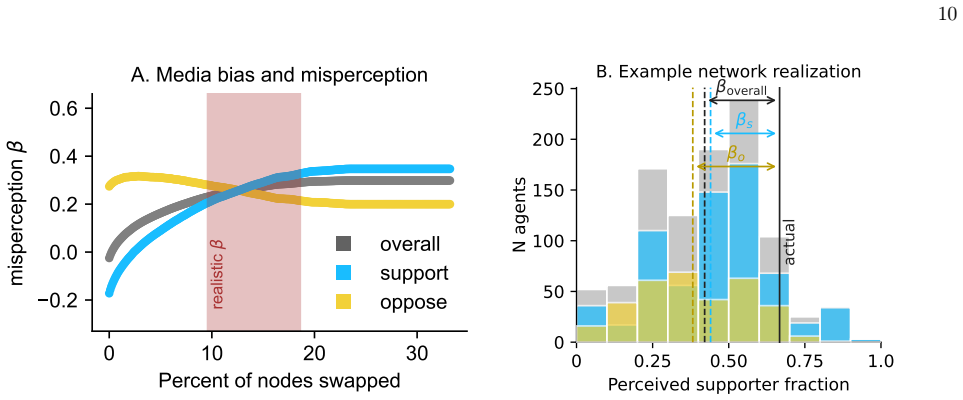
Homophily alone can explain opponents underestimating support by more than supporters, but supporters only underestimate support when their homophily is so low that they disproportionately associate with opponents. Media bias combined with realistic, symmetric homophily can produce realistic misperception patterns in the model, whereas Bayesian rescaling and inaccurate priors would still need highly asymmetric homophily to match observed patterns.
What carries the argument
Homophily within stochastic block models and preferential attachment networks, which sets connection probabilities within and between supporter and opponent groups and thereby shapes perceived policy support.
If this is right
- Opponents underestimate support more than supporters under any positive homophily level.
- Supporters underestimate support only when their homophily drops low enough for them to connect mainly with opponents.
- Media bias combined with symmetric homophily reproduces the observed asymmetry in misperceptions.
- Bayesian rescaling or inaccurate priors require strongly asymmetric homophily to match real patterns.
Where Pith is reading between the lines
- Increasing cross-group contacts could reduce underestimation among both sides if homophily is the main driver.
- The same network mechanisms may shape misperceptions on other polarized topics such as immigration policy.
- Measuring actual homophily in climate-opinion networks would provide a direct test of the model's conditions.
Load-bearing premise
The stochastic block model and preferential attachment model, together with the added mechanisms for rescaling or media prominence, capture the actual social processes that shape how people learn about climate policy opinions.
What would settle it
A survey measuring actual homophily levels among climate policy supporters that finds high homophily yet still widespread underestimation of support would contradict the model's explanation for supporter misperceptions.
Figures


read the original abstract
Many climate change mitigation policies enjoy large majority support from the U.S. public. Yet, both Republicans and Democrats underestimate public support for climate policies, on average, with Republicans underestimating by more. Explaining this is a major puzzle in climate change politics. Homophily is one possible explanation: if citizens are selectively exposed to views reinforcing their own, then policy opponents might underestimate support more than supporters. Here, we explore how homophily could interact with social network structure to produce misperceptions of policy support, using a stochastic block model and preferential attachment model. Homophily alone can explain opponents underestimating support by more than supporters, but supporters only underestimate support when their homophily is so low that they disproportionately associate with opponents. We then expand our model to combine homophily with Bayesian rescaling, inaccurate priors, or asymmetric prominence of opposing opinions (simulating media bias). With Bayesian rescaling and inaccurate priors, homophily would still need to be highly asymmetric to produce realistic misperception patterns. Media bias combined with realistic, symmetric homophily can produce realistic misperception patterns in our model. However, empirical evidence on media bias in coverage of climate change policy is mixed. Our analyses provide theoretical foundations for advancing understanding of public opinion misperception, on climate change and other issues.
Editorial analysis
A structured set of objections, weighed in public.
Referee Report
Summary. The manuscript uses stochastic block models and preferential attachment networks to test whether homophily can generate the observed pattern that climate-policy opponents underestimate public support more than supporters do. It reports that homophily alone produces this asymmetry only when homophily is highly asymmetric; adding media bias (asymmetric prominence) with symmetric homophily yields realistic misperception gaps, while Bayesian rescaling or inaccurate priors still require strong asymmetry. The paper concludes that homophily plus media bias offers a plausible mechanism, though it notes mixed empirical evidence on media bias.
Significance. If the modeling results survive empirical calibration of homophily parameters and robustness checks on sampling assumptions, the work supplies a useful theoretical scaffold for explaining asymmetric opinion misperceptions on climate policy and analogous issues. The use of two standard network generators and explicit exploration of added mechanisms (Bayesian updating, priors, prominence) is a strength; however, the absence of direct comparison to measured homophily in climate-discussion networks limits immediate applicability.
major comments (2)
- [Model description and Results] The central claim that homophily (alone or with media bias) can explain the Republican-Democrat gap in underestimation rests on specific homophily values and an implicit uniform sampling rule for estimating population support. No section demonstrates that the homophily levels required to match survey gaps lie inside empirically measured ranges for climate-policy discussion networks.
- [Media bias simulations] The media-bias extension is presented as sufficient to produce realistic patterns under symmetric homophily, yet the manuscript does not test whether altering the sampling assumption (e.g., to degree-weighted or topic-weighted exposure) removes the need for the asymmetric-prominence term.
minor comments (1)
- [Abstract] The abstract states that media bias 'can produce realistic misperception patterns' without a quantitative definition of 'realistic' (e.g., matching specific survey gap sizes or confidence intervals).
Simulated Author's Rebuttal
We thank the referee for the constructive comments and the recommendation for major revision. We address each major comment below, clarifying the scope of our theoretical analysis and outlining specific revisions.
read point-by-point responses
-
Referee: [Model description and Results] The central claim that homophily (alone or with media bias) can explain the Republican-Democrat gap in underestimation rests on specific homophily values and an implicit uniform sampling rule for estimating population support. No section demonstrates that the homophily levels required to match survey gaps lie inside empirically measured ranges for climate-policy discussion networks.
Authors: Our central claim is theoretical: we demonstrate the parameter conditions (including homophily asymmetry levels) under which homophily in standard network models can generate the observed asymmetric misperceptions. The paper does not assert that these conditions match measured values in climate networks, but rather identifies what would be required. We will add a dedicated discussion subsection that reviews available empirical estimates of homophily from political discussion networks and climate-related studies, comparing them to the ranges used in our simulations. This will make the plausibility assessment explicit while acknowledging data limitations in the climate-policy domain. revision: partial
-
Referee: [Media bias simulations] The media-bias extension is presented as sufficient to produce realistic patterns under symmetric homophily, yet the manuscript does not test whether altering the sampling assumption (e.g., to degree-weighted or topic-weighted exposure) removes the need for the asymmetric-prominence term.
Authors: We agree that testing robustness to the sampling assumption is important. We will add new simulations that replace uniform sampling with degree-weighted sampling (where exposure probability scales with node degree) and report the resulting misperception gaps. If the asymmetric-prominence term is no longer required under degree-weighted sampling, we will revise the conclusions accordingly; otherwise, we will clarify the conditions under which media bias remains necessary. These results will be presented in an expanded robustness subsection. revision: yes
Circularity Check
No circularity: forward simulation from homophily inputs to misperception outputs
full rationale
The paper defines homophily levels as explicit parameters in stochastic block and preferential attachment models, then computes estimated policy support via network sampling and exposure rules as derived outputs. No quoted equation, result, or claim reduces the reported misperception patterns to a fitted quantity defined from the target data, a self-citation chain, or an ansatz smuggled from prior work by the same authors. The derivation chain is self-contained as a standard generative model exercise.
Axiom & Free-Parameter Ledger
free parameters (1)
- homophily level and asymmetry
axioms (1)
- domain assumption Social networks governing climate policy opinion exposure can be represented by stochastic block models and preferential attachment models.
Reference graph
Works this paper leans on
-
[1]
J.R.Marlon, X.Wang, P.Bergquist, P.D.Howe, A.Leis- erowitz, E. Maibach, M. Mildenberger, and S. Rosenthal, Environ. Res. Lett.17, 124046 (2022)
work page 2022
-
[2]
M. G. Burgess, C. Suarez, A. Dancer, L. J. Watkins, and R. E. Marshall, A Center for Social and Environmental Futures Report (2024)
work page 2024
-
[3]
G. Sparkman, N. Geiger, and E. U. Weber, Nature com- munications13, 4779 (2022)
work page 2022
- [4]
-
[5]
M. S. Levendusky and N. Malhotra, Public Opinion Quarterly80, 378 (2016)
work page 2016
-
[6]
J. N. Druckman, S. Klar, Y. Krupnikov, M. Levendusky, and J. B. Ryan, The Journal of Politics84, 1106 (2022)
work page 2022
-
[7]
N. Geiger and J. K. Swim, Journal of Envi- ronmental Psychology47, 79 (2016), ISSN 0272- 4944, URLhttps://www.sciencedirect.com/science/ article/pii/S027249441630038X
work page 2016
-
[8]
M. Mildenberger and D. Tingley, British Journal of Po- litical Science49, 1279–1307 (2019)
work page 2019
-
[9]
A. Hertel-Fernandez, M. Mildenberger, and L. C. Stokes, American Political Science Review113, 1 (2019)
work page 2019
-
[10]
P. J. Egan and M. Mullin, PS: Political Science & Politics 57, 30 (2024)
work page 2024
-
[11]
M. McPherson, L. Smith-Lovin, and J. M. Cook, Annual review of sociology27, 415 (2001)
work page 2001
- [12]
- [13]
- [14]
-
[15]
G. Gerbner, L. Gross, M. Morgan, and N. Signorielli, Perspectives on media effects1986, 17 (1986)
work page 1986
-
[16]
D. K. Sherman and L. Van Boven, Social Issues and Pol- icy Review18, 31 (2024)
work page 2024
-
[17]
W. Samuelson and R. Zeckhauser, Journal of risk and uncertainty1, 7 (1988)
work page 1988
-
[18]
M. T. Boykoff and J. M. Boykoff, Global environmental change14, 125 (2004)
work page 2004
-
[19]
L. McAllister, M. Daly, P. Chandler, M. McNatt, A. Ben- ham, and M. Boykoff, Environmental Research Letters 16, 094008 (2021)
work page 2021
-
[20]
E. Landgren, J. Osborne-Gowey, J. Garland, M. T. Boykoff, and M. G. Burgess, Environmental Research Communications (2026)
work page 2026
- [21]
-
[22]
R. K. Garrett, J. A. Long, and M. S. Jeong, Journal of Communication69, 490 (2019)
work page 2019
-
[23]
B. Guay, T. Marghetis, C. Wong, and D. Landy, Pro- ceedings of the National Academy of Sciences122, e2413064122 (2025)
work page 2025
-
[24]
J. S. Mernyk, S. L. Pink, J. N. Druckman, and R. Willer, Proceedings of the National Academy of Sciences119, e2116851119 (2022)
work page 2022
- [25]
-
[26]
E. Colleoni, A. Rozza, and A. Arvidsson, Journal of com- munication64, 317 (2014)
work page 2014
- [27]
- [28]
-
[29]
L. Feldman, E. W. Maibach, C. Roser-Renouf, and A. Leiserowitz, The International Journal of Press/Politics17, 3 (2012)
work page 2012
- [30]
- [31]
-
[32]
C. E. Robertson, K. S. Del Rosario, and J. J. Van Bavel, Current Opinion in Psychology60, 101918 (2024)
work page 2024
-
[33]
L. A. Adamic and N. Glance, inProceedings of the 3rd international workshop on Link discovery(2005), pp. 36– 43
work page 2005
-
[34]
N. Rogers and J. T. Jost, Journal of the Association for Consumer Research7, 255 (2022)
work page 2022
-
[35]
H.-C. H. Chang, J. N. Druckman, E. Ferrara, and R. Willer, PNAS nexus4, pgaf206 (2025)
work page 2025
- [36]
-
[37]
J. M. Norman and B. Green, Political Psychology46, 1364 (2025)
work page 2025
-
[38]
Y. Sleiman, G. Melios, and P. Dolan, Political Science Research and Methods pp. 1–23 (2025)
work page 2025
- [39]
- [40]
- [41]
-
[42]
L. Van Boven, P. J. Ehret, and D. K. Sherman, Perspec- tives on Psychological Science13, 492 (2018)
work page 2018
- [43]
-
[44]
A. M. Mastroianni and J. Dana, Proceedings of the Na- tional Academy of Sciences119, e2107260119 (2022)
work page 2022
-
[45]
E. Lee, F. Karimi, C. Wagner, H.-H. Jo, M. Strohmaier, and M. Galesic, Nat. Hum. Behav.3, 1078 (2019). [46]https://github.com/kathlandgren/homophily- misperception S1 Supporting Information for Can homophily explain public underestimation of climate policy support? SUR VEY DA T A AND ADDITIONAL EMPIRICAL RESUL TS This present study contains a partial rean...
work page 2019
discussion (0)
Sign in with ORCID, Apple, or X to comment. Anyone can read and Pith papers without signing in.