REVIEW 1 major objections 3 minor 1 cited by
Monogenic fields arising from trinomials
T0 review · 1 major / 3 minor · reviewed 2026-08-14 · deepseek-v4-flash
Pith's one-line read For four trinomial families of degrees 5 and 6, the paper gives necessary and sufficient congruence conditions for monogeneity under a square-free discriminant hypothesis, and for every n>2 it proves that two trinomial families are…
desk verdict A mostly careful Montes-algorithm analysis with one statement-proof mismatch in Theorem 3.6; the explicit n=5,6 criteria and density lower bounds are the real value. read the letter →
The pith
A machine-rendered reading of the paper's core claim, the machinery that carries it, and where it could break.
The reading
What carries the argument
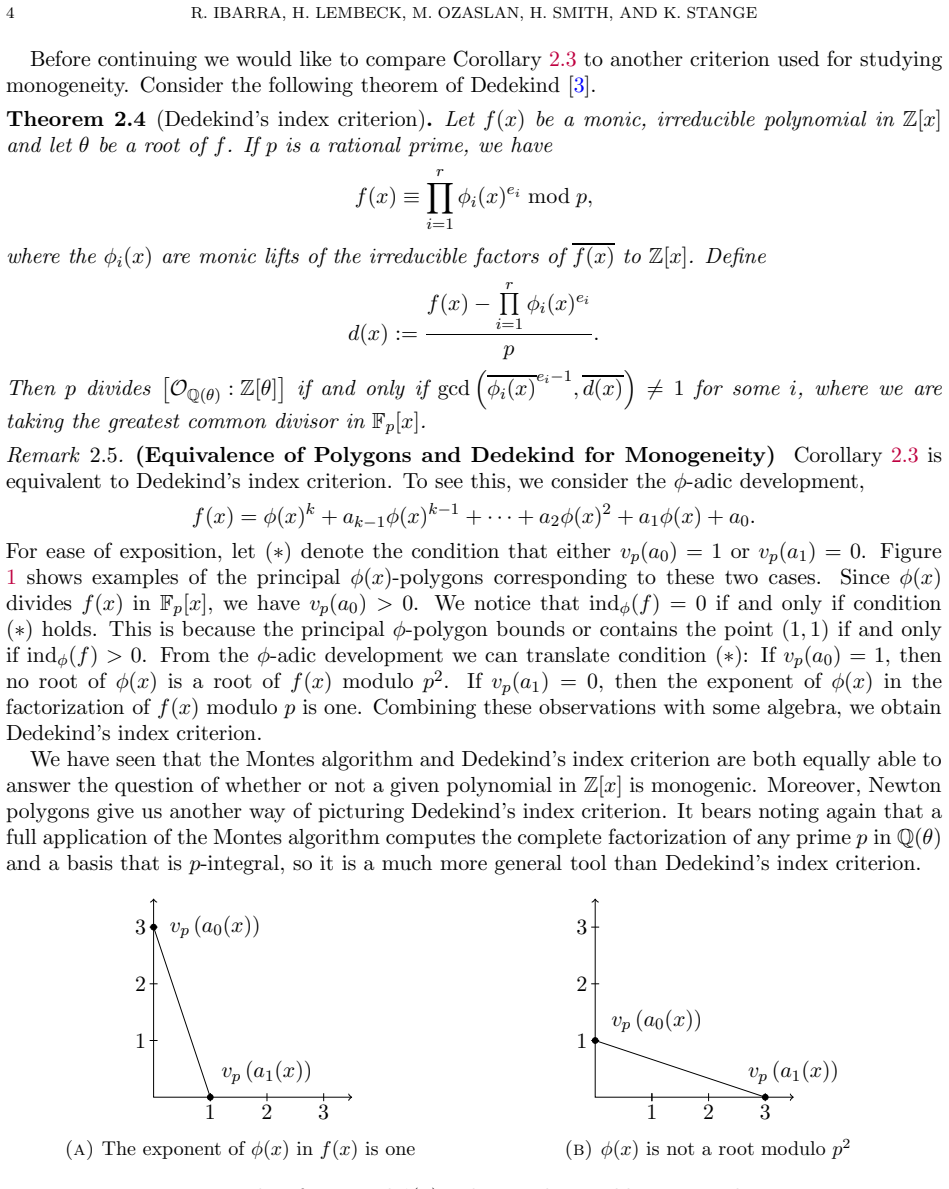
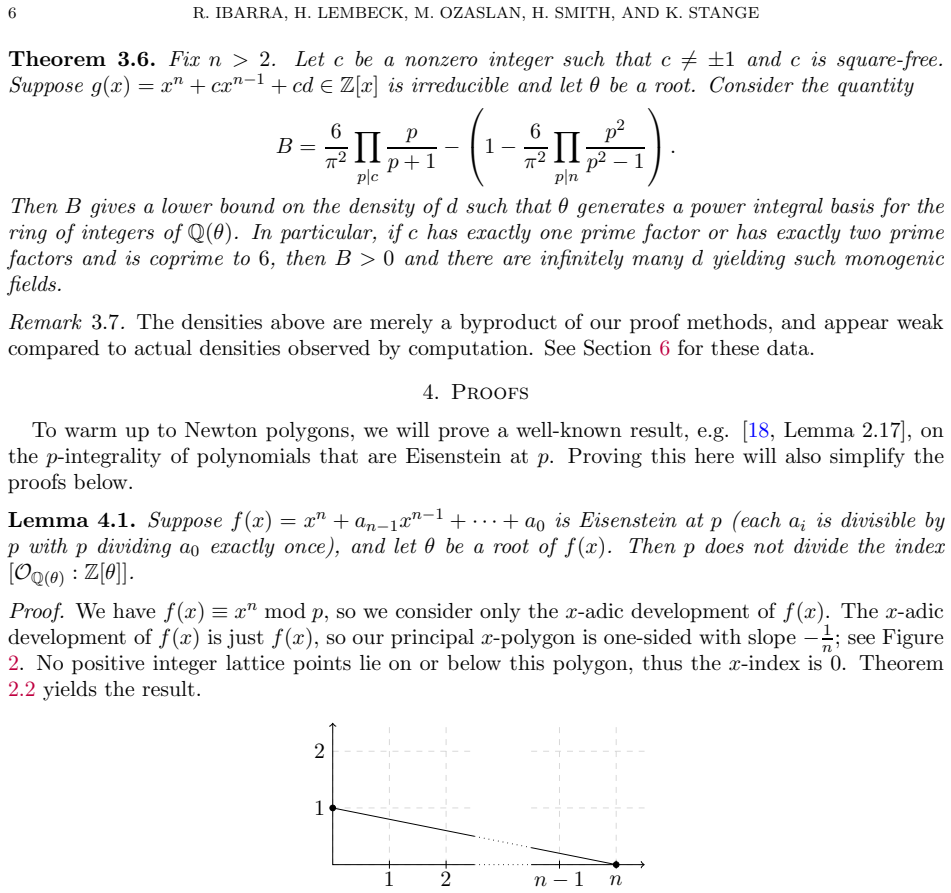
The central mechanism is Ore's theorem of the index, accessed through the Montes algorithm: for each prime p, one writes f in its φ-adic development for each irreducible factor φ of f modulo p, forms the principal φ-Newton polygon (the lower convex hull of the points (i, v_p(a_i(x)))), and defines the φ-index as the number of positive integer lattice points on or under that polygon. The theorem says p divides [O_K : Z[θ]] exactly when some φ-index is positive; the paper's Corollary 2.3 sharpens this to: p is harmless precisely when every principal polygon is one-sided. The discriminant formula for trinomials identifies the only primes that can appear, and the paper remarks that this polygon test is equivalent to Dedekind's index criterion.
What would settle it
Compute the index [O_K : Z[θ]] for an explicit trinomial in one of the degree-5 or 6 families whose discriminant factor is square-free but whose coefficients satisfy the theorem's congruence conditions; if any such polynomial has p dividing the index for p outside the listed primes, the classification fails. For Theorem 3.6, test n=4, c=2: the residue class (1-n)^(n-1)c^(n-1) modulo n^n has gcd 8 with the modulus, so Prachar's theorem does not apply, and the claimed positive density of d should be checked numerically or repaired.
Extended reading notes
Core claim
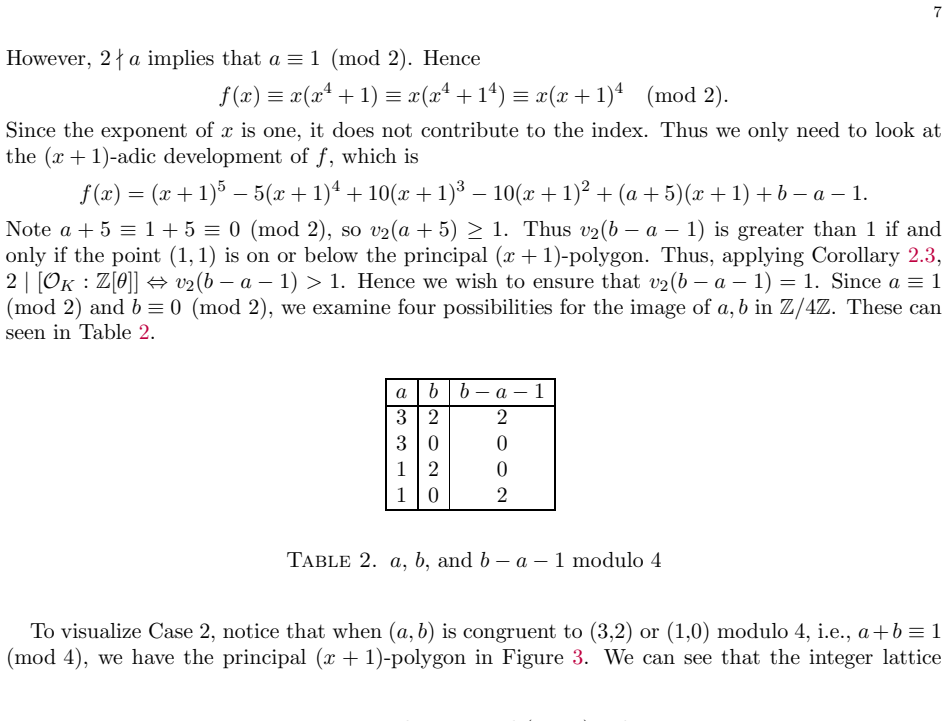
Under the square-free hypotheses, the primes that can divide the index [O_{Q(θ)} : Z[θ]] are exactly the primes dividing a specific gcd of coefficient terms, and monogeneity is decided by finitely many congruence conditions: for $x^{5}$+ax+b, conditions modulo 4 and 25 for primes 2 and 5; for $x^{6}$+ax+b, additional conditions modulo 9 for prime 3; for $x^{5}$+$cx^{4}$+d, square-freeness of d plus a condition modulo 25; for $x^{6}$+$cx^{5}$+d, square-freeness of d plus conditions modulo 4 and 9. The paper also proves that for every n>2, the family x^n+bx+b is monogenic for a set of b of density at least 21.58%, and that x^n+$cx^{{n-1}}$+cd is monogenic for a set of d of positive density when c has one prime factor or has two prime factors and is coprime to 6, with a larger lower bound in the latter case.
Load-bearing premise
The load-bearing premise is that the stated square-free factor of the discriminant is indeed square-free (and, for Theorem 3.6, that gcd(c,n)=1, a condition used in the proof but missing from the theorem statement).
Editorial extensions
If this is right
- For the degree 5 and 6 families, monogeneity becomes a finite congruence check whenever the stated discriminant factor is square-free, so one can enumerate candidates for power integral bases algorithmically.
- The families x^n+bx+b and x^n+cx^{n-1}+cd supply infinitely many monogenic number fields in every degree n>2, not just degrees 5 and 6.
- The density bounds in Theorems 3.5 and 3.6 show that monogeneity is not a rare phenomenon in these coefficient families, even though the full monogenic set is not completely characterized.
- The equivalence between one-sided Newton polygons and Dedekind's index criterion gives a geometric way to visualize and test a classical criterion, and the Montes algorithm carries strictly more information than the index criterion alone.
Reading between the lines
- The missing gcd(c,n)=1 hypothesis in the statement of Theorem 3.6 is likely repairable: one could add congruence conditions treating primes dividing both c and n, in the style of Theorems 3.1-3.4, rather than relying on Prachar's theorem for coprime residue classes.
- The congruence characterizations for n=5 and 6 suggest that for general n the analogous monogeneity conditions would take the form of p-adic congruence classes coming from one-sided Newton polygons, potentially yielding a full recursive classification for all n.
- If the square-freeness events in the density proofs were independent, the paper's own computation shows the density lower bounds would rise to roughly 0.28-0.61 for x^n+bx+b and up to about 0.74 for x^n+cx^{n-1}+cd; testing the actual correlations numerically would clarify how much the current bounds understate the true densities.
- The computational table indicates cases where the square-free hypotheses fail but the polynomial is still monogenic, so the true monogenic set is larger than the theorems capture; a refined analysis of when repeated discriminant factors fail to contribute to the index would extend the classification.
Signed reviews
Editorial analysis
A structured set of objections, weighed in public.
Referee Report
Summary. The paper studies monogeneity of trinomials. For the families x^n+ax+b and x^n+cx^{n-1}+d with n=5,6 and a square-free quotient of the discriminant, Theorems 3.1–3.4 give necessary and sufficient congruence conditions on the coefficients for a root to generate a power integral basis, proved via the Montes algorithm and Ore's theorem. For general n>2, Theorems 3.5 and 3.6 claim that the specialized families x^n+bx+b and x^n+cx^{n-1}+cd contain infinitely many monogenic examples, with explicit lower bounds on the natural density of the coefficients, using Prachar's theorem on square-free values in arithmetic progressions. The paper also remarks on the equivalence between the index part of the Montes algorithm and Dedekind's index criterion, and it includes computational data comparing the proved densities with observed monogeneity rates.
Significance. The n=5,6 congruence criteria are clean and appear to be a useful complement to the more general criteria of Jakhar–Khanduja–Sangwan, and the density analysis is a genuine addition to the existing literature on monogenic trinomials. The proofs of Theorems 3.1–3.5 are carefully structured around Ore's theorem and the Greenfield–Drucker discriminant formula, and the logical dependencies are transparent. The main weakness is Theorem 3.6, where the proof assumes a coprimality condition that is absent from the theorem statement; this is a statement–proof mismatch in a load-bearing result.
major comments (1)
- [Section 5, Theorem 3.6 (statement p. 5; proof p. 11)] The statement of Theorem 3.6 allows any nonzero square-free c with c ≠ ±1, but the proof begins with the additional hypothesis gcd(c,n)=1. This assumption is essential: the density calculation applies Prachar's theorem (Theorem 5.1) to the residue class m = (1−n)^{n−1} c^{n−1} modulo n^n, and Prachar's theorem requires gcd(m, n^n)=1, which is equivalent to gcd(c,n)=1. If a prime p divides both c and n, then every integer M(d) = d n^n + (1−n)^{n−1} c^{n−1} is divisible by p, so the density of square-free values M(d) is 0, not the positive quantity (6/π²)∏_{p|n} p²/(p²−1) that is inserted into the constant B. Consequently the lower bound B is not derived for allowed parameters such as n=3, c=3 or n=4, c=2, and the 'in particular' positivity and infinitude conclusions are not established in the stated generality. The theorem should either add gcd(c,n)=1 to its hypotheses or provide a separate argument for the non-coprime case (for instance, by removing the primes dividing gcd(c,n) from the square-free requirement on M(d)).
minor comments (3)
- [Title] The title contains a typographical artifact: 'T rinomials' should be 'Trinomials'.
- [Remark 3.7] The text 'See Section6' is missing a space and should read 'See Section 6'.
- [Sections 5 and 6] The density statements are formulated for natural density over N, but the theorems involve arbitrary integer coefficients; the authors should clarify that the densities are computed among positive values of the relevant parameter (or give a convention for handling negative integers).
Circularity Check
No significant circularity: the derivations are self-contained, with only a non-load-bearing self-citation for background.
full rationale
The central claims (Theorems 3.1–3.6) derive monogeneity via Ore's index theorem (Theorem 2.2), the Greenfield–Drucker discriminant formula (Theorem 2.1), and Prachar's square-free distribution theorem (Theorem 5.1). The only cited work by an author of this paper is [21] (H. Smith), used for the Montes-algorithm overview and for the previously studied n=4 case; neither supports any of the n=5, n=6, or density theorems. The proof of Theorem 3.6 does assume gcd(c,n)=1 although the statement does not state it, and Prachar's theorem requires that coprimality for the density argument; this is a statement–proof gap affecting the claimed generality of the positive-density bound, not a circularity, because the bound is not shown to be equivalent to an input or fitted to the conclusion. No prediction is obtained from fitted parameters, no uniqueness theorem is imported from the authors' prior work, and no known result is merely renamed. The paper is self-contained against external benchmarks (Ore, Greenfield–Drucker, Prachar, and the independent Jakhar–Khanduja–Sangwan / Jones–White comparisons), so the circularity score is 0.
Assumptions & free parameters
assumptions (5)
- standard math Ore's theorem of the index (Theorem 2.2), relating v_p([O_K:Z[theta]]) to the sum of phi-indices and giving equality under residual separability.
- standard math Greenfield-Drucker trinomial discriminant formula (Theorem 2.1), used to compute Delta_f for x^n + a x^k + b.
- standard math Prachar's theorem on square-free values in arithmetic progressions (Theorem 5.1), used for the density claims.
- standard math Dedekind's index criterion (Theorem 2.4), used for the equivalence remark in Section 2.
- domain assumption The trinomials studied are assumed irreducible, and each theorem inherits this as part of its hypothesis.
Cite this review
Pith. "Pith review of Monogenic fields arising from trinomials." pith.science (2026). https://pith.science/paper/TFZYU4SN
@misc{pith2026190809793,
  author       = {Pith},
  title        = {Pith review of: Monogenic fields arising from trinomials},
  year         = {2026},
  howpublished = {\url{https://pith.science/paper/TFZYU4SN}},
  note         = {Machine review of arXiv:1908.09793}
}
abstract
We call a polynomial monogenic if a root $\theta$ has the property that $\mathbb{Z}[\theta]$ is the full ring of integers in $\mathbb{Q}(\theta)$. Consider the two families of trinomials $x^n + ax + b$ and $x^n + cx^{n-1} + d$. For any $n>2$, we show that these families are monogenic infinitely often and give some positive densities in terms of the coefficients. When $n=5$ or 6 and when a certain factor of the discriminant is square-free, we use the Montes algorithm to establish necessary and sufficient conditions for monogeneity, illuminating more general criteria given by Jakhar, Khanduja, and Sangwan using other methods. Along the way we remark on the equivalence of certain aspects of the Montes algorithm and Dedekind's index criterion.
Figures
Figures from the paper (1 more)

Forward citations
Cited by 1 Pith paper
-
Discriminants of Fields Generated by Polynomials of Given Height
New upper bounds on how many monic integer polynomials of degree n and height H share a fixed field discriminant, plus improved lower bounds for distinct discriminants from trinomials.
Reference graph
Works this paper leans on
-
[1]
A. R. Booker and T. D. Browning. Square-free values of red ucible polynomials. Dis- crete Anal. , Paper No. 8, 16, 2016. ISSN 2397-3129. doi: 10.19086/da.73 2. URL https://doi.org/10.19086/da.732. 14 R. IBARRA, H. LEMBECK, M. OZASLAN, H. SMITH, AND K. STANGE
-
[2]
D. W. Boyd, G. Martin, and M. Thom. Squarefree values of tr inomial discriminants. LMS J. Comput. Math. , 18(1):148–169, 2015. ISSN 1461-1570. doi: 10.1112/S1461 157014000436. URL https://doi.org/10.1112/S1461157014000436
- [3]
-
[4]
J.-H. Evertse and K. Gy˝ ory. Discriminant equations in Diophantine number the- ory, volume 32 of New Mathematical Monographs . Cambridge University Press, Cam- bridge, 2017. ISBN 978-1-107-09761-2. doi: 10.1017/CBO97 81316160763. URL https://doi.org/10.1017/CBO9781316160763
doi:10.1017/cbo97 2017
-
[5]
L. E. Fadil, J. Montes, and E. Nart. Newton polygons and p- integral bases of quartic number fields. Journal of Algebra and Its Applica- tions, 11(04):1250073, 2012. doi: 10.1142/S0219498812500739. URL https://www.worldscientific.com/doi/abs/10.1142/S0219498812500739
-
[6]
I. Ga´ al. Diophantine equations and power integral bases . Birkh¨ auser/Springer, Cham,
-
[7]
T. A. Gassert. Discriminants of Chebyshev radical exten sions. J. Th´ eor. Nombres Bordeaux , 26(3):607–634, 2014. ISSN 1246-7405. URL http://jtnb.cedram.org/item?id=JTNB_2014__26_2_607_0
work page 2014
-
[8]
T. A. Gassert. A note on the monogeneity of power maps. Albanian J. Math. , 11(1):3–12,
Show all 23 references
-
[9]
M.-N. Gras. Condition n´ ecessaire de monog´ en´ eit´ e del’anneau des entiers d’une extension ab´ elienne deQ. In S´ eminaire de th´ eorie des nombres, Paris 1984–85, volume 63 of Progr. Math., pages 97–107. Birkh¨ auser Boston, Boston, MA, 1986
1984
-
[10]
M.-N. Gras. Non monog´ en´ eit´ e de l’anneau des entiersdes extensions cycliques de Q de degr´ e premier l ≥ 5. J. Number Theory , 23(3):347–353, 1986. ISSN 0022-314X. doi: 10.1016/ 0022-314X(86)90079-X. URL https://doi.org/10.1016/0022-314X(86)90079-X
1986 doi
-
[11]
G. R. Greenfield and D. Drucker. On the discriminant of a t rinomial. Linear Alge- bra Appl. , 62:105–112, 1984. ISSN 0024-3795. doi: 10.1016/0024-379 5(84)90089-2. URL https://doi.org/10.1016/0024-3795(84)90089-2
1984 doi
-
[12]
Gu` ardia, J
J. Gu` ardia, J. Montes, and E. Nart. Higher newton polyg ons and integral bases. Journal of Number Theory, 147:549 – 589, 2015. ISSN 0022-314X. doi: https://doi.org /10.1016/j.jnt.2014. 07.027. URL http://www.sciencedirect.com/science/article/pii/S0022314X14002777
2015 doi
-
[13]
Jakhar, S
A. Jakhar, S. K. Khanduja, and N. Sangwan. On prime divis ors of the index of an algebraic integer. J. Number Theory , 166:47–61, 2016. ISSN 0022-314X. doi: 10.1016/j.jnt.201 6.02.021. URL https://doi.org/10.1016/j.jnt.2016.02.021
2016 doi
-
[14]
Jakhar, S
A. Jakhar, S. K. Khanduja, and N. Sangwan. Characteriza tion of primes dividing the index of a trinomial. Int. J. Number Theory , 13(10):2505–2514, 2017. ISSN 1793-0421. doi: 10.1142/ S1793042117501391. URL https://doi.org/10.1142/S1793042117501391
2017 doi
-
[15]
Jones and T
L. Jones and T. Phillips. Infinite families of monogenic trinomials and their Galois groups. In- ternat. J. Math. , 29(5):1850039, 11, 2018. ISSN 0129-167X. doi: 10.1142/S0 129167X18500398. URL https://doi.org/10.1142/S0129167X18500398
2018 doi
-
[16]
Jones and D
L. Jones and D. White. Monogenic trinomials with non-sq uarefree discriminant. arXiv e-prints, art. arXiv:1908.07947, Aug 2019
1908 arXiv
-
[17]
K. S. Kedlaya. A construction of polynomials with squar efree discriminants. Proc. Amer. Math. Soc., 140(9):3025–3033, 2012. ISSN 0002-9939. doi: 10.1090/S0 002-9939-2012-11231-6. URL https://doi.org/10.1090/S0002-9939-2012-11231-6
2012 doi
-
[18]
Narkiewicz
W. Narkiewicz. Elementary and analytic theory of algebraic numbers . Springer Monographs in Mathematics. Springer-Verlag, Berlin, third edition, 200 4. ISBN 3-540-21902-1. doi: 10.1007/ 15 978-3-662-07001-7. URL https://doi.org/10.1007/978-3-662-07001-7
-
[19]
Ø. Ore. Newtonsche Polygone in der Theorie der algebrai schen K¨ orper. Math. Ann., 99(1):84–117, 1928. ISSN 0025-5831. doi: 10.1007/BF0145 9087. URL https://doi.org/10.1007/BF01459087
1928 doi
-
[20]
K. Prachar. ¨Uber die kleinste quadratfreie zahl einer arithmetischen r eihe. Monatshefte f¨ ur Mathematik, 62:173–176, 1958. URL http://eudml.org/doc/177039
1958
-
[21]
H. Smith. Two families of monogenic S4 quartic number fields. Acta Arith. , 186(3):257–271, 2018. ISSN 0065-1036. doi: 10.4064/aa180 423-24-8. URL https://doi.org/10.4064/aa180423-24-8
2018 doi
-
[22]
Westlund
J. Westlund. On the fundamental number of the algebraic number-field k( p√m). Trans. Amer. Math. Soc. , 11(4):388–392, 1910. ISSN 0002-9947. doi: 10.2307/19886 40. URL https://doi.org/10.2307/1988640. Email address : Henry.Lembeck@colorado.edu Email address : Mohammad.Ozaslan@c...
1910 doi
-
[2019]
doi: 10 .1007/978-3-030-23865-0
ISBN 978-3-030-23864-3; 978-3-030-23865-0. doi: 10 .1007/978-3-030-23865-0. URL https://doi.org/10.1007/978-3-030-23865-0 . Theory and algorithms, Second edition of [ MR1896601]
Reviewed August 14, 2026 · model on record in the stance chip above.
Discussion (0). Continue with ORCID to comment.