REVIEW 3 major objections 4 minor 2 cited by
Update on Glueballs
T0 review · 3 major / 4 minor · reviewed 2026-08-09 · deepseek-v4-flash
Pith's one-line read The paper argues that no scalar state below about 2 GeV is predominantly a glueball, and that the light scalars f0(1370), f0(1500), and f0(1710) are better understood as molecular states.
desk verdict A useful conference-proceedings review of recent lattice glueball work, but its headline no-glueball-below-2-GeV claim rests on an exploratory single-operator calculation and is stated more firmly in the abstract than the body supports. read the letter →
The pith
A machine-rendered reading of the paper's core claim, the machinery that carries it, and where it could break.
The reading
What carries the argument
The carrying mechanism is the finite-volume correlation matrix $C_{ij}(t)=\langle 0|O_i(t)O_j(0)|0\rangle$, processed with a pivot diagonalization that yields stationary-state energies and operator overlap factors $Z_j^{(n)}=\langle 0|O_j|n\rangle$; the overlaps reveal which operator predominantly creates each level. In the scalar channel, the $12\times12$ basis of two quark-antiquark operators and ten meson-meson operators is enlarged to a $13\times13$ matrix by adding one scalar glueball operator, and the comparison of the two spectra is what exposes the absence of a low-lying glueball-dominated level. Supporting machinery includes smeared Wilson-loop glueball operators, vacuum-expectation-value subtraction in the scalar channel, and the pure-gauge glueball spectrum used as the baseline for mass expectations.
What would settle it
Repeat the scalar-channel calculation on a larger lattice at physical pion mass with a much larger operator set, including several scalar glueball operators of different sizes and three- and four-meson operators: if a finite-volume level below about $1.9\,m_{\rm ref}$ with dominant glueball overlap appears, the central claim is refuted. A confirmed scalar resonance below 2 GeV with flavor-symmetric decays in gluon-rich production that resists molecular and quark-antiquark descriptions would also put the molecular interpretation under pressure.
Extended reading notes
Core claim
On its own terms, the paper's central finding is that in the isoscalar scalar channel of $N_f=2+1$ lattice QCD, adding one scalar glueball operator to a basis of two quark-antiquark and ten meson-meson operators does not generate any new low-lying finite-volume level. The extracted operator overlaps show that no energy eigenstate below about $1.9\,m_{\rm ref}$ is predominantly produced by the scalar glueball operator; the only additional level lies above the region where the operator set is designed to create states. The author concludes that no scalar state below roughly 2 GeV can be considered a predominantly glueball state, and that the experimentally observed $f_0(1370)$, $f_0(1500)$, and $f_0(1710)$ are more naturally interpreted as molecular states. The calculation is explicitly labeled exploratory and insufficient for definitive statements about the infinite-volume resonances.
Load-bearing premise
The claim assumes that the exploratory operator basis --- two quark-antiquark operators, ten meson-meson operators, and one scalar glueball operator --- is complete enough that any predominantly glueball finite-volume level below about $1.9\,m_{\rm ref}$ would have appeared in the $13\times13$ spectrum.
Editorial extensions
If this is right
- The light scalar mesons $f_0(1370)$, $f_0(1500)$, and $f_0(1710)$ should not be identified with the scalar glueball predicted near 1.6--1.7 GeV by pure-gauge lattice QCD.
- If the calculation is right, a predominantly glueball scalar state must lie above the region probed or be so strongly mixed that no single finite-volume level carries dominant glueball character below about $1.9\,m_{\rm ref}$.
- Glueball searches with dynamical quarks must include meson-meson operators; glueball-only operator sets cannot settle whether the scalar sector contains a glueball.
- The BESIII $X(2370)$ with quantum numbers $0^{-+}$ is a pseudoscalar glueball candidate whose mass agrees with the pure-gauge result, but the identification is not definitive without decay-pattern and mixing information.
- Resonance parameters for any glueball will require fits of scattering $K$-matrix parametrizations to finite-volume spectra through a Lüscher-type quantization condition.
Reading between the lines
- One testable extension is to run the same with-versus-without comparison in the pseudoscalar channel, adding a $0^{-+}$ glueball operator to $\eta$, $\eta'$, and meson-meson operators, to test whether the $X(2370)$ region contains a glueball-dominated level.
- If the molecular interpretation is correct, coupled-channel scattering amplitudes for $\pi\pi$, $K\bar K$, and $\eta\pi$ should reproduce the $f_0(1370)$, $f_0(1500)$, and $f_0(1710)$ lineshapes without needing a bare scalar glueball.
- A larger lattice at physical pion mass with several scalar glueball operators of different sizes would either confirm the null result or reveal that the current absence is a basis artifact.
- Unquenching may change what 'glueball' means: the pure-gauge scalar state could dissolve into a broad mixture of meson-meson and gluonic components rather than appearing as a distinct resonance.
Editorial analysis
A structured set of objections, weighed in public.
Referee Report
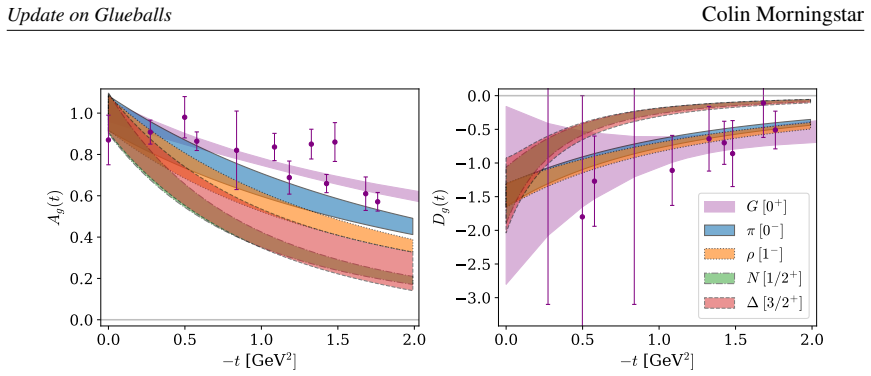
Summary. This proceedings contribution reviews recent lattice-QCD work on glueballs, covering pure-gauge spectroscopy, Nf=4 spectra, radiative decays, error-reduction algorithms, pseudoscalar glueball-eta mixing, gravitational form factors, and scalar-glueball scattering. The paper's central and most consequential content is Sec. 2.7, which summarizes an exploratory Nf=2+1 calculation (Refs [26,27]) using a 12x12 correlation matrix of two q-qbar and ten meson-meson operators, and a 13x13 matrix with one additional scalar glueball operator. The paper reports that no finite-volume energy eigenstate below about 1.9 m_ref (with m_ref = 2 m_K) is predominantly created by a scalar glueball operator, and it goes on to suggest that no scalar state below about 2 GeV is predominantly a glueball, with the f0(1370), f0(1500), and f0(1710) resonances possibly being molecular in nature.
Significance. The paper is a timely and readable survey of active glueball topics, and the explicit discussion of BESIII's X(2370) quantum-number determination is useful. The central claim about the absence of a predominantly-glueball scalar below roughly 2 GeV is provocative: if correct, it would reshape the interpretation of the light scalar mesons and challenge common glueball assignments in the f0(1370)/f0(1500)/f0(1710) system. However, the claim rests on a single exploratory ensemble with m_pi ~ 390 MeV, one volume, and a small operator set. The paper is honest in Sec. 2.7 about the exploratory nature of the finite-volume calculation, but the abstract and conclusion state the claim more definitively than the evidence warrants. The review also correctly emphasizes the technical challenges of glueball spectroscopy with dynamical quarks. The paper would benefit from a more cautious framing and from explicit documentation of the operator-overlap properties on which the main inference rests.
major comments (3)
- [Sec. 2.7, Fig. 10] The inference that no state below about 1.9 m_ref is predominantly a glueball depends on the single scalar glueball operator in the 13x13 matrix having sufficiently strong overlap with any physical glueball-dominated state to reveal it as a new level. The paper does not report the construction, smearing levels, or operator overlap factors Z for this operator, nor does it provide a variational or truncation check demonstrating that the operator basis is complete for the glueball channel in this energy region. Pure-gauge glueball spectroscopy typically requires multiple operators of differing sizes and shapes to achieve good overlap; with only one glueball operator, the 'essentially unchanged' spectrum could be a basis artifact rather than evidence of absence.
- [Abstract and Sec. 3] The statement 'no scalar state below 2 GeV or so can be considered to be predominantly a glueball state' is stronger than the finite-volume result stated in Sec. 2.7, which is limited to 'no finite-volume energy eigenstate below ~1.9 m_ref can be identified as being predominantly created by a scalar glueball operator' and is explicitly acknowledged to be insufficient for definitive infinite-volume statements. The leap from an operator-basis statement to a claim about physical resonances requires additional assumptions about the completeness of the operator set and about the mapping of finite-volume levels to infinite-volume resonances at m_pi ~ 390 MeV; these assumptions are not demonstrated. The abstract and conclusion should be reworded to match the qualifiers in Sec. 2.7.
- [Sec. 2.7, molecular interpretation] The suggestion that f0(1370), f0(1500), and f0(1710) are molecular follows from finding 'only two qq dominated states below 2 m_ref.' This count is itself a property of the specific operator basis and of the single ensemble; if qq operators with different radial or orbital structures are missing, or if the qq operators have poor overlap with the physical states, the number of qq-dominated levels could be underestimated. The paper should either provide a systematic check of operator completeness (for example, tests with additional operators) or explicitly list this as a caveat that prevents drawing the molecular conclusion.
minor comments (4)
- [Sec. 1] The text reads 'Millenium Prize problems'; the correct spelling is 'Millennium'.
- [Sec. 2.7, Fig. 10] The quantity m_ref is defined only in the Fig. 10 caption as m_ref = 2 m_K; it should be defined in the text where it first appears in Sec. 2.7.
- [Sec. 2.7] The statement that the low-lying spectrum is 'essentially unchanged' would be more convincing if the numerical energies and overlap factors were given in a table, rather than only in the rearranged figure.
- [References] Since the central result depends on Refs [26,27], it would help readers to know that one is an AIP Conference Proceedings contribution and the other a PhD thesis; this context is not provided in the reference list.
Circularity Check
No significant circularity: the no-glueball suggestion is an interpretation of an exploratory finite-volume lattice calculation, not a fit or definitional reduction.
full rationale
This paper is a conference review; its central claim ('no scalar state below 2 GeV or so can be considered to be predominantly a glueball state') is not derived here from first principles, but carried over from the exploratory lattice study of Refs [26,27] and presented as a summary. No new parameters are fitted and no input quantity is renamed as a prediction. The lattice result itself is a statement about finite-volume overlap factors: none of the extracted levels below ~1.9 m_ref has its largest overlap with the single scalar glueball operator. That is a direct variational analysis output, not an identity forced by the input. The physical extrapolation from 'no level is predominantly glueball-operator in this basis' to 'no scalar state is predominantly glueball' assumes the one glueball operator has adequate overlap with any true glueball-dominated state; this is a completeness/overlap limitation, not a circular step. The paper itself states the limitation: 'While these finite-volume results are insufficient to make any definitive statements regarding the infinite-volume resonances in this channel, we can make some qualitative comparisons to experiment' (Sec. 2.7). The dependence on the author's own collaboration (Refs [26,27]) lowers the independent weight of the conclusion but is transparent self-citation in a review, not a definitional equivalence.
Assumptions & free parameters
free parameters (3)
- scale-setting for pure-gauge glueball masses =
r0^-1 = 410 MeV
- pion mass on the Nf=2+1 ensemble =
m_pi ~ 390 MeV
- operator basis for the scalar channel =
2 q qbar + 10 meson-meson operators (12x12); plus 1 glueball operator (13x13)
assumptions (4)
- standard math Euclidean correlation matrices have a spectral decomposition into discrete exponentials with energies E_n, so finite-volume energies can be extracted from fits to C_ij(t).
- domain assumption Finite-volume energy levels and their operator overlaps can be interpreted in terms of hadronic states and their dominant quark-gluon content.
- domain assumption The pure-gauge Yang-Mills glueball spectrum provides a relevant benchmark for physical, dynamical-quark QCD.
- ad hoc to paper The hand-built operator basis in the Nf=2+1 scalar study is complete enough below about 2 m_ref that no predominantly glueball state is missed.
Cite this review
Pith. "Pith review of Update on Glueballs." pith.science (2026). https://pith.science/paper/TGJYQWK3
@misc{pith2026250202547,
  author       = {Pith},
  title        = {Pith review of: Update on Glueballs},
  year         = {2026},
  howpublished = {\url{https://pith.science/paper/TGJYQWK3}},
  note         = {Machine review of arXiv:2502.02547}
}
read the original abstract
The recent BESIII announcement of a pseudoscalar glueball candidate makes an update on glueballs from lattice QCD timely. A brief review of how glueballs are studied in lattice QCD is given, and the reasons that glueballs are difficult to study both in lattice QCD with dynamical quarks and in experiments are outlined. Recent glueball studies in lattice QCD are then presented, and an exploratory investigation of the scalar glueball using glueball, meson, and meson-meson operators is summarized, suggesting that no scalar state below 2 GeV or so can be considered to be predominantly a glueball state.
Figures


Figures from the paper (7 more)




Forward citations
Cited by 2 Pith papers
-
Lattice evidence that scalar glueballs are small
First lattice extraction of scalar glueball gravitational form factors gives a mass radius of 0.263(31) fm, smaller than typical hadrons.
-
Flavor mixing in charmonium and light mesons with optimal distillation profiles
In two lattice QCD ensembles, flavor-singlet charmonium and light-meson operators mix with each other and with gluonic operators, and adding a two-pion operator reveals an additional low-lying state.
Reference graph
Works this paper leans on
-
[1]
BESIII collaboration, Determination of Spin-Parity Quantum Numbers of𝑋(2370) as 0−+ from𝐽/𝜓→𝛾𝐾 0 𝑆𝐾 0 𝑆𝜂 ′ ,Phys. Rev. Lett.132 (2024) 181901
work page 2024
-
[2]
BESIII collaboration, Confirmation of the𝑋(1835) and Observation of the Resonances 𝑋(2120) and𝑋(2370) in𝐽/𝜓→𝛾𝜋+𝜋−𝜂 ′ ,Phys. Rev. Lett.106 (2011) 072002
work page 2011
-
[3]
G. Bali, K. Schilling, A. Hulsebos, A. Irving, C. Michael and P. Stephenson,A comprehensive lattice study of SU(3) glueballs,Physics Letters B309 (1993) 378
work page 1993
-
[4]
C.J. Morningstar and M. Peardon,Glueball spectrum from an anisotropic lattice study,Phys. Rev. D60(1999) 034509
work page 1999
-
[5]
Y. Chen, A. Alexandru, S.J. Dong, T. Draper, I. Horváth, F.X. Lee et al.,Glueball spectrum and matrix elements on anisotropic lattices, Phys. Rev. D73(2006) 014516
work page 2006
-
[6]
E. Gregory, A. Irving, B. Lucini, C. McNeile, A. Rago, C. Richards et al.,Towards the glueball spectrum from unquenched lattice QCD,JHEP 10 (2012) 170
work page 2012
- [7]
-
[8]
D0 and TOTEM collaboration, Odderon Exchange from Elastic Scattering Differences between𝑝𝑝 and𝑝𝑝 Data at 1.96 TeV and from𝑝𝑝 Forward Scattering Measurements, Phys. Rev. Lett.127 (2021) 062003
work page 2021
Show all 28 references
-
[9]
Clay Mathematics Institute Millenium Prize Problems: Yang-Mills and the Mass Gap
“Clay Mathematics Institute Millenium Prize Problems: Yang-Mills and the Mass Gap.” https://www.claymath.org/millennium/yang-mills-the-maths-gap
-
[10]
Teper,An improved method for lattice glueball calculations,Physics Letters B183(1987) 345
M. Teper,An improved method for lattice glueball calculations,Physics Letters B183(1987) 345
1987
-
[11]
Morningstar and M.J
C. Morningstar and M.J. Peardon,Analytic smearing of SU(3) link variables in lattice QCD, Phys. Rev. D69(2004) 054501
2004
-
[12]
Jaffe, K
R. Jaffe, K. Johnson and Z. Ryzak,Qualitative features of the glueball spectrum, Annals of Physics 168(1986) 344
1986
-
[13]
Carlson, T.H
C.E. Carlson, T.H. Hansson and C. Peterson,Meson, baryon, and glueball masses in the MIT bag model,Phys. Rev. D27(1983) 1556
1983
-
[14]
J. Kuti. private communication
-
[15]
Isgur and J
N. Isgur and J. Paton,Flux-tube model for hadrons in QCD, Phys. Rev. D31 (1985) 2910
1985
-
[16]
Athenodorou, J
A. Athenodorou, J. Finkenrath, A. Lantos and M. Teper,Glueball Spectrum with four light dynamical fermions, 2308.10054
-
[17]
Lüscher,Properties and uses of the Wilson flow in lattice QCD, JHEP 08(2010) 071 [Erratum: JHEP 03 (2014) 092] [1006.4518]
M. Lüscher,Properties and uses of the Wilson flow in lattice QCD, JHEP 08(2010) 071 [Erratum: JHEP 03 (2014) 092] [1006.4518]
2010 arXiv
-
[18]
Zou, L.-C
J. Zou, L.-C. Gui, Y. Chen, W. Qin, J. Liang, X. Jiang et al.,The radiative decay of scalar glueball from lattice QCD,Sci. China Phys. Mech. Astron.67(2024) 111012 [2404.01564]
2024 arXiv
-
[19]
Barca, S
L. Barca, S. Schaefer, F. Knechtli, J.A. Urrea-Niño, S. Martins and M. Peardon,Exponential error reduction for glueball calculations using a two-level algorithm in pure gauge theory, Phys. Rev. D110(2024) 054515 [2406.12656]
2024 arXiv
-
[20]
Athenodorou and M
A. Athenodorou and M. Teper,The glueball spectrum of SU(3) gauge theory in3+ 1 dimensions, JHEP 11(2020) 172 [2007.06422]
2020 arXiv
-
[21]
Jiang, W
X. Jiang, W. Sun, F. Chen, Y. Chen, M. Gong, Z. Liu et al.,𝜂-glueball mixing from𝑁𝑓 = 2 lattice QCD, Phys. Rev. D107 (2023) 094510 [2205.12541]
2023 arXiv
-
[22]
Hadron Spectrumcollaboration,A Novel quark-field creation operator construction for hadronic physics in lattice QCD, Phys. Rev. D80(2009) 054506 [0905.2160]
2009 arXiv
-
[23]
R.Abbott,D.C.Hackett,D.A.Pefkou,F.Romero-LópezandP.Shanahan, Gravitationalform factors of glueballs in Yang-Mills theory, PoS LATTICE2024(2025) 459 [2410.02706]
2025 arXiv
-
[24]
Pefkou, D.C
D.A. Pefkou, D.C. Hackett and P.E. Shanahan,Gluon gravitational structure of hadrons of different spin, Phys. Rev. D105 (2022) 054509 [2107.10368]. 11 Update on Glueballs Colin Morningstar
2022 arXiv
-
[25]
Hansen, M
M. Hansen, M. Bruno and A. Rago,Towards glueball scattering in lattice Yang-Mills theory, PoS LATTICE2024(2025) 127
2025
-
[26]
Brett, J
R. Brett, J. Bulava, D. Darvish, J. Fallica, A. Hanlon, B. Hörz et al.,Spectroscopy From The Lattice: The Scalar Glueball,AIP Conf. Proc.2249(2020) 030032 [1909.07306]
2020 arXiv
-
[27]
Brett,The Scalar Glueball and𝐾𝜋 Scattering from Lattice QCD, Ph.D
R. Brett,The Scalar Glueball and𝐾𝜋 Scattering from Lattice QCD, Ph.D. thesis, Carnegie Mellon University, 2019
2019
-
[28]
Morningstar, J
C. Morningstar, J. Bulava, J. Foley, K.J. Juge, D. Lenkner, M. Peardon et al.,Improved stochastic estimation of quark propagation with Laplacian Heaviside smearing in lattice QCD, Phys. Rev. D83(2011) 114505 [1104.3870]. 12
2011 arXiv
Reviewed August 9, 2026 · model on record in the stance chip above.
Discussion (0). Continue with ORCID to comment.