Spatio-Temporal Disaggregation with Changing Areal Boundaries
Pith reviewed 2026-06-25 21:51 UTC · model grok-4.3
The pith
Replacing lognormal effects with gamma overdispersion removes one latent variable per polygon-time pair in models for counts reported under changing boundaries.
A machine-rendered reading of the paper's core claim, the machinery that carries it, and where it could break.
Core claim
We develop a computationally efficient spatio-temporal disaggregation method to recover high-resolution risk surfaces from observed counts under changing boundaries. Our approach extends the spatially aggregated log-Gaussian Cox process and uses the Extended Latent Gaussian Model framework for fast approximate posterior inference. We replace standard lognormal polygon-specific effects with gamma-distributed overdispersion which yields a marginal negative binomial likelihood, and removes one latent variable per polygon-time pair.
What carries the argument
Gamma-distributed overdispersion in place of lognormal polygon effects, which produces a marginal negative binomial likelihood and eliminates one latent variable per polygon-time pair inside the aggregated log-Gaussian Cox process.
If this is right
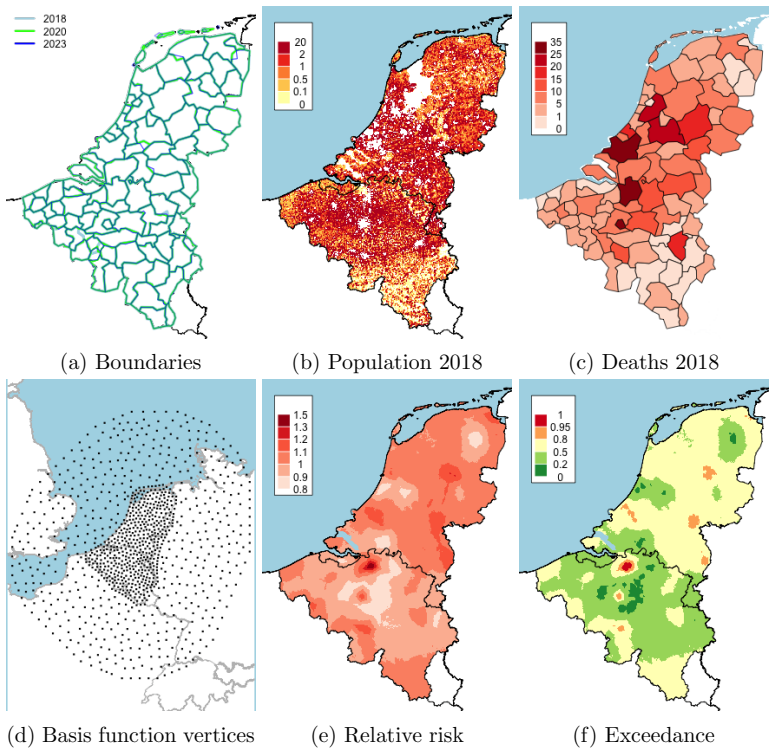
- Enables practical mapping of mortality risk across shifting NUTS-3 boundaries in Belgium and the Netherlands.
- Supports fast approximate posterior inference for large spatio-temporal count datasets.
- Implemented in the open-source R package DAST.
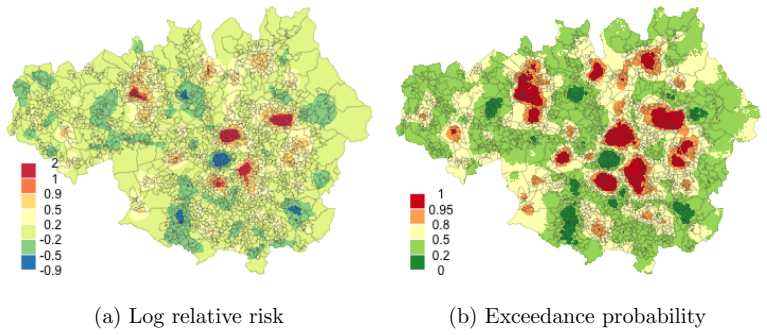
- Applied to a separate Manchester dataset for dissemination.
Where Pith is reading between the lines
- The reduced latent-variable count could allow the same framework to handle higher temporal resolution without a matching rise in compute cost.
- The marginal negative binomial form may let the model plug directly into other count-based spatial tools that already assume negative binomial margins.
- The same boundary-change handling could be tested on non-health count data such as crime incidents or environmental samples collected under evolving administrative units.
Load-bearing premise
Gamma overdispersion is an adequate stand-in for the extra variation normally captured by lognormal polygon effects, and the Extended Latent Gaussian Model approximation stays accurate when boundaries change over time.
What would settle it
Apply the method to a simulated dataset in which the true high-resolution risk surface is known and boundaries change, then check whether the recovered surface lies inside the reported credible intervals.
Figures
read the original abstract
Small area estimation and disease mapping increasingly rely on areal data where reporting boundaries change over time. We develop a computationally efficient spatio-temporal disaggregation method to recover high-resolution risk surfaces from observed counts under changing boundaries. Our approach extends the spatially aggregated log-Gaussian Cox process and uses the Extended Latent Gaussian Model framework for fast approximate posterior inference. We replace standard lognormal polygon-specific effects with gamma-distributed overdispersion which yields a marginal negative binomial likelihood, and removes one latent variable per polygon-time pair. We illustrate the approach by mapping mortality risk across shifting NUTS-3 boundaries in Belgium and the Netherlands. For the purpose of dissemination we use Codex to leverage the methodology presented in this paper for the analysis of a separate data set concerning the city of Manchester. The methodology is implemented in the open-source R package DAST.
Editorial analysis
A structured set of objections, weighed in public.
Referee Report
Summary. The paper develops a computationally efficient spatio-temporal disaggregation method to recover high-resolution risk surfaces from observed counts under changing areal boundaries. It extends the spatially aggregated log-Gaussian Cox process by replacing standard lognormal polygon-specific effects with gamma-distributed overdispersion, yielding a marginal negative binomial likelihood and removing one latent variable per polygon-time pair. Approximate posterior inference is performed using the Extended Latent Gaussian Model (ELGM) framework. The method is illustrated by mapping mortality risk across shifting NUTS-3 boundaries in Belgium and the Netherlands, and applied to a separate Manchester dataset using Codex, with the methodology implemented in the open-source R package DAST.
Significance. If the central approximation holds, this work addresses a practical challenge in small area estimation and disease mapping where reporting boundaries change over time. The computational efficiency gained by the gamma overdispersion choice and ELGM usage, combined with the open-source implementation, could make the method useful for practitioners. The real-world application to European mortality data provides a concrete demonstration.
major comments (1)
- [Methods (ELGM and gamma overdispersion)] The manuscript invokes the ELGM framework for the gamma-overdispersed model under time-varying aggregation boundaries, but provides no simulation study or diagnostic checks to verify the accuracy of the Laplace-type approximation when the observation operator changes across time slices. This is load-bearing for the disaggregation claim, as the changing boundaries may affect the integrand curvature and approximation quality, unlike the static-boundary case.
minor comments (2)
- [Abstract] The sentence 'For the purpose of dissemination we use Codex to leverage the methodology presented in this paper for the analysis of a separate data set concerning the city of Manchester' appears out of place in the abstract and could be moved to the application section or removed for clarity.
- [Abstract] No numerical results, validation metrics, or comparisons to alternative methods are mentioned, making it difficult to assess performance from the summary alone.
Simulated Author's Rebuttal
We thank the referee for their thoughtful review and constructive feedback. We address the single major comment below and agree that additional validation is warranted.
read point-by-point responses
-
Referee: [Methods (ELGM and gamma overdispersion)] The manuscript invokes the ELGM framework for the gamma-overdispersed model under time-varying aggregation boundaries, but provides no simulation study or diagnostic checks to verify the accuracy of the Laplace-type approximation when the observation operator changes across time slices. This is load-bearing for the disaggregation claim, as the changing boundaries may affect the integrand curvature and approximation quality, unlike the static-boundary case.
Authors: We agree that explicit verification of the ELGM Laplace approximation under time-varying observation operators is important for the disaggregation claim. While the ELGM framework is formulated for general (possibly time-dependent) observation models and the gamma overdispersion yields a marginal negative binomial that preserves the latent Gaussian structure, the manuscript does not include targeted diagnostics for changing boundaries. In the revision we will add a simulation study that (i) generates data under shifting areal units, (ii) compares ELGM posterior approximations against MCMC reference solutions, and (iii) reports metrics such as coverage and bias in the recovered high-resolution surfaces. This will directly address the concern about integrand curvature and approximation quality. revision: yes
Circularity Check
No circularity: derivation extends external ELGM framework with independent modeling choice
full rationale
The paper's core construction replaces lognormal polygon effects with gamma overdispersion to obtain a marginal negative binomial likelihood and then applies the pre-existing Extended Latent Gaussian Model (ELGM) approximation for inference. Neither step reduces the target disaggregation result to a quantity defined by the same model or to a self-citation chain; the gamma choice is presented as a modeling decision that removes one latent per polygon-time, and ELGM is invoked as an external computational tool whose accuracy under changing boundaries is an empirical modeling assumption rather than a definitional identity. No equations or claims equate the output risk surface to a fitted input by construction, and the cited frameworks are treated as independent. This is the normal case of an extension whose validity rests on external verification rather than internal reduction.
Axiom & Free-Parameter Ledger
Reference graph
Works this paper leans on
-
[1]
Fast, Scalable Approximations to Posterior Distributions in Extended Latent Gaussian Models , volume =
Stringer, Alex and Brown, Patrick and Stafford, Jamie , address =. Fast, Scalable Approximations to Posterior Distributions in Extended Latent Gaussian Models , volume =. Journal of computational and graphical statistics , keywords =
-
[2]
Log Gaussian Cox processes and spatially aggregated disease incidence data , volume =
Li, Ye and Brown, Patrick and Gesink, Dionne C and Rue, Håvard , address =. Log Gaussian Cox processes and spatially aggregated disease incidence data , volume =. Statistical methods in medical research , keywords =
-
[3]
and Moraga, Paula and Rowlingson, Barry and Taylor, Benjamin M
Diggle, Peter J. and Moraga, Paula and Rowlingson, Barry and Taylor, Benjamin M. , address =. Spatial and Spatio-Temporal Log-Gaussian Cox Processes: Extending the Geostatistical Paradigm , volume =. Statistical science , keywords =
-
[4]
The root-. Spatial Statistics , author =. 2021 , pages =. doi:10.1016/j.spasta.2021.100509 , language =
-
[5]
and Ciuti, Simone and Burkitt, Tim and Morera‐Pujol, Virginia , address =
Murphy, Kilian J. and Ciuti, Simone and Burkitt, Tim and Morera‐Pujol, Virginia , address =. Bayesian areal disaggregation regression to predict wildlife distribution and relative density with low‐resolution data , volume =. Ecological applications , keywords =
-
[6]
Spatial disaggregation of poverty and disability: application to Tanzania , volume =
Fujii, Tomoki , address =. Spatial disaggregation of poverty and disability: application to Tanzania , volume =. Empirical economics , keywords =
-
[7]
Bayesian image restoration, with two applications in spatial statistics , volume =
Besag, Julian and York, Jeremy and Molli, Annie , issn =. Bayesian image restoration, with two applications in spatial statistics , volume =. Annals of the Institute of Statistical Mathematics , language =
-
[8]
and Lucas, Tim C
Nandi, Anita K. and Lucas, Tim C. D. and Arambepola, Rohan and Gething, Peter and Weiss, Daniel J. , issn =. disaggregation : An R Package for Bayesian Spatial Disaggregation Modeling , volume =. Journal of statistical software , language =
-
[9]
Approximate Bayesian inference for latent Gaussian models by using integrated nested Laplace approximations , volume =
Rue, Håvard and Martino, Sara and Chopin, Nicolas , address =. Approximate Bayesian inference for latent Gaussian models by using integrated nested Laplace approximations , volume =. Journal of the Royal Statistical Society. Series B, Statistical methodology , keywords =
-
[10]
2020 , doi =
Gomez-Rubio, Vicente , title =. 2020 , doi =
2020
-
[11]
and Nielsen, A
Kristensen, K. and Nielsen, A. and Berg, C. W. and Skaug, H. and Bell, B. M. , title =. Journal of Statistical Software , volume =. 2016 , doi =
2016
-
[12]
Computational Statistics , author =
The root-. Computational Statistics , author =. 2024 , keywords =. doi:10.1007/s00180-024-01532-y , abstract =
-
[13]
Taylor, B. M. and Diggle, P. J. , title =. Journal of Statistical Computation and Simulation , volume =. 2013 , doi =
2013
-
[14]
Krainski, E. T. and others , title =. 2019 , address =
2019
-
[15]
2023 , isbn =
Moraga, Paula , title =. 2023 , isbn =
2023
-
[16]
Going off grid: computationally efficient inference for log-. Biometrika , author =. 2016 , note =. doi:10.1093/biomet/asv064 , abstract =
-
[17]
Journal of the Royal Statistical Society: Series B (Statistical Methodology) , author =
An explicit link between. Journal of the Royal Statistical Society: Series B (Statistical Methodology) , author =. 2011 , note =. doi:10.1111/j.1467-9868.2011.00777.x , abstract =
-
[18]
2024 , url =
R: A Language and Environment for Statistical Computing , author =. 2024 , url =
2024
-
[19]
and Diggle, P
Johnson, O. and Diggle, P. and Giorgi, E. , title =. Statistics in Medicine , volume =. 2019 , doi =
2019
-
[20]
, issn =
Brown, Patrick E. , issn =. Model-Based Geostatistics the Easy Way , volume =. Journal of statistical software , language =
-
[21]
and Thorley, J
Utazi, C. and Thorley, J. and Alegana, V. and Ferrari, M. and Nilsen, K. and Takahashi, S. and Metcalf, C. and Lessler, J. and Tatem, A. , title =. Statistical Methods in Medical Research , volume =. 2019 , doi =
2019
-
[22]
and Krainski, E
Van Niekerk, J. and Krainski, E. and Rustand, D. and Rue, H. , title =. Computational Statistics & Data Analysis , volume =. 2023 , doi =
2023
-
[23]
and Belmaker, J
Keil, P. and Belmaker, J. and Wilson, A. M. and Unitt, P. and Jetz, W. and Freckleton, R. , title =. Methods in Ecology and Evolution , volume =. 2013 , doi =
2013
-
[24]
Socio-Economic Planning Sciences , volume=
Health-care demand and supply at municipal level: A spatial disaggregation approach , author=. Socio-Economic Planning Sciences , volume=. 2022 , doi=
2022
-
[25]
Computers & Geosciences , volume=
A scalable method for the estimation of spatial disaggregation models , author=. Computers & Geosciences , volume=. 2022 , doi=
2022
-
[26]
Journal of the American Statistical Association , author =
Constructing. Journal of the American Statistical Association , author =. 2019 , note =. doi:10.1080/01621459.2017.1415907 , language =
-
[27]
Penalising. Statistical Science , author =. 2017 , note =. doi:10.1214/16-sts576 , language =
-
[28]
The Annals of Mathematical Statistics , author =
On. The Annals of Mathematical Statistics , author =. 1951 , note =. doi:10.1214/aoms/1177729694 , abstract =
-
[29]
Journal of Statistical Software , author =
Bayesian. Journal of Statistical Software , author =. 2015 , pages =. doi:10.18637/jss.v063.i07 , language =
-
[30]
Scandinavian Journal of Statistics , volume=
Log Gaussian Cox Processes , author=. Scandinavian Journal of Statistics , volume=. 1998 , publisher=
1998
-
[31]
and Priyatikanto, R
Bondarenko, M. and Priyatikanto, R. and Tejedor-Garavito, N. and Zhang, W. and McKeen, T. and Cunningham, A. and Woods, T. and Hilton, J. and Cihan, D. and Nosatiuk, B. and Brinkhoff, T. and Tatem, A. and Sorichetta, A. , title =. Global Demographic Data Project - Funded by The Bill and Melinda Gates Foundation (INV-045237) , doi =. 2025 , publisher =
2025
-
[32]
2024 , note =
2010 Land Cover of North America at 30 meters , howpublished =. 2024 , note =
2010
-
[33]
2024 , note =
2020 Land Cover of North America at 30 meters , howpublished =. 2024 , note =
2020
-
[34]
2021 , Eprint =
Alex Stringer , Title =. 2021 , Eprint =
2021
-
[35]
arXiv preprint arXiv:2109.10330 , year=
A Bayesian hierarchical model for disease mapping that accounts for scaling and heavy-tailed latent effects , author=. arXiv preprint arXiv:2109.10330 , year=. doi:10.48550/arxiv.2109.10330 , eprint=
-
[36]
Analytic Methods in Accident Research , volume=
Using the multivariate spatio-temporal Bayesian model to analyze traffic crashes by severity , author=. Analytic Methods in Accident Research , volume=. 2018 , doi=
2018
-
[37]
2006 , publisher=
Numerical Optimization , author=. 2006 , publisher=
2006
discussion (0)
Sign in with ORCID, Apple, or X to comment. Anyone can read and Pith papers without signing in.