REVIEW 3 major objections 5 minor 119 references
Pressure profiles and mass estimates using high-resolution Sunyaev-Zel'dovich effect observations of Zwicky 3146 with MUSTANG-2
T0 review · 3 major / 5 minor · reviewed 2026-08-14 · deepseek-v4-flash
Pith's one-line read This paper shows that deep, high-resolution 90 GHz Sunyaev-Zel'dovich observations of the relaxed cluster Zwicky 3146 recover the intracluster pressure profile non-parametrically and pin its $M_{500}$ at $8.16^{+0.44}_{-0.54}$ (stat.)…
desk verdict Solid single-cluster SZ measurement with a genuinely useful pipeline advance; the mass is plausible, but the quoted error bar omits a known outer-bin systematic that can move M500 by roughly 20%. read the letter →
The pith
A machine-rendered reading of the paper's core claim, the machinery that carries it, and where it could break.
The reading
What carries the argument
The central object is the Compton $y$ parameter, the line-of-sight integral of thermal electron pressure, which is what the 90 GHz observations measure through the SZ temperature decrement. The argument is carried by three pieces: (1) a non-parametric model that bins pressure into twelve logarithmically spaced radii and fits those bins directly to the detector timestreams with a maximum-likelihood pipeline, recovering scales beyond the 4.25-arcminute field of view; (2) a generalized NFW pressure profile with A10 shape parameters as a parametric cross-check; and (3) three mass estimators -- integrated $Y_{\rm sph}$ compared with published $Y$-$M$ relations, the hydrostatic equation $M_{\rm HE} = -(d\ln P_e/d\ln r)\,P_e\,r/(n_e\,\mu m_p G)$ using X-ray electron densities, and a virial-theorem expression relating thermal energy to an NFW gravitational potential. All mass estimates are made self-consistent by finding where the derived mass curve crosses the reference $M_{500}(<r)$ curve.
What would settle it
Re-observe Zwicky 3146 with a larger scan radius (or use an independent X-ray pressure measurement beyond 200 arcseconds) and compare the recovered outermost pressure bin with the value assumed here. A rise of roughly a factor of 2.3, as the paper's entropy-power-law test predicts, would confirm the suspected bias and shift the hydrostatic mass estimate upward by about $1.7 \times 10^{14}\,M_\odot$.
Extended reading notes
Core claim
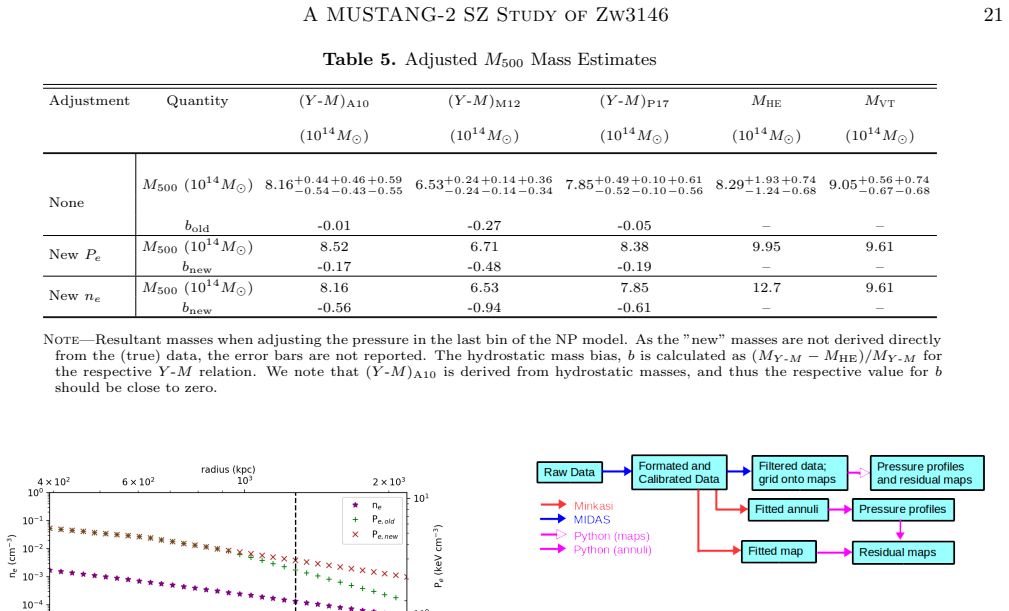
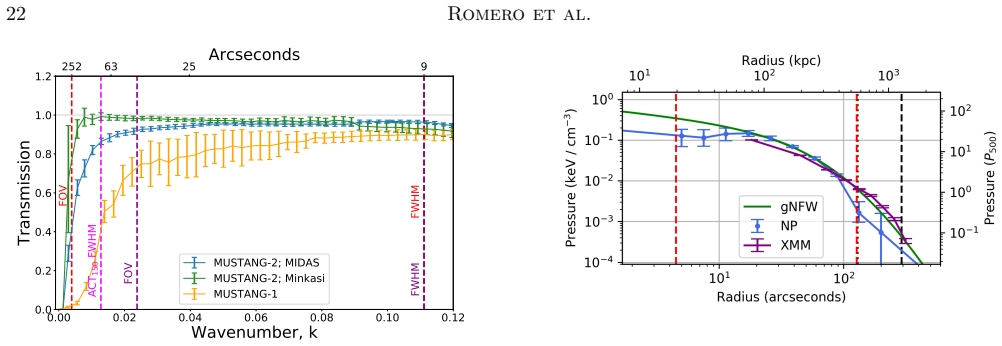
For a relaxed, cool-core cluster, the paper demonstrates that SZ data alone can deliver a deconvolved, non-parametric pressure profile spanning radii from about 5 arcseconds to beyond 300 arcseconds, with the outermost bin extending to infinity. That profile is statistically consistent with the pressure profile derived from XMM-Newton, and it anchors the cluster's total mass: the fiducial estimate $M_{500} = 8.16^{+0.44}_{-0.54}$ (stat.) $^{+0.46}_{-0.43}$ (sys., $Y$-$M$) $^{+0.59}_{-0.55}$ (sys., calibration) $\times 10^{14}\,M_\odot$. The paper also finds that the hydrostatic mass estimate, $8.29^{+1.93}_{-1.24}$ (stat.) $^{+0.74}_{-0.68}$ (sys., calibration) $\times 10^{14}\,M_\odot$, sits above the $Y$-$M$ masses, implying a negative hydrostatic mass bias rather than the usual positive one, and it investigates whether residual SZ substructure or an underestimated outer pressure bin can explain the inconsistencies.
Load-bearing premise
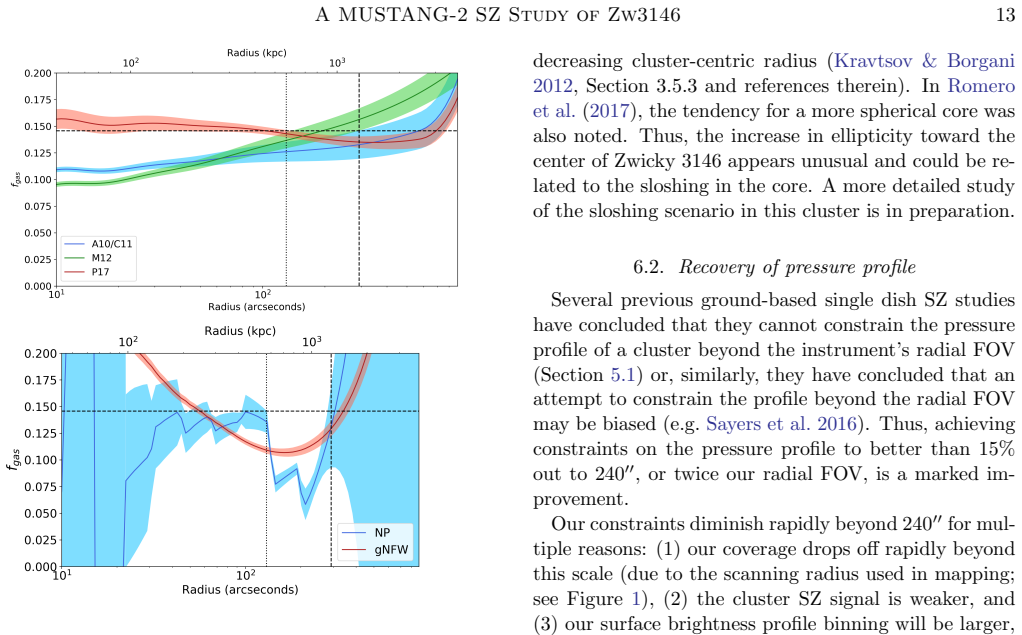
The load-bearing assumption is that the outermost non-parametric pressure bin, spanning 207 arcseconds to infinity, is unbiased; if that bin is low, the paper's own entropy-continuity test raises it by about 2.1 $\sigma$ and pushes $M_{500}$ estimates, such as the hydrostatic one from $8.29$ to $9.95 \times 10^{14}\,M_\odot$, substantially higher.
Editorial extensions
If this is right
- If the non-parametric recovery beyond the field of view is unbiased, single-dish SZ instruments can measure cluster masses to a few percent without relying on X-ray or weak-lensing calibration for the pressure shape.
- The fiducial mass of $\sim 8.16 \times 10^{14}\,M_\odot$ agrees with ACT, Planck, and X-ray based estimates near $8 \times 10^{14}\,M_\odot$, sharpening the picture against weak-lensing estimates that prefer lower masses.
- The negative hydrostatic mass bias, if real, suggests that non-thermal pressure support alone cannot explain the offset between hydrostatic and $Y$-$M$ masses for this cluster, and that calibration of the $Y$-$M$ relations themselves may be implicated.
- The agreement between SZ and X-ray pressure profiles implies that high-resolution SZ data can supply the pressure side of thermodynamic products such as temperature, entropy, and gas fraction when X-ray or other data supply the density.
Reading between the lines
- A direct extension, not made in the paper, is to apply the same timestream-fitting pressure recovery to a sample of relaxed clusters spanning a range of masses and redshifts; if the outer-bin low bias is generic, current SZ mass estimates from ground-based dishes could be systematically low and $Y$-$M$ calibrations would need revisiting.
- The paper's suspected link between the residual SZ decrement and the radio minihalo could be tested with high-resolution spectral-index mapping: a thermal SZ component tracing the minihalo would indicate that sloshing redistributes pressure as well as gas density on small scales.
- If the negative hydrostatic bias persists across a larger sample, the standard practice of applying a 10-30% positive correction for hydrostatic bias in cluster cosmology would have to be reexamined, directly affecting mass-function estimates.
Signed reviews
Editorial analysis
A structured set of objections, weighed in public.
Referee Report
Summary. The paper presents MUSTANG-2 90 GHz Sunyaev-Zel'dovich observations of the relaxed cool-core cluster Zwicky 3146. Using a new maximum-likelihood processing pipeline (Minkasi) that fits surface-brightness annuli directly to time-ordered data, the authors derive non-parametric and gNFW/A10 pressure profiles over 5" to 300", compare them with an XMM-Newton pressure profile, and estimate M500 and M2500 through three routes: Y-M scaling relations (A10, M12, P17, C11), the virial theorem, and hydrostatic equilibrium with an external X-ray electron density profile. The fiducial Y-M mass is 8.16(+0.44,-0.54)(+0.46,-0.43)(+0.59,-0.55)x10^14 M_sun, and the hydrostatic mass is 8.29(+1.93,-1.24)(+0.74,-0.68)x10^14 M_sun. The paper also investigates residuals, temperature, entropy, and gas fraction profiles, and it explicitly analyzes the possibility that the outermost pressure bin is biased low.
Significance. If the central mass estimates held at their quoted precision, this would be a valuable demonstration that a ground-based SZ instrument can constrain a cluster pressure profile non-parametrically beyond its radial field of view, and it would provide a useful multi-method mass comparison for a relaxed cluster that has a wide spread of literature masses. The paper's strengths are its detailed treatment of the Minkasi covariance matrix, the MCMC fitting, the dual-pipeline (MIDAS/Minkasi) comparison, the careful point-source modeling, and the unusually honest Appendix B, which tests the outermost pressure bin against a physically motivated entropy-continuation prior. However, the same appendix shows that this single bin shifts mass estimates by up to about 20%, and Section 7 admits that the associated systematic error cannot yet be quantified. Because the fiducial mass and the hydrostatic mass both integrate over this bin, the quoted error budget is incomplete and the central mass claims are not yet established at the stated precision.
major comments (3)
- [Sections 4.2, Appendix B, Table 5] The outermost non-parametric pressure bin, spanning 207 arcseconds to infinity, is load-bearing for the integrated quantities Y_sph(R500) and the hydrostatic mass profile (Eqs. 6, 7, and 10), yet its value is weakly constrained. Appendix B shows that requiring the entropy profile to continue the fitted r^1.34 power law raises this bin's pressure by a factor of 2.3, a 2.1-sigma shift, and Table 5 reports that this shift moves M_HE from 8.29 to 9.95 x 10^14 M_sun and the fiducial (Y-M)_A10 estimate from 8.16 to 8.52 x 10^14 M_sun, with larger excursions for some other relations. Section 7 concedes that the associated systematic error is currently unquantifiable. As a result, the reported 5.5% statistical and 7% calibration error bars on the fiducial mass do not include a systematic that can change M500 by roughly 20% in a physically motivated direction. The authors should either quantify this systematic with a prior-based analysis or restate the central mass as a range that encompasses the entropy-continuation adjustment.
- [Sections 5.2, 6.3, and 7] The paper finds that the hydrostatic mass is larger than the Y-M masses, implying a negative hydrostatic mass bias, in direct tension with the expected positive bias of 0.1-0.3. This is not a peripheral discrepancy: it is a central consistency check for the three mass estimators. Appendix B shows that the adjustment that resolves the entropy turnover makes the bias more negative (b = -0.17 to -0.48 for the A10 relation), so the tension is not cured by the apparently plausible outer-bin correction. The manuscript should directly examine whether the negative bias points to a bias in the MUSTANG-2 pressure profile, a bias in the XMM electron density profile, or a problem in the adopted Y-M relations. As written, Section 7's statement that there is an additional problem to be solved leaves the origin unresolved and weakens the paper's claim that the mass estimates are self-consistent.
- [Section 4.3.2, Eq. (10)] The hydrostatic mass estimate uses an external X-ray electron density profile, but the quoted errors for M_HE include only statistical and flux-calibration terms; uncertainties in the XMM density profile (background subtraction, absolute calibration, and possible clumping) are not propagated. Given that the hydrostatic mass is one of the headline results and is compared against the Y-M masses, the absence of a ne-related systematic term makes the error budget incomplete. The authors should either quote M_HE with a density-profile systematic term or explicitly present the hydrostatic estimate as a consistency check rather than a primary mass measurement.
minor comments (5)
- [Abstract and Section 6.2] The abstract states that the SZ-derived pressure profile is in excellent agreement with the X-ray pressure profile, but Section 6.2 and Appendix B describe conflicts in derived products such as entropy and hydrostatic mass. I recommend softening the abstract or quantifying the agreement with a goodness-of-fit statistic.
- [Section 4.2] The relativistic SZ correction assumes kBTe = 7 keV, which is reasonable for this cluster, but the sensitivity of the fitted pressure profile and masses to this assumed temperature is not stated. A short statement that the effect is negligible would be sufficient.
- [Section 5.4.2] The gNFW entropy slope is quoted with an uncertainty of 4e-5, which is artificially small because the pressure shape parameters are fixed to the A10 values. The text should note that this uncertainty does not include shape-parameter or calibration systematics.
- [Appendix C] The MIDAS pressure profile shows its two outermost points about 2 sigma below the Minkasi and X-ray profiles, which reinforces the outer-bin concern in Appendix B. Cross-referencing this behavior in Section 4.2 or Appendix B would make the systematic issue easier for the reader to track.
- [Throughout] There are several typographical and wording issues, including 'quadropole' (Section 5.3), 'The conversion is comes from' (Section 4.2), and 'completeleness' (Appendix C). I recommend a careful proofreading pass.
Circularity Check
No significant circularity: the fiducial mass estimate is applied from external scaling relations to a direct SZ measurement, not derived from the paper's own fitted inputs.
full rationale
The paper's central mass claim rests on external calibrations and independent data, not on its own fitted constants or on a self-citation chain. The non-parametric pressure profile is fit directly to MUSTANG-2 timestreams without a mass prior, and the fiducial M500 = 8.16 x 10^14 Msun is obtained by evaluating externally calibrated Y-M relations (A10, M12, P17, C11) on that profile. Hydrostatic masses combine the SZ pressure profile with an XMM-derived electron density profile through Eq. 10, and virial masses apply the fixed-assumption Mroczkowski (2011) relation; neither method feeds fitted parameters back into the pressure fit. The gNFW comparison adopts A10 shape parameters from the literature but is not the fiducial estimator. The Appendix B adjustment of the outermost pressure bin is explicitly a sensitivity test guided by the entropy power-law expectation, and the paper does not promote the adjusted values to a prediction; Section 7 instead concedes that the associated systematic cannot yet be quantified. That concession, and the potential ~20% shift in M500 flagged in Appendix B, is a completeness and error-budget concern about the data, not a circularity of the derivation. No equation in the paper reduces to its own input by construction, and no load-bearing uniqueness claim is imported from overlapping-author prior work.
Assumptions & free parameters
free parameters (4)
- Assumed ICM temperature for relativistic SZ correction =
7 keV
- Gas fraction fgas for virial theorem =
0.13
- Electron mean molecular mass per electron mu_e =
1.17
- gNFW shape parameters alpha, beta, gamma =
1.05, 5.41, 0.31
assumptions (6)
- domain assumption Spherical symmetry of the ICM
- domain assumption Hydrostatic equilibrium with only thermal pressure support
- domain assumption Virial equilibrium and NFW matter profile
- domain assumption Universal pressure profile (A10) shape applies to this cluster
- domain assumption X-ray electron density profile from XMM is reliable
- domain assumption Published Y-M scaling relations are valid calibrations
Cite this review
Pith. "Pith review of Pressure profiles and mass estimates using high-resolution Sunyaev-Zel'dovich effect observations of Zwicky 3146 with MUSTANG-2." pith.science (2026). https://pith.science/paper/THOAS4MX
@misc{pith2026190809200,
  author       = {Pith},
  title        = {Pith review of: Pressure profiles and mass estimates using high-resolution Sunyaev-Zel'dovich effect observations of Zwicky 3146 with MUSTANG-2},
  year         = {2026},
  howpublished = {\url{https://pith.science/paper/THOAS4MX}},
  note         = {Machine review of arXiv:1908.09200}
}
abstract
The galaxy cluster Zwicky 3146 is a sloshing cool core cluster at $z=0.291$ that in X-ray imaging does not appear to exhibit significant pressure substructure in the intracluster medium (ICM). The published $M_{500}$ values range between $3.88^{+0.62}_{-0.58}$ to $22.50 \pm 7.58 \times 10^{14}$ M$_{\odot}$, where ICM-based estimates with reported errors $<20$\% suggest that we should expect to find a mass between $6.53^{+0.44}_{-0.44} \times 10^{14}$ M$_{\odot}$ (from Planck, with an $8.4\sigma$ detection) and $8.52^{+1.77}_{-1.47} \times 10^{14}$ M$_{\odot}$ (from ACT, with a $14\sigma$ detection). This broad range of masses is suggestive that there is ample room for improvement for all methods. Here, we investigate the ability to estimate the mass of Zwicky 3146 via the Sunyaev-Zel'dovich (SZ) effect with data taken at 90 GHz by MUSTANG-2 to a noise level better than $15\ \mu$K at the center, and a cluster detection of $104\sigma$. We derive a pressure profile from our SZ data which is in excellent agreement with that derived from X-ray data. From our SZ-derived pressure profiles, we infer $M_{500}$ and $M_{2500}$ via three methods -- $Y$-$M$ scaling relations, the virial theorem, and hydrostatic equilibrium -- where we employ X-ray constraints from \emph{XMM-Newton} on the electron density profile when assuming hydrostatic equilibrium. Depending on the model and estimation method, our $M_{500}$ estimates range from $6.23 \pm 0.59$ to $10.6 \pm 0.95 \times 10^{14}$ M$_{\odot}$, where our estimate from hydrostatic equilibrium, is $8.29^{+1.93}_{-1.24}$ ($\pm 19.1$\% stat) ${}^{+0.74}_{-0.68}$ ($\pm 8.6$\% sys, calibration) $\times 10^{14}$ M$_{\odot}$. Our fiducial mass, derived from a $Y$-$M$ relation is $8.16^{+0.44}_{-0.54}$ ($\pm 5.5$\% stat) ${}^{+0.46}_{-0.43}$ ($\pm 5.5$\% sys, $Y$-$M$) ${}^{+0.59}_{-0.55}$ ($\pm 7.0$\% sys, cal.) $\times 10^{14}$ M$_{\odot}$.
Figures

Figures from the paper (12 more)







Reference graph
Works this paper leans on
-
[1]
, " * write output.state after.block = add.period write newline
ENTRY address archivePrefix author booktitle chapter doi edition editor eprint howpublished institution journal key month number organization pages publisher school series title misctitle type volume year version url label extra.label sort.label short.list INTEGERS output.state before.all mid.sentence after.sentence after.block FUNCTION init.state.consts ...
-
[2]
write newline
" write newline "" before.all 'output.state := FUNCTION format.url url empty "" new.block "" url * "" * if FUNCTION format.eprint eprint empty "" archivePrefix empty "" archivePrefix "arXiv" = new.block " " eprint * " " * new.block " " eprint * " " * if if if FUNCTION format.doi doi empty "" " " doi * " " * if FUNCTION format.pid doi empty eprint empty ur...
-
[3]
- [1] #1 = = ^ ^ ^ .\!\!^ d .\!\!^ h .\!\!^ m .\!\!^ s .\!\!^ @mss
thebibliography [1] 20pt to REFERENCES 6pt =0pt 10pt plus 3pt =0pt =0pt =1pt plus 1pt =0pt =0pt -12pt =13pt plus 1pt =20pt =13pt plus 1pt \@M =10000 =-1.0em =0pt =0pt 0pt =0pt =1.0em @enumiv\@empty 10000 10000 `\.\@m \@noitemerr \@latex@warning Empty `thebibliography' environment \@ifnextchar \@reference \@latexerr Missing key on reference command Each re...
2017
-
[4]
y @ R4D* Ȁz ]
thebibliography [1] 20pt to REFERENCES 6pt =0pt 10pt plus 3pt =0pt =0pt =1pt plus 1pt =0pt =0pt -12pt =13pt plus 1pt =20pt =13pt plus 1pt \@M =10000 =-1.0em =0pt =0pt 0pt =0pt =1.0em @enumiv\@empty 10000 10000 `\.\@m \@noitemerr \@latex@warning Empty `thebibliography' environment \@ifnextchar \@reference \@latexerr Missing key on reference command Each re...
2019
-
[5]
Adam , R., Comis , B., Mac \' as-P \'e rez , J. F., et al. 2014, , 569, A66, 10.1051/0004-6361/201322902
-
[6]
Allen , S. W., Evrard , A. E., & Mantz , A. B. 2011, , 49, 409, 10.1146/annurev-astro-081710-102514
-
[8]
Allen , S. W., Edge , A. C., Fabian , A. C., et al. 1992, , 259, 67, 10.1093/mnras/259.1.67
-
[9]
E., von der Linden , A., Kelly , P
Applegate , D. E., von der Linden , A., Kelly , P. L., et al. 2014, , 439, 48, 10.1093/mnras/stt2129
Show all 119 references
-
[10]
Arnaud , M., Pointecouteau , E., & Pratt , G. W. 2005, , 441, 893, 10.1051/0004-6361:20052856
2005 doi
-
[11]
W., Piffaretti , R., et al
Arnaud , M., Pratt , G. W., Piffaretti , R., et al. 2010, , 517, A92, 10.1051/0004-6361/200913416
2010 doi
-
[12]
R., Pfrommer , C., & Sievers , J
Battaglia , N., Bond , J. R., Pfrommer , C., & Sievers , J. L. 2012, , 758, 74, 10.1088/0004-637X/758/2/74
2012 doi
-
[13]
H., White , R
Becker , R. H., White , R. L., & Helfand , D. J. 1994, in Astronomical Society of the Pacific Conference Series, Vol. 61, Astronomical Data Analysis Software and Systems III, ed. D. R. Crabtree , R. J. Hanisch , & J. Barnes , 165
1994
-
[14]
A., Church , S
Benson , B. A., Church , S. E., Ade , P. A. R., et al. 2004, , 617, 829, 10.1086/425677
2004 doi
-
[15]
2016, , 827, 112, 10.3847/0004-637X/827/2/112
Biffi , V., Borgani , S., Murante , G., et al. 2016, , 827, 112, 10.3847/0004-637X/827/2/112
2016 doi
-
[16]
E., Stalder , B., de Haan , T., et al
Bleem , L. E., Stalder , B., de Haan , T., et al. 2015, , 216, 27, 10.1088/0067-0049/216/2/27
2015 doi
-
[17]
P., Schrabback , T., et al
Bocquet , S., Dietrich , J. P., Schrabback , T., et al. 2019, , 878, 55, 10.3847/1538-4357/ab1f10
2019 doi
-
[18]
J., et al
Bonamente , M., Joy , M., LaRoque , S. J., et al. 2008, , 675, 106, 10.1086/525517
2008 doi
-
[19]
2016, , 455, L41, 10.1093/mnrasl/slv137
Bravi , L., Gitti , M., & Brunetti , G. 2016, , 455, L41, 10.1093/mnrasl/slv137
2016 doi
-
[20]
E., Holder , G
Carlstrom , J. E., Holder , G. P., & Reese , E. D. 2002, , 40, 643, 10.1146/annurev.astro.40.060401.093803
2002
-
[21]
W., Donahue , M., Voit , G
Cavagnolo , K. W., Donahue , M., Voit , G. M., & Sun , M. 2009, , 182, 12, 10.1088/0067-0049/182/1/12
2009 doi
-
[22]
1978, , 70, 677
Cavaliere , A., & Fusco-Femiano , R. 1978, , 70, 677. http://adsabs.harvard.edu/cgi-bin/nph-bib_query?bibcode=1978A
1978
-
[24]
R., Grego , L., Holzapfel , W
Cooray , A. R., Grego , L., Holzapfel , W. L., Joy , M., & Carlstrom , J. E. 1998, , 115, 1388. http://adsabs.harvard.edu/cgi-bin/nph-bib_query?bibcode=1998AJ....115.1388C&db_key=AST
1998
-
[25]
G., Sayers , J., Mantz , A., et al
Czakon , N. G., Sayers , J., Mantz , A., et al. 2015, , 806, 18, 10.1088/0004-637X/806/1/18
2015 doi
- [26]
-
[27]
2019, , 487, 4037, 10.1093/mnras/stz1550
Di Mascolo , L., Churazov , E., & Mroczkowski , T. 2019, , 487, 4037, 10.1093/mnras/stz1550
2019 doi
-
[28]
R., Korngut , P
Dicker , S. R., Korngut , P. M., Mason , B. S., et al. 2008, in Society of Photo-Optical Instrumentation Engineers (SPIE) Conference Series, Vol. 7020, Society of Photo-Optical Instrumentation Engineers (SPIE) Conference Series, 10.1117/12.788361
2008 doi
-
[29]
R., Ade , P
Dicker , S. R., Ade , P. A. R., Aguirre , J., et al. 2014, in Society of Photo-Optical Instrumentation Engineers (SPIE) Conference Series, Vol. 9153, Society of Photo-Optical Instrumentation Engineers (SPIE) Conference Series, 0, 10.1117/12.2056455
2014 doi
- [30]
-
[31]
2019, , 621, A40, 10.1051/0004-6361/201833324
Eckert , D., Ghirardini , V., Ettori , S., et al. 2019, , 621, A40, 10.1051/0004-6361/201833324
2019 doi
-
[32]
C., Fabian, A
Edge, A. C., Fabian, A. C., Allen, S. W., et al. 1994, Monthly Notices of the Royal Astronomical Society, 270, L1, 10.1093/mnras/270.1.L1
1994 doi
-
[33]
H., Fadda , D., & Hines , D
Egami , E., Rieke , G. H., Fadda , D., & Hines , D. C. 2006 a , , 652, L21, 10.1086/509886
2006 doi
-
[34]
A., Rieke , G
Egami , E., Misselt , K. A., Rieke , G. H., et al. 2006 b , , 647, 922, 10.1086/504519
2006 doi
-
[35]
Ettori , S., & Fabian , A. C. 1999, , 305, 834. http://adsabs.harvard.edu/cgi-bin/nph-bib_query?bibcode=1999MNRAS.305..834E&db_key=AST
1999
-
[36]
2011, , 526, C1, 10.1051/0004-6361/201015271e
Ettori , S., Gastaldello , F., Leccardi , A., et al. 2011, , 526, C1, 10.1051/0004-6361/201015271e
2011 doi
-
[37]
2019, , 621, A39, 10.1051/0004-6361/201833323
Ettori , S., Ghirardini , V., Eckert , D., et al. 2019, , 621, A39, 10.1051/0004-6361/201833323
2019 doi
-
[38]
P., Davis , M., & Schlegel , D
Finkbeiner , D. P., Davis , M., & Schlegel , D. J. 1999, , 524, 867, 10.1086/307852
1999 doi
-
[39]
2014, The Messenger, 155, 19
Fomalont , E., van Kempen , T., Kneissl , R., et al. 2014, The Messenger, 155, 19
2014
-
[40]
W., Lang , D., & Goodman , J
Foreman-Mackey , D., Hogg , D. W., Lang , D., & Goodman , J. 2013, , 125, 306, 10.1086/670067
2013 doi
-
[41]
2002, Highlights of Astronomy, 12, 504
Forman , W., Donnelly , H., Markevitch , M., et al. 2002, Highlights of Astronomy, 12, 504
2002
-
[42]
2013, Astronomische Nachrichten, 334, 394, 10.1002/asna.201211865
Gaspari , M., Brighenti , F., & Ruszkowski , M. 2013, Astronomische Nachrichten, 334, 394, 10.1002/asna.201211865
2013 doi
-
[43]
2018, , 614, A7, 10.1051/0004-6361/201731748
Ghirardini , V., Ettori , S., Eckert , D., et al. 2018, , 614, A7, 10.1051/0004-6361/201731748
2018 doi
-
[44]
2019, , 621, A41, 10.1051/0004-6361/201833325
Ghirardini , V., Eckert , D., Ettori , S., et al. 2019, , 621, A41, 10.1051/0004-6361/201833325
2019 doi
-
[45]
2014, , 781, 9, 10.1088/0004-637X/781/1/9
Giacintucci , S., Markevitch , M., Venturi , T., et al. 2014, , 781, 9, 10.1088/0004-637X/781/1/9
2014 doi
-
[46]
M., Goldberg , D
Groener , A. M., Goldberg , D. M., & Sereno , M. 2016, , 455, 892, 10.1093/mnras/stv2341
2016 doi
-
[47]
P., Hasinger , G., & Szokoly , G
Hashimoto , Y., B \"o hringer , H., Henry , J. P., Hasinger , G., & Szokoly , G. 2007, , 467, 485, 10.1051/0004-6361:20065125
2007 doi
-
[48]
A., et al
Hasselfield , M., Hilton , M., Marriage , T. A., et al. 2013, , 7, 8, 10.1088/1475-7516/2013/07/008
2013 doi
-
[49]
2018, , 235, 20, 10.3847/1538-4365/aaa6cb
Hilton , M., Hasselfield , M., Sif \'o n , C., et al. 2018, , 235, 20, 10.3847/1538-4365/aaa6cb
2018 doi
-
[50]
Hurier , G., & Angulo , R. E. 2018, , 610, L4, 10.1051/0004-6361/201731999
2018 doi
-
[51]
1998, , 502, 7
Itoh , N., Kohyama , Y., & Nozawa , S. 1998, , 502, 7. http://adsabs.harvard.edu/cgi-bin/nph-bib_query?bibcode=1998ApJ...502....7I&db_key=AST
1998
-
[52]
M., Fabian , A
Johnstone , R. M., Fabian , A. C., & Nulsen , P. E. J. 1987, , 224, 75, 10.1093/mnras/224.1.75
1987 doi
-
[53]
1986, , 222, 323
Kaiser , N. 1986, , 222, 323
1986
-
[54]
2015, , 579, A92, 10.1051/0004-6361/201525695
Kale , R., Venturi , T., Giacintucci , S., et al. 2015, , 579, A92, 10.1051/0004-6361/201525695
2015 doi
-
[55]
2018, Publications of the Astronomical Society of Japan, 70, L6, 10.1093/pasj/psy087
Kato , Y., Matsuda , Y., Iono , D., et al. 2018, Publications of the Astronomical Society of Japan, 70, L6, 10.1093/pasj/psy087
2018 doi
-
[56]
2007, , 471, 31, 10.1051/0004-6361:20054413
Kausch , W., Gitti , M., Erben , T., & Schindler , S. 2007, , 471, 31, 10.1051/0004-6361:20054413
2007 doi
-
[57]
2016, , 463, 655, 10.1093/mnras/stw2027
Khatri , R., & Gaspari , M. 2016, , 463, 655, 10.1093/mnras/stw2027
2016 doi
-
[58]
2012, Stellar Structure and Evolution (Springer-Verlag), 10.1007/978-3-642-30304-3
Kippenhahn , R., Weigert , A., & Weiss , A. 2012, Stellar Structure and Evolution (Springer-Verlag), 10.1007/978-3-642-30304-3
2012 doi
-
[59]
2004, , 56, 17
Kitayama , T., Komatsu , E., Ota , N., et al. 2004, , 56, 17
2004
-
[60]
2016, , 68, 88, 10.1093/pasj/psw082
Kitayama , T., Ueda , S., Takakuwa , S., et al. 2016, , 68, 88, 10.1093/pasj/psw082
2016 doi
-
[61]
2001, , 53, 57
Komatsu , E., Matsuo , H., Kitayama , T., et al. 2001, , 53, 57. http://adsabs.harvard.edu/cgi-bin/nph-bib_query?bibcode=2001PASJ...53...57K&db_key=AST
2001
-
[62]
M., Dicker , S
Korngut , P. M., Dicker , S. R., Reese , E. D., et al. 2011, , 734, 10, 10.1088/0004-637X/734/1/10
2011 doi
-
[63]
V., & Borgani , S
Kravtsov , A. V., & Borgani , S. 2012, , 50, 353, 10.1146/annurev-astro-081811-125502
2012 doi
-
[64]
P., et al
Lancaster , K., Birkinshaw , M., Gawro \'n ski , M. P., et al. 2011, , 418, 1441, 10.1111/j.1365-2966.2011.19241.x
2011
-
[65]
J., Bonamente , M., Carlstrom , J
LaRoque , S. J., Bonamente , M., Carlstrom , J. E., et al. 2006, , 652, 917, 10.1086/508139
2006 doi
-
[66]
T., Gaspari , M., Nagai , D., & Coppi , P
Lau , E. T., Gaspari , M., Nagai , D., & Coppi , P. 2017, , 849, 54, 10.3847/1538-4357/aa8c00
2017 doi
-
[67]
P., Smith , G
Marrone , D. P., Smith , G. P., Okabe , N., et al. 2012, , 754, 119, 10.1088/0004-637X/754/2/119
2012 doi
-
[68]
2014, , 443, 2342, 10.1093/mnras/stu1267
Martino , R., Mazzotta , P., Bourdin , H., et al. 2014, , 443, 2342, 10.1093/mnras/stu1267
2014 doi
-
[69]
2019, arXiv e-prints, arXiv:1905.05221
Mason , B., Dicker , S., Sadavoy , S., et al. 2019, arXiv e-prints, arXiv:1905.05221. 1905.05221
2019 arXiv
-
[70]
G., Holder , G
McCarthy , I. G., Holder , G. P., Babul , A., & Balogh , M. L. 2003, , 591, 526, 10.1086/375487
2003 doi
-
[71]
R., & Tremblay , G
McDonald , M., Gaspari , M., McNamara , B. R., & Tremblay , G. R. 2018, , 858, 45, 10.3847/1538-4357/aabace
2018 doi
-
[72]
R., & Nulsen , P
McNamara , B. R., & Nulsen , P. E. J. 2007, , 45, 117, 10.1146/annurev.astro.45.051806.110625
2007 arXiv
-
[73]
2019, , 875, 63, 10.3847/1538-4357/ab0af0
Miyatake , H., Battaglia , N., Hilton , M., et al. 2019, , 875, 63, 10.3847/1538-4357/ab0af0
2019 doi
-
[75]
M., Hallman , E
Motl , P. M., Hallman , E. J., Burns , J. O., & Norman , M. L. 2005, , 623, L63, 10.1086/430144
2005 doi
-
[76]
2011, , 728, L35, 10.1088/2041-8205/728/2/L35
Mroczkowski , T. 2011, , 728, L35, 10.1088/2041-8205/728/2/L35
2011 doi
-
[77]
2012, , 746, L29, 10.1088/2041-8205/746/2/L29
---. 2012, , 746, L29, 10.1088/2041-8205/746/2/L29
2012 doi
-
[78]
E., et al
Mroczkowski , T., Bonamente , M., Carlstrom , J. E., et al. 2009, , 694, 1034, 10.1088/0004-637X/694/2/1034
2009 doi
-
[79]
2019, , 215, 17, 10.1007/s11214-019-0581-2
Mroczkowski , T., Nagai , D., Basu , K., et al. 2019, , 215, 17, 10.1007/s11214-019-0581-2
2019 doi
-
[80]
V., & Vikhlinin , A
Nagai , D., Kravtsov , A. V., & Vikhlinin , A. 2007, , 668, 1, 10.1086/521328
2007 doi
-
[81]
F., Frenk , C
Navarro , J. F., Frenk , C. S., & White , S. D. M. 1997, , 490, 493. http://adsabs.harvard.edu/cgi-bin/nph-bib_query?bibcode=1997ApJ...490..493N&db_key=AST
1997
-
[82]
2004, , 608, 166, 10.1086/381231
Nevalainen , J., Oosterbroek , T., Bonamente , M., & Colafrancesco , S. 2004, , 608, 166, 10.1086/381231
2004 doi
-
[83]
Okabe , N., & Smith , G. P. 2016, , 461, 3794, 10.1093/mnras/stw1539
2016 doi
-
[84]
2007, , 667, 26, 10.1086/520945
Pedersen , K., & Dahle , H. 2007, , 667, 26, 10.1086/520945
2007 doi
-
[85]
J., Marrone , D
Plagge , T. J., Marrone , D. P., Abdulla , Z., et al. 2013, , 770, 112, 10.1088/0004-637X/770/2/112
2013 doi
-
[86]
Planck Collaboration , Ade , P. A. R., Aghanim , N., et al. 2014, , 571, A20, 10.1051/0004-6361/201321521
2014 doi
-
[87]
2016, , 594, A27, 10.1051/0004-6361/201525823
---. 2016, , 594, A27, 10.1051/0004-6361/201525823
2016 doi
-
[88]
2017, , 467, 3827, 10.1093/mnras/stx318
Planelles , S., Fabjan , D., Borgani , S., et al. 2017, , 467, 3827, 10.1093/mnras/stx318
2017 doi
-
[89]
W., Arnaud, M., Biviano, A., et al
Pratt, G. W., Arnaud, M., Biviano, A., et al. 2019, Space Science Reviews, 215, 25, 10.1007/s11214-019-0591-0
2019 doi
-
[90]
W., Arnaud , M., Piffaretti , R., et al
Pratt , G. W., Arnaud , M., Piffaretti , R., et al. 2010, , 511, A85, 10.1051/0004-6361/200913309
2010 doi
-
[91]
2004, , 351, 237, 10.1111/j.1365-2966.2004.07775.x
Rasia , E., Tormen , G., & Moscardini , L. 2004, , 351, 237, 10.1111/j.1365-2966.2004.07775.x
2004
-
[92]
2018, , 612, A39, 10.1051/0004-6361/201731599
Romero , C., McWilliam , M., Mac \' as-P \'e rez , J.-F., et al. 2018, , 612, A39, 10.1051/0004-6361/201731599
2018 doi
-
[93]
E., Mason , B
Romero , C. E., Mason , B. S., Sayers , J., et al. 2015, , 807, 121, 10.1088/0004-637X/807/2/121
2015 doi
- [94]
-
[95]
W., et al
Ruppin , F., Mayet , F., Pratt , G. W., et al. 2018, , 615, A112, 10.1051/0004-6361/201732558
2018 doi
-
[96]
2019, arXiv e-prints
Ruppin , F., Sembolini , F., De Petris , M., et al. 2019, arXiv e-prints. 1901.04580
2019 arXiv
-
[97]
2018, , 614, A13, 10.1051/0004-6361/201731990
Salvati , L., Douspis , M., & Aghanim , N. 2018, , 614, A13, 10.1051/0004-6361/201731990
2018 doi
-
[98]
Sarazin , C. L. 1988, X-ray emission from clusters of galaxies (Cambridge Astrophysics Series, Cambridge: Cambridge University Press, 1988). http://adsabs.harvard.edu/cgi-bin/nph-bib_query?bibcode=1988xrec.book.....S&db_key=AST
1988
-
[99]
2003, Physics of Plasmas, 10, 1992, 10.1063/1.1556300
---. 2003, Physics of Plasmas, 10, 1992, 10.1063/1.1556300
2003 doi
-
[100]
R., Mantz , A
Sayers , J., Golwala , S. R., Mantz , A. B., et al. 2016, , 832, 26, 10.3847/0004-637X/832/1/26
2016 doi
-
[101]
2018, arXiv e-prints
Sayers , J., Monta \ n a , A., Mroczkowski , T., et al. 2018, arXiv e-prints. 1812.06926
2018 arXiv
-
[102]
W., & Allen , S
Schmidt , R. W., & Allen , S. W. 2007, , 379, 209, 10.1111/j.1365-2966.2007.11928.x
2007
-
[103]
Schrabback , T., Schirmer , M., van der Burg , R. F. J., et al. 2018, , 610, A85, 10.1051/0004-6361/201731730
2018 doi
-
[104]
2015, , 450, 3665, 10.1093/mnras/stu2505
Sereno , M. 2015, , 450, 3665, 10.1093/mnras/stu2505
2015 doi
- [105]
-
[106]
A., & Ercolano , B
Shetty , R., Kauffmann , J., Schnee , S., Goodman , A. A., & Ercolano , B. 2009, The Astrophysical Journal, 696, 2234, 10.1088/0004-637X/696/2/2234
2009 doi
-
[107]
2003, , 590, 197, 10.1086/367955
Shimizu , M., Kitayama , T., Sasaki , S., & Suto , Y. 2003, , 590, 197, 10.1086/367955
2003 doi
-
[108]
2013, , 772, 25, 10.1088/0004-637X/772/1/25
Sif \'o n , C., Menanteau , F., Hasselfield , M., et al. 2013, , 772, 25, 10.1088/0004-637X/772/1/25
2013 doi
-
[109]
A., & Zel'dovich , Y
Sunyaev , R. A., & Zel'dovich , Y. B. 1970, Comments Astrophys. Space Phys., 2, 66
1970
-
[110]
1972, Comments Astrophys
---. 1972, Comments Astrophys. Space Phys., 4, 173
1972
-
[111]
2017, , 837, 34, 10.3847/1538-4357/aa5c3e
Ueda , S., Kitayama , T., & Dotani , T. 2017, , 837, 34, 10.3847/1538-4357/aa5c3e
2017 doi
-
[112]
2014, ALMA Memo 598
van Kempen , T., Kneissl , R., Marcelino , N., et al. 2014, ALMA Memo 598
2014
-
[113]
2006, , 640, 691, 10.1086/500288
Vikhlinin , A., Kravtsov , A., Forman , W., et al. 2006, , 640, 691, 10.1086/500288
2006 doi
-
[114]
A., Ebeling , H., et al
Vikhlinin , A., Burenin , R. A., Ebeling , H., et al. 2009, , 692, 1033, 10.1088/0004-637X/692/2/1033
2009 doi
-
[115]
Voit , G. M. 2005, Reviews of Modern Physics, 77, 207, 10.1103/RevModPhys.77.207
2005 doi
-
[116]
2019, , 215, 7, 10.1007/s11214-018-0572-8
Walker , S., Simionescu , A., Nagai , D., et al. 2019, , 215, 7, 10.1007/s11214-018-0572-8
2019 doi
-
[117]
A., Fabian , A
Walker , S. A., Fabian , A. C., Russell , H. R., & Sand ers , J. S. 2014, , 442, 2809, 10.1093/mnras/stu1067
2014 doi
-
[118]
2013, , 549, A19, 10.1051/0004-6361/201219333
Wei mann , A., B \"o hringer , H., S uhada , R., & Ameglio , S. 2013, , 549, A19, 10.1051/0004-6361/201219333
2013 doi
- [119]
-
[120]
L., Han , J
Wen , Z. L., Han , J. L., & Liu , F. S. 2012, , 199, 34, 10.1088/0067-0049/199/2/34
2012 doi
-
[121]
L., Becker , R
White , R. L., Becker , R. H., Helfand , D. J., & Gregg , M. D. 1997, , 475, 479. http://adsabs.harvard.edu/cgi-bin/nph-bib_query?bibcode=1997ApJ...475..479W&db_key=AST
1997
-
[122]
Zwicky , F., Herzog , E., Wild , P., Karpowicz , M., & Kowal , C. T. 1961, Catalogue of galaxies and of clusters of galaxies, Vol. I (California Institute of Technology)
1961
Reviewed August 14, 2026 · model on record in the stance chip above.
Discussion (0). Continue with ORCID to comment.