REVIEW 4 major objections 8 minor 2 cited by
Fast and Modular Whole-Body Lagrangian Dynamics of Legged Robots with Changing Morphology
T0 review · 4 major / 8 minor · reviewed 2026-08-16 · deepseek-v4-flash
Pith's one-line read By embedding binary link and leg existence numbers in the mass and Coriolis matrices, the equations of motion of a damaged legged robot are obtained by matrix addition, subtraction, and row/column removal—no re-derivation or retraining.
desk verdict The modular mass/Coriolis decomposition is a real idea, but the gravity vector breaks the row-deletion story, so the central "any damage" claim is not supported as written. read the letter →
The pith
A machine-rendered reading of the paper's core claim, the machinery that carries it, and where it could break.
The reading
What carries the argument
The central object is the modular mass matrix (27) together with the modular Coriolis matrix (36), built from the Boltzmann-Hamel equations (singularity-free Lagrange equations on the Lie group SE(3)) and screw-theory twists. The mechanism that carries the argument is block decoupling: under the single-branch serial-leg assumption, each leg's Jacobian has nonzero columns only for that leg's own joints (Lemma 2), so every link's contribution to the mass matrix is nonzero only in that leg's block. Binary link and leg existence numbers $x_{ij}$ and $\bar{x}_i$ multiply these blocks, so a damaged morphology is exactly the healthy matrix with some blocks zeroed and then rows and columns deleted. The Coriolis derivative terms are precomputed symbolically by decomposing each mass block into constant coefficient matrices times a fixed vector of trigonometric functions (46), so runtime updates require only substitution and matrix operations.
What would settle it
Take a robot with one branched or closed-chain leg and run the same construction: assemble the modular mass matrix (27) from per-link blocks, then compare it term by term with a direct re-derivation of the full equations for that leg. If off-diagonal coupling between joints in different branches is missing, the modularity claim is confined to unbranched serial legs; if the matrices match and the damaged-model update still runs faster than a full re-derivation, the central claim survives this test.
Extended reading notes
Core claim
The paper's central claim is that the whole-body dynamics of a multi-legged robot can be made modular in morphology: the presence of each link and each leg is coded as a binary existence number ($x_{ij}$ and $\bar{x}_i$) inside the block-sparse mass matrix (27) and Coriolis matrix (36). When a link or leg is lost, the equations of motion for the damaged robot are obtained from the healthy model by matrix addition, subtraction, and deleting rows and columns; no symbolic differentiation, re-derivation, or retraining is needed. The authors also claim that the same modular equations run about three times faster than real time on a standard CPU, and they validate the model against motion-capture and inertial measurements from a hexapod under two different leg-damage patterns.
Load-bearing premise
The whole modular assembly depends on each leg being a simple unbranched chain of joints connected to one rigid body, so that a leg's motion depends only on that leg's own joints; if a leg branches, forms a loop, or the body bends, the block-switch construction no longer represents the robot.
Editorial extensions
If this is right
- A control loop can reconfigure its dynamics model mid-simulation as soon as a leg or link failure is detected, without pausing for re-derivation.
- Model-based damage identification becomes a comparison among candidate morphology vectors $\bar{X}$ and $X$: each candidate's equations are assembled by the same matrix operations and scored against measured motion.
- Because the equations remain singularity-free on SE(3), the model stays valid during extreme body poses that damage can cause, where Euler-angle parameterizations fail.
- New leg morphologies need to be added to the symbolic repository only once; any number of instances attached at arbitrary body locations reuse the same precomputed matrices.
- The same symbolic model generation can support online planning over multiple candidate structures without a separate training phase.
Reading between the lines
- Beyond the paper: the existence-number switch could be used in reverse, treating $\bar{X}$ and $X$ as hidden binary states and inferring the most probable morphology from residuals between predicted and measured accelerations, giving online self-modeling without retraining.
- Beyond the paper: the same block-decoupling property should extend to adding legs, not just removing them, as long as the new leg's morphology is already in the repository; that would cover self-reconfiguration and modular assembly, not only damage.
- Beyond the paper: a testable extension is to stress the model in regimes the paper does not cover, such as asymmetric ground contacts, slipping feet, or high-speed gaits where leg inertia and Coriolis coupling matter more; the runtime advantage may shrink as contact nonlinearities dominate.
- Beyond the paper: the method's dependence on single-branch serial legs suggests a natural benchmark—quantify the error if a branched or closed-chain leg is approximated by this assembly, which would identify the boundary of the modularity result.
Signed reviews
Editorial analysis
A structured set of objections, weighed in public.
Referee Report
Summary. The paper proposes a modular whole-body dynamic modeling framework for multi-legged robots (MLRs) based on Boltzmann-Hamel equations and screw theory. The authors derive modular forms of the mass matrix (Proposition 1) and Coriolis matrix (Proposition 2) that embed link and leg existence numbers, and a fast symbolic decomposition that reuses per-leg expressions for arbitrary leg morphologies. They claim that morphology changes caused by damage can be accommodated through matrix addition, subtraction, and row/column removal without re-deriving the equations of motion. Validation is provided via a custom simulation engine and hardware experiments on a Hiwonder JetHexa hexapod under leg and link damage scenarios, with a reported computation speed about three times faster than real-time.
Significance. If the central claim were fully supported, the framework would be a valuable contribution to real-time model-based control and damage adaptation for legged robots, as it would avoid re-deriving the equations of motion or retraining learned models after structural damage. The algebraic derivation of the modular mass and Coriolis matrices is original and appears internally consistent under the stated single-branch serial-chain assumption; the closed-form derivative expressions in Lemma 3 are a useful standalone contribution. The use of hardware experiments, albeit qualitative, is a strength, and the symbolic decomposition approach is a reasonable basis for a fast implementation. However, the potential-force modularity gap and the unaddressed non-suffix link-removal cases are load-bearing limitations that currently prevent the paper from supporting its advertised 'any combination' claim.
major comments (4)
- [Section IV.C, Algorithms 1 and 3] The potential-force vector N(Q) in Eq. (9) is never given a modular form. Algorithms 1 (lines 25-28) and 3 (lines 29-32) only delete the rows of N that correspond to removed links or legs. This is not equivalent to recomputing N for the damaged morphology: the body row N_b and the rows of retained joints receive gravitational contributions from every distal link through ∂U/∂θ_ik, so a removed link's contribution remains in those rows. For example, in the second damage scenario where l42 and l43 are removed, the retained θ41 row of the original N still contains the gravitational torques from links 2 and 3 unless U is recomputed. The same applies to the body row when entire legs are removed. Consequently, the reduced equations of motion implemented by the algorithms are not the dynamics of the damaged robot, and the central claim that 'any combination' of missing links can be handled by row/column removal is not supported.
- [Lemma 2, Eq. (16) and Definition 1] The modular mass matrix of Proposition 1 is only correct for suffix removals of links. By Eq. (16), the Jacobian of a distal link l_ij has nonzero columns only for joints 1..j, and the instantaneous twists ξ'_iβ for β>k are functions of the removed coordinate θ_ik through Eq. (17). If a non-suffix link is removed while a distal link remains, the retained entries of M_ij for that distal link still contain the removed coordinate after row/column deletion, so the reduced mass matrix is not a valid model of the damaged leg. The manuscript never defines what 'a valid morphology' means in Algorithm 1 line 5; if only suffix removals are allowed, that restriction should be stated and the 'any combination' wording in the abstract and introduction should be narrowed.
- [Section VI.B and Figures 9-10] The experimental section explicitly states that two damage scenarios are simulated, yet Figures 9 and 10 show results for a 'third damage scenario' that is never described in the text. The missing scenario makes the validation section incomplete and confusing; the authors should either add the corresponding description and setup or remove the orphaned figures.
- [Section VI.B, Table III] The validation of the model against hardware is purely qualitative: the paper presents time plots of body orientation and CoM position but no error metrics such as RMSE, maximum deviation, or correlation. Because the contact parameters in Table III are experimentally identified on the same robot, the agreement could be substantially influenced by parameter fitting. To support the claimed 'accuracy and adaptability', the paper should include quantitative error measures and ideally a sensitivity analysis with respect to the fitted contact parameters.
minor comments (8)
- [Section III.A] The text introduces the 'Special Euclidean grop'; this should be 'group'.
- [Eq. (12)] Eq. (12) says 'PEO formula'; the standard name is 'POE' (product of exponentials).
- [Reference [73]] Reference [73] appears to have a formatting error ('J. M. Scheurle and J'); please correct the author list.
- [Algorithm 1 line 5 and Algorithm 3 line 5] The phrase 'Xlegi is a valid morphology' is used without defining what makes a morphology valid; please specify the condition (e.g., suffix-preserving or arbitrary).
- [Section V, Eq. (46)] The decomposition in Eq. (46) assumes linear independence of the elements of Fα; the manuscript should justify this assumption for the considered leg morphologies or note any dependence.
- [Section VI.B] The reported runtime (5 s simulation in 1.93 s) is a single measurement without statistical spread or a baseline comparison; please state the number of runs and specify the comparison method.
- [Section I.A] The introduction defines damage to include 'locked joints', but the modular derivations only address link/leg removal; clarify how locked joints are represented in the model.
- [Figures 3-10] Figures 3-10 would benefit from axis labels and units; several plots appear compressed and hard to read.
Circularity Check
Foundational EOMs are imported from the authors' own prior work without proof, but the modular rearrangement itself is independently derived.
-
self citation load bearing
[Section III.A, Theorem 1 (Eqs. 6-11); used in Section IV, Propositions 1 and 2]
"Based on this mathematical notation, in our recent publication [92], we presented a theory for deriving singularity-free whole-body equations for an MLR that will be presented in the next section. ... Theorem 1 (Boltzmann-Hamel equations of legged robots [92]). Consider an MLR ... The singularity-free Boltzmann-Hamel equations of the system are given by: M(θ) ˙v +C(θ,v)v +N (Q) =τ +JTFt"
The modular mass matrix (Prop. 1, Eq. 27) and modular Coriolis matrix (Prop. 2, Eq. 36) are generated by inserting link/leg existence numbers into the block sums of Theorem 1's Eqs. (7) and (10). Theorem 1 itself is stated without proof and attributed to the authors' own prior publication [92]; no independent derivation, machine-checking, or reproduction is provided in this manuscript. Thus the first-principles content of the entire modular chain is inherited from an unverified self-citation. The modularity reconstruction itself is new and rests on Lemmas 1-3, so the circularity is partial rather than total.
full rationale
The paper's central modularity claim has substantial independent mathematical content: Lemmas 1-3, Proposition 1, and Proposition 2 work directly from the structure of the Jacobian blocks and do not merely rename the input. The main circularity concern is that the governing equations (Theorem 1) are taken from the authors' own prior paper [92] without proof in this text, making the foundation a load-bearing self-citation. The hardware validation uses contact parameters identified on the same robot (Table III), which weakens the validation as an external check, although it is not a fitted parameter renamed as a prediction. Separately, the potential-force vector N is handled only by row deletion in Algorithms 1 and 3 rather than by a modular recomputation of ∂U/∂θ; this is a correctness/completeness gap in the 'any combination of missing links' claim, not a circularity. External citations such as [67] and [93] are standard or external and are not treated as circular. On balance, the modular derivation is self-contained enough for a moderate score: some self-citation, but the central modularity claim retains independent content.
Assumptions & free parameters
free parameters (3)
- Ground stiffness k_z =
10000 N/m
- Ground damping d_z =
150 N/(m/s)
- Viscous friction coefficient d_t =
50 N/(m/s)
assumptions (5)
- domain assumption Theorem 1 of [92]: the Boltzmann-Hamel equations (6)-(11) correctly describe the whole-body dynamics of an MLR with a 6-DoF main body and serial legs.
- domain assumption Each leg is a single-branch serial chain attached to one rigid main body (Remark 1), so each leg's Jacobian has nonzero columns only for that leg's joints (Lemma 2).
- standard math The leg mass matrices contain only trigonometric terms up to order 2n, as in Lemma 4 from [93].
- domain assumption Constant gravitational field (Remark 8).
- domain assumption Contact forces at leg tips follow a linear spring-damper normal model and viscous tangential friction.
Cite this review
Pith. "Pith review of Fast and Modular Whole-Body Lagrangian Dynamics of Legged Robots with Changing Morphology." pith.science (2026). https://pith.science/paper/THXBXTNZ
@misc{pith2026250416383,
  author       = {Pith},
  title        = {Pith review of: Fast and Modular Whole-Body Lagrangian Dynamics of Legged Robots with Changing Morphology},
  year         = {2026},
  howpublished = {\url{https://pith.science/paper/THXBXTNZ}},
  note         = {Machine review of arXiv:2504.16383}
}
read the original abstract
Fast and modular modeling of multi-legged robots (MLRs) is essential for resilient control, particularly under significant morphological changes caused by mechanical damage. Conventional fixed-structure models, often developed with simplifying assumptions for nominal gaits, lack the flexibility to adapt to such scenarios. To address this, we propose a fast modular whole-body modeling framework using Boltzmann-Hamel equations and screw theory, in which each leg's dynamics is modeled independently and assembled based on the current robot morphology. This singularity-free, closed-form formulation enables efficient design of model-based controllers and damage identification algorithms. Its modularity allows autonomous adaptation to various damage configurations without manual re-derivation or retraining of neural networks. We validate the proposed framework using a custom simulation engine that integrates contact dynamics, a gait generator, and local leg control. Comparative simulations against hardware tests on a hexapod robot with multiple leg damage confirm the model's accuracy and adaptability. Additionally, runtime analyses reveal that the proposed model is approximately three times faster than real-time, making it suitable for real-time applications in damage identification and recovery.
Figures


Figures from the paper (7 more)




Forward citations
Cited by 2 Pith papers
-
Robust Embodied Self-Identification of Morphology in Damaged Multi-Legged Robots
A hexapod robot can identify its damaged legs by matching its IMU-measured body orientation against a fast simulator, using a genetic algorithm with an FFT-based filter, achieving 89% scenario-level accuracy in under ...
-
Evolutionary Gait Reconfiguration in Damaged Legged Robots
A training-free pipeline that selects a stable gait and optimizes leg tip trajectories with differential evolution restored forward walking in a damaged hexapod.
Reference graph
Works this paper leans on
-
[1]
Bigdog, the rough-terrain quadruped robot,
M. Raibert, K. Blankespoor, G. Nelson, and R. Playter, “Bigdog, the rough-terrain quadruped robot,” IFAC Proceedings Volumes , vol. 41, no. 2, pp. 10 822–10 825, 2008
2008
-
[2]
Spacebok: A dynamic legged robot for space exploration,
P. Arm, R. Zenkl, P. Barton, L. Beglinger, A. Dietsche, L. Ferrazzini, E. Hampp, J. Hinder, C. Huber, D. Schaufelberger et al., “Spacebok: A dynamic legged robot for space exploration,” in International Confer- ence on Robotics and Automation (ICRA) , 2019, pp. 6288–6294
2019
-
[3]
Scientific exploration of chal- lenging planetary analog environments with a team of legged robots,
P. Arm, G. Waibel, J. Preisig, T. Tuna, R. Zhou, V . Bickel, G. Ligeza, T. Miki, F. Kehl, H. Kolvenbach et al., “Scientific exploration of chal- lenging planetary analog environments with a team of legged robots,” Science robotics, vol. 8, no. 80, p. eade9548, 2023
2023
-
[4]
Spot® Boston Dynamics,
Boston Dynamics, “Spot® Boston Dynamics,” https://www. bostondynamics.com/spot, 2015, [Accessed: November, 2022]
2015
-
[5]
ANYmal X by ANYbotics,
ANYbotics, “ANYmal X by ANYbotics,” https://www.anybotics.com/ anymal-ex-proof-inspection-robot/, 2022, [Accessed: November, 2022]
2022
-
[6]
Legged robots for object manipulation: A review,
Y . Gong, G. Sun, A. Nair, A. Bidwai, R. CS, J. Grezmak, G. Sartoretti, and K. A. Daltorio, “Legged robots for object manipulation: A review,” Frontiers in Mechanical Engineering , vol. 9, p. 1142421, 2023
2023
-
[7]
Model predictive control of legged and humanoid robots: models and algorithms,
S. Katayama, M. Murooka, and Y . Tazaki, “Model predictive control of legged and humanoid robots: models and algorithms,” Advanced Robotics, vol. 37, no. 5, pp. 298–315, 2023
2023
-
[8]
Design and control of a miniature bipedal robot with proprioceptive actuation for dynamic behaviors,
Y . Liu, J. Shen, J. Zhang, X. Zhang, T. Zhu, and D. Hong, “Design and control of a miniature bipedal robot with proprioceptive actuation for dynamic behaviors,” in 2022 International Conference on Robotics and Automation (ICRA). IEEE, 2022, pp. 8547–8553
2022
Show all 94 references
-
[9]
Multicontact locomotion of legged robots,
J. Carpentier and N. Mansard, “Multicontact locomotion of legged robots,” IEEE Transactions on Robotics , vol. 34, no. 6, pp. 1441–1460, 2018
2018
-
[10]
Convex model predictive control of single rigid body model on so(3) for versatile dynamic legged motions,
J. Shen and D. Hong, “Convex model predictive control of single rigid body model on so(3) for versatile dynamic legged motions,” in 2022 International Conference on Robotics and Automation (ICRA) , 2022, pp. 6586–6592
2022
-
[11]
Optimizing bipedal maneuvers of single rigid-body models for rein- forcement learning,
R. Batke, F. Yu, J. Dao, J. Hurst, R. L. Hatton, A. Fern, and K. Green, “Optimizing bipedal maneuvers of single rigid-body models for rein- forcement learning,” in 2022 IEEE-RAS 21st International Conference on Humanoid Robots (Humanoids) . IEEE, 2022, pp. 714–721
2022
-
[12]
An investigation of 2 nd-order fixed point slip behavior,
I. Kontolatis and E. Papadopoulos, “An investigation of 2 nd-order fixed point slip behavior,” in 2018 IEEE/RSJ International Conference on Intelligent Robots and Systems (IROS) . IEEE, 2018, pp. 1739–1744
2018
-
[13]
Dynamic period-two gait generation in a hexapod robot based on the fixed-point motion of a reduced-order model,
W.-C. Lu and P.-C. Lin, “Dynamic period-two gait generation in a hexapod robot based on the fixed-point motion of a reduced-order model,” in 2019 International Conference on Robotics and Automation (ICRA). IEEE, 2019, pp. 7427–7433
2019
-
[14]
Dynamic modeling and gait analysis for miniature robots in the absence of foot placement control,
M. Askari and O. ¨Ozcan, “Dynamic modeling and gait analysis for miniature robots in the absence of foot placement control,” in 2019 international conference on robotics and automation (ICRA) . IEEE, 2019, pp. 9754–9760
2019
-
[15]
A framework for dynamic modeling of legged modular miniature robots with soft backbones,
N. Mahkam and O. ¨Ozcan, “A framework for dynamic modeling of legged modular miniature robots with soft backbones,” Robotics and Autonomous Systems, vol. 144, p. 103841, 2021
2021
-
[16]
Optimal feet-forces’ and torque distributions of six-legged robot maneuvering on various terrains,
A. Mahapatra, S. S. Roy, and D. K. Pratihar, “Optimal feet-forces’ and torque distributions of six-legged robot maneuvering on various terrains,” Robotica, vol. 38, no. 6, p. 1041–1063, 2020
2020
-
[17]
Analysis of position and angular velocity of four-legged robot (mini-bot) from dynamic model using euler-lagrange method,
S. Y . Naing and T. Rain, “Analysis of position and angular velocity of four-legged robot (mini-bot) from dynamic model using euler-lagrange method,” in 2019 International Conference on Industrial Engineering, Applications and Manufacturing (ICIEAM) , 2019, pp. 1–4
2019
-
[18]
Modeling of a quadruped robot with spine joints and full-dynamics simulation environment con- struction,
O. K. Adak, B. Bahceci, and K. Erbatur, “Modeling of a quadruped robot with spine joints and full-dynamics simulation environment con- struction,” arXiv preprint arXiv:2203.09622 , 2022
2022 arXiv
-
[19]
Optimization-based control for dynamic legged robots,
P. M. Wensing, M. Posa, Y . Hu, A. Escande, N. Mansard, and A. Del Prete, “Optimization-based control for dynamic legged robots,” IEEE Transactions on Robotics , 2023
2023
-
[20]
Biswal and P
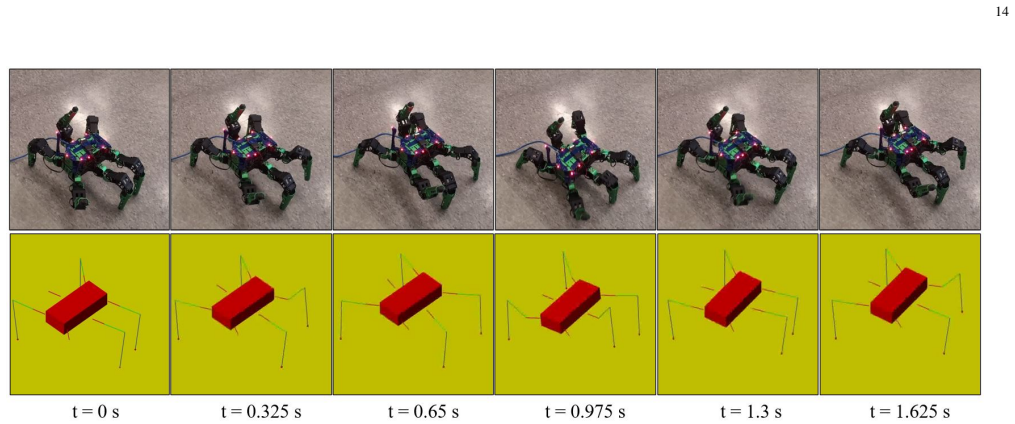
P. Biswal and P. K. Mohanty, “Modeling and effective foot force 14 Fig. 8. Snapshots of 1.625 seconds of model and robot motions motion for the second damage scenario Fig. 9. Main body orientation during the third damage scenario Fig. 10. Main body COM position during the thir...
-
[21]
Artificial neural network-based ground reaction force estimation and learning for dynamic-legged robot systems,
J. An and I. Lee, “Artificial neural network-based ground reaction force estimation and learning for dynamic-legged robot systems,” PeerJ Computer Science, vol. 9, p. e1720, 2023
2023
-
[22]
Fully spiking neural network for legged robots,
X. Jiang, Q. Zhang, J. Sun, and R. Xu, “Fully spiking neural network for legged robots,” arXiv preprint arXiv:2310.05022 , 2023
2023 arXiv
-
[23]
Data efficient reinforcement learning for legged robots,
Y . Yang, K. Caluwaerts, A. Iscen, T. Zhang, J. Tan, and V . Sindhwani, “Data efficient reinforcement learning for legged robots,” in Conference on Robot Learning . PMLR, 2020, pp. 1–10
2020
-
[24]
Energy- based legged robots terrain traversability modeling via deep inverse reinforcement learning,
L. Gan, J. W. Grizzle, R. M. Eustice, and M. Ghaffari, “Energy- based legged robots terrain traversability modeling via deep inverse reinforcement learning,” IEEE Robotics and Automation Letters , vol. 7, no. 4, pp. 8807–8814, 2022
2022
-
[25]
Learning agile and dynamic motor skills for legged robots,
J. Hwangbo, J. Lee, A. Dosovitskiy, D. Bellicoso, V . Tsounis, V . Koltun, and M. Hutter, “Learning agile and dynamic motor skills for legged robots,” Science Robotics, vol. 4, no. 26, p. eaau5872, 2019
2019
-
[26]
Generic neural locomotion control framework for legged robots,
M. Thor, T. Kulvicius, and P. Manoonpong, “Generic neural locomotion control framework for legged robots,” IEEE transactions on neural networks and learning systems , vol. 32, no. 9, pp. 4013–4025, 2020
2020
-
[27]
Legged robots that keep on learning: Fine-tuning locomotion policies in the real world,
L. Smith, J. C. Kew, X. B. Peng, S. Ha, J. Tan, and S. Levine, “Legged robots that keep on learning: Fine-tuning locomotion policies in the real world,” in 2022 International Conference on Robotics and Automation (ICRA). IEEE, 2022, pp. 1593–1599
2022
-
[28]
Legged robot running using a physics-data hybrid motion template,
W.-S. Yang, W.-C. Lu, and P.-C. Lin, “Legged robot running using a physics-data hybrid motion template,” IEEE Transactions on Robotics , vol. 37, no. 5, pp. 1680–1695, 2021
2021
-
[29]
Dynamic modeling, stability, and energy efficiency of a quadrupedal walking machine,
B. S. Lin and S.-M. Song, “Dynamic modeling, stability, and energy efficiency of a quadrupedal walking machine,” Journal of Robotic Systems, vol. 18, no. 11, pp. 657–670, 2001
2001
-
[30]
Dynamic modelling of a four-legged robot,
M. Bennani and F. Giri, “Dynamic modelling of a four-legged robot,” Journal of Intelligent and Robotic Systems , vol. 17, pp. 419–428, 1996
1996
-
[31]
Estimation of optimal feet forces and joint torques for on-line control of six-legged robot,
S. S. Roy, A. K. Singh, and D. K. Pratihar, “Estimation of optimal feet forces and joint torques for on-line control of six-legged robot,” Robotics and Computer-Integrated Manufacturing , vol. 27, no. 5, pp. 910–917, 2011
2011
-
[32]
Dynamic modeling, stability and energy consumption analysis of a realistic six-legged walking robot,
S. S. Roy and D. K. Pratihar, “Dynamic modeling, stability and energy consumption analysis of a realistic six-legged walking robot,” Robotics and Computer-Integrated Manufacturing , vol. 29, no. 2, pp. 400–416, 2013
2013
-
[33]
High speed trot-running: Im- plementation of a hierarchical controller using proprioceptive impedance control on the mit cheetah,
D. J. Hyun, S. Seok, J. Lee, and S. Kim, “High speed trot-running: Im- plementation of a hierarchical controller using proprioceptive impedance control on the mit cheetah,” The International Journal of Robotics Research, vol. 33, no. 11, pp. 1417–1445, 2014
2014
-
[34]
Centroidal dynamics of a humanoid robot,
D. E. Orin, A. Goswami, and S.-H. Lee, “Centroidal dynamics of a humanoid robot,” Autonomous robots, vol. 35, pp. 161–176, 2013
2013
-
[35]
Simultaneous contact, gait, and motion planning for robust multilegged locomotion via mixed-integer convex optimization,
B. Aceituno-Cabezas, C. Mastalli, H. Dai, M. Focchi, A. Radulescu, D. G. Caldwell, J. Cappelletto, J. C. Grieco, G. Fern ´andez-L´opez, and C. Semini, “Simultaneous contact, gait, and motion planning for robust multilegged locomotion via mixed-integer convex optimization,” IEE...
2017
-
[36]
Gait and trajectory optimization for legged systems through phase-based end-effector parameterization,
A. W. Winkler, C. D. Bellicoso, M. Hutter, and J. Buchli, “Gait and trajectory optimization for legged systems through phase-based end-effector parameterization,” IEEE Robotics and Automation Letters , vol. 3, no. 3, pp. 1560–1567, 2018
2018
-
[37]
Study of dynamic biped locomotion on rugged terrain-derivation and application of the linear inverted pendulum mode,
S. Kajita and K. Tani, “Study of dynamic biped locomotion on rugged terrain-derivation and application of the linear inverted pendulum mode,” in Proceedings. 1991 IEEE International Conference on Robotics and Automation. IEEE Computer Society, 1991, pp. 1405–1406. 15
1991
-
[38]
Online walking motion generation with automatic footstep placement,
A. Herdt, H. Diedam, P.-B. Wieber, D. Dimitrov, K. Mombaur, and M. Diehl, “Online walking motion generation with automatic footstep placement,” Advanced Robotics, vol. 24, no. 5-6, pp. 719–737, 2010
2010
-
[39]
Zmp support areas for multicontact mobility under frictional constraints,
S. Caron, Q.-C. Pham, and Y . Nakamura, “Zmp support areas for multicontact mobility under frictional constraints,” IEEE Transactions on Robotics, vol. 33, no. 1, pp. 67–80, 2016
2016
-
[40]
Trajectory planning of flexible walking for biped robots using linear inverted pendulum model and linear pendulum model,
L. Li, Z. Xie, X. Luo, and J. Li, “Trajectory planning of flexible walking for biped robots using linear inverted pendulum model and linear pendulum model,” Sensors, vol. 21, no. 4, p. 1082, 2021
2021
-
[41]
Drs-lip: Linear inverted pendulum model for legged locomotion on dynamic rigid surfaces,
A. Iqbal, S. Veer, and Y . Gu, “Drs-lip: Linear inverted pendulum model for legged locomotion on dynamic rigid surfaces,” arXiv preprint arXiv:2202.00151, 2022
2022 arXiv
-
[42]
Integrat- ing physics-based modeling with machine learning: A survey,
J. Willard, X. Jia, S. Xu, M. Steinbach, and V . Kumar, “Integrat- ing physics-based modeling with machine learning: A survey,” arXiv preprint arXiv:2003.04919, vol. 1, no. 1, pp. 1–34, 2020
2003 arXiv
-
[43]
Physics-guided deep learning for dynamical systems: A survey,
R. Wang and R. Yu, “Physics-guided deep learning for dynamical systems: A survey,” arXiv preprint arXiv:2107.01272 , 2021
2021 arXiv
-
[44]
Theory- training deep neural networks for an alloy solidification benchmark problem,
M. Torabi Rad, A. Viardin, G. Schmitz, and M. Apel, “Theory- training deep neural networks for an alloy solidification benchmark problem,” Computational Materials Science , vol. 180, p. 109687, 2020. [Online]. Available: https://www.sciencedirect.com/science/article/pii/ S0927...
2020
-
[45]
Hamiltonian neural net- works,
S. Greydanus, M. Dzamba, and J. Yosinski, “Hamiltonian neural net- works,” Advances in neural information processing systems , vol. 32, 2019
2019
-
[46]
Deep hidden physics models: Deep learning of nonlinear partial differential equations,
M. Raissi, “Deep hidden physics models: Deep learning of nonlinear partial differential equations,” Journal of Machine Learning Research , vol. 19, no. 25, pp. 1–24, 2018
2018
-
[47]
Symplectic ode-net: Learning hamiltonian dynamics with control,
Y . D. Zhong, B. Dey, and A. Chakraborty, “Symplectic ode-net: Learning hamiltonian dynamics with control,” arXiv preprint arXiv:1909.12077 , 2019
1909 arXiv
-
[48]
Dynamic modeling of robotic manipulator via an augmented deep lagrangian network,
S. Wu, Z. Li, W. Chen, and F. Sun, “Dynamic modeling of robotic manipulator via an augmented deep lagrangian network,” Tsinghua Science and Technology, vol. 29, no. 5, pp. 1604–1614, 2024
2024
-
[49]
Dynamics consensus between centroidal and whole-body models for locomotion of legged robots,
R. Budhiraja, J. Carpentier, and N. Mansard, “Dynamics consensus between centroidal and whole-body models for locomotion of legged robots,” in 2019 International Conference on Robotics and Automation (ICRA). IEEE, 2019, pp. 6727–6733
2019
-
[50]
Mahapatra, S
A. Mahapatra, S. S. Roy, and D. K. Pratihar, Multi-body Dynamic Modeling of Multi-legged Robots . Springer Nature, 2020
2020
-
[51]
Dynamic analysis tool for legged robots,
F. Ouezdou, O. Bruneau, and J. Guinot, “Dynamic analysis tool for legged robots,” Multibody System Dynamics, vol. 2, no. 4, pp. 369–391, 1998
1998
-
[52]
Modular framework for dynamic modeling and analyses of legged robots,
S. Shah, S. Saha, and J. Dutt, “Modular framework for dynamic modeling and analyses of legged robots,” Mechanism and Machine Theory, vol. 49, pp. 234–255, 2012
2012
-
[53]
Dynamic modeling, analysis, and comparative study of a quadruped with bio-inspired robotic tails,
Y . Liu and P. Ben-Tzvi, “Dynamic modeling, analysis, and comparative study of a quadruped with bio-inspired robotic tails,” Multibody System Dynamics, vol. 51, no. 2, pp. 195–219, 2021
2021
-
[54]
Trajec- tory optimization through contacts and automatic gait discovery for quadrupeds,
M. Neunert, F. Farshidian, A. W. Winkler, and J. Buchli, “Trajec- tory optimization through contacts and automatic gait discovery for quadrupeds,” IEEE Robotics and Automation Letters , vol. 2, no. 3, pp. 1502–1509, 2017
2017
-
[55]
Whole-body nonlinear model predictive control through contacts for quadrupeds,
M. Neunert, M. St ¨auble, M. Giftthaler, C. D. Bellicoso, J. Carius, C. Gehring, M. Hutter, and J. Buchli, “Whole-body nonlinear model predictive control through contacts for quadrupeds,” IEEE Robotics and Automation Letters, vol. 3, no. 3, pp. 1458–1465, 2018
2018
-
[56]
Dynamic locomotion and whole-body control for quadrupedal robots,
C. D. Bellicoso, F. Jenelten, P. Fankhauser, C. Gehring, J. Hwangbo, and M. Hutter, “Dynamic locomotion and whole-body control for quadrupedal robots,” in 2017 IEEE/RSJ International Conference on Intelligent Robots and Systems (IROS) . IEEE, 2017, pp. 3359–3365
2017
-
[57]
Dynamic formulation using the decoupled natural orthogonal complement (denoc),
P. V . Nandihal, A. Mohan, S. K. Saha, P. V . Nandihal, A. Mohan, and S. K. Saha, “Dynamic formulation using the decoupled natural orthogonal complement (denoc),” Dynamics of Rigid-Flexible Robots and Multibody Systems , pp. 29–42, 2022
2022
-
[58]
Nonlinear mpc for free-flying space manipulator,
C. Sirois, “Nonlinear mpc for free-flying space manipulator,” TESI DI LAUREA MAGISTRALE, Politecnico di Milano , 2021
2021
-
[59]
Geometric methods and formulations in computational multibody system dynamics,
A. M ¨uller and Z. Terze, “Geometric methods and formulations in computational multibody system dynamics,” Acta mechanica, vol. 227, pp. 3327–3350, 2016
2016
-
[60]
D. A. Lind, D. Lind, and B. Marcus, An introduction to symbolic dynamics and coding . Cambridge university press, 2021
2021
-
[61]
Constrained multibody dynamics with python: From symbolic equation generation to publication,
G. Gede, D. L. Peterson, A. S. Nanjangud, J. K. Moore, and M. Hub- bard, “Constrained multibody dynamics with python: From symbolic equation generation to publication,” in International Design Engineering Technical Conferences and Computers and Information in Engineering Confe...
2013
-
[62]
Symbolic derivation of dynamic equations of motion for robot manipulators using piogram symbolic method,
P.-Y . Cheng, C.-I. Weng, and C.-K. Chen, “Symbolic derivation of dynamic equations of motion for robot manipulators using piogram symbolic method,” IEEE Journal on Robotics and Automation , vol. 4, no. 6, pp. 599–609, 1988
1988
-
[63]
A fully symbolic generation of the equations of motion of multibody systems containing flexible beams,
P. Fisette, D. Johnson, and J.-C. Samin, “A fully symbolic generation of the equations of motion of multibody systems containing flexible beams,” Computer Methods in Applied Mechanics and Engineering, vol. 142, no. 1-2, pp. 123–152, 1997
1997
-
[64]
Symbolic genetic algorithm for discovering open-form partial differential equations (sga- pde),
Y . Chen, Y . Luo, Q. Liu, H. Xu, and D. Zhang, “Symbolic genetic algorithm for discovering open-form partial differential equations (sga- pde),” Physical Review Research, vol. 4, no. 2, p. 023174, 2022
2022
-
[65]
R. S. Ball, A Treatise on the Theory of Screws . Cambridge university press, 1998
1998
-
[66]
Robotic manipulators and the product of exponentials formula,
R. W. Brockett, “Robotic manipulators and the product of exponentials formula,” in Mathematical theory of networks and systems . Springer, 1984, pp. 120–129
1984
-
[67]
Murray, Z
R. Murray, Z. Lie, and S. Sastry, A Mathematical Introduction to Robotic Manipulation. CRC Press, 1994
1994
-
[68]
Computational aspects of the product-of-exponentials for- mula for robot kinematics,
F. C. Park, “Computational aspects of the product-of-exponentials for- mula for robot kinematics,” IEEE Transactions on Automatic Control , vol. 39, no. 3, pp. 643–647, 1994
1994
-
[69]
Robotic machining: A review of recent progress,
S. H. Kim, E. Nam, T. I. Ha, S.-H. Hwang, J. H. Lee, S.-H. Park, and B.- K. Min, “Robotic machining: A review of recent progress,” International Journal of Precision Engineering and Manufacturing, vol. 20, pp. 1629– 1642, 2019
2019
-
[70]
Stramigioli, Modeling and IPC control of interactive mechanical systems—A coordinate-free approach
S. Stramigioli, Modeling and IPC control of interactive mechanical systems—A coordinate-free approach. Springer, 2001
2001
-
[71]
Singularity-free lagrange-poincare equations on lie groups for vehicle-manipulator systems,
B. M. Moghaddam and R. Chhabra, “Singularity-free lagrange-poincare equations on lie groups for vehicle-manipulator systems,” IEEE Trans- actions on Robotics , 2023
2023
-
[72]
The reduced euler-lagrange equations,
J. E. Marsden and J. Scheurle, “The reduced euler-lagrange equations,” Fields Institute Comm , vol. 1, no. 6, pp. 139–164, 1993
1993
-
[73]
Singularity-free lagrange-poincar ´e equations on lie groups for vehicle-manipulator systems,
B. M. Moghaddam and R. Chhabra, “Singularity-free lagrange-poincar ´e equations on lie groups for vehicle-manipulator systems,” IEEE Trans- actions on Robotics , vol. 40, pp. 1393–1409, 2024
2024
-
[74]
The reduced euler–lagrange equations,
J. M. Scheurle and J, “The reduced euler–lagrange equations,” Fields Institute Comm, vol. 1, pp. 139–164, 1993
1993
-
[75]
Nonlinear control of mechanical systems: A lagrangian perspective,
R. M. Murray, “Nonlinear control of mechanical systems: A lagrangian perspective,” Annual Reviews in Control , vol. 21, pp. 31–42, 1997
1997
-
[76]
Lagrangian dynamics of open multi- body systems with generalized holonomic and nonholonomic joints,
V . Duindam and S. Stramigioli, “Lagrangian dynamics of open multi- body systems with generalized holonomic and nonholonomic joints,” in 2007 IEEE/RSJ International Conference on Intelligent Robots and Systems. IEEE, 2007, pp. 3342–3347
2007
-
[77]
A hamiltonian formulation of the dynamics of spatial mechanisms using lie groups and screw theory,
S. Stramigioli, B. Maschke, and C. Bidard, “A hamiltonian formulation of the dynamics of spatial mechanisms using lie groups and screw theory,” in Proc. Symposium Commemorating the Legacy, Work and Life of Sir RS Ball, J. Duffy and H. Lipkin organizers , 2000, pp. 9–11
2000
-
[78]
Corrections to “singularity- free dynamic equations of open-chain mechanisms with general holo- nomic and nonholonomic joints
P. J. From, V . Duindam, and S. Stramigioli, “Corrections to “singularity- free dynamic equations of open-chain mechanisms with general holo- nomic and nonholonomic joints”,” IEEE transactions on robotics , vol. 28, no. 6, pp. 1431–1432, 2012
2012
-
[79]
Singularity-free dynamic equations of vehicle–manipulator systems,
P. J. From, V . Duindam, K. Y . Pettersen, J. T. Gravdahl, and S. Sastry, “Singularity-free dynamic equations of vehicle–manipulator systems,” Simulation Modelling Practice and Theory , vol. 18, no. 6, pp. 712–731, 2010
2010
-
[80]
Singularity-free dynamic equations of auv-manipulator systems,
P. J. From, K. Y . Pettersen, and J. T. Gravdahl, “Singularity-free dynamic equations of auv-manipulator systems,” IFAC Proceedings Volumes , vol. 43, no. 16, pp. 31–36, 2010
2010
-
[81]
A singularity free formulation of the dynamically equivalent manipulator mapping of space manipulators,
——, “A singularity free formulation of the dynamically equivalent manipulator mapping of space manipulators,” AIAA SPACE Conference & Exposition, pp. 1–10, 2011
2011
-
[82]
An error-state model predictive control on connected matrix lie groups for legged robot control,
S. Teng, D. Chen, W. Clark, and M. Ghaffari, “An error-state model predictive control on connected matrix lie groups for legged robot control,” in 2022 IEEE/RSJ International Conference on Intelligent Robots and Systems (IROS) . IEEE, 2022, pp. 8850–8857
2022
-
[83]
Geometric control and learning for dynamic legged robots,
A. Siravuru, “Geometric control and learning for dynamic legged robots,” Ph.D. dissertation, Carnegie Mellon University, 2020
2020
-
[84]
M. M. Rohde, J. Crawford, M. Toschlog, K. D. Iagnemma, G. Kewlani, C. L. Cummins, R. A. Jones, and D. A. Horner, “An interactive physics-based unmanned ground vehicle simulator leveraging open source gaming technology: progress in the development and application of the virtual...
2009
-
[85]
High-fidelity yet fast dynamic models of wheeled mobile robots,
N. Seegmiller and A. Kelly, “High-fidelity yet fast dynamic models of wheeled mobile robots,” IEEE Transactions on robotics , vol. 32, no. 3, pp. 614–625, 2016
2016
-
[86]
Open dynamics engine,
R. Smith et al., “Open dynamics engine,” 2005
2005
-
[87]
Rigid body dynamics library,
M. Felis., “Rigid body dynamics library,” Available online at: http://rbdl.bitbucket.org/
-
[88]
Opensymoro: An open-source software package for symbolic modelling of robots,
W. Khalil, A. Vijayalingam, B. Khomutenko, I. Mukhanov, P. Lemoine, and G. Ecorchard, “Opensymoro: An open-source software package for symbolic modelling of robots,” in 2014 IEEE/ASME International Conference on Advanced Intelligent Mechatronics . IEEE, 2014, pp. 1206–1211
2014
-
[89]
Robots that can adapt like animals,
A. Cully, J. Clune, D. Tarapore, and J.-B. Mouret, “Robots that can adapt like animals,” Nature, vol. 521, no. 7553, pp. 503–507, 2015
2015
-
[90]
Resilient machines through continuous self-modeling,
J. Bongard, V . Zykov, and H. Lipson, “Resilient machines through continuous self-modeling,” Science, vol. 314, no. 5802, pp. 1118–1121, 2006
2006
-
[91]
A generalized exponential formula for forward and differential kinematics of open-chain multibody systems,
R. Chhabra and M. Emami, “A generalized exponential formula for forward and differential kinematics of open-chain multibody systems,” Mechanism and Machine Theory , vol. 73, pp. 61–75, 2014
2014
-
[92]
Singularity-free whole-body dynamical equations of legged robots for damage simulation,
S. Farghdani and R. Chhabra, “Singularity-free whole-body dynamical equations of legged robots for damage simulation,” in AIAA SCITECH 2024 Forum, 2024, p. 1017
2024
-
[93]
A numeric derivation for fast regressive modeling of manipulator dynamics,
S. Lloyd, R. Irani, and M. Ahmadi, “A numeric derivation for fast regressive modeling of manipulator dynamics,”Mechanism and Machine Theory, vol. 156, p. 104149, 2021
2021
-
[94]
Available online at: https://www.hiwonder.com/products/jethexa (Accessed March, 2024)
Hiwonder JetHexa ROS Hexapod Robot Kit Powered by Jetson Nano Boston Dynamics.; 2022. Available online at: https://www.hiwonder.com/products/jethexa (Accessed March, 2024). APPENDIX A PROOF OF LEMMA 3 Proof. GivenMij from (30) and knowing that the only vari- able part of the e...
2022
Reviewed August 16, 2026 · model on record in the stance chip above.
Discussion (0). Continue with ORCID to comment.