Kleshchev multipartitions, affine Mirkovi\'c-Vilonen polytopes, and representations of KLR algebras in type {tt A}⁽¹⁾₁
Pith reviewed 2026-06-28 19:20 UTC · model grok-4.3
The pith
Explicit isomorphisms connect affine Mirkovic-Vilonen polytopes, Kleshchev multipartitions, and upper ledge diagrams for the B(∞) crystal in type A1^(1).
A machine-rendered reading of the paper's core claim, the machinery that carries it, and where it could break.
Core claim
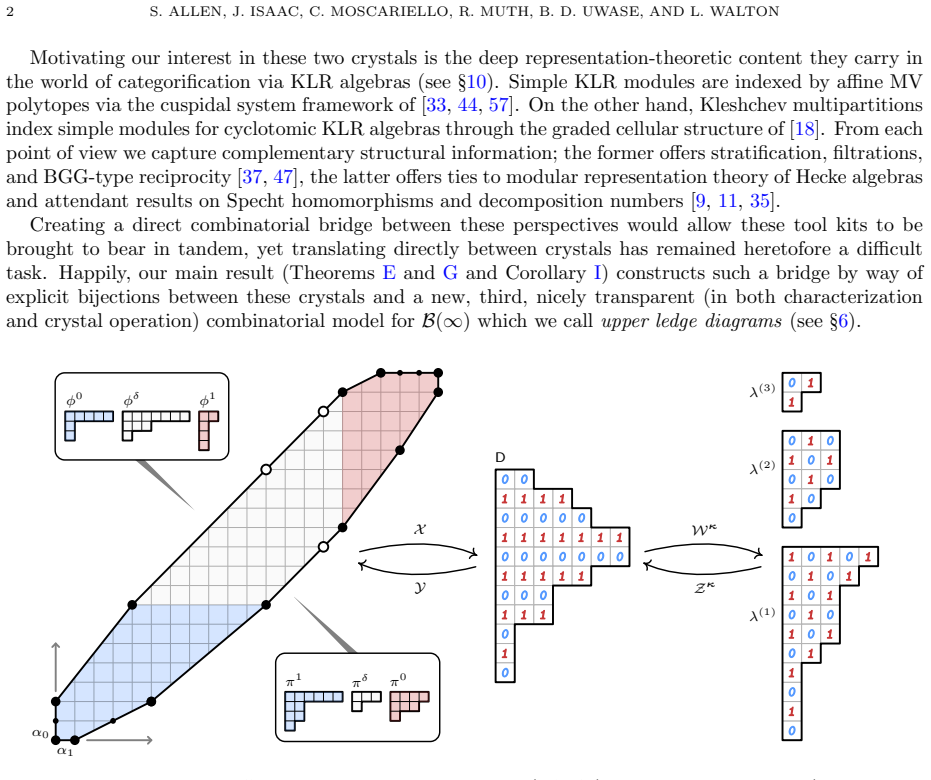
We construct explicit isomorphisms between affine Mirkovi'c--Vilonen polytopes, Kleshchev multipartitions, and upper ledge diagrams that serve as models for the B(∞) crystal in type A1^(1). We present a direct method for completing an affine MV polytope from the data of one of its boundary root partitions and a non-iterative recognition theorem which characterizes Kleshchev multipartitions in type A1^(1). These results are applied to the representation theory of KLR algebras to yield a combinatorial dictionary between cuspidal- and cellular-theoretic frameworks, along with some augmented branching rules for real root functors of induction and restriction.
What carries the argument
Explicit isomorphisms between the three crystal models that preserve all crystal operations.
If this is right
- The isomorphisms allow transferring properties between the geometric, partition-based, and diagrammatic models of the crystal.
- A direct method exists for completing an affine MV polytope from its boundary root partition data.
- A non-iterative theorem recognizes Kleshchev multipartitions in this type.
- The results give a combinatorial dictionary between cuspidal- and cellular-theoretic frameworks for KLR algebras.
- Augmented branching rules are obtained for real root functors of induction and restriction.
Where Pith is reading between the lines
- The explicit maps enable computation of crystal elements by switching to the most convenient model for the task at hand.
- This approach provides a template that could be adapted for identifying models in other affine types.
- The dictionary for KLR algebras may help bridge different theoretical frameworks in representation theory.
Load-bearing premise
The three models describe the same underlying B(∞) crystal structure, with the explicit maps preserving all crystal operations.
What would settle it
A case where one of the maps fails to preserve a crystal operator, such as the Kashiwara operator e_i or f_i on some element, would falsify the isomorphisms.
Figures
read the original abstract
We construct explicit isomorphisms between three models for the $B(\infty)$ crystal in type ${\tt A}_1^{(1)}$: affine Mirkovi\'c--Vilonen polytopes, Kleshchev multipartitions, and a new model we call upper ledge diagrams. We also present some clarifying results on these crystals, giving a direct method for completing an affine MV polytope from the data of one of its boundary root partitions, and a non-iterative recognition theorem which characterizes Kleshchev multipartitions in type ${\tt A}_1^{(1)}$. We apply these results to the representation theory of KLR algebras, where they yield a combinatorial dictionary between cuspidal- and cellular-theoretic frameworks, along with some augmented branching rules for real root functors of induction and restriction.
Editorial analysis
A structured set of objections, weighed in public.
Referee Report
Summary. The paper constructs explicit isomorphisms between three models for the B(∞) crystal in type A_1^{(1)}: affine Mirković-Vilonen polytopes, Kleshchev multipartitions, and a new model called upper ledge diagrams. It also gives a direct (non-iterative) method for completing an affine MV polytope from the data of one boundary root partition and a non-iterative recognition theorem characterizing Kleshchev multipartitions in this type. These results are applied to KLR algebra representation theory, yielding a combinatorial dictionary between cuspidal- and cellular-theoretic frameworks together with augmented branching rules for real root functors of induction and restriction.
Significance. The explicit isomorphisms and non-iterative theorems, if verified in detail, supply a concrete combinatorial dictionary among three distinct models of the same crystal. This is potentially useful for computations in the representation theory of KLR algebras of type A_1^{(1)}, where the branching rules and dictionary between frameworks could streamline arguments that previously relied on iterative constructions.
minor comments (3)
- The abstract states that the isomorphisms are 'explicit' and that the recognition theorem is 'non-iterative'; a short summary table or diagram in §1 comparing the three models and indicating which crystal operators are preserved by each map would make the central contribution easier to locate.
- Notation for the affine root system is not uniform: the title uses A^{(1)}_1 while the abstract uses A_1^{(1)}. Consistent use throughout the manuscript (including in section headings) would improve readability.
- The applications to KLR algebras are described only at the level of 'combinatorial dictionary' and 'augmented branching rules'. A single concrete example (e.g., a small weight space or a specific real root functor) in §5 or §6 would illustrate the claimed dictionary.
Simulated Author's Rebuttal
We thank the referee for their positive assessment of the paper, the clear summary of its contributions, and the recommendation for minor revision. No specific major comments appear in the report.
Circularity Check
No significant circularity; direct combinatorial constructions
full rationale
The paper's core contribution is the explicit construction of isomorphisms between three models (affine MV polytopes, Kleshchev multipartitions, upper ledge diagrams) for the B(∞) crystal, plus a direct completion method and non-iterative recognition theorem. These are presented as new combinatorial maps and theorems without reduction to fitted parameters, self-definitions, or load-bearing self-citations. The abstract and results indicate independent constructions that preserve crystal operations by direct verification, with no equations or steps that equate outputs to inputs by construction. This is the standard case of a self-contained mathematical paper.
Axiom & Free-Parameter Ledger
Reference graph
Works this paper leans on
-
[1]
Abbasian, L
D. Abbasian, L. Difulvio, R. Muth, G. Pasternak, I. Sholtes, and F. Sinclair,Cuspidal ribbon tableaux in affine type A, Algebr. Comb.6(2023), no. 2, 285–319
2023
-
[2]
K. Alladi,Euler’s partition theorem and refinements without appeal to infinite products, Algorithmic combinatorics: enumerative combinatorics, special functions and computer alge, Texts Monogr. Symbol. Comput., Springer, Cham, 2020, pp. 9–23
2020
-
[3]
Ariki,On the classification of simple modules for cyclotomic Hecke algebras of typeG(m,1, n)and Kleshchev multi- partitions, Osaka J
S. Ariki,On the classification of simple modules for cyclotomic Hecke algebras of typeG(m,1, n)and Kleshchev multi- partitions, Osaka J. Math.38(2001), 827–837
2001
-
[4]
Ariki, V
S. Ariki, V. Kreiman, and S. Tsuchioka,On the tensor product of two basic representations ofU v(sle), Adv. Math.218 (2008), no. 1, 28–86
2008
-
[5]
Ariki and A
S. Ariki and A. Mathas,The number of simple modules of the Hecke algebras of typeG(r,1, n), Math. Z.233(2000), no. 3, 601–623
2000
-
[6]
Baumann, T
P. Baumann, T. Dunlap, J. Kamnitzer, and P. Tingley,Rank 2 affine MV polytopes, Represent. Theory17(2013), 442–468
2013
-
[7]
Affine Mirkovi\'c-Vilonen polytopes
P. Baumann, J. Kamnitzer, and P. Tingley,Affine Mirkovi´ c–Vilonen polytopes, Publ. Math. Inst. Hautes ´Etudes Sci. 120(2014), 113–205, arXiv:1110.3661
work page internal anchor Pith review Pith/arXiv arXiv 2014
-
[8]
Bessenrodt,A bijection for Lebesgue’s partition identity in the spirit of Sylvester, Discrete Math.132(1994), no
C. Bessenrodt,A bijection for Lebesgue’s partition identity in the spirit of Sylvester, Discrete Math.132(1994), no. 1-3, 1–10
1994
-
[9]
Brundan and A
J. Brundan and A. Kleshchev,Blocks of cyclotomic Hecke algebras and Khovanov-Lauda algebras, Invent. Math.178 (2009), no. 3, 451–484
2009
-
[10]
Math.222(2009), no
,Graded decomposition numbers for cyclotomic Hecke algebras, Adv. Math.222(2009), no. 6, 1883–1942
2009
-
[11]
J. Brundan, A. Kleshchev, and W. Wang,Graded Specht modules, J. Reine Angew. Math.655(2011), 61–87, arXiv:0901.0218
work page internal anchor Pith review Pith/arXiv arXiv 2011
-
[12]
N. Davidson, J. R. Kujawa, and R. Muth,Superalgebra deformations of web categories: Affine and cyclotomic webs, 2025,arXiv:2511.21671
-
[13]
Fayers,An LLT-type algorithm for computing higher-level canonical bases, J
M. Fayers,An LLT-type algorithm for computing higher-level canonical bases, J. Pure Appl. Algebra214(2010), no. 12, 2186–2198
2010
-
[14]
,e-modular combinatorics of partitions, 2026, In preparation
2026
-
[15]
Fayers, S
M. Fayers, S. Lyle, and S. Martin,p-restriction of partitions and homomorphisms between Specht modules, J. Algebra 306(2006), no. 1, 175–190
2006
-
[16]
O. Foda, B. Leclerc, M. Okado, J.-Y. Thibon, and T. Welsh,Branching functions ofA (1) n−1 and Jantzen–Seitz problem for Ariki–Koike algebras, Adv. Math.141(1999), no. 2, 322–365
1999
-
[17]
Gerber,Crystal isomorphisms in Fock spaces and Schensted correspondence in affine typeA, Algebr
T. Gerber,Crystal isomorphisms in Fock spaces and Schensted correspondence in affine typeA, Algebr. Represent. Theory18(2015), no. 4, 1009–1046
2015
-
[18]
Hu and A
J. Hu and A. Mathas,Graded cellular bases for the cyclotomic Khovanov-Lauda-Rouquier algebras of typeA, Adv. Math.225(2010), no. 2, 598–642
2010
-
[19]
Jacon,Kleshchev multipartitions and extended Young diagrams, Adv
N. Jacon,Kleshchev multipartitions and extended Young diagrams, Adv. Math.339(2018), 367–403. CRYSTALS AND KLR REPRESENTATIONS IN TYPEA (1) 1 59
2018
-
[20]
Jacon and C
N. Jacon and C. Lecouvey,Crystal isomorphisms for irreducible highest weightU v(bsle)-modules of higher level, Algebr. Represent. Theory13(2010), no. 4, 467–489
2010
-
[21]
G. D. James,On the decomposition matrices of the symmetric groups. II, J. Algebra43(1976), no. 1, 45–54
1976
-
[22]
V. G. Kac,Infinite Dimensional Lie Algebras, 3rd ed., Cambridge University Press, Cambridge, 1990
1990
-
[23]
Kamnitzer,Mirkovi´ c–Vilonen cycles and polytopes, Ann
J. Kamnitzer,Mirkovi´ c–Vilonen cycles and polytopes, Ann. of Math. (2)171(2010), no. 1, 245–294
2010
-
[24]
Kang,Crystal bases for quantum affine algebras and combinatorics of Young walls, Proc
S.-J. Kang,Crystal bases for quantum affine algebras and combinatorics of Young walls, Proc. London Math. Soc. (3) 86(2003), no. 1, 29–69
2003
-
[25]
Kang and M
S.-J. Kang and M. Kashiwara,Categorification of highest weight modules via Khovanov-Lauda-Rouquier algebras, Invent. Math.190(2012), no. 3, 699–742
2012
-
[26]
Kashiwara,On crystal bases, Representations of groups (Banff, AB, 1994), CMS Conf
M. Kashiwara,On crystal bases, Representations of groups (Banff, AB, 1994), CMS Conf. Proc., vol. 16, Amer. Math. Soc., Providence, RI, 1995, pp. 155–197
1994
-
[27]
Kato,Poincar´ e-Birkhoff-Witt bases and Khovanov-Lauda-Rouquier algebras, Duke Math
S. Kato,Poincar´ e-Birkhoff-Witt bases and Khovanov-Lauda-Rouquier algebras, Duke Math. J.163(2014), no. 3, 619– 663
2014
-
[28]
Khovanov and A
M. Khovanov and A. D. Lauda,A diagrammatic approach to categorification of quantum groups. I, Represent. Theory 13(2009), 309–347
2009
-
[29]
Kim,Monomial realization of crystal graphs forU q(A(1) n ), Math
J.-A. Kim,Monomial realization of crystal graphs forU q(A(1) n ), Math. Ann.332(2005), no. 1, 17–35
2005
-
[30]
Kim and D.-U
J.-A. Kim and D.-U. Shin,Generalized Young walls and crystal bases for quantum affine algebra of typeA (1) n , Proc. Amer. Math. Soc.138(2010), no. 11, 3877–3889
2010
-
[31]
Kleshchev,Branching rules for modular representations of symmetric groups
A. Kleshchev,Branching rules for modular representations of symmetric groups. I, J. Algebra178(1995), no. 2, 493–511
1995
-
[32]
,Branching rules for modular representations of symmetric groups. II, J. Reine Angew. Math.459(1995), 163–212
1995
-
[33]
Z.276(2014), no
,Cuspidal systems for affine Khovanov-Lauda-Rouquier algebras, Math. Z.276(2014), no. 3-4, 691–726
2014
-
[34]
,Modular representation theory of symmetric groups, Proceedings of the International Congress of Mathematicians—Seoul 2014. Vol. III, Kyung Moon Sa, Seoul, 2014, pp. 97–120
2014
-
[35]
Kleshchev, A
A. Kleshchev, A. Mathas, and A. Ram,Universal graded Specht modules for cyclotomic Hecke algebras, Proc. Lond. Math. Soc. (3)105(2012), no. 6, 1245–1289
2012
-
[36]
Kleshchev and R
A. Kleshchev and R. Muth,Imaginary Schur-Weyl duality, Mem. Amer. Math. Soc.245(2017), no. 1157, xvii+83
2017
-
[37]
Algebra475(2017), 133–170
,Stratifying KLR algebras of affine ADE types, J. Algebra475(2017), 133–170
2017
-
[38]
,Affine zigzag algebras and imaginary strata for KLR algebras, Trans. Amer. Math. Soc.371(2019), 4535–4583
2019
-
[39]
Kvinge and M
H. Kvinge and M. Vazirani,A combinatorial categorification of the tensor product of the Kirillov-Reshetikhin crystal B1,1 and a fundamental crystal, Algebr. Represent. Theor.21(2018), no. 6, 1277–1331
2018
-
[40]
Lascoux, B
A. Lascoux, B. Leclerc, and J.-Y. Thibon,Hecke algebras at roots of unity and crystal bases of quantum affine algebras, Comm. Math. Phys.181(1996), no. 1, 205–263
1996
-
[41]
A. D. Lauda and M. Vazirani,Crystals from categorified quantum groups, Adv. Math.228(2011), no. 2, 803–861
2011
-
[42]
Li,Integral basis theorem of cyclotomic Khovanov-Lauda-Rouquier algebras of type A, J
G. Li,Integral basis theorem of cyclotomic Khovanov-Lauda-Rouquier algebras of type A, J. Algebra482(2017), 1–101
2017
-
[43]
Mathas,Simple modules of Ariki-Koike algebras, Group representations: cohomology, group actions and topology (Seattle, WA, 1996), Proc
A. Mathas,Simple modules of Ariki-Koike algebras, Group representations: cohomology, group actions and topology (Seattle, WA, 1996), Proc. Sympos. Pure Math., vol. 63, Amer. Math. Soc., Providence, RI, 1998, pp. 383–396
1996
-
[44]
P. J. McNamara,Representations of Khovanov-Lauda-Rouquier algebras III: symmetric affine type, Math. Z.287 (2017), no. 1-2, 243–286
2017
-
[45]
P. J. McNamara and P. Tingley,Face functors for KLR algebras, Represent. Theory21(2017), 106–131
2017
-
[46]
Misra and T
K. Misra and T. Miwa,Crystal base for the basic representation ofU q(bsl(n)), Comm. Math. Phys.134(1990), no. 1, 79–88
1990
-
[47]
H. Murata,Affine highest weight structures on module categories over quiver hecke algebras, 2024,arXiv:2412.12903
-
[48]
Muth,Graded skew Specht modules and cuspidal modules for Khovanov-Lauda-Rouquier algebras of affine type A, Algebr
R. Muth,Graded skew Specht modules and cuspidal modules for Khovanov-Lauda-Rouquier algebras of affine type A, Algebr. Represent. Theory22(2019), no. 4, 977–1015
2019
-
[49]
R. Muth, T. Nicewicz, L. Speyer, and L. Sutton,A skew Specht perspective of rock blocks and cuspidal systems for KLR algebras in affine type A, Represent. Theory29(2025), 718–788
2025
-
[50]
Muthiah and P
D. Muthiah and P. Tingley,Affine PBW bases and MV polytopes in rank 2, Selecta Math. (N.S.)20(2014), no. 1, 237–260
2014
-
[51]
(N.S.)24(2018), no
,Affine PBW bases and affine MV polytopes, Selecta Math. (N.S.)24(2018), no. 5, 4781–4810
2018
-
[52]
Pak,Partition bijections, a survey, Ramanujan J.12(2006), no
I. Pak,Partition bijections, a survey, Ramanujan J.12(2006), no. 1, 5–75
2006
-
[53]
Pynchon,Against the Day, Penguin Press, New York, 2006
T. Pynchon,Against the Day, Penguin Press, New York, 2006
2006
-
[54]
R. Rouquier,2-Kac-Moody algebras, 2008,arXiv:0812.5023
work page internal anchor Pith review Pith/arXiv arXiv 2008
-
[55]
Salisbury and T
B. Salisbury and T. Scrimshaw,A rigged configuration model forB(∞), J. Combin. Theory Ser. A133(2015), 29–57
2015
-
[56]
K. M. Tan and W. H. Teo,Sign sequences and decomposition numbers, Trans. Amer. Math. Soc.365(2013), no. 12, 6385–6401
2013
-
[57]
Tingley and B
P. Tingley and B. Webster,Mirkovi´ c-Vilonen polytopes and Khovanov-Lauda-Rouquier algebras, Compos. Math.152 (2016), no. 8, 1648–1696
2016
-
[58]
Uglov,Canonical bases of higher-levelq-deformed Fock spaces and Kazhdan–Lusztig polynomials, Physical Combi- natorics, Progr
D. Uglov,Canonical bases of higher-levelq-deformed Fock spaces and Kazhdan–Lusztig polynomials, Physical Combi- natorics, Progr. Math., vol. 191, Birkh¨ auser, Boston, 2000, pp. 249–299
2000
-
[59]
Varagnolo and E
M. Varagnolo and E. Vasserot,Canonical bases and KLR-algebras, J. Reine Angew. Math.659(2011), 67–100. 60 S. ALLEN, J. ISAAC, C. MOSCARIELLO, R. MUTH, B. D. UWASE, AND L. WALTON
2011
-
[60]
Vazirani,Categorifying the tensor product of a level 1 highest weight and perfect crystal in type A, Lie algebras, Lie superalgebras, vertex algebras and related topics, Proc
M. Vazirani,Categorifying the tensor product of a level 1 highest weight and perfect crystal in type A, Lie algebras, Lie superalgebras, vertex algebras and related topics, Proc. Sympos. Pure Math., vol. 92, Amer. Math. Soc., Providence, RI, 2016, pp. 293–324. Email address:allens6@duq.edu Department of Mathematics and Computer Science, Duquesne Universit...
2016
discussion (0)
Sign in with ORCID, Apple, or X to comment. Anyone can read and Pith papers without signing in.