REVIEW 4 major objections 4 minor 1 cited by
Is Semantic SLAM Ready for Embedded Systems ? A Comparative Survey
T0 review · 4 major / 4 minor · reviewed 2026-08-15 · deepseek-v4-flash
Pith's one-line read Semantic geometric SLAM is the only family that runs near real time on embedded hardware.
desk verdict A useful but uneven embedded semantic SLAM survey whose central claim is plausible yet rests on a benchmark with incomparable preprocessing conditions. read the letter →
The pith
A machine-rendered reading of the paper's core claim, the machinery that carries it, and where it could break.
The reading
What carries the argument
The argument is carried by a resource-utilization benchmark on a single embedded platform, the Jetson AGX Orin, that measures trajectory accuracy (ATE RMSE, the root-mean-square error between estimated and ground-truth trajectories), semantic quality (mIoU, the average overlap between predicted and true masks), memory, power, and speed across the three architecture families, using a dynamic RGB-D benchmark for geometric accuracy and the Replica dataset for semantic quality. The decisive mechanism is the semantic-integration mode: systems that apply segmentation only to keyframes or run it live, versus systems that consume precomputed semantic masks, determine whether semantics can stay within real-time budgets. These measurements are what separate the geometric family's near-real-time performance from the neural-representation families' high semantic detail.
What would settle it
Re-running the benchmark with all systems required to compute semantic segmentation live on the Jetson AGX Orin, and reporting per-sequence accuracy on the dynamic RGB-D benchmark including the hardest walking sequence (fr3/walking_xyz), would settle the ranking: if Gaussian-splatting systems then approach real time while geometric systems stall, or if the geometric advantage disappears on the hardest sequences, the conclusion fails.
Extended reading notes
Core claim
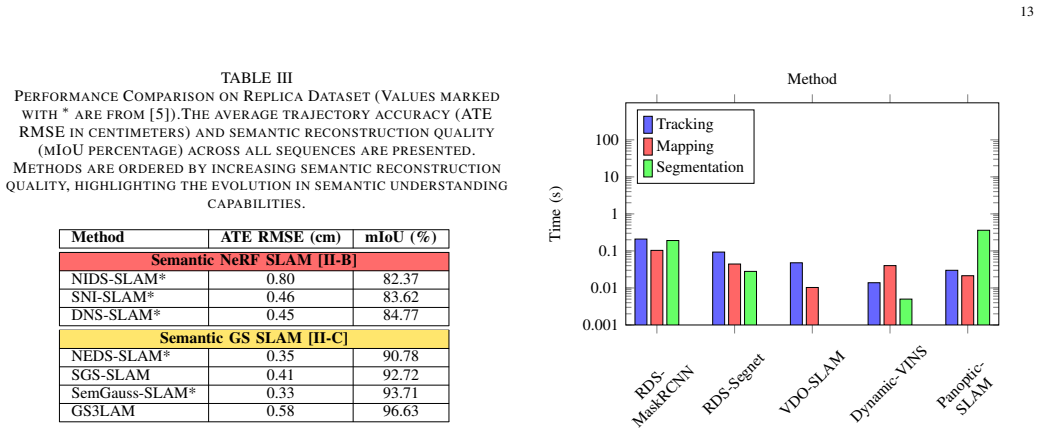
The paper's central claim is that, on the Jetson AGX Orin, semantic geometric SLAM is currently the only architecture family that balances accuracy, memory, power, and speed well enough for real-time embedded deployment: Dynamic-VINS runs at 24.9 FPS with 8.29 GB RAM and 12 W, and VDO-SLAM at 20.9 FPS with 6.62 GB and 10.9 W, while the two Gaussian-splatting systems, GS3LAM and SGS-SLAM, run at 0.013–0.014 FPS with over 16 GB RAM and over 15 W even when consuming precomputed semantic masks. NeRF-based semantic SLAM systems could not be executed on the Orin under the paper's setup, and their reported accuracy on the Replica dataset, while sub-centimeter, does not close the embedded-deployment gap. The paper also observes that Gaussian-splatting methods are more efficient than NeRF methods while delivering comparable reconstruction quality and semantic consistency, but still far from real time on embedded hardware.
Load-bearing premise
The central comparison assumes that systems given precomputed semantic masks can be ranked for embedded deployment on the same footing as systems that must run segmentation live, and that the average over the chosen RGB-D dynamic sequences fairly represents dynamic-scene performance.
Editorial extensions
If this is right
- Embedded semantic SLAM research should prioritize geometric pipelines with lightweight, keyframe-only semantic modules, since those delivered the only near-real-time results on the Orin.
- Gaussian-splatting SLAM needs memory and compute reductions of more than an order of magnitude before real-time embedded deployment; at 0.013–0.014 FPS it is two orders of magnitude below real-time.
- Panoptic semantics are not yet viable on embedded hardware, with Panoptic-SLAM reaching only 2.7 FPS, so the current embedded trade-off favors object-level or lightweight semantic segmentation.
- NeRF-based semantic SLAM, despite sub-centimeter accuracy on Replica, could not be run on the Orin in this study, leaving its embedded feasibility unproven.
- Algorithm–hardware co-design, including accelerators and lightweight model variants, is the paper's proposed path for making dense neural representations embeddable.
Reading between the lines
- A natural extension is to rerun the comparison with hardware-accelerated neural-network inference, since the paper deliberately used unoptimized inference; such acceleration could change the ranking if geometric systems benefit more from faster segmentation.
- A fairer embedded-deployment metric would count segmentation cost in the end-to-end loop for every system, since the current protocol gives precomputed-mask systems an advantage and the geometric-vs-Gaussian gap could narrow or widen under uniform treatment.
- The dynamic-scene comparison is currently only geometric; a dynamic benchmark with semantic annotations could test whether Gaussian-splatting systems' high mIoU degrades when objects move and are occluded.
Signed reviews
Editorial analysis
A structured set of objections, weighed in public.
Referee Report
Summary. This manuscript surveys three families of semantic visual SLAM (geometric, NeRF, and Gaussian Splatting), then reports an experimental comparison of a selected subset (RDS-SLAM, VDO-SLAM, Dynamic-VINS, Panoptic-SLAM, GS3LAM, SGS-SLAM) on an NVIDIA Jetson AGX Orin using ATE, mIoU, RAM, power, and FPS metrics. The central conclusion is that Semantic-aware Geometric SLAM currently provides the most viable solution for real-time embedded deployment, while NeRF- and 3DGS-based methods are too resource-intensive for constrained platforms. The paper also argues that GS-based systems are more computationally efficient than NeRF-based ones, and it discusses future directions such as hardware-software co-design.
Significance. If accepted, the central conclusion would give the embedded SLAM community a clear research direction: focus on geometric pipelines with selective semantics rather than dense neural scene representations. The paper's strengths are its concrete resource measurements on the Jetson AGX Orin, the containerized experimental setup, the per-component timing breakdown in Figure 9, and the broad coverage of recent literature. The conclusion is plausible, but the support has load-bearing gaps: Table IV mixes end-to-end and off-device semantic processing, Table II averages over an unspecified TUM sequence subset, and the NeRF-versus-GS efficiency comparison is not backed by any Orin measurements of NeRF systems.
major comments (4)
- [Section IV-C, Table IV] Table IV is the main evidence for the paper's central claim, but it compares systems under different semantic-preprocessing conditions. As the text states, VDO-SLAM consumed precomputed Mask R-CNN masks in an offline preprocessing step, so its reported 20.9 FPS and 10.9 W exclude the semantic extraction cost; Section II-A further notes that VDO-SLAM is only applicable to pre-recorded benchmarks. The conclusion in Section V cites VDO-SLAM alongside Dynamic-VINS as evidence that selective semantic processing keeps costs manageable, yet VDO-SLAM's measurements are not end-to-end. Please provide end-to-end numbers with on-device segmentation, or explicitly add the segmentation time and energy to VDO-SLAM's totals, and flag in Table IV which systems perform semantics in real time.
- [Section IV-B, Table II] Table II reports a single average ATE over TUM RGB-D sequences, but the sequence subset is not stated. The ORB-SLAM2 baseline of 1.0 cm ATE RMSE is far below typical values on the dynamic walking sequences, which strongly suggests that the hardest sequences are excluded from the average. Since the paper claims that semantic geometric methods improve accuracy in dynamic environments, the table should either list per-sequence ATE for all TUM sequences used or clearly state the subset and justify it; otherwise the accuracy advantage is not demonstrated on the regime that motivates semantic SLAM.
- [Section V, with Section IV-C and Table III] The conclusion that "GS-enhanced SLAM systems typically offer better computational efficiency than NeRF-based methods" is not supported by the experiments in this paper, because no NeRF-based system was run on the Jetson AGX Orin: Section IV-C states that NIS-SLAM and vMAP could not be executed due to insufficient resources, and the NeRF entries in Tables II and III are literature values from [5] that were obtained on different platforms. Either run representative NeRF systems on the same Orin setup, or restrict the conclusion to what Table IV can support, namely geometric systems versus the two GS systems.
- [Section IV-A, Section IV-C] The power figures in Table IV are load-bearing for the embedded-deployment recommendation, but the manuscript does not describe how power was measured (e.g., wall meter, on-module sensors, averaging window, or load conditions). Without this methodology, even the end-to-end comparisons that remain after the VDO-SLAM issue are hard to interpret; please add a short measurement-protocol paragraph.
minor comments (4)
- [Section IV, first paragraph] RDS-SLAM is described as being built on the ORB-SLAM2 framework, but Table I and Section II-A state ORB-SLAM3; please reconcile this inconsistency.
- [Section IV-B, first sentence] The sentence "For these experiments, two widely used datasets TUM RGB-D and Replica" lacks a verb; rephrase to something like "For these experiments, we use two widely used datasets: TUM RGB-D and Replica."
- [Table I] The bullet symbol (•) is used in several columns without a legend; please state that a bullet means "yes" or otherwise explain the notation.
- [Figure 6 caption] The caption contains a typo: "an be incorporated" should read "can be incorporated."
Circularity Check
No significant circularity: the survey's conclusions rest on measured or externally reported benchmark numbers, and the only author self-citation [16] is background context, not load-bearing.
full rationale
The paper contains no derived prediction or fitted-parameter claim whose output is equivalent to its input by construction. The central conclusion, that semantic-aware geometric SLAM is currently the most viable option for real-time embedded deployment, is supported by Tables II?IV, which report ATE, mIoU, RAM, power, and FPS values. Those values come either from the authors' own runs on the Jetson AGX Orin or from state-of-the-art reports marked with asterisks from the external survey [5]; they are not obtained from an equation that defines the conclusion into existence. The only self-citation is reference [16], by Salhi, Poreba, et al., used in Section I as background ('In the context of embedded devices, the survey of [16] presents the existing multimodal localization techniques'). That citation is descriptive context and does not justify the ranking, the accuracy comparison, or the architecture taxonomy, so it is not load-bearing. The paper itself flags the main validity limitation in Section IV-C: for VDO-SLAM, 'we followed the authors' recommendation and used Mask-RCNN pre-processing offline. This means that the second place achieved by this system is only possible because it only needs to load pre-computed segmentation masks.' This is an experimental-confounding issue that could affect the fairness of the FPS/power comparison, but it is not a circular derivation: no quantity is defined in terms of the target conclusion. Similarly, the ORB-SLAM2 baseline of 1.0 cm on TUM RGB-D may indicate selection of easier sequences, but that is a benchmark-representativeness concern, not a circularity concern. No self-definitional step, no fitted-input-renamed-as-prediction step, and no uniqueness theorem or ansatz imported from the authors' prior work appears in the manuscript. The survey is therefore self-contained in the sense relevant to circularity analysis; its weaknesses, if any, belong to experimental design and correctness risk, not to circular reasoning.
Assumptions & free parameters
assumptions (3)
- domain assumption The TUM RGB-D results are averaged over sequences that include dynamic walking sequences; if the average excludes the hardest dynamic sequences, the ORB-SLAM2 baseline of 1.0 cm would be artificially low.
- ad hoc to paper Direct comparison of FPS and resource usage across systems with different preprocessing pipelines is meaningful for embedded deployment assessment.
- domain assumption Default settings and PyTorch inference without TensorRT are representative of a fair embedded deployment comparison.
Cite this review
Pith. "Pith review of Is Semantic SLAM Ready for Embedded Systems ? A Comparative Survey." pith.science (2026). https://pith.science/paper/TJFSQDFM
@misc{pith2026250512384,
  author       = {Pith},
  title        = {Pith review of: Is Semantic SLAM Ready for Embedded Systems ? A Comparative Survey},
  year         = {2026},
  howpublished = {\url{https://pith.science/paper/TJFSQDFM}},
  note         = {Machine review of arXiv:2505.12384}
}
read the original abstract
In embedded systems, robots must perceive and interpret their environment efficiently to operate reliably in real-world conditions. Visual Semantic SLAM (Simultaneous Localization and Mapping) enhances standard SLAM by incorporating semantic information into the map, enabling more informed decision-making. However, implementing such systems on resource-limited hardware involves trade-offs between accuracy, computing efficiency, and power usage. This paper provides a comparative review of recent Semantic Visual SLAM methods with a focus on their applicability to embedded platforms. We analyze three main types of architectures - Geometric SLAM, Neural Radiance Fields (NeRF), and 3D Gaussian Splatting - and evaluate their performance on constrained hardware, specifically the NVIDIA Jetson AGX Orin. We compare their accuracy, segmentation quality, memory usage, and energy consumption. Our results show that methods based on NeRF and Gaussian Splatting achieve high semantic detail but demand substantial computing resources, limiting their use on embedded devices. In contrast, Semantic Geometric SLAM offers a more practical balance between computational cost and accuracy. The review highlights a need for SLAM algorithms that are better adapted to embedded environments, and it discusses key directions for improving their efficiency through algorithm-hardware co-design.
Figures


Figures from the paper (6 more)


Forward citations
Cited by 1 Pith paper
-
Robotic Contextual Awareness for Human-Robot Collaboration and Environmental Understanding
Novel person re-identification with continual adaptation plus submap LiDAR SLAM, ground-aware filtering, Gaussian Scan Context, and multi-modal semantic mapping improve robotic contextual awareness for HRC and navigation.
Reference graph
Works this paper leans on
-
[17]
A survey on real-time 3d scene reconstruction with slam methods in embedded systems,
Q. Picard, S. Chevobbe, M. Darouich, and J.-Y . Didier, “A survey on real-time 3d scene reconstruction with slam methods in embedded systems,” ArXiv, vol. abs/2309.05349, 2023. [Online]. Available: https://api.semanticscholar.org/CorpusID:261682162
arXiv 2023
-
[5]
How nerfs and 3d gaussian splatting are reshaping slam: a survey,
F. Tosi, Y . Zhang, Z. Gong, E. Sandstr¨om, S. Mattoccia, M. R. Oswald, and M. Poggi, “How nerfs and 3d gaussian splatting are reshaping slam: a survey,” 2024. [Online]. Available: https://arxiv.org/abs/2402.13255
arXiv 2024
-
[1]
Semantic visual simultaneous localization and mapping: A survey,
K. Chen, J. Zhang, J. Liu, Q. Tong, R. Liu, and S. Chen, “Semantic visual simultaneous localization and mapping: A survey,” 2022. [Online]. Available: https://arxiv.org/abs/2209.06428
arXiv 2022
-
[2]
A survey of visual slam in dynamic environment: The evolution from geometric to semantic approaches,
Y . Wang, Y . Tian, J. Chen, K. Xu, and X. Ding, “A survey of visual slam in dynamic environment: The evolution from geometric to semantic approaches,” IEEE Transactions on Instrumentation and Measurement, vol. 73, pp. 1–21, 2024
2024
-
[3]
A survey of image semantics-based visual simultaneous localization and mapping: Application-oriented solutions to autonomous navigation of mobile robots,
L. Xia, J. Cui, R. Shen, X. Xu, Y . Gao, and X. Li, “A survey of image semantics-based visual simultaneous localization and mapping: Application-oriented solutions to autonomous navigation of mobile robots,” International Journal of Advanced Robotic Systems , vol. 17, p. 172988142091918, 05 2020
2020
-
[4]
An overview on visual slam: From tradition to semantic,
W. Chen, G. Shang, A. Ji, C. Zhou, X. Wang, C. Xu, Z. Li, and K. Hu, “An overview on visual slam: From tradition to semantic,” Remote Sensing, vol. 14, no. 13, 2022. [Online]. Available: https://www.mdpi.com/2072-4292/14/13/3010
2022
-
[6]
G. Wang, L. Pan, S. Peng, S. Liu, C. Xu, Y . Miao, W. Zhan, M. Tomizuka, M. Pollefeys, and H. Wang, “Nerf in robotics: A survey,” 2024. [Online]. Available: https://arxiv.org/abs/2405.01333
arXiv 2024
-
[7]
Slam meets nerf: A survey of implicit slam methods,
K. Yang, Y . Cheng, Z. Chen, and J. Wang, “Slam meets nerf: A survey of implicit slam methods,” World Electric Vehicle Journal , vol. 15, no. 3, 2024. [Online]. Available: https://www.mdpi.com/2032-6653/ 15/3/85
2024
Show all 156 references
-
[8]
Neural fields in robotics: A survey,
M. Z. Irshad, M. Comi, Y .-C. Lin, N. Heppert, A. Valada, R. Ambrus, Z. Kira, and J. Tremblay, “Neural fields in robotics: A survey,” 2024. [Online]. Available: https://arxiv.org/abs/2410.20220
2024 arXiv
-
[9]
A survey on 3d gaussian splatting,
G. Chen and W. Wang, “A survey on 3d gaussian splatting,” ArXiv, vol. abs/2401.03890, 2024. [Online]. Available: https://api. semanticscholar.org/CorpusID:266844057
2024 arXiv
-
[10]
3d gaussian splatting: Survey, technologies, challenges, and opportunities,
Y . Bao, T. Ding, J. Huo, Y . Liu, Y . Li, W. Li, Y . Gao, and J. Luo, “3d gaussian splatting: Survey, technologies, challenges, and opportunities,” ArXiv, vol. abs/2407.17418, 2024. [Online]. Available: https://api.semanticscholar.org/CorpusID:271404782
2024 arXiv
-
[11]
Customizable perturbation synthesis for robust slam benchmarking,
X. Xu, T. Zhang, S. Wang, X. Li, Y . Chen, Y . Li, B. Raj, M. Johnson-Roberson, and X. Huang, “Customizable perturbation synthesis for robust slam benchmarking,” 2024. [Online]. Available: https://arxiv.org/abs/2402.08125
2024 arXiv
-
[12]
From perfect to noisy world simulation: Customizable embodied multi-modal perturbations for slam robustness benchmarking,
——, “From perfect to noisy world simulation: Customizable embodied multi-modal perturbations for slam robustness benchmarking,” 2024. [Online]. Available: https://arxiv.org/abs/2406.16850
2024 arXiv
-
[13]
Benchmarking implicit neural representation and geometric rendering in real-time rgb-d slam,
T. Hua and L. Wang, “Benchmarking implicit neural representation and geometric rendering in real-time rgb-d slam,” 2024. [Online]. Available: https://arxiv.org/abs/2403.19473
2024 arXiv
-
[14]
Benchmarking neural radiance fields for autonomous robots: An overview,
Y . Ming, X. Yang, W. Wang, Z. Chen, J. Feng, Y . Xing, and G. Zhang, “Benchmarking neural radiance fields for autonomous robots: An overview,” 2024. [Online]. Available: https://arxiv.org/abs/2405.05526
2024 arXiv
-
[15]
Evaluating modern approaches in 3d scene reconstruction: Nerf vs gaussian-based methods,
Y . Zhou, Z. Zeng, A. Chen, X. Zhou, H. Ni, S. Zhang, P. Li, L. Liu, M. Zheng, and X. Chen, “Evaluating modern approaches in 3d scene reconstruction: Nerf vs gaussian-based methods,” in 2024 6th International Conference on Data-driven Optimization of Complex Systems (DOCS) . I...
2024
-
[16]
Chapter 8 - multimodal localization for embedded systems: A survey,
I. Salhi, M. Poreba, E. Piriou, V . Gouet-Brunet, and M. Ojail, “Chapter 8 - multimodal localization for embedded systems: A survey,” in Multimodal Scene Understanding , M. Y . Yang, B. Rosenhahn, and V . Murino, Eds. Academic Press, 2019, pp. 199–278. [Online]. Available: htt...
2019
-
[18]
Rds-slam: Real-time dynamic slam using semantic segmentation methods,
Y . Liu and J. Miura, “Rds-slam: Real-time dynamic slam using semantic segmentation methods,” IEEE Access , vol. 9, pp. 23 772– 23 785, 2021
2021
-
[19]
VDO-SLAM: A Visual Dynamic Object-aware SLAM System,
J. Zhang, M. Henein, R. Mahony, and V . Ila, “VDO-SLAM: A Visual Dynamic Object-aware SLAM System,” 2020
2020
-
[20]
Rgb-d inertial odometry for a resource-restricted robot in dynamic environments,
J. Liu, X. Li, Y . Liu, and H. Chen, “Rgb-d inertial odometry for a resource-restricted robot in dynamic environments,” IEEE Robotics and Automation Letters, vol. 7, no. 4, pp. 9573–9580, 2022
2022
-
[21]
Panoptic-slam: Visual slam in dynamic environments using panoptic segmentation,
G. F. Abati, J. C. V . Soares, V . S. Medeiros, M. A. Meggiolaro, and C. Semini, “Panoptic-slam: Visual slam in dynamic environments using panoptic segmentation,” 2024
2024
-
[22]
GS$ˆ {3}$LAM: Gaussian semantic splatting SLAM,
L. Li, L. Zhang, Z. Wang, and Y . Shen, “GS$ˆ {3}$LAM: Gaussian semantic splatting SLAM,” in ACM Multimedia 2024 , 2024. [Online]. Available: https://openreview.net/forum?id=juMYrkJlV3
2024
-
[23]
Sni-slam: Semantic neural implicit slam,
S. Zhu, G. Wang, H. Blum, J. Liu, L. Song, M. Pollefeys, and H. Wang, “Sni-slam: Semantic neural implicit slam,” 2024. [Online]. Available: https://arxiv.org/abs/2311.11016
2024 arXiv
-
[24]
Sgs-slam: Semantic gaussian splatting for neural dense slam,
M. Li, S. Liu, H. Zhou, G. Zhu, N. Cheng, T. Deng, and H. Wang, “Sgs-slam: Semantic gaussian splatting for neural dense slam,” Feb 2024, european Conference on Computer Vision (ECCV) 2024. [Online]. Available: http://arxiv.org/abs/2402.03246v5
2024 arXiv
-
[25]
Octomap: an efficient probabilistic 3d mapping framework based on octrees,
A. Hornung, K. M. Wurm, M. Bennewitz, C. Stachniss, and W. Burgard, “Octomap: an efficient probabilistic 3d mapping framework based on octrees,” Autonomous Robots , vol. 34, pp. 189 – 206, 2013. [Online]. Available: https://api.semanticscholar.org/ CorpusID:8655888
2013
-
[26]
Faster r-cnn: Towards real-time object detection with region proposal networks,
S. Ren, K. He, R. Girshick, and J. Sun, “Faster r-cnn: Towards real-time object detection with region proposal networks,” 2016. [Online]. Available: https://arxiv.org/abs/1506.01497
2016 arXiv
-
[27]
You only look once: Unified, real-time object detection,
J. Redmon, S. Divvala, R. Girshick, and A. Farhadi, “You only look once: Unified, real-time object detection,” in Proceedings of the IEEE Conference on Computer Vision and Pattern Recognition (CVPR) , 2016, pp. 779–788
2016
-
[28]
Dinov2: Learning robust visual features without supervision,
M. Oquab, T. Darcet, T. Moutakanni, H. V o, M. Szafraniec, V . Khalidov, P. Fernandez, D. Haziza, F. Massa, A. El-Nouby, M. Assran, N. Ballas, W. Galuba, R. Howes, P.-Y . Huang, S.-W. Li, I. Misra, M. Rabbat, V . Sharma, G. Synnaeve, H. Xu, H. Jegou, J. Mairal, P. Labatut, A. ...
2024 arXiv
-
[29]
Dunet: A deformable network for retinal vessel segmentation,
Q. Jin, Z. Meng, T. D. Pham, Q. Chen, L. Wei, and R. Su, “Dunet: A deformable network for retinal vessel segmentation,” Knowledge- Based Systems , vol. 178, pp. 149–162, 2019. [Online]. Available: https://www.sciencedirect.com/science/article/pii/S0950705119301984
2019
-
[30]
Pyramid scene parsing network,
H. Zhao, J. Shi, X. Qi, X. Wang, and J. Jia, “Pyramid scene parsing network,” in CVPR, 2017
2017
-
[31]
Segnet: A deep convolutional encoder-decoder architecture for image segmentation,
V . Badrinarayanan, A. Kendall, and R. Cipolla, “Segnet: A deep convolutional encoder-decoder architecture for image segmentation,” IEEE Transactions on Pattern Analysis and Machine Intelligence , vol. 39, pp. 2481–2495, 2015. [Online]. Available: https://api. semanticscholar....
2015
-
[32]
Hardnet: A low memory traffic network,
P. Chao, C.-Y . Kao, Y .-S. Ruan, C.-H. Huang, and Y .-L. Lin, “Hardnet: A low memory traffic network,” 2019. [Online]. Available: https://arxiv.org/abs/1909.00948
2019 arXiv
-
[33]
Bisenet v2: Bilateral network with guided aggregation for real- time semantic segmentation,
C. Yu, C. Gao, J. Wang, G. Yu, C. Shen, and N. Sang, “Bisenet v2: Bilateral network with guided aggregation for real- time semantic segmentation,” 2020. [Online]. Available: https: //arxiv.org/abs/2004.02147 16
2020 arXiv
-
[34]
Mask r-cnn,
K. He, G. Gkioxari, P. Doll ´ar, and R. Girshick, “Mask r-cnn,” in 2017 IEEE International Conference on Computer Vision (ICCV) , 2017, pp. 2980–2988
2017
-
[35]
Yolact++ better real-time instance segmentation,
D. Bolya, C. Zhou, F. Xiao, and Y . J. Lee, “Yolact++ better real-time instance segmentation,” IEEE Transactions on Pattern Analysis and Machine Intelligence, vol. 44, no. 2, pp. 1108–1121, 2022
2022
-
[37]
Psmd-slam: Panoptic segmentation-aided multi-sensor fusion simultaneous localization and mapping in dynamic scenes,
C. Song, B. Zeng, J. Cheng, F. Wu, and F. Hao, “Psmd-slam: Panoptic segmentation-aided multi-sensor fusion simultaneous localization and mapping in dynamic scenes,” Applied Sciences , vol. 14, no. 9, 2024. [Online]. Available: https://www.mdpi.com/2076-3417/14/9/3843
2024
-
[38]
V olumetric semantically consistent 3d panoptic mapping,
Y . Miao, I. Armeni, M. Pollefeys, and D. Barath, “V olumetric semantically consistent 3d panoptic mapping,” 2024. [Online]. Available: https://arxiv.org/abs/2309.14737
2024 arXiv
-
[39]
Panoptic Feature Pyramid Networks ,
A. Kirillov, R. Girshick, K. He, and P. Dollar, “ Panoptic Feature Pyramid Networks ,” in 2019 IEEE/CVF Conference on Computer Vision and Pattern Recognition (CVPR) . Los Alamitos, CA, USA: IEEE Computer Society, Jun. 2019, pp. 6392–
2019
-
[40]
Segment everything everywhere all at once,
X. Zou, J. Yang, H. Zhang, F. Li, L. Li, J. Wang, L. Wang, J. Gao, and Y . J. Lee, “Segment everything everywhere all at once,” inProceedings of the 37th International Conference on Neural Information Processing Systems, ser. NIPS ’23. Red Hook, NY , USA: Curran Associates Inc., 2023
2023
-
[41]
Orb-slam2: An open-source slam system for monocular, stereo, and rgb-d cameras,
R. Mur-Artal and J. D. Tardos, “Orb-slam2: An open-source slam system for monocular, stereo, and rgb-d cameras,” IEEE Transactions on Robotics , vol. 33, no. 5, p. 1255–1262, Oct. 2017. [Online]. Available: http://dx.doi.org/10.1109/TRO.2017.2705103
2017
-
[42]
Orb-slam3: An accurate open-source library for visual, visual–inertial, and multimap slam,
C. Campos, R. Elvira, J. J. G. Rodr ´ıguez, J. M. M. Montiel, and J. D. Tard ´os, “Orb-slam3: An accurate open-source library for visual, visual–inertial, and multimap slam,” IEEE Transactions on Robotics , vol. 37, no. 6, pp. 1874–1890, 2021
2021
-
[43]
Towards real-time semantic rgb-d slam in dynamic environments,
T. Ji, C. Wang, and L. Xie, “Towards real-time semantic rgb-d slam in dynamic environments,” 2021 IEEE International Conference on Robotics and Automation (ICRA) , pp. 11 175–11 181, 2021. [Online]. Available: https://api.semanticscholar.org/CorpusID:233025267
2021
-
[44]
Rtsdm: A real-time semantic dense mapping system for uavs,
Z. Li, J. Zhao, X. Zhou, S. Wei, P. Li, and F. Shuang, “Rtsdm: A real-time semantic dense mapping system for uavs,” Machines, vol. 10, no. 4, 2022. [Online]. Available: https://www.mdpi.com/ 2075-1702/10/4/285
2022
-
[45]
Solo-slam: A parallel semantic slam algorithm for dynamic scenes,
L. Sun, J. Wei, S. Su, and P. Wu, “Solo-slam: A parallel semantic slam algorithm for dynamic scenes,” Sensors, vol. 22, no. 18, 2022. [Online]. Available: https://www.mdpi.com/1424-8220/22/18/6977
2022
-
[46]
Rdmo-slam: Real-time visual slam for dynamic environments using semantic label prediction with optical flow,
Y . Liu and J. Miura, “Rdmo-slam: Real-time visual slam for dynamic environments using semantic label prediction with optical flow,” IEEE Access, vol. 9, pp. 106 981–106 997, 2021
2021
-
[47]
D-vins: Dynamic adaptive visual–inertial slam with imu prior and semantic constraints in dynamic scenes,
Y . Sun, Q. Wang, C. Yan, Y . Feng, R. Tan, X. Shi, and X. Wang, “D-vins: Dynamic adaptive visual–inertial slam with imu prior and semantic constraints in dynamic scenes,” Remote Sensing , vol. 15, no. 15, 2023. [Online]. Available: https://www.mdpi.com/2072-4292/ 15/15/3881
2023
-
[48]
Semantic visual slam in dynamic environment,
Wen, Li, Zhao et al., “Semantic visual slam in dynamic environment,” Auton Robot, vol. 45, p. 493–504, 2021
2021
-
[49]
Fch-slam: A slam method for dynamic environments using semantic segmentation,
Y . Wang, M. Mikawa, and M. Fujisawa, “Fch-slam: A slam method for dynamic environments using semantic segmentation,” in 2022 2nd In- ternational Conference on Image Processing and Robotics (ICIPRob) , 2022, pp. 1–6
2022
-
[50]
Wf-slam: A robust vslam for dynamic scenarios via weighted features,
Y . Zhong, S. Hu, G. Huang, L. Bai, and Q. Li, “Wf-slam: A robust vslam for dynamic scenarios via weighted features,” IEEE Sensors Journal, vol. 22, pp. 1–1, 06 2022
2022
-
[51]
Slamantic - leveraging semantics to improve vslam in dynamic environments,
M. Sch ¨orghuber, D. Steininger, Y . Cabon, M. Humenberger, and M. Gelautz, “Slamantic - leveraging semantics to improve vslam in dynamic environments,” in 2019 IEEE/CVF International Conference on Computer Vision Workshop (ICCVW) , 2019, pp. 3759–3768
2019
-
[52]
Sad-slam: A visual slam based on semantic and depth information,
X. Yuan and S. Chen, “Sad-slam: A visual slam based on semantic and depth information,” in 2020 IEEE/RSJ International Conference on Intelligent Robots and Systems (IROS) . IEEE Press, 2020, p. 4930–4935. [Online]. Available: https://doi.org/10.1109/IROS45743. 2020.9341180
2020
-
[53]
Ds-slam: A semantic visual slam towards dynamic environments
C. Yu, Z. Liu, X.-J. Liu, F. Xie, Y . Yang, Q. Wei, and Q. Fei, “Ds-slam: A semantic visual slam towards dynamic environments.” IEEE Press, 2018, p. 1168–1174. [Online]. Available: https://doi.org/10.1109/IROS.2018.8593691
2018
-
[54]
Dynaslam: Tracking, mapping, and inpainting in dynamic scenes,
B. Besc ´os, J. M. F ´acil, J. Civera, and J. Neira, “Dynaslam: Tracking, mapping, and inpainting in dynamic scenes,” IEEE Robotics and Automation Letters, vol. 3, pp. 4076–4083, 2018. [Online]. Available: https://api.semanticscholar.org/CorpusID:49207678
2018
-
[55]
Sof-slam: A semantic visual slam for dynamic environments,
L. Cui and C. Ma, “Sof-slam: A semantic visual slam for dynamic environments,” IEEE Access, vol. 7, pp. 166 528–166 539, 2019
2019
-
[56]
Dynamic scene semantics slam based on semantic segmentation,
S. Han and Z. Xi, “Dynamic scene semantics slam based on semantic segmentation,” IEEE Access, vol. PP, pp. 1–1, 03 2020
2020
-
[57]
Ofm-slam: A visual semantic slam for dynamic indoor environments,
X. Zhao, T. Zuo, and X. Hu, “Ofm-slam: A visual semantic slam for dynamic indoor environments,” Mathematical Problems in Engineering, vol. 2021, no. 1, p. 5538840, 2021. [Online]. Available: https://onlinelibrary.wiley.com/doi/abs/10.1155/2021/5538840
2021 doi
-
[58]
Ddl-slam: A robust rgb-d slam in dynamic environments combined with deep learning,
Y . Ai, T. Rui, M. Lu, L. Fu, S. Liu, and S. Wang, “Ddl-slam: A robust rgb-d slam in dynamic environments combined with deep learning,” IEEE Access, vol. 8, pp. 162 335–162 342, 2020
2020
-
[59]
D2slam: Semantic visual slam based on the influence of depth for dynamic environments,
A. Beghdadi, M. Mallem, and L. Beji, “D2slam: Semantic visual slam based on the influence of depth for dynamic environments,” ArXiv, vol. abs/2210.08647, 2022. [Online]. Available: https://api. semanticscholar.org/CorpusID:252917876
2022 arXiv
-
[60]
A semantic SLAM system for dynamic environments,
F. Hu, Q. Zong, X. Mou, Y . Chen, H. Wang, and M. He, “A semantic SLAM system for dynamic environments,” in International Conference on Automation and Intelligent Technology (ICAIT 2024) , R. Usubamatov, S. Feng, and X. Mei, Eds., vol. 13401, International Society for Optics a...
2024 doi
-
[61]
Learning from feedback: Semantic enhancement for object slam using foundation models,
J. Hong, R. Choi, and J. J. Leonard, “Learning from feedback: Semantic enhancement for object slam using foundation models,”
-
[62]
V3d-slam: Robust rgb-d slam in dynamic environments with 3d semantic geometry voting,
T. Dang and M. Huber, “V3d-slam: Robust rgb-d slam in dynamic environments with 3d semantic geometry voting,” 10 2024
2024
-
[63]
3ds-slam: A 3d object detection based semantic slam towards dynamic indoor environments,
G. S. Krishna, K. Supriya, and S. Baidya, “3ds-slam: A 3d object detection based semantic slam towards dynamic indoor environments,”
-
[64]
Blitz-slam: A semantic slam in dynamic environments,
Y . Fan, Q. Zhang, Y . Tang, S. Liu, and H. Han, “Blitz-slam: A semantic slam in dynamic environments,” Pattern Recognition , vol. 121, p. 108225, 2022. [Online]. Available: https://www.sciencedirect. com/science/article/pii/S0031320321004064
2022
-
[65]
By-slam: Dynamic visual slam system based on beblid and semantic information extraction,
D. Zhu, P. Liu, Q. Qiu, J. Wei, and R. Gong, “By-slam: Dynamic visual slam system based on beblid and semantic information extraction,” Sensors, vol. 24, no. 14, 2024. [Online]. Available: https://www.mdpi.com/1424-8220/24/14/4693
2024
-
[66]
Yolo-slam: A semantic slam system towards dynamic environment with geometric constraint,
W. Wu, L. Guo, H. Gao, Z. You, Y . Liu, and Z. Chen, “Yolo-slam: A semantic slam system towards dynamic environment with geometric constraint,” Neural Computing and Applications , vol. 34, pp. 1–16, 04 2022
2022
-
[67]
A dynamic object filtering approach based on object detection and geometric constraint between frames,
J. Wei, S. Pan, W. Gao, and T. Zhao, “A dynamic object filtering approach based on object detection and geometric constraint between frames,” IET Image Processing, vol. 16, pp. 1636–1647, 2022. [Online]. Available: https://digital-library.theiet.org/doi/abs/10.1049/ipr2.12436
2022 doi
-
[68]
Orbslam-atlas: a robust and accurate multi-map system,
R. Elvira, J. D. Tard ´os, and J. M. M. Montiel, “Orbslam-atlas: a robust and accurate multi-map system,” 2019 IEEE/RSJ International Conference on Intelligent Robots and Systems (IROS) , pp. 6253–6259,
2019
-
[69]
Solov2: Dynamic and fast instance segmentation,
X. Wang, R. Zhang, T. Kong, L. Li, and C. Shen, “Solov2: Dynamic and fast instance segmentation,” in Advances in Neural Information Processing Systems, H. Larochelle, M. Ranzato, R. Hadsell, M. Balcan, and H. Lin, Eds., vol. 33. Curran Associates, Inc., 2020, pp. 17 721– 17 73...
2020
-
[70]
Mid-fusion: Octree-based object-level multi-instance dynamic slam,
B. Xu, W. Li, D. Tzoumanikas, M. Bloesch, A. Davison, and S. Leutenegger, “Mid-fusion: Octree-based object-level multi-instance dynamic slam,” 12 2018
2018
-
[71]
PWC-Net: CNNs for optical flow using pyramid, warping, and cost volume,
D. Sun, X. Yang, M.-Y . Liu, and J. Kautz, “PWC-Net: CNNs for optical flow using pyramid, warping, and cost volume,” 2018
2018
-
[72]
Suma++: Efficient lidar-based semantic slam,
X. Chen, A. M. E. Palazzolo, P. Gigu `ere, J. Behley, and C. Stachniss, “Suma++: Efficient lidar-based semantic slam,” 2019 IEEE/RSJ International Conference on Intelligent Robots and Systems (IROS) , pp. 4530–4537, 2019. [Online]. Available: https: //api.semanticscholar.org/C...
2019
-
[73]
Efficient surfel-based slam using 3d laser range data in urban environments,
J. Behley and C. Stachniss, “Efficient surfel-based slam using 3d laser range data in urban environments,” Robotics: Science and Systems XIV,
-
[74]
Dynamic-SLAM: Semantic Monocular Visual Localiza- tion and Mapping Based on Deep Learning in Dynamic Environment,
L. X. et al., “Dynamic-SLAM: Semantic Monocular Visual Localiza- tion and Mapping Based on Deep Learning in Dynamic Environment,” Robot. Auton. Syst. , vol. 117, pp. 1–16, 2019. 17
2019
-
[75]
SALSA: Semantic assisted life-long SLAM for indoor environments,
A. Jhalani, H. Vhavle, and S. Mahajan, “SALSA: Semantic assisted life-long SLAM for indoor environments,” May 2020, 16-833 Robot Localization and Mapping (Spring 2020) Final Project at Carnegie Mellon University
2020
-
[76]
Dynaslam ii: Tightly-coupled multi-object tracking and slam,
B. Bescos, C. Campos, J. D. Tard ´os, and J. Neira, “Dynaslam ii: Tightly-coupled multi-object tracking and slam,” 2020. [Online]. Available: https://arxiv.org/abs/2010.07820
2020 arXiv
-
[77]
An fpga based energy efficient ds-slam accelerator for mobile robots in dynamic environment,
Y . Wu, L. Luo, S. Yin, M. Yu, F. Qiao, H. Huang, X. Shi, Q. Wei, and X. Liu, “An fpga based energy efficient ds-slam accelerator for mobile robots in dynamic environment,” Applied Sciences, vol. 11, no. 4, 2021. [Online]. Available: https://www.mdpi.com/2076-3417/11/4/1828
2021
-
[78]
Dp-slam: A visual slam with moving probability towards dynamic environments,
A. Li, J. Wang, M. Xu, and Z. Chen, “Dp-slam: A visual slam with moving probability towards dynamic environments,” Information Sciences, vol. 556, pp. 128–142, 2021. [Online]. Available: https://www.sciencedirect.com/science/article/pii/S0020025520311841
2021
-
[79]
Vins-mono: A robust and versatile monocular visual-inertial state estimator,
T. Qin, P. Li, and S. Shen, “Vins-mono: A robust and versatile monocular visual-inertial state estimator,” IEEE Transactions on Robotics, vol. 34, pp. 1004–1020, 2017. [Online]. Available: https://api.semanticscholar.org/CorpusID:7334757
2017
-
[80]
Rgbd-inertial trajectory estimation and mapping for ground robots,
Z. Shan, R. Li, and S. Schwertfeger, “Rgbd-inertial trajectory estimation and mapping for ground robots,” Sensors, vol. 19, no. 10,
-
[81]
Semantic lidar odometry and mapping for mobile robots using rangenet++,
X. Dong, G. He, P. Fan, F. Zhang, T. Li, J. Zhou, J. Xie, J. Zhang, J. Huang, and W. Shang, “Semantic lidar odometry and mapping for mobile robots using rangenet++,” in 2022 IEEE International Conference on Mechatronics and Automation (ICMA) , 2022, pp. 721– 726
2022
-
[82]
Twistslam++: Fusing multiple modalities for accurate dynamic semantic slam,
M. Gonzalez, E. Marchand, A. Kacete, and J. Royan, “Twistslam++: Fusing multiple modalities for accurate dynamic semantic slam,”
-
[83]
Twistslam: Constrained slam in dynamic environment,
——, “Twistslam: Constrained slam in dynamic environment,” IEEE Robotics and Automation Letters , vol. 7, pp. 1–1, 05 2022
2022
-
[84]
S3lam: Structured scene slam,
M. Gonzalez, ´E. Marchand, A. Kacete, and J. Royan, “S3lam: Structured scene slam,” 2022 IEEE/RSJ International Conference on Intelligent Robots and Systems (IROS), pp. 6389–6395, 2021. [Online]. Available: https://api.semanticscholar.org/CorpusID:237513510
2022
-
[85]
3dssd: Point-based 3d single stage object detector,
Z. Yang, Y . Sun, S. Liu, and J. Jia, “3dssd: Point-based 3d single stage object detector,” Proceedings of the IEEE Conference on Computer Vision and Pattern Recognition , 2020
2020
-
[86]
Available: https://www.mdpi.com/1424-8220/19/10/ 2251
[Online]. Available: https://www.mdpi.com/1424-8220/19/10/ 2251
-
[87]
An online semantic mapping system for extending and enhancing visual slam,
T. Hempel and A. Al-Hamadi, “An online semantic mapping system for extending and enhancing visual slam,” Engineering Applications of Artificial Intelligence , vol. 111, p. 104830, 2022. [Online]. Available: https://www.sciencedirect.com/science/article/pii/ S095219762200094X
2022
-
[88]
Factor graphs and gtsam: A hands-on introduction,
F. Dellaert, “Factor graphs and gtsam: A hands-on introduction,”
-
[89]
Available: https://arxiv.org/abs/2209.07888
[Online]. Available: https://arxiv.org/abs/2209.07888
-
[90]
So-slam: Semantic object slam with scale proportional and symmetrical texture constraints,
Z. Liao, Y . Hu, J. Zhang, X. Qi, X. Zhang, and W. Wang, “So-slam: Semantic object slam with scale proportional and symmetrical texture constraints,” IEEE Robotics and Automation Letters , vol. 7, no. 2, pp. 4008–4015, 2022
2022
-
[91]
Quadricslam: Dual quadrics from object detections as landmarks in object-oriented slam,
L. Nicholson, M. Milford, and N. S ¨underhauf, “Quadricslam: Dual quadrics from object detections as landmarks in object-oriented slam,” IEEE Robotics and Automation Letters , vol. 4, no. 1, pp. 1–8, 2019
2019
-
[92]
Visual localization and mapping in dynamic and changing environments,
J. C. V . Soares, V . S. Medeiros, G. F. Abati, M. Becker, G. A. P. Caurin, M. Gattass, and M. A. Meggiolaro, “Visual localization and mapping in dynamic and changing environments,” Journal of Intelligent & Robotic Systems , vol. 109, pp. 1–20, 2022. [Online]. Available: https...
2022
-
[93]
Detectron2,
Y . Wu, A. Kirillov, F. Massa, W.-Y . Lo, and R. Girshick, “Detectron2,” https://github.com/facebookresearch/detectron2, 2019
2019
-
[94]
A general optimization- based framework for global pose estimation with multiple sensors,
T. Qin, S. Cao, J. Pan, and S. Shen, “A general optimization- based framework for global pose estimation with multiple sensors,” ArXiv, vol. abs/1901.03642, 2019. [Online]. Available: https://api. semanticscholar.org/CorpusID:57825739
1901 arXiv
-
[95]
An End-to-End Transformer Model for 3D Object Detection,
I. Misra, R. Girdhar, and A. Joulin, “An End-to-End Transformer Model for 3D Object Detection,” in ICCV, 2021
2021
-
[96]
Ydd-slam: Indoor dynamic visual slam fusing yolov5 with depth information,
P. Cong, J. Liu, J. Li, Y . Xiao, X. Chen, X. Feng, and X. Zhang, “Ydd-slam: Indoor dynamic visual slam fusing yolov5 with depth information,” Sensors, vol. 23, no. 23, 2023. [Online]. Available: https://www.mdpi.com/1424-8220/23/23/9592
2023
-
[97]
Dgs-slam: A fast and robust rgbd slam in dynamic environments combined by geometric and semantic information,
L. Yan, X. Hu, L. Zhao, Y . Chen, P. Wei, and H. Xie, “Dgs-slam: A fast and robust rgbd slam in dynamic environments combined by geometric and semantic information,” Remote Sensing, vol. 14, no. 3,
-
[98]
PVO: Panoptic visual odometry,
W. Ye, X. Lan, S. Chen, Y . Ming, X. Yu, H. Bao, Z. Cui, and G. Zhang, “PVO: Panoptic visual odometry,” in Proceedings of the IEEE/CVF Conference on Computer Vision and Pattern Recognition , 2023, pp. 9579–9589
2023
-
[99]
DROID-SLAM: Deep Visual SLAM for Monoc- ular, Stereo, and RGB-D Cameras,
Z. Teed and J. Deng, “DROID-SLAM: Deep Visual SLAM for Monoc- ular, Stereo, and RGB-D Cameras,” Advances in neural information processing systems, 2021
2021
-
[100]
Sd-slam: A semantic slam approach for dynamic scenes based on lidar point clouds,
F. Li, C. Fu, D. Sun, J. Li, and J. Wang, “Sd-slam: A semantic slam approach for dynamic scenes based on lidar point clouds,” Big Data Research , vol. 36, p. 100463, 2024. [Online]. Available: https: //www.sciencedirect.com/science/article/pii/S221457962400039X
2024
-
[101]
Grounding dino: Marrying dino with grounded pre-training for open-set object detection,
S. Liu, Z. Zeng, T. Ren, F. Li, H. Zhang, J. Yang, C. Li, J. Yang, H. Su, J. Zhu et al. , “Grounding dino: Marrying dino with grounded pre-training for open-set object detection,” arXiv preprint arXiv:2303.05499, 2023
2023 arXiv
-
[102]
Fusing panoptic segmentation and geometry information for robust visual slam in dynamic environments,
H. Zhu, C. Yao, Z. Zhu, Z. Liu, and Z. Jia, “Fusing panoptic segmentation and geometry information for robust visual slam in dynamic environments,” in 2022 IEEE 18th International Conference on Automation Science and Engineering (CASE), 2022, pp. 1648–1653
2022
-
[103]
Masked-attention mask transformer for universal image segmenta- tion,
B. Cheng, I. Misra, A. G. Schwing, A. Kirillov, and R. Girdhar, “Masked-attention mask transformer for universal image segmenta- tion,” 2022. [Online]. Available: https://arxiv.org/abs/2112.01527
2022 arXiv
-
[104]
Be-slam: Bev-enhanced dynamic semantic slam with static object reconstruction,
J. Luo, G. Wang, H. Liu, L. Wu, T. Huang, D. Xiao, H. Pu, and J. Luo, “Be-slam: Bev-enhanced dynamic semantic slam with static object reconstruction,” 2024 IEEE/RSJ International Conference on Intelligent Robots and Systems (IROS) , pp. 10 105–10 112, 2024. [Online]. Available...
2024
-
[105]
Dsp-slam: Object oriented slam with deep shape priors,
J. Wang, M. R ¨unz, and L. Agapito, “Dsp-slam: Object oriented slam with deep shape priors,” in 2021 International Conference on 3D Vision (3DV). IEEE, 2021, pp. 1362–1371
2021
-
[106]
Improving rgb-d slam accuracy in dynamic environments based on semantic and geometric constraints,
X. Wang, S. Zheng, X. Lin, and F. Zhu, “Improving rgb-d slam accuracy in dynamic environments based on semantic and geometric constraints,” Measurement, vol. 217, p. 113084, 2023. [Online]. Available: https://www.sciencedirect.com/science/article/pii/ S0263224123006486
2023
-
[107]
imap: Implicit mapping and positioning in real-time,
E. Sucar, S. Liu, J. Ortiz, and A. J. Davison, “imap: Implicit mapping and positioning in real-time,” 2021. [Online]. Available: https://arxiv.org/abs/2103.12352
2021 arXiv
-
[108]
Feature-realistic neural fusion for real-time, open set scene understanding,
K. Mazur, E. Sucar, and A. J. Davison, “Feature-realistic neural fusion for real-time, open set scene understanding,” 2022. [Online]. Available: https://arxiv.org/abs/2210.03043
2022 arXiv
-
[109]
Efficientnet: Rethinking model scaling for convolutional neural networks,
M. Tan and Q. V . Le, “Efficientnet: Rethinking model scaling for convolutional neural networks,” 2020. [Online]. Available: https://arxiv.org/abs/1905.11946
2020 arXiv
-
[110]
Emerging properties in self-supervised vision transformers,
M. Caron, H. Touvron, I. Misra, H. J ´egou, J. Mairal, P. Bojanowski, and A. Joulin, “Emerging properties in self-supervised vision transformers,”
-
[111]
Segment anything,
A. Kirillov, E. Mintun, N. Ravi, H. Mao, C. Rolland, L. Gustafson, T. Xiao, S. Whitehead, A. C. Berg, W.-Y . Lo, P. Doll´ar, and R. Girshick, “Segment anything,” arXiv:2304.02643, 2023
2023 arXiv
-
[113]
vmap: Vectorised object mapping for neural field slam,
X. Kong, S. Liu, M. Taher, and A. J. Davison, “vmap: Vectorised object mapping for neural field slam,” 2023. [Online]. Available: https://arxiv.org/abs/2302.01838
2023 arXiv
-
[114]
Ro-map: Real-time multi-object mapping with neural radiance fields,
X. Han, H. Liu, Y . Ding, and L. Yang, “Ro-map: Real-time multi-object mapping with neural radiance fields,” IEEE Robotics and Automation Letters, vol. 8, no. 9, pp. 5950–5957, 2023
2023
-
[115]
Ilabel: Interactive neural scene labelling,
S. Zhi, E. Sucar, A. Mouton, I. Haughton, T. Laidlow, and A. J. Davison, “Ilabel: Interactive neural scene labelling,” 2021. [Online]. Available: https://arxiv.org/abs/2111.14637
2021 arXiv
-
[116]
Dn-slam: A visual slam with orb features and nerf mapping in dynamic environments,
C. Ruan, Q. Zang, K. Zhang, and K. Huang, “Dn-slam: A visual slam with orb features and nerf mapping in dynamic environments,” IEEE Sensors Journal, vol. 24, no. 4, pp. 5279–5287, 2024
2024
-
[117]
Dynamon: Motion- aware fast and robust camera localization for dynamic neural radiance fields,
N. Schischka, H. Schieber, M. A. Karaoglu, M. Gorgulu, F. Gr ¨otzner, A. Ladikos, N. Navab, D. Roth, and B. Busam, “Dynamon: Motion- aware fast and robust camera localization for dynamic neural radiance fields,” IEEE Robotics and Automation Letters, vol. 10, no. 1, pp. 548– 55...
2025
-
[118]
Ddn-slam: Real-time dense dynamic neural implicit slam,
M. Li, Y . Zhou, G. Jiang, T. Deng, Y . Wang, and H. Wang, “Ddn-slam: Real-time dense dynamic neural implicit slam,” 2024. [Online]. Available: https://arxiv.org/abs/2401.01545
2024 arXiv
-
[119]
Nid-slam: Neural implicit representation-based rgb-d slam in dynamic environments,
Z. Xu, J. Niu, Q. Li, T. Ren, and C. Chen, “Nid-slam: Neural implicit representation-based rgb-d slam in dynamic environments,”
-
[120]
Dvn-slam: Dynamic visual neural slam based on local-global encoding,
W. Wu, G. Wang, T. Deng, S. Aegidius, S. Shanks, V . Modugno, D. Kanoulas, and H. Wang, “Dvn-slam: Dynamic visual neural slam based on local-global encoding,” 2024. [Online]. Available: https://arxiv.org/abs/2403.11776
2024 arXiv
-
[121]
Neural implicit dense semantic slam,
Y . Haghighi, S. Kumar, J.-P. Thiran, and L. V . Gool, “Neural implicit dense semantic slam,” 2023. [Online]. Available: https: //arxiv.org/abs/2304.14560
2023 arXiv
-
[122]
Neds-slam: A neural explicit dense semantic slam framework using 3d gaussian splatting,
Y . Ji, Y . Liu, G. Xie, B. Ma, Z. Xie, and H. Liu, “Neds-slam: A neural explicit dense semantic slam framework using 3d gaussian splatting,” IEEE Robotics and Automation Letters , vol. 9, pp. 8778–8785,
-
[123]
Depth anything: Unleashing the power of large-scale unlabeled data,
L. Yang, B. Kang, Z. Huang, X. Xu, J. Feng, and H. Zhao, “Depth anything: Unleashing the power of large-scale unlabeled data,” 2024. [Online]. Available: https://arxiv.org/abs/2401.10891
2024 arXiv
-
[124]
Hi-slam: Scaling- up semantics in slam with a hierarchically categorical gaussian splatting,
B. Li, Z. Cai, Y .-F. Li, I. Reid, and H. Rezatofighi, “Hi-slam: Scaling- up semantics in slam with a hierarchically categorical gaussian splatting,” 2024. [Online]. Available: https://arxiv.org/abs/2409.12518
2024 arXiv
-
[125]
Nis-slam: Neural implicit semantic rgb-d slam for 3d consistent scene understanding,
H. Zhai, G. Huang, Q. Hu, G. Li, H. Bao, and G. Zhang, “Nis-slam: Neural implicit semantic rgb-d slam for 3d consistent scene understanding,” 2024. [Online]. Available: https://arxiv.org/abs/ 2407.20853
2024 arXiv
-
[126]
Splatam: Splat, track & map 3d gaussians for dense rgb-d slam,
N. Keetha, J. Karhade, K. M. Jatavallabhula, G. Yang, S. Scherer, D. Ramanan, and J. Luiten, “Splatam: Splat, track & map 3d gaussians for dense rgb-d slam,” in Proceedings of the IEEE/CVF Conference on Computer Vision and Pattern Recognition , 2024
2024
-
[127]
Nerf: representing scenes as neural radiance fields for view synthesis,
B. Mildenhall, P. P. Srinivasan, M. Tancik, J. T. Barron, R. Ramamoorthi, and R. Ng, “Nerf: representing scenes as neural radiance fields for view synthesis,” Commun. ACM , vol. 65, no. 1, p. 99–106, Dec. 2021. [Online]. Available: https://doi.org/10.1145/3503250
2021 doi
-
[128]
Dns slam: Dense neural semantic-informed slam,
K. Li, M. Niemeyer, N. Navab, and F. Tombari, “Dns slam: Dense neural semantic-informed slam,” ArXiv, vol. abs/2312.00204,
-
[129]
Ro-map: Real-time multi-object mapping with neural radiance fields,
X. Han, H. Liu, Y . Ding, and L. Yang, “Ro-map: Real-time multi-object mapping with neural radiance fields,” IEEE Robotics and Automation Letters, vol. 8, no. 9, p. 5950–5957, Sep. 2023. [Online]. Available: http://dx.doi.org/10.1109/LRA.2023.3302176
2023
-
[130]
Available: https://arxiv.org/abs/2401.01189
[Online]. Available: https://arxiv.org/abs/2401.01189
-
[131]
Stereo visual inertial odometry for robots with limited computational resources,
S. Bahnam, S. Pfeiffer, and G. C. de Croon, “Stereo visual inertial odometry for robots with limited computational resources,” in 2021 IEEE/RSJ International Conference on Intelligent Robots and Systems (IROS), 2021, pp. 9154–9159
2021
-
[132]
Semgauss-slam: Dense semantic gaussian splatting slam,
S. Zhu, R. Qin, G. Wang, J. Liu, and H. Wang, “Semgauss-slam: Dense semantic gaussian splatting slam,” Mar 2024. [Online]. Available: http://arxiv.org/abs/2403.07494v3
2024 arXiv
-
[133]
GitHub - HiIAmTzeKean/Jetson-Nano-SLAM: A Nanyang Technological University Research Project. Multi-USB- Cam Implementation on Jetson Nano,
HiIAmTzeKean, “GitHub - HiIAmTzeKean/Jetson-Nano-SLAM: A Nanyang Technological University Research Project. Multi-USB- Cam Implementation on Jetson Nano,” 2022, accessed Oct. 08, 2024. [Online]. Available: https://github.com/HiIAmTzeKean/ Jetson-Nano-SLAM
2022
-
[134]
Available: https://api.semanticscholar.org/CorpusID: 268532088
[Online]. Available: https://api.semanticscholar.org/CorpusID: 268532088
-
[135]
Hw/sw codesign and fpga acceleration of visual odometry algorithms for rover navigation on mars,
G. Lentaris, I. Stamoulias, D. Soudris, and M. Lourakis, “Hw/sw codesign and fpga acceleration of visual odometry algorithms for rover navigation on mars,” IEEE Transactions on Circuits and Systems for Video Technology, vol. 26, no. 8, pp. 1563–1577, 2016
2016
-
[136]
Fpga design of ekf block accelerator for 3d visual slam,
D. T ¨ortei Tertei, J. Piat, and M. Devy, “Fpga design of ekf block accelerator for 3d visual slam,” Computers & Electrical Engineering, vol. 55, pp. 123–137, 2016. [Online]. Available: https://www.sciencedirect.com/science/article/pii/S0045790616301045
2016
-
[137]
Panoslam: Panoptic 3d scene reconstruction via gaussian slam,
C. Runnan, Z. Wang, J. Wang, B. Ma, M. Gong, W. Wang, and T. Liu, “Panoslam: Panoptic 3d scene reconstruction via gaussian slam,” 12 2024
2024
-
[138]
Navion: A 2-mw fully integrated real-time visual-inertial odometry accelerator for autonomous navigation of nano drones,
A. Suleiman, Z. Zhang, L. Carlone, S. Karaman, and V . Sze, “Navion: A 2-mw fully integrated real-time visual-inertial odometry accelerator for autonomous navigation of nano drones,” IEEE Journal of Solid- State Circuits, vol. 54, no. 4, pp. 1106–1119, 2019
2019
-
[139]
An 879gops 243mw 80fps vga fully visual cnn-slam processor for wide-range autonomous exploration,
Z. Li, Y . Chen, L. Gong, L. Liu, D. Sylvester, D. Blaauw, and H.-S. Kim, “An 879gops 243mw 80fps vga fully visual cnn-slam processor for wide-range autonomous exploration,” in 2019 IEEE International Solid-State Circuits Conference - (ISSCC) , 2019, pp. 134–136
2019
-
[140]
Low latency visual inertial odom- etry with on-sensor accelerated optical flow for resource-constrained uavs,
J. K ¨uhne, M. Magno, and L. Benini, “Low latency visual inertial odom- etry with on-sensor accelerated optical flow for resource-constrained uavs,” 06 2024
2024
-
[141]
Available: https://api.semanticscholar.org/CorpusID: 265551655
[Online]. Available: https://api.semanticscholar.org/CorpusID: 265551655
-
[142]
An energy-efficient processor for real-time semantic lidar slam in mobile robots,
J. Jung, S. Kim, B. Seo, W. Jang, S. Lee, J. Shin, D. Han, and K. Lee, “An energy-efficient processor for real-time semantic lidar slam in mobile robots,” IEEE Journal of Solid-State Circuits, vol. PP, pp. 1–13, 01 2024
2024
-
[143]
3d gaussian splatting for real-time radiance field rendering,
B. Kerbl, G. Kopanas, T. Leimk ¨uhler, and G. Drettakis, “3d gaussian splatting for real-time radiance field rendering,” ACM Transactions on Graphics , vol. 42, no. 4, July 2023. [Online]. Available: https://repo-sam.inria.fr/fungraph/3d-gaussian-splatting/
2023
-
[144]
The replica dataset: A digital replica of indoor spaces,
J. Straub, T. Whelan, L. Ma, Y . Chen, E. Wijmans, S. Green, J. J. Engel, R. Mur-Artal, C. Ren, S. Verma, A. Clarkson, M. Yan, B. Budge, Y . Yan, X. Pan, J. Yon, Y . Zou, K. Leon, N. Carter, J. Briales, T. Gillingham, E. Mueggler, L. Pesqueira, M. Savva, D. Batra, H. M. Strasd...
2019 arXiv
-
[145]
Arm-vo: an efficient monocular visual odometry for ground vehicles on arm cpus,
Z. Z. Nejad and A. H. Ahmadabadian, “Arm-vo: an efficient monocular visual odometry for ground vehicles on arm cpus,” Machine Vision and Applications, vol. 30, no. 6, pp. 1061–1070, 2019
2019
-
[147]
SLAM Performance on Embedded Robots Undergraduate Student Research: Individual Project,
N. Ghalehshahi, G. Tech, R. Hadidi, and H. Kim, “SLAM Performance on Embedded Robots Undergraduate Student Research: Individual Project,” 2024, accessed Oct. 08, 2024. [Online]. Available: https://ramyadhadidi.github.io/files/shoghi src esweek.pdf
2024
-
[150]
Visual- inertial odometry on chip: An algorithm-and-hardware co-design ap- proach,
Z. Zhang, A. Suleiman, L. Carlone, V . Sze, and S. Karaman, “Visual- inertial odometry on chip: An algorithm-and-hardware co-design ap- proach,” 07 2017
2017
-
[154]
A low-power and real-time semantic lidar slam processor with point neural network segmentation and knn acceleration for mobile robots,
J. Jung, S. Kim, B. Seo, W. Jang, S. Lee, J. Shin, D. Han, and K. J. Lee, “A low-power and real-time semantic lidar slam processor with point neural network segmentation and knn acceleration for mobile robots,” in 2024 IEEE Symposium in Low-Power and High-Speed Chips (COOL CHI...
2024
-
[156]
A benchmark for the evaluation of rgb-d slam systems,
J. Sturm, N. Engelhard, F. Endres, W. Burgard, and D. Cremers, “A benchmark for the evaluation of rgb-d slam systems,” in Proc. of the International Conference on Intelligent Robot Systems (IROS) , Oct. 2012
2012
-
[2009]
Since 2022, he is a full Professor and deputy director of the U2IS (Robotics and AI) Lab at ENSTA Paris - Institut Polytechnique de Paris
He worked for a few years as a research engineer at the French electrical company EDF and then as an Assistant, Associate, and Full Professor at Mines Paris - PSL University. Since 2022, he is a full Professor and deputy director of the U2IS (Robotics and AI) Lab at ENSTA Pari...
2022
-
[2012]
Available: https://api.semanticscholar.org/CorpusID: 131215724
[Online]. Available: https://api.semanticscholar.org/CorpusID: 131215724
-
[2018]
Available: https://api.semanticscholar.org/CorpusID: 46954808
[Online]. Available: https://api.semanticscholar.org/CorpusID: 46954808
-
[2019]
Available: https://api.semanticscholar.org/CorpusID: 201698330
[Online]. Available: https://api.semanticscholar.org/CorpusID: 201698330
-
[2021]
Available: https://arxiv.org/abs/2104.14294
[Online]. Available: https://arxiv.org/abs/2104.14294
-
[2022]
Available: https://www.mdpi.com/2072-4292/14/3/795
[Online]. Available: https://www.mdpi.com/2072-4292/14/3/795
-
[2023]
Available: https://arxiv.org/abs/2310.06385
[Online]. Available: https://arxiv.org/abs/2310.06385
-
[2024]
Available: https://arxiv.org/abs/2411.06752
[Online]. Available: https://arxiv.org/abs/2411.06752
-
[6401]
Available: https://doi.ieeecomputersociety.org/10.1109/ CVPR.2019.00656
[Online]. Available: https://doi.ieeecomputersociety.org/10.1109/ CVPR.2019.00656
2019
Reviewed August 15, 2026 · model on record in the stance chip above.
Discussion (0). Continue with ORCID to comment.