REVIEW 3 major objections 4 minor 1 cited by
Cabling in terms of immersed curves
T0 review · 3 major / 4 minor · reviewed 2026-08-14 · deepseek-v4-flash
Pith's one-line read Cabling a knot is one explicit shear of its immersed curves
desk verdict Clean geometric formula for cabling in immersed-curve Floer theory; the main theorem is credible and useful, but the local-system extension is asserted rather than proved. read the letter →
The pith
A machine-rendered reading of the paper's core claim, the machinery that carries it, and where it could break.
The reading
What carries the argument
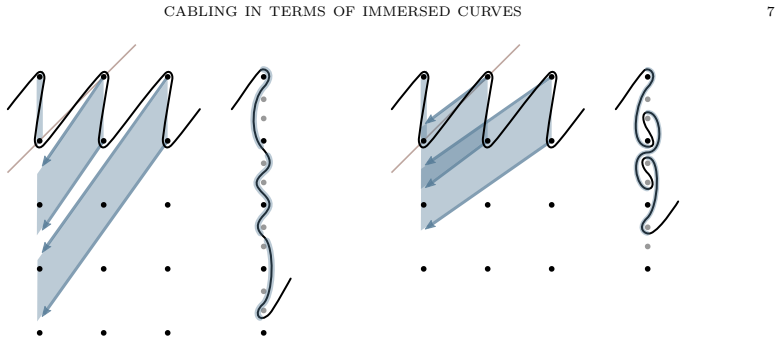
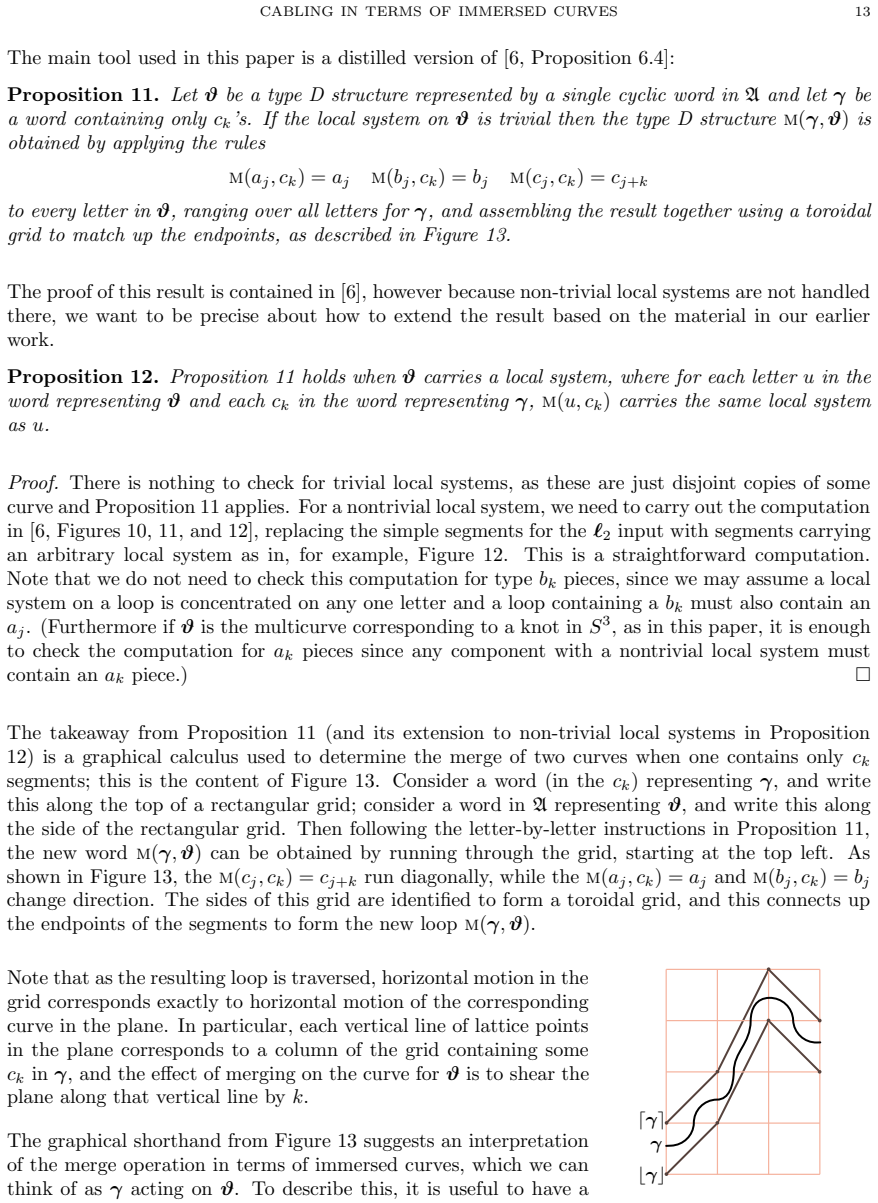
The load-bearing object is the merge operation from the authors' earlier loop calculus, reinterpreted as a fractional plane shear. When one input to the merge is a curve made only of c_k segments, merging acts by shearing each vertical line of lattice points so that the horizontal axis is carried to the piecewise-linear curve that tracks the second input just below its lattice points. Cabling is the special case where that second input is a straight line of rational slope q/p; the shear then slides points along lines of slope q/p, and the bookkeeping of the cable framing turns this into the explicit plane map f_{p,q} appearing in the theorem.
What would settle it
Compute, from the bordered Floer complexes, the immersed multicurve for the (2,1)-cable of a knot whose complement's invariant includes a component with a nontrivial local system, and compare the result with the image of the original multicurve under f_{2,1}; a mismatch at the decorated component would refute the theorem as stated for arbitrary immersed multicurves.
Extended reading notes
Core claim
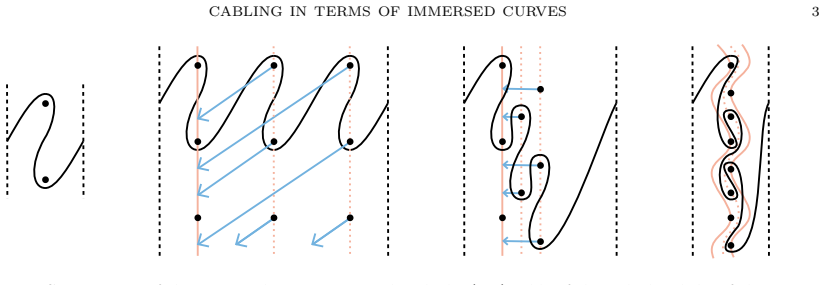
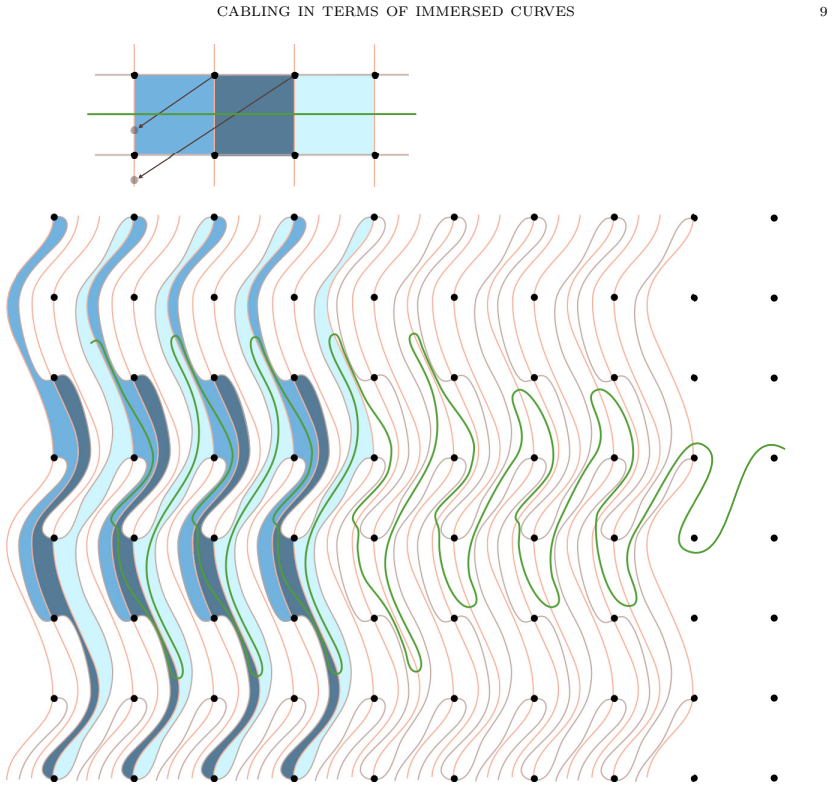
The paper proves that cabling a knot acts on its knot Floer data by an explicit homeomorphism of the punctured plane. Knot complements carry an invariant called an immersed multicurve: a finite set of immersed curves, possibly decorated with vector spaces, drawn in a punctured torus. The central theorem states that the multicurve for the (p,q)-cable is obtained from the multicurve for K by sliding each lattice point leftward along a line of slope q/p until it lands on a vertical line x = np, then compressing horizontally and stretching vertically by p, with a fixed vertical shift recorded. In drawing terms: lay p staggered copies of the original curve side by side, connect the loose ends, then slide the lattice pegs horizontally so they all line up vertically. The same map can be read as a periodic tiling of the plane by new tiles; the image of the original lattice under the map is the lattice of that tiling, and the cable's invariant is the image of the original curve under the tiling transformation.
Load-bearing premise
The whole result rests on an earlier gluing construction being correct for curves with extra decorations; the paper asserts rather than proves that extension, so if that gluing construction fails for decorated curves, the cabling formula fails.
Editorial extensions
If this is right
- The (p,q)-cable invariant can be computed by drawing p copies of the original curve, staggering them vertically by q, joining ends, and compressing horizontally; no new bordered Floer computation is needed.
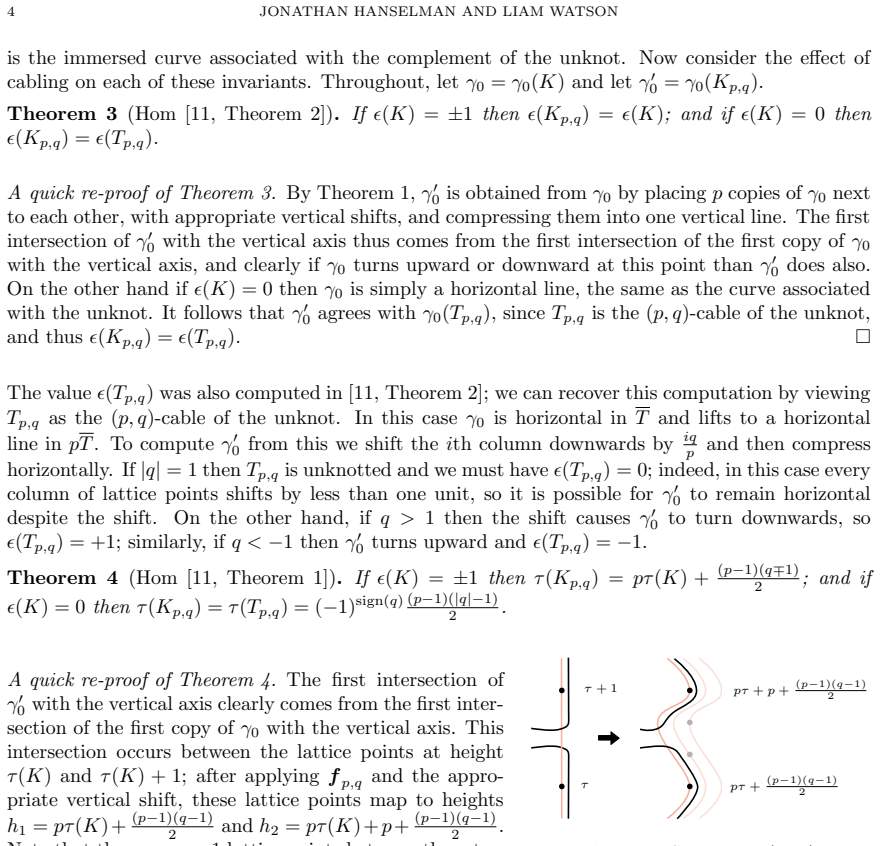
- The formulas of Hom for tau and epsilon under cabling are recovered directly from the first intersection of the first copy of the distinguished curve with the vertical axis.
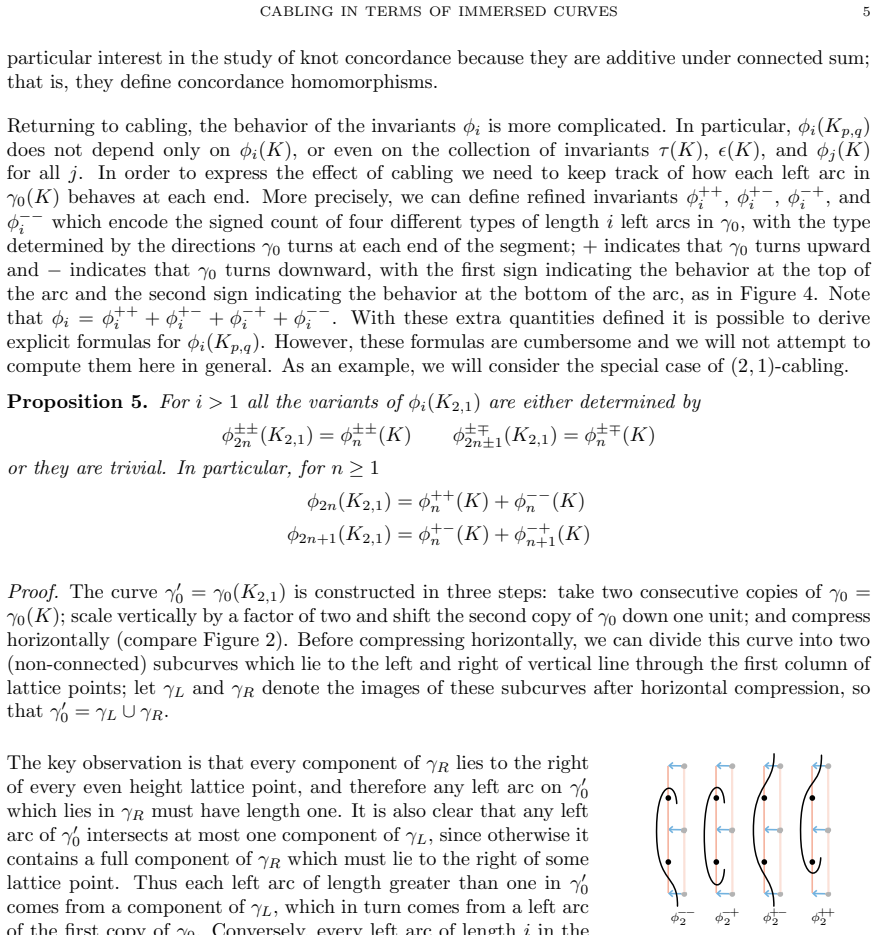
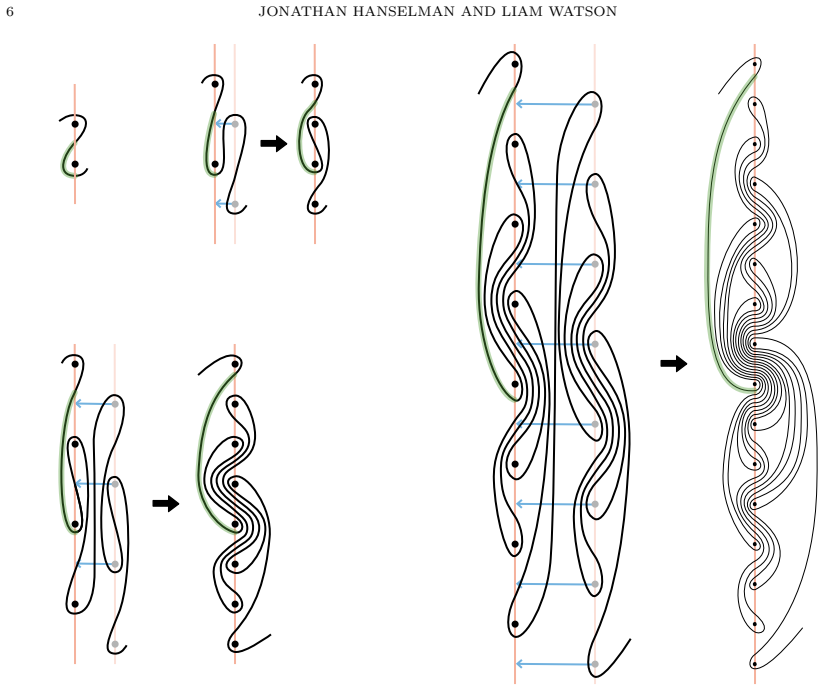
- For (2,1)-cables, the refined Phi_i counts obey parity rules: Phi_{2n} = Phi_n^{++} + Phi_n^{--} and Phi_{2n+1} = Phi_n^{+-} + Phi_{n+1}^{-+} for n at least 1.
- Iterated (2,1)-cabling doubles the length of a unique maximal ++ left arc, yielding an infinite family of topologically slice knots that are linearly independent in the smooth concordance group.
- If a knot's curve set contains a closed component enclosing two adjacent lattice points of different height modulo p, that knot cannot be a (p,q)-cable of another knot.
Reading between the lines
- The same plane-shear picture should describe how satellite operations act on immersed curves in general: a satellite operation is likely realized by a multivalued Lagrangian correspondence, and the cabling theorem is the first instance where that action is visibly a fractional plane shear.
- The immersed-curve encoding loses only diagonal arrows from the full chain complex, so a refined curve-with-decorations invariant would be needed to lift the cabling formula to complete CFK^- complexes rather than just their curve shadows.
- The asserted extension of the merge operation to nontrivial local systems could be tested explicitly on a small example with a nontrivial local system; this is the one step of the proof that is stated as a straightforward computation rather than written out.
- The tiling reformulation may make the cabling action available to other invariants that admit curve or graph models in the punctured torus, provided those models satisfy the same merge rule.
Signed reviews
Editorial analysis
A structured set of objections, weighed in public.
Referee Report
Summary. The paper proposes a concise geometric formula for the behavior of the immersed-curve invariant of knot Floer homology under cabling. Concretely, for a knot K in S^3 with associated immersed multicurve γ in the punctured torus, the paper claims that the immersed curve of the (p,q)-cable complement γ_{p,q} is obtained, after lifting to the universal cover, by applying an explicit plane map f_{p,q} to γ. The argument is based on a merge operation imported from the authors' earlier loop-calculus work with J. Rasmussen, translated into the immersed-curve language via a graphical toroidal-grid calculus. The paper also gives quick re-derivations of Hom's theorems on τ and ε under cabling, a re-proof of the L-space surgery criterion for cables, and a concordance application producing a Z^∞ summand from iterated (2,1)-cables of a knot with trivial Alexander polynomial and prescribed γ_0.
Significance. If the main theorem is fully established, the paper's formula is valuable: it turns cabling into a transparent geometric operation on immersed curves and immediately explains several known numerical cabling formulas. Its strengths are that the geometric picture is clear, the re-proofs of Hom's theorems are genuine consequences rather than assumed inputs, and the consistency checks against known results are convincing. The concordance application is also interesting, since it gives an independent family of topologically slice, smoothly independent knots from simple curve data. However, the paper currently depends in an essential place on an unproved local-system extension of the merge operation, so the full generality of the main theorem is not yet established.
major comments (3)
- [§1.2, Proposition 12] Proposition 12 is load-bearing for Theorem 1, but its proof is not supplied: the text says only 'This is a straightforward computation' after referring to [6, Figures 10–12]. Since [6] does not handle nontrivial local systems, Proposition 12 is a new claim rather than an imported theorem. The concern is not cosmetic: in the local-system expansion, the extra arrows representing Φ interact with the c_k columns in the toroidal grid, and a basepoint, ordering, or contraction issue could change the holonomy on the image component. Without a written verification, Theorem 1 is unproved for any K whose HF-hat(M) has a nontrivial local system on a closed component. Please include the actual computation, or explicitly restrict the statement of Theorem 1 (and of Corollary 13) to trivial local systems.
- [§1.2, Corollary 13] The proof of Corollary 13 is descriptive rather than formal: it says 'This is the main thrust of Figure 13' and then asserts that the toroidal grid produces p copies of the word for ϑ with shifted c-indices, distinguishing only between components homologous to λ and nullhomologous components. Since Corollary 13 is used directly in the proof of Theorem 1 in §2.2, the argument should be written out as a verification that the grid assembly respects endpoints, periodicity, and the stated period pq. In particular, the claim that relative primality of p and q forces the new curve to make p vertical passes before closing deserves a precise justification.
- [§2.2, proof of Theorem 1] The final step of the proof of Theorem 1 is a sequence of geometric shears described in words and pictures, but the map f_{p,q} is not given by an explicit formula or by a precise composition of piecewise-linear maps on the plane. In particular, the vertical shift (p-1)(q-1)/2 and the claim that f_{p,q} sends Z^2 to Z^2 are stated without calculation. This is not fatal, but a precise definition of f_{p,q} would make the theorem checkable and would also clarify the meaning of 'homotopic' for the lifted curves.
minor comments (4)
- [Abstract and §2] There are several typos: 'corresonding' in Theorem 1, 'the the' in the caption of Figure 7, and 'effects' in §2.1 should read 'affects'.
- [§1.1] The definitions of letters a_k, b_k, c_k, d_k, and e are given informally through Figure 10 and the surrounding text; a short formal definition or an explicit reference to the corresponding notation in [6, Figure 1] would improve precision.
- [§1.1, local systems] The phrase 'a letter decorated by the trivial local system of dimension n corresponds to n parallel copies of the relevant curve segment' is clear, but the notation for the local system (V, Φ) on a cyclic word would benefit from an explicit convention about the order of composition of the endomorphisms.
- [Figure 16] The captions in Figures 15 and 16 are long and partly repeat the text; labeling the key curves in the figures themselves would make the two-step shear argument easier to follow.
Circularity Check
No significant circularity: Theorem 1 is a genuine geometric translation of the authors' earlier merge theorem, with the main caveat being an unproved but non-circular local-system extension in Proposition 12.
full rationale
The claimed derivation is not circular. Theorem 1 is not assumed in the construction of f_{p,q}: the map is defined from the framings in the gluing of M, P×S1, and D2×S1 (Section 2.1), and the curve formula is derived by first invoking the authors' earlier merge theorem for bordered Floer homology (Proposition 11, from [6]), then translating the letter-level merge rules into a plane shear (Corollary 13 and Section 2.2). The result is checked against external theorems of Hom and Hedden (Theorems 3, 4, 9), so the formula has independent content rather than being a fitted restatement. The main weakness is Proposition 12: the extension of the merge to non-trivial local systems is asserted with 'This is a straightforward computation' and a reference to [6, Figures 10–12], even though the paper itself states that [6] does not handle local systems. That is a load-bearing omitted proof for the full generality of Theorem 1, and Corollary 13's proof is likewise descriptive; but neither step assumes the target formula or renames a fitted input, so these are correctness/completeness gaps, not circularity.
Assumptions & free parameters
assumptions (5)
- domain assumption Bordered Floer invariants for manifolds with torus boundary are equivalent to immersed multicurves in the punctured torus.
- domain assumption The merge operation m(gamma,theta) computes the bordered invariant of the manifold glued along essential annuli, with the letter-by-letter rules of Proposition 11.
- domain assumption Type D structures of knot complements can be represented by cyclic words in the alphabet {a_k, b_k, c_k, d_k, e}, with nontrivial local systems concentrated on an a_k segment.
- standard math Knots with trivial Alexander polynomial are topologically slice (Freedman).
- domain assumption The invariants phi_i are concordance homomorphisms.
Cite this review
Pith. "Pith review of Cabling in terms of immersed curves." pith.science (2026). https://pith.science/paper/TKYNRNSF
@misc{pith2026190804397,
  author       = {Pith},
  title        = {Pith review of: Cabling in terms of immersed curves},
  year         = {2026},
  howpublished = {\url{https://pith.science/paper/TKYNRNSF}},
  note         = {Machine review of arXiv:1908.04397}
}
read the original abstract
In joint work with J. Rasmussen, we gave an interpretation of Heegaard Floer homology for manifolds with torus boundary in terms of immersed curves in a punctured torus. In particular, knot Floer homology is captured by this invariant. Appealing to earlier work of the authors on bordered Floer homology, we give a formula for the behaviour of these immersed curves under cabling.
Figures

Figures from the paper (13 more)





Forward citations
Cited by 1 Pith paper
-
Fractional Dehn twist coefficients and rank bounds for categorified link invariants
Fibered links whose monodromy twists many times around a boundary component have large next-to-top link Floer homology, and braid closures with large fractional Dehn twist coefficient have large annular Khovanov homology.
Reference graph
Works this paper leans on
-
[6]
A calculus for bordered Floer homology
Jonathan Hanselman and Liam Watson. A calculus for bordered Floer homology. Preprint, arXiv.1508.05445
-
[1]
More concordance homomorphisms from knot Floer homology
Irving Dai, Jennifer Hom, Matthew Stoffregen, and Linh Truong. More concordance homomorphisms from knot Floer homology. Preprint, arXiv:1902.03333
arXiv 1902
-
[2]
The topology of four-dimensional manifolds
Michael Hartley Freedman. The topology of four-dimensional manifolds. J. Differential Geom. , 17(3):357–453, 1982
work page 1982
-
[3]
Bordered Heegaard Floer homology and graph manifolds
Jonathan Hanselman. Bordered Heegaard Floer homology and graph manifolds. Algebr. Geom. Topol. , 16(6):3103–3166, 2016
work page 2016
-
[4]
Bordered Floer homology for manifolds with torus boundary via immersed curves
Jonathan Hanselman, Jacob Rasmussen, and Liam Watson. Bordered Floer homology for manifolds with torus boundary via immersed curves. Preprint, arXiv:1604.03466
-
[5]
Heegaard Floer homology for manifolds with torus boundary: properties and examples
Jonathan Hanselman, Jacob Rasmussen, and Liam Watson. Heegaard Floer homology for manifolds with torus boundary: properties and examples. Preprint, arXiv.1810.10355
-
[7]
On knot Floer homology and cabling
Matthew Hedden. On knot Floer homology and cabling . ProQuest LLC, Ann Arbor, MI, 2005. Thesis (Ph.D.)– Columbia University. 18 JONATHAN HANSELMAN AND LIAM W ATSON
work page 2005
-
[8]
On knot Floer homology and cabling
Matthew Hedden. On knot Floer homology and cabling. Algebr. Geom. Topol., 5:1197–1222, 2005
work page 2005
Show all 21 references
-
[9]
On knot Floer homology and cabling
Matthew Hedden. On knot Floer homology and cabling. II. Int. Math. Res. Not. IMRN , (12):2248–2274, 2009
2009
-
[10]
A note on cabling and L-space surgeries
Jennifer Hom. A note on cabling and L-space surgeries. Algebr. Geom. Topol., 11(1):219–223, 2011
2011
-
[11]
Bordered Heegaard Floer homology and the tau-invariant of cable knots
Jennifer Hom. Bordered Heegaard Floer homology and the tau-invariant of cable knots. J. Topol., 7(2):287–326, 2014
2014
-
[12]
A survey on Heegaard Floer homology and concordance
Jennifer Hom. A survey on Heegaard Floer homology and concordance. J. Knot Theory Ramifications , 26(2):1740015, 24, 2017
2017
-
[13]
Knot doubling operators and bordered Heegaard Floer homology
Adam Simon Levine. Knot doubling operators and bordered Heegaard Floer homology. J. Topol., 5(3):651–712, 2012
2012
-
[14]
Ozsv´ ath, and Dylan P
Robert Lipshitz, Peter S. Ozsv´ ath, and Dylan P. Thurston. Bimodules in bordered Heegaard Floer homology. Geom. Topol., 19(2):525–724, 2015
2015
-
[15]
Ozsvath, and Dylan P
Robert Lipshitz, Peter S. Ozsvath, and Dylan P. Thurston. Bordered Heegaard Floer homology. Mem. Amer. Math. Soc., 254(1216):viii+279, 2018
2018
-
[16]
What is a train track? Notices of the AMS , 50(3):354–355, 2003
Lee Mosher. What is a train track? Notices of the AMS , 50(3):354–355, 2003
2003
-
[17]
Holomorphic disks and knot invariants.Adv
Peter Ozsv´ ath and Zolt´ an Szab´ o. Holomorphic disks and knot invariants.Adv. Math., 186(1):58–116, 2004
2004
-
[18]
Ozsv´ ath, Andr´ as I
Peter S. Ozsv´ ath, Andr´ as I. Stipsicz, and Zolt´ an Szab´ o. Concordance homomorphisms from knot Floer homology. Adv. Math., 315:366–426, 2017
2017
-
[19]
Cables of thin knots and bordered Heegaard Floer homology
Ina Petkova. Cables of thin knots and bordered Heegaard Floer homology. Quantum Topol., 4(4):377–409, 2013
2013
-
[20]
Floer homology and knot complements
Jacob Andrew Rasmussen. Floer homology and knot complements . ProQuest LLC, Ann Arbor, MI, 2003. Thesis (Ph.D.)–Harvard University
2003
-
[21]
Van Cott
Cornelia A. Van Cott. Ozsv´ ath-Szab´ o and Rasmussen invariants of cable knots.Algebr. Geom. Topol., 10(2):825– 836, 2010. Department of Mathematics, Princeton University. E-mail address: jh66@math.princeton.edu Department of Mathematics, University of British Columbia. E-mai...
2010
Reviewed August 14, 2026 · model on record in the stance chip above.
Discussion (0). Continue with ORCID to comment.