Inelastic collisions of fast charged particles with atoms. Relativistic plane-wave Born approximation
Pith reviewed 2026-05-22 01:53 UTC · model grok-4.3
The pith
The double-differential cross section for inelastic collisions separates into longitudinal and transverse generalized oscillator strengths each multiplied by kinematic factors.
A machine-rendered reading of the paper's core claim, the machinery that carries it, and where it could break.
Core claim
Within the relativistic plane-wave Born approximation the double-differential cross section is written as the sum of two products, each consisting of purely kinematic factors and a generalized oscillator strength; the longitudinal GOS accounts for transitions induced by the instantaneous Coulomb interaction while the transverse GOS accounts for transitions caused by the transverse electromagnetic field, and both GOSs are given in closed form by vector coupling coefficients and radial integrals evaluated with Dirac-Hartree-Fock-Slater orbitals.
What carries the argument
The longitudinal and transverse generalized oscillator strengths, which isolate the atomic response from the kinematic factors in the cross section and are evaluated from the independent-electron Dirac orbitals.
If this is right
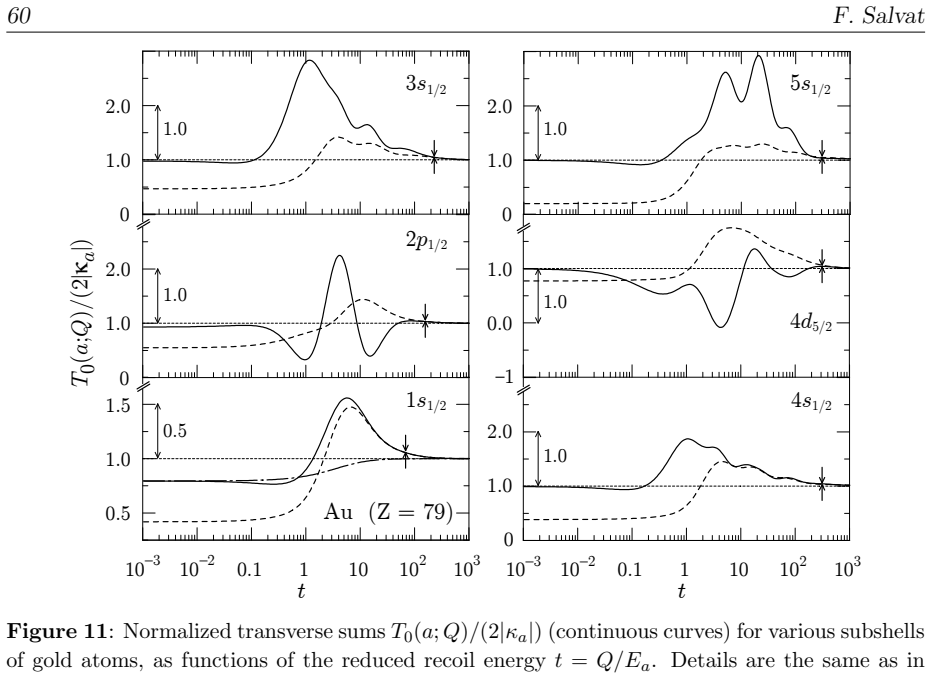
- A complete numerical database of longitudinal and transverse GOSs now exists for every subshell of the ground-state configuration of neutral atoms from hydrogen through einsteinium.
- Asymptotic high-energy formulas follow directly for the total inelastic cross section, the stopping cross section, and the energy-straggling cross section.
- Shell corrections to the asymptotic stopping cross section are obtained by subtracting the computed numerical values from the high-energy limit.
- The same expressions yield energy-loss spectra and integrated quantities for any atomic number without further approximation.
Where Pith is reading between the lines
- The clean separation between longitudinal and transverse channels may make it easier to isolate relativistic magnetic and retardation corrections in measured spectra.
- The tabulated GOS database supplies a ready input for Monte Carlo codes that track fast particles through matter.
- The same formal structure can be reused for positive ions or for excited target states once the corresponding orbitals are supplied.
- Systematic comparison of the relativistic results with the non-relativistic limit quantifies the energy range where relativistic kinematics become essential.
Load-bearing premise
Wave functions obtained from a central-field independent-electron model with the Dirac-Hartree-Fock-Slater self-consistent potential are accurate enough to give reliable generalized oscillator strengths for the collision kinematics of interest.
What would settle it
Direct experimental measurement of the double-differential energy-loss cross section for, say, 100 MeV protons on neon or argon, compared against the numerical values generated from the derived GOS database.
Figures
read the original abstract
A detailed formulation of the relativistic plane-wave Born approximation for inelastic collisions of charged particles with free atoms and positive ions is presented. The wave functions of the target atom or ion are calculated from a central-field independent-electron model with the Dirac-Hartree-Fock-Slater self-consistent potential, and the electromagnetic field is expressed in the Coulomb gauge. The double-differential cross section, depending on the energy loss and the recoil energy, is given as a sum of two terms which are products of purely kinematic factors and the generalized oscillator strengths (GOSs). Transitions induced by the instantaneous Coulomb interaction between the projectile and the active target electron are described by the longitudinal GOS. Transitions caused by the transverse interaction (exchange of virtual photons) are accounted for by a transverse GOS. We derive closed expressions for the longitudinal and transverse GOSs in terms of vector coupling coefficients and radial integrals. A set of Fortran programs have been written to compute the GOSs, the energy-loss differential cross section, and integrals of the latter. A complete numerical database of GOSs has been calculated for all the subshells of the ground-state configuration of neutral atoms of the elements with atomic numbers from 1 (hydrogen) to 99 (einsteinium). A systematic derivation of asymptotic formulas for the total cross section, the stopping cross section and the energy-straggling cross section is presented. The shell correction to the asymptotic formula for the stopping cross section of protons is obtained from the difference between computed numerical values and the predictions of that formula.
Editorial analysis
A structured set of objections, weighed in public.
Referee Report
Summary. The manuscript presents a detailed relativistic plane-wave Born approximation (PWBA) formulation for inelastic collisions of fast charged particles with free atoms and positive ions. Target wave functions are obtained from a central-field independent-electron model using the Dirac-Hartree-Fock-Slater potential in the Coulomb gauge. The double-differential cross section is expressed as a sum of two terms, each a product of kinematic factors and generalized oscillator strengths (GOSs): the longitudinal GOS for instantaneous Coulomb interactions and the transverse GOS for virtual-photon exchange. Closed expressions for both GOSs are derived in terms of vector coupling coefficients and radial integrals. A numerical database of GOSs is computed for all subshells of neutral atoms with Z from 1 to 99, Fortran programs are provided for GOSs and cross sections, and asymptotic formulas for total, stopping, and straggling cross sections are derived, with the shell correction to the stopping cross section obtained from the difference between numerical results and the asymptotic formula.
Significance. If the central results hold, the work supplies a systematic relativistic framework, closed-form GOS expressions, and an extensive numerical database that can serve as a reference for high-energy stopping-power calculations in radiation physics and particle transport. The separation into longitudinal and transverse contributions, the derivation of asymptotics, and the extraction of shell corrections from direct numerical comparison represent practical strengths that extend beyond purely numerical tabulations.
minor comments (3)
- [Introduction] The manuscript should specify the energy range and Z values over which the PWBA remains valid, including any quantitative criteria for the Born approximation (e.g., projectile velocity relative to orbital velocities).
- [Numerical implementation] A brief description of the Fortran programs' input/output formats, compilation requirements, and example usage would improve reproducibility of the reported GOS database and cross-section integrals.
- [Derivation of GOSs] The definition and normalization of the transverse GOS could be cross-referenced more explicitly to the longitudinal GOS to clarify the kinematic prefactors in the double-differential cross section.
Simulated Author's Rebuttal
We thank the referee for the detailed and accurate summary of our manuscript, for highlighting its practical strengths in providing a systematic relativistic PWBA framework, closed-form GOS expressions, an extensive numerical database, and asymptotic formulas with shell corrections, and for recommending minor revision. We are pleased that the separation into longitudinal and transverse contributions and the extraction of shell corrections from numerical comparison were noted as useful extensions beyond tabulations.
Circularity Check
No significant circularity in the derivation chain
full rationale
The paper derives the double-differential cross section as kinematic prefactors times longitudinal and transverse GOSs from the relativistic PWBA in Coulomb gauge, obtains closed expressions for the GOSs via standard angular-momentum recoupling of Dirac matrix elements, computes a numerical database using the DHFS central-field model as an explicit input assumption, and derives asymptotic formulas for total, stopping, and straggling cross sections directly from those expressions. The shell correction is then obtained by subtracting the asymptotic predictions from the full numerical results, which is a post-processing difference rather than a fitted parameter renamed as a prediction. No step reduces by construction to its own inputs, no load-bearing self-citation chain is present, and the derivation remains self-contained against external benchmarks and the stated atomic model.
Axiom & Free-Parameter Ledger
axioms (2)
- domain assumption Central-field independent-electron model with Dirac-Hartree-Fock-Slater potential yields adequate single-particle wave functions for GOS calculations.
- domain assumption Plane-wave Born approximation is valid for the fast-particle kinematics considered.
Lean theorems connected to this paper
-
IndisputableMonolith/Cost/FunctionalEquation.leanwashburn_uniqueness_aczel unclear?
unclearRelation between the paper passage and the cited Recognition theorem.
wave functions ... Dirac-Hartree-Fock-Slater self-consistent potential
What do these tags mean?
- matches
- The paper's claim is directly supported by a theorem in the formal canon.
- supports
- The theorem supports part of the paper's argument, but the paper may add assumptions or extra steps.
- extends
- The paper goes beyond the formal theorem; the theorem is a base layer rather than the whole result.
- uses
- The paper appears to rely on the theorem as machinery.
- contradicts
- The paper's claim conflicts with a theorem or certificate in the canon.
- unclear
- Pith found a possible connection, but the passage is too broad, indirect, or ambiguous to say the theorem truly supports the claim.
Reference graph
Works this paper leans on
-
[1]
Abramowitz, M. and I. A. Stegun (1972), Handbook of Mathematical Functions (Dover, New York)
work page 1972
-
[2]
Ahlen, S. P. (1980), Theoretical and experimental aspects of the energy loss of relativistic heavily ionizing particles, Rev.\ Mod.\ Phys. 52, 121--173
work page 1980
-
[3]
Akhiezer, A. I. and V. B. Berestetskii (1965), Quantum Electrodynamics (Interscience, New York)
work page 1965
-
[4]
Amundsen, P. A. (1977), Coulomb deflection effects in ion-induced K-shell ionisation , J. Phys.\ B: Atom.\ Molec.\ Phys. 10, 2177--2187
work page 1977
-
[5]
Arfken, G. (1985), Mathematical Methods for Physicists (Academic Press, Inc., San Diego, California), 3rd edition
work page 1985
-
[6]
Basbas, G., W. Brandt, and R. Laubert (1978), Universal cross sections for K-shell ionization by heavy charged particles. II. Intermediate particle velocities , Phys.\ Rev.\ A 17, 1655--1674
work page 1978
-
[7]
(1974), Lectures in Quantum Mechanics (Westview Press, Boulder, Colorado)
Baym, G. (1974), Lectures in Quantum Mechanics (Westview Press, Boulder, Colorado)
work page 1974
-
[8]
Berger, M. J. and H. Bichsel (1994), BEST, BEthe STopping power program , unpublished
work page 1994
-
[9]
Bethe, H. A. (1930), Zur Theorie des Durchgangs schneller Korpuskularstrahlen durch Materie , Ann.\ Physik 397, 325--400
work page 1930
-
[10]
Bethe, H. A. (1932), Bremsformel f\"ur Elektronen relativistischer Geschwindigkeit , Z. Physik 76, 293--299
work page 1932
-
[11]
Bethe, H. A. (1933), Quantenmechanik der Ein und Zwei Elektronenprobleme , in H. Geiger and K. Scheel (editor), Handbuch der Physik, volume 24, pages 273--560 (Springer, Berlin)
work page 1933
-
[12]
Bethe, H. A. and R. Jackiw (1997), Intermediate Quantum Mechanics (Westview Press, Boulder, CO)
work page 1997
-
[13]
Bethe, H. A. and E. E. Salpeter (1957), Quantum Mechanics of One- and Two-Electron Atoms (Springer-Verlag, Berlin)
work page 1957
-
[14]
Bhabha, H. J. (1936), The scattering of positrons by electrons with exchange on Dirac's theory of electrons , Proc.\ Phys.\ Soc.\ A 154, 195--196
work page 1936
-
[15]
Bichsel, H. (1983), Stopping power of M-shell electrons for heavy charged particles , Phys.\ Rev.\ A 28, 1147--1150
work page 1983
-
[16]
(2002), Shell corrections in stopping powers , Phys.\ Rev.\ A 65, 052709
Bichsel, H. (2002), Shell corrections in stopping powers , Phys.\ Rev.\ A 65, 052709
work page 2002
-
[17]
Bonderup, E. (1967), Stopping of swift protons evaluated from statistical atomic model, Mat.\ Fys.\ Medd.\ Dan.\ Vid.\ Selsk. 35, 1--19
work page 1967
-
[18]
Bote, D. and F. Salvat (2008), Calculations of inner-shell ionization by electron impact with the distorted-wave and plane-wave Born approximations , Phys.\ Rev.\ A 77, 042701
work page 2008
-
[19]
Brandt, W. and G. Lapicki (1979), L-shell Coulomb ionization by heavy charged particles , Phys.\ Rev.\ A 20, 465--480
work page 1979
-
[20]
Bransden, B. H. and C. J. Joachain (1983), Physics of Atoms and Molecules (Longman, Essex, England)
work page 1983
-
[21]
Breit, G. and H. A. Bethe (1954), Ingoing waves in final state of scattering problems, Phys.\ Rev. 93, 888--890
work page 1954
-
[22]
Chen, M. H. and B. Crasemann (1985), Relativistic cross sections for atomic K- and L-shell ionization by protons, calculated from a Dirac-Hartree-Slater model , At.\ Data and Nucl.\ Data Tables 33, 217--233
work page 1985
-
[23]
Chen, M. H. and B. Crasemann (1989), Atomic K, L-, and M-shell cross sections for ionization by protons: a relativistic Hartree-Slater calculation , At.\ Data and Nucl.\ Data Tables 41, 257--285
work page 1989
-
[24]
Chen, M. H., B. Crasemann, and H. M \"a rk (1983), Relativistic calculation of atomic M-shell ionization by protons , Phys.\ Rev.\ A 27, 2358--2364
work page 1983
-
[25]
Cohen, S. M. (2003 a ), Bethe stopping power theory for heavy-element targets and relativistic projectiles, Phys.\ Rev.\ A 68, 012720
work page 2003
-
[26]
Cohen, S. M. (2003 b ), Range of validity for perturbative treatments of relativistic sum rules, Phys.\ Rev.\ A 68, 042704
work page 2003
-
[27]
Colgan, J., C. J. Fontes, and H. L. Zhang (2006), Inner-shell electron-impact ionization of neutral atoms, Phys.\ Rev.\ A 73, 062711
work page 2006
-
[28]
Condon, E. U. (1930), The theory of complex spectra, Phys.\ Rev. 36, 1121--1133
work page 1930
-
[29]
Condon, E. U. and H. Odaba s i (1980), Atomic Structure (Cambridge University Press, Cambridge, UK)
work page 1980
-
[30]
Cullen, D. E., J. H. Hubbell, and L. Kissel (1997), EPDL97 The Evaluated Photon Data Library, ' 97 Version , Technical Report UCRL-50400, Lawrence Livermore National Laboratory, Livermore, California
work page 1997
-
[31]
Dehmer, J. L., M. Inokuti, and R. P. Saxon (1975), Systematics of moments of dipole oscillator-strength distributions for atoms of the first and second row , Phys.\ Rev.\ A 12, 102--121
work page 1975
-
[32]
Edmonds, A. R. (1960), Angular Momentum in Quantum Mechanics (Princeton University Press, Princeton, NJ)
work page 1960
-
[33]
Egerton, R. F. (2011), Electron Energy-loss Spectroscopy in the Electron Microscope (Springer, New York), 3 edition
work page 2011
-
[34]
Fano, U. (1954), Ionizing collisions of very fast particles and the dipole strength of optical transitions, Phys.\ Rev. 95, 1198--1200
work page 1954
-
[35]
(1956), Atomic theory of electromagnetic interactions in dense materials, Phys.\ Rev
Fano, U. (1956), Atomic theory of electromagnetic interactions in dense materials, Phys.\ Rev. 103, 1202--1218
work page 1956
-
[36]
(1963), Penetration of protons, alpha particles and mesons, Ann.\ Rev.\ Nucl.\ Sci
Fano, U. (1963), Penetration of protons, alpha particles and mesons, Ann.\ Rev.\ Nucl.\ Sci. 13, 1--66
work page 1963
-
[37]
Fano, U. and J. W. Cooper (1968), Spectral distributions of atomic oscillator strengths, Rev.\ Mod.\ Phys. 40, 441--507
work page 1968
-
[38]
Fern \'a ndez-Varea, J. M., R. Mayol, J. Bar\' o , and F. Salvat (1993), On the theory and simulation of multiple elastic scattering of electrons, Nucl.\ Instrum.\ Meth.\ B 73, 447--473
work page 1993
-
[39]
Fern \'a ndez-Varea, J. M., F. Salvat, M. Dingfelder, and D. Liljequist (2005), A relativistic optical-data model for inelastic scattering of electrons and positrons in condensed matter, Nucl.\ Instrum.\ Meth.\ B 229, 187--218
work page 2005
-
[40]
Furry, W. H. (1951), On bound states and scattering in positron theory, Phys.\ Rev. 81, 115--124
work page 1951
-
[41]
Grant, I. P. (1961), Relativistic self-consistent fields, Proc.\ Roy.\ Soc.\ A 262, 555--576
work page 1961
-
[42]
Grant, I. P. (1965), Relativistic self-consistent fields, Proc.\ Phys.\ Soc.\ A 86, 523--527
work page 1965
-
[43]
Greiner, W. and J. Reinhardt (1994), Quantum Electrodynamics (Springer, Berlin)
work page 1994
-
[44]
(1954), The Quantum Theory of Radiation (Oxford University Press, London)
Heitler, W. (1954), The Quantum Theory of Radiation (Oxford University Press, London)
work page 1954
-
[45]
Hubbell, J. H., W. J. Veigele, E. A. Briggs, R. T. Brown, D. T. Cromer, and R. J. Howerton (1975), Atomic form factors, incoherent scattering functions, and photon scattering cross sections, J. Phys.\ Chem.\ Ref.\ Data 4, 471--538
work page 1975
-
[46]
Hubbell, J. H., W. J. Veigele, E. A. Briggs, R. T. Brown, D. T. Cromer, and R. J. Howerton (1977), Erratum: Atomic form factors, incoherent scattering functions, and photon scattering cross sections , J. Phys.\ Chem.\ Ref.\ Data 6, 615--616
work page 1977
-
[47]
ICRU Report 37 (1984), Stopping Powers for Electrons and Positrons (ICRU, Bethesda, MD)
work page 1984
-
[48]
ICRU Report 49 (1993), Stopping Powers and Ranges for Protons and Alpha Particles (ICRU, Bethesda, MD)
work page 1993
-
[49]
Inokuti, M. (1971), Inelastic collisions of fast charged particles with atoms and molecules --- T he B ethe theory revisited , Rev.\ Mod.\ Phys. 43, 297--347
work page 1971
-
[50]
Inokuti, M., J. L. Dehmer, T. Baer, and J. D. Hanson (1981), Oscillator-strength moments, stopping powers, and total inelastic-scattering cross sections of all atoms through strontium, Phys.\ Rev.\ A 23, 95--109
work page 1981
-
[51]
Inokuti, M., Y. Itikawa, and J. E. Turner (1978), Adenda: Inelastic collisions of fast charged particles with atoms and molecules --- T he B ethe theory revisited , Rev.\ Mod.\ Phys. 50, 23--35
work page 1978
-
[52]
Inokuti, M., R. P. Saxon, and J. L. Dehmer (1975), Total cross-sections for inelastic scattering of charged particles by atoms and molecules -- VIII. Systematics for atoms in the first and second row , Int.\ J.\ Radiat.\ Phys.\ Chem 7, 109--120
work page 1975
-
[53]
Inokuti, M. and D. Y. Smith (1982), Fermi density effect on the stopping power of metallic aluminum, Phys.\ Rev. 25, 61--66
work page 1982
-
[54]
Jackson, J. D. (1975), Classical Electrodynamics (John Wiley and Sons, New York), 2nd edition
work page 1975
-
[55]
Joachain, C. J. (1975), Quantum Collision Theory (North Holland, Amsterdam)
work page 1975
-
[56]
Johnson, W. R. and K. T. Cheng (1979), Quantum defects for highly stripped ions, J.\ Phys.\ B: At.\ Mol.\ Phys. 12, 863--879
work page 1979
-
[57]
Khandelwal, G. S. and E. Merzbacher (1966), Stopping power of M electrons, Phys.\ Rev. 144, 349--352
work page 1966
-
[58]
Kim, Y. K. and M. Inokuti (1971), Total cross sections for inelastic scattering of charged particles by atoms and molecules. V. Evaluation to the next order beyond the Bethe asymptote , Phys.\ Rev.\ A 3, 665--678
work page 1971
-
[59]
(1955), Atomic energy levels for the Thomas--Fermi and Thomas--Fermi--Dirac potential , Phys.\ Rev
Latter, R. (1955), Atomic energy levels for the Thomas--Fermi and Thomas--Fermi--Dirac potential , Phys.\ Rev. 99, 510--519
work page 1955
-
[60]
Levinger, J. S., M. L. Rustgi, and K. Okamoto (1957), Relativistic corrections to the dipole sum rule , Phys.\ Rev. 106, 1191--1194
work page 1957
-
[61]
Liberman, D., D. T. Cromer, and J. T. Waber (1971), Relativistic self-consistent field program for atoms and ions, Comput.\ Phys.\ Commun. 2, 107--113
work page 1971
-
[62]
(1954), On the properties of a gas of charged particles, Dan.\ Mat.\ Fys.\ Medd
Lindhard, J. (1954), On the properties of a gas of charged particles, Dan.\ Mat.\ Fys.\ Medd. 28, 1--57
work page 1954
-
[63]
Lindhard, J. and M. Scharff (1953), Energy loss in matter by charged particles of low charge, Dan.\ Mat.\ Fys.\ Medd. 27, 1--31
work page 1953
-
[64]
Lindhard, J. and A. H. S rensen (1996), Relativistic theory of stopping for heavy ions, Phys.\ Rev.\ A 53, 2443--2456
work page 1996
-
[65]
Llovet, X., C. J. Powell, A. Jablonski, and F. Salvat (2014), Cross sections for inner-shell ionization by electron impact, J.\ Phys.\ Chem.\ Ref.\ Data 43, 013102
work page 2014
-
[66]
Louck, J. D. (1958), New recursion relation for the Clebsch-Gordan coefficients , Phys.\ Rev. 110, 815--816
work page 1958
-
[67]
Mann, J. B. and W. R. Johnson (1971), Breit interaction in multielectron atoms, Phys.\ Rev.\ A 4, 41--51
work page 1971
-
[68]
Manson, S. T. (1972), Inelastic collisions of fast charged particles with atoms: ionization of the aluminum L shell , Phys.\ Rev.\ A 6, 1013--1024
work page 1972
-
[69]
(1970), Quantum Mechanics (John Wiley and Sons, New York), 3rd edition
Merzbacher, E. (1970), Quantum Mechanics (John Wiley and Sons, New York), 3rd edition
work page 1970
-
[70]
(1932), Zur Theorie des Durchgangs schneller Elektronen durch Materie , Ann
M ller , C. (1932), Zur Theorie des Durchgangs schneller Elektronen durch Materie , Ann. Physik 14, 531--585
work page 1932
-
[71]
Montanari, C. C. and P. Dimitriou (2017), The IAEA stopping power database, following the trends in stopping power of ions in matter , Nucl.\ Instrum.\ Meth.\ B 408, 50--55
work page 2017
-
[72]
Morse, P. M. (1932), Unelastische Streuung von Kathodenstrahlen , Physik.\ Zeitschr. 33, 443--445
work page 1932
-
[73]
Mott, N. F. and H. S. W. Massey (1965), The Theory of Atomic Collisions (Oxford University Press, London)
work page 1965
-
[74]
Ochkur, V. I. (1964), The B orn- O ppenheimer method in the theory of atomic collisions, Sov.\ Phys.\ JETP 18, 503--508
work page 1964
-
[75]
Ochkur, V. I. (1965), Ionization of the hydrogen atom by electron impact with allowance for the exchange, Sov.\ Phys.\ JETP 20, 1175--1178
work page 1965
-
[76]
Powell, C. J., X. Llovet, and F. Salvat (2016), Use of the Bethe equation for inner-shell ionization by electron impact , J.\ Appl.\ Phys. 119, 184904
work page 2016
-
[77]
Riley, M. E. and D. G. Truhlar (1975), Approximations for the exchange potential in electron scattering, J.\ Chem.\ Phys. 63, 2182--2191
work page 1975
-
[78]
Rohrlich, F. and B. C. Carlson (1954), Positron-electron differences in energy loss and multiple scattering, Phys.\ Rev. 93, 38--44
work page 1954
-
[79]
Rose, M. E. (1961), Relativistic Electron Theory (John Wiley and Sons, New York)
work page 1961
-
[80]
Rose, M. E. (1995), Elementary Theory of Angular Momentum (Dover, New York)
work page 1995
discussion (0)
Sign in with ORCID, Apple, or X to comment. Anyone can read and Pith papers without signing in.