Physics of relativistic collisionless shocks: The scattering center frame
Pith reviewed 2026-05-24 19:57 UTC · model grok-4.3
The pith
The Weibel frame moves at subrelativistic velocities relative to the background plasma in relativistic shocks.
A machine-rendered reading of the paper's core claim, the machinery that carries it, and where it could break.
Core claim
Both the kinetic linear analysis and the quasistatic nonlinear model show that the Weibel frame moves at subrelativistic velocities relative to the background plasma, therefore at relativistic velocities relative to the shock front, that its velocity scales with ξ_b, and that it moves slightly less fast than the background plasma relative to the shock front.
What carries the argument
The Weibel frame, defined as the frame in which the microturbulence generated by the current filamentation instability is of mostly magnetic nature.
If this is right
- The Weibel frame moves at subrelativistic velocities relative to the background plasma.
- Its velocity relative to the background plasma scales with the suprathermal beam pressure ξ_b.
- The Weibel frame moves slightly less fast than the background plasma relative to the shock front.
- The theoretical results agree with measurements from large-scale 2D3V PIC simulations.
Where Pith is reading between the lines
- The velocity offset between the Weibel frame and background plasma supplies a natural reference velocity for computing particle scattering rates in the precursor.
- The scaling with ξ_b implies that the frame speed changes when beam pressure varies, which could modify the effective diffusion coefficient for suprathermal particles.
- The same frame construction could be applied to other beam-plasma instabilities to locate their scattering centers.
Load-bearing premise
The assumption that there exists a frame in which the microturbulence is of mostly magnetic nature anchors the velocity calculations.
What would settle it
A dedicated 2D3V PIC simulation in which the measured velocity of the Weibel frame fails to scale with the beam pressure parameter ξ_b would falsify the result.
Figures


read the original abstract
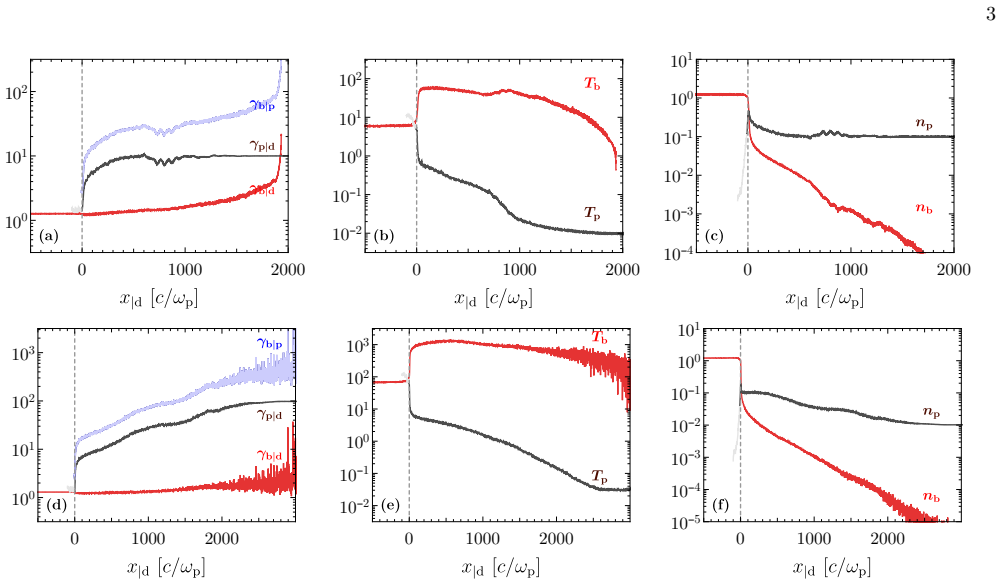
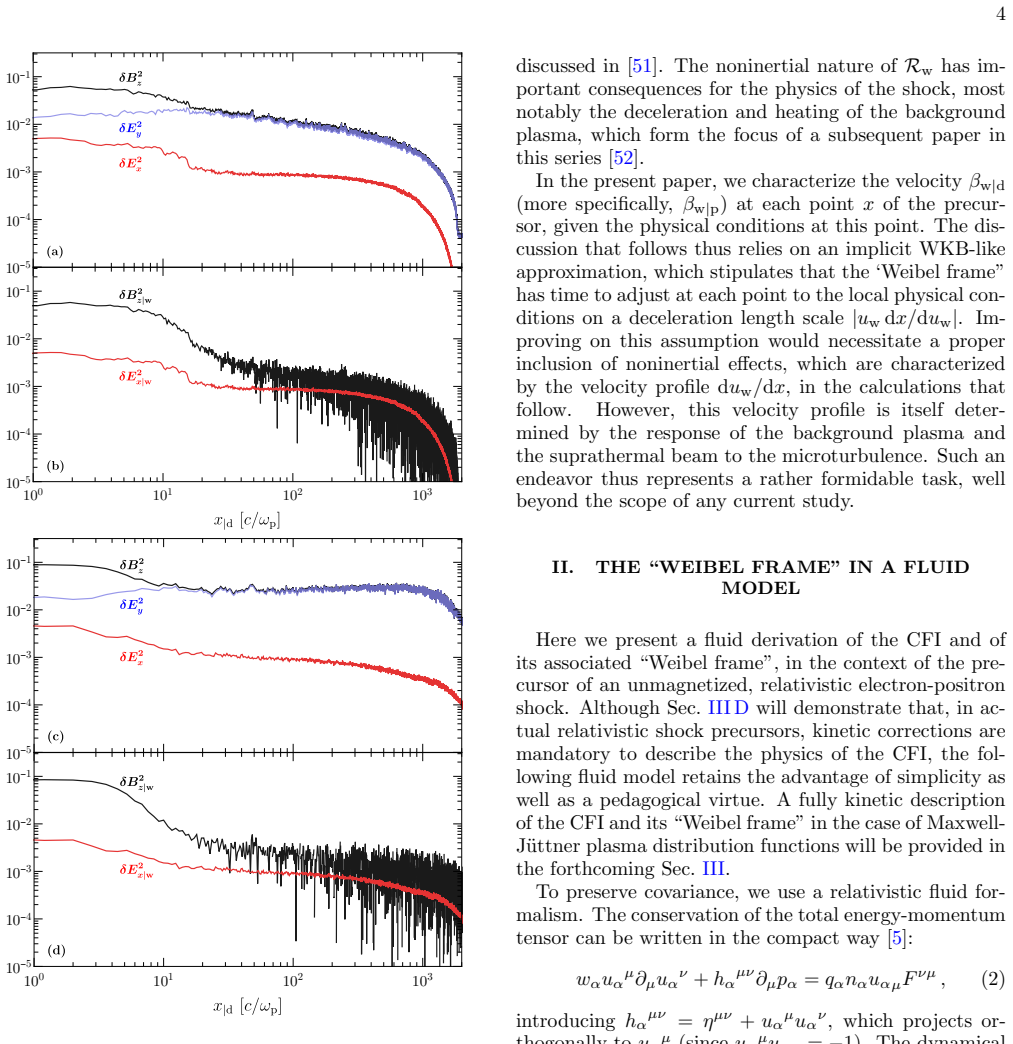
In this first paper of a series dedicated to the microphysics of unmagnetized, relativistic collisionless pair shocks, we discuss the physics of the Weibel-type transverse current filamentation instability (CFI) that develops in the shock precursor, through the interaction of an ultrarelativistic suprathermal particle beam with the background plasma. We introduce in particular the notion of "Weibel frame", or scattering center frame, in which the microturbulence is of mostly magnetic nature. We calculate the properties of this frame, using first a kinetic formulation of the linear phase of the instability, relying on Maxwell-J\"uttner distribution functions, then using a quasistatic model of the nonlinear stage of the instability. Both methods show that: (i) the Weibel frame moves at subrelativistic velocities relative to the background plasma, therefore at relativistic velocities relative to the shock front; (ii) the velocity of the Weibel frame relative to the background plasma scales with $\xi_{\rm b}$, i.e., the pressure of the suprathermal particle beam in units of the momentum flux density incoming into the shock; and (iii), the Weibel frame moves slightly less fast than the background plasma relative to the shock front. Our theoretical results are found to be in satisfactory agreement with the measurements carried out in dedicated large-scale 2D3V PIC simulations.
Editorial analysis
A structured set of objections, weighed in public.
Referee Report
Summary. The paper introduces the 'Weibel frame' (scattering center frame) in which CFI microturbulence in the precursor of unmagnetized relativistic pair shocks is of mostly magnetic nature. Using a kinetic linear analysis based on Maxwell-Jüttner distributions and a quasistatic nonlinear model, it derives three properties: (i) the frame moves at subrelativistic speed relative to the background plasma (hence relativistic relative to the shock), (ii) this velocity scales with the beam pressure parameter ξ_b, and (iii) the frame moves slightly slower than the background plasma relative to the shock front. These results are stated to agree with dedicated 2D3V PIC simulations.
Significance. If the central claims hold after clarification of the frame definition, the work would offer a useful first-principles characterization of the microturbulence frame relevant to particle scattering in relativistic shocks. The dual-method approach (linear kinetic + quasistatic nonlinear) plus direct PIC comparison is a positive feature that strengthens the result if the anchoring assumption is independently justified.
major comments (1)
- [Abstract / Introduction] Abstract and opening paragraphs: the Weibel frame is introduced by definition as the frame in which 'the microturbulence is of mostly magnetic nature,' after which the two methods are used to compute its velocity. No derivation is supplied showing that such a frame must exist, how its boost velocity is located (e.g., by extremizing |E|/|B| or nulling the electric component in the dispersion relation or nonlinear equations), or why the resulting velocity is unique. Because this definition anchors all subsequent scalings with ξ_b and the comparison to PIC, the reported properties risk being dependent on the a priori choice rather than an emergent outcome of the instability.
Simulated Author's Rebuttal
We thank the referee for their careful reading of the manuscript and for highlighting the need for greater clarity on the definition and determination of the Weibel frame. We address the major comment below.
read point-by-point responses
-
Referee: [Abstract / Introduction] Abstract and opening paragraphs: the Weibel frame is introduced by definition as the frame in which 'the microturbulence is of mostly magnetic nature,' after which the two methods are used to compute its velocity. No derivation is supplied showing that such a frame must exist, how its boost velocity is located (e.g., by extremizing |E|/|B| or nulling the electric component in the dispersion relation or nonlinear equations), or why the resulting velocity is unique. Because this definition anchors all subsequent scalings with ξ_b and the comparison to PIC, the reported properties risk being dependent on the a priori choice rather than an emergent outcome of the instability.
Authors: The definition of the Weibel frame is physically motivated by the fact that the CFI generates predominantly magnetic fluctuations, so that the frame in which electric fields are subdominant is the natural one for analyzing particle scattering. In the linear kinetic analysis the dispersion relation is evaluated in a boosted frame and the velocity is identified as the boost that renders the unstable mode essentially magnetic (i.e., the electric component of the eigenmode is minimized). The quasistatic nonlinear model likewise solves for the frame in which the self-consistent electric fields remain negligible relative to the magnetic ones. Both independent calculations return the same ξ_b scaling, which is then confirmed by the PIC measurements; this convergence indicates that the velocity is fixed by the instability physics rather than chosen a priori. We nevertheless agree that the manuscript would benefit from an explicit statement of the extremization procedure and a short discussion of uniqueness, and we will add this material to the revised introduction and methods sections. revision: yes
Circularity Check
No circularity: Weibel frame velocity derived from independent kinetic and quasistatic models
full rationale
The paper introduces the Weibel frame by definition as the frame in which CFI microturbulence is mostly magnetic, then applies a kinetic linear analysis (Maxwell-Jüttner distributions) and quasistatic nonlinear model to compute its velocity relative to the background plasma and its scaling with the input parameter ξ_b. These calculations are first-principles derivations from the instability equations rather than tautological redefinitions or self-citations; no equation reduces to its own input by construction, and the reported agreement with PIC simulations rests on the model outputs, not on the anchoring definition alone. The derivation chain is therefore self-contained against external benchmarks.
Axiom & Free-Parameter Ledger
free parameters (1)
- ξ_b
Lean theorems connected to this paper
-
IndisputableMonolith/Foundation/RealityFromDistinction.leanreality_from_one_distinction unclear?
unclearRelation between the paper passage and the cited Recognition theorem.
We introduce in particular the notion of 'Weibel frame'... in which the microturbulence is of mostly magnetic nature.
-
IndisputableMonolith/Cost/FunctionalEquation.leanwashburn_uniqueness_aczel unclear?
unclearRelation between the paper passage and the cited Recognition theorem.
βw|p ≃ ξb / (4 κTb²) (fluid limit); kinetic limits yield ξb^{1/3} or ξb scalings
What do these tags mean?
- matches
- The paper's claim is directly supported by a theorem in the formal canon.
- supports
- The theorem supports part of the paper's argument, but the paper may add assumptions or extra steps.
- extends
- The paper goes beyond the formal theorem; the theorem is a base layer rather than the whole result.
- uses
- The paper appears to rely on the theorem as machinery.
- contradicts
- The paper's claim conflicts with a theorem or certificate in the canon.
- unclear
- Pith found a possible connection, but the passage is too broad, indirect, or ambiguous to say the theorem truly supports the claim.
Forward citations
Cited by 1 Pith paper
-
Physics of Weibel-mediated relativistic collisionless shocks
A comprehensive theoretical model of Weibel-mediated relativistic collisionless pair shocks is developed, including a noninertial frame analysis and microscopic plasma interaction description, and validated against 2D...
Reference graph
Works this paper leans on
-
[1]
in 3D and κTb = 1/(2 √
-
[2]
in 2D. Strictly speaking, the tem- perature of suprathermal particles is by definition larger than that of the shocked plasma, defined above. Yet, as this temperature of suprathermal particles always scales withγ∞, we retain the above definition, emphasizing that κTb is generically larger than the above, by about an order of magnitude, so that κTb ∼ a few. T...
work page 2000
-
[3]
The response δjp x |w of the background plasma can be written δjp x |w≃ ω2 p 4π δAx |w (24) to first order inξb, since the term that has been neglected here with respect to Eq. (16) is of the order of β2 p|w∼ξ2 b. Note also that we have assumed that the background plasma temperature remains sub-relativistic over most of the precursor, as discussed in Paper...
-
[4]
Hydrodynamic limit In the outermost part of the precursor, the background plasma is characterized by a nonrelativistic proper tem- perature, µp ≫ 1 [52]. In this limit, ∆ sp ≃ √ 2/µp, and hence the hydrodynamic response of the background plasma implies √ µp/2|χp|≫ 1. This condition coincides with the large-argument limit (˜χp≃|χp| √ µp/2≫ 1) of theZ andZ′...
-
[5]
Kinetic limit We now consider the limit ˜ χp ≪ 1 of Eqs. (B8), (B10) and (B12). Using the power series Z(η) ≃ i√π exp(−η2)− 2η··· [66] and assuming |ζ2|≪ 1, this yields, in the background plasma rest frame εp xx≃ 1 +i √πµp 2 ω2 p k2ζ , (45) εp yy≃ 1 +ω2 pµp k2 ( 1 +i √πµp 2 ζ ) , (46) εp xy = 0. (47) B. Evaluation of the dielectric tensor for the suprathe...
-
[6]
As a re- sult, the integrand of Eq
Hydrodynamic limit In contrast to the background plasma, the beam parti- cles are characterized by an ultrarelativistic drift velocity in the background plasma rest frame ( γb≡ γb|p≫ 1) and a relativistic proper temperature (µb≪ 1). As a re- sult, the integrand of Eq. (38) presents the approximate width ∆sb≃ 1, so that the hydrodynamic response of the sup...
-
[7]
Kinetic limit The kinetic response of the beam particles can be read- ily obtained, to leading order in|χb|, from the expansion (χb−s)−1≃−iπδ(s)−P (1/s) in Eq. (A30), where δ(s) is the Dirac delta function and P denotes the Cauchy principal value, which here vanishes. In general, how- ever, the beam particles appear to be only marginally kinetic in PIC sh...
-
[8]
Hydrodynamic plasma and beam In the hydrodynamic regime (and in the background plasma rest frame),|ζ|≪ µ−1/2 p and|ζ|≪ 1/γb|p. Hence, the dispersion relation gives to leading order: ζ2≃− ω2 pbµbβ2 b|p k2 + 2ω2p , (60) and so the growth rate saturates at Γ max≃ ω2 pbµb for k≫ √ 2ωp. Adding up the hydrodynamic plasma and beam con- tributions into Eq. (35) a...
-
[9]
Kinetic plasma and hydrodynamic beam In this limit, 1/γb|p≫| ζ|≫ µ−1/2 p ; to leading order, the dispersion relation takes the form i √ 2πµpω2 pbζ− ω2 pbµbβ2 b|p ζ2 −k2≃ 0. (65) 10 The growth rate reaches its maximum value Γ max =√ ω2 pbµb for k ≲ kmax≃ (2πω2 pbµpµb)1/6ω2/3 p . We de- fine|ζmax| = Γmax/kmax≃ ( ω2 pbµb/√2πµpω2 p )1/3 . Making use of Eqs. (4...
-
[10]
Hydrodynamic plasma and kinetic beam In this limit, we now have 1/γb|p≪|ζ|≪ µ−1/2 p . Using Eqs. (42) and (56), the dispersion relation reduces to 2ω2 pbµbγ2 b|p [ 1 +i3π 4 γb|pζ ] − 2ω2 p [ 1 + 1 µpζ2 ] −k2≃ 0. (68) Let us first assume that ω2 p/(µpζ2) can be neglected in front of 2ω2 pbµbγ3 b|pζ. An unstable solution then exists provided γ2 b|p > ω2 p/ (...
-
[11]
Kinetic plasma and beam Finally, we consider the case of a fully kinetic beam- plasma system. This regime is of particular importance since it is found to hold in most of the precursor region in long-time shock simulations (see Sec. III D). Using the expressions (45) and (56), the dispersion relation writes i √ 2πµpω2 pζ + 2ω2 pbµbγ2 b|p ( 1 +i3π 4 γb|pζ ...
work page 2000
-
[12]
E. S. Weibel, Phys. Rev. Lett. 2, 83 (1959). [2] B. D. Fried, Phys. Fluids 2, 337 (1959). 23
work page 1959
-
[13]
R. C. Davidson, D. A. Hammer, I. Haber, and C. E. Wagner, Phys. Fluids 15, 317 (1972)
work page 1972
- [14]
- [15]
-
[16]
S. S. Moiseev and R. Z. Sagdeev, Journal of Nuclear En- ergy. Part C, Plasma Physics, Accelerators, Thermonu- clear Research 5, 43 (1963)
work page 1963
-
[17]
M. V. Medvedev and A. Loeb, Astrophys. J. 526, 697 (1999)
work page 1999
-
[18]
Gamma-Ray Burst Afterglow: Polarization and Analytic Light Curves
A. Gruzinov and E. Waxman, Astrophys. J. 511, 852 (1999), astro-ph/9807111
work page internal anchor Pith review Pith/arXiv arXiv 1999
-
[19]
Y. Sentoku, K. Mima, P. Kaw, and K. Nishikawa, Phys. Rev. Lett. 90, 155001 (2003)
work page 2003
-
[20]
J. C. Adam, A. H´ eron, and G. Laval, Phys. Rev. Lett. 97, 205006 (2006)
work page 2006
- [21]
-
[22]
A. Debayle, J. J. Honrubia, E. d’Humi` eres, and V. T. Tikhonchuk, Phys. Rev. E 82, 036405 (2010)
work page 2010
-
[23]
P. E. Masson-Laborde, W. Rozmus, Z. Peng, D. Pesme, S. H¨ uller, M. Casanova, V. Y. Bychenkov, T. Chapman, and P. Loiseau, Phys. Plasmas 17, 092704 (2010)
work page 2010
- [24]
- [25]
- [26]
- [27]
-
[28]
W. Fox, G. Fiksel, A. Bhattacharjee, P.-Y. Chang, K. Germaschewski, S. X. Hu, and P. M. Nilson, Phys. Rev. Lett. 111, 225002 (2013)
work page 2013
-
[29]
C. M. Huntington, F. Fiuza, J. S. Ross, A. B. Zyl- stra, R. P. Drake, D. H. Froula, G. Gregori, N. L. Kug- land, C. C. Kuranz, M. C. Levy, C. K. Li, J. Meinecke, T. Morita, R. Petrasso, C. Plechaty, B. A. Remington, D. D. Ryutov, Y. Sakawa, A. Spitkovsky, H. Takabe, and H.-S. Park, Nat. Phys. 11, 173 (2015)
work page 2015
-
[30]
R. P. Drake and G. Gregori, Astrophys. J. 749, 171 (2012)
work page 2012
-
[31]
H. Chen, F. Fiuza, A. Link, A. Hazi, M. Hill, D. Hoarty, S. James, S. Kerr, D. D. Meyerhofer, J. Myatt, J. Park, Y. Sentoku, and G. J. Williams, Phys. Rev. Lett. 114, 215001 (2015)
work page 2015
- [32]
- [33]
- [34]
- [35]
-
[36]
M. V. Medvedev, M. Fiore, R. A. Fonseca, L. O. Silva, and W. B. Mori, Astrophys. J. 618, L75 (2004)
work page 2004
- [37]
-
[38]
A. Achterberg, J. Wiersma, and C. A. Norman, Astron. Astrophys. 475, 19 (2007)
work page 2007
-
[39]
A. Bret, A. Stockem, D. Fiuza, C. Ruyer, L. Gremillet, R. Narayan, and L. O. Silva, Phys. Plasmas 20, 042102 (2013)
work page 2013
- [40]
-
[41]
A. Vanthieghem, M. Lemoine, and L. Gremillet, Phys. Plasmas 25, 072115 (2018)
work page 2018
- [42]
-
[43]
L. O. Silva, R. A. Fonseca, J. W. Tonge, J. M. Dawson, W. B. Mori, and M. V. Medvedev, Astrophys. J. Lett. 596, L121 (2003)
work page 2003
-
[44]
J. T. Frederiksen, C. B. Hededal, T. Haugbølle, and ˚A. Nordlund, Astrophys. J. Lett. 608, L13 (2004)
work page 2004
-
[45]
C. H. Jaroschek, H. Lesch, and R. A. Treumann, Astro- phys. J. 618, 822 (2005)
work page 2005
-
[46]
K.-I. Nishikawa, J. Niemiec, P. E. Hardee, M. Medvedev, H. Sol, Y. Mizuno, B. Zhang, M. Pohl, M. Oka, and D. H. Hartmann, Astrophys. J. Lett. 698, L10 (2009)
work page 2009
- [47]
-
[48]
A. Bret, L. Gremillet, and M. E. Dieckman, Phys. Plas- mas 17, 120501 (2010)
work page 2010
-
[49]
T. N. Kato, Astrophys. J. Lett. 668, 974 (2007)
work page 2007
- [50]
-
[51]
S. F. Martins, R. A. Fonseca, L. O. Silva, and W. B. Mori, Astrophys. J. Lett. 695, L189 (2009)
work page 2009
- [52]
- [53]
- [54]
- [55]
- [56]
-
[57]
M. Lemoine and G. Pelletier, Mon. Not. Roy. Astron. Soc. 402, 321 (2010)
work page 2010
- [58]
-
[59]
M. Lemoine and G. Pelletier, Mon. Not. Roy. Astron. Soc. 417, 1148 (2011)
work page 2011
-
[60]
R. Shaisultanov, Y. Lyubarsky, and D. Eichler, Astro- phys. J. 744, 182 (2012)
work page 2012
-
[61]
Physics of Weibel-mediated relativistic collisionless shocks
M. Lemoine, L. Gremillet, G. Pelletier, and A. Van- thieghem, Phys. Rev. Lett. 123, 035101 (2019), arXiv:1907.07595
work page internal anchor Pith review Pith/arXiv arXiv 2019
-
[62]
M. Lemoine, A. Vanthieghem, G. Pelletier, and L. Gremillet, Phys. Rev. E, submitted (Pap. II) (2019), arXiv:1907.08219 [astro-ph.HE]
-
[63]
M. Lemoine, G. Pelletier, A. Vanthieghem, and L. Gremillet, Phys. Rev. E, submitted (Pap. III) (2019), arXiv:1907.10294 [astro-ph.HE]
-
[64]
A. Vanthieghem, M. Lemoine, L. Gremillet, and G. Pel- letier, Phys. Rev. E, in prep. (Pap. IV) (2019)
work page 2019
-
[65]
R. D. Blandford and C. F. McKee, Phys. Fluids 19, 1130 (1976)
work page 1976
-
[66]
L. O. Silva, R. A. Fonseca, J. W. Tonge, W. B. Mori, and J. M. Dawson, Phys. Plasmas 9, 2458 (2002)
work page 2002
-
[67]
S. Ichimaru, Basic Principles of Plasma Physics: A Sta- 24 tistical Approach, A lecture note and reprint series (W. A. Benjamin, Reading, MA (USA), 1973)
work page 1973
- [68]
-
[69]
J. R. Cary, L. E. Thode, D. S. Lemons, M. E. Jones, and M. A. Mostrom, Phys. Fluids 24, 1818 (1981)
work page 1981
- [70]
-
[71]
J. M. Hill, M. H. Key, S. P. Hatchett, and R. R. Freeman, Phys. Plasmas 12, 082304 (2005)
work page 2005
- [72]
-
[73]
A. Bret, L. Gremillet, and J. C. Bellido, Phys. Plasmas 14, 032103 (2007)
work page 2007
-
[74]
J¨ uttner, Annalen der Physik339, 856 (1911)
F. J¨ uttner, Annalen der Physik339, 856 (1911)
work page 1911
-
[75]
T. P. Wright and G. R. Hadley, Phys. Rev. A 12, 686 (1975)
work page 1975
-
[76]
J. D. Huba, Plasma Physics (Naval Research Laboratory, Washington, DC, 2013) pp. 1–71
work page 2013
-
[77]
E. Lefebvre, N. Cochet, S. Fritzler, V. Malka, M.- M. Al´ eonard, J.-F. Chemin, S. Darbon, L. Disdier, J. Faure, A. Fedotoff, O. Landoas, G. Malka, V. M´ eot, P. Morel, M. Rabec LeGloahec, A. Rouyer, C. Rubbe- lynck, V. Tikhonchuk, R. Wrobel, P. Audebert, and C. Rousseaux, Nucl. Fus. 43, 629 (2003)
work page 2003
-
[78]
B. B. Godfrey and J.-L. Vay, J. Comput. Phys. 267, 1 (2014)
work page 2014
-
[79]
A. Bret, L. Gremillet, and D. B´ enisti, Phys. Rev. E 81, 036402 (2010)
work page 2010
-
[80]
M. Abramowitz and I. A. Stegun, Handbook of Mathe- matical Functions (Dover Publications, New York, 1972)
work page 1972
discussion (0)
Sign in with ORCID, Apple, or X to comment. Anyone can read and Pith papers without signing in.