REVIEW 4 major objections 4 minor 148 references
Protoplanetary Disk Survival Time-scales: A Blind Survey of Young Clusters up to 100 Myr in the Solar Vicinity
T0 review · 4 major / 4 minor · reviewed 2026-08-06 · deepseek-v4-flash
Pith's one-line read A blind survey of 32 clusters (1–100 Myr) within 500 pc establishes wavelength-dependent disk dissipation: 1.6 ± 0.1 Myr at 1.6–4.6 microns versus 4.4 ± 0.3 Myr at 12 microns, with 120 disk candidates surviving past 10 Myr.
desk verdict A genuinely useful larger and older cluster sample confirming the wavelength-dependent disk decay, but the W4 fractions and old-disk population are detection-conditioned and need completeness work before the long timescales are quoted. read the letter →
The pith
A machine-rendered reading of the paper's core claim, the machinery that carries it, and where it could break.
The reading
What carries the argument
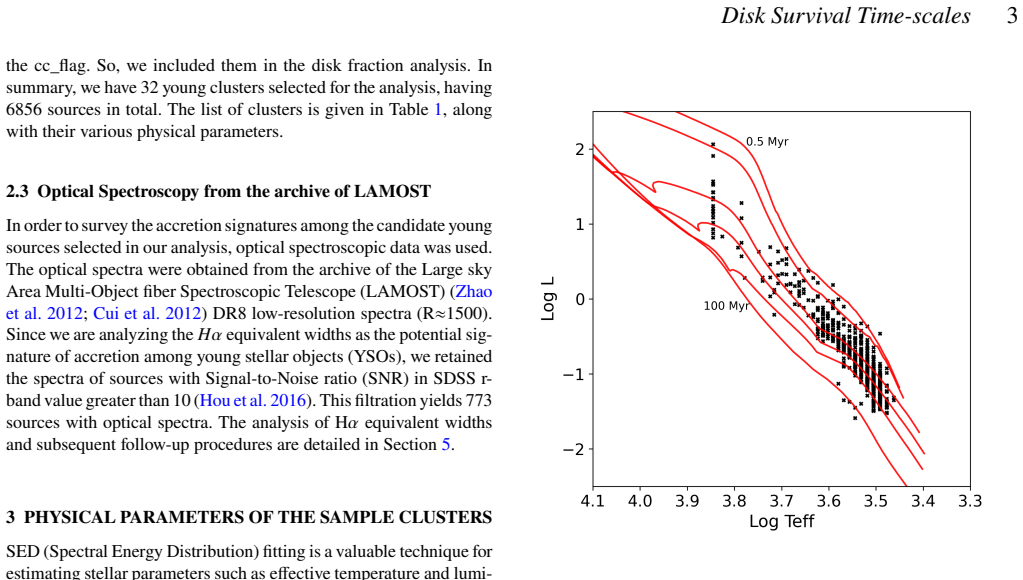
The argument runs on a wavelength ladder of disk detection plus an exponential decay fit. Disks are identified separately in three regimes: JHK color–color diagrams for the innermost dust; the standard Class II criteria applied to the H, K, W1, W2 bands (1.6–4.6 $\mu$m); and, for the W3 and W4 bands, a $5\sigma$ excess index $\chi = (F_{\rm obs} - F_{\rm model})/\sigma_{\rm obs}$ combined with color cuts ($J-W3 \ge 3$ mag and $K-W4 \ge 3.55$ mag) calibrated on independently known disk-bearing stars in IC 348. Each regime probes a different disk radius, with W3 corresponding to about 0.03–5 AU and W4 to 0.3–60 AU. The characteristic timescales come from fitting $f(t) = A e^{-t/\tau}$ with $A = 100$ to the cluster disk fractions, and complementary linear fits in the log(disk fraction)–log(age) plane yield the decay slopes. Because per-cluster W4 detections are sparse, an age-binned analysis pools sources across clusters to recover the statistics behind the long-wavelength fractions.
What would settle it
A mid-infrared survey reaching roughly three magnitudes deeper than the all-sky catalogues used here, over the same clusters, would settle the selection question: if the previously missed non-excess stars greatly outnumber the excess sources, the high W4 disk fractions at 6–8 Myr (92% and 86%) and the 120 old disk candidates are detection artifacts, whereas if a substantial excess population survives the deeper census, the long-lived disks are real. Optical spectroscopy of the 25 disk candidates older than 30 Myr would provide a second test, separating true low-mass stars with actively accreting disks from background giants that only mimic mid-infrared excess.
Extended reading notes
Core claim
On its own terms, the paper establishes that protoplanetary disk dissipation is wavelength-dependent in a way that maps onto disk structure: the disk fraction decays on an exponential timescale of $\tau_{\rm short} = 1.6 \pm 0.1$ Myr in the 1.6–4.6 $\mu$m bands and $\tau_{\rm W3} = 4.4 \pm 0.3$ Myr at 12 $\mu$m, with logarithmic decay slopes steepening from $-0.53$ in the W4 band to $-1.17$ in the short bands. Reading wavelength as disk radius (W3 traces roughly 0.03–5 AU, W4 roughly 0.3–60 AU), this is a quantitative confirmation of inside-out clearing: the inner disk vanishes within about 10–20 Myr while outer material lingers. The survey further finds 12 and 22 $\mu$m excesses beyond 20 Myr, with disk fractions of roughly 5–10% persisting to about 50 Myr and a population of 120 disk candidates older than 10 Myr (25 older than 30 Myr) classified mostly as full disks. The median mass of disk-hosting stars falls from 0.62 $M_\odot$ in the youngest bin to 0.27 $M_\odot$ above 40 Myr, and no disk host above 0.75 $M_\odot$ appears in the oldest bins — evidence, as the authors read it, that lower-mass stars dissipate their disks more slowly and keep planet-forming material longer.
Load-bearing premise
The load-bearing premise is that the stars detected at 12 and 22 microns fairly represent their whole clusters rather than being a brighter, disk-rich subset; the paper itself cautions that excess sources are preferentially detected in the long-wavelength bands and that some long-wavelength disk fractions must be taken cautiously.
Editorial extensions
If this is right
- Inner disks, traced at 1.6–4.6 microns, are essentially gone within 10–20 Myr across all 32 clusters, confirming that the near-IR disk fraction drops to zero on the short clock.
- The 2.7-times longer 12-micron timescale (4.4 Myr versus 1.6 Myr) directly quantifies inside-out clearing: the outer disk material probed at 12 microns survives roughly three times longer than the inner disk.
- A population of 120 full disks older than 10 Myr, including 25 beyond 30 Myr, means primordial disk structures can persist far beyond the conventional ~10 Myr dissipation boundary, at least around low-mass stars.
- Disk-hosting stars older than 40 Myr are all below about 0.75 solar masses, with median mass 0.27 solar masses, so the stars that keep their disks longest are the lowest-mass ones — the stars where planet formation therefore has the most time to operate.
- The 33 transitional disk candidates across all age bins provide a target list for studying inner-disk clearing as it happens, and the single probable 92 Myr accretor is a candidate long-lived accreting disk (a 'Peter Pan' disk) for follow-up confirmation.
Reading between the lines
- If the old full disks are real, then 'Peter Pan' disks are not a rare curiosity but the high-age tail of a continuous, mass-dependent disk lifetime distribution; past surveys concentrated on clusters beyond roughly 250 parsecs would systematically miss most of this population because only the brightest disk hosts are detectable there.
- The non-monotonic W3/W4 disk fraction — a minimum near 17 Myr, a secondary peak in the 20–30 Myr range, then decline — mirrors a similar trend in an independent 2024 study; if physical rather than a detection artifact, it points to a real process (delayed accretion, disk re-brightening, or a distinct late disk population) operating in that age window.
- A clean test of the mass-dependence claim would be a spectroscopically confirmed census of disk hosts in the three old, nearby clusters (Melotte 22, IC 2602, Platais 8): the prediction is that every confirmed disk host there is an M-type star below about 0.75 solar masses.
- For planet formation theory, the consequence of 0.27-solar-mass median disk hosts beyond 40 Myr is that low-mass stars offer up to an order of magnitude longer assembly time than the canonical few-million-year disk lifetime, shifting expectations for giant-planet formation and disk dissipation around M dwarfs.
Editorial analysis
A structured set of objections, weighed in public.
Referee Report
Summary. The paper presents a survey of protoplanetary disk fractions in 32 nearby clusters (ages ~1-100 Myr) selected from the Gaia-based Cantat-Gaudin et al. (2020) catalog, using 2MASS and WISE photometry to identify infrared excesses in the near- and mid-infrared. Disk fractions are measured in four wavelength regimes (JHK, HKW1W2, W3, W4) using three different excess-selection methods, and are fit with exponential decay functions and log-log linear relations. The authors report a monotonic decline of disk fraction with cluster age at all wavelengths, with characteristic timescales tau_short = 1.6 +/- 0.1 Myr (1.6-4.6 um) and tau_W3 = 4.4 +/- 0.3 Myr (12 um), which they interpret as evidence for inside-out disk clearing. They also identify 120 disk candidates in clusters older than 10 Myr (25 older than 30 Myr), a decrease in the median mass of disk-hosting stars from 0.62 to 0.27 Msun between young and old clusters, 33 transitional disk candidates, and 29 accretors with estimated mass accretion rates from LAMOST H-alpha spectroscopy.
Significance. If the long-wavelength results are secure, the paper would provide a valuable quantitative confirmation of inside-out disk clearing and would strengthen the case for a population of long-lived disks around low-mass stars, complementing work by Ribas et al. (2014, 2015), Pfalzner et al. (2022), and Luhman (2024). The survey's strengths include its uniform Gaia-based membership, the use of all-sky surveys to avoid small-field-of-view biases, the explicit acknowledgement of WISE sensitivity limitations (Sections 4.4 and 6.1), and the favorable comparison with independent disk-fraction measurements for short wavelengths. However, the central long-wavelength claims rest on W3/W4 samples whose denominators are WISE-detected sources, and the paper itself notes that distant W4 detections are biased toward excess sources; the age-binned W4 fractions in Table 2 (92% at 6 Myr, 86% at 8 Myr) are therefore detection-conditioned ratios rather than unbiased disk fractions.
major comments (4)
- [Section 4.6, Table 2; Section 4.4] The age-binned W4 disk fractions (92%, 86%, 44%, 50% at median ages 6, 8, 12, 25 Myr) are computed as excess sources divided by sources detected in W4, not by cluster members. Section 4.4 restricts the cluster-based W4 analysis to d <= 250 pc precisely because 'for the distant clusters (>250 pc), the detections in W4 band could be biased towards the excess sources,' but the binned analysis in Section 4.6 pools 'all good detections' from W3 and W4 without that restriction. Because W4 is shallow and diskless low-mass members are preferentially undetected, these binned fractions are detection-conditioned ratios. They cannot be used to support the W4 point in Figure 9 (bottom left), the fitted slope of -0.53 in Equation (10), or the claimed 22 um long-lived disk population.
- [Section 6.1, Equations (7)-(10); Table 1] The exponential fits f(t) = A exp(-t/tau) fix A = 100 and are applied to data with no clusters younger than 2.6 Myr, so tau_short = 1.6 +/- 0.1 Myr is anchored by an assumed initial fraction rather than measured from the youngest populations; the paper itself attributes the low value to the lack of very young clusters. More importantly, the W3 fit is strongly influenced by clusters RSG 7, RSG 8, and Trumpler 10 (Table 1) at 340-450 pc that show W3 fractions of 12-19% at 15-20 Myr, which Section 6.1 says 'must be taken cautiously.' Their W3-detected denominators are small (41-117 sources) and biased toward brighter excess sources. Removing, down-weighting, or correcting these clusters for completeness would substantially change tau_W3; as presented, tau_W3 = 4.4 +/- 0.3 Myr is not robust.
- [Section 6.2, Figure 10; Conclusions item 2] The 120 disk candidates older than 10 Myr are selected from the K-W3 versus K-W4 color-color diagram alone, after removing four sources with upper-limit photometry, but with no explicit rejection of background AGN or debris disks. At ages >10 Myr, 12 and 22 um excess can be produced by debris disks or by AGN coincident with cluster members; the paper's conclusion that these are 'full disks' preserving primordial structure (Conclusions item 2) requires either spectroscopic accretion diagnostics or longer-wavelength/sub-mm confirmation. Given the W3/W4 detection bias documented in Sections 4.4 and 6.1, the 25 sources older than 30 Myr may be preferentially drawn from the brightest excess sources and do not by themselves establish a primordial disk population at ~100 Myr.
- [Section 6.3, Figure 11 and Table 1] The claim that the median mass of disk-hosting stars decreases from 0.62 Msun to 0.27 Msun between young and old clusters is confounded by the distance-dependent sample selection. Table 1 shows that clusters with log(age) > 7.6 are predominantly within 200 pc, while most younger clusters lie beyond 300 pc, and Section 4.1 applies different mass-completeness cuts by distance (all masses within 250 pc, >0.4 Msun for 250-400 pc, >0.45 Msun beyond 400 pc). The apparent shift in median mass could therefore be a completeness artifact rather than a physical mass dependence. The manuscript should repeat the analysis restricted to the intersection mass range (e.g., 0.45-2.0 Msun) or to d <= 250 pc only; without such a test, the conclusion that lower-mass stars retain disks longer is not established by these data.
minor comments (4)
- [Table 2] The notation [660], [174], etc., in Table 2 is not defined in the table caption or the text; please add a footnote stating that the bracketed values are the number of disk candidates and the total number of sources, respectively.
- [Section 6.1, Equations (7)-(10)] The intercepts in Equations (7)-(10) are reported to two decimal places but are dimensionless logarithms; please state explicitly that log(DF) is in percent and log(age) is in Myr, and note that the fits exclude clusters with zero disk fraction, which may bias the slopes toward less negative values.
- [Section 3.1 and Figure 2] The Gaussian fitting procedure for cluster ages is described only briefly; please specify the initial guess, the binning of the age distribution, and how the standard error in the mean is propagated, since the cluster ages underpin all disk-fraction-versus-age fits.
- [Section 5] The uncertainty propagation from EW(H-alpha) and R-band flux to mass accretion rate is not described; please state whether the scatter in the Fang et al. (2009) relation is included in the quoted accretion-rate uncertainties.
Circularity Check
No significant circularity: the paper's central claims are empirical fits to observed disk fractions, not derivations from fitted inputs.
full rationale
The principal quantitative results (tau_short = 1.6 ± 0.1 Myr, tau_W3 = 4.4 ± 0.3 Myr, and the >10 Myr disk candidate counts) are obtained by fitting exponential and power-law functions to measured disk fractions, with the initial fraction A = 100 adopted from external literature (Fedele et al. 2010; Briceño et al. 2019). No equation in the paper predicts a quantity from a parameter that was fitted to that same quantity; the characteristic timescales are descriptive fits, explicitly labeled as such in Section 6.1. The citations to Damian et al. (2021) and Patra et al. (2024) for VOSA SED fitting and Gaussian age estimation are methodological and do not carry the central claim; the age estimates are additionally checked against literature values for IC 348, Collinder 69, IC 2602, Trumpler 10, and Melotte 22. The W3/W4 detection-bias caveats raised in Sections 4.4 and 6.1 concern completeness and selection effects, which may affect accuracy but do not make the analysis circular: the disk fractions are not constructed to equal their own inputs. The >10 Myr full-disk classification relies on color-color boundaries from Esplin et al. (2014), an external criterion, and the paper explicitly flags the need for spectroscopic confirmation. Therefore no circular step is exhibited.
Assumptions & free parameters
free parameters (10)
- A (initial disk fraction in exponential fit) =
100 (adopted, not fitted)
- tau_short (exponential decay timescale, H, K, W1, W2) =
1.6 +/- 0.1 Myr
- tau_W3 (exponential decay timescale, W3 band) =
4.4 +/- 0.3 Myr
- log-linear slope m for H, K, W1, W2 =
-1.17 +/- 0.19
- log-linear slope m for W3 =
-1.08 +/- 0.19
- log-linear slope m for W4 combined sample =
-0.53 +/- 0.08
- J-W3 color cutoff for W3 excess selection =
3 mag
- K-W4 color cutoff for W4 excess selection =
3.55 mag
- W4 distance and detection cuts =
d <= 250 pc and detection count > 10
- Mass completeness thresholds =
0.4 Msun for 250 < d <= 400 pc; 0.45 Msun for d > 400 pc
assumptions (7)
- domain assumption CG2020 Gaia DR2 membership lists with probability > 70% are reliable for cluster membership, distances, and extinctions.
- domain assumption PARSEC 1.2 isochrones and BT-Settl SED models give reliable stellar ages and masses.
- domain assumption All clusters in the sample have solar metallicity.
- domain assumption A cluster age can be represented by the Gaussian mean of its member ages after 3-sigma clipping.
- domain assumption Disk fraction decline is well described by f(t) = A exp(-t/tau).
- domain assumption Color-color boundaries from Esplin et al. 2014 and Gutermuth et al. 2009 separate full, transitional, evolved, and debris disks.
- domain assumption Accretion rate calibrations (Fang et al. 2009, White and Basri 2003, Gullbring et al. 1998) apply to the LAMOST sample.
Cite this review
Pith. "Pith review of Protoplanetary Disk Survival Time-scales: A Blind Survey of Young Clusters up to 100 Myr in the Solar Vicinity." pith.science (2026). https://pith.science/paper/TLWKIR6R
@misc{pith2026250701619,
  author       = {Pith},
  title        = {Pith review of: Protoplanetary Disk Survival Time-scales: A Blind Survey of Young Clusters up to 100 Myr in the Solar Vicinity},
  year         = {2026},
  howpublished = {\url{https://pith.science/paper/TLWKIR6R}},
  note         = {Machine review of arXiv:2507.01619}
}
abstract
We study the protoplanetary disk lifetimes using a large sample of young stellar objects in nearby clusters. To investigate the final phase of disk dissipation, we selected 32 clusters, located within 500 pc and aged between 1 and 100 Myr, with membership determined using Gaia data. The Age and mass information of the sources are obtained through spectral energy distribution (SED) analysis and using evolutionary models of various ages. Using the IR data from 2MASS and WISE catalogues, we employ three methods to identify disks across the different wavelength regimes (1.1- 22 $\mu$m). We find that disk fraction consistently decreases as stellar systems age, a trend observed across all wavelengths included in this study. However, there is an increase in the time scale of disk decay as wavelength increases, with characteristic timescales of $\tau_{\text{short}}$ = 1.6 $\pm$ 0.1 Myr for shorter wavelengths (1.6-4.6 $\mu$m) versus $\tau_{\text{W3}}$ = 4.4 $\pm$ 0.3 Myr for 12 $\mu$m. This supports the idea that outer disk regions evolve more slowly. Notably, we detect infrared excesses at 12 $\mu$m and 22 $\mu$m in relatively older systems ($>$10 Myr), with some disks with estimated ages up to $\sim$ 100 Myr. Among these, we identify a population of full disks that persist beyond the typical dissipation timescale. We also observe that the median mass of disk-hosting stars decreases from 0.62 $M_\odot$ to 0.27 $M_\odot$ in clusters younger and older than 40 Myr, respectively, indicating slower disk dissipation around lower-mass stars. We identify 33 transitional disk candidates using various color-color diagrams. Using LAMOST DR8 optical spectra and H-alpha equivalent widths, we identify possible accretors and estimate their mass accretion rates, finding most are younger than 10 Myr.
Figures


Figures from the paper (8 more)


Reference graph
Works this paper leans on
-
[1]
write newline
" write newline "" before.all 'output.state := FUNCTION fin.entry write newline FUNCTION new.block output.state before.all = 'skip after.block 'output.state := if FUNCTION new.sentence output.state after.block = 'skip output.state before.all = 'skip after.sentence 'output.state := if if FUNCTION not #0 #1 if FUNCTION and 'skip pop #0 if FUNCTION or pop #1...
-
[2]
Adams F. C., Hollenbach D., Laughlin G., Gorti U., 2004, @doi [ ] 10.1086/421989 , https://ui.adsabs.harvard.edu/abs/2004ApJ...611..360A 611, 360
doi:10.1086/421989 2004
-
[3]
Adams F. C., Proszkow E. M., Fatuzzo M., Myers P. C., 2006, @doi [ ] 10.1086/500393 , https://ui.adsabs.harvard.edu/abs/2006ApJ...641..504A 641, 504
doi:10.1086/500393 2006
-
[4]
Alcal \'a J. M., et al., 2017, @doi [ ] 10.1051/0004-6361/201629929 , https://ui.adsabs.harvard.edu/abs/2017A&A...600A..20A 600, A20
-
[5]
Alexander R., Pascucci I., Andrews S., Armitage P., Cieza L., 2014, in Beuther H., Klessen R. S., Dullemond C. P., Henning T., eds, Protostars and Planets VI. pp 475--496 ( @eprint arXiv 1311.1819 ), @doi 10.2458/azu_uapress_9780816531240-ch021
arXiv 2014
-
[6]
Alfonso J., Garc \' a-Varela A., Vieira K., 2024, @doi [ ] 10.1051/0004-6361/202450901 , https://ui.adsabs.harvard.edu/abs/2024A&A...689A..18A 689, A18
-
[7]
Allard F., Homeier D., et al., 2013, @doi [Memorie della Societa Astronomica Italiana Supplementi] 10.48550/arXiv.1302.6559 , https://ui.adsabs.harvard.edu/abs/2013MSAIS..24..128A 24, 128
-
[8]
Andrews S. M., Wilner D. J., Espaillat C., Hughes A. M., Dullemond C. P., McClure M. K., Qi C., Brown J. M., 2011, @doi [ ] 10.1088/0004-637X/732/1/42 , https://ui.adsabs.harvard.edu/abs/2011ApJ...732...42A 732, 42
Show all 148 references
-
[9]
Ansdell M., et al., 2016, @doi [ ] 10.3847/0004-637X/828/1/46 , https://ui.adsabs.harvard.edu/abs/2016ApJ...828...46A 828, 46
2016 doi
-
[10]
J., 2013, Astrophysics of Planet Formation
Armitage P. J., 2013, Astrophysics of Planet Formation
2013
-
[11]
Ashraf M., Jose J., Herczeg G., Fang M., 2023, @doi [Journal of Astrophysics and Astronomy] 10.1007/s12036-023-09951-x , https://ui.adsabs.harvard.edu/abs/2023JApA...44...67A 44, 67
2023 doi
-
[12]
Rodrigo, C
Bayo, A. Rodrigo, C. Barrado y Navascu\'es, D. et al., 2008, @doi [A&A] 10.1051/0004-6361:200810395 , 492, 277
2008 doi
-
[13]
Bayo A., et al., 2011, @doi [ ] 10.1051/0004-6361/201116617 , https://ui.adsabs.harvard.edu/abs/2011A&A...536A..63B 536, A63
2011 doi
-
[14]
S., Brett J
Bessell M. S., Brett J. M., 1988, @doi [ ] 10.1086/132281 , https://ui.adsabs.harvard.edu/abs/1988PASP..100.1134B 100, 1134
1988 doi
-
[15]
M., Covino E., Frasca A., Getman F., Spezzi L., 2012, @doi [ ] 10.1051/0004-6361/201219680 , https://ui.adsabs.harvard.edu/abs/2012A&A...547A.104B 547, A104
Biazzo K., Alcal \'a J. M., Covino E., Frasca A., Getman F., Spezzi L., 2012, @doi [ ] 10.1051/0004-6361/201219680 , https://ui.adsabs.harvard.edu/abs/2012A&A...547A.104B 547, A104
2012 doi
-
[16]
P., 2011, @doi [ ] 10.1088/0004-637X/731/1/74 , https://ui.adsabs.harvard.edu/abs/2011ApJ...731...74B 731, 74
Boss A. P., 2011, @doi [ ] 10.1088/0004-637X/731/1/74 , https://ui.adsabs.harvard.edu/abs/2011ApJ...731...74B 731, 74
2011 doi
- [17]
-
[18]
D., Eisner J
Boyden R. D., Eisner J. A., 2020, @doi [ ] 10.3847/1538-4357/ab86b7 , https://ui.adsabs.harvard.edu/abs/2020ApJ...894...74B 894, 74
2020 doi
-
[20]
Brice \ n o C., et al., 2019, @doi [ ] 10.3847/1538-3881/aaf79b , https://ui.adsabs.harvard.edu/abs/2019AJ....157...85B 157, 85
2019 doi
-
[21]
G., et al., 2011, @doi [ ] 10.1007/s11207-010-9541-4 , https://ui.adsabs.harvard.edu/abs/2011SoPh..268..255C 268, 255
Caffau E., Ludwig H. G., et al., 2011, @doi [ ] 10.1007/s11207-010-9541-4 , https://ui.adsabs.harvard.edu/abs/2011SoPh..268..255C 268, 255
2011 doi
-
[22]
Calvet N., Gullbring E., 1998, @doi [ ] 10.1086/306527 , https://ui.adsabs.harvard.edu/abs/1998ApJ...509..802C 509, 802
1998 doi
-
[23]
Calvet N., et al., 2005, @doi [ ] 10.1086/491652 , https://ui.adsabs.harvard.edu/abs/2005ApJ...630L.185C 630, L185
2005 doi
-
[24]
Cantat-Gaudin T., Anders F., Castro-Ginard A., et al., 2020, @doi [ ] 10.1051/0004-6361/202038192 , https://ui.adsabs.harvard.edu/abs/2020A&A...640A...1C 640, A1
2020 doi
-
[25]
M., 2001, @doi [ ] 10.1086/320383 , https://ui.adsabs.harvard.edu/abs/2001AJ....121.2851C 121, 2851
Carpenter J. M., 2001, @doi [ ] 10.1086/320383 , https://ui.adsabs.harvard.edu/abs/2001AJ....121.2851C 121, 2851
2001 doi
-
[26]
M., Mamajek E
Carpenter J. M., Mamajek E. E., Hillenbrand L. A., Meyer M. R., 2006, @doi [ ] 10.1086/509121 , https://ui.adsabs.harvard.edu/abs/2006ApJ...651L..49C 651, L49
2006 doi
-
[27]
Chabrier G., 2003, @doi [ ] 10.1086/376392 , https://ui.adsabs.harvard.edu/abs/2003PASP..115..763C 115, 763
2003 doi
- [28]
-
[29]
Coleman G. A. L., Haworth T. J., 2020, @doi [ ] 10.1093/mnrasl/slaa098 , https://ui.adsabs.harvard.edu/abs/2020MNRAS.496L.111C 496, L111
2020 doi
-
[30]
Coleman G. A. L., Haworth T. J., 2022, @doi [ ] 10.1093/mnras/stac1513 , https://ui.adsabs.harvard.edu/abs/2022MNRAS.514.2315C 514, 2315
2022 doi
-
[31]
Cui X.-Q., et al., 2012, @doi [Research in Astronomy and Astrophysics] 10.1088/1674-4527/12/9/003 , https://ui.adsabs.harvard.edu/abs/2012RAA....12.1197C 12, 1197
2012 doi
-
[32]
E., Hillenbrand L
Dahm S. E., Hillenbrand L. A., 2007, @doi [ ] 10.1086/512156 , https://ui.adsabs.harvard.edu/abs/2007AJ....133.2072D 133, 2072
2007 doi
-
[33]
R., Moraux E., Das S
Damian B., Jose J., Samal M. R., Moraux E., Das S. R., Patra S., 2021, @doi [ ] 10.1093/mnras/stab194 , https://ui.adsabs.harvard.edu/abs/2021MNRAS.504.2557D 504, 2557
2021 doi
-
[34]
T., 2023, @doi [Journal of Astrophysics and Astronomy] 10.1007/s12036-023-09968-2 , https://ui.adsabs.harvard.edu/abs/2023JApA...44...77D 44, 77
Damian B., Jose J., Biller B., Paul K. T., 2023, @doi [Journal of Astrophysics and Astronomy] 10.1007/s12036-023-09968-2 , https://ui.adsabs.harvard.edu/abs/2023JApA...44...77D 44, 77
2023 doi
-
[35]
Damian B., et al., 2024, @doi [ ] 10.1093/mnras/stae2452 , https://ui.adsabs.harvard.edu/abs/2024MNRAS.535.1321D 535, 1321
2024 doi
-
[36]
R., Jose J., Samal M
Das S. R., Jose J., Samal M. R., Zhang S., Panwar N., 2021, @doi [ ] 10.1093/mnras/staa3222 , https://ui.adsabs.harvard.edu/abs/2021MNRAS.500.3123D 500, 3123
2021 doi
-
[37]
R., Gupta S., Prakash P., Samal M., Jose J., 2023, @doi [ ] 10.3847/1538-4357/acbf54 , https://ui.adsabs.harvard.edu/abs/2023ApJ...948....7D 948, 7
Das S. R., Gupta S., Prakash P., Samal M., Jose J., 2023, @doi [ ] 10.3847/1538-4357/acbf54 , https://ui.adsabs.harvard.edu/abs/2023ApJ...948....7D 948, 7
2023 doi
- [38]
-
[39]
M., et al., 2014, in Beuther H., Klessen R
Dunham M. M., et al., 2014, in Beuther H., Klessen R. S., Dullemond C. P., Henning T., eds, Protostars and Planets VI. pp 195--218 ( @eprint arXiv 1401.1809 ), @doi 10.2458/azu_uapress_9780816531240-ch009
2014 arXiv
-
[40]
M., et al., 2015, @doi [The Astrophysical Journal Supplement Series] 10.1088/0067-0049/220/1/11 , 220, 11
Dunham M. M., et al., 2015, @doi [The Astrophysical Journal Supplement Series] 10.1088/0067-0049/220/1/11 , 220, 11
2015 doi
-
[41]
K., Samal M
Dutta S., Mondal S., Jose J., Das R. K., Samal M. R., Ghosh S., 2015, @doi [ ] 10.1093/mnras/stv2190 , https://ui.adsabs.harvard.edu/abs/2015MNRAS.454.3597D 454, 3597
2015 doi
-
[42]
Espaillat C., et al., 2012, @doi [ ] 10.1088/0004-637X/747/2/103 , https://ui.adsabs.harvard.edu/abs/2012ApJ...747..103E 747, 103
2012 doi
-
[43]
L., Luhman K
Esplin T. L., Luhman K. L., Mamajek E. E., 2014, @doi [ ] 10.1088/0004-637X/784/2/126 , https://ui.adsabs.harvard.edu/abs/2014ApJ...784..126E 784, 126
2014 doi
-
[44]
L., Luhman K
Esplin T. L., Luhman K. L., Miller E. B., Mamajek E. E., 2018, @doi [ ] 10.3847/1538-3881/aacce0 , https://ui.adsabs.harvard.edu/abs/2018AJ....156...75E 156, 75
2018 doi
-
[45]
J., Bisbas T
Facchini S., Clarke C. J., Bisbas T. G., 2016, @doi [ ] 10.1093/mnras/stw240 , https://ui.adsabs.harvard.edu/abs/2016MNRAS.457.3593F 457, 3593
2016 doi
-
[46]
Fang M., van Boekel R., Wang W., Carmona A., Sicilia-Aguilar A., Henning T., 2009, @doi [ ] 10.1051/0004-6361/200912468 , https://ui.adsabs.harvard.edu/abs/2009A&A...504..461F 504, 461
2009 doi
-
[47]
J., Rizzuto A., 2017, @doi [ ] 10.3847/1538-4357/aa74ca , https://ui.adsabs.harvard.edu/abs/2017ApJ...842..123F 842, 123
Fang Q., Herczeg G. J., Rizzuto A., 2017, @doi [ ] 10.3847/1538-4357/aa74ca , https://ui.adsabs.harvard.edu/abs/2017ApJ...842..123F 842, 123
2017 doi
-
[48]
E., Henning T., Jayawardhana R., Oliveira J
Fedele D., van den Ancker M. E., Henning T., Jayawardhana R., Oliveira J. M., 2010, @doi [ ] 10.1051/0004-6361/200912810 , https://ui.adsabs.harvard.edu/abs/2010A&A...510A..72F 510, A72
2010 doi
-
[49]
Fiorellino E., et al., 2021, @doi [ ] 10.1051/0004-6361/202039264 , https://ui.adsabs.harvard.edu/abs/2021A&A...650A..43F 650, A43
2021 doi
-
[50]
S., Dullemond C
Frank A., et al., 2014, in Beuther H., Klessen R. S., Dullemond C. P., Henning T., eds, Protostars and Planets VI. pp 451--474 ( @eprint arXiv 1402.3553 ), @doi 10.2458/azu_uapress_9780816531240-ch020
2014 arXiv
-
[51]
M., Manara C
Frasca A., Biazzo K., Alcal \'a J. M., Manara C. F., Stelzer B., Covino E., Antoniucci S., 2017, @doi [ ] 10.1051/0004-6361/201630108 , https://ui.adsabs.harvard.edu/abs/2017A&A...602A..33F 602, A33
2017 doi
-
[52]
Gaia Collaboration et al., 2016, @doi [ ] 10.1051/0004-6361/201629272 , https://ui.adsabs.harvard.edu/abs/2016A&A...595A...1G 595, A1
2016 doi
-
[53]
Garcia Lopez R., Natta A., Testi L., Habart E., 2006, @doi [ ] 10.1051/0004-6361:20065575 , https://ui.adsabs.harvard.edu/abs/2006A&A...459..837G 459, 837
2006 doi
-
[54]
P., Hollenbach D., 2009, @doi [ ] 10.1088/0004-637X/705/2/1237 , https://ui.adsabs.harvard.edu/abs/2009ApJ...705.1237G 705, 1237
Gorti U., Dullemond C. P., Hollenbach D., 2009, @doi [ ] 10.1088/0004-637X/705/2/1237 , https://ui.adsabs.harvard.edu/abs/2009ApJ...705.1237G 705, 1237
2009 doi
-
[55]
L., et al., 2021, @doi [ ] 10.3847/1538-4357/abf432 , https://ui.adsabs.harvard.edu/abs/2021ApJ...913..123G 913, 123
Grant S. L., et al., 2021, @doi [ ] 10.3847/1538-4357/abf432 , https://ui.adsabs.harvard.edu/abs/2021ApJ...913..123G 913, 123
2021 doi
-
[56]
G., et al., 2021, @doi [ ] 10.1051/0004-6361/202140361 , https://ui.adsabs.harvard.edu/abs/2021A&A...650A.157G 650, A157
Guarcello M. G., et al., 2021, @doi [ ] 10.1051/0004-6361/202140361 , https://ui.adsabs.harvard.edu/abs/2021A&A...650A.157G 650, A157
2021 doi
-
[57]
Gullbring E., Hartmann L., et al., 1998, @doi [ ] 10.1086/305032 , https://ui.adsabs.harvard.edu/abs/1998ApJ...492..323G 492, 323
1998 doi
-
[58]
Gupta S., et al., 2021, @doi [ ] 10.1093/mnras/stab2751 , https://ui.adsabs.harvard.edu/abs/2021MNRAS.508.3388G 508, 3388
2021 doi
-
[59]
R., Guo Z., Damian B., Prakash P., Samal M
Gupta S., Jose J., Das S. R., Guo Z., Damian B., Prakash P., Samal M. R., 2024, @doi [ ] 10.1093/mnras/stae369 , https://ui.adsabs.harvard.edu/abs/2024MNRAS.528.5633G 528, 5633
2024 doi
-
[60]
A., Megeath S
Gutermuth R. A., Megeath S. T., Myers P. C., Allen L. E., Pipher J. L., Fazio G. G., 2009, @doi [The Astrophysical Journal Supplement Series] 10.1088/0067-0049/184/1/18 , 184, 18
2009 doi
-
[61]
Haerken H., Li G.-W., Li M., Duan F., Zhao Y., 2024, @doi [ ] 10.3847/1538-4357/ad04d3 , https://ui.adsabs.harvard.edu/abs/2024ApJ...960...58H 960, 58
2024 doi
-
[62]
J., Lada E
Haisch Karl E. J., Lada E. A., Lada C. J., 2001, @doi [ ] 10.1086/320685 , https://ui.adsabs.harvard.edu/abs/2001ApJ...553L.153H 553, L153
2001 doi
-
[63]
M., Clarke C
Hall S. M., Clarke C. J., Pringle J. E., 1996, @doi [ ] 10.1093/mnras/278.2.303 , https://ui.adsabs.harvard.edu/abs/1996MNRAS.278..303H 278, 303
1996 doi
-
[64]
Hartmann L., Herczeg G., Calvet N., 2016, @doi [ ] 10.1146/annurev-astro-081915-023347 , https://ui.adsabs.harvard.edu/abs/2016ARA&A..54..135H 54, 135
2016 doi
-
[65]
S., Dullemond C
Helled R., et al., 2014, in Beuther H., Klessen R. S., Dullemond C. P., Henning T., eds, Protostars and Planets VI. pp 643--665 ( @eprint arXiv 1311.1142 ), @doi 10.2458/azu_uapress_9780816531240-ch028
2014 arXiv
-
[66]
J., Hillenbrand L
Herczeg G. J., Hillenbrand L. A., 2008, @doi [ ] 10.1086/586728 , https://ui.adsabs.harvard.edu/abs/2008ApJ...681..594H 681, 594
2008 doi
-
[67]
J., Hillenbrand L
Herczeg G. J., Hillenbrand L. A., 2015, @doi [The Astrophysical Journal] 10.1088/0004-637x/808/1/23 , 808, 23
2015 doi
-
[68]
Hern \'a ndez J., et al., 2007, @doi [ ] 10.1086/513735 , https://ui.adsabs.harvard.edu/abs/2007ApJ...662.1067H 662, 1067
2007 doi
-
[69]
Hern \'a ndez J., Calvet N., Hartmann L., Muzerolle J., Gutermuth R., Stauffer J., 2009, @doi [ ] 10.1088/0004-637X/707/1/705 , https://ui.adsabs.harvard.edu/abs/2009ApJ...707..705H 707, 705
2009 doi
-
[70]
Hern \'a ndez J., et al., 2023, @doi [ ] 10.3847/1538-3881/acc467 , https://ui.adsabs.harvard.edu/abs/2023AJ....165..205H 165, 205
2023 doi
-
[71]
A., 2008, @doi [Physica Scripta Volume T] 10.1088/0031-8949/2008/T130/014024 , https://ui.adsabs.harvard.edu/abs/2008PhST..130a4024H 130, 014024
Hillenbrand L. A., 2008, @doi [Physica Scripta Volume T] 10.1088/0031-8949/2008/T130/014024 , https://ui.adsabs.harvard.edu/abs/2008PhST..130a4024H 130, 014024
2008 doi
-
[72]
Hou W., et al., 2016, @doi [Research in Astronomy and Astrophysics] 10.1088/1674-4527/16/9/138 , https://ui.adsabs.harvard.edu/abs/2016RAA....16..138H 16, 138
2016 doi
-
[73]
Jose J., et al., 2012, @doi [ ] 10.1111/j.1365-2966.2012.21175.x , https://ui.adsabs.harvard.edu/abs/2012MNRAS.424.2486J 424, 2486
2012
-
[74]
S., Herczeg G
Jose J., Kim J. S., Herczeg G. J., Samal M. R., Bieging J. H., Meyer M. R., Sherry W. H., 2016, @doi [ ] 10.3847/0004-637X/822/1/49 , https://ui.adsabs.harvard.edu/abs/2016ApJ...822...49J 822, 49
2016 doi
-
[75]
J., Samal M
Jose J., Herczeg G. J., Samal M. R., Fang Q., Panwar N., 2017, @doi [ ] 10.3847/1538-4357/836/1/98 , https://ui.adsabs.harvard.edu/abs/2017ApJ...836...98J 836, 98
2017 doi
-
[76]
Jose J., et al., 2020, @doi [ ] 10.3847/1538-4357/ab74dd , https://ui.adsabs.harvard.edu/abs/2020ApJ...892..122J 892, 122
2020 doi
-
[77]
P., Leisawitz D
Koenig X. P., Leisawitz D. T., 2014, @doi [ ] 10.1088/0004-637X/791/2/131 , https://ui.adsabs.harvard.edu/abs/2014ApJ...791..131K 791, 131
2014 doi
-
[78]
L., Ireland M
Kraus A. L., Ireland M. J., Hillenbrand L. A., Martinache F., 2012, @doi [ ] 10.1088/0004-637X/745/1/19 , https://ui.adsabs.harvard.edu/abs/2012ApJ...745...19K 745, 19
2012 doi
-
[79]
L., Herczeg G
Kraus A. L., Herczeg G. J., Rizzuto A. C., Mann A. W., Slesnick C. L., Carpenter J. M., Hillenbrand L. A., Mamajek E. E., 2017, @doi [ ] 10.3847/1538-4357/aa62a0 , https://ui.adsabs.harvard.edu/abs/2017ApJ...838..150K 838, 150
2017 doi
-
[80]
Kroupa P., 2001, @doi [ ] 10.1046/j.1365-8711.2001.04022.x , https://ui.adsabs.harvard.edu/abs/2001MNRAS.322..231K 322, 231
2001
-
[81]
Kroupa P., 2002, @doi [Science] 10.1126/science.1067524 , https://ui.adsabs.harvard.edu/abs/2002Sci...295...82K 295, 82
2002 doi
-
[82]
W., Schlegel D
Lang D., Hogg D. W., Schlegel D. J., 2016, @doi [ ] 10.3847/0004-6256/151/2/36 , https://ui.adsabs.harvard.edu/abs/2016AJ....151...36L 151, 36
2016 doi
-
[83]
Laos S., et al., 2022, @doi [ ] 10.3847/1538-4357/ac8156 , https://ui.adsabs.harvard.edu/abs/2022ApJ...935..111L 935, 111
2022 doi
-
[84]
Lawson K., et al., 2023, @doi [The Astronomical Journal] 10.3847/1538-3881/aced08 , 166, 150
2023 doi
-
[85]
L., 2022, @doi [ ] 10.3847/1538-3881/ac35e2 , https://ui.adsabs.harvard.edu/abs/2022AJ....163...24L 163, 24
Luhman K. L., 2022, @doi [ ] 10.3847/1538-3881/ac35e2 , https://ui.adsabs.harvard.edu/abs/2022AJ....163...24L 163, 24
2022 doi
-
[86]
L., 2024, @doi [ ] 10.3847/1538-3881/ad697d , https://ui.adsabs.harvard.edu/abs/2024AJ....168..159L 168, 159
Luhman K. L., 2024, @doi [ ] 10.3847/1538-3881/ad697d , https://ui.adsabs.harvard.edu/abs/2024AJ....168..159L 168, 159
2024 doi
-
[87]
L., Mamajek E
Luhman K. L., Mamajek E. E., 2012, @doi [ ] 10.1088/0004-637X/758/1/31 , https://ui.adsabs.harvard.edu/abs/2012ApJ...758...31L 758, 31
2012 doi
-
[88]
B., Heggie D
Malmberg D., Davies M. B., Heggie D. C., 2011, @doi [ ] 10.1111/j.1365-2966.2010.17730.x , https://ui.adsabs.harvard.edu/abs/2011MNRAS.411..859M 411, 859
2011
-
[89]
E., 2009, in Usuda T., Tamura M., Ishii M., eds, American Institute of Physics Conference Series Vol
Mamajek E. E., 2009, in Usuda T., Tamura M., Ishii M., eds, American Institute of Physics Conference Series Vol. 1158, Exoplanets and Disks: Their Formation and Diversity. AIP, pp 3--10 ( @eprint arXiv 0906.5011 ), @doi 10.1063/1.3215910
2009 arXiv
-
[90]
F., et al., 2016, @doi [Astronomy & amp; Astrophysics] 10.1051/0004-6361/201628549 , 591, L3
Manara C. F., et al., 2016, @doi [Astronomy & amp; Astrophysics] 10.1051/0004-6361/201628549 , 591, L3
2016 doi
-
[91]
F., Ansdell M., Rosotti G
Manara C. F., Ansdell M., Rosotti G. P., Hughes A. M., Armitage P. J., Lodato G., Williams J. P., 2023, in Inutsuka S., Aikawa Y., Muto T., Tomida K., Tamura M., eds, Astronomical Society of the Pacific Conference Series Vol. 534, Protostars and Planets VII. p. 539 ( @eprint a...
-
[92]
Manzo-Mart \' nez E., et al., 2020, @doi [ ] 10.3847/1538-4357/ab7ead , https://ui.adsabs.harvard.edu/abs/2020ApJ...893...56M 893, 56
2020 doi
-
[93]
Masana E., Jordi C., Ribas I., 2006, @doi [ ] 10.1051/0004-6361:20054021 , https://ui.adsabs.harvard.edu/abs/2006A&A...450..735M 450, 735
2006 doi
-
[94]
Mathew B., et al., 2018, @doi [The Astrophysical Journal] 10.3847/1538-4357/aab3d8 , 857, 30
2018 doi
-
[95]
Mauc \'o K., et al., 2025, @doi [ ] 10.1051/0004-6361/202452386 , https://ui.adsabs.harvard.edu/abs/2025A&A...693A..87M 693, A87
2025 doi
-
[96]
Mendigut \' a I., Solano E., Vioque M., Balaguer-Nu \ n ez L., Ribas A., Hu \'e lamo N., Rodrigo C., 2022, @doi [ ] 10.1051/0004-6361/202243146 , https://ui.adsabs.harvard.edu/abs/2022A&A...664A..66M 664, A66
2022 doi
-
[97]
Meng H. Y. A., Rieke G. H., Su K. Y. L., G \'a sp \'a r A., 2017, @doi [ ] 10.3847/1538-4357/836/1/34 , https://ui.adsabs.harvard.edu/abs/2017ApJ...836...34M 836, 34
2017 doi
-
[98]
R., Calvet N., Hillenbrand L
Meyer M. R., Calvet N., Hillenbrand L. A., 1997, @doi [ ] 10.1086/118474 , https://ui.adsabs.harvard.edu/abs/1997AJ....114..288M 114, 288
1997 doi
- [99]
-
[100]
C., Kataoka A., 2023, in Inutsuka S., Aikawa Y., Muto T., Tomida K., Tamura M., eds, Astronomical Society of the Pacific Conference Series Vol
Miotello A., Kamp I., Birnstiel T., Cleeves L. C., Kataoka A., 2023, in Inutsuka S., Aikawa Y., Muto T., Tomida K., Tamura M., eds, Astronomical Society of the Pacific Conference Series Vol. 534, Protostars and Planets VII. p. 501 ( @eprint arXiv 2203.09818 ), @doi 10.48550/ar...
-
[101]
J., Mamajek E
Murphy S. J., Mamajek E. E., Bell C. P. M., 2018, @doi [ ] 10.1093/mnras/sty471 , https://ui.adsabs.harvard.edu/abs/2018MNRAS.476.3290M 476, 3290
2018 doi
-
[102]
Muzerolle J., Hillenbrand L., Calvet N., Briceño C., Hartmann L., 2003, @doi [The Astrophysical Journal] 10.1086/375704 , 592, 266
2003 doi
-
[103]
Natta A., Testi L., Randich S., 2006, @doi [ ] 10.1051/0004-6361:20054706 , https://ui.adsabs.harvard.edu/abs/2006A&A...452..245N 452, 245
2006 doi
-
[104]
S., 2023, @doi [Journal of Astrophysics and Astronomy] 10.1007/s12036-023-09965-5 , https://ui.adsabs.harvard.edu/abs/2023JApA...44...75N 44, 75
Nidhi S., Mathew B., Shridharan B., Bhattacharyya S., Edwin D., Kartha S. S., 2023, @doi [Journal of Astrophysics and Astronomy] 10.1007/s12036-023-09965-5 , https://ui.adsabs.harvard.edu/abs/2023JApA...44...75N 44, 75
2023 doi
-
[105]
H., White R
Nisak A. H., White R. J., Yep A., Henry T. J., Paredes L., James H.-S., Jao W.-C., 2022, @doi [ ] 10.3847/1538-3881/ac63c3 , https://ui.adsabs.harvard.edu/abs/2022AJ....163..278N 163, 278
2022 doi
-
[106]
T., Alam M., DeLaurentiis S., 2022, PHEW: PytHon Equivalent Widths , @doi 10.5281/zenodo.6422571
N \'u \ n ez A., Douglas S. T., Alam M., DeLaurentiis S., 2022, PHEW: PytHon Equivalent Widths , @doi 10.5281/zenodo.6422571
2022 doi
-
[107]
K., et al., 2004, @doi [The Astrophysical Journal] 10.1086/425068 , 616, 1042–1057
Ojha D. K., et al., 2004, @doi [The Astrophysical Journal] 10.1086/425068 , 616, 1042–1057
2004 doi
-
[108]
M., Garc \' a Hern \'a ndez A., Su \'a rez Yanes J
Pamos Ortega D., Mirouh G. M., Garc \' a Hern \'a ndez A., Su \'a rez Yanes J. C., Barcel \'o Forteza S., 2023, @doi [ ] 10.1051/0004-6361/202346323 , https://ui.adsabs.harvard.edu/abs/2023A&A...675A.167P 675, A167
2023 doi
-
[109]
Panwar N., et al., 2017, @doi [ ] 10.1093/mnras/stx616 , https://ui.adsabs.harvard.edu/abs/2017MNRAS.468.2684P 468, 2684
2017 doi
-
[110]
R., Lahuis F., Natta A., 2009, @doi [ ] 10.1088/0004-637X/696/1/143 , https://ui.adsabs.harvard.edu/abs/2009ApJ...696..143P 696, 143
Pascucci I., Apai D., Luhman K., Henning T., Bouwman J., Meyer M. R., Lahuis F., Natta A., 2009, @doi [ ] 10.1088/0004-637X/696/1/143 , https://ui.adsabs.harvard.edu/abs/2009ApJ...696..143P 696, 143
2009 doi
-
[111]
K., 2023, in Inutsuka S., Aikawa Y., Muto T., Tomida K., Tamura M., eds, Astronomical Society of the Pacific Conference Series Vol
Pascucci I., Cabrit S., Edwards S., Gorti U., Gressel O., Suzuki T. K., 2023, in Inutsuka S., Aikawa Y., Muto T., Tomida K., Tamura M., eds, Astronomical Society of the Pacific Conference Series Vol. 534, Protostars and Planets VII. p. 567 ( @eprint arXiv 2203.10068 ), @doi 10...
-
[112]
J., 2024, @doi [ ] 10.3847/1538-4357/ad4996 , https://ui.adsabs.harvard.edu/abs/2024ApJ...970...88P 970, 88
Patra S., Jose J., Evans N. J., 2024, @doi [ ] 10.3847/1538-4357/ad4996 , https://ui.adsabs.harvard.edu/abs/2024ApJ...970...88P 970, 88
2024 doi
-
[113]
J., Mamajek E
Pecaut M. J., Mamajek E. E., 2013, @doi [The Astrophysical Journal Supplement Series] 10.1088/0067-0049/208/1/9 , 208, 9
2013 doi
-
[114]
Pfalzner S., Dincer F., 2024, @doi [ ] 10.3847/1538-4357/ad1bef , https://ui.adsabs.harvard.edu/abs/2024ApJ...963..122P 963, 122
2024 doi
-
[115]
Pfalzner S., Steinhausen M., Menten K., 2014, @doi [ ] 10.1088/2041-8205/793/2/L34 , https://ui.adsabs.harvard.edu/abs/2014ApJ...793L..34P 793, L34
2014 doi
-
[116]
Pfalzner S., Dehghani S., Michel A., 2022, @doi [ ] 10.3847/2041-8213/ac9839 , https://ui.adsabs.harvard.edu/abs/2022ApJ...939L..10P 939, L10
2022 doi
-
[117]
Picogna G., Marzari F., 2014, @doi [ ] 10.1051/0004-6361/201322816 , https://ui.adsabs.harvard.edu/abs/2014A&A...564A..28P 564, A28
2014 doi
-
[118]
E., Weber M
Picogna G., Ercolano B., Owen J. E., Weber M. L., 2019, @doi [ ] 10.1093/mnras/stz1166 , https://ui.adsabs.harvard.edu/abs/2019MNRAS.487..691P 487, 691
2019 doi
-
[119]
C., 2021, @doi [ ] 10.1093/mnras/stab2883 , https://ui.adsabs.harvard.edu/abs/2021MNRAS.508.3611P 508, 3611
Picogna G., Ercolano B., Espaillat C. C., 2021, @doi [ ] 10.1093/mnras/stab2883 , https://ui.adsabs.harvard.edu/abs/2021MNRAS.508.3611P 508, 3611
2021 doi
-
[120]
Ribas \'A ., Mer \' n B., et al., 2014, @doi [ ] 10.1051/0004-6361/201322597 , https://ui.adsabs.harvard.edu/abs/2014A&A...561A..54R 561, A54
2014 doi
-
[121]
Ribas \'A ., Bouy H., Mer \' n B., 2015, @doi [ ] 10.1051/0004-6361/201424846 , https://ui.adsabs.harvard.edu/abs/2015A&A...576A..52R 576, A52
2015 doi
-
[122]
Ribas \'A ., et al., 2023, @doi [ ] 10.1051/0004-6361/202245637 , https://ui.adsabs.harvard.edu/abs/2023A&A...673A..77R 673, A77
2023 doi
-
[124]
Richert A. J. W., Getman K. V., Feigelson E. D., Kuhn M. A., Broos P. S., Povich M. S., Bate M. R., Garmire G. P., 2018b, @doi [Monthly Notices of the Royal Astronomical Society] 10.1093/mnras/sty949 , 477, 5191–5206
-
[125]
S., Sicilia-Aguilar A., Lawson W
Roccatagliata V., Bouwman J., Henning T., Gennaro M., Feigelson E., Kim J. S., Sicilia-Aguilar A., Lawson W. A., 2011, @doi [ ] 10.1088/0004-637X/733/2/113 , https://ui.adsabs.harvard.edu/abs/2011ApJ...733..113R 733, 113
2011 doi
-
[126]
Ru \' z-Rodr \' guez D., et al., 2018, @doi [ ] 10.1093/mnras/sty1351 , https://ui.adsabs.harvard.edu/abs/2018MNRAS.478.3674R 478, 3674
2018 doi
-
[127]
R., Pandey A
Samal M. R., Pandey A. K., Ojha D. K., Chauhan N., Jose J., Pandey B., 2012, @doi [ ] 10.1088/0004-637X/755/1/20 , https://ui.adsabs.harvard.edu/abs/2012ApJ...755...20S 755, 20
2012 doi
-
[128]
Schneider G., et al., 2014, @doi [ ] 10.1088/0004-6256/148/4/59 , https://ui.adsabs.harvard.edu/abs/2014AJ....148...59S 148, 59
2014 doi
-
[129]
Sicilia-Aguilar A., et al., 2006, @doi [ ] 10.1086/498085 , https://ui.adsabs.harvard.edu/abs/2006ApJ...638..897S 638, 897
2006 doi
-
[130]
M., et al., 2020, @doi [The Astrophysical Journal] 10.3847/1538-4357/ab68e6 , 890, 106
Silverberg S. M., et al., 2020, @doi [The Astrophysical Journal] 10.3847/1538-4357/ab68e6 , 890, 106
2020 doi
-
[131]
F., Cutri R
Skrutskie M. F., Cutri R. M., et al., 2006, @doi [ ] 10.1086/498708 , https://ui.adsabs.harvard.edu/abs/2006AJ....131.1163S 131, 1163
2006 doi
-
[132]
R., Hillenbrand L
Soderblom D. R., Hillenbrand L. A., Jeffries R. D., Mamajek E. E., Naylor T., 2014, in Beuther H., Klessen R. S., Dullemond C. P., Henning T., eds, Protostars and Planets VI. pp 219--241 ( @eprint arXiv 1311.7024 ), @doi 10.2458/azu_uapress_9780816531240-ch010
2014 arXiv
-
[133]
G., Torres G., 2016, @doi [ ] 10.3847/2041-8205/831/1/L6 , https://ui.adsabs.harvard.edu/abs/2016ApJ...831L...6S 831, L6
Stassun K. G., Torres G., 2016, @doi [ ] 10.3847/2041-8205/831/1/L6 , https://ui.adsabs.harvard.edu/abs/2016ApJ...831L...6S 831, L6
2016 doi
-
[134]
Sugitani K., et al., 2002, @doi [ ] 10.1086/339196 , https://ui.adsabs.harvard.edu/abs/2002ApJ...565L..25S 565, L25
2002 doi
-
[135]
Thanathibodee T., Calvet N., Hern \'a ndez J., Mauc \'o K., Brice \ n o C., 2022, @doi [ ] 10.3847/1538-3881/ac3ee6 , https://ui.adsabs.harvard.edu/abs/2022AJ....163...74T 163, 74
2022 doi
-
[136]
J., et al., 2020, @doi [ ] 10.3847/1538-4357/ab6f64 , https://ui.adsabs.harvard.edu/abs/2020ApJ...890..130T 890, 130
Tobin J. J., et al., 2020, @doi [ ] 10.3847/1538-4357/ab6f64 , https://ui.adsabs.harvard.edu/abs/2020ApJ...890..130T 890, 130
2020 doi
-
[137]
Venuti L., et al., 2014, @doi [ ] 10.1051/0004-6361/201423776 , https://ui.adsabs.harvard.edu/abs/2014A&A...570A..82V 570, A82
2014 doi
-
[138]
Villenave M., et al., 2020, @doi [ ] 10.1051/0004-6361/202038087 , https://ui.adsabs.harvard.edu/abs/2020A&A...642A.164V 642, A164
2020 doi
-
[139]
Vlasblom M., De Marchi G., 2023, @doi [ ] 10.1051/0004-6361/202245248 , https://ui.adsabs.harvard.edu/abs/2023A&A...675A.204V 675, A204
2023 doi
-
[140]
A., Ren B., Kalas P., Carpenter J., 2021, @doi [ ] 10.1093/mnras/stab1080 , https://ui.adsabs.harvard.edu/abs/2021MNRAS.504.3074W 504, 3074
Walker S., Millar-Blanchaer M. A., Ren B., Kalas P., Carpenter J., 2021, @doi [ ] 10.1093/mnras/stab1080 , https://ui.adsabs.harvard.edu/abs/2021MNRAS.504.3074W 504, 3074
2021 doi
-
[141]
Wang S., Chen X., 2019, @doi [ ] 10.3847/1538-4357/ab1c61 , https://ui.adsabs.harvard.edu/abs/2019ApJ...877..116W 877, 116
2019 doi
-
[142]
J., Basri G., 2003, @doi [The Astrophysical Journal] 10.1086/344673 , 582, 1109
White R. J., Basri G., 2003, @doi [The Astrophysical Journal] 10.1086/344673 , 582, 1109
2003 doi
-
[144]
P., Cieza L
Williams J. P., Cieza L. A., 2011b, @doi [ ] 10.1146/annurev-astro-081710-102548 , https://ui.adsabs.harvard.edu/abs/2011ARA&A..49...67W 49, 67
-
[145]
J., Clarke C
Winter A. J., Clarke C. J., Rosotti G., Ih J., Facchini S., Haworth T. J., 2018, @doi [ ] 10.1093/mnras/sty984 , https://ui.adsabs.harvard.edu/abs/2018MNRAS.478.2700W 478, 2700
2018 doi
-
[146]
L., Eisenhardt P
Wright E. L., Eisenhardt P. R. M., et al., 2010, @doi [ ] 10.1088/0004-6256/140/6/1868 , https://ui.adsabs.harvard.edu/abs/2010AJ....140.1868W 140, 1868
2010 doi
-
[147]
T., Saito M., 2014, @doi [ ] 10.1093/mnras/stu1013 , https://ui.adsabs.harvard.edu/abs/2014MNRAS.442.2543Y 442, 2543
Yasui C., Kobayashi N., Tokunaga A. T., Saito M., 2014, @doi [ ] 10.1093/mnras/stu1013 , https://ui.adsabs.harvard.edu/abs/2014MNRAS.442.2543Y 442, 2543
2014 doi
-
[148]
Yasui C., Kobayashi N., Saito M., Izumi N., Skidmore W., 2021, @doi [ ] 10.3847/1538-3881/abd331 , https://ui.adsabs.harvard.edu/abs/2021AJ....161..139Y 161, 139
2021 doi
- [149]
-
[150]
Zuckerman B., Song I., 2004, @doi [ ] 10.1146/annurev.astro.42.053102.134111 , https://ui.adsabs.harvard.edu/abs/2004ARA&A..42..685Z 42, 685
2004
-
[151]
D., 2021, @doi [ ] 10.3847/1538-3881/ac0255 , https://ui.adsabs.harvard.edu/abs/2021AJ....162...28V 162, 28
van der Marel N., Mulders G. D., 2021, @doi [ ] 10.3847/1538-3881/ac0255 , https://ui.adsabs.harvard.edu/abs/2021AJ....162...28V 162, 28
2021 doi
Reviewed August 6, 2026 · model on record in the stance chip above.
Discussion (0). Sign in to comment.