Frayed Demazure weaves for Poisson-compatible cluster structures on Bott--Samelson charts
Pith reviewed 2026-06-28 00:57 UTC · model grok-4.3
The pith
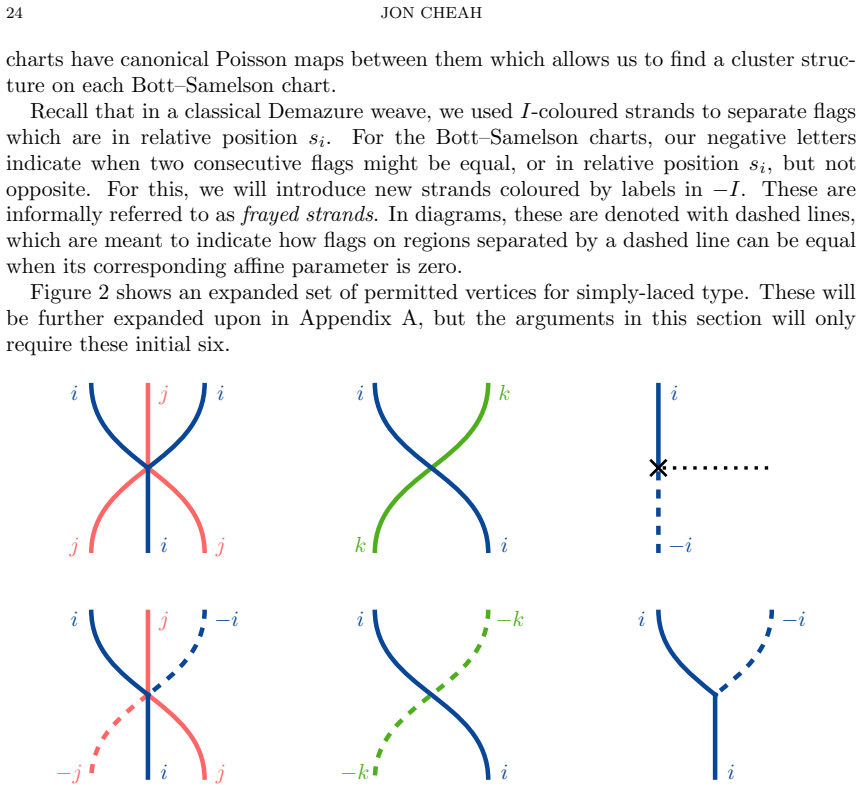
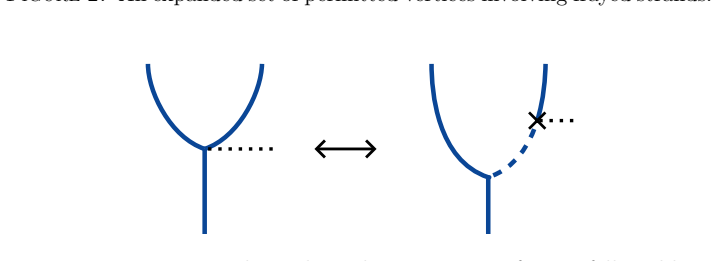
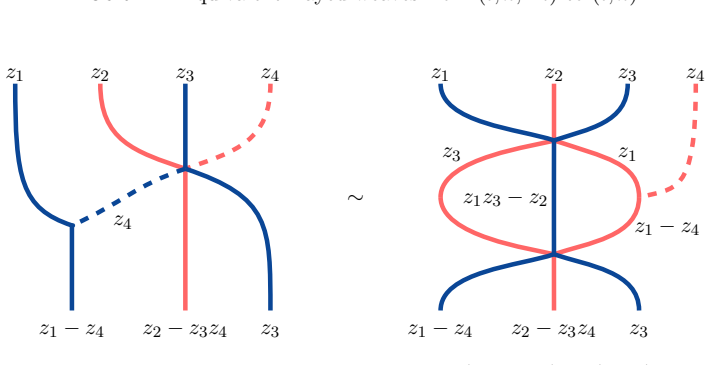
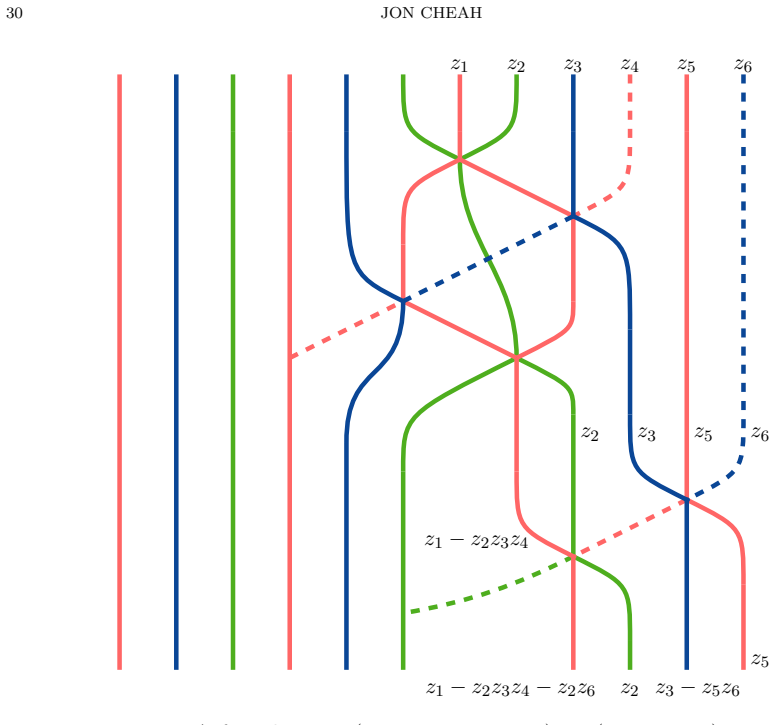
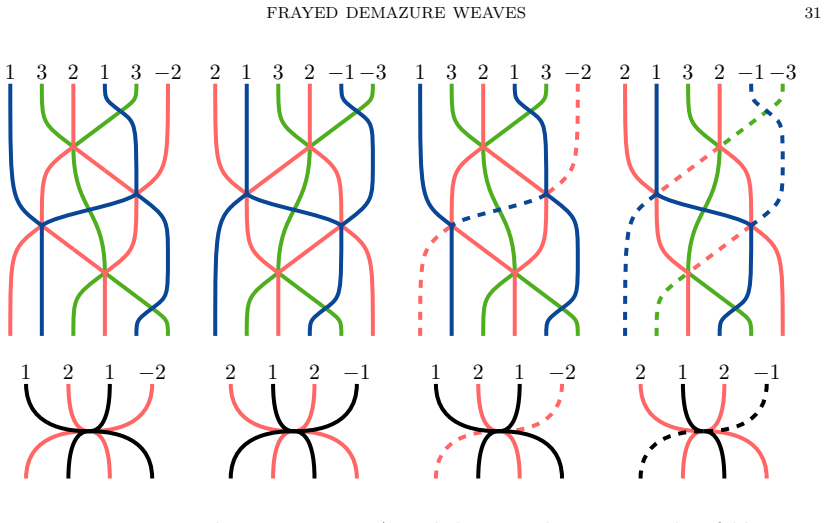
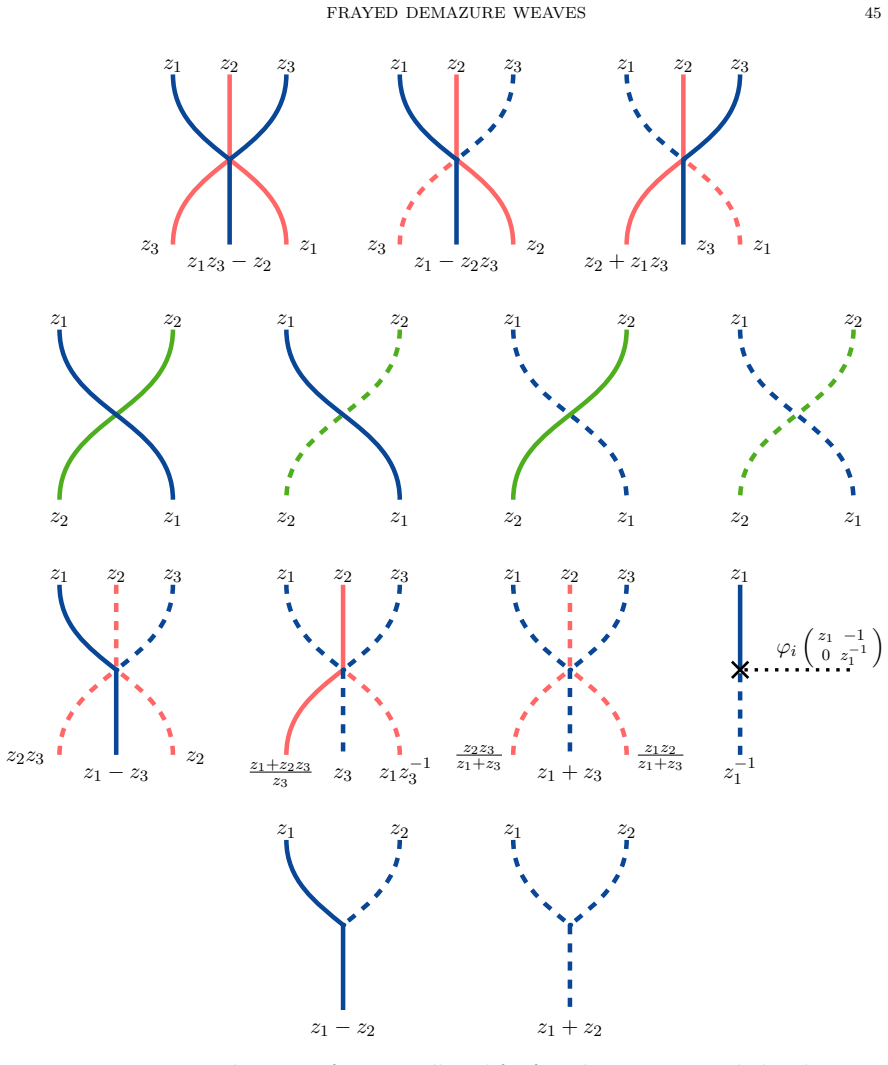
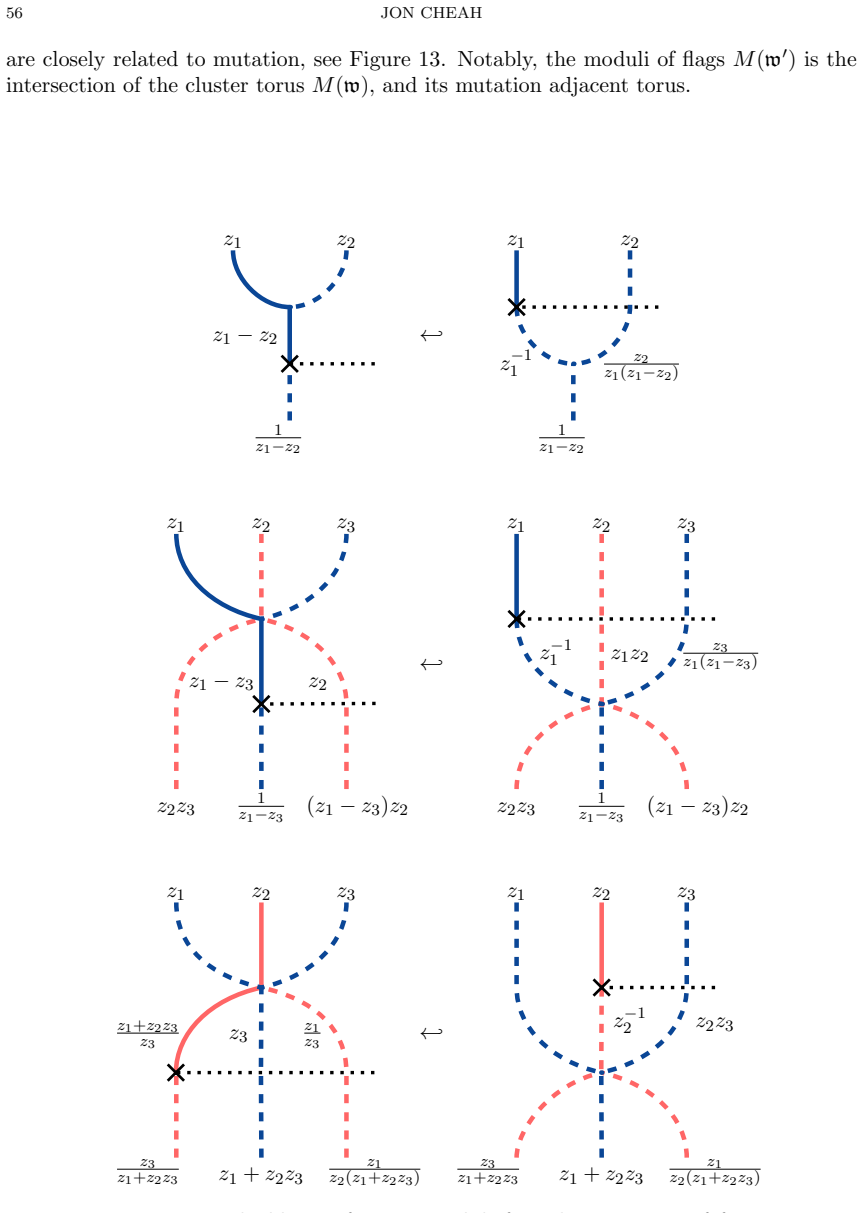
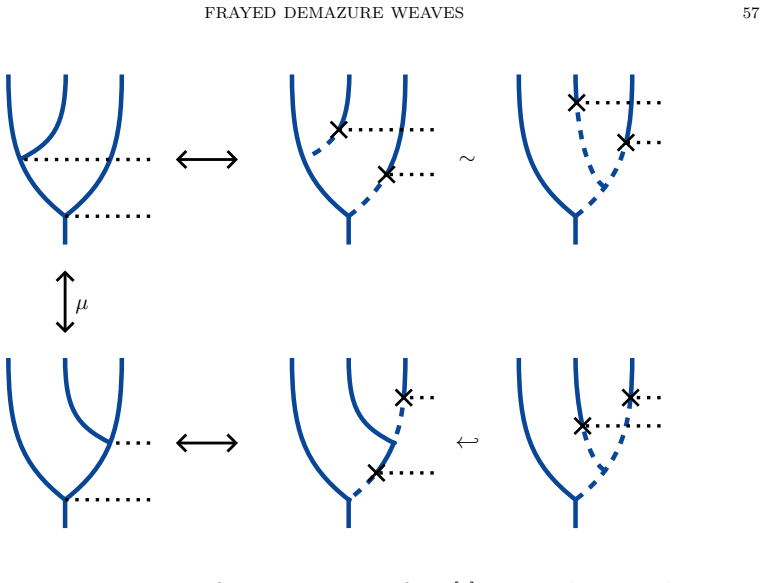
Adding frayed strands to Demazure weaves produces Poisson-compatible cluster structures on further affine charts of the Bott-Samelson variety, with chart transitions becoming rational quasi-cluster morphisms.
A machine-rendered reading of the paper's core claim, the machinery that carries it, and where it could break.
Core claim
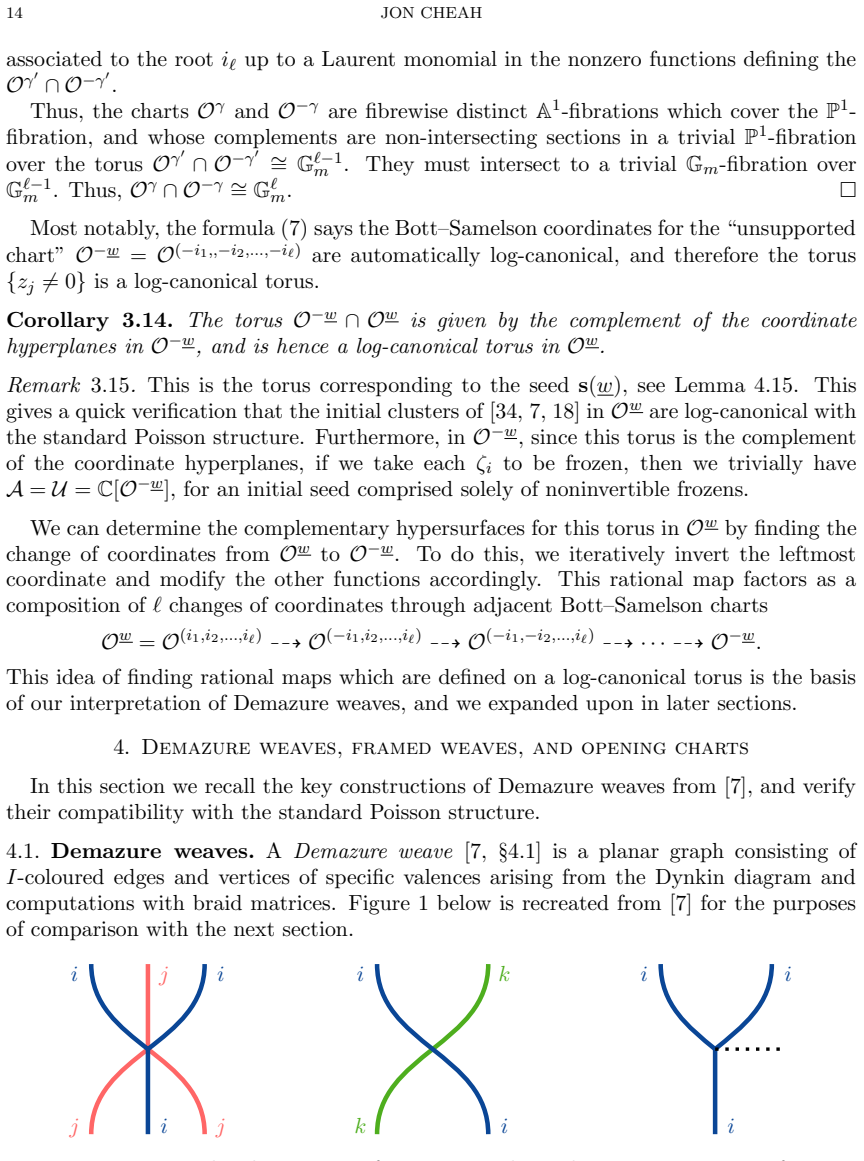
Demazure weaves represent maps between Bott-Samelson cells and construct cluster structures on braid varieties that remain compatible with the standard Poisson structure. Adding frayed strands produces Poisson-compatible cluster structures on other affine charts of the Bott-Samelson variety. The transition functions across these charts become rational quasi-cluster morphisms, and the mutation sequences constructed for these morphisms are closely related to those of Ménard for open Richardson seeds.
What carries the argument
Frayed Demazure weaves, which are ordinary Demazure weaves augmented by frayed strands, that represent maps preserving Poisson compatibility while turning chart transitions into rational quasi-cluster morphisms.
If this is right
- Cluster structures already known on braid varieties extend to other affine charts while preserving Poisson compatibility.
- Transition functions between the new charts and the original ones become rational quasi-cluster morphisms.
- The mutation sequences needed for these morphisms are the same as those appearing for open Richardson seeds.
- The construction supplies Poisson-compatible cluster data on a larger collection of affine charts than previously available.
Where Pith is reading between the lines
- Covering the whole Bott-Samelson variety by such charts could produce a global cluster structure respecting the Poisson form.
- The fraying technique may apply to other varieties equipped with Poisson structures and combinatorial maps similar to Demazure weaves.
- The relation to open Richardson seeds suggests possible overlap or unification between two families of cluster constructions on related spaces.
Load-bearing premise
The standard Poisson structure on the Bott-Samelson variety remains compatible with the maps given by frayed Demazure weaves so that cluster algebra relations are preserved after the fraying step.
What would settle it
An explicit computation on a concrete pair of charts showing that the transition map induced by a frayed Demazure weave fails to be a rational quasi-cluster morphism, or that the Poisson bracket is not preserved, would disprove the claim.
Figures
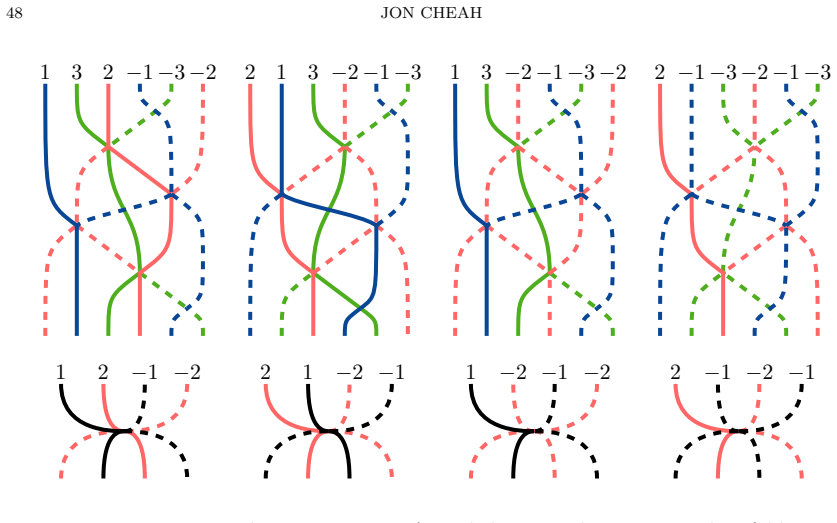
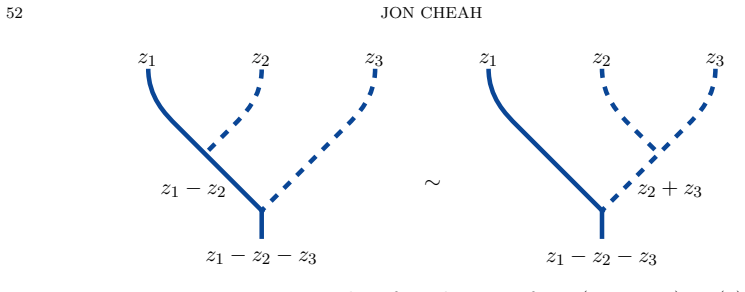
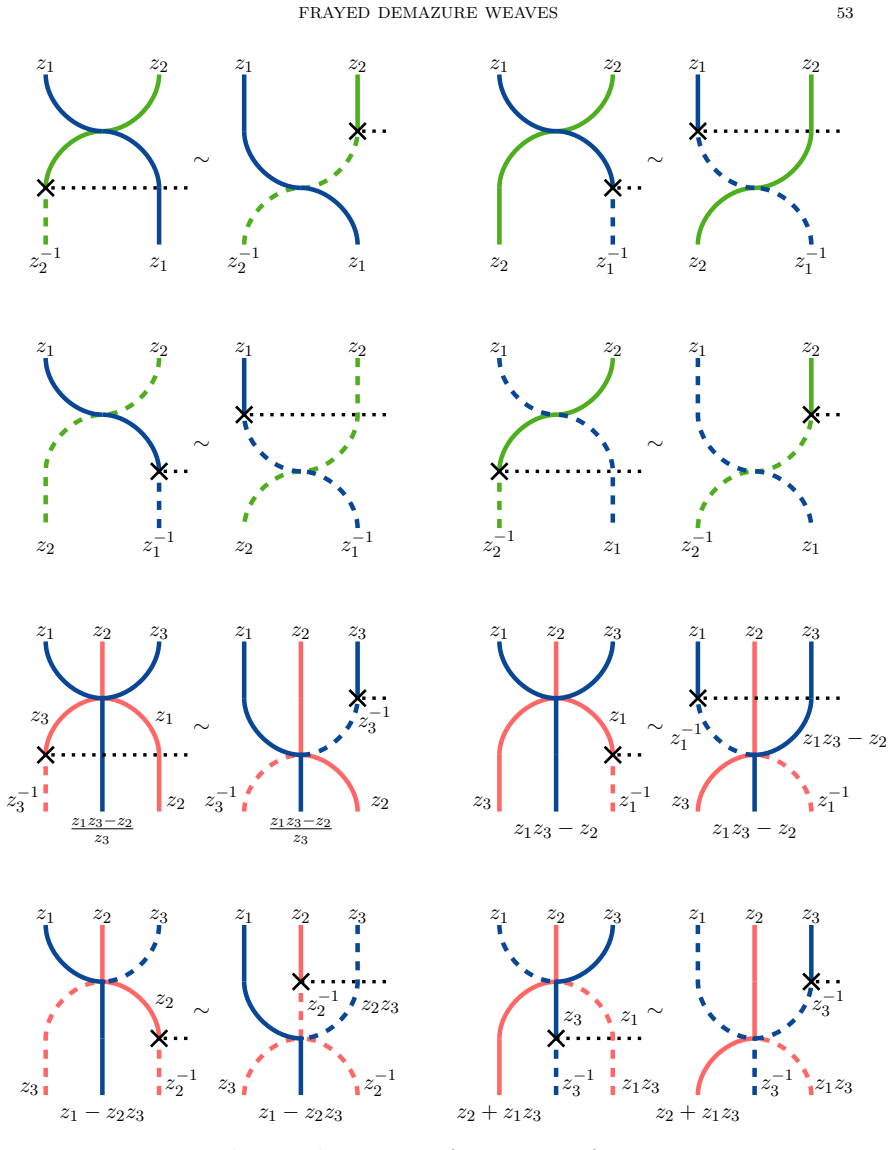
read the original abstract
Demazure weaves are combinatorial representations of maps between Bott--Samelson cells and have been used to construct cluster structures on braid varieties. We show the compatibility of these maps and the resulting cluster structures with the standard Poisson structure on the Bott--Samelson variety. Adding frayed strands to Demazure weaves, we further construct Poisson compatible cluster structures on other affine charts of the Bott--Samelson variety in a manner that transition functions across charts become rational quasi-cluster. The mutation sequences we construct for these quasi-cluster morphisms are closely related to those of M\'enard for open Richardson seeds.
Editorial analysis
A structured set of objections, weighed in public.
Referee Report
Summary. The manuscript claims that Demazure weaves are compatible with the standard Poisson structure on the Bott--Samelson variety and that adding frayed strands produces Poisson-compatible cluster structures on additional affine charts, with transition functions across charts becoming rational quasi-cluster morphisms. The constructed mutation sequences are stated to be closely related to those of Ménard for open Richardson seeds.
Significance. If the central claims hold, the work extends prior combinatorial constructions of cluster structures from braid varieties to a wider collection of affine charts on the Bott--Samelson variety while preserving Poisson compatibility and producing explicit rational quasi-cluster transition maps. The combinatorial (rather than data-fitted) definition of the frayed objects and the explicit link to Ménard’s mutation sequences are strengths that support potential applications in Poisson geometry and cluster algebra theory on flag varieties.
major comments (2)
- [§3] §3 (definition of frayed strands): the claim that fraying preserves Poisson compatibility and yields quasi-cluster morphisms after mutation is load-bearing for the extension beyond braid-variety charts; the manuscript must supply an explicit verification that the added strands do not alter the Poisson bracket relations in a way that breaks the cluster algebra structure, rather than relying solely on the combinatorial extension of the weave.
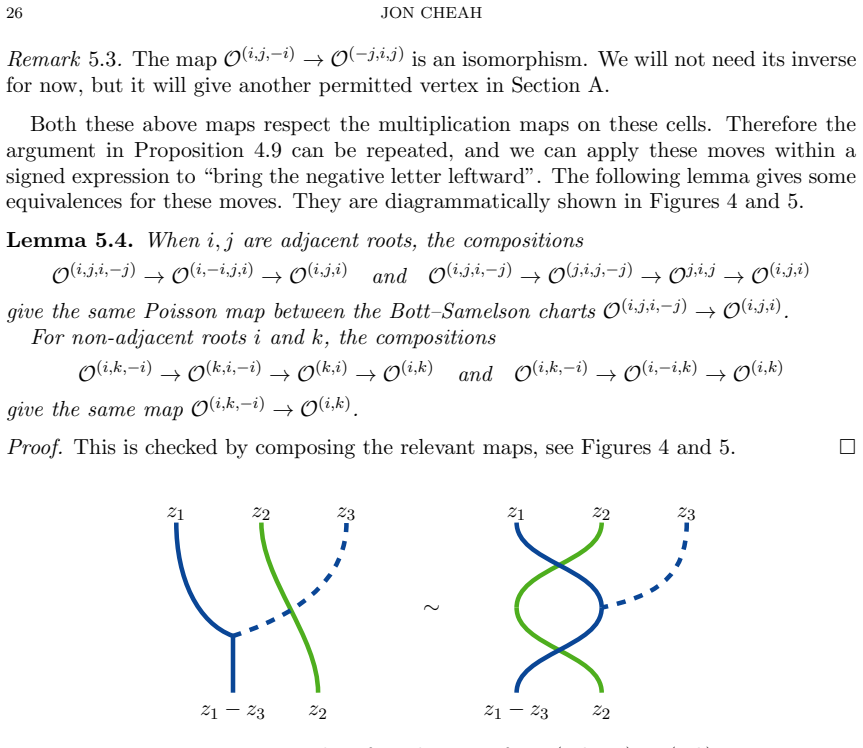
- [§5] §5 (mutation sequences for quasi-cluster morphisms): the asserted close relation to Ménard’s sequences for open Richardson seeds is central to the transition-function claim; a concrete comparison (e.g., explicit sequence of mutations or a table of corresponding exchanges) is required to confirm that the sequences indeed produce rational quasi-cluster maps rather than merely analogous combinatorics.
minor comments (2)
- [Introduction] The introduction would benefit from an early, self-contained statement of the main theorem (including the precise statement of Poisson compatibility) before the technical definitions.
- [§2] Notation for the standard Poisson structure on the Bott--Samelson variety should be fixed once in §2 and used consistently thereafter to avoid ambiguity when discussing compatibility.
Simulated Author's Rebuttal
We thank the referee for the careful reading and constructive suggestions. Both major comments identify places where explicit verification would strengthen the manuscript; we agree and will incorporate the requested material in the revision.
read point-by-point responses
-
Referee: [§3] §3 (definition of frayed strands): the claim that fraying preserves Poisson compatibility and yields quasi-cluster morphisms after mutation is load-bearing for the extension beyond braid-variety charts; the manuscript must supply an explicit verification that the added strands do not alter the Poisson bracket relations in a way that breaks the cluster algebra structure, rather than relying solely on the combinatorial extension of the weave.
Authors: We agree that an explicit verification of Poisson compatibility for the frayed strands is required. In the revised manuscript we will add, in §3, a direct computation of the Poisson brackets on the new variables introduced by fraying. The calculation shows that these variables behave as frozen variables whose brackets are compatible with the existing cluster algebra structure on the braid-variety charts, thereby confirming that the combinatorial extension preserves the Poisson relations. revision: yes
-
Referee: [§5] §5 (mutation sequences for quasi-cluster morphisms): the asserted close relation to Ménard’s sequences for open Richardson seeds is central to the transition-function claim; a concrete comparison (e.g., explicit sequence of mutations or a table of corresponding exchanges) is required to confirm that the sequences indeed produce rational quasi-cluster maps rather than merely analogous combinatorics.
Authors: We accept that a concrete side-by-side comparison is needed. The revised §5 will contain an explicit table listing the mutation sequences arising from our frayed Demazure weaves together with the corresponding sequences from Ménard’s construction for open Richardson seeds. The table will highlight the precise exchange relations that guarantee the transition maps are rational quasi-cluster morphisms. revision: yes
Circularity Check
No significant circularity identified
full rationale
The paper defines frayed Demazure weaves combinatorially as an extension of prior Demazure weave constructions for braid varieties, then shows compatibility with the standard Poisson structure on the Bott-Samelson variety and constructs transition functions as rational quasi-cluster morphisms. The mutation sequences are stated to be closely related to Ménard's (distinct author) work on open Richardson seeds. No equation or definition reduces by construction to its own inputs, no fitted parameter is relabeled as a prediction, and no load-bearing premise rests solely on self-citation. The derivation chain remains self-contained against external combinatorial and Poisson-geometric benchmarks.
Axiom & Free-Parameter Ledger
axioms (2)
- domain assumption The Bott-Samelson variety carries a standard Poisson structure compatible with its cell decomposition.
- domain assumption Demazure weaves represent maps between Bott-Samelson cells that can be extended by frayed strands while preserving cluster relations.
Reference graph
Works this paper leans on
-
[1]
Upper cluster structure on Kac–Moody Richardson varieties.arXiv preprint arXiv:2506.10382, 2025
Huanchen Bao and Jeff York Ye. Upper cluster structure on Kac–Moody Richardson varieties.arXiv preprint arXiv:2506.10382, 2025
arXiv 2025
-
[2]
Quantum cluster algebras.Advances in Mathematics, 195(2):405–455, 2005
Arkady Berenstein and Andrei Zelevinsky. Quantum cluster algebras.Advances in Mathematics, 195(2):405–455, 2005. doi: https://doi.org/10.1016/j.aim.2004.08.003
-
[3]
Arkady Berenstein, Sergey. Fomin, and Andrei Zelevinsky. Cluster algebras III: Upper bounds and double Bruhat cells.Duke Mathematical Journal, 126(1):1–52, 2005. doi: 10.1215/S0012-7094-04-12611-9
-
[4]
Peigen Cao and Bernhard Keller. On Leclerc’s conjectural cluster structures for open Richardson varieties.arXiv preprint arXiv:2207.10184, 2022
arXiv 2022
-
[5]
Roger Casals and Eric Zaslow. Legendrian weaves:N-graph calculus, flag moduli and applications.Geometry & Topology, 26(8):3589–3745, 2022. doi: 10.2140/gt.2022.26. 3589. 58 JON CHEAH
-
[6]
Algebraic weaves and braid varieties.American Journal of Mathematics, 146(6):1469–1576, 2024
Roger Casals, Eugene Gorsky, Mikhail Gorsky, and Jos´ e Simental. Algebraic weaves and braid varieties.American Journal of Mathematics, 146(6):1469–1576, 2024. doi: 10.1353/ajm.2024.a944357
-
[7]
Roger Casals, Eugene Gorsky, Mikhail Gorsky, Ian Le, Linhui Shen, and Jos´ e Si- mental. Cluster structures on braid varieties.Journal of the American Mathematical Society, 38(2):369–479, 2025. doi: 10.1090/jams/1048
-
[8]
Sherman- Bennett, and Jos´ e Simental
Roger Casals, Pavel Galashin, Mikhail Gorsky, Linhui Shen, Melissa. Sherman- Bennett, and Jos´ e Simental. Comparing cluster algebras on braid varieties.arXiv preprint arXiv:2508.03816, 2026
arXiv 2026
-
[9]
Positroid links and braid varieties.Journal f ur die reine und angewandte Mathematik (Crelles Journal),
Roger Casals, Eugene Gorsky, Mikhail Gorsky, and Jos´ e Simental. Positroid links and braid varieties.Journal f ur die reine und angewandte Mathematik (Crelles Journal),
-
[10]
doi: doi:10.1515/crelle-2026-0007
-
[11]
Bott–Samelson varieties and Poisson Ore extensions
Bal´ azs Elek and Jiang-Hua Lu. Bott–Samelson varieties and Poisson Ore extensions. International Mathematics Research Notices, 2021(14):10745–10797, 07 2019. doi: 10.1093/imrn/rnz127
-
[12]
Laura Escobar. Brick manifolds and toric varieties of brick polytopes.The Electronic Journal of Combinatorics, 23(P2.25), 2016. doi: 10.37236/5038
-
[13]
V. V. Fock and A. B. Goncharov. Cluster ensembles, quantization and the diloga- rithm.Annales scientifiques de l’ ´Ecole Normale Sup´ erieure, Ser. 4, 42(6):865–930,
-
[14]
doi: 10.24033/asens.2112
- [15]
-
[16]
Sergey Fomin and Andrei Zelevinsky. Double bruhat cells and total positiv- ity.Journal of the American Mathematical Society, 12(2):335–380, 1999. doi: 10.1090/S0894-0347-99-00295-7
-
[17]
Cluster algebras I: Foundations.Jour- nal of the American Mathematical Society, 15(2):497–529, 2002
Sergey Fomin and Andrei Zelevinsky. Cluster algebras I: Foundations.Jour- nal of the American Mathematical Society, 15(2):497–529, 2002. doi: 10.1090/ S0894-0347-01-00385-X
2002
-
[18]
Quasi-homomorphisms of cluster algebras.Advances in Applied Math- ematics, 81:40–77, 2016
Chris Fraser. Quasi-homomorphisms of cluster algebras.Advances in Applied Math- ematics, 81:40–77, 2016. doi: 10.1016/j.aam.2016.06.005
-
[19]
Braid variety cluster structures, I: 3D plabic graphs.arXiv preprint arXiv:2210.04778, 2024
Pavel Galashin, Thomas Lam, Melissa Sherman-Bennett, and David Speyer. Braid variety cluster structures, I: 3D plabic graphs.arXiv preprint arXiv:2210.04778, 2024
arXiv 2024
-
[20]
Braid variety cluster structures, II: general type.Inventiones mathematicae, 243:1079–1127, 2026
Pavel Galashin, Thomas Lam, and Melissa Sherman-Bennett. Braid variety cluster structures, II: general type.Inventiones mathematicae, 243:1079–1127, 2026. doi: 10.1007/s00222-025-01390-5
-
[21]
F. A. Garside. The braid group and other groups.The Quarterly Journal of Mathe- matics, 20(1):235–254, 1969. doi: 10.1093/qmath/20.1.235
-
[22]
Kac–Moody groups and cluster algebras.Advances in Mathematics, 228(1):329–433, 2011
Christof Geiß, Benard Leclerc, and Jan Schr¨ oer. Kac–Moody groups and cluster algebras.Advances in Mathematics, 228(1):329–433, 2011. doi: 10.1016/j.aim.2011. 05.011
-
[23]
Cluster algebras and Poisson geometry.Moscow Mathematical Journal, 3(3):899–934, 2003
Michael Gekhtman, Michael Shapiro, and Alek Vainshtein. Cluster algebras and Poisson geometry.Moscow Mathematical Journal, 3(3):899–934, 2003. doi: 10.17323/ 1609-4514-2003-3-3-899-934
2003
-
[24]
the American Mathematical Society, 2010
Michael Gekhtman, Michael Shapiro, and Alek Vainshtein.Cluster algebras and Pois- son geometry, volume 167 ofMathematical Surveys and Monographs. the American Mathematical Society, 2010. FRAYED DEMAZURE WEAVES 59
2010
-
[25]
A generalized cluster struc- ture onGL n via birational Poisson maps.arXiv preprint arXiv:03.12486, 2026
Misha Gekhtman, Michael Shapiro, and Alek Vainshtein. A generalized cluster struc- ture onGL n via birational Poisson maps.arXiv preprint arXiv:03.12486, 2026
2026
-
[26]
Regular pullback of gener- alized cluster structures.arXiv preprint arXiv:2603.12496, 2026
Misha Gekhtman, Michael Shapiro, and Alek Vainshtein. Regular pullback of gener- alized cluster structures.arXiv preprint arXiv:2603.12496, 2026
arXiv 2026
-
[27]
K. R. Goodearl and M. Yakimov. Poisson structures on affine spaces and flag varieties. II.Transactions of the American Mathematical Society, 361(11):5753–5780, 2009. doi: 10.1090/S0002-9947-09-04654-6
-
[28]
K. R. Goodearl and M. T. Yakimov. Cluster algebra structures on Poisson nilpotent algebras.arXiv preprint arXiv:1801.01963, 2018
Pith/arXiv arXiv 2018
-
[29]
B. Leclerc. Cluster structures on strata of flag varieties.Advances in Mathematics, 300:190–228, 2016. doi: 10.1016/j.aim.2016.03.018
-
[30]
Mutation matrices for Poisson CGL extensions
Jiang-Hua Lu and Yipeng Mi. Mutation matrices for Poisson CGL extensions. 2026. In preparation
2026
-
[31]
B. R. Marsh and K. Rietsch. Parametrizations of flag varieties.Representation Theory, 8:212–242, 2004. doi: 10.1090/S1088-4165-04-00230-4
-
[32]
Etienne M´ enard. Cluster algebras associated with open Richardson varieties: an algorithm to compute initial seeds.arXiv preprint arXiv:2201.10292, 2022
arXiv 2022
-
[33]
Locally acyclic cluster algebras.Advances in Mathematics, 233(1): 207–247, 2013
Greg Muller. Locally acyclic cluster algebras.Advances in Mathematics, 233(1): 207–247, 2013. doi: 10.1016/j.aim.2012.10.002
-
[34]
K. Rietsch and L. Williams. Newton–Okounkov bodies, cluster duality, and mirror symmetry for Grassmannians.Duke Mathematical Journal, 168(18):3437–3527, 2019. doi: 10.1215/00127094-2019-0028
-
[35]
A superpotential for Grassmannian Schubert varieties.arXiv preprint arXiv:2409.00734, 2025
Konstanze Rietsch and Lauren Williams. A superpotential for Grassmannian Schubert varieties.arXiv preprint arXiv:2409.00734, 2025
arXiv 2025
-
[36]
Linhui. Shen and Daping Weng. Cluster structures on double Bott-–Samelson cells. Forum of Mathematics, Sigma, 9:e66 1–89, 2021. doi: 10.1017/fms.2021.59
-
[37]
J. R. Stembridge. On the fully commutative elements of Coxeter groups.Journal of Algebraic Combinatorics, 5:353–385, 1996. doi: 10.1007/BF00193185
-
[38]
Maximal green sequences for quantum and Poisson CGL extensions
Milen Yakimov. Maximal green sequences for quantum and Poisson CGL extensions. arXiv preprint arXiv:2603.14376, 2026. Department of Mathematics, The University of Hong Kong, Pokfulam Road, Hong Kong Email address:joncheah@connect.hku.hk
arXiv 2026
discussion (0)
Sign in with ORCID, Apple, or X to comment. Anyone can read and Pith papers without signing in.