REVIEW 5 minor 22 references
On the multipoint distribution formulas of the parabolic Airy process
T0 review · 0 major / 5 minor · reviewed 2026-08-15 · deepseek-v4-flash
Pith's one-line read This paper proves that the equal-time multipoint distribution formula for the KPZ fixed point with narrow-wedge initial condition gives the same parabolic Airy process as the extended Airy kernel Fredholm determinant.
desk verdict A solid, honest equivalence proof that Liu's equal-time KPZ fixed point formula really is the parabolic Airy process; it deserves peer review, not a desk reject. read the letter →
The pith
A machine-rendered reading of the paper's core claim, the machinery that carries it, and where it could break.
The reading
What carries the argument
The machinery is the factorization of the kernel as $L=-A_1(\sum_{k=0}^{m-1}(-1)^k B^k)A_2$, where $B$ is strictly upper-triangular, meaning it vanishes on and below the diagonal; this makes $B^m=0$ and $\det(I+B)$ harmless inside the Fredholm determinant, so $\det(I+L)=\det(I+B-A)$, and the latter is the conjugated Airy kernel determinant. The generalized Andreief identity (Lemma 1.2) is the combinatorial tool that replaces determinants of single-variable integrals, $\det(\int_X A_i(x)B_j(x)\,d\mu(x))$, by integrals over products of the block determinants $\det[B_i(x_j)]_{i,j\in I_k}$, and it is what lets the paper reorganize the $m$-level contour integrals from the KPZ fixed point formula.
What would settle it
Compute both sides for the first non-trivial case, $m=2$, at specific ordered points such as $\alpha_1=0$, $\alpha_2=1$, $\beta_1=\beta_2=0$: evaluate the Fredholm determinant of $K$ in Proposition 2.1 by truncating its series expansion and evaluate the extended-Airy-kernel determinant in (1.1) by a separate numerical scheme; any discrepancy beyond numerical error would disprove the stated equality.
Extended reading notes
Core claim
The central claim is that formula (1.10), the equal-time case of the KPZ fixed point multipoint distribution with narrow-wedge initial condition, coincides with (1.1), the extended Airy kernel Fredholm determinant that defines the parabolic Airy process, for every ordered $m$-tuple $\alpha_1<\cdots<\alpha_m$. The argument passes through an intermediate Fredholm determinant $\det(I+K)$ (Proposition 2.1) whose kernel $K$ is built from contour integrals of the functions $f_i(w)=e^{-w^3/3+\alpha_i w^2+\beta_i w}$. By evaluating the auxiliary integrations, conjugating the kernel, and using $\det(I+AB)=\det(I+BA)$, the determinant is reduced to the extended Airy kernel determinant, with the Gaussian factors in (3.16)--(3.17) providing the conjugation and the final identification.
Load-bearing premise
The paper relies, without reproving it, on the multipoint distribution formula for the KPZ fixed point with narrow-wedge initial condition (Theorem 1.1) and on the absolute convergence of several contour integrals cited to other works; if either gave way, the equality of the two formulas would not follow.
Editorial extensions
If this is right
- The two known multipoint formulas for the parabolic Airy process, the defining extended Airy kernel determinant and the equal-time KPZ fixed point formula, can now be used interchangeably.
- Proposition 2.1 gives a new contour-integral Fredholm determinant for the process, which is simpler than the original $D$-function expansion and may be better suited to asymptotic analysis.
- The intermediate identities recorded as (2.21), Lemmas 2.3 and 2.4, (3.5), and (3.15) are new explicit formulas for the same multipoint distributions.
- The generalized Andreief identity stands on its own as a tool for converting Fredholm determinants into block-determinant integrals, independent of the probabilistic context.
Reading between the lines
- The same residue-and-factorization pattern should apply to the unequal-time KPZ fixed point formula, where time differences enter only through extra Gaussian factors in the $F_i$; proving that would give a direct, limit-free derivation of the alternative multitime formula discussed in the paper.
- The strict upper-triangular structure of $B$ suggests a hierarchical decomposition of the $m$-point distribution: each added spatial point contributes a new layer conjugated by Gaussian kernels, which could make asymptotic regimes such as widely spaced $\alpha_i$ tractable from the formula alone.
- Replacing the narrow-wedge initial condition by other initial data in the KPZ fixed point would likely require a different $F_1$, and the proof indicates exactly where the Gaussian-factor structure is indispensable.
Signed reviews
Editorial analysis
A structured set of objections, weighed in public.
Referee Report
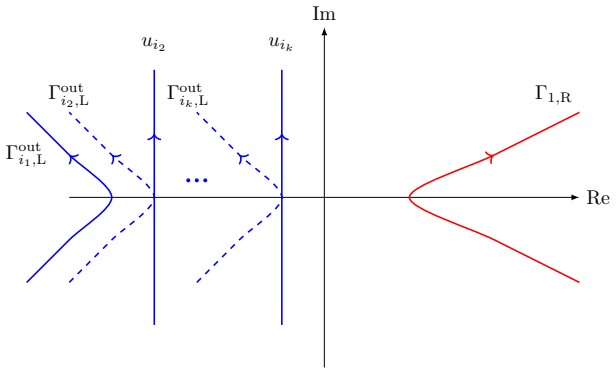
Summary. The paper proves that the equal-time multipoint distribution formula for the KPZ fixed point with narrow-wedge initial condition obtained in [Liu22a], specialized to τ_i = 1 and α_1 < ... < α_m, coincides with the extended Airy kernel Fredholm determinant (1.1) that defines the parabolic Airy process. The proof evaluates the z-contour integrals in the [Liu22a] formula (Lemma 2.3), reorganizes the remaining u-integrals using a generalized Andreief identity (Lemma 2.4), obtains a new contour-integral Fredholm determinant (Proposition 2.1), and then factorizes that kernel through L2(R+) and a strictly upper-triangular nilpotent operator B to identify the result with the conjugated extended Airy kernel. The paper also records several intermediate formulas for the parabolic Airy process and proves a generalized Andreief identity that is independent of the process.
Significance. If the main theorem holds, the paper closes a gap between two independent published formulas for the same object and provides a direct algebraic verification that the equal-time [Liu22a] formula indeed reproduces the original definition of the parabolic Airy process. The proof is largely self-contained modulo Theorem 1.1, which is a published result used explicitly as an input, and the algebraic reductions in Lemmas 2.3, 2.4, and Section 3 are coherent. The generalized Andreief identity is proved in full, and the paper honestly flags its dependence on convergence details from [Liu22a, LZ25]. No ad hoc parameters are introduced, and the final claim is falsifiable through the explicit equality of two contour-integral formulas.
minor comments (5)
- [Section 3, after Lemma 3.2] The equality of det(I+B-A) with the conjugated extended Airy determinant (1.1) is asserted in a single sentence ("after a conjugation and a simple notation change"), but this is the main conclusion of the paper. Please spell out the conjugation, for example by setting λ = x - β_i - α_i^2 and θ = y - β_j - α_j^2, and show explicitly how the (i,j) entries of I+B-A combine to reproduce the piecewise definition of K_ext, in particular how the strictly upper-triangular B corrects the i<j entries of A. As written, a reader cannot verify the orientation switch.
- [Section 2.1, after (2.5)] The claimed Hadamard-inequality proof of absolute convergence of the series (2.5) is not immediate, because for i = 1 the kernel K(1,z;1,u) decays only like |u|^{-1} along Γ_L rather than super-exponentially in the second variable. Please either give a trace-class or Hilbert-Schmidt factorization before using the series expansion, or define det(I+K) via the absolutely convergent expression obtained from (2.21) and from the cited estimates in [Liu22a, LZ25], and correct the sentence accordingly.
- [Lemma 2.3(i), around (2.25)] The derivation of (2.25) suppresses the cancellation between the prefactors (1-z_i^{-1})^{n_{i+1}} and the surviving contour coefficients (-z_i/(1-z_i))^{n_{i+1}} coming from the Γout_{i,R} integrals. Please display this cancellation explicitly; as printed, (2.25) appears to omit the R-contour coefficients, and the reader must reconstruct the analyticity argument by hand.
- [Sections 2.1 and 2.3] The Fredholm determinant in (2.5) is written on the contour Γ_L defined in (2.4), while the proof of Proposition 2.1 in (2.50) uses the contour Γ1_L from Definition 2.2. Please state explicitly that Γ_L may be taken to be Γ1_L, or explain that the determinant is invariant under admissible deformations of the left contour.
- [Lemma 1.2] In the statement of Lemma 1.2, "µ be a measure on Γ" should presumably read "measure on X"; the symbol Γ has not been defined at that point.
Circularity Check
No significant circularity: the paper is an independent equivalence proof between the [Liu22a] equal-time KPZ fixed point formula and the defining extended Airy kernel formula.
full rationale
The paper's central claim is the equality of two independently sourced formulas for the multipoint distribution of the parabolic Airy process: (1.10), inherited from Theorem 1.1 of [Liu22a] for the KPZ fixed point with narrow wedge initial condition, and (1.1), the defining Fredholm determinant with the extended Airy kernel. The derivation does not assume (1.1) while proving the new determinant formula: Proposition 2.1 is obtained from (1.10) by evaluating the z-contour integrals (Lemma 2.3), reorganizing the u-integrals through a generalized Andreief identity (Lemma 2.4), and identifying the resulting series with det(I+K). Section 3 then factors K through the operator B and identifies the conjugated kernel with the extended Airy kernel via direct contour computations and the known identity [Oko02, Lemma 2.6]. No parameter is fitted to the target distribution, and no step defines the input in terms of the claimed output. Theorem 1.1 from [Liu22a] is used as a black box, and convergence details are deferred to [Liu22a, LZ25], but these are technical supports from externally derived TASEP/KPZ results, not ingredients that force the conclusion by construction. Self-citation by the first author is present but not load-bearing in a circular sense, since [Liu22a] itself does not rely on the equivalence proved here.
Assumptions & free parameters
assumptions (5)
- domain assumption Theorem 1.1 from [Liu22a]: the multipoint distribution formula for the KPZ fixed point with narrow wedge initial condition.
- domain assumption The one-time marginal of the KPZ fixed point with narrow wedge at time one is the parabolic Airy process, equations (1.7) and (1.8), from [MQR21].
- standard math Okounkov's Airy integral identity (3.18), from [Oko02].
- standard math Fredholm determinant cyclicity and multiplicativity for absolutely convergent series expansions, used around (3.5) and (3.15).
- domain assumption Absolute convergence and contour deformation principles for the chosen Gamma contours.
Cite this review
Pith. "Pith review of On the multipoint distribution formulas of the parabolic Airy process." pith.science (2026). https://pith.science/paper/TME3C2V7
@misc{pith2026250720487,
  author       = {Pith},
  title        = {Pith review of: On the multipoint distribution formulas of the parabolic Airy process},
  year         = {2026},
  howpublished = {\url{https://pith.science/paper/TME3C2V7}},
  note         = {Machine review of arXiv:2507.20487}
}
abstract
The parabolic Airy process is the Airy$_2$ process minus a parabola, initially defined by its finite-dimensional distributions, which are given by a Fredholm determinant formula with the extended Airy kernel. This process is also the one-time spatial marginal of the KPZ fixed point with the narrow wedge initial condition. There are two formulas for the space-time multipoint distribution of the KPZ fixed point with the narrow wedge initial condition obtained by arXiv:1906.01053 and arXiv:1907.09876. Especially, the equal-time case of arXiv:1907.09876 gives a different formula of the multipoint distribution of the parabolic Airy process. In this paper, we present a direct proof that this formula matches the one with the extended Airy kernel. Some byproducts in the proof include several new formulas for the parabolic Airy process, and a generalization of the Andreief's identity.
Figures


Reference graph
Works this paper leans on
-
[1]
Scaling limit of the colored ASEP and stochastic six-vertex models, 2024
Amol Aggarwal, Ivan Corwin, and Milind Hegde. Scaling limit of the colored ASEP and stochastic six-vertex models, 2024. arXiv:2403.01341
arXiv 2024
-
[2]
Probability distribution of the free energy of the continuum directed random polymer in 1+1 dimensions
Gideon Amir, Ivan Corwin, and Jeremy Quastel. Probability distribution of the free energy of the continuum directed random polymer in 1+1 dimensions. Comm. Pure Appl. Math. , 64(4):466--537, 2011
2011
-
[3]
C. Andr\' e ief. Note sur une relation entre les int\' e grales d\' e finines des produits des fonctions. M\' e m. Soc. Sci. Phys. Nat. Bordeaux (3) , 2:1--14, 1886
-
[4]
Alexei Borodin and Ivan Corwin. Macdonald processes. Probab. Theory Related Fields , 158(1-2):225--400, 2014
work page 2014
-
[5]
Alexei Borodin, Ivan Corwin, and Vadim Gorin. Stochastic six-vertex model. Duke Math. J. , 165(3):563 -- 624, 2016
work page 2016
-
[6]
On the distribution of the length of the longest increasing subsequence of random permutations
Jinho Baik, Percy Deift, and Kurt Johansson. On the distribution of the length of the longest increasing subsequence of random permutations. J. Amer. Math. Soc. , 12(4):1119--1178, 1999
1999
-
[7]
Duncan Dauvergne, Janosch Ortmann, and B \'a lint Vir \'a g. The directed landscape . Acta Mathematica , 229(2):201 -- 285, 2022
work page 2022
-
[8]
Characterization of the directed landscape from the KPZ fixed point
Duncan Dauvergne and Lingfu Zhang. Characterization of the directed landscape from the KPZ fixed point. arXiv:2412.13032 , 2024
arXiv 2024
Show all 22 references
-
[9]
Patrik L. Ferrari. The universal Airy _1 and Airy _2 processes in the totally asymmetric simple exclusion process. In Integrable systems and random matrices , volume 458 of Contemp. Math. , pages 321--332. Amer. Math. Soc., Providence, RI, 2008
2008
-
[10]
The A iry _2 process and the 3d I sing model
Patrik L Ferrari and Senya Shlosman. The A iry _2 process and the 3d I sing model. Journal of Physics A: Mathematical and Theoretical , 56(1), 2023
2023
-
[11]
Shape fluctuations and random matrices
Kurt Johansson. Shape fluctuations and random matrices. Comm. Math. Phys. , 209(2):437--476, 2000
2000
-
[12]
Multitime distribution in discrete polynuclear growth
Kurt Johansson and Mustazee Rahman. Multitime distribution in discrete polynuclear growth. Comm. Pure Appl. Math. , 74(12):2561--2627, 2021
2021
-
[13]
Multipoint distribution of TASEP
Zhipeng Liu. Multipoint distribution of TASEP . Ann. Probab. , 50(4):1255--1321, 2022
2022
-
[14]
One-point distribution of the geodesic in directed last passage percolation
Zhipeng Liu. One-point distribution of the geodesic in directed last passage percolation. Probab. Theory Related Fields , 184(1-2):425--491, 2022
2022
-
[15]
A conditional scaling limit of the KPZ fixed point with height tending to infinity at one location
Zhipeng Liu and Yizao Wang. A conditional scaling limit of the KPZ fixed point with height tending to infinity at one location. Electron. J. Probab. , 29:Paper No. 30, 27, 2024
2024
-
[16]
An upper tail field of the KPZ fixed point
Zhipeng Liu and Ruixuan Zhang. An upper tail field of the KPZ fixed point. Comm. Math. Phys. , 406(8):Paper No. 198, 2025
2025
-
[17]
The KPZ fixed point
Konstantin Matetski, Jeremy Quastel, and Daniel Remenik. The KPZ fixed point. Acta Math. , 227(1):115--203, 2021
2021
-
[18]
Generating functions for intersection numbers on moduli spaces of curves
Andrei Okounkov. Generating functions for intersection numbers on moduli spaces of curves. Int. Math. Res. Not. , (18):933--957, 2002
2002
-
[19]
Scale invariance of the PNG droplet and the A iry process
Michael Pr \"a hofer and Herbert Spohn. Scale invariance of the PNG droplet and the A iry process. J. Stat. Phys. , 108(5-6):1071--1106, 2002
2002
-
[20]
Convergence of exclusion processes and the KPZ equation to the KPZ fixed point
Jeremy Quastel and Sourav Sarkar. Convergence of exclusion processes and the KPZ equation to the KPZ fixed point. J. Amer. Math. Soc. , 36(1):251--289, 2023
2023
-
[21]
Tracy and Harold Widom
Craig A. Tracy and Harold Widom. Asymptotics in ASEP with step initial condition. Comm. Math. Phys. , 290(1):129--154, 2009
2009
-
[22]
The heat and the landscape i
Balint Virag. The heat and the landscape i. arXiv:2008.07241 , 2020
2008 arXiv
Reviewed August 15, 2026 · model on record in the stance chip above.
Discussion (0). Continue with ORCID to comment.