REVIEW 4 major objections 5 minor 36 references
Advancing Medical Image Segmentation via Self-supervised Instance-adaptive Prototype Learning
T0 review · 4 major / 5 minor · reviewed 2026-08-06 · deepseek-v4-flash
Pith's one-line read This paper claims that per-scan prototypes, built by pooling features weighted with transformer-produced confidence masks, lift 3D medical image segmentation by 3.72 mean Dice on BTCV, 0.82 on Lungs, and 0.2 on BraTS.
desk verdict Plausible segmentation paper with a real attribution gap: the ablations don't isolate instance-adaptivity from the transformer decoder and auxiliary loss, and 'self-supervised' is a misnomer. read the letter →
The pith
A machine-rendered reading of the paper's core claim, the machinery that carries it, and where it could break.
The reading
What carries the argument
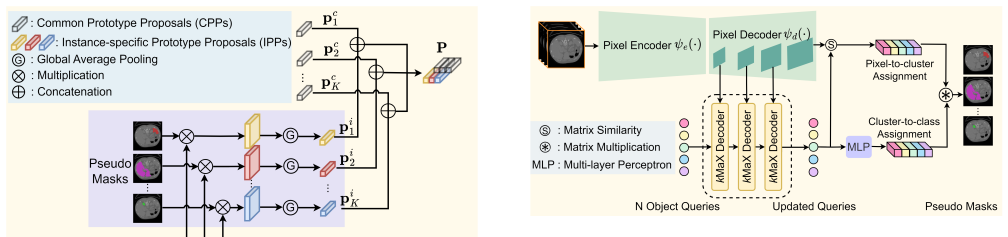
The load-bearing object is the instance-specific prototype proposal $p^i_k = \mathrm{GAP}(M_k \otimes F)$: global average pooling, over the whole volume, of the product of the intermediate feature map and the pseudo-mask confidence map of class $k$. It converts the transformer decoder's per-pixel confidence signal into a per-class vector that changes from patient to patient, so the same organ is represented differently in different scans. Its companion is the self-supervised filtering rule, which compares each object-query cluster's overlap with the previous layer's pseudo masks and updates only clusters whose overlap exceeds $\tau$; this is what keeps the confidence maps from drifting toward the background during training.
What would settle it
Run SIPL on BTCV with $M_k$ in Eq. (2) replaced by random confidence maps of the same shape, normalized to sum to one; if the +13.87-point gap over the no-IPL ablation survives, then the instance-adaptive mechanism is not the driver and the gain must come from another component such as added decoder capacity.
Extended reading notes
Core claim
The paper's central discovery is that the final class prototype should be a function of the input, not a fixed vector. Formally, the prototype for class $k$ is $g_k = \mathrm{MLP}(p^i_k \oplus p^c_k)$, where $p^c_k$ is a learnable common prototype proposal and $p^i_k = \mathrm{GAP}(M_k \otimes F)$ is the instance-specific prototype proposal obtained by weighting the intermediate feature map $F$ with the pseudo-mask confidence map $M_k$ and pooling. The pseudo masks come from the self-supervised mask generation module: object queries are updated through k-means-style transformer decoders, pixels are assigned to query clusters, clusters are projected to classes, and a filtering rule keeps only clusters whose overlap with the previous pseudo mask exceeds a threshold $\tau$ that ramps from 0.1 to 0.5. The paper argues this design captures intra-class variation and avoids the background bias noted in earlier mask transformers, and reports state-of-the-art mean Dice on three benchmarks.
Load-bearing premise
The whole method assumes the pseudo masks produced by the transformer decoder are accurate enough to be used as confidence weights; if those masks are noisy, misaligned with semantic classes, or background-dominated in early training, the instance-specific prototype is biased and the reported gains can shrink or disappear.
Editorial extensions
If this is right
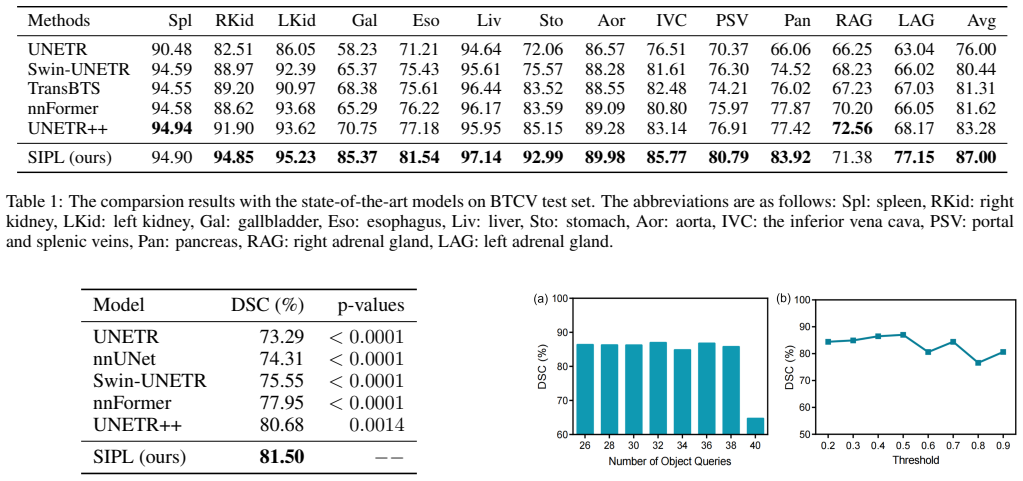
- On the BTCV multi-organ benchmark, SIPL reports 87.00 mean Dice, beating the next-best method (UNETR++) by 3.72 points and achieving the best score in 11 of 13 organs.
- Removing the IPL module drops BTCV mean Dice by 13.87 points, while removing only the SMG module drops it by 2.84 points, so the ablation attributes most of the gain to instance-adaptive prototypes.
- Random initialization of the common prototype proposals outperforms one-hot, BioBERT, and CLIP initializations by at least 1.28 points, suggesting the gains do not come from semantic text or image-text priors.
- On the Lungs and BraTS datasets the improvements over the best baseline are 0.82 and 0.2 mean Dice, with paired t-test p-values below 0.05, so the authors claim statistical significance on all three tasks.
Reading between the lines
- One implication the authors leave implicit: the per-organ BTCV table shows the largest gains on small, shape-variable organs such as the gallbladder, left adrenal gland, stomach, and pancreas, which suggests instance-adaptive prototypes pay off most where intra-class appearance varies.
- A control the paper does not run is fixed prototypes plus the same transformer decoder and auxiliary loss; isolating the filtering rule from added decoder capacity would sharpen the attribution of the reported gain.
- Testable extension: apply the same confidence-weighted pooling to few-shot or class-incremental segmentation, where class prototypes are otherwise frozen; the mechanism predicts larger relative gains in those settings.
Editorial analysis
A structured set of objections, weighed in public.
Referee Report
Summary. The paper proposes SIPL, a prototype-based 3D medical image segmentation method. It augments a learnable common prototype proposal (CPP) with an instance-specific prototype proposal (IPP) computed by global-average-pooling the intermediate feature map after pixel-wise multiplication with pseudo masks. The pseudo masks are produced by a transformer-decoder module (SMG) that hierarchically combines pixel-to-cluster and cluster-to-class assignments, with a filtering rule intended to prioritize foreground clusters and an auxiliary loss. Experiments on BTCV, Lungs, and BraTS report favorable Dice scores over several SOTA methods, and ablations show that removing either the IPL or SMG module degrades performance. The paper also studies the number of object queries, the filtering threshold, and CPP initialization.
Significance. If the central claim is established, instance-adaptive prototypes are a useful extension of prototype-based segmentation: they provide a mechanism for per-input prototype adjustment without requiring per-class run-time optimization. The paper reports consistent gains on three datasets and includes paired t-tests on two of them, which is a strength. However, the reported evidence does not yet isolate the mechanism of instance-adaptivity from added model capacity and auxiliary supervision, and the lack of error bars on the main comparison table and lack of code make the quantitative claims difficult to verify. The contribution is incremental over existing mask-transformers (kMaX-DeepLab, Devil in the Queries), so the attribution of the gain to adaptivity is the load-bearing point.
major comments (4)
- [§4.2, Table 4] The ablation study does not test the central claim that instance-adaptivity, rather than extra capacity or supervision, drives the reported gains. The "- IPL" condition removes the IPP branch, the MLP fusion, and the SMG pathway simultaneously, while "- SMG" removes the transformer decoder that generates the IPP; no condition fixes the SMG module and auxiliary loss while comparing an instance-adaptive prototype against a fixed or global prototype. The 13.87% drop under "- IPL" could therefore come from the additional MLP parameters, the multi-scale features, or the auxiliary loss. Please add a control that keeps SMG and L_aux active and replaces the IPP with a fixed prototype (e.g., a running mean of class features or the CPP alone projected through the same MLP). Without this control, the phrase "enables the learned prototypes to dynamically adapt to different inputs" is not supported.
- [§3.4, Eqs. (10)-(11)] The self-supervised filtering strategy is under-specified at the point where it is supposed to act. The text says clusters with overlap exceeding tau are "chosen for query embedding update," but Eq. (6) updates Q^l from Q^{l-1} via attention A with no reference to tau, M^{l-1}, or the argmax in Eq. (10). No equation shows whether the selected clusters mask the attention, reweight the feature vectors, or modify the gradient. Please specify the exact integration of the selection into Eq. (6), including how M^{l,n}_{pc} is binarized and how the threshold affects training (e.g., a hard mask on A or a loss weighting).
- [§3.4, Eq. (12)] The label "self-supervised" is inaccurate for the described mechanism. L_aux in Eq. (12) is a supervised auxiliary loss computed against the ground-truth mask Y, and the filtering in Eq. (10) compares clusters with previous pseudo masks and ground-truth-derived class masks. No self-supervised signal (pretext task, contrastive objective, or unsupervised consistency) is defined anywhere in Section 3.4. Either rename the module to something like "hierarchical mask generation" or introduce a genuinely self-supervised training signal; as written, the title and abstract overstate the nature of the supervision.
- [Tables 1-3] The statistical evidence for the improvement claims is incomplete. Table 1 reports no variance, confidence intervals, or p-values, while Tables 2 and 3 report p-values without variance estimates and without any multiple-comparison correction (five comparisons per table). Given that two of the reported margins are 0.82 and 0.2 Dice points, the claim that these improvements are "statistically significant" is not substantiated by the information presented. Please report mean±std over multiple runs or bootstrapped confidence intervals, and state whether the p-values are corrected for the number of tested methods.
minor comments (5)
- [§3.1, Eq. (1)] The softmax uses exp(-<f_i, g_k>) with <,> defined as cosine similarity; since cosine similarity is higher for more similar vectors, the sign is inverted and would assign higher probability to less similar pairs. Please correct the sign or clarify that the angle brackets denote a distance.
- [Eqs. (5) and (12)] The notation "dY_{k,i}" and similar symbols appear to be the predicted mask \hat{Y}_{k,i} or \hat{M}_{k,i}; the hat is missing in the rendered equations, which makes the loss formulas hard to read.
- [Figure 5] The axis labels and tick values are missing in Figure 5, so the reader cannot determine the exact query counts and threshold values tested. Please add labeled axes.
- [Conclusion] The conclusion contains dangling citations "[Zhou et al., 2023], [Wang et al., 2022a], [Shaker et al., 2024]" that are not mentioned in the text; either integrate them properly or remove them.
- [Reproducibility] No code or trained checkpoints are provided, and several architecture details (number of MLP layers, feature dimensions d and d_i, exact data split generation for Lungs and BraTS) are omitted. Given that the quantitative claims rest on small margins, please provide code or at least complete hyperparameter and data-split documentation.
Circularity Check
No significant circularity; the prototype construction and segmentation losses are independently specified and the main claims are benchmarked against external SOTA methods.
full rationale
The paper's derivation chain has no step whose output is built into its input. The final prototype for class k is G_k = MLP(IPP_k ⊕ CPP_k) (Eq. 3), with IPP_k = GAP(M_k ⊗ F) (Eq. 2). Although IPP depends on the pseudo-mask confidence map M_k, M_k is not defined as the final prediction; it is generated by the SMG transformer decoder and is supervised by the auxiliary loss L_aux in Eq. (12) against the ground-truth mask. The final segmentation cY_k = σ(F_o ⊛ g_k) (Eq. 4) is a separately optimized pixel-to-prototype comparison with the segmentation loss L_seg (Eq. 5). Using the same ground truth to train both branches is standard multi-task supervision, not a definitional reduction. The self-supervised filtering rule in Eq. (10) reuses the network's own previous pseudo masks to select object-query clusters, but those pseudo masks are anchored by Eq. (12); this is self-training with an external anchor, not circularity. The ablations in Table 4 remove whole modules and therefore do not isolate instance-adaptivity from the transformer decoder, but that is an attribution or experimental-design limitation, not a circular derivation. The only reference co-authored by a SIPL author is [Wang et al., 2022b], cited in related work for the existence of local prototypes; it is not load-bearing. Reported gains are against external SOTA methods on standard benchmarks, so the central empirical claim has independent content.
Assumptions & free parameters
free parameters (4)
- Threshold tau schedule =
from 0.1 to 0.5, tau = min(epoch/50,1.0)*0.4+0.1
- Number of object queries N =
32
- Auxiliary loss weight alpha =
0.05
- CPP initialization =
random initialization
assumptions (5)
- domain assumption Pixel-to-prototype cosine matching (Eq 1) is a sufficient segmentation formulation.
- domain assumption Each object query cluster represents a specific part of a particular semantic class.
- ad hoc to paper Pseudo masks from SMG are reliable confidence maps for IPP reweighting.
- ad hoc to paper Concatenation of IPP and CPP followed by an MLP is an effective fusion rule.
- domain assumption The 3D backbone and kMax decoder operate successfully on downsampled multi-scale features.
Cite this review
Pith. "Pith review of Advancing Medical Image Segmentation via Self-supervised Instance-adaptive Prototype Learning." pith.science (2026). https://pith.science/paper/TOT4R7DI
@misc{pith2026250707602,
  author       = {Pith},
  title        = {Pith review of: Advancing Medical Image Segmentation via Self-supervised Instance-adaptive Prototype Learning},
  year         = {2026},
  howpublished = {\url{https://pith.science/paper/TOT4R7DI}},
  note         = {Machine review of arXiv:2507.07602}
}
read the original abstract
Medical Image Segmentation (MIS) plays a crucial role in medical therapy planning and robot navigation. Prototype learning methods in MIS focus on generating segmentation masks through pixel-to-prototype comparison. However, current approaches often overlook sample diversity by using a fixed prototype per semantic class and neglect intra-class variation within each input. In this paper, we propose to generate instance-adaptive prototypes for MIS, which integrates a common prototype proposal (CPP) capturing common visual patterns and an instance-specific prototype proposal (IPP) tailored to each input. To further account for the intra-class variation, we propose to guide the IPP generation by re-weighting the intermediate feature map according to their confidence scores. These confidence scores are hierarchically generated using a transformer decoder. Additionally we introduce a novel self-supervised filtering strategy to prioritize the foreground pixels during the training of the transformer decoder. Extensive experiments demonstrate favorable performance of our method.
Figures


Figures from the paper (1 more)
Reference graph
Works this paper leans on
-
[1]
UNETR++: Delving into Efficient and Accurate 3D Medical Image Segmentation
[Abdelrahman Shakeret al., 2022 ] Muhammad Maaz Ab- delrahman Shaker, Hanoona Rasheed, Salman Khan, Ming-Hsuan Yang, and Fahad Shahbaz Khan. Unetr++: Delving into efficient and accurate 3d medical image seg- mentation.arXiv:2212.04497, 1,
work page Pith review arXiv 2022
-
[4]
End-to-end object detection with transformers
[Carionet al., 2020 ] Nicolas Carion, Francisco Massa, Gabriel Synnaeve, Nicolas Usunier, Alexander Kirillov, and Sergey Zagoruyko. End-to-end object detection with transformers. InEuropean conference on computer vision, pages 213–229. Springer,
work page 2020
-
[7]
An image is worth 16x16 words: Transformers for image recognition at scale.arXiv:2010.11929,
[Dosovitskiyet al., 2020 ] Alexey Dosovitskiy, Lucas Beyer, Alexander Kolesnikov, Dirk Weissenborn, Xiaohua Zhai, Thomas Unterthiner, Mostafa Dehghani, Matthias Min- derer, Georg Heigold, Sylvain Gelly, et al. An image is worth 16x16 words: Transformers for image recognition at scale.arXiv:2010.11929,
arXiv 2020
-
[8]
Deepncm: Deep nearest class mean classifiers
[Guerrieroet al., 2018 ] Samantha Guerriero, Barbara Ca- puto, and Thomas Mensink. Deepncm: Deep nearest class mean classifiers. InInternational Conference on Learning Representations - Workshop,
work page 2018
-
[10]
Unet 3+: A full-scale connected unet for medical image segmenta- tion
[Huanget al., 2020 ] Huimin Huang, Lanfen Lin, Ruofeng Tong, Hongjie Hu, Qiaowei Zhang, Yutaro Iwamoto, Xi- anhua Han, Yen-Wei Chen, and Jian Wu. Unet 3+: A full-scale connected unet for medical image segmenta- tion. InICASSP 2020-2020 IEEE international conference on acoustics, speech and signal processing, pages 1055–
work page 2020
-
[11]
[Isenseeet al., 2021 ] Fabian Isensee, Paul F Jaeger, Si- mon AA Kohl, Jens Petersen, and Klaus H Maier-Hein. nnu-net: a self-configuring method for deep learning- based biomedical image segmentation.Nature Methods, 18:203–211,
work page 2021
-
[14]
Swin transformer: Hierarchical vision transformer using shifted windows
[Liuet al., 2021 ] Ze Liu, Yutong Lin, Yue Cao, Han Hu, Yixuan Wei, Zheng Zhang, Stephen Lin, and Baining Guo. Swin transformer: Hierarchical vision transformer using shifted windows. InProceedings of the IEEE/CVF in- ternational conference on computer vision, pages 10012– 10022,
2021
-
[15]
[Mensinket al., 2013 ] Thomas Mensink, Jakob Verbeek, Florent Perronnin, and Gabriela Csurka. Distance-based image classification: Generalizing to new classes at near- zero cost.IEEE transactions on pattern analysis and ma- chine intelligence, 35(11):2624–2637,
work page 2013
Show all 36 references
-
[18]
U-net: Convolutional networks for biomedical image segmentation
[Ronnebergeret al., 2015 ] Olaf Ronneberger, Philipp Fis- cher, and Thomas Brox. U-net: Convolutional networks for biomedical image segmentation. InMedical Image Computing and Computer-Assisted Intervention, pages 234–241. Springer,
2015
-
[19]
Meta-learning with memory-augmented neural networks
[Santoroet al., 2016 ] Adam Santoro, Sergey Bartunov, Matthew Botvinick, Daan Wierstra, and Timothy Lill- icrap. Meta-learning with memory-augmented neural networks. InInternational conference on machine learning, pages 1842–1850. PMLR,
2016
-
[22]
Prototypical networks for few-shot learning
[Snellet al., 2017 ] Jake Snell, Kevin Swersky, and Richard Zemel. Prototypical networks for few-shot learning. Advances in neural information processing systems, 30,
2017
-
[23]
Learning to compare: Relation network for few-shot learn- ing
[Sunget al., 2018 ] Flood Sung, Yongxin Yang, Li Zhang, Tao Xiang, Philip HS Torr, and Timothy M Hospedales. Learning to compare: Relation network for few-shot learn- ing. InProceedings of the IEEE conference on computer vision and pattern recognition, pages 1199–1208,
2018
-
[24]
A shape-based approach to the segmentation of medical imagery using level sets
[Tsaiet al., 2003 ] Andy Tsai, Anthony Yezzi, William Wells, Clare Tempany, Dewey Tucker, Ayres Fan, W Eric Grimson, and Alan Willsky. A shape-based approach to the segmentation of medical imagery using level sets. IEEE transactions on medical imaging, 22(2):137–154,
2003
-
[26]
A discriminative feature learning ap- proach for deep face recognition
[Wenet al., 2016 ] Yandong Wen, Kaipeng Zhang, Zhifeng Li, and Yu Qiao. A discriminative feature learning ap- proach for deep face recognition. InComputer Vision– ECCV 2016, pages 499–515. Springer,
2016
-
[27]
Weighted res-unet for high-quality retina ves- sel segmentation
[Xiaoet al., 2018 ] Xiao Xiao, Shen Lian, Zhiming Luo, and Shaozi Li. Weighted res-unet for high-quality retina ves- sel segmentation. In2018 9th international conference on information technology in medicine and education, pages 327–331. IEEE,
2018
-
[28]
Linkbert: Pretraining language models with document links.arXiv:2203.15827,
[Yasunagaet al., 2022 ] Michihiro Yasunaga, Jure Leskovec, and Percy Liang. Linkbert: Pretraining language models with document links.arXiv:2203.15827,
2022 arXiv
-
[29]
A location- sensitive local prototype network for few-shot medical im- age segmentation
[Yuet al., 2021 ] Qinji Yu, Kang Dang, Nima Tajbakhsh, Demetri Terzopoulos, and Xiaowei Ding. A location- sensitive local prototype network for few-shot medical im- age segmentation. In2021 IEEE 18th international sympo- sium on biomedical imaging (ISBI), pages 262–266. IEEE,
2021
-
[30]
k-means mask transformer
[Yuet al., 2022 ] Qihang Yu, Huiyu Wang, Siyuan Qiao, Maxwell Collins, Yukun Zhu, Hartwig Adam, Alan Yuille, and Liang-Chieh Chen. k-means mask transformer. InEu- ropean Conference on Computer Vision, pages 288–307. Springer,
2022
-
[31]
Devil is in the queries: Ad- vancing mask transformers for real-world medical image segmentation and out-of-distribution localization
[Yuanet al., 2023 ] Mingze Yuan, Yingda Xia, Hexin Dong, Zifan Chen, Jiawen Yao, Mingyan Qiu, Ke Yan, Xiaoli Yin, Yu Shi, Xin Chen, et al. Devil is in the queries: Ad- vancing mask transformers for real-world medical image segmentation and out-of-distribution localization. InP...
2023
-
[33]
Unet++: A nested u-net architecture for medical image segmentation
[Zhouet al., 2018 ] Zongwei Zhou, Md Mahfuzur Rah- man Siddiquee, Nima Tajbakhsh, and Jianming Liang. Unet++: A nested u-net architecture for medical image segmentation. InDeep Learning in Medical Image Anal- ysis and Multimodal Learning for Clinical Decision Sup- port, pages ...
2018
-
[34]
nn- former: Interleaved transformer for volumetric segmenta- tion.arXiv:2109.03201,
[Zhouet al., 2021 ] Hong-Yu Zhou, Jiansen Guo, Yinghao Zhang, Lequan Yu, Liansheng Wang, and Yizhou Yu. nn- former: Interleaved transformer for volumetric segmenta- tion.arXiv:2109.03201,
2021 arXiv
-
[35]
Rethinking semantic segmentation: A prototype view
[Zhouet al., 2022 ] Tianfei Zhou, Wenguan Wang, Ender Konukoglu, and Luc Van Gool. Rethinking semantic segmentation: A prototype view. InProceedings of the IEEE/CVF Conference on Computer Vision and Pattern Recognition, pages 2582–2593,
2022
-
[36]
nnformer: V olumetric medical image segmen- tation via a 3d transformer.IEEE Transactions on Image Processing, 32:4036–4045, 2023
[Zhouet al., 2023 ] Hong-Yu Zhou, Jiansen Guo, Yinghao Zhang, Xiaoguang Han, Lequan Yu, Liansheng Wang, and Yizhou Yu. nnformer: V olumetric medical image segmen- tation via a 3d transformer.IEEE Transactions on Image Processing, 32:4036–4045, 2023
2023
-
[2003]
Matching networks for one shot learning.Advances in neural information pro- cessing systems, 29,
[Vinyalset al., 2016 ] Oriol Vinyals, Charles Blundell, Timo- thy Lillicrap, Daan Wierstra, et al. Matching networks for one shot learning.Advances in neural information pro- cessing systems, 29,
2016
-
[2013]
The multimodal brain tumor image segmentation benchmark (brats).IEEE transactions on medical imaging, 34(10):1993–2024,
[Menzeet al., 2014 ] Bjoern H Menze, Andras Jakab, Ste- fan Bauer, Jayashree Kalpathy-Cramer, Keyvan Farahani, Justin Kirby, Yuliya Burren, Nicole Porz, Johannes Slot- boom, Roland Wiest, et al. The multimodal brain tumor image segmentation benchmark (brats).IEEE transactions ...
2014
-
[2014]
Learning transferable visual models from nat- ural language supervision
[Radfordet al., 2021 ] Alec Radford, Jong Wook Kim, Chris Hallacy, Aditya Ramesh, Gabriel Goh, Sandhini Agar- wal, Girish Sastry, Amanda Askell, Pamela Mishkin, Jack Clark, et al. Learning transferable visual models from nat- ural language supervision. InInternational conferen...
2021
-
[2015]
Medical image segmentation using squeeze-and-expansion transformers
[Liet al., 2021 ] Shaohua Li, Xiuchao Sui, Xiangde Luo, Xinxing Xu, Yong Liu, and Rick Goh. Medical image segmentation using squeeze-and-expansion transformers. arXiv:2105.09511,
2021 arXiv
-
[2016]
Shaker, Muhammad Maaz, Hanoona Rasheed, Salman Khan, Ming-Hsuan Yang, and Fahad Shahbaz Khan
[Shakeret al., 2024 ] Abdelrahman M. Shaker, Muhammad Maaz, Hanoona Rasheed, Salman Khan, Ming-Hsuan Yang, and Fahad Shahbaz Khan. Unetr++: Delving into efficient and accurate 3d medical image segmentation. IEEE Transactions on Medical Imaging, pages 1–1,
2024
-
[2017]
Swin-unet: Unet-like pure transformer for medical image segmentation
[Caoet al., 2022 ] Hu Cao, Yueyue Wang, Joy Chen, Dong- sheng Jiang, Xiaopeng Zhang, Qi Tian, and Manning Wang. Swin-unet: Unet-like pure transformer for medical image segmentation. InEuropean conference on computer vision, pages 205–218. Springer,
2022
-
[2018]
Unetr: Trans- formers for 3d medical image segmentation
[Hatamizadehet al., 2022 ] Ali Hatamizadeh, Yucheng Tang, Vishwesh Nath, Dong Yang, Andriy Myronenko, Bennett Landman, Holger R Roth, and Daguang Xu. Unetr: Trans- formers for 3d medical image segmentation. InProceed- ings of the IEEE/CVF winter conference on applications of c...
2022
-
[2019]
Schwing, Alexander Kirillov, and Rohit Girdhar
[Chenget al., 2022 ] Bowen Cheng, Ishan Misra, Alexan- der G. Schwing, Alexander Kirillov, and Rohit Girdhar. Masked-attention mask transformer for universal image segmentation. InProceedings of the IEEE/CVF Confer- ence on Computer Vision and Pattern Recognition, pages 1290–1...
2022
-
[2020]
A closer look at few-shot classification.arXiv:1904.04232,
[Chenet al., 2019 ] Wei-Yu Chen, Yen-Cheng Liu, Zsolt Kira, Yu-Chiang Frank Wang, and Jia-Bin Huang. A closer look at few-shot classification.arXiv:1904.04232,
2019 arXiv
-
[2021]
Miccai multi-atlas labeling beyond the cranial vault–workshop and challenge
[Landmanet al., 2015 ] Bennett Landman, Zhoubing Xu, J Igelsias, Martin Styner, Thomas Langerak, and Arno Klein. Miccai multi-atlas labeling beyond the cranial vault–workshop and challenge. InProc. MICCAI Multi- Atlas Labeling Beyond Cranial V ault—Workshop Chal- lenge, volume...
2015
-
[2022]
Semi-supervised few-shot learning with prototypical net- works.CoRR abs/1711.10856,
[Boney and Ilin, 2017] Rinu Boney and Alexander Ilin. Semi-supervised few-shot learning with prototypical net- works.CoRR abs/1711.10856,
2017 arXiv
-
[2023]
Dodnet: Learning to segment multi- organ and tumors from multiple partially labeled datasets
[Zhanget al., 2021 ] Jianpeng Zhang, Yutong Xie, Yong Xia, and Chunhua Shen. Dodnet: Learning to segment multi- organ and tumors from multiple partially labeled datasets. InProceedings of the IEEE/CVF conference on computer vision and pattern recognition, pages 1195–1204,
2021
-
[2024]
A large annotated medical image dataset for the development and evaluation of segmentation algorithms.arXiv:1902.09063,
[Simpsonet al., 2019 ] Amber L Simpson, Michela An- tonelli, Spyridon Bakas, Michel Bilello, Keyvan Farahani, Bram Van Ginneken, Annette Kopp-Schneider, Bennett A Landman, Geert Litjens, Bjoern Menze, et al. A large annotated medical image dataset for the development and evalu...
2019 arXiv
Reviewed August 6, 2026 · model on record in the stance chip above.
Discussion (0). Sign in to comment.