REVIEW 3 major objections 4 minor 16 references
Topology of the icosidodecahedral arrangement
T0 review · 3 major / 4 minor · reviewed 2026-08-14 · deepseek-v4-flash
Pith's one-line read The icosidodecahedral arrangement is a K(pi,1) space, and so is its Milnor fiber.
desk verdict Plausible short proof that Yoshinaga's icosidodecahedral arrangement is K(pi,1), with the finite verification left too vague for comfort. read the letter →
The pith
A machine-rendered reading of the paper's core claim, the machinery that carries it, and where it could break.
The reading
What carries the argument
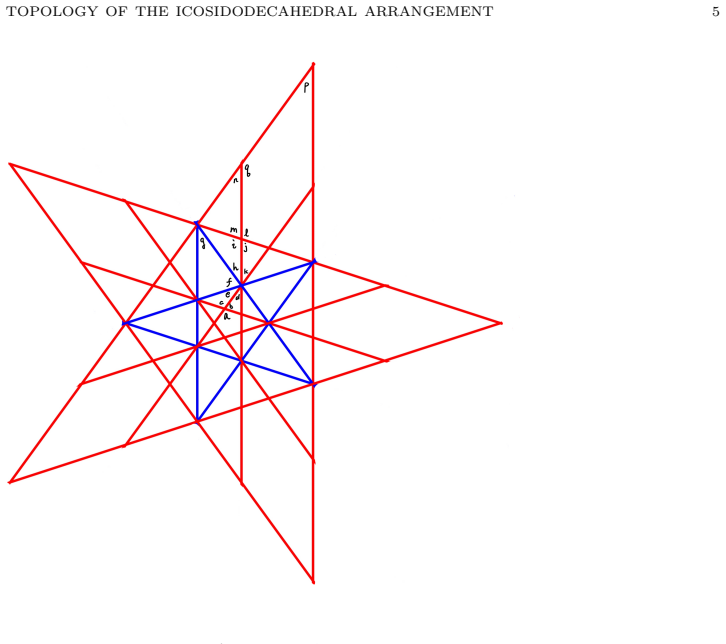
The carrying object is the bounded complex $\Gamma$ of the deconing $\mathcal{L}_{ID}$, a 2-dimensional CW complex whose cells are the bounded strata cut out by the affine lines. On it the paper places a system of weights on corners (vertex-face incidences) and applies Falk's $K(\pi,1)$ test from [Fal95]. The test requires two things: for each bounded face, the corner weights sum to at most $d(f)-2$ (asphericity), and for each vertex, every circuit of a specified form in the link has total weight at least 2 (L-admissibility). The specific weights ($\frac{3}{5},\frac{2}{5},\frac{1}{5},1,\frac{3}{10}$) are chosen so that the asphericity inequalities become equalities and the circuit inequalities hold; symmetry reduces the vertex checks to five links, three cycles and two paths.
What would settle it
Recompute the face sums and vertex circuit sums from the weights given in Figure 3: if any bounded face has corner-weight sum exceeding $d(f)-2$, or any vertex link contains a circuit of the listed types with total weight below 2, Theorem 3.2 fails. The check is purely arithmetic and can be done by hand from the figure, including the four representative vertices the paper does not work out.
Extended reading notes
Core claim
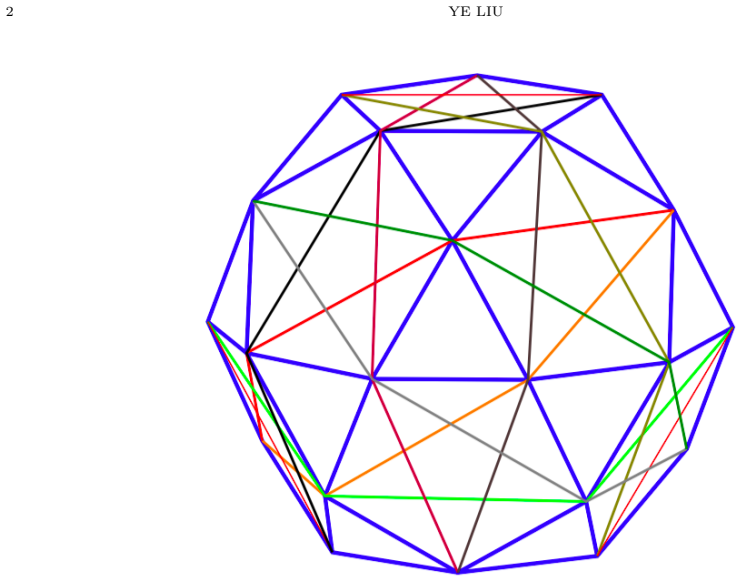
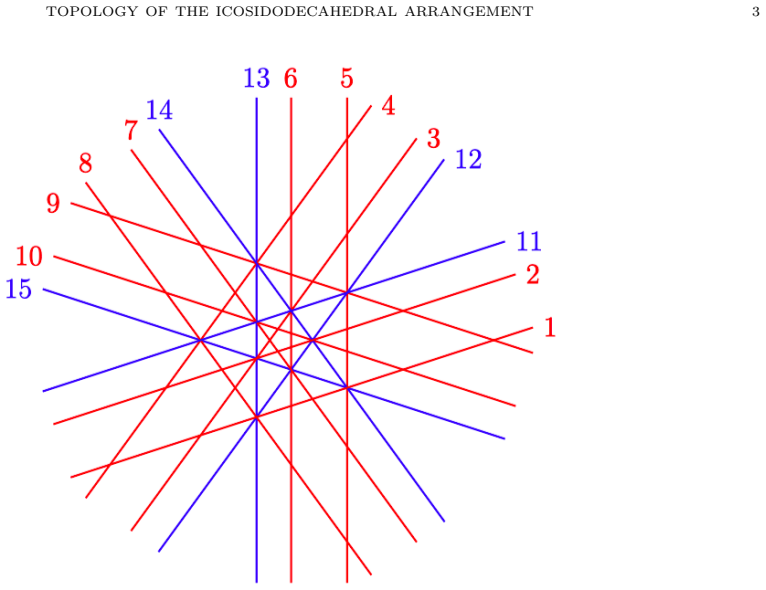
The central claim, stated as Theorem 3.2, is that $\mathcal{A}_{ID}$ is $K(\pi,1)$, and hence the Milnor fiber is $K(\pi,1)$ as well. The proof works with the affine deconing $\mathcal{L}_{ID}$, the line arrangement obtained by sectioning $\mathcal{A}_{ID}$ with a plane, and exhibits a system of weights on the corners of its bounded complex that satisfies the two conditions of the $K(\pi,1)$ test of [Fal95]: face-wise asphericity inequalities and vertex-wise circuit admissibility. The paper lists a fractional weight solution and, using the arrangement's symmetry, reduces the admissibility checks to five representative vertices. Since a $K(\pi,1)$ space has vanishing higher homotopy groups, the conclusion is that both the complement $\mathcal{M}(\mathcal{A}_{ID})$ and the Milnor fiber are aspherical.
Load-bearing premise
Everything depends on the listed fractional weights actually satisfying the required inequalities at every face and vertex of the bounded complex; the paper asserts the asphericity equalities without showing the arithmetic and checks the admissibility condition for only one of the five symmetry representatives, leaving the rest to the reader.
Editorial extensions
If this is right
- The complement $\mathcal{M}(\mathcal{A}_{ID})$ is aspherical: $\pi_i(\mathcal{M})=0$ for $i\ge 2$.
- The Milnor fiber $F(\mathcal{A}_{ID})$ is aspherical as well, so its higher homotopy groups vanish.
- The fundamental group $\pi_1(\mathcal{M}(\mathcal{A}_{ID}))$ is of type FL, has cohomological dimension 3, and is torsion-free.
- $\mathcal{A}_{ID}$ is $K(\pi,1)$ even though it is not simplicial, supersolvable, free, factored, or rational $K(\pi,1)$; these sufficient conditions are not necessary.
Reading between the lines
- If the theorem stands, this becomes the first $K(\pi,1)$ arrangement whose Milnor fiber has torsion in first integral homology, suggesting that asphericity does not force torsion-free Milnor fiber homology.
- The weight solution attains equalities in the asphericity condition, hinting that the bounded complex of $\mathcal{L}_{ID}$ is tight for this test; similar equal-weight systems might be sought for arrangements built from other Archimedean solids.
- Working out the circuit sums for the four representative vertices that are left to the reader would turn the symmetry argument into a fully displayed verification and would make the proof easier to check or automate.
Signed reviews
Editorial analysis
A structured set of objections, weighed in public.
Referee Report
Summary. The paper studies Yoshinaga's icosidodecahedral arrangement A_ID, a real central arrangement of 16 planes in R^3. The main result (Theorem 3.2) claims that A_ID is K(pi,1), and hence so is its Milnor fiber. The proof applies Falk's criterion (Theorem 3.1) to the bounded complex of the deconing L_ID, using an explicit rational weight system on corners. The paper also records that A_ID is not simplicial, not free, not supersolvable, not factored, and not rational K(pi,1), so the K(pi,1) property is not obtained from any of the standard sufficient conditions.
Significance. If the weight-system verification is completed, the result is significant: it would provide the first example of a K(pi,1) arrangement whose Milnor fiber has torsion in H_1, showing that such torsion is compatible with asphericity of the complement and of the Milnor fiber. The overall strategy is appropriate and non-circular: Falk's theorem is a published criterion, and the weight system is an explicitly constructed witness rather than an artifact of fitting the conclusion. The proof is transparent and reduces to a finite enumeration, which makes the missing finite checks particularly easy to supply.
major comments (3)
- [Section 3, proof of Theorem 3.2] The asphericity condition (1) of Theorem 3.1 is supported only by the sentence 'It is easily checked that all equalities in the asphericity condition hold in this case.' This is a load-bearing finite check: for every face f of the bounded complex Gamma one must verify sum_v Delta(v,f) <= d(f)-2, and a single face violating this inequality would invalidate Theorem 3.2. The paper does not list the faces, their corner sums, or d(f). This is especially delicate because the corner labeled l has weight 1, so any triangular face containing that corner would already be at the boundary of the condition. Please include a complete face-by-face table (or a small reproducible script with its output) verifying the asphericity inequalities for all faces of Gamma.
- [Section 3, proof of Theorem 3.2] The L-admissibility condition (2) of Theorem 3.1 is checked for only one of the five representative vertices, namely the vertex surrounded by the labels defhkhfe. The other four vertices (abcb, mijl, mhghm, nq) are dismissed with 'the reader can easily complete the rest.' This is also load-bearing: each vertex and each applicable circuit type (i)-(iv) must be checked, and a violation at any vertex would break the proof of K(pi,1). Please provide the explicit inequalities for the remaining four vertices, with the relevant circuits and weighted sums, or include a verification script. In addition, the symmetry reduction should be stated precisely: which symmetry group is used, what the orbits of vertices, faces, and corners are, and why the five listed vertices represent all orbits.
- [Section 3, Table of link shapes] The table of shapes of Lambda_v is not self-explanatory. For example, the row '123456' with m=4 is listed with type (i) as N/A, which is confusing if that row represents a cycle of length 6; if it represents a path, the table should say so explicitly. The text says 'the links of the first three are cycles of length 4, 8, 4 respectively', but the third row listed would have length 6 if it were a cycle. Please clarify the correspondence between the five representative vertices and the rows of the table, and state for each row whether Lambda_v is a cycle or a path.
minor comments (4)
- [Section 2, non-factored argument] The argument that L_ID is not factored refers to lines H1, H3, and H9 without labeling these lines in the text; please add a reference to Figure 2 or include a diagram with line labels so that the intersections X=H1∩H9 and H3∩H9 can be checked.
- [Section 3, Theorem 3.1 statement] In the statement of Theorem 3.1, the circuits in types (ii)-(iv) are written in compressed notation; please specify explicitly how indices are read on a cycle (e.g., modulo the cycle length) and on a path, since this affects the listed sums.
- [Section 3, asphericity statement] The proof says 'all equalities in the asphericity condition hold', but the theorem only requires inequalities. If indeed every face has equality, please state this explicitly; otherwise specify which faces are strict.
- [Section 1, notation] The term 'rank 3 arrangement' is used for a central arrangement in C^3, while the deconing L_ID is an affine arrangement in R^2; this switch of conventions can confuse readers. A sentence clarifying the rank conventions would help.
Circularity Check
No circularity: the proof applies an external sufficient criterion (Falk 1995) to an explicitly constructed weight system.
full rationale
The paper's central claim that the icosidodecahedral arrangement is K(pi,1) is proved by verifying the hypotheses of Falk's theorem (Theorem 3.1, cited from [Fal95]), an external and published criterion. The weight system in Figure 3 is a constructed witness whose values are chosen to satisfy the asphericity and L-admissibility inequalities; it is not fitted to the conclusion in any statistical or definitional sense, and the conditions checked are not the same as the target property K(pi,1) but a known sufficient condition for it. The Milnor fiber conclusion follows from the standard homotopy long exact sequence of the Milnor fibration, an independent topological fact. No load-bearing step reduces to the paper's own prior results, to a self-citation, or to a quantity defined in terms of the target conclusion. The only substantive concern is that parts of Falk's condition are asserted rather than fully tabulated, but that is a completeness/verification gap, not circularity. The derivation is self-contained modulo an external theorem and therefore receives score 0.
Assumptions & free parameters
free parameters (1)
- Weight system Δ (corner weights a through q) =
a=c=3/5, b=f=h=j=m=p=2/5, d=e=g=i=k=n=1/5, l=1, q=3/10
assumptions (2)
- domain assumption Falk's test theorem [Fal95, Theorem 3.1]: existence of an aspherical and L-admissible weight system on the bounded complex of the deconing implies the cone arrangement is K(pi,1).
- standard math The Milnor fibration F -> M(A) -> C* gives a long exact sequence of homotopy groups, and if the base is aspherical then the fiber is aspherical.
Cite this review
Pith. "Pith review of Topology of the icosidodecahedral arrangement." pith.science (2026). https://pith.science/paper/TOZ3JZ7K
@misc{pith2026190801280,
  author       = {Pith},
  title        = {Pith review of: Topology of the icosidodecahedral arrangement},
  year         = {2026},
  howpublished = {\url{https://pith.science/paper/TOZ3JZ7K}},
  note         = {Machine review of arXiv:1908.01280}
}
abstract
The icosidodecahedral arrangement is introduced by M. Yoshinaga (arXiv:1902.06256) as the first known example that is a hyperplane arrangement whose Milnor fiber has torsions in first integral homology. In this note, we prove that the icosidodecahedral arrangement is $K(\pi,1)$, hence so is its Milnor fiber.
Figures
Reference graph
Works this paper leans on
-
[1]
write newline
" write newline "" before.all 'output.state := FUNCTION fin.entry add.period write newline FUNCTION new.block output.state before.all = 'skip after.block 'output.state := if FUNCTION new.sentence skip FUNCTION not #0 #1 if FUNCTION and 'skip pop #0 if FUNCTION or pop #1 'skip if FUNCTION new.block.checka empty 'skip 'new.block if FUNCTION new.block.checkb...
-
[2]
D. C. Cohen, G. Denham and A. I. Suciu, Torsion in M ilnor fiber homology , Algebr. Geom. Topol. 3, 511--535 (2003)
work page 2003
-
[3]
Deligne, Les immeubles des groupes de tresses g\' e n\' e ralis\' e s , Invent
P. Deligne, Les immeubles des groupes de tresses g\' e n\' e ralis\' e s , Invent. Math. 17, 273--302 (1972)
work page 1972
-
[4]
Dimca, Hyperplane arrangements , Universitext, Springer, Cham, 2017, An introduction
A. Dimca, Hyperplane arrangements , Universitext, Springer, Cham, 2017, An introduction
work page 2017
-
[5]
G. Denham and A. I. Suciu, Multinets, parallel connections, and M ilnor fibrations of arrangements , Proc. Lond. Math. Soc. (3) 108(6), 1435--1470 (2014)
work page 2014
-
[6]
Falk, K( ,1) arrangements , Topology 34(1), 141--154 (1995)
M. Falk, K( ,1) arrangements , Topology 34(1), 141--154 (1995)
work page 1995
-
[7]
Falk and R
M. Falk and R. Randell, The lower central series of a fiber-type arrangement , Invent. Math. 82(1), 77--88 (1985)
1985
-
[8]
M. Falk and R. Randell, On the homotopy theory of arrangements. II , in Arrangements--- T okyo 1998 , volume 27 of Adv. Stud. Pure Math. , pages 93--125, Kinokuniya, Tokyo, 2000
work page 1998
Show all 16 references
-
[9]
Jambu and H
M. Jambu and H. Terao, Free arrangements of hyperplanes and supersolvable lattices , Adv. in Math. 52(3), 248--258 (1984)
1984
-
[10]
Orlik and L
P. Orlik and L. Solomon, Combinatorics and topology of complements of hyperplanes , Invent. Math. 56(2), 167--189 (1980)
1980
-
[11]
Paris, Topology of factored arrangements of lines , Proc
L. Paris, Topology of factored arrangements of lines , Proc. Amer. Math. Soc. 123(1), 257--261 (1995)
1995
-
[12]
Papadima and S
S. Papadima and S. Yuzvinsky, On rational K[ ,1] spaces and K oszul algebras , J. Pure Appl. Algebra 144(2), 157--167 (1999)
1999
-
[13]
Randell, Homotopy and group cohomology of arrangements , Topology Appl
R. Randell, Homotopy and group cohomology of arrangements , Topology Appl. 78(3), 201--213 (1997)
1997
-
[14]
Terao, Generalized exponents of a free arrangement of hyperplanes and S hepherd- T odd- B rieskorn formula , Invent
H. Terao, Generalized exponents of a free arrangement of hyperplanes and S hepherd- T odd- B rieskorn formula , Invent. Math. 63(1), 159--179 (1981)
1981
-
[15]
Terao, Modular elements of lattices and topological fibration , Adv
H. Terao, Modular elements of lattices and topological fibration , Adv. in Math. 62(2), 135--154 (1986)
1986
-
[16]
Yoshinaga, Double coverings of arrangement complements and 2-torsion in Milnor fiber homology , (2019), arXiv:1902.06256v1
M. Yoshinaga, Double coverings of arrangement complements and 2-torsion in Milnor fiber homology , (2019), arXiv:1902.06256v1
2019 arXiv
Reviewed August 14, 2026 · model on record in the stance chip above.
Discussion (0). Continue with ORCID to comment.