REVIEW 5 major objections 5 minor 57 references
QPO signatures of disk restoration after type-I X-ray bursts from 4U~1636$-$536
T0 review · 5 major / 5 minor · reviewed 2026-08-16 · deepseek-v4-flash
Pith's one-line read A Type-I thermonuclear burst on the neutron star 4U 1636-536 makes the inner disk's kHz quasi-periodic oscillations disappear for about 200 seconds, and they return as the disk refills on a viscous timescale.
desk verdict A careful but incremental AstroSat extension of Peille et al. showing kHz QPO suppression for ~200 s after three bursts in 4U 1636-536, with honest caveats but one unsupported energy-band claim. read the letter →
The pith
A machine-rendered reading of the paper's core claim, the machinery that carries it, and where it could break.
The reading
What carries the argument
The central object is the kHz quasi-periodic oscillation—a rapid, roughly 700-1100 Hz brightness wobble thought to trace the innermost accretion flow—used as a diagnostic of whether that flow is present. The identity that carries the argument is the viscous refilling time, $t_{\mathrm{visc}} \approx R_{\mathrm{in}}^2/\nu$, evaluated at the inner disk radius; with $R_{\mathrm{in}} = 4\times 10^6$ cm and $\nu \sim 10^{11}$ cm$^2$/s it gives about 160 s, close to the observed ~200 s gap. The paper also uses Lorentzian fits to the power density spectra, with signal-to-noise and null-hypothesis probabilities, to certify which intervals contain a QPO and which only support upper limits.
What would settle it
Reconstruct the post-burst power spectrum with the burst emission removed and with longer effective exposure, for instance by co-adding several bursts of the same source: a QPO appearing in the 0-200 s window at the pre-burst frequency with signal-to-noise ratio above 3 would refute the claimed disruption-and-refilling scenario.
Extended reading notes
Core claim
The paper's central discovery is that the kHz QPO in 4U 1636-536 follows a reproducible disappear-and-reappear cycle around Type-I bursts. In each of the three analyzed bursts, the lower kHz QPO (centroid roughly 683-768 Hz before the burst) is detected in the 100-200 s before burst onset, is not detected in the first 100-200 s afterward with signal-to-noise ratio below 3 and rms upper limits of about 4-8.4%, and re-emerges around 200 s later. The fractional rms amplitude in the 3-20 keV band falls by about 5-6% in the immediate post-burst window. The authors interpret this as burst radiation pushing the inner accretion flow outward; once the burst ends, the inner disk refills on a viscous time scale, and the QPO returns. For an inner radius $R_{\mathrm{in}} = 4\times 10^6$ cm and kinematic viscosity $\nu \sim 10^{11}$ cm$^2$/s, the viscous time $t_{\mathrm{visc}} \approx R_{\mathrm{in}}^2/\nu \approx 160$ s, matching the observed ~200 s restoration.
Load-bearing premise
The load-bearing assumption is that the missing kHz oscillation in the first 100-200 seconds after the burst is a real disappearance, not a signal hidden by burst-related noise or reduced sensitivity.
Editorial extensions
If this is right
- If the claim is right, the ~200 s QPO-free gap is a direct signature of inner-disk disruption: the same gap is seen after all three bursts regardless of spectral state or peak intensity.
- The restoration time, matching $t_{\mathrm{visc}} \approx R_{\mathrm{in}}^2/\nu$ with $\nu \sim 10^{11}$ cm$^2$/s, turns burst-QPO timing into a probe of disk viscosity in this source.
- Because kHz QPOs vanish and return with the inner flow, their recovery lets observers watch the inner disk rebuild in real time after a burst.
- The upper kHz QPO can appear about 200 s after the burst even when it was undetectable before, suggesting the high-frequency part of the flow may recover ahead of the full oscillation pattern.
Reading between the lines
- If radiation pressure is the cause, bursts closer to the Eddington limit should produce longer QPO-free gaps; a larger burst sample could test this correlation quantitatively.
- The same analysis applied to other atoll neutron-star sources with frequent bursts could turn the ~200 s restoration into a general measure of inner-disk viscosity rather than a single-source result.
- Because the first 200 s are upper limits rather than detections, co-adding many bursts in the same spectral state could push the rms limits low enough to reveal a weak residual QPO, which would discriminate between full disruption and partial suppression.
Signed reviews
Editorial analysis
A structured set of objections, weighed in public.
Referee Report
Summary. The paper analyzes three AstroSat LAXPC observations of the neutron-star low-mass X-ray binary 4U 1636-536, selecting one Type-I burst per observation (TNB-1, TNB-2, TNB-3) for which a lower kHz QPO is detected in the 100-200 s before burst onset. The authors fit power density spectra in the 3-20 keV band and report that the lower kHz QPO is not detected in the first 100-200 s after the burst (rms upper limits of ~4-8.4%), reappears after ~200 s, and that the fractional rms drops by ~5-6%. They interpret this as temporary disruption of the inner accretion disk by burst radiation, followed by viscous refilling on a ~200 s timescale, using t_visc = R_in^2/nu with R_in = 4e6 cm and nu = 1e11 cm2/s. Section 5.1 lists caveats including the small sample and possible instrumental masking of the post-burst signal.
Significance. If the disappearance is real, the paper provides one of the few systematic before/after characterizations of kHz QPO evolution across Type-I bursts in a single source, extending the earlier RXTE-based work of Peille et al. (2014). The pre-burst/post-burst count-rate matching and the null-hypothesis probability formalism in Appendix A, validated with simulated dead-time-affected event files, are careful strengths; Table 2 consistently shows p < 0.05 for segments with SNR > 3. The main weakness is that the post-burst non-detection is an upper-limit result whose physical interpretation depends on excluding masking or broadening of the oscillation, and one of the paper's stated supporting checks (the 10-20 keV band) is not actually shown.
major comments (5)
- [§4 and Table 1] The post-burst "non-detection" is established only through Lorentzian fits with centroid and width fixed to the pre-burst values (e.g., Obs 1 and Obs 3 post-burst rows with daggered parameters) and through a blind search that optimizes over narrow frequency bins (Table 2). Neither test has demonstrated sensitivity to a QPO that survives the burst but broadens or drifts, for example due to burst-driven turbulence or a changing inner disk radius. Since the central conclusion is that the oscillation disappears rather than is hidden, the authors should add a search over broader Lorentzian widths or an integrated excess-power statistic over 400-1200 Hz and report the corresponding upper limits for the 0-200 s post-burst segments.
- [§5, first bullet] The bullet claims that non-detection of QPOs in the 10-20 keV band, "where burst intensity is lower," rules out energy-band dependence, but Section 4 presents only 3-20 keV power spectra and no energy-resolved PDS analysis is shown. This check is the most direct rebuttal to the masking/broadening alternative and should either be presented explicitly or the claim should be removed.
- [§3-4, OB4 in Observation 3] The text states that the third burst in Observation 3 (OB4) is omitted from the analysis even though it "meets the necessary conditions," because no QPO is detected in either the pre-burst or post-burst zone. Because this is a qualifying burst whose behavior differs from the three analyzed bursts, its exclusion weakens the claim of a systematic post-burst disappearance and ~200 s reappearance. The authors should either include OB4 in the analysis or justify its exclusion with explicit, pre-defined criteria.
- [§5, Eqs. (2)-(4)] The viscous-timescale agreement is not an independent test: R_in is fixed at 4e6 cm from a companion paper, the viscosity range 1e10-1e13 cm2/s is broad, and the value nu = 1e11 cm2/s that produces ~160-200 s is effectively chosen because it matches the observed delay. This should be presented as an order-of-magnitude consistency check with a free effective viscosity, not as a measurement of the viscosity, and the degeneracy between R_in and nu should be discussed.
- [Abstract, §4, and Table 1] The claimed "drop of approximately 5-6%" in fractional rms is not what Table 1 shows for the lower kHz QPO: TNB-1 drops from 20 +/- 3% to an upper limit of <8.36%, and TNB-3 drops from 11 +/- 3% to <5.0%, which are larger drops or upper limits only. The quantitative statement in the abstract and Section 4 should be reconciled with the tabulated values.
minor comments (5)
- [§1] The sentence describing Type-II TNBs says their duration can range from milliseconds to "a few fours"; this should read "a few hours."
- [§4 and Table 1] The pre-burst interval is -200 to 0 s for Observations 1 and 3 but -100 to 0 s for Observation 2, while the text refers generically to "100-200 sec before the burst"; the interval definitions should be stated consistently in one place.
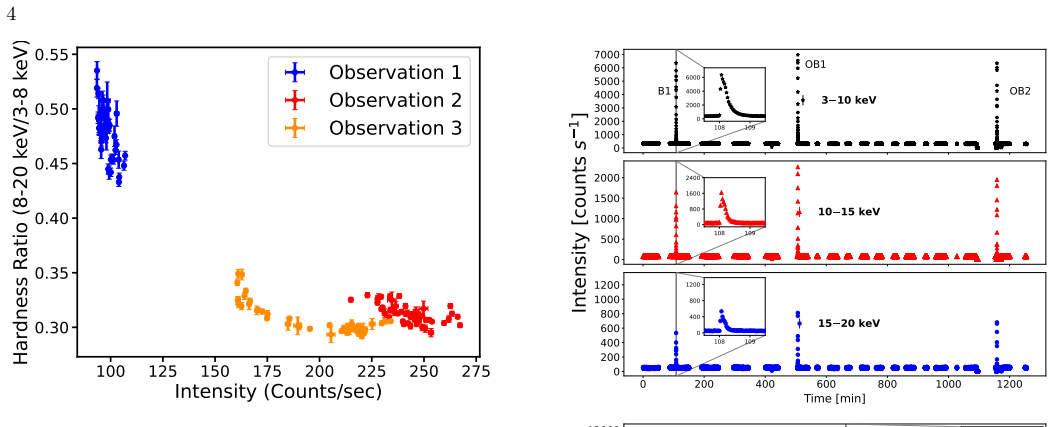
- [Figure 2] The x-axis tick labels near "108 109" appear to be garbled time labels and should be fixed.
- [Abstract] The phrase "The kHz QPOs then re-emerges after approximately 200 sec" has a subject-verb agreement error and should be corrected.
- [Table 2] The column header "p (1-p)%" is ambiguous; it should be made clear that the tabulated quantity is the confidence level 1 - p_N(<P_max).
Circularity Check
No significant circularity: the QPO disappearance and reappearance are directly measured, and the viscous-timescale match is an explicitly caveated consistency check rather than a fitted prediction.
full rationale
The paper's central empirical claim—kHz QPOs present within 200 s before a Type-I burst, absent in the first 100–200 s after, and reappearing after about 200 s—rests on PDS fits and upper limits reported in Table 1 and Figures 3–5. These are direct measurements, and the upper limits are computed with standard SNR and null-hypothesis methods (van der Klis 2004; Barret et al. 2008; Appendix A). No quantity is defined in terms of the result it is claimed to predict. The rms drop of about 5–6% is derived by comparing the pre-burst rms with post-burst upper limits while fixing the pre-burst Lorentzian parameters; this is a detection-threshold comparison, and Section 5.1 explicitly concedes that non-detection 'may result not only from physical disruption but also from instrumental limitations.' The viscous-timescale argument (Eqs. 2–4) adopts R_in = 4e6 cm from Chattopadhyay et al. (2025), a same-group paper, and a viscosity range of 10^10–10^13 cm^2/s from Frank et al. (1985). Choosing nu = 10^11 cm^2/s to match the observed ~160–200 s delay is a post-hoc order-of-magnitude consistency check, not a derivation, and the paper states that 'this should be regarded as an order-of-magnitude consistency rather than a precise measurement.' The self-citation is therefore not load-bearing for the empirical result. The bullet claiming non-detection of QPOs in 10–20 keV is not backed by an energy-resolved PDS in Section 4, but this is a missing-evidence issue, not circularity. Overall, the derivation chain is self-contained for the primary observational claim, with only a mild, explicitly caveated interpretive consistency argument involving a same-group radius estimate.
Assumptions & free parameters
free parameters (1)
- Kinematic viscosity (effective value chosen to match the observed delay) =
~10^11 cm^2/s (within a 10^10-10^13 cm^2/s range)
assumptions (6)
- standard math The Poisson-noise model and chi-square distribution of averaged PDS powers apply to the LAXPC data.
- domain assumption LAXPC dead time (about 42 microseconds) is correctly modeled by the simulator and does not create spurious QPO features.
- domain assumption The inner disk radius of this source is about 4x10^6 cm, taken from the companion paper Chattopadhyay et al. (2025).
- domain assumption The kinematic viscosity of the disk lies in the range 10^10 to 10^13 cm^2/s from Frank et al. (1985).
- domain assumption kHz QPOs originate in the inner accretion flow, as in the relativistic precession model.
- domain assumption The post-burst non-detection of kHz QPOs reflects a real physical disappearance rather than masking by burst emission.
Cite this review
Pith. "Pith review of QPO signatures of disk restoration after type-I X-ray bursts from 4U~1636$-$536." pith.science (2026). https://pith.science/paper/TP6FYZ3Z
@misc{pith2026250501291,
  author       = {Pith},
  title        = {Pith review of: QPO signatures of disk restoration after type-I X-ray bursts from 4U~1636$-$536},
  year         = {2026},
  howpublished = {\url{https://pith.science/paper/TP6FYZ3Z}},
  note         = {Machine review of arXiv:2505.01291}
}
abstract
Type--I thermonuclear bursts (TNBs) from neutron star low-mass X-ray binaries (NS LMXBs) originate on the neutron star's surface from the unstable burning of the accreted material. On the other hand, kHz quasi-periodic oscillations (QPOs) are thought to originate in the innermost regions of the in-spiralling accretion disk. Type-I TNBs are expected to impact the inner accretion flow, and consequently the kHz QPOs, due to the intense radiation pressure. In this work, we systematically study the evolution of the upper and the lower kHz QPOs immediately before and after a Type--I TNB on 4U 1636-536 using AstroSat observations in the 3--20,keV band. The analysis of the power-density-spectra show the presence of kHz QPOs within 200,seconds before the onset of the Type--I burst. However, we have not detected any prominent signature of the same within 100--200,sec after the burst. The kHz QPOs then re-emerges after $\approx$\,200\,sec. The fractional rms variation in the 3--20\,keV band drops by $\approx$\,5--6\,\%, supporting the non-existence of kHz QPOs in the 200\,sec post-Burst Zone. The time scale of 200\,sec coincides with the viscous time scale, highlighting a scenario where the inner disk is temporarily disrupted by the intense radiation from the Type--I TNB. The kHz QPO then re-establishes as the inner disk is restored.
Figures


Figures from the paper (3 more)


Reference graph
Works this paper leans on
-
[1]
Agrawal, P. C., Yadav, J. S., Antia, H. M., et al. 2017, Journal of Astrophysics and Astronomy, 38, 30, doi: 10.1007/s12036-017-9451-z
-
[2]
Anand, K., Misra, R., Yadav, J. S., et al. 2024, The Astrophysical Journal, 967, 129, doi: 10.3847/1538-4357/ad410c
-
[3]
Antia, H. M., Yadav, J. S., Agrawal, P. C., et al. 2017, ApJS, 231, 10, doi: 10.3847/1538-4365/aa7a0e
-
[4]
Antia, H. M., Agrawal, P. C., Dedhia, D., et al. 2021, Journal of Astrophysics and Astronomy, 42, doi: 10.1007/s12036-021-09712-8
-
[5]
Galloway, D. K. 2015, Monthly Notices of the Royal Astronomical Society, 449, 268, doi: 10.1093/mnras/stv330
-
[7]
Barret, D., Olive, J.-F., & Miller, M. C. 2005, Monthly Notices of the Royal Astronomical Society, 361, 855, doi: 10.1111/j.1365-2966.2005.09214.x
arXiv 2005
-
[8]
2022, MNRAS, 515, 2099, doi: 10.1093/mnras/stac1922
Bellavita, C., Garc´ ıa, F., M´ endez, M., & Karpouzas, K. 2022, MNRAS, 515, 2099, doi: 10.1093/mnras/stac1922
-
[9]
Belloni, T., Homan, J., Motta, S., Ratti, E., & M´ endez, M. 2007, Monthly Notices of the Royal Astronomical Society, 379, 247, doi: 10.1111/j.1365-2966.2007.11943.x
arXiv 2007
Show all 57 references
-
[10]
2002, The Astrophysical Journal, 572, 392, doi: 10.1086/340290 ˇCadeˇ z, A., Calvani, M., & Kosti´ c, U
Belloni, T., Psaltis, D., & van der Klis, M. 2002, The Astrophysical Journal, 572, 392, doi: 10.1086/340290 ˇCadeˇ z, A., Calvani, M., & Kosti´ c, U. 2008, Astronomy & Astrophysics, 487, 527
2002 doi
-
[11]
2006, Monthly Notices of the Royal Astronomical Society, 373, 1235, doi: 10.1111/j.1365-2966.2006.11106.x
Casares, J., Cornelisse, R., Steeghs, D., et al. 2006, Monthly Notices of the Royal Astronomical Society, 373, 1235, doi: 10.1111/j.1365-2966.2006.11106.x
2006
-
[12]
2025, Spectral-timing analysis of the kilohertz quasi-periodic oscillations and constraints on the mass of the neutron star in 4U1636 − 536 using AstroSat observations
Chattopadhyay, S., Mandal, S., & Misra, R. 2025, Spectral-timing analysis of the kilohertz quasi-periodic oscillations and constraints on the mass of the neutron star in 4U1636 − 536 using AstroSat observations. https://arxiv.org/abs/2505.00676
2025
-
[13]
Pandey, S. K. 2024, The Astrophysical Journal, 977, 216, doi: 10.3847/1538-4357/ad9332
2024 doi
-
[14]
V., Yadav, J
Chauhan, J. V., Yadav, J. S., Misra, R., et al. 2017, The Astrophysical Journal, 841, 41, doi: 10.3847/1538-4357/aa6d7e
2017 doi
-
[15]
2013, MNRAS, 428, 2500, doi: 10.1093/mnras/sts215
Corbel, S., Coriat, M., Brocksopp, C., et al. 2013, MNRAS, 428, 2500, doi: 10.1093/mnras/sts215
2013 doi
-
[16]
C., Ballantyne, D
Fragile, P. C., Ballantyne, D. R., & Blankenship, A. 2020, Nature Astronomy, 4, 541, doi: 10.1038/s41550-019-0987-5
2020 doi
-
[17]
1985, Accretion Power in Astrophysics, Cambridge astrophysics series (Cambridge University Press)
Frank, J., Frank, J., King, A., et al. 1985, Accretion Power in Astrophysics, Cambridge astrophysics series (Cambridge University Press). https://books.google.fr/books?id=QJ08AAAAIAAJ
1985
-
[18]
K., & Keek, L
Galloway, D. K., & Keek, L. 2021, in Astrophysics and Space Science Library, Vol. 461, Timing Neutron Stars:
2021
- [19]
-
[20]
K., Muno, M
Galloway, D. K., Muno, M. P., Hartman, J. M., Psaltis, D., & Chakrabarty, D. 2008, The Astrophysical Journal Supplement Series, 179, 360, doi: 10.1086/592044
2008 doi
-
[21]
K., Psaltis, D., Muno, M
Galloway, D. K., Psaltis, D., Muno, M. P., & Chakrabarty, D. 2006, The Astrophysical Journal, 639, 1033, doi: 10.1086/499579 14 German` a, C., Kosti´ c, U.,ˇCadeˇ z, A., & Calvani, M. 2009, in American Institute of Physics Conference Series, Vol. 1126, SIMBOL-X: Focusing on th...
2006 doi
-
[22]
B., Hill, K
Giles, A. B., Hill, K. M., Strohmayer, T. E., & Cummings, N. 2002, The Astrophysical Journal, 568, 279, doi: 10.1086/338890
2002 doi
-
[23]
F., Hernquist, L., Martini, P., et al
Hopkins, P. F., Hernquist, L., Martini, P., et al. 2005, ApJL, 625, L71, doi: 10.1086/431146
2005 doi
-
[24]
2012, PhD thesis, Durham University
Ingram, A. 2012, PhD thesis, Durham University. https://etheses.dur.ac.uk/3582/
2012
-
[25]
2010, Monthly Notices of the Royal Astronomical Society, 405, 2447, doi: 10.1111/j.1365-2966.2010.16614.x
Ingram, A., & Done, C. 2010, Monthly Notices of the Royal Astronomical Society, 405, 2447, doi: 10.1111/j.1365-2966.2010.16614.x
2010
-
[26]
Ingram, A., Done, C., & Fragile, P. C. 2009, Monthly Notices of the Royal Astronomical Society: Letters, 397, L101, doi: 10.1111/j.1745-3933.2009.00693.x in’t Zand, J. J. M., Galloway, D. K., & Ballantyne, D. R. 2011, A&A, 525, A111, doi: 10.1051/0004-6361/201015556
2009
-
[27]
G., M´ endez, M., & van der Klis, M
Jonker, P. G., M´ endez, M., & van der Klis, M. 2002, MNRAS, 336, L1, doi: 10.1046/j.1365-8711.2002.05781.x
2002
-
[28]
2007, Publications of the Astronomical Society of Japan, 59, 451
Kato, S. 2007, Publications of the Astronomical Society of Japan, 59, 451
2007
-
[29]
Keek, L., Wolf, Z., & Ballantyne, D. R. 2016, ApJ, 826, 79, doi: 10.3847/0004-637X/826/1/79
2016 doi
-
[30]
Klis, M. V. D. 1997, in Astronomical Time Series (Springer Netherlands), 121–132, doi: 10.1007/978-94-015-8941-3 10
1997 doi
-
[31]
2014, MNRAS, 445, 2818 —
Kumar, N., & Misra, R. 2014, MNRAS, 445, 2818 —. 2016, MNRAS, 461, 2580
2014
-
[32]
A., Darbro, W., Elsner, R
Leahy, D. A., Darbro, W., Elsner, R. F., et al. 1983, ApJ, 266, 160, doi: 10.1086/160766
1983 doi
-
[33]
C., Misra, R., & Taam, R
Lee, H. C., Misra, R., & Taam, R. E. 2001, ApJ, 549, L229
2001
-
[34]
Lewin, W. H. G., van Paradijs, J., & Taam, R. E. 1993, SSRv, 62, 223, doi: 10.1007/BF00196124
1993 doi
-
[35]
2011, ApJ, 726, 74, doi: 10.1088/0004-637X/726/2/74
Lin, Y.-F., Boutelier, M., Barret, D., & Zhang, S.-N. 2011, ApJ, 726, 74, doi: 10.1088/0004-637X/726/2/74
2011 doi
- [36]
-
[37]
Miller, M. C. 1999, ApJL, 515, L77, doi: 10.1086/311970
1999 doi
-
[38]
2004, MNRAS, 354, 945, doi: 10.1111/j.1365-2966.2004.08260.x
Misra, R., & Shanthi, K. 2004, MNRAS, 354, 945, doi: 10.1111/j.1365-2966.2004.08260.x
2004
-
[39]
2015, ApJ, 811, 109
Peille, P., Barret, D., & Uttley, P. 2015, ApJ, 811, 109
2015
-
[40]
2014, A&A, 567, A80, doi: 10.1051/0004-6361/201423784
Peille, P., Olive, J.-F., & Barret, D. 2014, A&A, 567, A80, doi: 10.1051/0004-6361/201423784
2014 doi
-
[41]
2021, MNRAS, 508, 2123, doi: 10.1093/mnras/stab2680
Roy, P., Beri, A., & Bhattacharyya, S. 2021, MNRAS, 508, 2123, doi: 10.1093/mnras/stab2680
2021 doi
-
[42]
D., Degenaar, N., van den Eijnden, J., et al
Russell, T. D., Degenaar, N., van den Eijnden, J., et al. 2024, Nature, 627, 763, doi: 10.1038/s41586-024-07133-5
2024 doi
- [43]
-
[44]
1998, ApJL, 492, L59, doi: 10.1086/311075 —
Stella, L., & Vietri, M. 1998, ApJL, 492, L59, doi: 10.1086/311075 —. 1999, PhRvL, 82, 17, doi: 10.1103/PhysRevLett.82.17
1998 doi
-
[45]
M., Kalemci, E., & Motta, S
Stiele, H., Belloni, T. M., Kalemci, E., & Motta, S. 2013, MNRAS, 429, 2655, doi: 10.1093/mnras/sts548
2013 doi
- [46]
-
[47]
M., & van den Heuvel, E
Tauris, T. M., & van den Heuvel, E. P. J. 2006, in Compact stellar X-ray sources, ed. W. H. G. Lewin & M. van der
2006
- [48]
-
[49]
Gladstone, J. C. 2016, ApJS, 222, 15, doi: 10.3847/0067-0049/222/2/15 van der Klis, M. 1989, ARA&A, 27, 517, doi: 10.1146/annurev.aa.27.090189.002505 —. 2004, arXiv e-prints, astro, doi: 10.48550/arXiv.astro-ph/0410551 van der Klis, M. 2006, in Compact Stellar X-ray Sources, e...
2016
-
[50]
2016, International Journal of Astronomy and Astrophysics, 6, 82
Wang, J., et al. 2016, International Journal of Astronomy and Astrophysics, 6, 82
2016
-
[51]
Wijnands, R. A. D., van der Klis, M., van Paradijs, J., et al. 1997, ApJL, 479, L141, doi: 10.1086/310600
1997 doi
-
[52]
P., Mason, K
Willmore, A. P., Mason, K. O., Sanford, P. W., et al. 1974, Monthly Notices of the Royal Astronomical Society, 169, 7, doi: 10.1093/mnras/169.1.7
1974 doi
-
[53]
V., et al
Yadav, J., Misra, R., Chauhan, J. V., et al. 2016, The Astrophysical Journal, 833, 27
2016
-
[54]
S., Misra, R., Verdhan Chauhan, J., et al
Yadav, J. S., Misra, R., Verdhan Chauhan, J., et al. 2016, ApJ, 833, 27, doi: 10.3847/0004-637X/833/1/27
2016 doi
-
[55]
2024, Insight-HXMT observations of thermonuclear X-ray bursts in 4U 1636-53
Yan, Z., Zhang, G., Chen, Y.-P., et al. 2024, Insight-HXMT observations of thermonuclear X-ray bursts in 4U 1636-53. https://arxiv.org/abs/2401.11172
2024 arXiv
-
[56]
P., Zhang, W., & Zhang, S
Yu, W., Li, T. P., Zhang, W., & Zhang, S. N. 1999, The Astrophysical Journal, 512, L35, doi: 10.1086/311859
1999 doi
-
[57]
Giles, A. B. 1995, ApJ, 449, 930, doi: 10.1086/176111
1995 doi
-
[58]
E., & Titarchuk, L
Zhang, W., Lapidus, I., White, N. E., & Titarchuk, L. 1996, ApJL, 473, L135, doi: 10.1086/310411
1996 doi
Reviewed August 16, 2026 · model on record in the stance chip above.
Discussion (0). Continue with ORCID to comment.