The flash-ionised SN Ibn 2025kzr: H-free CSM formed during a precursor outburst 55 days prior to explosion
Pith reviewed 2026-06-26 19:55 UTC · model grok-4.3
The pith
A precursor outburst 55 days before SN 2025kzr produced its hydrogen-free CSM
A machine-rendered reading of the paper's core claim, the machinery that carries it, and where it could break.
Core claim
The flash-ionised features in SN 2025kzr trace a hydrogen-free CSM shell ejected during the precursor outburst 55 days before explosion. The 1500 km/s velocity and the ~10-day duration of the flash phase imply the mass-loss event occurred ~66 days pre-explosion, matching the precursor timing and establishing a direct physical link. This yields a CSM mass of 0.03-1.7 M_sun at a rate ≳10^{-1} M_sun/yr and supports a single massive Wolf-Rayet progenitor with M_ZAMS ~30-40 M_sun.
What carries the argument
The timing match between the observed precursor and the mass-loss episode inferred from flash-feature disappearance combined with CSM velocity, which links the two events.
If this is right
- The CSM mass of 0.03-1.7 solar masses requires a mass-loss rate exceeding 0.1 solar masses per year shortly before explosion.
- The fully hydrogen-free CSM and lack of hydrogen lines support a completely stripped Wolf-Rayet progenitor.
- The precursor timescale and brightness are consistent with wave-driven mass loss during the oxygen-burning phase.
- A single massive star is favored to explain the event, though a binary channel remains possible.
Where Pith is reading between the lines
- This case supplies a direct observational example of how a precursor can supply the dense CSM that produces the narrow helium lines in Type Ibn supernovae.
- Repeating the timing analysis on other well-observed Type Ibn events could test whether such pre-explosion ejections are typical.
- If the link holds, it constrains the final nuclear-burning stages of massive stars by showing that extreme mass loss can occur only weeks before core collapse.
Load-bearing premise
The assumption that the precursor outburst and the mass-loss event inferred from the flash features are the same physical episode rests on their close timing agreement.
What would settle it
A precise velocity or ionization measurement showing the CSM ejection occurred at a time differing by more than a few days from the observed precursor, or detection of hydrogen in the early spectra.
Figures
read the original abstract
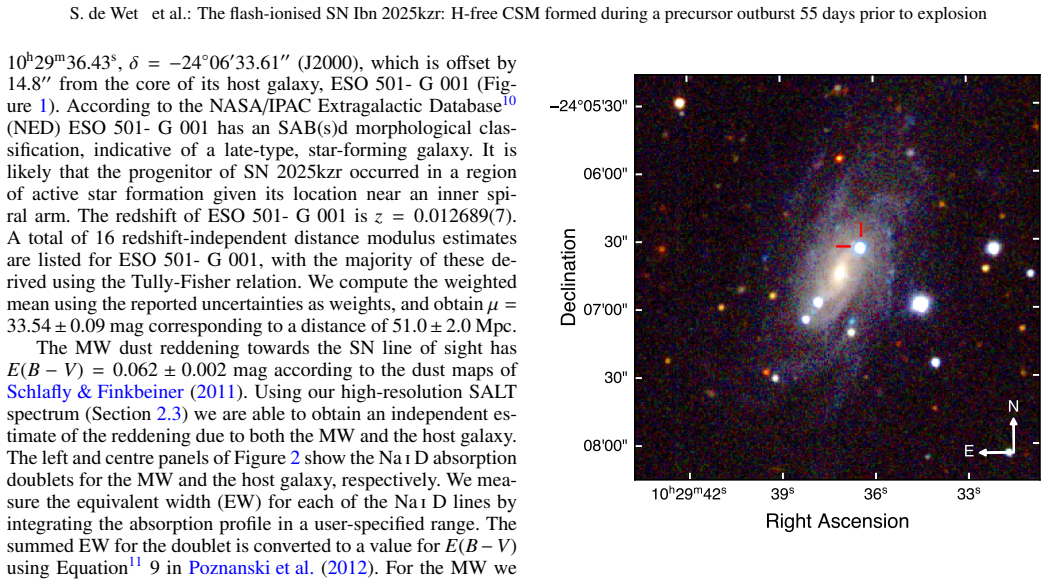
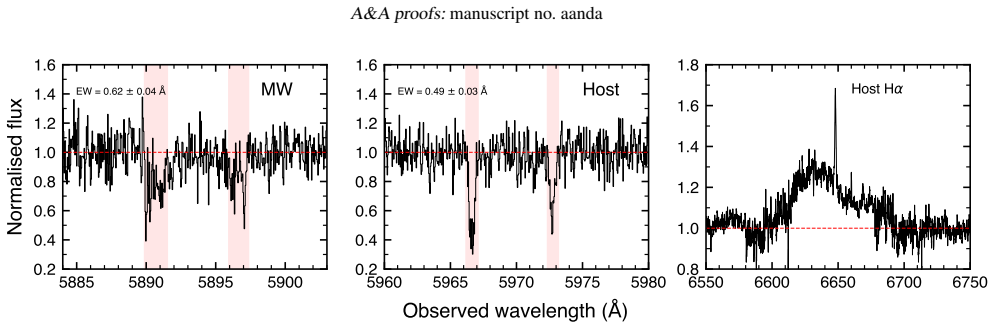
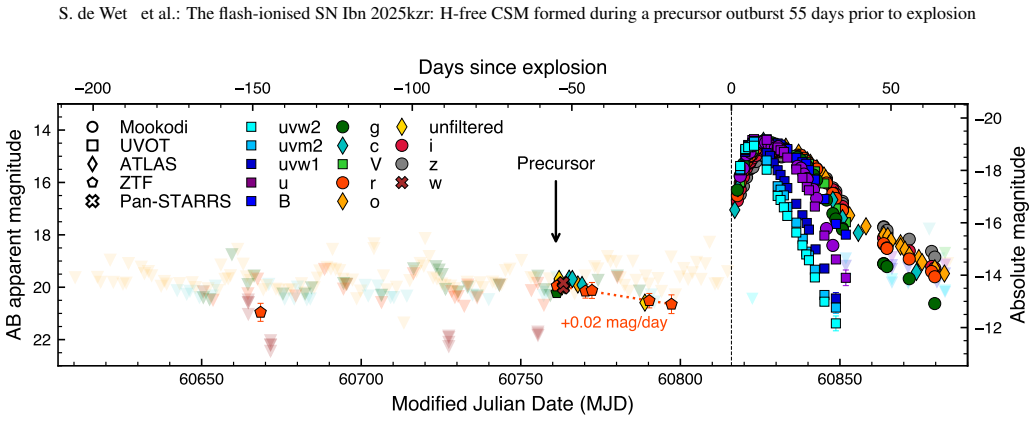
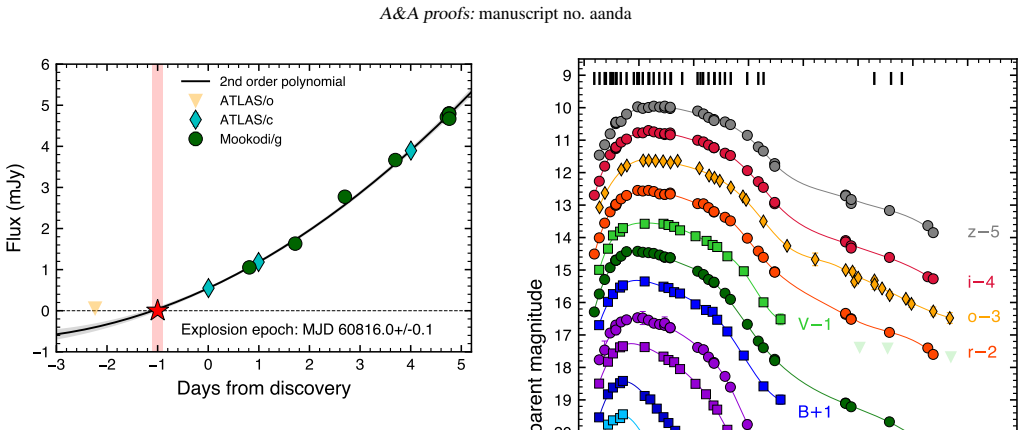
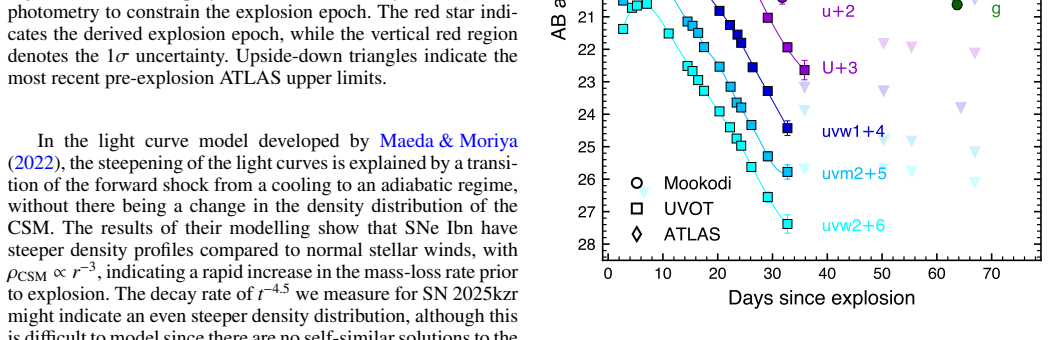
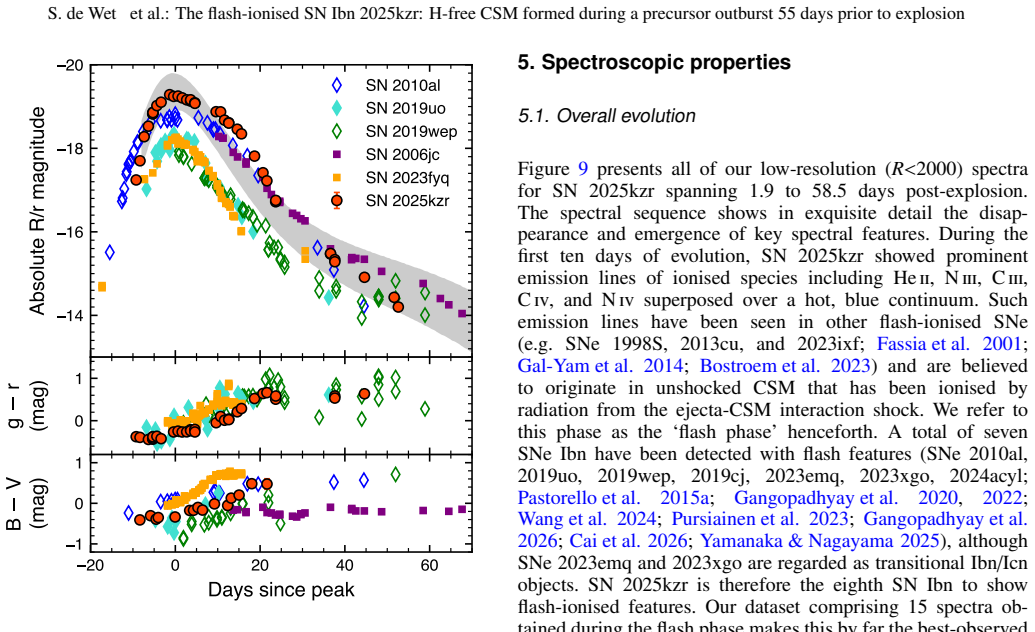
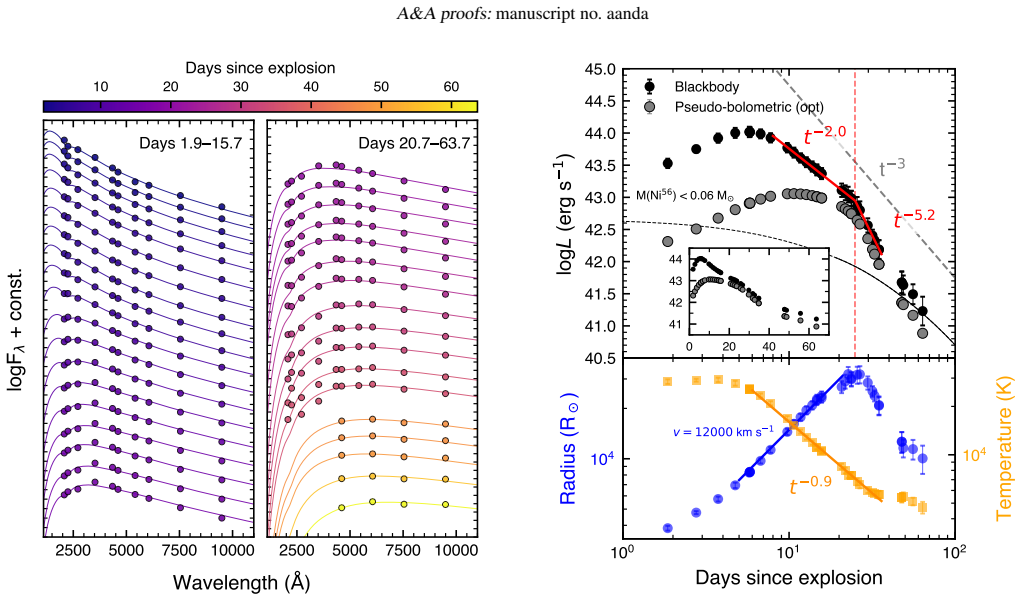
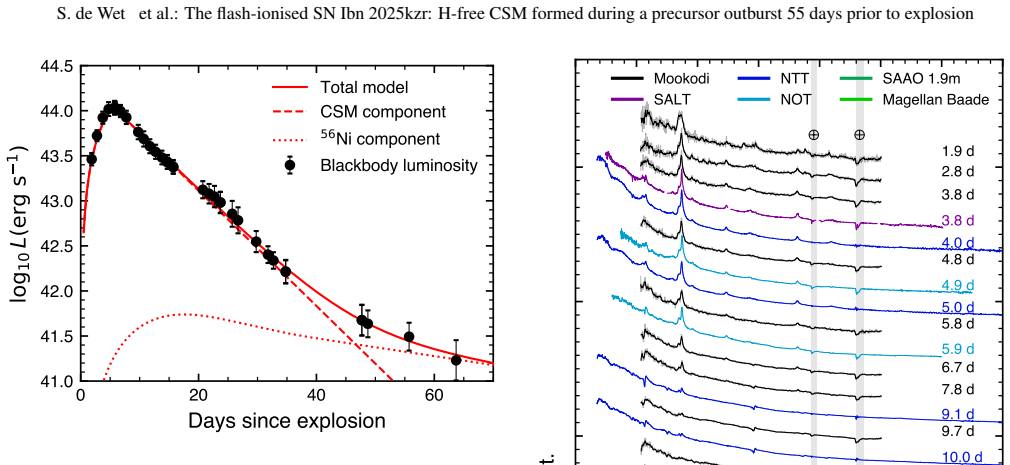
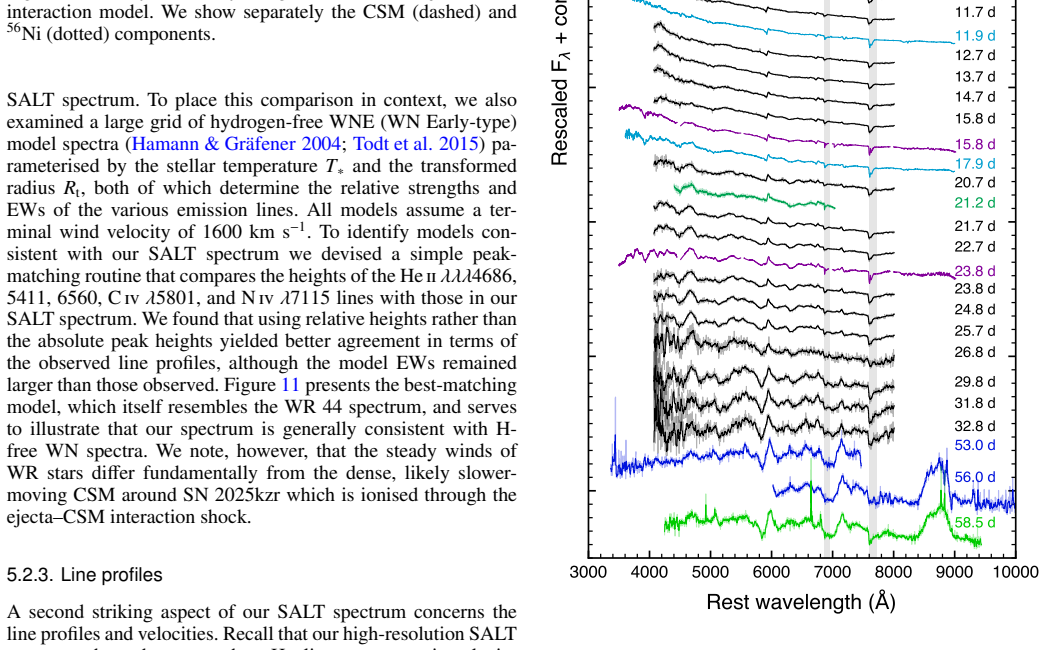
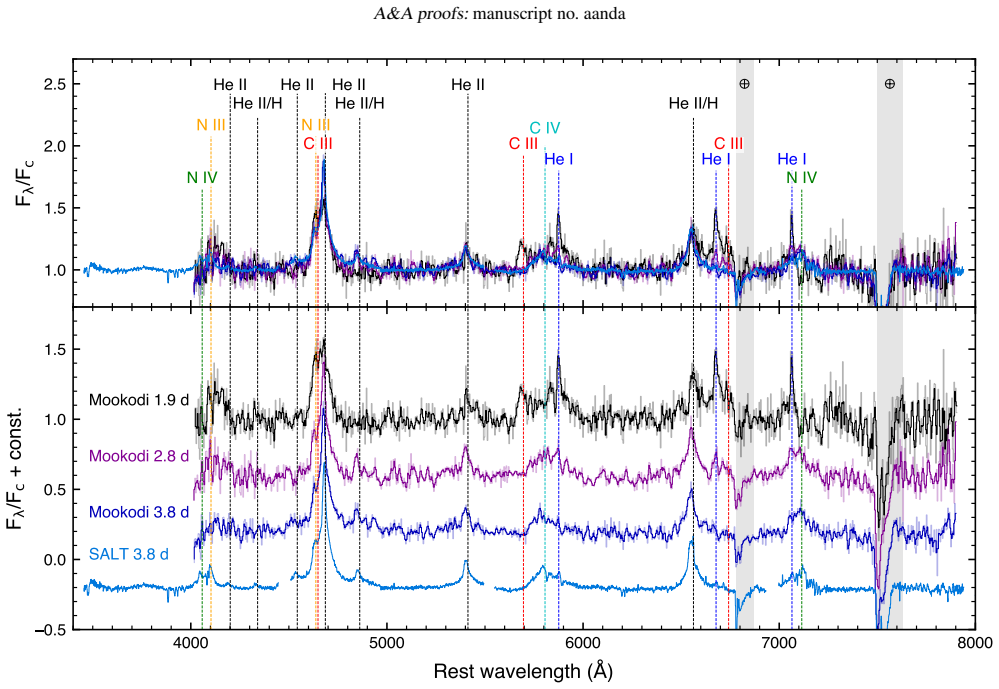
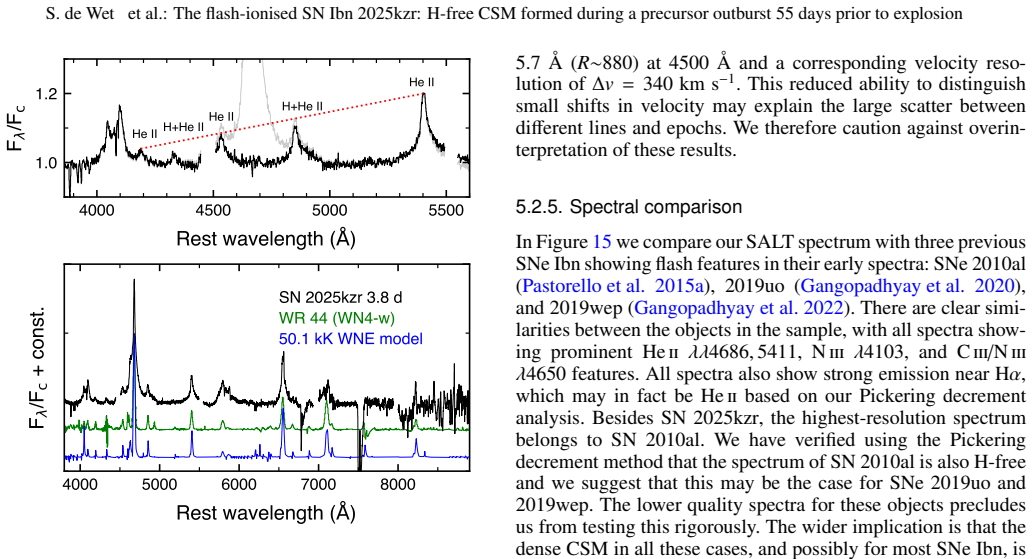
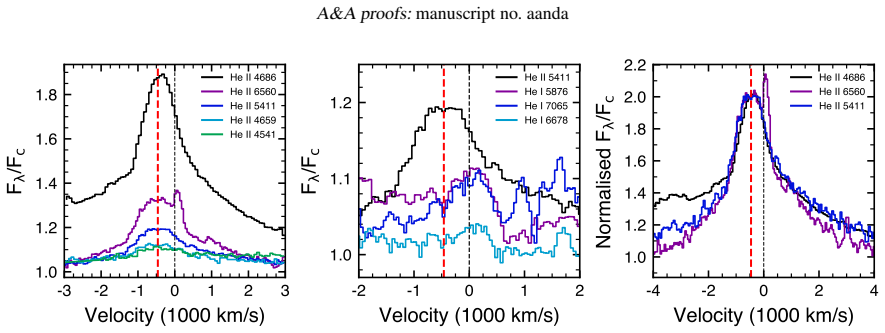
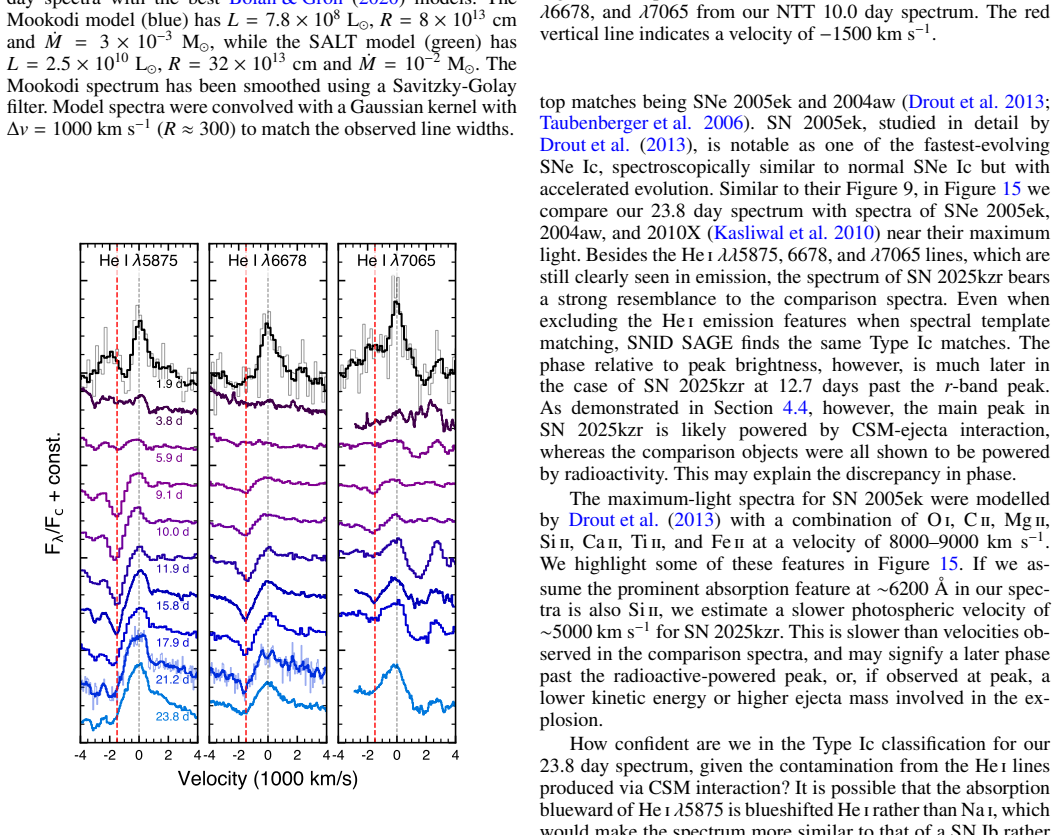
Type Ibn supernovae (SNe) are a class of interacting SNe characterised by narrow helium lines in their spectra. We present an extensive observational dataset of the Type Ibn SN 2025kzr at 51 Mpc, including the discovery of a precursor outburst with a peak brightness of M_r~-13.6 mag beginning ~55 days before explosion. Our photometry indicates the SN was discovered within the first day of explosion, showing fast-rising, ultraviolet-bright emission peaking at M_r=-19.26+/-0.09 mag and a peak blackbody temperature of T~29000 K, consistent with shock breakout within a region of dense and confined circumstellar material (CSM). Our high-cadence spectroscopic dataset spanning 1.9-58.5 days post-explosion shows flash-ionised emission features during the first 10 days. In our SALT spectrum at 3.8 days we observe a pronounced blueshift of the He II lines by 460 km/s compared to the He I lines at zero velocity, while a Pickering-decrement analysis reveals a CSM that is fully hydrogen-free. The timing of the disappearance of the flash features combined with the CSM velocity of 1500 km/s imply a mass-loss event ~66 days before explosion, in close agreement with the timing of the precursor observed 55 days before explosion and strongly suggestive of a physical link. We derive a CSM mass of 0.03-1.7 M_sun and a corresponding high mass-loss rate >~10^{-1} M_sun/yr. The precursor timescale and energetics suggest an extreme mass-loss event that might be explained by wave-driven mass loss during the late stages of nuclear burning, in particular the oxygen-burning phase. Overall, we favour a single massive Wolf-Rayet progenitor with M_ZAMS~30-40 M_sun to explain SN 2025kzr, although a binary origin cannot be excluded.
Editorial analysis
A structured set of objections, weighed in public.
Referee Report
Summary. The manuscript reports the discovery and analysis of Type Ibn supernova 2025kzr at 51 Mpc, featuring a precursor outburst peaking at M_r ~ -13.6 mag ~55 days before explosion. The SN shows fast rise, UV-bright peak at M_r = -19.26 mag, high temperature ~29000 K, and flash-ionized He features in the first 10 days post-explosion. Using the timing of flash feature disappearance and CSM velocity of 1500 km/s, they infer a mass-loss event ~66 days pre-explosion, linking it to the precursor. They derive CSM mass 0.03-1.7 M_sun, mass-loss rate ≳0.1 M_sun/yr, and favor a single massive Wolf-Rayet progenitor of 30-40 M_sun ZAMS.
Significance. If the claimed physical connection between the precursor and the mass-loss event is robust, this work provides important constraints on extreme mass-loss mechanisms in the final stages of massive star evolution, particularly wave-driven mass loss during oxygen burning. The high-cadence spectroscopic coverage and the hydrogen-free CSM determination via Pickering decrement are notable strengths. The timing agreement (55 vs 66 days) offers a falsifiable prediction for similar events, though the result's impact depends on confirming the single-shell interpretation.
major comments (2)
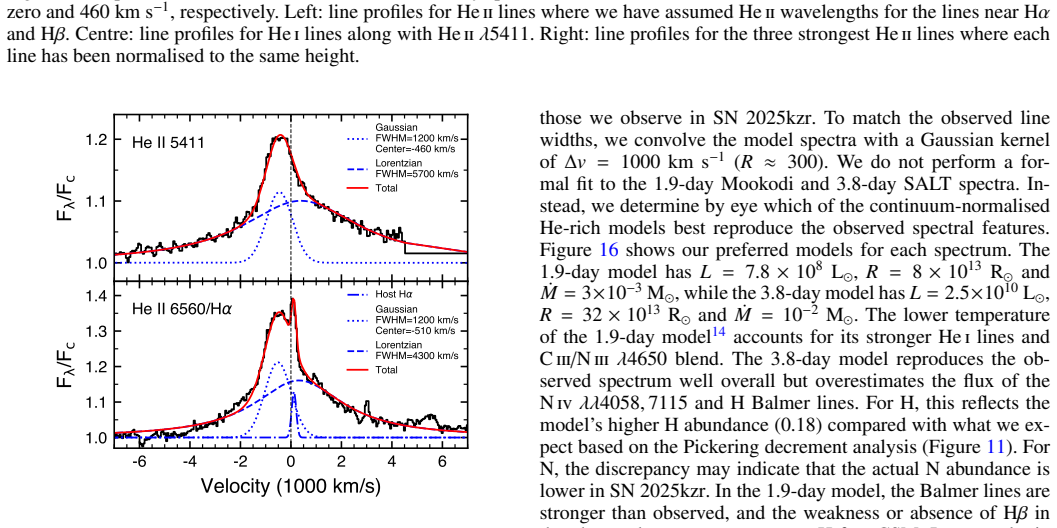
- [Abstract / spectral analysis] Abstract and SALT spectrum at 3.8 days: The derivation of the ~66-day pre-explosion mass-loss timing (t_pre = t_flash × v_ej / 1500 km/s) assumes a thin, single-velocity CSM shell with uniform 1500 km/s velocity. However, the reported 460 km/s blueshift of He II lines relative to He I at zero velocity indicates possible ionization stratification or multiple components. This directly affects whether the adopted velocity uniquely traces one ejection episode, weakening the physical link to the 55-day precursor unless addressed with explicit justification for the velocity choice.
- [CSM properties derivation] CSM mass and mass-loss rate: The reported range 0.03-1.7 M_sun and rate ≳10^{-1} M_sun/yr are load-bearing for the extreme mass-loss and progenitor conclusions. The manuscript must detail the derivation method, including any equations for mass estimation, assumed density profile, and how the broad range is obtained from the data.
minor comments (2)
- [Abstract] The abstract gives peak temperature as T~29000 K without uncertainty; include the error if reported in the main text for consistency.
- [Timing analysis] Clarify the exact post-explosion epoch used for 'disappearance of the flash features' (~10 days) and the ejecta velocity value adopted in the timing calculation.
Simulated Author's Rebuttal
We thank the referee for their constructive and detailed report, which has helped us improve the clarity and robustness of our analysis. We address each major comment below and have revised the manuscript accordingly where appropriate.
read point-by-point responses
-
Referee: [Abstract / spectral analysis] Abstract and SALT spectrum at 3.8 days: The derivation of the ~66-day pre-explosion mass-loss timing (t_pre = t_flash × v_ej / 1500 km/s) assumes a thin, single-velocity CSM shell with uniform 1500 km/s velocity. However, the reported 460 km/s blueshift of He II lines relative to He I at zero velocity indicates possible ionization stratification or multiple components. This directly affects whether the adopted velocity uniquely traces one ejection episode, weakening the physical link to the 55-day precursor unless addressed with explicit justification for the velocity choice.
Authors: We thank the referee for highlighting this subtlety in the velocity interpretation. The 1500 km/s value is taken from the FWHM of the narrow He I emission lines, which we interpret as the bulk expansion velocity of the CSM shell. The 460 km/s blueshift in He II is noted in the manuscript and may reflect ionization stratification or the location of the ionization front rather than a distinct velocity component. We agree that explicit justification for adopting a single velocity is warranted to strengthen the single-shell interpretation and the link to the precursor. In the revised manuscript we will expand the spectral analysis section with a dedicated discussion of this point, including why we consider the He I velocity the most appropriate tracer for the timing calculation while addressing the possible implications of the blueshift. revision: partial
-
Referee: [CSM properties derivation] CSM mass and mass-loss rate: The reported range 0.03-1.7 M_sun and rate ≳10^{-1} M_sun/yr are load-bearing for the extreme mass-loss and progenitor conclusions. The manuscript must detail the derivation method, including any equations for mass estimation, assumed density profile, and how the broad range is obtained from the data.
Authors: We agree that the derivation of the CSM mass and mass-loss rate requires additional methodological detail to allow readers to assess the robustness of the quoted range. The broad interval arises from varying assumptions on the radial extent of the CSM (constrained by the duration of the flash-ionization phase) and on the density profile (steady wind versus discrete shell). In the revised version we will insert a new subsection (or expanded paragraph) that explicitly presents the equations used (e.g., M_CSM ≈ 4π r^2 Δr ρ with ρ derived from the observed luminosity and line optical depths), states the assumed density profile (ρ ∝ r^{-2} for a wind-like outflow), and explains how the lower and upper bounds are obtained from the observational constraints. This addition will make the load-bearing conclusions more transparent. revision: yes
Circularity Check
No significant circularity in timing or mass-loss derivations.
full rationale
The paper calculates the ~66-day pre-explosion mass-loss epoch directly from the observed ~10-day flash-feature disappearance combined with the spectroscopically measured CSM velocity of 1500 km/s (t_pre = t_flash * v_ej / v_csm), then notes its proximity to the independently observed 55-day photometric precursor. This is an observational comparison, not a reduction of any result to a fitted input or self-defined quantity. CSM mass (0.03-1.7 M_sun) and mass-loss rate (>~10^{-1} M_sun/yr) follow from standard luminosity and density estimates without equations that force the output by construction from the same data. No load-bearing self-citations, uniqueness theorems, or ansatzes appear in the derivation chain.
Axiom & Free-Parameter Ledger
free parameters (2)
- CSM mass
- Mass-loss rate
axioms (2)
- domain assumption Standard supernova distance and extinction corrections apply without significant host-galaxy peculiarities.
- domain assumption The blueshifted He II lines and zero-velocity He I lines trace the same physical shell whose velocity sets the ejection timing.
Reference graph
Works this paper leans on
-
[1]
Anderson, J. P. 2019, A&A, 628, A7
2019
-
[2]
2026, MNRAS, 547, stag404
Aster, C., Inserra, C., Pastorello, A., et al. 2026, MNRAS, 547, stag404
2026
-
[3]
J., N., Jacobson-Galán, W., et al
Baer-Way, R., A. J., N., Jacobson-Galán, W., et al. 2025, ApJ, 995, L49
2025
-
[4]
R., Davies, B., Smith, N., et al
Beasor, E. R., Davies, B., Smith, N., et al. 2020, MNRAS, 492, 5994
2020
-
[5]
C., Kulkarni, S
Bellm, E. C., Kulkarni, S. R., Graham, M. J., et al. 2019, PASP, 131, 018002
2019
-
[6]
2023, ApJ, 946, 30
Ben-Ami, T., Arcavi, I., Newsome, M., et al. 2023, ApJ, 946, 30
2023
-
[7]
1994, A&A, 285, L13
Benetti, S., Patat, F., Turatto, M., et al. 1994, A&A, 285, L13
1994
-
[8]
& Groh, J
Boian, I. & Groh, J. H. 2019, A&A, 621, A109
2019
-
[9]
& Groh, J
Boian, I. & Groh, J. H. 2020, MNRAS, 496, 1325
2020
-
[10]
A., Pearson, J., Shrestha, M., et al
Bostroem, K. A., Pearson, J., Shrestha, M., et al. 2023, ApJ, 956, L5
2023
-
[11]
J., Sollerman, J., Irani, I., et al
Brennan, S. J., Sollerman, J., Irani, I., et al. 2024, A&A, 684, L18
2024
-
[12]
J., Gal-Yam, A., Schulze, S., et al
Bruch, R. J., Gal-Yam, A., Schulze, S., et al. 2021, ApJ, 912, 46
2021
-
[13]
J., Gal-Yam, A., Yaron, O., et al
Bruch, R. J., Gal-Yam, A., Yaron, O., et al. 2023, ApJ, 952, 119
2023
-
[14]
Buckley, D. A. H., Swart, G. P., & Meiring, J. G. 2006, in Society of Photo- Optical Instrumentation Engineers (SPIE) Conference Series, V ol. 6267, Ground-based and Airborne Telescopes, ed. L. M. Stepp, 62670Z
2006
-
[15]
N., Hill, J
Burrows, D. N., Hill, J. E., Nousek, J. A., et al. 2005, Space Sci. Rev., 120, 165
2005
-
[16]
2026, A&A, 707, A157
Cai, Y .-Z., Pastorello, A., Maeda, K., et al. 2026, A&A, 707, A157
2026
-
[17]
Chambers, K. C., Magnier, E. A., Metcalfe, N., et al. 2016, arXiv e-prints, arXiv:1612.05560
Pith/arXiv arXiv 2016
-
[18]
C., & Vinko, J
Chatzopoulos, E., Wheeler, J. C., & Vinko, J. 2012, ApJ, 746, 121
2012
-
[19]
2024, Nature, 625, 253
Chen, P., Gal-Yam, A., Sollerman, J., et al. 2024, Nature, 625, 253
2024
-
[20]
Chevalier, R. A. 1982, ApJ, 258, 790 Article number, page 23 A&A proofs:manuscript no. aanda
1982
-
[21]
Chevalier, R. A. & Fransson, C. 2017, in Handbook of Supernovae, ed. A. W. Alsabti & P. Murdin, 875
2017
-
[22]
Chevalier, R. A. & Irwin, C. M. 2011, ApJ, 729, L6
2011
-
[23]
Chugai, N. N. 2001, MNRAS, 326, 1448
2001
-
[24]
Chugai, N. N. 2022, Astronomy Letters, 48, 163
2022
-
[25]
N., Blinnikov, S
Chugai, N. N., Blinnikov, S. I., Cumming, R. J., et al. 2004, MNRAS, 352, 1213
2004
-
[26]
N., Blinnikov, S
Chugai, N. N., Blinnikov, S. I., Fassia, A., et al. 2002, MNRAS, 330, 473
2002
-
[27]
S., Leep, M
Conti, P. S., Leep, M. E., & Perry, D. N. 1983, ApJ, 268, 228
1983
-
[28]
A., Gilbank, D., Gend, C
Crause, L. A., Gilbank, D., Gend, C. v., et al. 2019, Journal of Astronomical
2019
-
[29]
Crowther, P. A. 2007, ARA&A, 45, 177 de Wet, S., Leloudas, G., & Erasmus, N. 2025, Transient Name Server As- troNote, 154, 1
2007
-
[30]
J., & Audit, E
Dessart, L., Hillier, D. J., & Audit, E. 2017, A&A, 605, A83
2017
-
[31]
J., Audit, E., Livne, E., & Waldman, R
Dessart, L., Hillier, D. J., Audit, E., Livne, E., & Waldman, R. 2016, MNRAS, 458, 2094
2016
-
[32]
J., & Kuncarayakti, H
Dessart, L., Hillier, D. J., & Kuncarayakti, H. 2022, A&A, 658, A130
2022
-
[33]
& Jacobson-Galán, W
Dessart, L. & Jacobson-Galán, W. V . 2023, A&A, 677, A105
2023
-
[34]
2024, ApJ, 977, 254
Dong, Y ., Tsuna, D., Valenti, S., et al. 2024, ApJ, 977, 254
2024
-
[35]
Dong, Y ., Villar, V . A., Nugent, A., et al. 2025, arXiv e-prints, arXiv:2511.03926
arXiv 2025
-
[36]
2011, PASP, 123, 288
Dressler, A., Bigelow, B., Hare, T., et al. 2011, PASP, 123, 288
2011
-
[37]
R., Chornock, R., Soderberg, A
Drout, M. R., Chornock, R., Soderberg, A. M., et al. 2014, ApJ, 794, 23
2014
-
[38]
R., Soderberg, A
Drout, M. R., Soderberg, A. M., Mazzali, P. A., et al. 2013, ApJ, 774, 58
2013
-
[39]
J., Fraser, M., Smartt, S
Eldridge, J. J., Fraser, M., Smartt, S. J., Maund, J. R., & Crockett, R. M. 2013, MNRAS, 436, 774
2013
-
[40]
J., Izzard, R
Eldridge, J. J., Izzard, R. G., & Tout, C. A. 2008, MNRAS, 384, 1109
2008
-
[41]
Eldridge, J. J. & Maund, J. R. 2016, MNRAS, 461, L117
2016
-
[42]
B., van Gend, C
Erasmus, N., Potter, S. B., van Gend, C. H. D., et al. 2025, in Revista Mexicana de Astronomia y Astrofisica Conference Series, V ol. 59, Revista Mexicana de Astronomia y Astrofisica Conference Series, 201–207
2025
-
[43]
A., Piascik, A
Erasmus, N., Steele, I. A., Piascik, A. S., et al. 2024, Journal of Astronomical
2024
-
[44]
2019, Nature Astronomy, 3, 434
Fang, Q., Maeda, K., Kuncarayakti, H., Sun, F., & Gal-Yam, A. 2019, Nature Astronomy, 3, 434
2019
-
[45]
Fassia, A., Meikle, W. P. S., Chugai, N., et al. 2001, MNRAS, 325, 907
2001
-
[46]
Filippenko, A. V . 1997, ARA&A, 35, 309
1997
-
[47]
J., Smith, N., Ganeshalingam, M., et al
Foley, R. J., Smith, N., Ganeshalingam, M., et al. 2007, ApJ, 657, L105
2007
-
[48]
J., et al
Fransson, C., Ergon, M., Challis, P. J., et al. 2014, ApJ, 797, 118
2014
-
[49]
M., et al
Fremling, C., Sollerman, J., Kasliwal, M. M., et al. 2018, A&A, 618, A37
2018
-
[50]
2017, MNRAS, 470, 1642
Fuller, J. 2017, MNRAS, 470, 1642
2017
-
[51]
Fuller, J. & Ro, S. 2018, MNRAS, 476, 1853
2018
-
[52]
D., Smartt, S
Fulton, M. D., Smartt, S. J., Huber, M. E., et al. 2025, MNRAS, 542, 541
2025
-
[53]
2017, in Handbook of Supernovae, ed
Gal-Yam, A. 2017, in Handbook of Supernovae, ed. A. W. Alsabti & P. Murdin, 195
2017
-
[54]
O., et al
Gal-Yam, A., Arcavi, I., Ofek, E. O., et al. 2014, Nature, 509, 471
2014
-
[55]
2020, ApJ, 889, 170
Gangopadhyay, A., Misra, K., Hiramatsu, D., et al. 2020, ApJ, 889, 170
2020
-
[56]
2022, ApJ, 930, 127
Gangopadhyay, A., Misra, K., Hosseinzadeh, G., et al. 2022, ApJ, 930, 127
2022
-
[57]
2026, MNRAS, 547, staf1517
Gangopadhyay, A., Sollerman, J., Tsalapatas, K., et al. 2026, MNRAS, 547, staf1517
2026
-
[58]
Garnavich, P. M. & Ann, H. B. 1994, AJ, 108, 1002 Gräfener, G. & Vink, J. S. 2016, MNRAS, 455, 112
1994
-
[59]
Groh, J. H. 2014, A&A, 572, L11
2014
-
[60]
J., Bloemen, S., Vreeswijk, P
Groot, P. J., Bloemen, S., Vreeswijk, P. M., et al. 2024, PASP, 136, 115003
2024
-
[61]
& Gräfener, G
Hamann, W.-R. & Gräfener, G. 2004, A&A, 427, 697
2004
-
[62]
1995, A&AS, 113, 459
Hamann, W.-R., Koesterke, L., & Wessolowski, U. 1995, A&AS, 113, 459
1995
-
[63]
L., Woosley, S
Heger, A., Fryer, C. L., Woosley, S. E., Langer, N., & Hartmann, D. H. 2003, ApJ, 591, 288
2003
-
[64]
2000, The Astronomical Journal, 119, 923 HI4PI Collaboration, Ben Bekhti, N., Flöer, L., et al
Heiles, C. 2000, The Astronomical Journal, 119, 923 HI4PI Collaboration, Ben Bekhti, N., Flöer, L., et al. 2016, A&A, 594, A116
2000
-
[65]
Hillier, D. J. 1991, A&A, 247, 455
1991
-
[66]
2024, arXiv e-prints, arXiv:2411.07287
Hiramatsu, D., Berger, E., Gomez, S., et al. 2024, arXiv e-prints, arXiv:2411.07287
arXiv 2024
-
[67]
Ho, A. Y . Q., Perley, D. A., Gal-Yam, A., et al. 2023, ApJ, 949, 120
2023
-
[68]
2026, arXiv e-prints, arXiv:2605.16526
Hong, X., Sun, N.-C., Shao, Y ., et al. 2026, arXiv e-prints, arXiv:2605.16526
Pith/arXiv arXiv 2026
-
[69]
2017, ApJ, 836, 158
Hosseinzadeh, G., Arcavi, I., Valenti, S., et al. 2017, ApJ, 836, 158
2017
-
[70]
I., et al
Hosseinzadeh, G., McCully, C., Zabludoff, A. I., et al. 2019, ApJ, 871, L9
2019
-
[71]
2026, ApJ, 1002, 62
Hu, M., Yan, S., Wang, X., et al. 2026, ApJ, 1002, 62
2026
-
[72]
& Chevalier, R
Huang, C. & Chevalier, R. A. 2018, MNRAS, 475, 1261
2018
-
[73]
2008, ApJ, 674, L85
Immler, S., Modjaz, M., Landsman, W., et al. 2008, ApJ, 674, L85
2008
-
[74]
& Maeda, K
Inoue, Y . & Maeda, K. 2025, ApJ, 980, 86 Jacobson-Galán, W. V ., Dessart, L., Davis, K. W., et al. 2024, ApJ, 970, 189 Jacobson-Galán, W. V ., Dessart, L., Jones, D. O., et al. 2022, ApJ, 924, 15
2025
-
[75]
2020, Research Notes of the American Astronomical Society, 4, 16
Jiang, B., Jiang, S., & Ashley Villar, V . 2020, Research Notes of the American Astronomical Society, 4, 16
2020
-
[76]
M., Kulkarni, S
Kasliwal, M. M., Kulkarni, S. R., Gal-Yam, A., et al. 2010, ApJ, 723, L98
2010
-
[77]
2016, ApJ, 818, 3
Khazov, D., Yaron, O., Gal-Yam, A., et al. 2016, ApJ, 818, 3
2016
-
[78]
2012, ApJ, 744, 10
Kiewe, M., Gal-Yam, A., Arcavi, I., et al. 2012, ApJ, 744, 10
2012
-
[79]
Y ., Gvaramadze, V
Kniazev, A. Y ., Gvaramadze, V . V ., & Berdnikov, L. N. 2016, MNRAS, 459, 3068
2016
-
[80]
Y ., Gvaramadze, V
Kniazev, A. Y ., Gvaramadze, V . V ., & Berdnikov, L. N. 2017, in Astronomi- cal Society of the Pacific Conference Series, V ol. 510, Stars: From Collapse to Collapse, ed. Y . Y . Balega, D. O. Kudryavtsev, I. I. Romanyuk, & I. A. Yakunin, 480
2017
discussion (0)
Sign in with ORCID, Apple, or X to comment. Anyone can read and Pith papers without signing in.