REVIEW 2 major objections 5 minor 3 references
The (Mis)use of Information in Decentralised Markets
T0 review · 2 major / 5 minor · reviewed 2026-08-07 · deepseek-v4-flash
Pith's one-line read This paper claims that in a decentralised market, more buyers improve allocative efficiency only when buyers' signals can fully reveal high quality; otherwise surplus converges to the no-information level.
desk verdict A genuinely novel paper on information and competition in decentralized markets, but Theorem 1's proof has a load-bearing gap that the authors must fix before the central claim can be accepted. read the letter →
The pith
A machine-rendered reading of the paper's core claim, the machinery that carries it, and where it could break.
The reading
What carries the argument
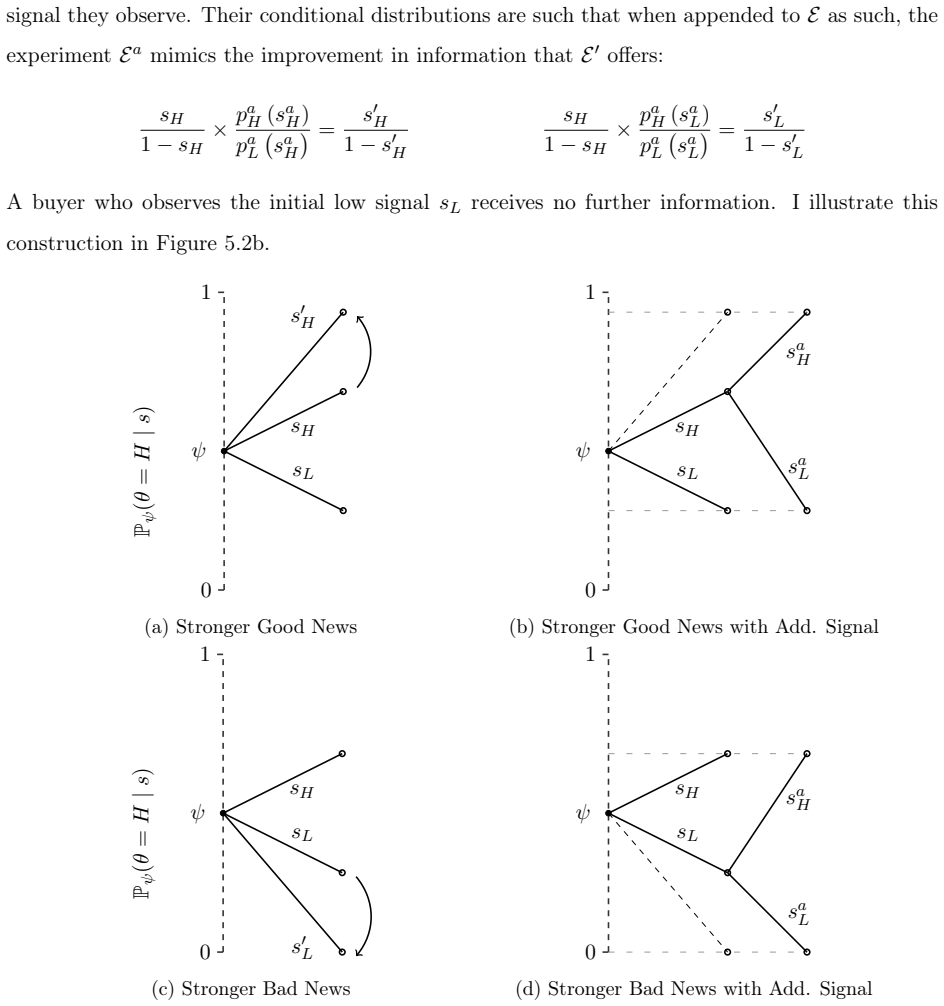
The load-bearing object is the buyer's interim belief after being visited, $\psi = \rho \nu_H/(\rho \nu_H + (1-\rho)\nu_L)$, where $\nu_\theta = \frac{1}{n}\sum_{k=0}^{n-1} r_\theta^k$ and $r_\theta$ is the per-visit rejection probability under a strategy. This identity converts past rejections into a pessimistic prior, and posterior odds are interim odds times the signal's likelihood ratio $s/(1-s)$. The theorems turn on comparing that quantity with $c/(1-c)$, especially through the adverse-selection-irrelevance condition $\frac{\rho}{1-\rho}\left(\frac{r_H}{r_L}\right)^{n-1}\frac{s}{1-s} \ge \frac{c}{1-c}$. For general finite experiments, the paper decomposes any Blackwell improvement into local mean preserving spreads, labels them positive or negative overrides, and thereby signs the surplus change without tracking the full change in interim beliefs.
What would settle it
Fix a binary experiment with $s_H < 1$ and $\rho > c$; Theorem 1 predicts that under the most selective equilibrium, total surplus eventually decreases and converges to $\rho - c$ as $n$ grows, so computing that equilibrium for large $n$ and finding surplus instead increasing or failing to approach $\rho - c$ would refute the central claim.
Extended reading notes
Core claim
The paper's central claim is Theorem 1: under the most selective equilibrium, expected total surplus as the number of buyers grows eventually increases and converges to the full-information benchmark if and only if the experiment has an outcome that fully reveals High quality; otherwise it eventually decreases and converges to the no-information benchmark. The mechanism is that in a larger market a buyer is more likely to be visited only after several earlier rejections, so past refusals become a stronger signal of Low quality. Theorems 2 and 3 extend this to better information: a Blackwell improvement that makes acceptance harder (a negative override) raises surplus, while one that makes rejection harder (a positive override) lowers surplus unless adverse selection is irrelevant, meaning the buyer would want to trade even if all other buyers had rejected. The paper also shows that a surplus-maximising regulator will coarsen buyers' information into binary accept/reject recommendations, and when the reservation value weakly exceeds the prior, the optimum is the least selective such garbling under which adverse selection is irrelevant.
Load-bearing premise
The buyer has no information about how many other buyers the seller has already visited, and if buyers could see their place in the queue, past rejections would no longer drive the pessimistic inference on which all three theorems depend.
Editorial extensions
If this is right
- In a large market, adding buyers is good for efficiency exactly when some signal fully reveals high quality; otherwise the market ends up at the no-information benchmark.
- More accurate data in the hands of buyers can lower total surplus when it mainly rescues deals that would otherwise have been rejected; a regulator should restrict such positive overrides unless a buyer would trade even after everyone else rejected.
- With binary signals, stronger good news always helps, while stronger bad news eventually hurts once it is strong enough to make buyers reject on low signals.
- A surplus-maximising regulator can restrict attention to monotone binary garblings that produce incentive-compatible accept/reject recommendations; when $\rho \le c$, the optimum is the least selective garbling under which adverse selection is irrelevant.
- The extension to buyer ultimatum offers shows that any equilibrium surplus level can be achieved with buyers offering either the seller's value $c$ or zero.
Reading between the lines
- If buyers could observe how many previous buyers rejected the seller, the adverse-selection channel would largely disappear, so a testable extension of the paper's logic is that revealing queue position in markets like housing or over-the-counter trading should blunt the surplus decline from more buyers.
- The paper's policy principle is that data restrictions should be designed against the deepest adverse selection, not the average; this suggests banning data that upgrades previously rejected borrowers can raise total surplus even when it reduces lending.
- The condition that a signal fully reveal High quality also appears in large common-value auctions, which suggests the real friction is the opacity of the trading history rather than competition itself; making histories observable may be an alternative to coarsening buyers' information.
Editorial analysis
A structured set of objections, weighed in public.
Referee Report
Summary. The paper studies a decentralised market in which a seller with a common-value asset sequentially visits n buyers, each of whom receives a private signal about the asset's quality. Buyers do not observe how many previous buyers rejected the seller, creating adverse selection. The paper asks whether allocative efficiency improves with (i) more buyers or (ii) better-informed buyers. The main theoretical results are: Theorem 1, which states that in the most selective equilibrium total surplus is eventually increasing and converges to the full-information benchmark if and only if the signal experiment has an outcome fully revealing High quality (sm=1); otherwise it is eventually decreasing and converges to the no-information benchmark max{0,ρ-c}. Theorems 2 and 3 characterize the effect of Blackwell-improved information: for binary signals, stronger good news always raises surplus while stronger bad news eventually lowers it; for general finite signals, negative overrides raise surplus and positive overrides lower it unless adverse selection is irrelevant. The paper also studies regulator-optimal coarsening of buyers' information and an extension with ultimatum offers by buyers.
Significance. If the results are correct, the paper makes a valuable contribution to the literature on information aggregation in decentralized markets. It provides a sharp, falsifiable condition (unbounded likelihood ratios) for when more competition improves or worsens efficiency, and it offers novel comparative statics on buyer informativeness, with direct policy implications for credit markets and OTC markets. The paper is well-motivated and connects to classic work by Wilson, Milgrom, and Lauermann-Wolinsky. The analytic approach is mostly self-contained and uses standard tools (Kakutani's fixed point theorem, Blackwell's theorem, monotone comparative statics). However, the proof of the central theorem (Theorem 1) contains serious gaps, as detailed below, so the main results are not yet established as rigorously as the journal would require.
major comments (2)
- [Section 9.3, proof of Theorem 1, Case 2] The argument that the sequence of total surplus is eventually decreasing relies on a displayed chain of inequalities using '≈' after establishing that the rejection probabilities rθ(σ̂_n;E) are Cauchy. This step is not rigorous. First, the total surplus formula is miswritten: the first term should be ρ(1-c)[1 - r_H(σ̂_m)^m], not ρ(1-c)[1 - r_H(σ̂_m)]^m as printed. Second, even with the correct formula, replacing r_H(σ̂_m) by r_H(σ̂_N) inside the term [1 - r_H^m] is not justified by Cauchy convergence alone, because the exponent m can amplify small differences in r_H; the error introduced by this replacement is not bounded. Hence the strict inequality Π_m > Π_{m+1} for all sufficiently large m is not established by the displayed argument.
- [Section 9.3, proof of Theorem 1, subcase L_m < c/(1-c)] In the subcase where L_m < c/(1-c), the proof asserts that the most selective equilibrium is eventually more selective than σ_m, and concludes 'Π_n(σ̂;E) = Π∅ = 0' for all sufficiently large n. However, Π∅ = max{0,ρ-c}, so the conclusion 'Π∅ = 0' requires ρ ≤ c. The proof does not explain why ρ > c cannot arise in this subcase. A careful reader can verify that, when s_m < 1, the limit L_m equals ρ/(1-ρ), so L_m < c/(1-c) indeed implies ρ < c; but this identity is not derived or stated in the proof. As written, the 'otherwise' branch of Theorem 1 is incomplete because the zero-benchmark conclusion is unsupported for ρ > c.
minor comments (5)
- [Section 9.3, proof of Theorem 1] The total surplus expression is written inconsistently: the first term appears as [1-r_H]^m while the second appears as [1-r_L^m]. The correct expression is ρ(1-c)[1-r_H^n] - c(1-ρ)[1-r_L^n].
- [Section 9.2, proof of Lemma 11] The proof uses both Z and A to denote the same set of score profiles; please standardize the notation.
- [Section 9.3, proof of Lemma 7] The proof states 'Since r*_H ≥ r_H and r*_L = r_L, efficiency is higher under σ*', but the preceding derivation showed r*_H ≤ r_H. The inequality sign appears to be reversed; please check and correct.
- [Section 3.2, proof of Proposition 3] The proof of the lower bound is hard to follow; the chain with conditional expectations and the decomposition of the no-information benchmark could be written more clearly.
- [Section 5.1, Figure 5.1] Figure 5.1 is referenced in the text but does not appear in the provided manuscript; the figures should be included or the reference adjusted.
Circularity Check
No significant circularity: the analysis is self-contained and derives its results from explicit model primitives and standard external theorems.
full rationale
The paper is a purely theoretical derivation with no parameters fitted to data and no load-bearing self-citations. Theorem 1 is proved from primitive objects—buyers' rejection probabilities rθ(σ;E), interim beliefs ψ, and the independently defined benchmarks Πf=ρ(1−c) and Π∅=max{0,ρ−c}—with the benchmark bounds established in Proposition 3 by a deviation argument rather than assumed. Theorems 2 and 3 derive comparative statics using the external local-mean-preserving-spread decomposition (Remark 1, citing Müller and Stoyan) and prove the relevant thresholds algebraically; Definition 4 names the condition 'adverse selection is σ-irrelevant' but does not presuppose the theorem's conclusion—it is exactly the condition that falls out of the marginal-reject calculation in the proof. All cited external results (Kakutani, Blackwell, Müller–Stoyan, Shaked–Shanthikumar) are standard and machine-independent. The proof of Theorem 1 contains a rigor concern in the '≈' step of Case 2, but that is a completeness/correctness issue, not a circularity: the derivation does not reduce to its own inputs by construction, nor does it rely on a self-citation chain.
Assumptions & free parameters
assumptions (5)
- domain assumption Finite signal space S with conditional distributions pθ
- domain assumption Buyers do not observe their position in the seller's search order
- domain assumption Seller's reservation value c is fixed and known; the seller cannot bargain
- standard math Kakutani fixed point theorem for equilibrium existence
- standard math Blackwell's theorem and local mean preserving spread decomposition
Cite this review
Pith. "Pith review of The (Mis)use of Information in Decentralised Markets." pith.science (2026). https://pith.science/paper/TPVQY4N4
@misc{pith2026250606848,
  author       = {Pith},
  title        = {Pith review of: The (Mis)use of Information in Decentralised Markets},
  year         = {2026},
  howpublished = {\url{https://pith.science/paper/TPVQY4N4}},
  note         = {Machine review of arXiv:2506.06848}
}
read the original abstract
A seller offers an asset in a decentralised market. Buyers have private signals about their common value. I study whether the market becomes allocatively more efficient with (i) more buyers, (ii) better-informed buyers. Both increase the information available about buyers' common value, but also the adverse selection each buyer faces. With more buyers, trade surplus eventually increases and converges to the full-information upper bound if and only if the likelihood ratios of buyers' signals are unbounded from above. Otherwise, it eventually decreases and converges to the no-information lower bound. With better information about trades buyers would have accepted, trade surplus increases. With better information about trades they would have rejected, trade surplus decreases--unless adverse selection is irrelevant. For binary signals, a sharper characterisation emerges: stronger good news increase total surplus, but stronger bad news eventually decrease it.
Figures


Figures from the paper (2 more)


Reference graph
Works this paper leans on
-
[1]
Agarwal, Sumit et al. (July 2024). “Searching for Approval”. In:Econometrica 92.4, pp. 1195–1231. doi: 10.3982/ECTA18554. Akerlof, George A. (1970). “The Market for "Lemons": Quality Uncertainty and the Market Mech- anism”. In:The Quarterly Journal of Economics84.3, pp. 488–500.issn: 00335533, 15314650. doi: 10.2307/1879431. BCBS (Dec. 2017).High-level su...
-
[5]
Elsevier B.V, pp. 813–886.isbn: 9780444595331. doi: 10.1016/B978-0-444-59531-7.00013-2 . Herrera, Helios and Johannes Hörner (2013). “Biased social learning”. In:Games and Economic Behavior 80.C, pp. 131–146.doi: 10.1016/j.geb.2012.12.006. Kay, John (2024). “HBOS Collapse Shows Danger of the Winner’s Curse”. In:Financial Times. url: https://www.ft.com/con...
-
[3309]
A Theory of Fads, Fashion, Cus- tom, and Cultural Change as Informational Cascades
doi: 10.1257/jep.22.2.217. Bikhchandani, Sushil, David Hirshleifer, and Ivo Welch (1992). “A Theory of Fads, Fashion, Cus- tom, and Cultural Change as Informational Cascades”. In:Journal of Political Economy100.5, pp. 992–1026. issn: 00223808, 1537534X.doi: 10.1086/261849. Blackwell, David (1953). “Equivalent Comparisons of Experiments”. In:The Annals of ...
arXiv 1992
Reviewed August 7, 2026 · model on record in the stance chip above.
Discussion (0). Sign in to comment.